Judges 7:21

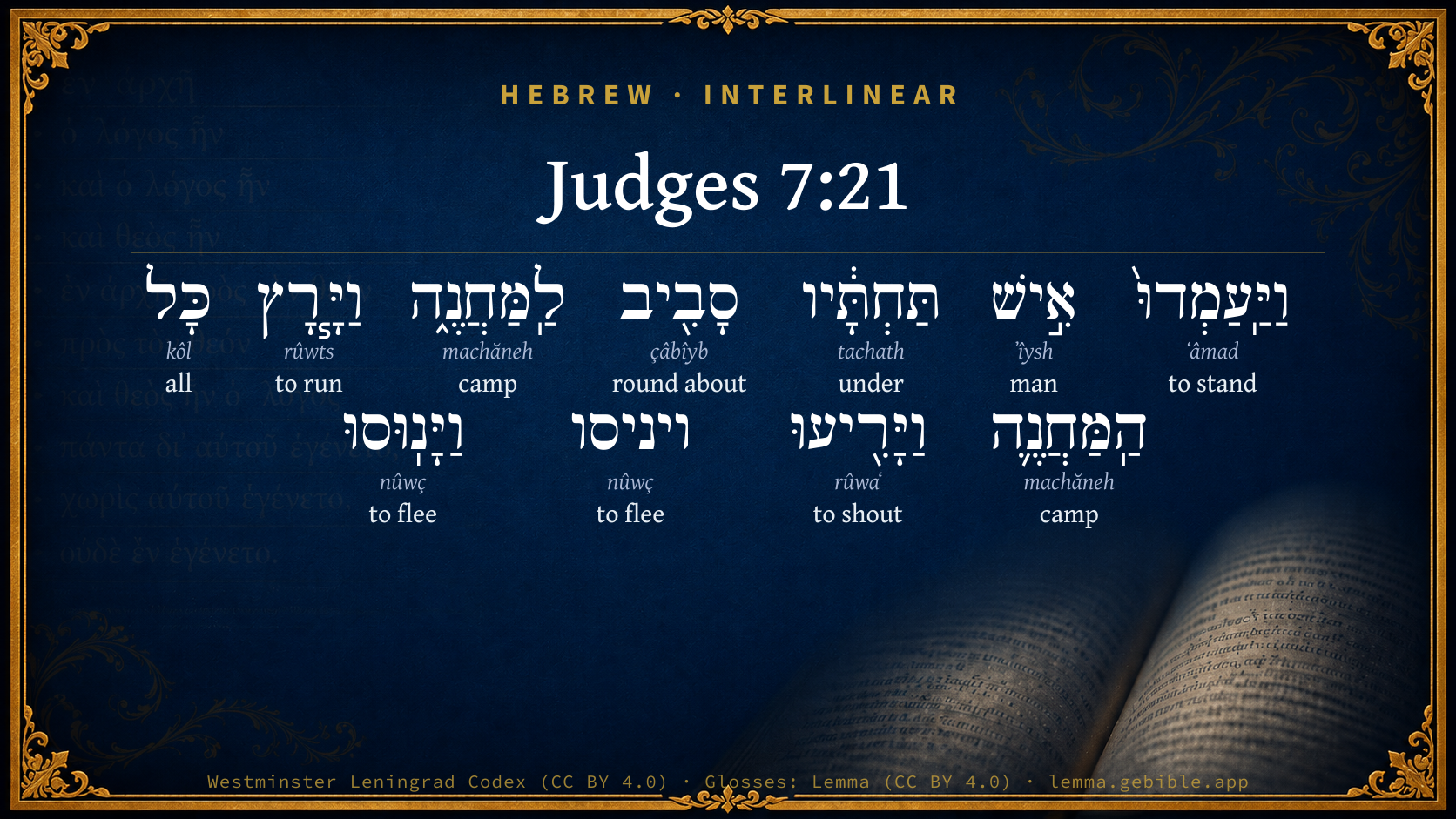
Hebrew (Westminster Leningrad Codex) Judges 7:21 appears in the Hebrew Old Testament. The text above is from the Westminster Leningrad Codex. Each word links to its Strong’s number, a concise gloss, and parsing drawn from the Open Scriptures Hebrew Bible morphology. Click any word for its full Brown-Driver-Briggs (BDB) entry.
Download image
Cite this verse

Judges 7:21 (World English Bible). Public Domain. Lemma interlinear Bible study tool, https://lemma.gebible.app/v/judges/7/21.

Show BibTeX & RIS
BibTeX
RIS
English Translation
They stood every man in his place round about the camp; and all the host ran; and they shouted, and put [them] to flight.
World English Bible · Public Domain
Download a study sheet

One document with this verse’s original text, its word-by-word gloss line, the meaning frame, cross-references with their text, attributed commentary, and full source and license credits — printable, and it pastes into notes with its structure intact.

This verse Autodidact and up

Study sheet (.html) Plain text (.txt)

A passage Seminary Student

Up to 50 verses in one chapter. A passage sheet keeps up to 6 commentary sources and 12 cross-references per verse, in the order this page ranks them, and says so on the sheet whenever that leaves anything out. Ask for a single verse and you get the Autodidact verse sheet above.

Everything on this page stays free to read, with no account — the sheet is a download of what is already on screen, not access to it.

Want to remove ads? Support Godless Engineer
Compare translations 3

The same verse in 3 English versions, stacked beneath the original-language interlinear above. Click any original word for its lexicon entry.

Each is an independent rendering of the whole verse — the interlinear is not word-aligned to these translations.

Highlighted words mark where these versions differ — a whole-verse word diff, not a word-by-word alignment.

  • World English Bible Public Domain
    They stood every man in his place round about the camp; and all the host ran; and they shouted, and put [them] to flight.
  • King James Version Public Domain
    And they stood every man in his place round about the camp; and all the host ran, and cried, and fled.
  • unfoldingWord Literal Text CC BY-SA 4.0
    And they stood, a man in his place, around the camp, and all of the camp ran and cried out and fled.

unfoldingWord Literal Text — © unfoldingWord, licensed CC BY-SA 4.0. Word-aligned USFM3 via Door43 (git.door43.org/unfoldingWord/en_ult).

Versions to compare (up to 4)

3 of 4 selected

Show all 18 translations

Every available English version of this verse, each an independent rendering of the whole verse.

  • World English Bible Public Domain
    They stood every man in his place round about the camp; and all the host ran; and they shouted, and put [them] to flight.
  • Berean Standard Bible Public Domain
    Each Israelite took his position around the camp, and the entire Midianite army fled, crying out as they ran.
  • Majority Standard Bible Public Domain
    Each Israelite took his position around the camp, and the entire Midianite army fled, crying out as they ran.
  • King James Version Public Domain
    And they stood every man in his place round about the camp; and all the host ran, and cried, and fled.
  • American Standard Version (1901) Public Domain
    And they stood every man in his place round about the camp; and all the host ran; and they shouted, and put `them' to flight.
  • Revised Version (1885) Public Domain
    And they stood every man in his place round about the camp: and all the host ran; and they shouted, and put them to flight.
  • Geneva Bible (1599) Public Domain
    And they stoode, euery man in his place round about the hoste: and all the hoste ranne, and cryed, and fled.
  • Douay-Rheims (1899) Public Domain
    Standing every man in his place round about the enemies' camp. So all the camp was troubled, and crying out and howling they fled away.
  • Young's Literal Translation Public Domain
    And they stand each in his place, round about the camp, and all the camp runneth, and they shout, and flee;
  • Literal Standard Version CC BY-SA 4.0
    And they each stand in his place, around the camp, and all the camp runs, and they shout, and flee;
  • Unlocked Literal Bible CC BY-SA 4.0
    Every man stood in his place around the camp and all the Midianite army ran. They shouted and ran away.
  • unfoldingWord Literal Text CC BY-SA 4.0
    And they stood, a man in his place, around the camp, and all of the camp ran and cried out and fled.
  • Darby Bible Public Domain
    They stood every man in his place round about the camp, and all the army ran; they cried out and fled.
  • World Messianic Bible Public Domain
    They each stood in his place around the camp, and all the army ran; and they shouted, and put them to flight.
  • Webster's Bible Public Domain
    And they stood every man in his place around the camp; and all the host ran, and cried, and fled.
  • Free Bible Version CC BY-SA 4.0
    Each man stood in his place encircling the camp, and all the enemy soldiers ran around shouting—then they fled.
  • Bible in Basic English Public Domain
    Then they made a line round the tents, every man in his place; and all the army, awaking from sleep, came running out, and with loud cries went in flight.
  • JPS Tanakh (1917) Public Domain
    And they stood every man in his place round about the camp; and all the host ran; and they shouted, and fled.

Literal Standard Version (2020), Covenant Press — licensed CC BY-SA 4.0. Text via the HelloAO Bible API (eBible.org). Unlocked Literal Bible (unfoldingWord) — licensed CC BY-SA 4.0. Text via the HelloAO Bible API (eBible.org). unfoldingWord Literal Text — © unfoldingWord, licensed CC BY-SA 4.0. Word-aligned USFM3 via Door43 (git.door43.org/unfoldingWord/en_ult). Free Bible Version, Dr. Jonathan Gallagher — licensed CC BY-SA 4.0. Text via the HelloAO Bible API (eBible.org).

Word by word

More ways to search: Search by grammar → Find every occurrence → Compare this word →

Practice this passage: Drill this verse → Learn its vocabulary →

וַיָּרִ֖יעוּ
rûwaʻ
H7321
“and · to shout”
Conjunction + Verb, Hiphil, Sequential Imperfect, 3rd Person, Masculine, Plural
Part of Speech
Conjunction + Verb
Stem
Hiphil
Form
Sequential Imperfect
Person
3rd Person
Gender
Masculine
Number
Plural
Full BDB Definition

Origin: a primitive root

TWOT: 2135

to shout, raise a sound, cry out, give a blast - (Hiphil) - to shout a war-cry or alarm of battle - to sound a signal for war or march - to shout in triumph (over enemies) - to shout in applause - to shout (with religious impulse) - to cry out in distress - (Polal) to utter a shout - (Hithpolel) - to shout in triumph - to shout for joy - (Niphal) destroyed
  1. וַיַּֽעַמְדוּ֙ ʻâmad H5975 “and · to stand” Conjunction + Verb, Qal, Sequential Imperfect, 3rd Person, Masculine, Plural
  2. אִ֣ישׁ ʼîysh H376 “man” Noun, Common, Masculine, Singular, Absolute
  3. תַּחְתָּ֔יו tachath H8478 “under · him” Preposition + Suffix, Personal, 3rd Person, Masculine, Singular
  4. סָבִ֖יב çâbîyb H5439 “round about” Noun, Common, Both, Singular, Absolute
  5. לַֽמַּחֲנֶ֑ה machăneh H4264 “to/for the · camp” Preposition, Determined + Noun, Common, Both, Singular, Absolute
  6. וַיָּ֧רָץ rûwts H7323 “and · to run” Conjunction + Verb, Qal, Sequential Imperfect, 3rd Person, Masculine, Singular
  7. כָּל kôl H3605 “all of” Noun, Common, Masculine, Singular, Construct
  8. הַֽמַּחֲנֶ֛ה machăneh H4264 “the · camp” Particle, Definite Article + Noun, Common, Both, Singular, Absolute
  9. ויניסו nûwç H5127 “and · to flee” Conjunction + Verb, Hiphil, Sequential Imperfect, 3rd Person, Masculine, Plural
  10. וַיָּנֽוּסוּ nûwç H5127 “and · to flee” Conjunction + Verb, Qal, Sequential Imperfect, 3rd Person, Masculine, Plural

About this verse

These counts appear in no published source. They are computed here, from the morphology-tagged text and Lemma’s own curated glosses. What Lemma adds →

11
words
9
distinct lemmas
Historical
section

Shared distinctive vocabulary

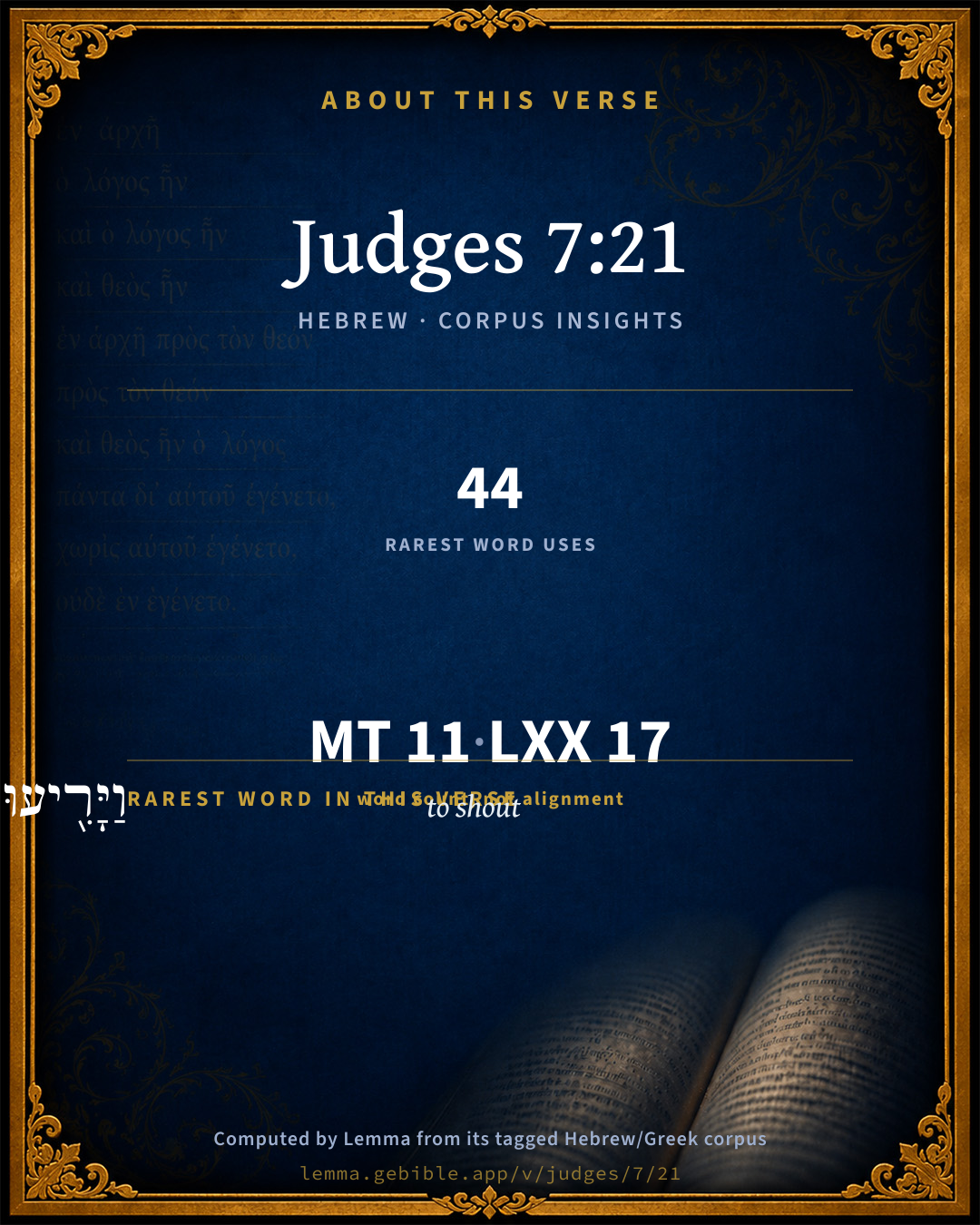
וַיָּרִ֖יעוּ to shout H7321 occurs in 40 verses of the Hebrew Bible. Also found in:

Grammatical profile

  • 5 verbs
  • 5 nouns
  • 1 preposition

Verb forms

  • וַיַּֽעַמְדוּ֙ Qal · Sequential Imperfect
  • וַיָּ֧רָץ Qal · Sequential Imperfect
  • וַיָּרִ֖יעוּ Hiphil · Sequential Imperfect
  • ויניסו Hiphil · Sequential Imperfect
  • וַיָּנֽוּסוּ Qal · Sequential Imperfect

Repetition

Words recur within this verse — often emphatic in Hebrew:

  • לַֽמַּחֲנֶ֑ה camp H4264 ×2
  • ויניסו to flee H5127 ×2

Hebrew & Septuagint length

In English translation the verse runs 24 words from the Hebrew and 22 from the Septuagint (LXX English) — closely comparable.

A rough comparison of the two English renderings, which tokenize alike — not a word-level alignment.

Word counts can differ between the Hebrew and the Greek without any difference in meaning — e.g. the Hebrew direct-object marker אֵת has no separate Greek word, and Greek often adds the article ὁ.

In the original languages it is 11 Hebrew tokens and 17 Greek tokens — but the two are counted differently (Hebrew bundles its prefixes and suffixes into one token; the Greek is in lemma form), so that isn’t a like-for-like length.

Cross-references

8

Topical passages linked to Judges 7:21 in the Treasury of Scripture Knowledge — connected by theme and wording, ordered by reader-vote popularity; previews shown in the World English Bible.

  • Proverbs 28:1 The wicked flee when no one pursues; But the righteous are as bold as a lion.
  • Exodus 14:13–14 Moses said to the people, "Don't be afraid. Stand still, and see the salvation of Yahweh, which he will work for you today: for the Egyptians whom you have seen today, you shall never see them again.
  • Exodus 14:25 He took off their chariot wheels, and they drove them heavily; so that the Egyptians said, "Let's flee from the face of Israel, for Yahweh fights for them against the Egyptians!"
  • 2 Kings 7:6–7 For the Lord had made the host of the Syrians to hear a noise of chariots, and a noise of horses, even the noise of a great host: and they said one to another, Behold, the king of Israel has hired against us the kings of the Hittites, and the kings of the Egyptians, to come on us.
  • 2 Chronicles 20:17 You shall not need to fight in this [battle]: set yourselves, stand you still, and see the salvation of Yahweh with you, O Judah and Jerusalem; don't be afraid, nor be dismayed: tomorrow go out against them: for Yahweh is with you.
  • Job 15:21–22 A sound of terrors is in his ears; In prosperity the destroyer shall come on him.
  • Isaiah 30:7 For Egypt helps in vain, and to no purpose: therefore have I called her Rahab who sits still.
  • Isaiah 30:15 For thus said the Lord Yahweh, the Holy One of Israel, In returning and rest shall you be saved; in quietness and in confidence shall be your strength. You would not:

Cross-references courtesy of OpenBible.info (CC BY 4.0).

Hebrew and Greek witnesses Masoretic Hebrew ↔ Greek Septuagint

The same verse in the two great witnesses to the Old Testament, shown verse-for-verse.

These are two independent witnesses, not word-aligned to each other, and the Septuagint is shown in lemma (dictionary) form.

Hebrew Judges 7:21 Masoretic · Westminster Leningrad Codex

וַיַּֽעַמְדוּ֙ אִ֣ישׁ תַּחְתָּ֔יו סָבִ֖יב לַֽמַּחֲנֶ֑ה וַיָּ֧רָץ כָּל הַֽמַּחֲנֶ֛ה וַיָּרִ֖יעוּ ויניסו וַיָּנֽוּסוּ

They stood every man in his place round about the camp; and all the host ran; and they shouted, and put [them] to flight.

World English Bible · Public Domain

Greek LXX Judges 7:21 Septuagint · lemma form

καί ἵστημι ἀνήρ ἐπί ἑαυτοῦ κύκλος ὁ παρεμβολή καί τρέχω πᾶς ὁ παρεμβολή καί σημαίνω καί φεύγω

And every man stood in his place round about the host; and all the host ran, and sounded an alarm, and fled.

LXX2012 (modern English Septuagint) · Public Domain

On this verse, Ellicott's Commentary for English Readers discusses the Septuagint’s reading. Read the note in Commentary ↓

Hebrew: Westminster Leningrad Codex (CC BY 4.0). Greek: Septuagint (public domain); English from LXX2012 (modern English Septuagint) (Public Domain). How the Septuagint differs from the Hebrew →

Targum (Aramaic paraphrase)

1

The Targum is the ancient Jewish Aramaic paraphrase of the Hebrew Scriptures — an interpretive translation, not the Hebrew text itself. Onkelos (literal) and Pseudo-Jonathan (expansive) render the Torah, and Jonathan the Prophets. Coverage is partial: where no permissively-licensed English translation exists for a verse, only the Aramaic is shown. This is verse-level text, not a word-by-word alignment to the Hebrew.

  1. Targum Jonathan Prophets (Joshua–Malachi)
    וְקָמוּ גְבַר בְּאַתְרֵיהּ סְחוֹר סְחוֹר לְמַשְׁרִיתָא וּרְהָטַת כָּל מַשְׁרִיתָא וְיַבִּיבוּ וְאַפָכוּ:

    (no public-domain English translation for this verse)

    Targum Jonathan — Aramaic: “Mikraot Gedolot” (public domain). English: “Sefaria Community Translation” (CC0 1.0 (public-domain dedication)); “London "Chaldee Paraphrase," 1871” (public domain). Text via Sefaria.

Commentary

Notes on Judges 7:21 from classic Christian and Jewish commentators (each source and its license shown beneath its notes). The classic Christian expositions comment on the surrounding passage and are grouped to its opening verse, so a note may address several verses; the Jewish commentaries on the Tanakh (Rashi and others) are per-verse, so they appear only where the commentator wrote on this verse.

Lemma curates 59 commentaries, every one of them public domain or Creative Commons licensed, each selected and text-cleaned for this edition rather than reprinted as found. About our sources →

Trapp's Complete Commentary

John Trapp

Jdg 7:21 And they stood every man in his place round about the camp: and all the host ran, and cried, and fled.

Ver. 21. And they stood every man in his place.] As if they had been trumpeters and torch bearers to a formidable army at the heels of them.

And all the host ran, and cried, and fled.] Daunted and dismayed with that sudden sound and sight. Who then, can we think, shall be able to stand before that last terror, wherein the archangel’s trumpet shall sound, and the heavens shall pass away with a noise, and the elements shall be on flame about our ears? {2Pe 3:10}

John Trapp, A Commentary or Exposition upon All the Books of the Old and New Testament (1647–1656) — public domain. Text from a community e-Sword module.

Joseph Benson's Commentary

Jdg 7:21-22. They stood — As if they had been torch-bearers to the several companies. Every man’s sword against his fellow — They slew one another, because they suspected treachery, and so fell upon those they first met with; which they might more easily do, because they consisted of several nations, because the darkness of the night made them unable to distinguish friends from foes, because the suddenness of the thing struck them with horror and amazement, and because God had infatuated them, as he had done many others.

Joseph Benson's Commentary on the Old and New Testaments (1811–1818) — public domain. Text from a community e-Sword module.

Geneva Bible (1599)

Geneva Bible translators

Or, broke their array.

Geneva Bible (1599) marginal notes — public domain. Text via Bolls.life.

Adam Clarke's Commentary

Verse 21. They stood every man in his place] Each of the three companies kept its station, and continued to sound their trumpets. The Midianites seeing this, and believing that they were the trumpets of a numerous army which had then penetrated their camp, were thrown instantly into confusion; and supposing that their enemies were in the midst of them, they turned their swords against every man they met, while at the same time they endeavoured to escape for their lives. No stratagem was ever better imagined, better executed, or more completely successful.

Adam Clarke's Commentary on the Bible (1810–1826) — public domain. Text from a community e-Sword/MySword module.

Ellicott's Commentary for English Readers

(21) Ran, and cried, and fled.—They ran about to discover the meaning of the trumpet-blast. Their “cries” were either the wail of despair (Vulg., ululantes), or a number of confused shouts and words of command (LXX., esêmainan); their flight would be a natural result of the hopeless terror and confusion which prevailed. The word, however, in the Kethibh, or written text, is yanîsoo, which means “caused to fly”—i.e., “carried off their tents,” &c.

A Bible Commentary for English Readers, edited by Charles John Ellicott (1878–1897) — public domain. Text from a community e-Sword module.

The Cambridge Bible for Schools and Colleges

gen. ed. J. J. S. Perowne

21. The three bands of Israelites stood still while the Midianites were thrown into a panic by the startling noises and the sudden lights.

ran] The expression is somewhat weak. A slight correction, proposed by Moore and generally accepted, greatly improves the narrative, woke up.

and they shouted, and fled] So Verss.; the subject of both verbs is the host. They shouted means sounded the alarm; see Hos_5:8, Joe_2:1, cf. Isa_15:4.

The Cambridge Bible for Schools and Colleges (gen. ed. J. J. S. Perowne; Cambridge University Press, 1878–1918) — public domain. Text from a community e-Sword module.

John Gill's Exposition

And they stood every man in his place around the camp,.... To see the salvation of God, and that it might most clearly appear to be his own doing; and indeed, had they gone into it, they could have done nothing; they had no weapons in their hands, a trumpet in one hand, and a lamp in the other; though this their position served to increase the terror of the enemy, who might suppose that they stood either to light and introduce a large army at the back of them; or to light the forces already in the midst of them, while they destroyed them; which latter seems rather to be the thing their imaginations were possessed with, since they fell to slaying their fellows, supposing them to be enemies, as in the following verse:

and all the host ran, and cried, and fled; or "were broken" (l); as some render the first word, their lines were broken; they could not put themselves in rank and file, but were thrown into the utmost confusion; and cried as being in the utmost danger of their lives, and fled for their safety as fast, as they could; see Isa 27:13.

(l) "confracta", Pagninus, Montanus, Vatablus.

John Gill's Exposition of the Whole Bible (1746–1763) — public domain (CC PDM 1.0). Text via the HelloAO Bible API.

Albert Barnes' Notes on the Bible

The effect to the Midianites would be, that they were surrounded by a mighty host. Their own camp being in darkness, as soon as the confusion of flight began they would mistake friends for foes, and fleers for pursuers. When once fighting had begun by the first casual mistake, the clashing of swords and the shouts of the combatants in the camp, accompanied by the continuous blowing of Gideon’s trumpets outside, would make it appear that the whole of the enemy was in the camp. Suspicion of treachery on the part of their allies would also be likely to arise in the minds of Midianites, Amalekites, and Arabs. Compare a similar scene in marginal references.

Albert Barnes' Notes on the Bible (1834–1885) — public domain. Text from a community e-Sword/MySword module.

Haydock's Catholic Bible Commentary

Camp. Hence the Madianites made no doubt but a great army was in the midst of the camp, and began to cut in pieces all whom they met. (Calmet)

George Leo Haydock (1774–1849), Haydock's Catholic Family Bible and Commentary, 1859 edition — public domain. Excludes Psalms (Douay-Rheims chapter numbering differs from Protestant) and Deuterocanonical books (Catholic canon only).

Matthew Poole's English Annotations

Every man in his place; as if they had only been torchbearers to the several companies.

Matthew Poole's English Annotations on the Holy Bible (1683–1685) — public domain. Text from a community e-Sword/MySword module.

Whedon's Commentary on the Bible

Daniel D. Whedon

21. They stood — They did not rush in among the Midianites, but kept their station on the outside of the camp, blowing their trumpets and leaving the enemy to fight in confusion among themselves.

Daniel D. Whedon (gen. ed.), Commentary on the Old and New Testaments (1874–1909) — public domain. Text from a community e-Sword module.

The Pulpit Commentary

They stood, etc. Gideon"s men did not advance, but stood, each company in the place assigned to them, at different sides of the-comp.

This had the effect of awakening the whole camp simultaneously, and they started to their feet and ran hither and thither in confusion, shouting as they went. Undisciplined troops, especially excitable Orientals, are very liable to be thus thrown into a panic. Fled. The Cethib has, caused to fly, i.e. either "put to flight," or "carried away," as in Jud_1:6:9 Exo_9:20. In the former case the nominative must be the Israelites; in the latter, their tents, herds, stuff, etc. , must be understood. Both are very awkward. The Keri, fled, is probably right, unless caused to fly has the sense of "bid them fly," in which case the preceding word, cried, might be taken in its common sense of they sounded an alarm. The whole clause would then run thus: And all the camp ran; and they sounded a retreat, and bid them flee.

The Pulpit Commentary (1880–1919), ed. H.D.M. Spence-Jones & Joseph S. Exell — public domain. Text from a community e-Sword module.

John Wesley's Explanatory Notes

They stood - As if they had been torch-bearers to the several companies.

John Wesley, Explanatory Notes Upon the Whole Bible (1754–1765) — public domain. Text via the GEBible commentary corpus.

Rashi

Rabbi Shlomo Yitzchaki (Rashi)

They sounded the alarm. The signal to withdraw and flee.

Rashi on the Tanakh — English translations: “The Judaica Press complete Tanach with Rashi, translated by A. J. Rosenberg” (CC BY 4.0); “Pentateuch with Rashi's commentary by M. Rosenbaum and A.M. Silbermann, 1929-1934” (public domain); “The Metsudah Tanach series, Lakewood, N.J” (CC BY 4.0); and “The Book of Joshua, Metsudah Publications, 1997” (CC BY 4.0). Text via Sefaria.

Lesson kit

Teaching starters — assembled from the data on this page, not authored interpretation. Every prompt links to the verse data it draws on. Edit before teaching.

Judges, in the Historical, opens this verse with 11 words (9 distinct Hebrew lemmas). Its most distinctive word is rûwaʻ (“to shout”). A historical commentator’s framing appears above. Read the whole chapter for the surrounding context.

Discussion questions

  1. The word rûwaʻ carries the sense “to shout.” How does it shape the verse?
  2. Numbers 10:7 shares the word «to shout» with this verse. How do the two illuminate each other?
  3. “camp” occurs 2× in this one verse. What is the effect of the repetition?
  4. These translations render this verse differently. What is at stake in choosing one wording over another?
  5. The verb «וַיַּֽעַמְדוּ֙» is Qal Sequential Imperfect. How does its form color the action?
  6. Reading how Trapp's Complete Commentary and Joseph Benson's Commentary read this verse, where do the two commentators agree and where do they part?

Things to notice

Reading settings

Reading text

Shown beneath each verse's original-language words.

Old Testament
Old Testament edition

Read the OT as the Masoretic Hebrew (MT) or the Greek Septuagint (LXX).

English shown for the Greek Septuagint (in the Hebrew ↔ Greek comparison).

Comparing translations? Open the Compare panel on any verse page to stack up to four side by side.