
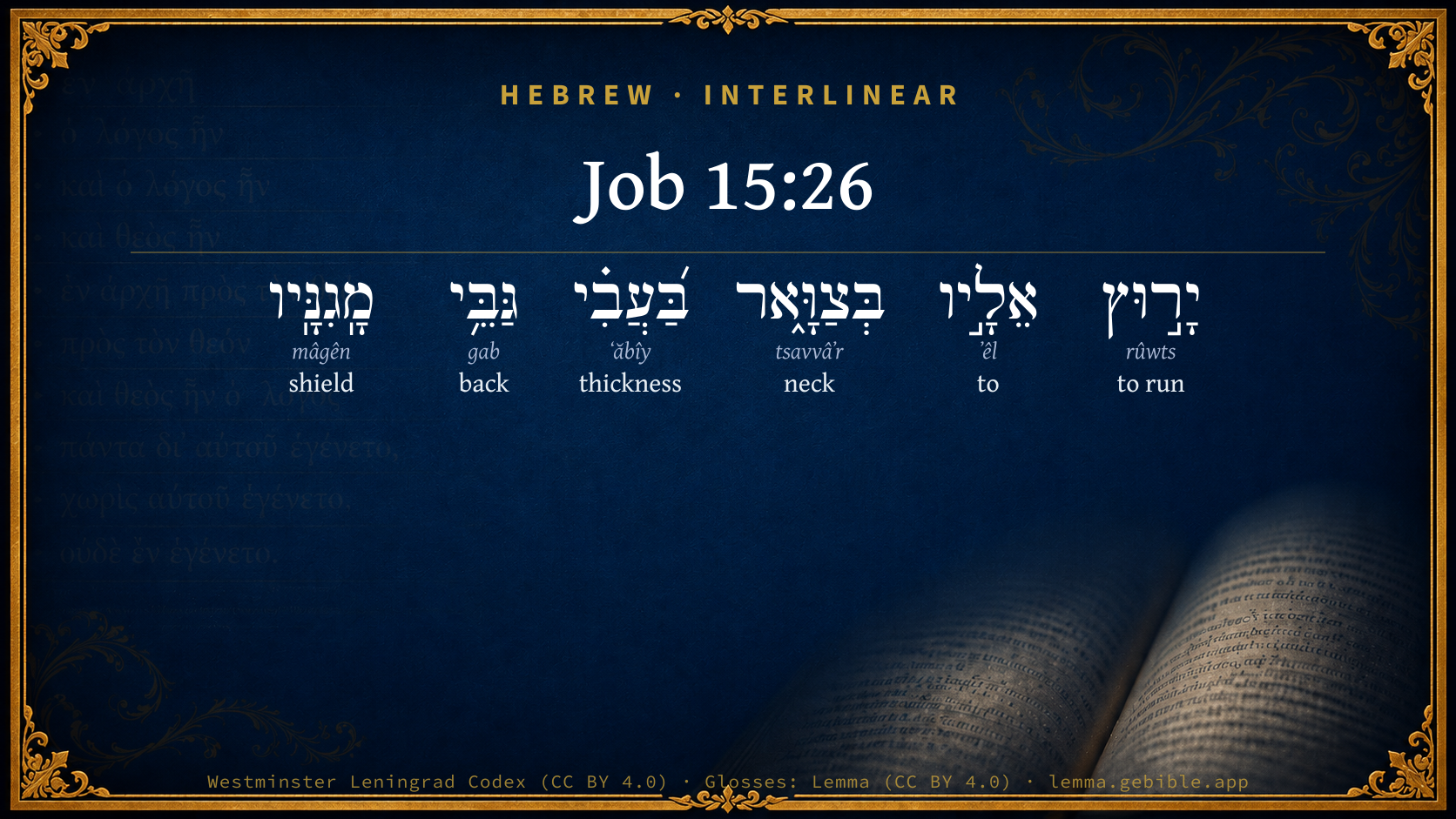
Job 15:26

Hebrew (Westminster Leningrad Codex) Job 15:26 appears in the Hebrew Old Testament. The text above is from the Westminster Leningrad Codex. Each word links to its Strong’s number, a concise gloss, and parsing drawn from the Open Scriptures Hebrew Bible morphology. Click any word for its full Brown-Driver-Briggs (BDB) entry.
Download image
Cite this verse

Job 15:26 (World English Bible). Public Domain. Lemma interlinear Bible study tool, https://lemma.gebible.app/v/job/15/26.

Show BibTeX & RIS
BibTeX
RIS
English Translation
He runs at him with a stiff neck, With the thick shields of his bucklers;
World English Bible · Public Domain
Download a study sheet

One document with this verse’s original text, its word-by-word gloss line, the meaning frame, cross-references with their text, attributed commentary, and full source and license credits — printable, and it pastes into notes with its structure intact.

This verse Autodidact and up

Study sheet (.html) Plain text (.txt)

A passage Seminary Student

Up to 50 verses in one chapter. A passage sheet keeps up to 6 commentary sources and 12 cross-references per verse, in the order this page ranks them, and says so on the sheet whenever that leaves anything out. Ask for a single verse and you get the Autodidact verse sheet above.

Everything on this page stays free to read, with no account — the sheet is a download of what is already on screen, not access to it.

Want to remove ads? Support Godless Engineer
Compare translations 3

The same verse in 3 English versions, stacked beneath the original-language interlinear above. Click any original word for its lexicon entry.

Each is an independent rendering of the whole verse — the interlinear is not word-aligned to these translations.

Highlighted words mark where these versions differ — a whole-verse word diff, not a word-by-word alignment.

  • World English Bible Public Domain
    He runs at him with a stiff neck, With the thick shields of his bucklers;
  • King James Version Public Domain
    He runneth upon him, even on his neck, upon the thick bosses of his bucklers:
  • unfoldingWord Literal Text CC BY-SA 4.0
    He rushes against him with the neck, with the thickness of the bosses of his shields,

unfoldingWord Literal Text — © unfoldingWord, licensed CC BY-SA 4.0. Word-aligned USFM3 via Door43 (git.door43.org/unfoldingWord/en_ult).

Versions to compare (up to 4)

3 of 4 selected

Show all 18 translations

Every available English version of this verse, each an independent rendering of the whole verse.

  • World English Bible Public Domain
    He runs at him with a stiff neck, With the thick shields of his bucklers;
  • Berean Standard Bible Public Domain
    rushing headlong at Him with a thick, studded shield.
  • Majority Standard Bible Public Domain
    rushing headlong at Him with a thick, studded shield.
  • King James Version Public Domain
    He runneth upon him, even on his neck, upon the thick bosses of his bucklers:
  • American Standard Version (1901) Public Domain
    He runneth upon him with a `stiff' neck, With the thick bosses of his bucklers;
  • Revised Version (1885) Public Domain
    He runneth upon him with a stiff neck, with the thick bosses of his bucklers:
  • Geneva Bible (1599) Public Domain
    Therefore God shall runne vpon him, euen vpon his necke, and against the most thicke part of his shielde.
  • Douay-Rheims (1899) Public Domain
    He hath run against him with his neck raised up, and is armed with a fat neck.
  • Young's Literal Translation Public Domain
    He runneth unto Him with a neck, With thick bosses of his shields.
  • Literal Standard Version CC BY-SA 4.0
    He runs to Him with a neck, || With thick bosses of his shields.
  • Unlocked Literal Bible CC BY-SA 4.0
    this wicked man runs at God with a stiff neck, with a thick shield.
  • unfoldingWord Literal Text CC BY-SA 4.0
    He rushes against him with the neck, with the thickness of the bosses of his shields,
  • Darby Bible Public Domain
    He runneth against him, with [outstretched] neck, with the thick bosses of his bucklers;
  • World Messianic Bible Public Domain
    he runs at him with a stiff neck, with the thick shields of his bucklers,
  • Webster's Bible Public Domain
    He runneth upon him, even on his neck, upon the thick bosses of his bucklers:
  • Free Bible Version CC BY-SA 4.0
    insolently attacking him with their shields.
  • Bible in Basic English Public Domain
    Running against him like a man of war, covered by his thick breastplate; even like a king ready for the fight,
  • JPS Tanakh (1917) Public Domain
    He runneth upon him with a stiff neck, with the thick bosses of his bucklers.

Literal Standard Version (2020), Covenant Press — licensed CC BY-SA 4.0. Text via the HelloAO Bible API (eBible.org). Unlocked Literal Bible (unfoldingWord) — licensed CC BY-SA 4.0. Text via the HelloAO Bible API (eBible.org). unfoldingWord Literal Text — © unfoldingWord, licensed CC BY-SA 4.0. Word-aligned USFM3 via Door43 (git.door43.org/unfoldingWord/en_ult). Free Bible Version, Dr. Jonathan Gallagher — licensed CC BY-SA 4.0. Text via the HelloAO Bible API (eBible.org).

Word by word

More ways to search: Search by grammar → Find every occurrence → Compare this word →

Practice this passage: Drill this verse → Learn its vocabulary →

About this verse

These counts appear in no published source. They are computed here, from the morphology-tagged text and Lemma’s own curated glosses. What Lemma adds →

6
words
6
distinct lemmas
Wisdom
section

Notable vocabulary

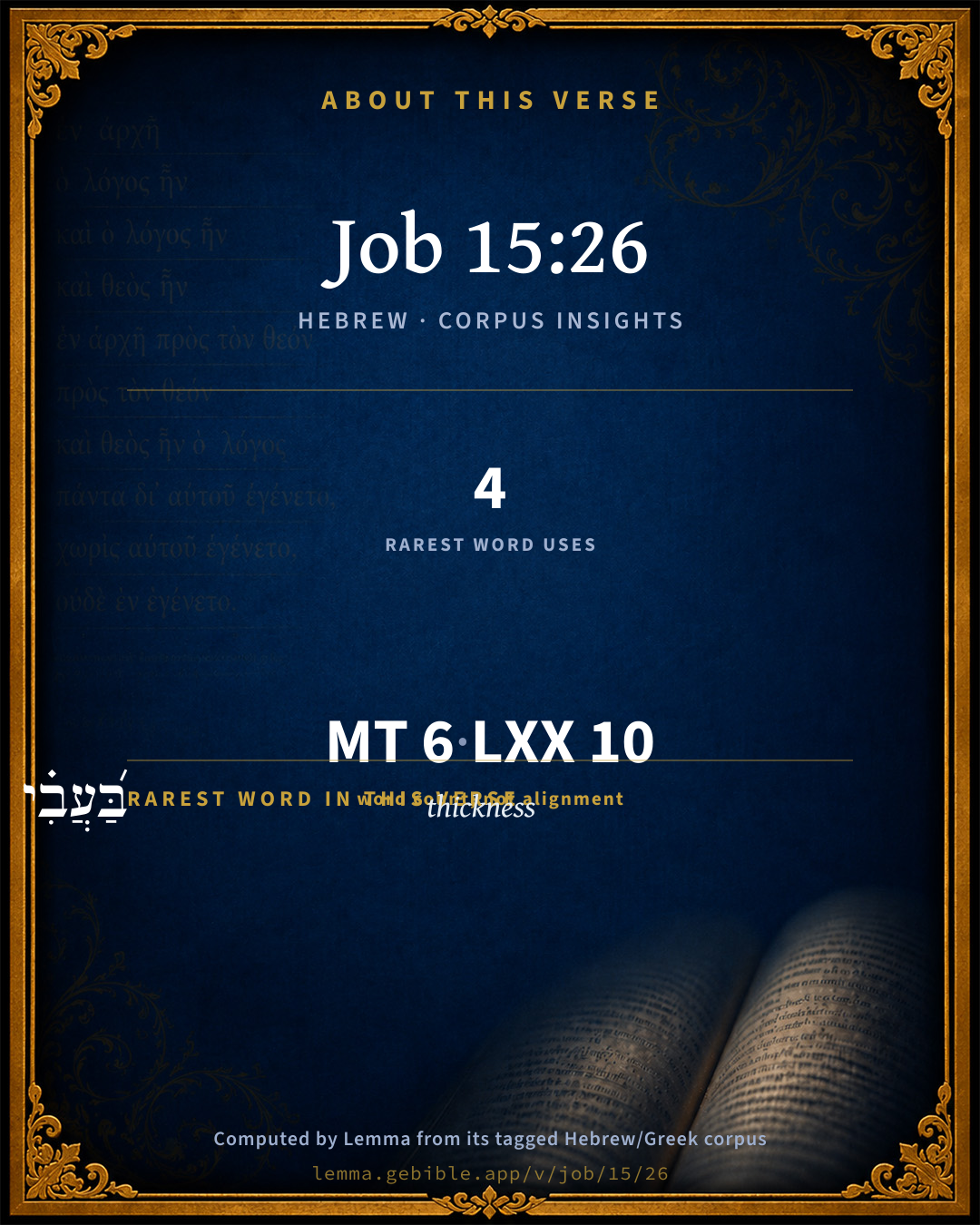
The rarest word here is בַּ֝עֲבִ֗י thickness H5672 — appearing just 4 times in the whole Hebrew Bible.

Shared distinctive vocabulary

בַּ֝עֲבִ֗י thickness H5672 occurs in 4 verses of the Hebrew Bible. Also found in:

Grammatical profile

  • 1 verb
  • 4 nouns
  • 1 preposition

Verb forms

  • יָר֣וּץ Qal · Imperfect

Hebrew & Septuagint length

In English translation the verse runs 15 words from the Hebrew and 17 from the Septuagint (LXX English) — closely comparable.

A rough comparison of the two English renderings, which tokenize alike — not a word-level alignment.

Word counts can differ between the Hebrew and the Greek without any difference in meaning — e.g. the Hebrew direct-object marker אֵת has no separate Greek word, and Greek often adds the article ὁ.

In the original languages it is 6 Hebrew tokens and 10 Greek tokens — but the two are counted differently (Hebrew bundles its prefixes and suffixes into one token; the Greek is in lemma form), so that isn’t a like-for-like length.

Cross-references

5

Topical passages linked to Job 15:26 in the Treasury of Scripture Knowledge — connected by theme and wording, ordered by reader-vote popularity; previews shown in the World English Bible.

  • Genesis 49:8 "Judah, your brothers will praise you: Your hand will be on the neck of your enemies; Your father's sons will bow down before you.
  • 2 Chronicles 28:22 In the time of his distress did he trespass yet more against Yahweh, this same king Ahaz.
  • 2 Chronicles 32:13–17 Don't you know what I and my fathers have done to all the peoples of the lands? Were the gods of the nations of the lands in any wise able to deliver their land out of my hand?
  • Job 16:12 I was at ease, and he broke me apart. Yes, he has taken me by the neck, and dashed me to pieces. He has also set me up for his target.
  • Psalms 18:40 You have also made my enemies turn their backs to me, That I might cut off those who hate me.

Cross-references courtesy of OpenBible.info (CC BY 4.0).

Hebrew and Greek witnesses Masoretic Hebrew ↔ Greek Septuagint

The same verse in the two great witnesses to the Old Testament, shown verse-for-verse.

These are two independent witnesses, not word-aligned to each other, and the Septuagint is shown in lemma (dictionary) form.

Hebrew Job 15:26 Masoretic · Westminster Leningrad Codex

יָר֣וּץ אֵלָ֣יו בְּצַוָּ֑אר בַּ֝עֲבִ֗י גַּבֵּ֥י מָֽגִנָּֽיו

He runs at him with a stiff neck, With the thick shields of his bucklers;

World English Bible · Public Domain

Greek LXX Job 15:26 Septuagint · lemma form

τρέχω δέ ἐναντίον αὐτός ὕβρις ἐν πάχος νῶτον ἀσπίς αὐτός

And he has run against him with insolence, on the thickness of the back of his shield.

LXX2012 (modern English Septuagint) · Public Domain

On this verse, Albert Barnes' Notes on the Bible discusses the Septuagint’s reading. Read the note in Commentary ↓

Hebrew: Westminster Leningrad Codex (CC BY 4.0). Greek: Septuagint (public domain); English from LXX2012 (modern English Septuagint) (Public Domain). How the Septuagint differs from the Hebrew →

Commentary

Notes on Job 15:26 from classic Christian and Jewish commentators (each source and its license shown beneath its notes). The classic Christian expositions comment on the surrounding passage and are grouped to its opening verse, so a note may address several verses; the Jewish commentaries on the Tanakh (Rashi and others) are per-verse, so they appear only where the commentator wrote on this verse.

Lemma curates 59 commentaries, every one of them public domain or Creative Commons licensed, each selected and text-cleaned for this edition rather than reprinted as found. About our sources →

Trapp's Complete Commentary

John Trapp

Job 15:26 He runneth upon him, [even] on [his] neck, upon the thick bosses of his bucklers:

Ver. 26. He runneth upon him, even on his neck] Vulgate, He runneth upon him (God) with an erected neck; such is his audaciousness and impudence, daring to do any heinous wickedness, and not fearing to run against the strongest part of God’s armour, though able to grind him to powder. Sin hath etched such an impudency in his face, that he dare with a full forehead encounter God, even upon the points of his justice and righteous judgments, wherein he is the ablest to give us the shock, &c. Thus some sense the text. Others (of good note also) refer the word runneth to God, and render it thus, God runneth upon him, even upon the neck, &c. He breaking his shields, how many and how thick soever they be, drags him by the neck, as a miserable vanquished wretch, and lays upon him exquisite and high punishments, according to that, Job 31:3, "Is not destruction to the wicked? and a strange punishment to the workers of iniquity?"

Upon the thick bosses of his bucklers] Wherewith the Belialist, this champion for hell, thinks himself best armed and secured against the dint of the divine displeasure. Bucklers, besides other bosses for ornament, had one great boss in the middle, with a sharp spike in it for use, to pierce and wound the adversary. Now God runs upon this also, and is no whit hindered thereby from punishing the refractories, these high attempters, these monstrous men of condition, that so fiercely and so fearlessly lift up their hands against heaven, as if they would pull God out of his throne, and throw the house, yea, the world, out at the windows. Surely as pride resisteth God in a special manner, so doth God in a special manner resist it, 1Pe 5:5. The reason whereof is given by Boetius: All other vices, saith he, fly from God, only pride flies at him, stands out, and makes head against him.

John Trapp, A Commentary or Exposition upon All the Books of the Old and New Testament (1647–1656) — public domain. Text from a community e-Sword module.

Joseph Benson's Commentary

Job 15:26. He runneth upon him — That is, the wicked man (of whom, and of whose sin and misery, he speaks in the whole context, both preceding and following) assaults God, and, as it were, rushes swiftly and furiously upon him, as the same phrase, ירצ אלו, jarats eelaiv, signifies, Dan 8:6. In the former verse he was represented as preparing for the battle, and here as actually and impudently fighting with him. Even on his neck — As a stout warrior who cometh close to his adversary and grapples with him. He acts in flat opposition to God, both to his precepts and providences. Upon the thick bosses of his bucklers — Even where his enemy is strongest. He is not discouraged with his enemy’s thick, and strong, and eminent shields, but boldly ventures to rush upon them, though to his own certain destruction. Every sinner departs, or runs, rather, from God: but the presumptuous sinner, who sins with a high hand, runs upon him, fights against him, and bids defiance to him; and it is easy to foretel what will be the issue.

Joseph Benson's Commentary on the Old and New Testaments (1811–1818) — public domain. Text from a community e-Sword module.

Jamieson, Fausset & Brown

Robert Jamieson, A. R. Fausset & David Brown

on his neck--rather, "with outstretched neck," namely, that of the rebel [UMBREIT] (Psa 75:5).

upon . . . bucklers--rather, "with--his (the rebel's, not God's) bucklers." The rebel and his fellows are depicted as joining shields together, to form a compact covering over their heads against the weapons hurled on them from a fortress [UMBREIT and GESENIUS].

Jamieson, Fausset & Brown — Commentary Critical and Explanatory on the Whole Bible (1871) — public domain (CC PDM 1.0). Text via the HelloAO Bible API.

Adam Clarke's Commentary

Verse 26. He runneth upon him.] Calmet has properly observed that this refers to GOD, who, like a mighty conquering hero, marches against the ungodly, rushes upon him, seizes him by the throat, which the mail by which it is encompassed cannot protect; neither his shield nor spear can save him when the Lord of hosts comes against him.

Adam Clarke's Commentary on the Bible (1810–1826) — public domain. Text from a community e-Sword/MySword module.

The Cambridge Bible for Schools and Colleges

gen. ed. J. J. S. Perowne

26. The whole verse means,

He ran upon him with stiff neck,

With the thick bosses of his bucklers.

The words describe the wicked man’s demeanour towards God. The figure is that of a warrior making an assault. The Heb. is “he ran upon him with neck,” Vulg., erecto collo, cf. Psa_75:5. The “bosses” are the convex sides of the bucklers, the sides turned to the foe, who here is God.

The Cambridge Bible for Schools and Colleges (gen. ed. J. J. S. Perowne; Cambridge University Press, 1878–1918) — public domain. Text from a community e-Sword module.

John Gill's Exposition

Because he covereth his face with his fatness,.... He has no fear of God, nor shame for his sin; he blushes not to rise up against God in the manner he does, because his eyes stand out with fatness; or rather his face is covered with it, that is, he abounds in riches, he enjoys great prosperity, a large affluence of all good things; and this makes him haughty and imperious, neither to fear God, nor regard man like Jeshurun, who, when he "waxed fat, was grown thick, and covered with fatness, kicked" against God, and his providences, sinned and rebelled against him; "forsook God which made him, and lightly esteemed the Rock of his salvation", Deu 32:15; and to the same purpose is the following clause:

and maketh collops of fat in his flanks; a description of a very fat man, and one that pampers the flesh, and indulges himself in eating and drinking; and, figuratively, of one that abounds in the good things of this world, and which make him vain and proud, and lead him on to commit sin in a bold and daring way, promising himself impunity in it, but without any just ground for it, as the following verses show; perhaps some respect may be had to Job's children feasting with one another in their prosperity, which led on to sin, and issued in their ruin, as Eliphaz would suggest.

John Gill's Exposition of the Whole Bible (1746–1763) — public domain (CC PDM 1.0). Text via the HelloAO Bible API.

Albert Barnes' Notes on the Bible

He runneth upon him - That is, upon God. The image here is taken from the mode in which people rushed into battle. It was with a violent concussion, and usually with a shout, that they might intimidate their foes, and overcome them at first, with the violence of the shock. The mode of warfare is now changed, and it is the vaunted excellency of modern warfare that armies now go deliberately and calmly to put each other to death.

Even “on his neck - literally, “with the neck” - בצואר betsavā'r. Vulgate, “With erect neck - erecto collo.” Septuagint, contemptuously, or with pride - ὕβρει hubrei. The idea seems to be, not that he ran “upon the neck” of his adversary - as would seem to be implied in our translation - but that he ran in a firm, haughty, confident manner; with a head erect and firm, as the indication of self confidence, and a determined purpose to overcome his foe. See Schultens in loc.

Upon the thick bosses - The word boss with us means a knob - a protuberant ornament of silver, brass, or ivory on a harness or a bridle; then a protuberant part, a prominence, or a round or swelling body of any kind. The Hebrew word used here (גב gab) means properly anything gibbous, convex, arched; and hence, “the back” - as of animals. Applied to a shield, it means the convex part or the back of it - the part which was presented to an enemy, and which was made swelling and strong, called by the Greeks ὀμφαλὸς omfalos, or μεσομφάλιον mesomfalion. Gesenius supposes that the metaphor here is taken from soldiers, who joined their shields together, and thus rushed upon an enemy. This was one mode of ancient warfare, when an army or a phalanx united their shields in front, so that nothing could penetrate them, or so united them over their heads when approaching a fortress, that they could safely march under them as a covering.

This, among the Romans and Greeks, was commonly practiced when approaching a besieged town. One form of the testudo - the χελώη στρατιωτῶν chelōnē stratiōtōn of the Greeks, was formed by the soldiers, pressed close together and holding their shields over their heads in such a manner as to form a compact covering. John H. Eschenburg, Manual of Classical Literature. by N. W. Fiske, pt. III, section 147. The Vulgate renders this, “and he is armed with a fat neck” - pingui cervice armatus est. Schultens expresses the idea that is adopted by Gesenius, and refers to Arabic customs to show that shields were thus united in defending an army from a foe, or in making an attack on them. He says, also, that it is a common expression - a proverb - among the Arabs, “he turns the back of his shield” to denote that one is an adversary; and quotes a passage from Hamasa, “When a friend meets me with base suspicions, I turn to him the back of my shield - a proverb, whose origin is derived from the fact, that a warrior turns the back of his shield to his foes.”

Paxton supposes that the expression here is taken from single combat, which early prevailed. But the idea here is not that which our translation would seem to convey. It is not that he rushes upon or against the hard or thick shield “of the Almighty” - and that, therefore, he must meet resistance and be overcome: it is that he rushes upon God with his own shield. He puts himself in the attitude of a warrior. He turns the boss of his own shield against God, and becomes his antagonist. He is his enemy. The omission of the word “with” in the passage - or the preposition which is in the Hebrew (ב b) has led to this erroneous translation. The passage is often quoted in a popular manner to denote that the sinner rushes upon God, “and must meet resistance” from his shield, or be overcome. It should be quoted only to denote that the sinner places himself in an attitude of opposition to God, and is his enemy.

Of his bucklers - Of his shields (מגניו megı̂nāy), that is, of the shields which the sinner has; not the shields of God. The shield was a well-known instrument of war, usually made with a rim of wood or metal, and covered with skins, and carried on the left arm; see the notes at Isa 21:5. The outer surface was made rounding from the center to the edge, and was smoothly polished, so that darts or arrows would glide off and not penetrate.

Albert Barnes' Notes on the Bible (1834–1885) — public domain. Text from a community e-Sword/MySword module.

Haydock's Catholic Bible Commentary

And is. Hebrew, "even upon the thick bosses of his buckler." (Haydock) --- God thus seizes his antagonist, who, like Pharao, swells with pride. (Calmet) (Deuteronomy xxxii. 15.)

George Leo Haydock (1774–1849), Haydock's Catholic Family Bible and Commentary, 1859 edition — public domain. Excludes Psalms (Douay-Rheims chapter numbering differs from Protestant) and Deuterocanonical books (Catholic canon only).

Matthew Poole's English Annotations

Runneth upon him, i.e. assaults him, or rusheth upon him with great swiftness and fury, as this phrase signifies, Dan 8:6. This he is either,

1. God, who was expressed twice in the last verse, and who is here produced as entering the lists and fighting with his daring adversary. Or rather,

2. The wicked man, of whom and whose sin and misery he speaks in the whole context, both before and after this; who in the last verse was introduced as preparing for the battle, and here as actually and impudently fighting with him.

Even on his neck; as a stout warrior, who cometh close to his adversary and grapples with him, and taketh him by the neck to throw him down. Compare 2Sa 2:16; Job 16:2. Or, with his neck. So it is a metaphor from a mad and raging bull, which runs upon his enemy with a hard and stiff neck.

Upon the thick bosses of his bucklers, i.e. even where his enemy is strongest; he is not discouraged with the enemies’ thick, and strong, and eminent shields, but boldly ventures in upon them, and amongst them. Or, with the thick bosses (Heb. the thickness and eminency) of his shields, wherewith he invaded the enemy, that so he might both defend himself and offend his enemy; for the ancient shields were useful both ways, because they had a sharp iron or steel in the midst of them.

Matthew Poole's English Annotations on the Holy Bible (1683–1685) — public domain. Text from a community e-Sword/MySword module.

Whedon's Commentary on the Bible

Daniel D. Whedon

26. On his neck — With his neck, (with neck erect — Vulgate, Furst,) as a combatant rushes upon his adversary. Upon the thick bosses, etc. — The central and projecting part of the shield, which was made thick and strong. The use of the word shield or buckler, in the plural, may denote the joining of shield to shield, thus forming what the Romans called a testudo, from the likeness of the linked shields to the scales of a tortoise. Schultens cites an Arabic proverb, “He turns the back of his shield:” denoting that such a one has become an enemy.

Daniel D. Whedon (gen. ed.), Commentary on the Old and New Testaments (1874–1909) — public domain. Text from a community e-Sword module.

The Pulpit Commentary

He runneth upon him, even on his neck; rather, with his neck. It is not God who runneth upon the wicked man, as our translators seem to have supposed, but the wicked man who rushes furiously against God. Like an infuriated bull, he makes his charge with his neck, i.e. with head lowered and neck stiffened, thinking to carry all before him. Upon the thick bosses of his bucklers; rather, with the thick bosses of his shield"The metaphor of the bull is dropped, and God"s enemy represented as charging him like a warrior, with the shield-arm outstretched, and the heavy bosses of the shield pressing him down.

The Pulpit Commentary (1880–1919), ed. H.D.M. Spence-Jones & Joseph S. Exell — public domain. Text from a community e-Sword module.

John Wesley's Explanatory Notes

He - The wicked man. Neck - As a stout warrior who cometh close to his adversary and grapples with him. He acts in flat opposition to God, both to his precepts and providences. Bosses - Even where his enemy is strongest.

John Wesley, Explanatory Notes Upon the Whole Bible (1754–1765) — public domain. Text via the GEBible commentary corpus.

Rashi

Rabbi Shlomo Yitzchaki (Rashi)

He runs towards Him He would run toward the Creator with his neck high and upright, in order to provoke Him.

the thickness of the body of his shields With the power of his strength. the body of an expression of height, as (Ezek 16:24), “and you built yourself a platform (גב).”

Rashi on the Tanakh — English translations: “The Judaica Press complete Tanach with Rashi, translated by A. J. Rosenberg” (CC BY 4.0); “Pentateuch with Rashi's commentary by M. Rosenbaum and A.M. Silbermann, 1929-1934” (public domain); “The Metsudah Tanach series, Lakewood, N.J” (CC BY 4.0); and “The Book of Joshua, Metsudah Publications, 1997” (CC BY 4.0). Text via Sefaria.

Lesson kit

Teaching starters — assembled from the data on this page, not authored interpretation. Every prompt links to the verse data it draws on. Edit before teaching.

Job, in the Wisdom, opens this verse with 6 words (6 distinct Hebrew lemmas). Its most distinctive word is ʻăbîy (“thickness”). A historical commentator’s framing appears above. Read the whole chapter for the surrounding context.

Discussion questions

  1. What does “thickness” (ʻăbîy) contribute to the verse as a whole?
  2. How does 1 Kings 7:26, which shares the word «thickness», read alongside this verse?
  3. These translations render this verse differently. What is at stake in choosing one wording over another?
  4. «יָר֣וּץ» is a Qal Imperfect verb. How does that grammatical form shape the action described?
  5. Compare how Trapp's Complete Commentary and Joseph Benson's Commentary read this verse. Where do they agree or differ?

Things to notice

Reading settings

Reading text

Shown beneath each verse's original-language words.

Old Testament
Old Testament edition

Read the OT as the Masoretic Hebrew (MT) or the Greek Septuagint (LXX).

English shown for the Greek Septuagint (in the Hebrew ↔ Greek comparison).

Comparing translations? Open the Compare panel on any verse page to stack up to four side by side.