
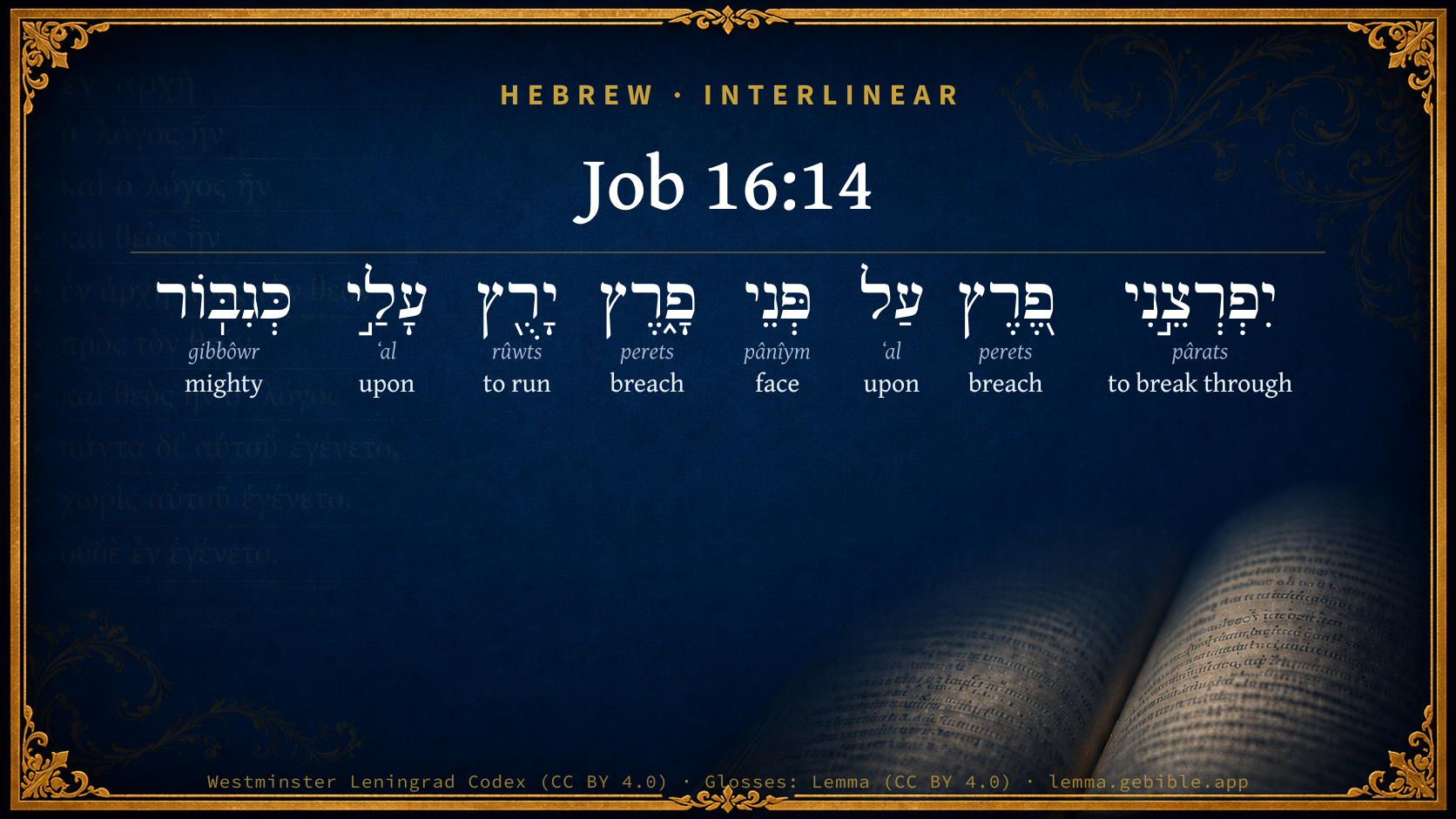
Job 16:14

Hebrew (Westminster Leningrad Codex) Job 16:14 appears in the Hebrew Old Testament. The text above is from the Westminster Leningrad Codex. Each word links to its Strong’s number, a concise gloss, and parsing drawn from the Open Scriptures Hebrew Bible morphology. Click any word for its full Brown-Driver-Briggs (BDB) entry.
Download image
Cite this verse

Job 16:14 (World English Bible). Public Domain. Lemma interlinear Bible study tool, https://lemma.gebible.app/v/job/16/14.

Show BibTeX & RIS
BibTeX
RIS
English Translation
He breaks me with breach on breach. He runs on me like a giant.
World English Bible · Public Domain
Download a study sheet

One document with this verse’s original text, its word-by-word gloss line, the meaning frame, cross-references with their text, attributed commentary, and full source and license credits — printable, and it pastes into notes with its structure intact.

This verse Autodidact and up

Study sheet (.html) Plain text (.txt)

A passage Seminary Student

Up to 50 verses in one chapter. A passage sheet keeps up to 6 commentary sources and 12 cross-references per verse, in the order this page ranks them, and says so on the sheet whenever that leaves anything out. Ask for a single verse and you get the Autodidact verse sheet above.

Everything on this page stays free to read, with no account — the sheet is a download of what is already on screen, not access to it.

Want to remove ads? Support Godless Engineer
Compare translations 3

The same verse in 3 English versions, stacked beneath the original-language interlinear above. Click any original word for its lexicon entry.

Each is an independent rendering of the whole verse — the interlinear is not word-aligned to these translations.

Highlighted words mark where these versions differ — a whole-verse word diff, not a word-by-word alignment.

  • World English Bible Public Domain
    He breaks me with breach on breach. He runs on me like a giant.
  • King James Version Public Domain
    He breaketh me with breach upon breach, he runneth upon me like a giant.
  • unfoldingWord Literal Text CC BY-SA 4.0
    He breaches me, breach upon the face of breach; he runs against me like a warrior.

unfoldingWord Literal Text — © unfoldingWord, licensed CC BY-SA 4.0. Word-aligned USFM3 via Door43 (git.door43.org/unfoldingWord/en_ult).

Versions to compare (up to 4)

3 of 4 selected

Show all 18 translations

Every available English version of this verse, each an independent rendering of the whole verse.

  • World English Bible Public Domain
    He breaks me with breach on breach. He runs on me like a giant.
  • Berean Standard Bible Public Domain
    He breaks me with wound upon wound; He rushes me like a mighty warrior.
  • Majority Standard Bible Public Domain
    He breaks me with wound upon wound; He rushes me like a mighty warrior.
  • King James Version Public Domain
    He breaketh me with breach upon breach, he runneth upon me like a giant.
  • American Standard Version (1901) Public Domain
    He breaketh me with breach upon breach; He runneth upon me like a giant.
  • Revised Version (1885) Public Domain
    He breaketh me with breach upon breach; he runneth upon me like a giant.
  • Geneva Bible (1599) Public Domain
    He hath broken me with one breaking vpon another, and runneth vpon me like a gyant.
  • Douay-Rheims (1899) Public Domain
    He hath compassed me round about with his lances, he hath wounded my loins, he hath not spared, and hath poured out my bowels on the earth.
  • Young's Literal Translation Public Domain
    He breaketh me -- breach upon breach, He runneth upon me as a mighty one.
  • Literal Standard Version CC BY-SA 4.0
    He breaks me—breach on breach, || He runs on me as a mighty one.
  • Unlocked Literal Bible CC BY-SA 4.0
    He smashes through my wall again and again; he runs upon me like a warrior.
  • unfoldingWord Literal Text CC BY-SA 4.0
    He breaches me, breach upon the face of breach; he runs against me like a warrior.
  • Darby Bible Public Domain
    He breaketh me with breach upon breach; he runneth upon me like a mighty man.
  • World Messianic Bible Public Domain
    He breaks me with breach on breach. He runs at me like a giant.
  • Webster's Bible Public Domain
    He breaketh me with breach upon breach, he runneth upon me like a giant.
  • Free Bible Version CC BY-SA 4.0
    Like a wall he breaks me down, breach upon breach, rushing at me like a warrior.
  • Bible in Basic English Public Domain
    I am broken with wound after wound; he comes rushing on me like a man of war.
  • JPS Tanakh (1917) Public Domain
    He breaketh me with breach upon breach; He runneth upon me like a giant.

Literal Standard Version (2020), Covenant Press — licensed CC BY-SA 4.0. Text via the HelloAO Bible API (eBible.org). Unlocked Literal Bible (unfoldingWord) — licensed CC BY-SA 4.0. Text via the HelloAO Bible API (eBible.org). unfoldingWord Literal Text — © unfoldingWord, licensed CC BY-SA 4.0. Word-aligned USFM3 via Door43 (git.door43.org/unfoldingWord/en_ult). Free Bible Version, Dr. Jonathan Gallagher — licensed CC BY-SA 4.0. Text via the HelloAO Bible API (eBible.org).

Word by word

More ways to search: Search by grammar → Find every occurrence → Compare this word →

Practice this passage: Drill this verse → Learn its vocabulary →

About this verse

These counts appear in no published source. They are computed here, from the morphology-tagged text and Lemma’s own curated glosses. What Lemma adds →

8
words
6
distinct lemmas
Wisdom
section

Notable vocabulary

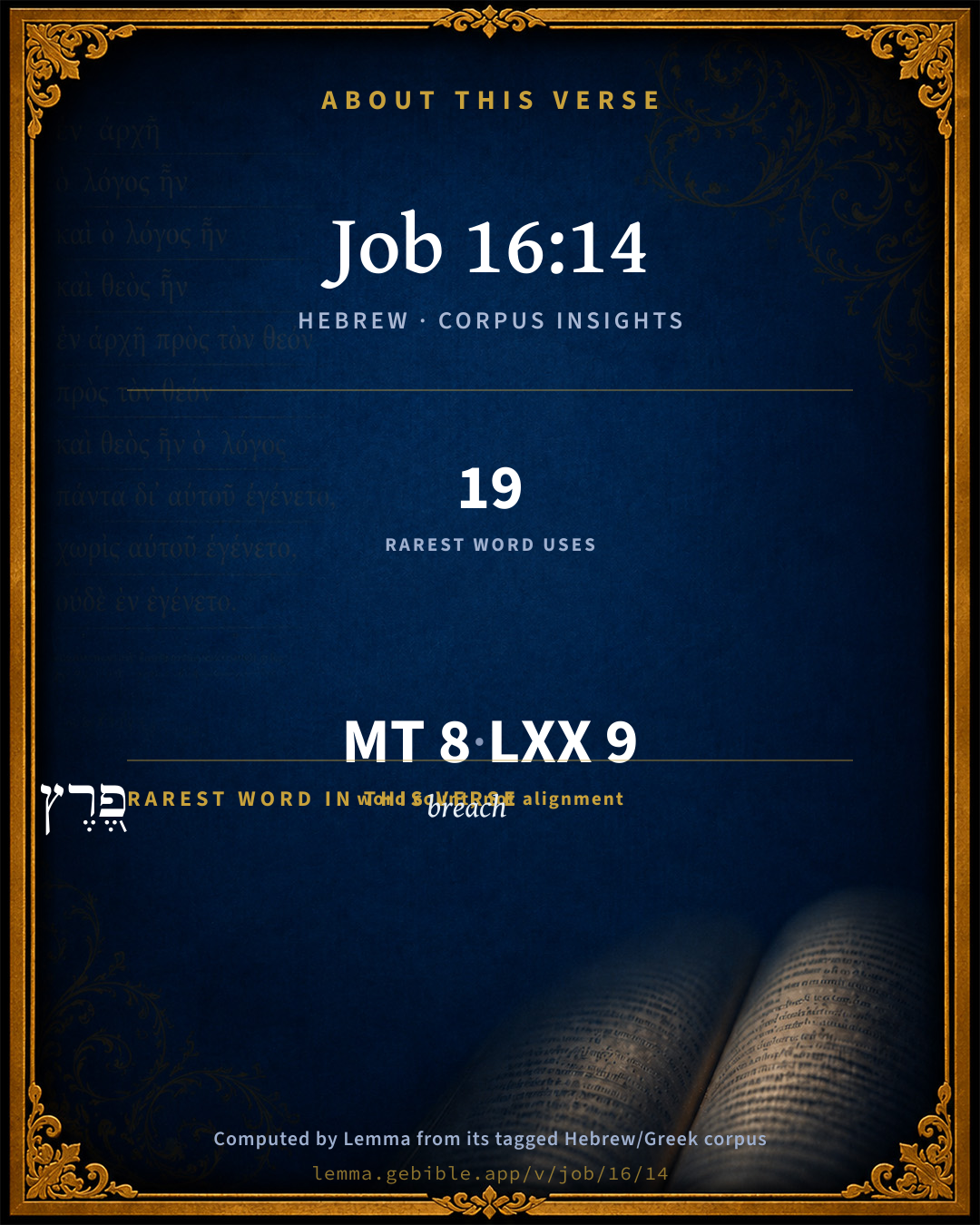
The rarest word here is פֶ֭רֶץ breach H6556 — appearing just 19 times in the whole Hebrew Bible.

Shared distinctive vocabulary

פֶ֭רֶץ breach H6556 occurs in 18 verses of the Hebrew Bible. Also found in:

Grammatical profile

  • 2 verbs
  • 3 nouns
  • 1 adjective
  • 2 prepositions

Verb forms

  • יִפְרְצֵ֣נִי Qal · Imperfect
  • יָרֻ֖ץ Qal · Imperfect

Repetition

Words recur within this verse — often emphatic in Hebrew:

  • פֶ֭רֶץ breach H6556 ×2
  • עַל upon H5921 ×2

Hebrew & Septuagint length

In English translation the verse runs 14 words from the Hebrew and 20 from the Septuagint (LXX English) — the Septuagint runs noticeably longer here. See the side-by-side →

A rough comparison of the two English renderings, which tokenize alike — not a word-level alignment.

Word counts can differ between the Hebrew and the Greek without any difference in meaning — e.g. the Hebrew direct-object marker אֵת has no separate Greek word, and Greek often adds the article ὁ.

In the original languages it is 8 Hebrew tokens and 9 Greek tokens — but the two are counted differently (Hebrew bundles its prefixes and suffixes into one token; the Greek is in lemma form), so that isn’t a like-for-like length.

Cross-references

5

Topical passages linked to Job 16:14 in the Treasury of Scripture Knowledge — connected by theme and wording, ordered by reader-vote popularity; previews shown in the World English Bible.

  • Judges 15:8 He struck them hip and thigh with a great slaughter: and he went down and lived in the cleft of the rock of Etam.
  • Job 9:17 For he breaks me with a tempest, Multiplies my wounds without cause.
  • Psalms 42:7 Deep calls to deep at the noise of your waterfalls. All your waves and your billows have swept over me.
  • Lamentations 3:3–5 Surely against me he turns his hand again and again all the day.
  • Joel 2:7 They run like mighty men. They climb the wall like warriors. They each march in his line, and they don't swerve off course.

Cross-references courtesy of OpenBible.info (CC BY 4.0).

Hebrew and Greek witnesses Masoretic Hebrew ↔ Greek Septuagint

The same verse in the two great witnesses to the Old Testament, shown verse-for-verse.

Here the Septuagint runs noticeably longer than the Hebrew — LXX2012 (modern English Septuagint) 20 words vs World English Bible 14. A rough length comparison of the two English translations, not a word-level alignment — read both below.

These are two independent witnesses, not word-aligned to each other, and the Septuagint is shown in lemma (dictionary) form.

Hebrew Job 16:14 Masoretic · Westminster Leningrad Codex

יִפְרְצֵ֣נִי פֶ֭רֶץ עַל פְּנֵי פָ֑רֶץ יָרֻ֖ץ עָלַ֣י כְּגִבּֽוֹר

He breaks me with breach on breach. He runs on me like a giant.

World English Bible · Public Domain

Greek LXX Job 16:14 Septuagint · lemma form

καταβάλλω ἐγώ πτῶμα ἐπί πτῶμα τρέχω πρός ἐγώ δύναμαι

They surrounded me with spears, aiming at my reins: without sparing me they poured out my gall upon the ground.

LXX2012 (modern English Septuagint) · Public Domain

On this verse, Albert Barnes' Notes on the Bible discusses the Septuagint’s reading. Read the note in Commentary ↓

Hebrew: Westminster Leningrad Codex (CC BY 4.0). Greek: Septuagint (public domain); English from LXX2012 (modern English Septuagint) (Public Domain). How the Septuagint differs from the Hebrew →

Commentary

Notes on Job 16:14 from classic Christian and Jewish commentators (each source and its license shown beneath its notes). The classic Christian expositions comment on the surrounding passage and are grouped to its opening verse, so a note may address several verses; the Jewish commentaries on the Tanakh (Rashi and others) are per-verse, so they appear only where the commentator wrote on this verse.

Lemma curates 59 commentaries, every one of them public domain or Creative Commons licensed, each selected and text-cleaned for this edition rather than reprinted as found. About our sources →

Trapp's Complete Commentary

John Trapp

Job 16:14 He breaketh me with breach upon breach, he runneth upon me like a giant.

Ver. 14. He breaketh me with breach upon breach] So that I have hardly any breathing while, Quis tot et tantis ferendis simul par sit? Let no man henceforth say, Never did any one suffer such hard and heavy things as I do. What! did not Job? This story of his is a case book to answer such an objection, since never any before nor since his time was so handled; witness the lamentable moan he maketh here, Non habet in nobis iam nova plaga locum. And yet to show his equanimity under the hand of God, Buxtorf and Amama have observed, that the Hebrew word, Perets, in this text rendered breath, hath a letter lesser than ordinary in the best copies, to signify that Job’s great calamities seemed to him to be but little, because he hoped that God would turn them all to the best unto his soul.

He runneth upon me like a giant] With speed, strength, and courage, fiercely and fearlessly. But now what doth Job? doth he stand stouting and sturdying it out with God? No, but in the next words he telleth us how be was affected with these afflictions; sc. that as God’s hand was heavy upon him, so he held out all the demonstrations and emblems of a heavy heart; and as God had laid him low, so be carried his soul accordingly. God reined him with a rough bit, and he repented.

John Trapp, A Commentary or Exposition upon All the Books of the Old and New Testament (1647–1656) — public domain. Text from a community e-Sword module.

Tyndale Open Study Notes

Tyndale Open Resources

16:14 Again and again he smashes against me: Job pictures himself as a fortress that God is besieging. Job saw God as a warrior (cp. Exod 15:3; Ps 24:8) who did not defend him or offer him salvation (Jer 20:11; Zeph 3:17) but attacked him as though he were dangerous (Job 6:12; see Isa 42:13).

Tyndale Open Study Notes — © Tyndale Open Resources, licensed CC BY-SA 4.0. Text via the HelloAO Bible API.

Jamieson, Fausset & Brown

Robert Jamieson, A. R. Fausset & David Brown

The image is from storming a fortress by making breaches in the walls (Kg2 14:13).

a giant--a mighty warrior.

Jamieson, Fausset & Brown — Commentary Critical and Explanatory on the Whole Bible (1871) — public domain (CC PDM 1.0). Text via the HelloAO Bible API.

The Cambridge Bible for Schools and Colleges

gen. ed. J. J. S. Perowne

14. Another figure, that of an edifice or fort overthrown by repeated breaches, and stormed by warriors. Giant is a mighty man, or warrior, Isa_42:13.

The Cambridge Bible for Schools and Colleges (gen. ed. J. J. S. Perowne; Cambridge University Press, 1878–1918) — public domain. Text from a community e-Sword module.

John Gill's Exposition

I have sewed sackcloth upon my skin,.... Which he very probably put on when he rent his mantle, or sat in ashes, Job 1:20; which actions were usually performed together in times of distress and sorrow, see Gen 37:34; and this was no doubt a voluntary action of his, like that of the king of Nineveh and his subjects Jon 3:5; though some have thought that Job was so reduced that he had no clothes to wear, and was obliged to put on such coarse raiment, which is not probable; and it seems that he put this next to his skin, which must be very uneasy to one that had been used to such soft apparel, as it seems did also the kings of Israel in time of mourning, Kg1 21:27; it is not only observed by several Jewish writers, that the word here used in the Arabic language signifies "skin", as we render it, as Aben Ezra, Ben Melech, and others; but the skin of the wound, the thin skin which is drawn over a wound when it is healing, as Ben Gersom and Bar Tzemach; which, being tender, must be very unfit to bear such rough raiment upon it; nay, Schultens observes, that the Arabic word more properly signifies "torn skin" (h), as Job's skin must be full of ruptures through the boils and ulcers upon him; he himself says, that his "skin was broken, and become loathsome", Job 7:5; now to have sackcloth put on such a skin must be intolerable; the phrase of sewing it to it is very unusual; though it may signify no more than an application of it, a putting it on him, and clothing himself with it; yet it seems to denote its sticking close to him, as if it was sewed to his skin, through the purulent matter of his boils clotting and cleaving to it; for he says in Job 7:5 that his "flesh was clothed with worms and clods of dust"; and those running into one another were like one scab, and, as it were, a garment to him; his "disease bound him about as the collar of his coat", and his "skin was as black" as sackcloth itself, Job 30:18; the design of the expression is both to show the wretched and miserable condition he was in, and his great humiliation on account of his present circumstances; and that he was not that proud and haughty man, or behaved under his affliction in the insolent manner Eliphaz had suggested, Job 15:12; but was one that humbled himself under the mighty hand of God, which is further confirmed by the next clause:

and defiled my horn, in the dust: as he did when he sat in ashes, as he afterwards repented in dust and ashes; and it was usual in the times of mourning to put dust or ashes upon the head; which may be meant by his horn, the horn of a beast, to which the allusion is, being in the head; and this may be put for the whole body, which sometimes, on such occasions, was rolled in dust and ashes, see Jos 7:6; and the horn being an emblem of grandeur, power, and authority, may denote that Job now laid aside all the ensigns of it, and was content to have his honour laid in the dust, and lie low before God, and not lift up his horn unto him, and much less stretch out his hand against him; the Targum is,

"I sprinkled my glory in or with dust.''

(h) "super laceram cutem", Schultens; "cutis eaque laesa et ulceribus percussa", Stockius, p. 188. "cutim percusiit", Hottinger. Smegma Orient. p. 135. Stockius, ib.

John Gill's Exposition of the Whole Bible (1746–1763) — public domain (CC PDM 1.0). Text via the HelloAO Bible API.

Albert Barnes' Notes on the Bible

He breaketh me - He crushes me.

With breach upon breach - He renews and repeats the attack, and thus completely overwhelms me. One blow follows another in such quick succession, that he does not give me time to recover.

He runneth upon me like a giant - With great and irresistible force - as some strong and mighty warrior whom his adversary cannot resist. The Hebrew is גבור gı̂bbôr - “a mighty one.” Septuagint, “The mighty - δυνάμενοι dunamenoi - run upon me.” Vulgate, “gigas” - a giant.

Albert Barnes' Notes on the Bible (1834–1885) — public domain. Text from a community e-Sword/MySword module.

Haydock's Catholic Bible Commentary

Lances. Hebrew, "archers." Septuagint, "they have encompassed me, throwing lances into my veins, or loins, not sparing," &c. (Haydock) --- Bowels. Hebrew and Septuagint, "gall," being afflicted with a dysentery. St. Thomas Aquinas explains it of his children, who were slain. (Haydock)

George Leo Haydock (1774–1849), Haydock's Catholic Family Bible and Commentary, 1859 edition — public domain. Excludes Psalms (Douay-Rheims chapter numbering differs from Protestant) and Deuterocanonical books (Catholic canon only).

Matthew Poole's English Annotations

My calamities have no interruption, but one immediately succeeds another, as it did Job 1.

Like a giant, who falls upon his enemy with all his might, that he may overthrow and kill him.

Matthew Poole's English Annotations on the Holy Bible (1683–1685) — public domain. Text from a community e-Sword/MySword module.

Whedon's Commentary on the Bible

Daniel D. Whedon

14. Breach upon breach — In the preceding verse the human body was compared to a target pierced through and through with arrows; it is now compared to a citadel of strength which the besiegers have breached again and again.

Giant — Warrior.

Daniel D. Whedon (gen. ed.), Commentary on the Old and New Testaments (1874–1909) — public domain. Text from a community e-Sword module.

The Pulpit Commentary

He breaketh me with breach upon breach. As an enemy, when he besieges a town, crushes its resistance by means of "breach upon breach." so is Job crushed by one attack after another. He runneth upon me like a giant; i.e. with overwhelming force a force that is quite irresistible.

The Pulpit Commentary (1880–1919), ed. H.D.M. Spence-Jones & Joseph S. Exell — public domain. Text from a community e-Sword module.

Lesson kit

Teaching starters — assembled from the data on this page, not authored interpretation. Every prompt links to the verse data it draws on. Edit before teaching.

Job, in the Wisdom, opens this verse with 8 words (6 distinct Hebrew lemmas). Its most distinctive word is perets (“breach”). The Greek Septuagint runs longer here. A historical commentator’s framing appears above. Read the whole chapter for the surrounding context.

Discussion questions

  1. How does “breach” (perets) shape what this verse is saying?
  2. How does Genesis 38:29, which shares the word «breach», read alongside this verse?
  3. What does the repetition of “breach” (2× in this one verse) do in this verse?
  4. The Septuagint runs longer here than the Hebrew. What might account for the difference?
  5. These translations render this verse differently. What is at stake in choosing one wording over another?
  6. «יִפְרְצֵ֣נִי» is a Qal Imperfect verb. How does that grammatical form shape the action described?
  7. Compare how Trapp's Complete Commentary and Tyndale Open Study Notes read this verse. Where do they agree or differ?

Things to notice

Reading settings

Reading text

Shown beneath each verse's original-language words.

Old Testament
Old Testament edition

Read the OT as the Masoretic Hebrew (MT) or the Greek Septuagint (LXX).

English shown for the Greek Septuagint (in the Hebrew ↔ Greek comparison).

Comparing translations? Open the Compare panel on any verse page to stack up to four side by side.