
1 Samuel 8:11

Hebrew (Westminster Leningrad Codex) 1 Samuel 8:11 appears in the Hebrew Old Testament. The text above is from the Westminster Leningrad Codex. Each word links to its Strong’s number, a concise gloss, and parsing drawn from the Open Scriptures Hebrew Bible morphology. Click any word for its full Brown-Driver-Briggs (BDB) entry.
Download image
Cite this verse

1 Samuel 8:11 (World English Bible). Public Domain. Lemma interlinear Bible study tool, https://lemma.gebible.app/v/1-samuel/8/11.

Show BibTeX & RIS
BibTeX
RIS
English Translation
He said, This will be the manner of the king who shall reign over you: he will take your sons, and appoint them to him, for his chariots, and to be his horsemen; and they shall run before his chariots;
World English Bible · Public Domain
Download a study sheet

One document with this verse’s original text, its word-by-word gloss line, the meaning frame, cross-references with their text, attributed commentary, and full source and license credits — printable, and it pastes into notes with its structure intact.

This verse Autodidact and up

Study sheet (.html) Plain text (.txt)

A passage Seminary Student

Up to 50 verses in one chapter. A passage sheet keeps up to 6 commentary sources and 12 cross-references per verse, in the order this page ranks them, and says so on the sheet whenever that leaves anything out. Ask for a single verse and you get the Autodidact verse sheet above.

Everything on this page stays free to read, with no account — the sheet is a download of what is already on screen, not access to it.

Want to remove ads? Support Godless Engineer
Compare translations 3

The same verse in 3 English versions, stacked beneath the original-language interlinear above. Click any original word for its lexicon entry.

Each is an independent rendering of the whole verse — the interlinear is not word-aligned to these translations.

Highlighted words mark where these versions differ — a whole-verse word diff, not a word-by-word alignment.

  • World English Bible Public Domain
    He said, This will be the manner of the king who shall reign over you: he will take your sons, and appoint them to him, for his chariots, and to be his horsemen; and they shall run before his chariots;
  • King James Version Public Domain
    And he said, This will be the manner of the king that shall reign over you: He will take your sons, and appoint them for himself, for his chariots, and to be his horsemen; and some shall run before his chariots.
  • unfoldingWord Literal Text CC BY-SA 4.0
    And he said, “This will be the custom of the king who will reign over you. He will take your sons and appoint for himself in his chariot and among his horsemen, and they will run to the face of his chariot.

unfoldingWord Literal Text — © unfoldingWord, licensed CC BY-SA 4.0. Word-aligned USFM3 via Door43 (git.door43.org/unfoldingWord/en_ult).

Versions to compare (up to 4)

3 of 4 selected

Show all 18 translations

Every available English version of this verse, each an independent rendering of the whole verse.

  • World English Bible Public Domain
    He said, This will be the manner of the king who shall reign over you: he will take your sons, and appoint them to him, for his chariots, and to be his horsemen; and they shall run before his chariots;
  • Berean Standard Bible Public Domain
    He said, “This will be the manner of the king who will reign over you: He will take your sons and appoint them to his own chariots and horses, to run in front of his chariots.
  • Majority Standard Bible Public Domain
    He said, “This will be the manner of the king who will reign over you: He will take your sons and appoint them to serve his own chariots and horses, and to run in front of his chariots.
  • King James Version Public Domain
    And he said, This will be the manner of the king that shall reign over you: He will take your sons, and appoint them for himself, for his chariots, and to be his horsemen; and some shall run before his chariots.
  • American Standard Version (1901) Public Domain
    And he said, This will be the manner of the king that shall reign over you: he will take your sons, and appoint them unto him, for his chariots, and to be his horsemen; and they shall run before his chariots;
  • Revised Version (1885) Public Domain
    And he said, This will be the manner of the king that shall reign over you: he will take your sons, and appoint them unto him, for his chariots, and to be his horsemen; and they shall run before his chariots:
  • Geneva Bible (1599) Public Domain
    And he saide, This shall be the maner of the King that shall reigne ouer you: he will take your sonnes, and appoint them to his charets, and to be his horsemen, and some shall runne before his charet.
  • Douay-Rheims (1899) Public Domain
    And said: This will be the right of the king, that shall reign over you: He will take your sons, and put them in his chariots, and will make them his horsemen, and his running footmen to run before his chariots,
  • Young's Literal Translation Public Domain
    and saith, `This is the custom of the king who doth reign over you: Your sons he doth take, and hath appointed for himself among his chariots, and among his horsemen, and they have run before his chariots;
  • Literal Standard Version CC BY-SA 4.0
    and says, “This is the custom of the king who reigns over you: he takes your sons, and has appointed for himself among his chariots, and among his horsemen, and they have run before his chariots;
  • Unlocked Literal Bible CC BY-SA 4.0
    He said, “This will be the practice of the king who will reign over you. He will take your sons and appoint them to his chariots and to be his horsemen, and to run before his chariots.
  • unfoldingWord Literal Text CC BY-SA 4.0
    And he said, “This will be the custom of the king who will reign over you. He will take your sons and appoint for himself in his chariot and among his horsemen, and they will run to the face of his chariot.
  • Darby Bible Public Domain
    And he said, This will be the manner of the king that shall reign over you: he will take your sons, and appoint them for himself, on his chariot and among his horsemen, and they shall run before his chariots;
  • World Messianic Bible Public Domain
    He said, “This will be the way of the king who shall reign over you: he will take your sons and appoint them as his servants, for his chariots and to be his horsemen; and they will run before his chariots.
  • Webster's Bible Public Domain
    And he said, This will be the manner of the king that shall reign over you: He will take your sons, and appoint them for himself, for his chariots, and to be his horsemen; and some will run before his chariots.
  • Free Bible Version CC BY-SA 4.0
    “This is what a king will do when he rules over you,” he told them. “He will take your sons and make them serve as charioteers and horsemen, and to run as a guard in front of his chariot.
  • Bible in Basic English Public Domain
    And he said, This is the sort of king who will be your ruler: he will take your sons and make them his servants, his horsemen, and drivers of his war-carriages, and they will go running before his war-carriages;
  • JPS Tanakh (1917) Public Domain
    And he said: 'This will be the manner of the king that shall reign over you: he will take your sons, and appoint them unto him, for his chariots, and to be his horsemen; and they shall run before his chariots.

Literal Standard Version (2020), Covenant Press — licensed CC BY-SA 4.0. Text via the HelloAO Bible API (eBible.org). Unlocked Literal Bible (unfoldingWord) — licensed CC BY-SA 4.0. Text via the HelloAO Bible API (eBible.org). unfoldingWord Literal Text — © unfoldingWord, licensed CC BY-SA 4.0. Word-aligned USFM3 via Door43 (git.door43.org/unfoldingWord/en_ult). Free Bible Version, Dr. Jonathan Gallagher — licensed CC BY-SA 4.0. Text via the HelloAO Bible API (eBible.org).

Word by word

More ways to search: Search by grammar → Find every occurrence → Compare this word →

Practice this passage: Drill this verse → Learn its vocabulary →

בְּמֶרְכַּבְתּ֣וֹ
merkâbâh
H4818
“in/at · chariot · his”
Preposition + Noun, Common, Feminine, Singular, Construct + Suffix, Personal, 3rd Person, Masculine, Singular
Part of Speech
Preposition + Noun
Type
Common
Gender
Feminine
Number
Singular
State
Construct
Full BDB Definition

Origin: from H4817

TWOT: 2163f

chariot
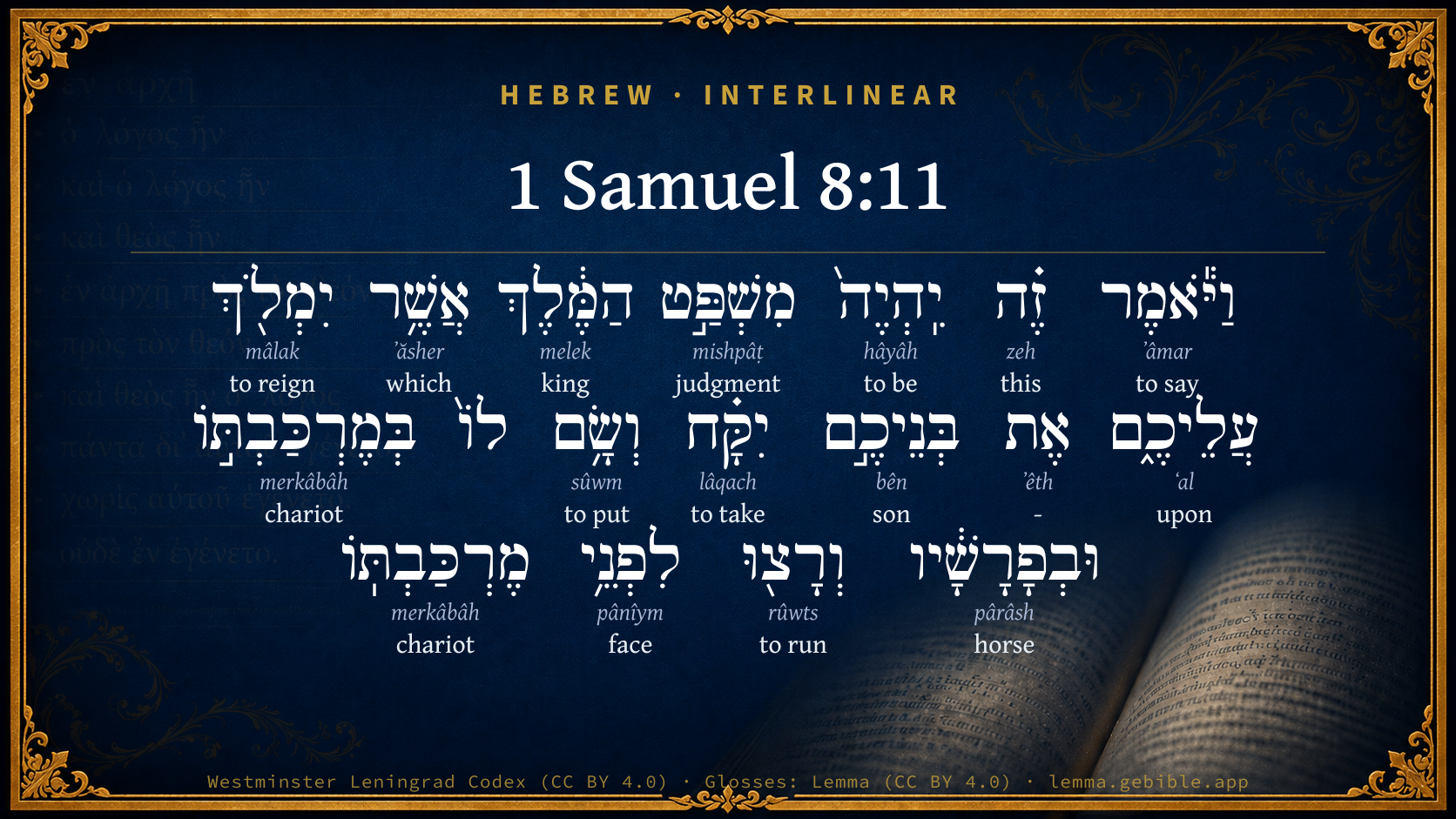
  1. וַיֹּ֕אמֶר ʼâmar H559 “and · to say” Conjunction + Verb, Qal, Sequential Imperfect, 3rd Person, Masculine, Singular
  2. זֶ֗ה zeh H2088 “this” Pronoun, Demonstrative, Masculine, Singular
  3. יִֽהְיֶה֙ hâyâh H1961 “to be” Verb, Qal, Imperfect, 3rd Person, Masculine, Singular
  4. מִשְׁפַּ֣ט mishpâṭ H4941 “judgment of” Noun, Common, Masculine, Singular, Construct
  5. הַמֶּ֔לֶךְ melek H4428 “the · king” Particle, Definite Article + Noun, Common, Masculine, Singular, Absolute
  6. אֲשֶׁ֥ר ʼăsher H834 “which” Particle, Relative
  7. יִמְלֹ֖ךְ mâlak H4427 “to reign” Verb, Qal, Imperfect, 3rd Person, Masculine, Singular
  8. עֲלֵיכֶ֑ם ʻal H5921 “upon · you” Preposition + Suffix, Personal, 2nd Person, Masculine, Plural
  9. אֶת ʼêth H853 “-” Particle, Direct Object
  10. בְּנֵיכֶ֣ם bên H1121 “sons · your” Noun, Common, Masculine, Plural, Construct + Suffix, Personal, 2nd Person, Masculine, Plural
  11. יִקָּ֗ח lâqach H3947 “to take” Verb, Qal, Imperfect, 3rd Person, Masculine, Singular
  12. וְשָׂ֥ם sûwm H7760 “and · to put” Conjunction + Verb, Qal, Sequential Perfect, 3rd Person, Masculine, Singular
  13. וּבְפָרָשָׁ֔יו pârâsh H6571 “and · in/at · horses · his” Conjunction + Preposition + Noun, Common, Masculine, Plural, Construct + Suffix, Personal, 3rd Person, Masculine, Singular
  14. וְרָצ֖וּ rûwts H7323 “and · to run” Conjunction + Verb, Qal, Sequential Perfect, 3rd Person, Common, Plural
  15. לִפְנֵ֥י pânîym H6440 “to/for · face(s) of” Preposition + Noun, Common, Both, Plural, Construct
  16. מֶרְכַּבְתּֽוֹ merkâbâh H4818 “chariot · his” Noun, Common, Feminine, Singular, Construct + Suffix, Personal, 3rd Person, Masculine, Singular

About this verse

These counts appear in no published source. They are computed here, from the morphology-tagged text and Lemma’s own curated glosses. What Lemma adds →

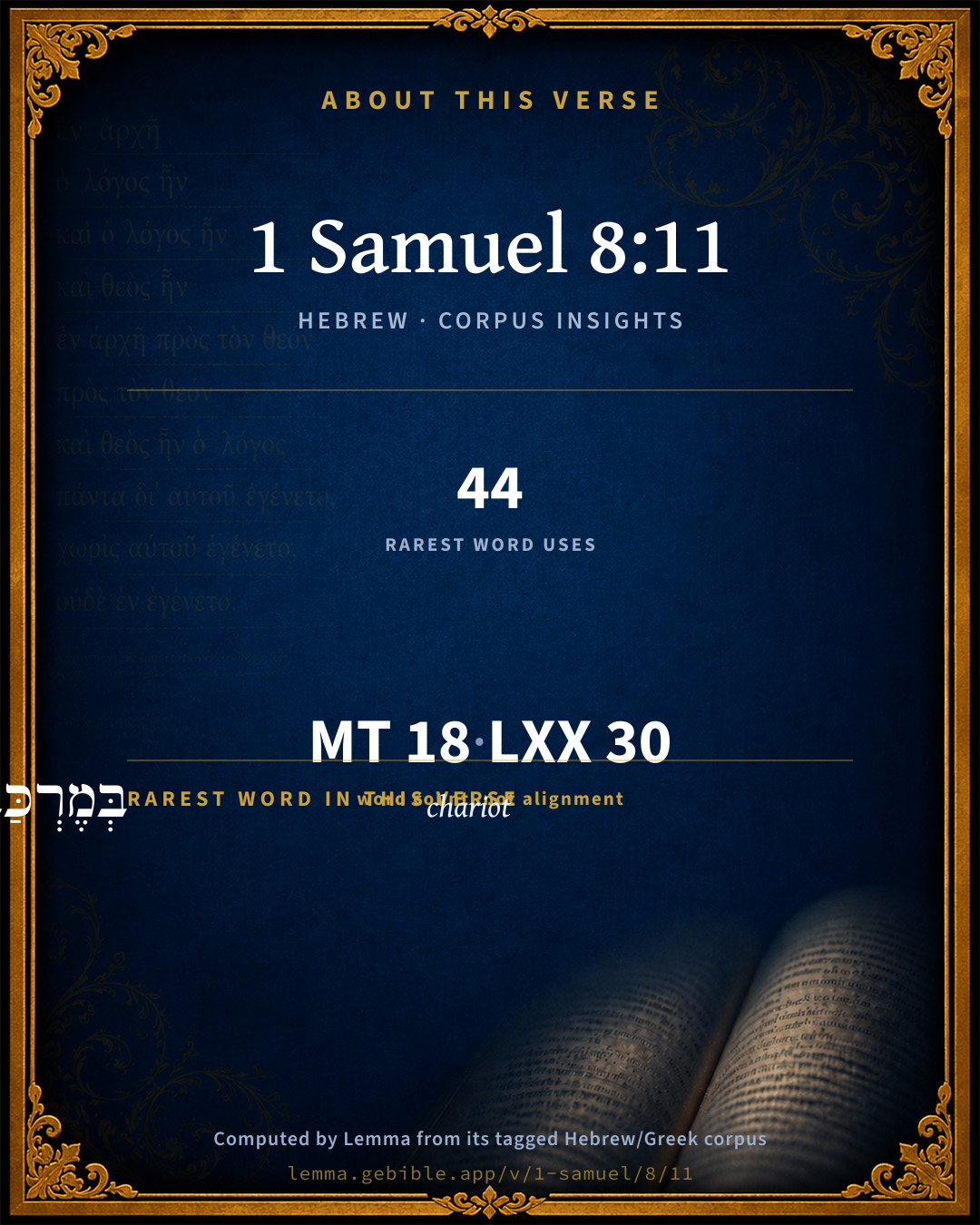
18
words
16
distinct lemmas
Historical
section

Shared distinctive vocabulary

בְּמֶרְכַּבְתּ֣וֹ chariot H4818 occurs in 41 verses of the Hebrew Bible. Also found in:

Grammatical profile

  • 6 verbs
  • 7 nouns
  • 1 pronoun
  • 2 prepositions
  • 2 particles

Verb forms

  • וַיֹּ֕אמֶר Qal · Sequential Imperfect
  • יִֽהְיֶה֙ Qal · Imperfect
  • יִמְלֹ֖ךְ Qal · Imperfect
  • יִקָּ֗ח Qal · Imperfect
  • וְשָׂ֥ם Qal · Sequential Perfect
  • וְרָצ֖וּ Qal · Sequential Perfect

Repetition

A word recurs within this verse — often emphatic in Hebrew:

  • בְּמֶרְכַּבְתּ֣וֹ chariot H4818 ×2

Hebrew & Septuagint length

In English translation the verse runs 40 words from the Hebrew and 36 from the Septuagint (LXX English) — closely comparable.

A rough comparison of the two English renderings, which tokenize alike — not a word-level alignment.

Word counts can differ between the Hebrew and the Greek without any difference in meaning — e.g. the Hebrew direct-object marker אֵת has no separate Greek word, and Greek often adds the article ὁ.

In the original languages it is 18 Hebrew tokens and 30 Greek tokens — but the two are counted differently (Hebrew bundles its prefixes and suffixes into one token; the Greek is in lemma form), so that isn’t a like-for-like length.

Cross-references

11

Topical passages linked to 1 Samuel 8:11 in the Treasury of Scripture Knowledge — connected by theme and wording, ordered by reader-vote popularity; previews shown in the World English Bible.

  • 1 Samuel 14:52 There was sore war against the Philistines all the days of Saul: and when Saul saw any mighty man, or any valiant man, he took him to him.
  • 1 Samuel 10:25 Then Samuel told the people the manner of the kingdom, and wrote it in a book, and laid it up before Yahweh. Samuel sent all the people away, every man to his house.
  • Deuteronomy 17:14–20 When you are come to the land which Yahweh your God gives you, and shall possess it, and shall dwell therein, and shall say, I will set a king over me, like all the nations that are round about me;
  • 2 Samuel 15:1 It happened after this, that Absalom prepared him a chariot and horses, and fifty men to run before him.
  • 1 Kings 10:26 Solomon gathered together chariots and horsemen: and he had a thousand and four hundred chariots, and twelve thousand horsemen, that he bestowed in the chariot cities, and with the king at Jerusalem.
  • 1 Kings 1:5 Then Adonijah the son of Haggith exalted himself, saying, I will be king: and he prepared him chariots and horsemen, and fifty men to run before him.
  • 1 Kings 12:4 Your father made our yoke grievous: now therefore make you the grievous service of your father, and his heavy yoke which he put on us, lighter, and we will serve you.
  • 1 Kings 12:10 The young men who had grown up with him spoke to him, saying, Thus shall you tell this people who spoke to you, saying, Your father made our yoke heavy, but make you it lighter to us; thus shall you speak to them, My little finger is thicker than my father's loins.
  • 1 Kings 18:46 and the hand of Yahweh was on Elijah; and he girded up his loins, and ran before Ahab to the entrance of Jezreel.
  • 2 Chronicles 26:10–15 He built towers in the wilderness, and hewed out many cisterns, for he had much cattle; in the lowland also, and in the plain: [and he had] farmers and vineyard keepers in the mountains and in the fruitful fields; for he loved farming.
  • 1 Kings 9:22–23 But of the children of Israel did Solomon make no bondservants; but they were the men of war, and his servants, and his princes, and his captains, and rulers of his chariots and of his horsemen.

Cross-references courtesy of OpenBible.info (CC BY 4.0).

Hebrew and Greek witnesses Masoretic Hebrew ↔ Greek Septuagint

The same verse in the two great witnesses to the Old Testament, shown verse-for-verse.

These are two independent witnesses, not word-aligned to each other, and the Septuagint is shown in lemma (dictionary) form.

Hebrew 1 Samuel 8:11 Masoretic · Westminster Leningrad Codex

וַיֹּ֕אמֶר זֶ֗ה יִֽהְיֶה֙ מִשְׁפַּ֣ט הַמֶּ֔לֶךְ אֲשֶׁ֥ר יִמְלֹ֖ךְ עֲלֵיכֶ֑ם אֶת בְּנֵיכֶ֣ם יִקָּ֗ח וְשָׂ֥ם לוֹ֙ בְּמֶרְכַּבְתּ֣וֹ וּבְפָרָשָׁ֔יו וְרָצ֖וּ לִפְנֵ֥י מֶרְכַּבְתּֽוֹ

He said, This will be the manner of the king who shall reign over you: he will take your sons, and appoint them to him, for his chariots, and to be his horsemen; and they shall run before his chariots;

World English Bible · Public Domain

Greek LXX 1 Samuel 8:11 Septuagint · lemma form

καί εἶπον οὗτος εἰμί ὁ δικαίωμα ὁ βασιλεύς ὅς βασιλεύω ἐπί σύ ὁ υἱός σύ λαμβάνω καί τίθημι αὐτός ἐν ἅρμα αὐτός καί ἱππεύς αὐτός καί προτρέχω ὁ ἅρμα αὐτός

And he said, This shall be the manner of the king that shall rule over you: he shall take your sons, and put them in his chariots, and among his horsemen, and running before his chariots,

LXX2012 (modern English Septuagint) · Public Domain

Hebrew: Westminster Leningrad Codex (CC BY 4.0). Greek: Septuagint (public domain); English from LXX2012 (modern English Septuagint) (Public Domain). How the Septuagint differs from the Hebrew →

Targum (Aramaic paraphrase)

1

The Targum is the ancient Jewish Aramaic paraphrase of the Hebrew Scriptures — an interpretive translation, not the Hebrew text itself. Onkelos (literal) and Pseudo-Jonathan (expansive) render the Torah, and Jonathan the Prophets. Coverage is partial: where no permissively-licensed English translation exists for a verse, only the Aramaic is shown. This is verse-level text, not a word-by-word alignment to the Hebrew.

  1. Targum Jonathan Prophets (Joshua–Malachi)
    וַאֲמַר דֵין יְהֵי נִימוּסָא דְמַלְכָּא דִי מְלַךְ עֲלֵיכוֹן יַת בְּנֵיכוֹן יַדְבֵּר וִימַנֵי לֵיהּ בִּרְתִיכוֹהִי וּבְפָרָשׁוֹהִי וְרָדְפִין קֳדָם רְתִיכוֹהִי:

    (no public-domain English translation for this verse)

    Targum Jonathan — Aramaic: “Mikraot Gedolot” (public domain). English: “Sefaria Community Translation” (CC0 1.0 (public-domain dedication)); “London "Chaldee Paraphrase," 1871” (public domain). Text via Sefaria.

Commentary

Notes on 1 Samuel 8:11 from classic Christian and Jewish commentators (each source and its license shown beneath its notes). The classic Christian expositions comment on the surrounding passage and are grouped to its opening verse, so a note may address several verses; the Jewish commentaries on the Tanakh (Rashi and others) are per-verse, so they appear only where the commentator wrote on this verse.

Lemma curates 59 commentaries, every one of them public domain or Creative Commons licensed, each selected and text-cleaned for this edition rather than reprinted as found. About our sources →

Trapp's Complete Commentary

John Trapp

1Sa 8:11 And he said, This will be the manner of the king that shall reign over you: He will take your sons, and appoint [them] for himself, for his chariots, and [to be] his horsemen; and [some] shall run before his chariots.

Ver. 11. This will be the manner.] Loquitur hic non tam de iure quam de more. The prophet here speaketh not so much of the office of a king what he ought to be, as of the manner of his rule, and what he is like to be: and it proved accordingly, as they soon found, {1Ki 12:4} and more cause they had afterwards: many of their kings being of Nero’s mind, who ruled by lust, rather than law: and like Constantius, who, commanding certain orthodox bishops to communicate with the Arians, yielded no other but this, Quod ego volo, pro Canone sit; Do as I bid, or get you into banishment. Claudian gave his Honorius better counsel -

“ Tu civem patremque geras, tu consule cunctis,

Non tibi; nec tua te moveant, sed publica damna. ”

He will take your sons.] Perforce, and without any considerable recompense: as the Turk doth at this day.

John Trapp, A Commentary or Exposition upon All the Books of the Old and New Testament (1647–1656) — public domain. Text from a community e-Sword module.

Joseph Benson's Commentary

1Sa 8:11. He will take your sons — Injuriously, and by violence. And appoint them for himself — To attend him as the guards of his body, and in other offices. This shows that he speaks of the arbitrary power which the kings in those days used. And therefore Samuel doth not say absolutely, I will show you the manner (Hebrews משׂפת, mispeth, judgment, or right) of a king, as if it were a right belonging to all kings, but, This will be the manner of the king that shall reign over you: or, such will be the consequence of your having kings. They will indeed be like those of the neighbouring nations, puffed up with their authority, haughty, arbitrary, and tyrannical: and you will find yourselves in a state of oppression and servitude. For his chariots, and to be his horsemen — To look after his chariots and his horses. Some shall run before his chariots — As his footmen.

Joseph Benson's Commentary on the Old and New Testaments (1811–1818) — public domain. Text from a community e-Sword module.

Whedon's Commentary on the Bible

Daniel D. Whedon

11. This will be the manner of the king — משׁפשׂ, judgment, right, claim. The judgment or manner of the king is what he would claim as his prerogative and right. 1Sa_8:11-17 contain a statement of what an eastern king, like those of the nations around Israel, would claim. The items of his claim (which extends both to the persons and properly of his subjects) may be classified thus: 1. Over their persons; to seize them arbitrarily for his court-servants and attendants, (1Sa_8:11,) and appoint them to his military, agricultural mechanical, or domestic service, (1Sa_8:12-13.) 2. Over their property, whether it consist in lands, harvests, slaves, or beasts. 1Sa_8:14-17. Here are presented the main features of an absolute monarchy; but observe, they are set forth as the possible manner or judgment of the king himself, not as divine or God-given rights which every king must claim. In Deu_17:16-20, we learn that the king of Jehovah’s choice must in divers ways be limited in his power.

Daniel D. Whedon (gen. ed.), Commentary on the Old and New Testaments (1874–1909) — public domain. Text from a community e-Sword module.

Tyndale Open Study Notes

Tyndale Open Resources

8:11 While the people wanted a king to judge them, Samuel warned that the king would reign over them. They wanted a leader but received a ruler.

Tyndale Open Study Notes — © Tyndale Open Resources, licensed CC BY-SA 4.0. Text via the HelloAO Bible API.

Geneva Bible (1599)

Geneva Bible translators

Not that kings have this authority by their office, but that such as reign in God’s wrath should usurp this over their brethren, contrary to the law, Deut. 17:20.

Geneva Bible (1599) marginal notes — public domain. Text via Bolls.life.

Jamieson, Fausset & Brown

Robert Jamieson, A. R. Fausset & David Brown

This will be the manner of the king--The following is a very just and graphic picture of the despotic governments which anciently and still are found in the East, and into conformity with which the Hebrew monarchy, notwithstanding the restrictions prescribed by the law, gradually slid.

He will take your sons, and appoint them for himself--Oriental sovereigns claim a right to the services of any of their subjects at pleasure.

some shall run before his chariots--The royal equipages were, generally throughout the East (as in Persia they still are), preceded and accompanied by a number of attendants who ran on foot.

Jamieson, Fausset & Brown — Commentary Critical and Explanatory on the Whole Bible (1871) — public domain (CC PDM 1.0). Text via the HelloAO Bible API.

Ellicott's Commentary for English Readers

(11) And he said, This will be the manner of the king that shall reign over you.—In obedience to the word of the Lord, Samuel, the judge of Israel, without blaming the people for their desire, quietly asks them if they were in real earnest—if they had fully considered the grave changes which such an appointment as that of a sovereign over the nation would bring about in the constitution. Were they willing to exchange their Republican freedom for the condition of subjection to a sovereign who, after the manner of those other kings of foreign nations—the Pharaohs, for instance—would of course govern Israel after his own will? in other words, were they really willing to give up their Republic for a Despotism?

In this whole transaction of the appointment of an earthly king in Israel, we must not forget that although under the present circumstances of Israel it was the best course to pursue, and, as such, received the Divine sanction, yet it was giving up the old grand ideal of a nation dwelling on earth ruled over directly by a King whose throne and home were in the eternal heavens. The glorious hope had to be given up, because Israel had been tried and found unworthy to share in the undreamed-of blessings of such a Government.

He will take your sons.—Here follows a graphic picture of the changed life of the people under a despotic monarch. They must be prepared, must those elders, for a court—a gorgeous court such as they had heard of, and perhaps some of them had seen on the banks of the Nile, the Euphrates, or the Tigris; all that was best and choicest in Israel would be summoned there. The old pastoral life would disappear; the dwelling under their own vines and fig-trees would give place to a very different way of living; the pleasures and vices of a gay and brilliant city life would allure the sons and daughters. and tempt them from the old simple way of living, dear to so many in Israel. War, too, on a scale they hitherto had never dreamed of, would be their portion—all these heavy burdens would become the heritage of Israel if they chose to imitate in their government the nations of the world. Had they thought of all this when they asked for a king?

A Bible Commentary for English Readers, edited by Charles John Ellicott (1878–1897) — public domain. Text from a community e-Sword module.

The Cambridge Bible for Schools and Colleges

gen. ed. J. J. S. Perowne

11. This will be the manner of the king] Or, “the right of the king;” such prerogatives as an absolute monarch claims.

We have here a vivid picture of the tyranny of an Oriental despot whose subjects are at his disposal for (1) court retainers, (2) military officers, (3) cultivators of the royal estates, (4) artificers in the arsenal, (5) domestics in the royal household. (6) Their property is liable to arbitrary seizure, beside (7) regular exactions of tithe, in order to enrich court favourites, and (8) their slaves and their cattle may at any time be pressed into the royal service. Under such a despotism political and social freedom is at an end. Prosperous as was Solomon’s reign, it tended in this direction. See 1Ki_5:13-18; 1Ki_12:4.

and appoint them] This may be rendered either as the E. V. or, and set them for himself upon his charlots and upon his chargers. Service in the retinue of the king rather than in the army appears to be meant.

some shall run before his chariots] A body of runners was a regular sign of regal state (2Sa_15:1; 1Ki_1:5).

The Cambridge Bible for Schools and Colleges (gen. ed. J. J. S. Perowne; Cambridge University Press, 1878–1918) — public domain. Text from a community e-Sword module.

John Gill's Exposition

And he said, this will be the manner of the king that shall reign over you,.... Not in which he ought to proceed, but what he will do: and this not the manner of one king, or of the first only, but of all of them, more or less; of kings in general, who are commonly inclined to arbitrary power. So Aristotle (a) in opposition to theocracy, describes a full and absolute kingdom, as he calls it, when a king does all things according to his will: and observes, that he that would have the mind or reason preside, would have God and the laws rule; but he that would have a man to reign, adds also a lust, or one led by his own lust: so it follows:

he will take your sons, and appoint them for himself; for his own use and service, to wait upon him, to be his pages, or grooms, or guards:

for his chariots; to take care of them, and drive them, though not without paying them for it; yet this being but a mean and servile employment, and what they should be obliged to, whether they would or no, is observed to show the tyranny and bondage to which they would be subject, when their sons otherwise might be free men, and possessed of estates and carriages of their own:

and to be his horsemen; or rather "for his horses", to take care of them, and go out along with him, and attend his person, whether when going to war, or on pleasure:

and some shall run before his chariots; be his running footmen, being swift of foot, and trained up for that service; some are naturally swift, as Asahel was Sa2 2:18. Pliny (b) speaks of some swifter than horses; and of the swiftness of some he elsewhere gives (c) many surprising instances. It seems as if it was usual to have fifty such men to run before them, see Sa2 15:1.

(a) In Politicis, l. 3. c. 16. (b) Nat. Hist. l. 7. c. 2. (c) Ibid. c. 20.

John Gill's Exposition of the Whole Bible (1746–1763) — public domain (CC PDM 1.0). Text via the HelloAO Bible API.

Haydock's Catholic Bible Commentary

Chariots; to be drivers, (Menochius) or will make them fight from them. --- Footmen, or guards. Xenophon places 4000 armed with bucklers before, and 2000 with lances all round the chariot of Cyrus. See chap. xxii. 17.

George Leo Haydock (1774–1849), Haydock's Catholic Family Bible and Commentary, 1859 edition — public domain. Excludes Psalms (Douay-Rheims chapter numbering differs from Protestant) and Deuterocanonical books (Catholic canon only).

Matthew Poole's English Annotations

He will take your sons, to wit, injuriously and by violence, as this Hebrew word is oft used, as Gen 20:3; 27:36; Job 5:5; and so it must be here; because otherwise the king would have no more privilege than any of his subjects; for any man might take a son with his own or parents’ consent.

And to be his horsemen, or, and for his horses; for so the Hebrew word parash sometimes signifies, as Isa 21:7,9; 28:28; to ride his horses.

Matthew Poole's English Annotations on the Holy Bible (1683–1685) — public domain. Text from a community e-Sword/MySword module.

The Pulpit Commentary

This will be the manner of the king. On the meaning of this word see 1Sa_2:13. Here also it signifies not so much the legal right itself, as the way in which that right was exercised. His chariots. The word is singular, both here and at the end of the verse, and though it may be taken, as in the A.V, for a collective noun, "his chariotry," yet the singular is better, because this verse does not refer to war, but to the personal magnificence and grandeur of the king. Instead of the old simplicity in which the judges had lived, he would have a state chariot, (see 2Ki_9:21) and go forth escorted by horsemen and runners on foot. To be his horsemen. Rather, "upon his homes." The whole clause should be translated, "And he will set them for him (i.e. for his service) upon his chariot and on his horses; and they will run before his chariot."

The Pulpit Commentary (1880–1919), ed. H.D.M. Spence-Jones & Joseph S. Exell — public domain. Text from a community e-Sword module.

John Wesley's Explanatory Notes

Will take - Injuriously and by violence.

John Wesley, Explanatory Notes Upon the Whole Bible (1754–1765) — public domain. Text via the GEBible commentary corpus.

Lesson kit

Teaching starters — assembled from the data on this page, not authored interpretation. Every prompt links to the verse data it draws on. Edit before teaching.

1 Samuel, in the Historical, opens this verse with 18 words (16 distinct Hebrew lemmas). Its most distinctive word is merkâbâh (“chariot”). A historical commentator’s framing appears above. Read the whole chapter for the surrounding context.

Discussion questions

  1. How does “chariot” (merkâbâh) shape what this verse is saying?
  2. Genesis 41:43 shares the word «chariot» with this verse. How do the two illuminate each other?
  3. “chariot” occurs 2× in this one verse. What is the effect of the repetition?
  4. These translations render this verse differently; the difference is in the English rendering, not the original. What questions does that raise?
  5. The verb «וַיֹּ֕אמֶר» is Qal Sequential Imperfect. How does its form color the action?
  6. Reading how Trapp's Complete Commentary and Joseph Benson's Commentary read this verse, where do the two commentators agree and where do they part?

Things to notice

Reading settings

Reading text

Shown beneath each verse's original-language words.

Old Testament
Old Testament edition

Read the OT as the Masoretic Hebrew (MT) or the Greek Septuagint (LXX).

English shown for the Greek Septuagint (in the Hebrew ↔ Greek comparison).

Comparing translations? Open the Compare panel on any verse page to stack up to four side by side.