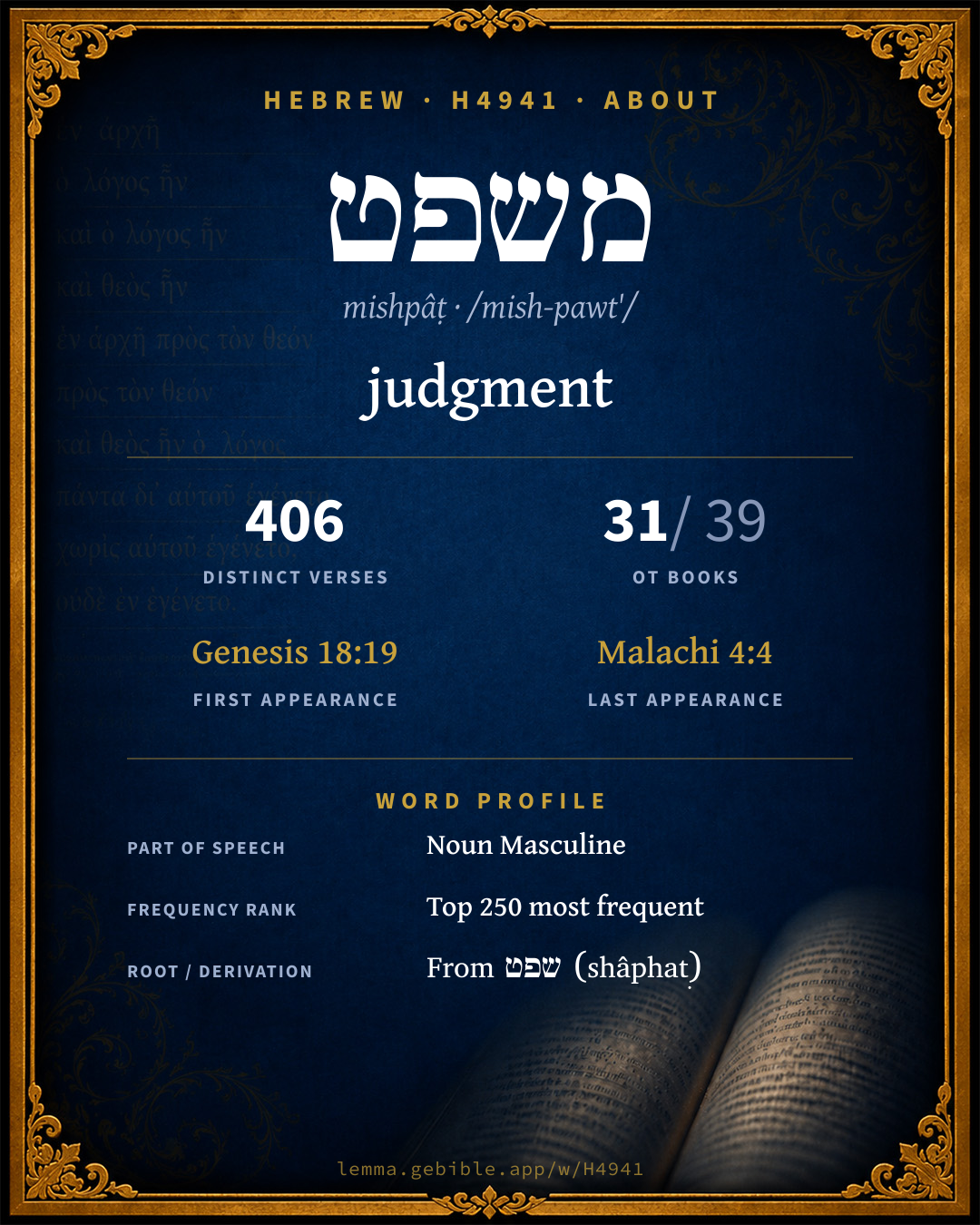
מִשְׁפָּט
judgment
also: justice, ordinance fuller range ↓
Full lexicon entry — Brown-Driver-Briggs (BDB)
From Brown-Driver-Briggs (BDB)
Where this word appears
See every Absolute-state word in the Hebrew Bible →
Grammar key — what these labels mean
Part of speech
- Noun
- A naming word — a person, place, thing, or idea.
Noun type
- Common
- A common noun — a general class of person, place, or thing (“king,” “city,” “water”), not a specific name.
State
- Absolute
- The independent form of a noun, not bound to a following word.
- Construct
- A noun bound to a following noun in a possessive / “of” relationship (the construct chain).
Gender
- Masculine
- Grammatically masculine.
Number
- Singular
- One.
- Plural
- More than one (in Hebrew, generally three or more).
Every verse where H4941 appears in the Book of Job — 23 distinct verses. Click any verse to open its interlinear word-by-word view. Verse text shown in the World English Bible for context — . Each verse’s Hebrew form is shown with its reference; the English is not keyword-highlighted, since the data carries no word-level English alignment. Use “Compare translations” on any verse to read it across multiple English versions. This concordance covers the Hebrew Bible; Septuagint (Greek Old Testament) occurrences are not indexed here.
Job
- Job 8:3 מִשְׁפָּ֑ט n c ms Does God pervert justice? Or does the Almighty pervert righteousness?
- Job 9:19 לְ֝/מִשְׁפָּ֗ט prep + n c ms If it is a matter of strength, behold, he is mighty! If of justice, 'Who,' says he, 'will summon me?'
- Job 9:32 בַּ/מִּשְׁפָּֽט prep det + n c ms For he is not a man, as I am, that I should answer him, That we should come together in judgment.
- Job 13:18 מִשְׁפָּ֑ט n c ms See now, I have set my cause in order. I know that I am righteous.
- Job 14:3 בְ/מִשְׁפָּ֣ט prep + n c ms Do you open your eyes on such a one, And bring me into judgment with you?
- Job 19:7 מִשְׁפָּֽט n c ms "Behold, I cry out of wrong, but I am not heard: I cry for help, but there is no justice.
- Job 22:4 בַּ/מִּשְׁפָּֽט prep det + n c ms Is it for your piety that he reproves you, That he enters with you into judgment?
- Job 23:4 מִשְׁפָּ֑ט n c ms I would set my cause in order before him, And fill my mouth with arguments.
- Job 27:2 מִשְׁפָּטִ֑/י n c ms cs + sfx pers 1cs "As God lives, who has taken away my right, The Almighty, who has made my soul bitter.
- Job 29:14 מִשְׁפָּטִֽ/י n c ms cs + sfx pers 1cs I put on righteousness, and it clothed me. My justice was as a robe and a diadem.
- Job 31:13 מִשְׁפַּ֣ט n c ms cs "If I have despised the cause of my man-servant Or of my maid-servant, When they contended with me;
- Job 32:9 מִשְׁפָּֽט n c ms It is not the great who are wise, Nor the aged who understand justice.
- Job 34:4 מִשְׁפָּ֥ט n c ms Let us choose for us that which is right. Let us know among ourselves what is good.
- Job 34:5 מִשְׁפָּטִֽ/י n c ms cs + sfx pers 1cs For Job has said, 'I am righteous, God has taken away my right:
- Job 34:6 מִשְׁפָּטִ֥/י n c ms cs + sfx pers 1cs Notwithstanding my right I am considered a liar; My wound is incurable, though I am without disobedience.'
- Job 34:12 מִשְׁפָּֽט n c ms Yes surely, God will not do wickedly, Neither will the Almighty pervert justice.
- Job 34:17 מִשְׁפָּ֣ט n c ms Shall even one who hates justice govern? Will you condemn him who is righteous and mighty?--
- Job 34:23 בַּ/מִּשְׁפָּֽט prep det + n c ms For he doesn't need to consider a man further, That he should go before God in judgment.
- Job 35:2 לְ/מִשְׁפָּ֑ט prep + n c ms "Do you think this to be your right, Or do you say, 'My righteousness is more than God's,'
- Job 36:6 וּ/מִשְׁפַּ֖ט conj + n c ms cs He doesn't preserve the life of the wicked, But gives to the afflicted their right.
- Job 36:17 וּ/מִשְׁפָּ֣ט conj + n c ms "But you are full of the judgment of the wicked. Judgment and justice take hold of you.
- Job 37:23 וּ/מִשְׁפָּ֥ט conj + n c ms We can't reach the Almighty, He is exalted in power; In justice and great righteousness he will not oppress.
- Job 40:8 מִשְׁפָּטִ֑/י n c ms cs + sfx pers 1cs Will you even annul my judgment? Will you condemn me, that you may be justified?
About this entry
At a glance — auto-summarized from this page’s data, not written by a person. Every figure links to its source below. This summary describes the numbers; it doesn’t interpret them.
“judgment” is the headline sense of the Hebrew noun משפט (mishpâṭ). Older and newer Bibles part ways — “judgment” in the King James Version, “justice” (Berean Standard Bible) in modern versions. See the renderings breakdown. It appears 406 verses across 31 books of the Hebrew Bible, among its common vocabulary. Scripture first uses it in Genesis 18:19. Not a single-sense word: its full sense range also takes in “justice” and “ordinance”. See the sense tree, 406-verse concordance, and the renderings breakdown below.
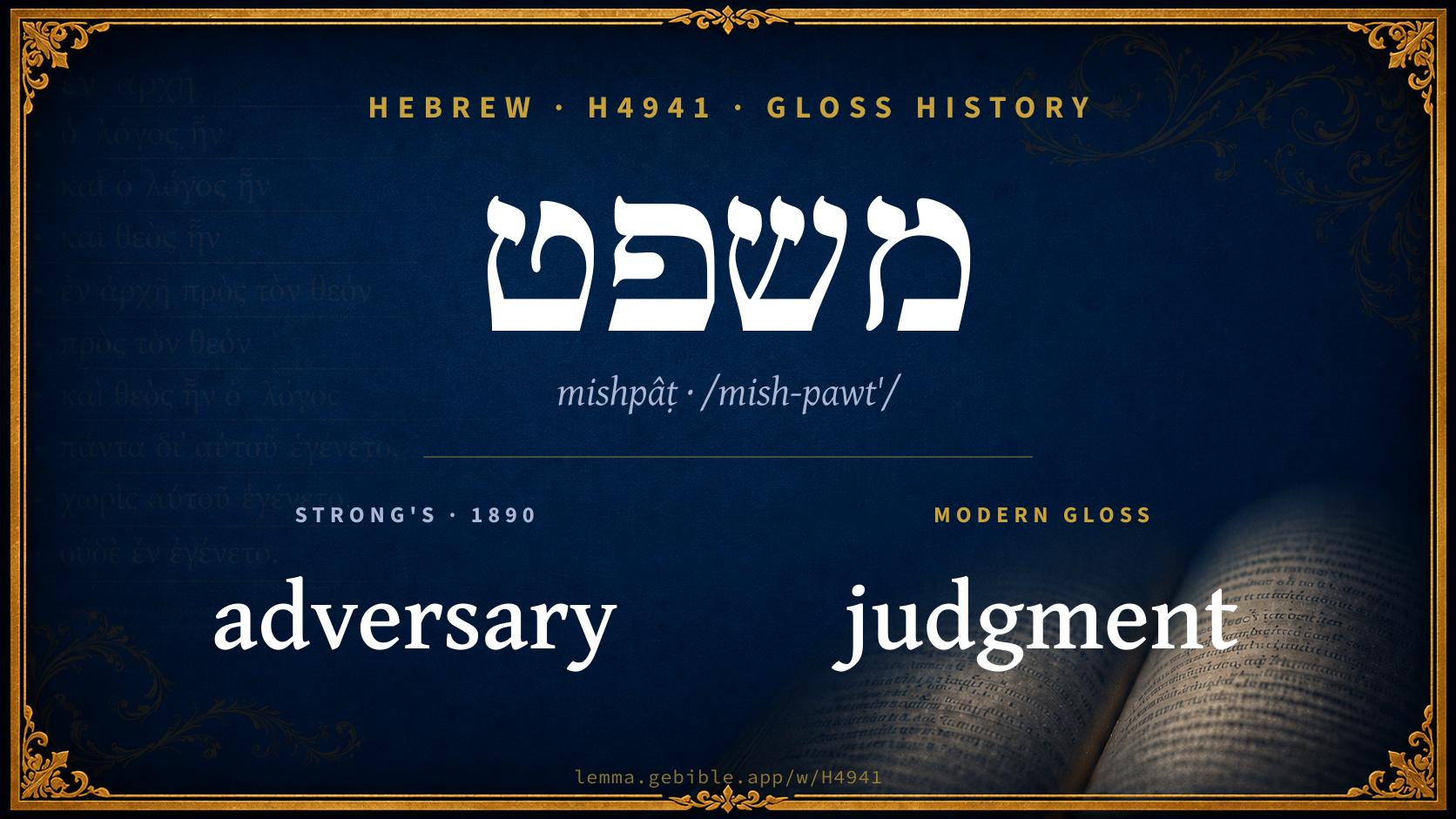
Gloss history
Strong's 1890 vs modern scholarship
About this word
Strong's H4941 catalogs a Hebrew word from the Hebrew Old Testament.
These counts are not copied from any lexicon or concordance. They are computed here, from the morphology-tagged Hebrew Old Testament. What Lemma adds →
- 406
- distinct verses
- The word appears in 406 distinct verses.
- 31 / 39
- OT books
- The word appears in 31 of 39 Old Testament books.
- #115
- by frequency
- Top 250 most frequent Hebrew words (rank 115 of 8,640 Hebrew words by occurrence).
View all 406 occurrences in the concordance →
By section of the Old Testament
By traditional corpus
Conventional, traditional groupings — biblical authorship is debated, so this is a traditional corpus grouping, not an authorship claim. Each share is this word’s portion of its verses in that division of the Hebrew canon. Each figure is a share of the word’s 406 distinct verses.
- Prophets (Nevi'im) 179 verses · 44%
- Writings (Ketuvim) 145 verses · 36%
- Torah (Pentateuch) 82 verses · 20%
How translations render this word
Counts come from each version’s own published word-to-Strong’s tagging or interlinear alignment — an approximate guide to how each version renders this word, not a word-level alignment the data otherwise carries. Because each total is that version’s own tagged count, the per-version totals vary from one another and need not match the appearance or distinct-verse counts above. These counts may also differ from a printed concordance because Lemma counts each distinctly tagged rendering and does not collapse phrase taggings into a single head-word total. This is a fixed set of word-tagged versions (KJV, ASV, BSB, ULT) and does not change with the reading translation you choose elsewhere. Each version’s license is shown beside its name below (and on Sources).
- King James Version: Judgment 166×, Judgments 91×, After the manner 14×
- American Standard Version: Justice 77×, Ordinances 72×, Judgment 56×
- Berean Standard Bible: Justice 109×, Ordinances 69×, Judgment 40×
- unfoldingWord Literal Text: Justice 125×, Judgment 67×, Judgments 54×
King James Version Public Domain
Renders H4941 across 419 tagged occurrences — most commonly:
Plus other, less common renderings. Plus 77 renderings that appear only once — usually multi-word phrases or single function words the recovered tagging swept in, not distinct renderings. Not rendered by a distinct English word in 2 further occurrences.
American Standard Version Public Domain
Renders H4941 across 413 tagged occurrences — most commonly:
Plus other, less common renderings. Plus 101 renderings that appear only once — usually multi-word phrases or single function words the recovered tagging swept in, not distinct renderings.
Berean Standard Bible Public Domain
Renders H4941 across 406 tagged occurrences — most commonly:
Plus other, less common renderings. Plus 59 renderings that appear only once — usually multi-word phrases or single function words the recovered tagging swept in, not distinct renderings. Not rendered by a distinct English word in 4 further occurrences.
unfoldingWord Literal Text CC BY-SA 4.0
Renders H4941 across 435 tagged occurrences — most commonly:
Plus other, less common renderings. Plus 53 renderings that appear only once — usually multi-word phrases or single function words the recovered tagging swept in, not distinct renderings.
18 senses and sub-senses in the full BDB
What do BDB’s symbols mean?
BDB uses these scholarly abbreviations:
| Symbol | Meaning |
|---|---|
| 𝔊 | the Septuagint (the ancient Greek translation, LXX) |
| 𝔙 | the Vulgate (the Latin translation) |
| 𝔖 | the Syriac version (the Peshitta) |
| 𝔗 | the Targum (the Aramaic translation) |
| ψ | the Psalms |
| √ | root (the underlying root or stem) |
| ‖ | parallel passage (a synonymous or contrasted parallel) |
| † | the dagger: every passage where the word occurs is cited |
The 18 senses and sub-senses the full Brown-Driver-Briggs lexicon distinguishes for this word, in lexicon order (not ranked by frequency), with BDB’s own verbatim wording and sub-sense lettering. Shown in Hebrew script with BDB’s own scholarly abbreviations. The condensed entry is in the Lexicon Entry tab. See also the Forms in the corpus table below.
- 1. judgment:
- a. act of deciding a case: מ׳ belongeth to God Dt 1:17, is from him Pr 16:33; 29:26; אֱלֹהֵי הַמּ׳ Mal 2:17; חשֶׁן מ׳ Ex 28:15 the pouch of judgment, so v 29, 30 (P); worn on heart of Aaron v 30 (P); מ׳ צֶדֶק Dt 16:18; הֵבִין מ׳ Jb 32:9; שׁפט מ׳ 1 K 3:28; עשׂה מ׳ 1 K 3:28; דְּבַר (ה)מ׳ Dt 17:9; 2 Ch 19:6; רוח מ׳ Is 28:6; במשׁפט Lv 19:15, 35 (H) Dt 1:17; Pr 16:10; 24:23; במ׳ האורים Nu 27:21 (P); למשׁפט 35:12 Jos 20:6 (P) Dt 17:8; Ju 4:5; 2 S 15:2, 6; 2 Ch 19:8; Is 34:5; 41:1; 54:17; 59:11; Hb 1:12; Mal 3:5 ψ 9:8; 35:23; 76:10; 122:5; Jb 9:19 (Ez 44:24 v. supr.). e.g. Deuteronomy 1:17
- b. place, court, seat of judgment Dt 25:1; 1 K 7:7; Is 28:6; Ec 3:16. e.g. Deuteronomy 25:1
- c. process, procedure, litigation before judges: הֵבִיא במ׳ Jb 14:3; Ec 11:9; 12:14; בא במ׳, c. עם Is 3:14; Jb 22:4, c. את ψ 143:2, c. יחדו Jb 9:32, הלך במ׳ Jb 34:23, cf. Ez 34:16 ψ 112:5; pl. דבּר משׁפטים, c. את litigate with Je 1:16; 4:12; 12:1; 39:5 = 52:9, sg. מִשְׁפָּט in ‖ 2 K 25:6, by error. e.g. Job 14:3
- d. case or cause presented for judgment: בעל מ׳ Is 50:8; ערךְ מ׳ Jb 13:18; 23:4; שׁמע מ׳ 1 K 3:11; שׁפט מ׳ La 3:59, cf. Nu 27:5 (P) 2 S 15:4. e.g. Isaiah 50:8
- e. sentence, decision of judgment: כן משׁפטךָ 1 K 20:40 thus is thy sentence; עת ומ׳ Ec 8:5, 6 time and sentence; על מ׳ Dt 17:11 according to the sentence; מ׳ מָוֶת 19:6; 21:22; Je 26:11, 16; מ׳ דמים Ez 7:23, cf. Hb 1:4(×2) ψ 7:7; 17:2; Ez 23:45; pl. only Ez 16:38 משׁפטֵי נאפות; Ho 6:5 read sg. מִשְׁפָּטִי כָאוֹר for מִשְׁפָּטֶיךָ אוֹר after 𝔊 𝔖 𝔗 Ew Hi Che; cf. Hos 5:1. e.g. 1 Kings 20:40
- f. execution of judgment, in gen., עשׂה מ׳, c. בֵּין Je 7:5; Ez 18:8, cf. Dt 32:41; Zp 3:8; c. בְּ against ψ 119:84; 149:9; ב om. 9:17; Ez 39:21, מ׳ בא אל Je 48:21, ברוח מ׳ Is 4:4, מ׳ מואב Je 48:47, cf. Is 53:8; Je 51:9; Ho 5:1, 11; 10:4; Jb 36:17; pl. Is 26:8, 9; Ez 5:8; Zp 3:15 ψ 10:5; in favour of, עשׂה משׁפטִי Mi 7:9 ψ 9:5; מ׳ לעשׁוקים 146:7; דין מ׳ והציל Je 21:12, cf. Zc 7:9; 8:16; pl. ψ 48:12 = 97:8; 103:6; 105:5, 7 = 1 Ch 16:12, 14. e.g. Jeremiah 7:5
- g. time of judgment, לא יקומו במ׳ ψ 1:5 (late; prob. judgment of the resurrection). e.g. Psalms 1:5
- 2. attribute of the שֹׁפֵט, justice, right, rectitude:
- a. of God, אלהי מ׳ Is 30:18; הֲשֹׁפֵט כָּל־הָאָרֶץ לֹא יַעֲשֶׂה מ׳ Gn 18:25 (J), cf. Jb 40:8; Dt 32:4 ψ 111:7; he loves it 33:5; 37:28; 99:4; צדק ומ׳ Ho 2:21 ψ 89:15 = 97:2; will not pervert it Jb 8:3; 34:12, cf. 37:23; כמשׁפטךָ ψ 119:149 (‖חסדךָ); מִשְׁפָּֽטְךָ תְּהוֹם רַבָּה 36:7 (read sg.). e.g. Isaiah 30:18
- b. of man: אַשְׁרֵי שֹׁמְרֵי מ׳ ψ 106:3 (‖צדקה); the tongue of the wise speaketh מ׳ 37:30; so of thoughts מ׳ Pr 12:5; put on מ׳ as robe Jb 29:14, chosen 34:4; עשׂה מ׳: God requires that man should do it Mi 6:8; Is 1:17; 56:1, cf. 61:8; it is the joy of the righteous Pr 21:15; rulers should know it Mi 3:1, cf. Pr 29:4; wicked ruler שׂוֹנֵא מ׳ Jb 34:17; abhors it Mi 3:9, cf. Pr 19:28; 21:7; 28:5. e.g. Psalms 106:3
- 3. ordinance promulgated by שֹׁפֵט: 1 S 8:9, 11; 10:25 (law of king); Levit. ordinances Lv 5:10; 9:16 + 13 times P, 1 Ch 15:13; 24:19 2 Ch 4:7, 20; 8:14; 35:13; Ne 8:18; חק ומ׳ Ex 15:25; Jos 24:25 (E) 1 S 30:25, cf. ψ 81:5; חקת מ׳ Nu 27:11; 35:29 (P); divine law in gen. מ׳ יהוה Je 8:7; מ׳ אלהים Is 58:2; Je 5:4, 5 (‖ דֶּרֶךְ), cf. ψ 25:9; ‖ תורה Is 42:4; 51:4; Ezr 7:10; cf. Zp 2:3 ψ 119:43, 160; pl. of particular ordinances Dt 33:10, 21 (poem), Is 58:2; Ez 44:24 ψ 19:10; 119:7 + 16 times, 147:20. e.g. 1 Samuel 8:9
- 4. decision of the שֹׁפֵט in a case of law (v. BrHex. 252 sq.): sg. of particular decision of a case Ex 21:31 (E); pl. of series of decisions 21:1; 24:3 (JE) Dt 7:12 (D2); in covt. code and D, collection of pentades in conditional or temp. cl., c. כּי or אם in D, and subj. in combination, חקים ומשׁפטים 4:1, 5, 8, 14, 45 +; in code of H and after, in combin. חקות ומשׁפטים, Lv 18:4, 5, 26; 19:37 +; (the specific type of these laws in H is אִישׁ כִּי, over against נפשׁ כי or אדם כי in code of P, v. BrHex. 254 f.); other combin., redactional and later, Lv 26:16; Nu 36:13; Dt 30:16; 2 K 17:37; 2 Ch 33:8; Ne 9:13 ψ 18:23; 89:31; 147:19. e.g. Exodus 21:31
- 5. one’s (legal) right, privilege, due: מ׳ הַכֹּהֲנִים Dt 18:3 due of the priests, מ׳ הַבְּכֹרָה 21:17; מ׳ הַגְּאֻלָּה Je 32:7 right of redemption; מ׳ הַיְרֻשָּׁה v 8; הִטָּה מ׳ Ex 23:6 (E) wrest right, so Dt 16:19; 23:6; 24:17; 27:19; 1 S 8:3; La 3:35, cf. Pr 18:5; מ׳ יְתוֹם Dt 10:18; מ׳ אביון Ex 23:6 (E) Je 5:28 ψ 140:13; מ׳ עניים Is 10:2; Jb 36:6; הסיר מ׳ 27:2; 34:5, cf. Is 40:27; 49:4. e.g. Deuteronomy 18:3
- 6.
- a. proper, fitting, measure 1 K 5:8; fitness Is 28:26; 40:14 (of fitness in the order of nature; cf. Di). e.g. 1 Kings 5:8
- b. custom, manner: מ׳ הכהנים 1 S 2:13 custom of the priests (rightful due, according to Th We Dr and most); מִשְׁפָּטוֹ 27:11 his (David’s) custom; מ׳ הגוים 2 K 17:33 manner of the nations, cf. 2 K 17:26, 27 (RSSem. 1, 24, 2nd ed. 23); כמ׳ after the manner, custom, fashion (of) Gn 40:13; Ex 21:9 (E) Ju 18:7; 1 K 18:28; 2 K 11:14; 17:34; 1 Ch 6:17; Ez 42:11 ψ 119:132. e.g. 1 Samuel 2:13
- c. מה משׁפט Ju 13:12 what manner of a boy, cf. 2 K 1:7. e.g. Judges 13:12
- d. . plan … of the tabernacle Ex 26:30 (P); temple 1 K 6:38; palace Je 30:18. e.g. Exodus 26:30
Senses from the full Brown-Driver-Briggs lexicon (Brown, Driver, Briggs; Oxford 1906 — public domain), digitized via Sefaria, supplemented by the OpenScriptures HebrewLexicon (CC BY 4.0). Full attribution on Sources.
Word origin
n.m. Gn 40:13 judgment;—abs. מִשְׁפָּט Ex 21:31 + 203 times, + לְ ִ֯שְׁפָּט Ez 44:24 (but read Kt לִשְׁפֹּט with 𝔊 𝔗 𝔖 Co al.); cstr. מִשְׁפַּט Ex 23:6 + 50 times; sf. מִשְׁפָּטִי Is 40:27 +; מִשְׁפָּטָם Je 49:12 +; מִשְׁפָּטָן Nu 27:5; pl. מִשְׁפָּטִים Je 4:12 + 34 times; sf. מִשְׁפָּטֶיךָ Dt 33:10 +, etc.;—
— Brown-Driver-Briggs (Oxford 1906, public domain), digitized via Sefaria, supplemented by the OpenScriptures HebrewLexicon (CC BY 4.0). See Sources.
Derived from שפט (shâphaṭ) (H8199) — to judge.
Jastrow Dictionary
A second Hebrew/Aramaic lexicon for comparison, covering Aramaic and post-biblical (Talmudic, Targumic, Midrashic) usage that the biblical-Hebrew BDB does not. Matched by lemma rather than by Strong’s number, so a lemma may carry more than one Jastrow headword (shown separately below), and the entries cover usage well beyond the Bible.
מִשְׁפָּט
- sentence, judgment; justice, law. Meg. 21ᵃ top; Snh. 11ᵇ מה מ׳ ביום וכ׳ as sentence can be passed in day-time only &c. Eduy. II, 10 מִשְׁפַּט רשעים וכ׳ the judgment (punishment) of the wicked in Gehenna lasts twelve months. Tanḥ. Mishp. 1 בעל זרוע אינו רוצה לעשות דבריו במ׳ אלא מעביר על המ׳ a man of might does not care to act according to law, but ignores the law; a. fr.—Pl. מִשְׁפָּטִים. Ex. R. s. 30 על ידי המ׳ שנתת להם וכ׳ through the laws which thou hast given to them, they, having a dispute with one another, go to law and make peace. Ib. בבקר ניתנה התורה … נתנו המ׳ in the morning the Law (religious principles) was given, and in the evening the civil law (Ex. XXI, sq.). Midr. Till. to Ps. XXXVI אין קצבה למ׳ וכ׳ there is no limit to the judgments for the wicked; a. fr.—Mishpatim, name of a Scriptural lesson of a week (Ex. XXI, 1 to XXIV, 18). e.g. Exodus 21:1
A Dictionary of the Targumim, the Talmud Babli and Yerushalmi, and the Midrashic Literature (Marcus Jastrow; London, Luzac, 1903) — Public Domain. Digitized via Sefaria. Digitized via Sefaria. Full attribution on Sources.
Forms in the corpus
The 205 distinct written forms H4941 takes in the Hebrew Bible, most frequent first — each parse links to that state’s occurrences in the concordance. Hebrew forms include their vowel points and cantillation, so a single lemma takes many written forms.
The 60 most common forms are shown; 145 rarer forms follow in the full concordance.
Same root — word family
Other BDB entries built from the same root as H4941, grouped by Strong’s listed origin. These share a root / origin per the lexicon — not necessarily a shared meaning. Each links to that word’s own entry.
Derives from
Shares the same root
- שפוט shᵉphôwṭ H8196 judgment
- שפט shᵉphaṭ H8200 to judge
- שפט shepheṭ H8201 judgment
- תפתי tiphtay H8614 magistrate
Proper names from this root
People and places named from this root — a name, not an additional meaning of the word.
Compare all same-root words → Showing 4 of 9 — not the complete family. 3 of the same-root words are proper names (people or places). They share a root, not necessarily a meaning.
Septuagint verse parallels
This word appears in 360 verses that also exist in the Greek Old Testament (Septuagint), out of the 406 Hebrew verses it occurs in. You can read those verses in Greek by switching the Old Testament edition to the Septuagint.
Read these verses in the Septuagint
- Genesis 18:19
- Exodus 15:25
- Leviticus 5:10
- Numbers 9:3
- Deuteronomy 1:17
- Joshua 6:15
- Judges 4:5
- 1 Samuel 2:13
- 2 Samuel 8:15
- 1 Kings 2:3
- 2 Kings 1:7
- 1 Chronicles 6:32
This is a verse-level parallel only — the same verses exist in both the Hebrew and Greek Old Testaments. No word-level Hebrew↔Greek correspondence is claimed: the data carries no such alignment, so no Greek word is shown as this Hebrew word’s translation. Coverage is not total — the Septuagint omits the deuterocanon and renumbers the Psalms, so some Hebrew verses have no direct Greek parallel.