
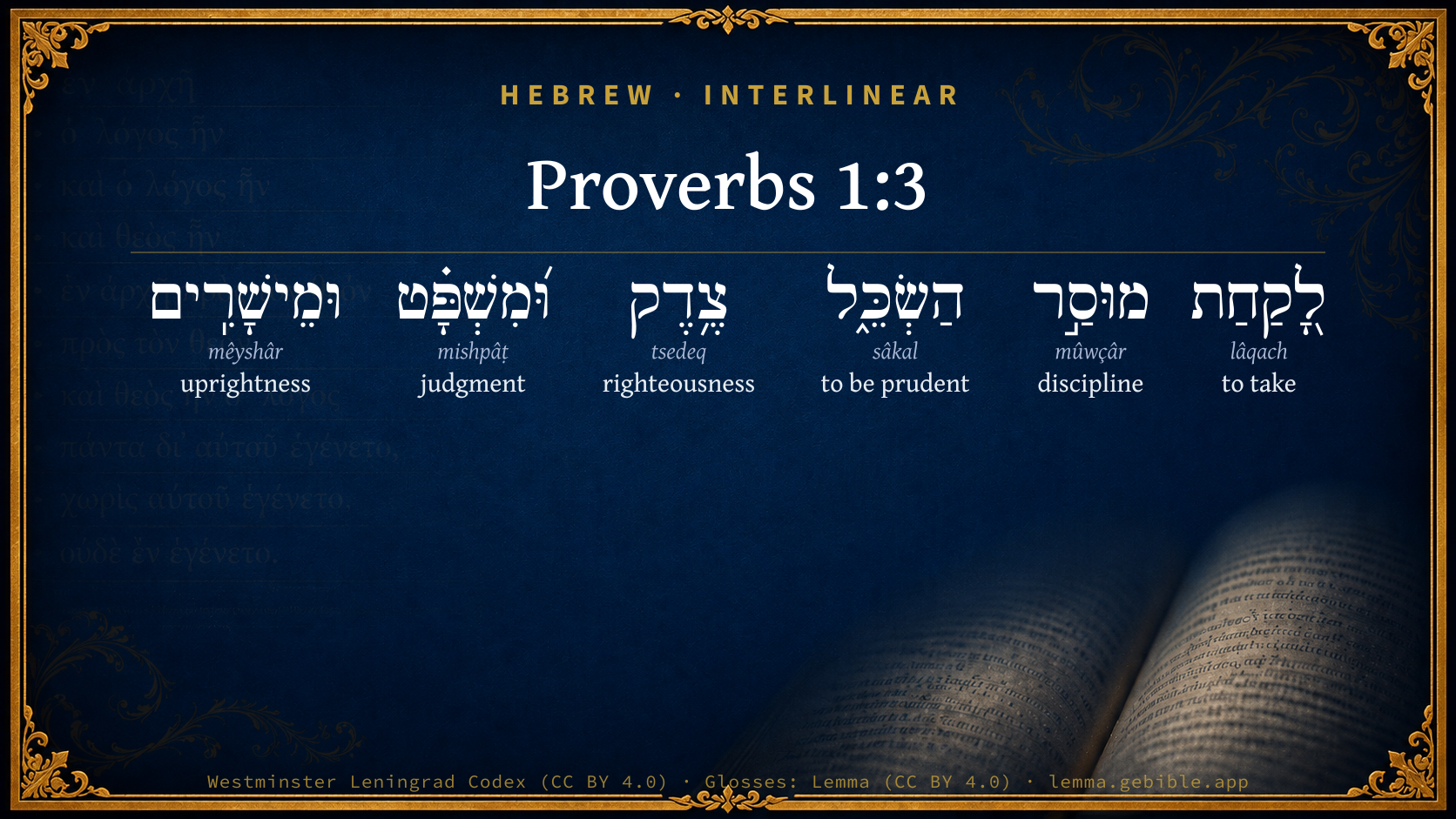
Proverbs 1:3

Hebrew (Westminster Leningrad Codex) Proverbs 1:3 appears in the Hebrew Old Testament. The text above is from the Westminster Leningrad Codex. Each word links to its Strong’s number, a concise gloss, and parsing drawn from the Open Scriptures Hebrew Bible morphology. Click any word for its full Brown-Driver-Briggs (BDB) entry.
Download image
Cite this verse

Proverbs 1:3 (World English Bible). Public Domain. Lemma interlinear Bible study tool, https://lemma.gebible.app/v/proverbs/1/3.

Show BibTeX & RIS
BibTeX
RIS
English Translation
To receive instruction in wise dealing, In righteousness, justice, and equity;
World English Bible · Public Domain
Download a study sheet

One document with this verse’s original text, its word-by-word gloss line, the meaning frame, cross-references with their text, attributed commentary, and full source and license credits — printable, and it pastes into notes with its structure intact.

This verse Autodidact and up

Study sheet (.html) Plain text (.txt)

A passage Seminary Student

Up to 50 verses in one chapter. A passage sheet keeps up to 6 commentary sources and 12 cross-references per verse, in the order this page ranks them, and says so on the sheet whenever that leaves anything out. Ask for a single verse and you get the Autodidact verse sheet above.

Everything on this page stays free to read, with no account — the sheet is a download of what is already on screen, not access to it.

Want to remove ads? Support Godless Engineer
Compare translations 3

The same verse in 3 English versions, stacked beneath the original-language interlinear above. Click any original word for its lexicon entry.

Each is an independent rendering of the whole verse — the interlinear is not word-aligned to these translations.

Highlighted words mark where these versions differ — a whole-verse word diff, not a word-by-word alignment.

  • World English Bible Public Domain
    To receive instruction in wise dealing, In righteousness, justice, and equity;
  • King James Version Public Domain
    To receive the instruction of wisdom, justice, and judgment, and equity;
  • unfoldingWord Literal Text CC BY-SA 4.0
    to receive instruction of insight, righteousness and justice and integrity;

unfoldingWord Literal Text — © unfoldingWord, licensed CC BY-SA 4.0. Word-aligned USFM3 via Door43 (git.door43.org/unfoldingWord/en_ult).

Versions to compare (up to 4)

3 of 4 selected

Show all 18 translations

Every available English version of this verse, each an independent rendering of the whole verse.

  • World English Bible Public Domain
    To receive instruction in wise dealing, In righteousness, justice, and equity;
  • Berean Standard Bible Public Domain
    and for receiving instruction in wise living and in righteousness, justice, and equity.
  • Majority Standard Bible Public Domain
    and for receiving instruction in wise living and in righteousness, justice, and equity.
  • King James Version Public Domain
    To receive the instruction of wisdom, justice, and judgment, and equity;
  • American Standard Version (1901) Public Domain
    To receive instruction in wise dealing, In righteousness and justice and equity;
  • Revised Version (1885) Public Domain
    To receive instruction in wise dealing, in righteousness and judgment and equity;
  • Geneva Bible (1599) Public Domain
    To receiue instruction to do wisely, by iustice and iudgement and equitie,
  • Douay-Rheims (1899) Public Domain
    To understand the words of prudence: and to receive the instruction of doctrine, justice, and judgment, and equity:
  • Young's Literal Translation Public Domain
    For receiving the instruction of wisdom, Righteousness, judgment, and uprightness,
  • Literal Standard Version CC BY-SA 4.0
    For receiving the instruction of wisdom, || Righteousness, judgment, and uprightness,
  • Unlocked Literal Bible CC BY-SA 4.0
    that you may receive instruction in order to live by doing what is right, just, and fair.
  • unfoldingWord Literal Text CC BY-SA 4.0
    to receive instruction of insight, righteousness and justice and integrity;
  • Darby Bible Public Domain
    to receive the instruction of wisdom, righteousness and judgment, and equity;
  • World Messianic Bible Public Domain
    to receive instruction in wise dealing, in righteousness, justice, and equity;
  • Webster's Bible Public Domain
    To receive the instruction of wisdom, justice, and judgment, and equity;
  • Free Bible Version CC BY-SA 4.0
    They provide education in what makes sense, living right, judging correctly, and acting fairly.
  • Bible in Basic English Public Domain
    To be trained in the ways of wisdom, in righteousness and judging truly and straight behaviour:
  • JPS Tanakh (1917) Public Domain
    To receive the discipline of wisdom, justice, and right, and equity;

Literal Standard Version (2020), Covenant Press — licensed CC BY-SA 4.0. Text via the HelloAO Bible API (eBible.org). Unlocked Literal Bible (unfoldingWord) — licensed CC BY-SA 4.0. Text via the HelloAO Bible API (eBible.org). unfoldingWord Literal Text — © unfoldingWord, licensed CC BY-SA 4.0. Word-aligned USFM3 via Door43 (git.door43.org/unfoldingWord/en_ult). Free Bible Version, Dr. Jonathan Gallagher — licensed CC BY-SA 4.0. Text via the HelloAO Bible API (eBible.org).

Word by word

More ways to search: Search by grammar → Find every occurrence → Compare this word →

Practice this passage: Drill this verse → Learn its vocabulary →

About this verse

These counts appear in no published source. They are computed here, from the morphology-tagged text and Lemma’s own curated glosses. What Lemma adds →

6
words
6
distinct lemmas
Wisdom
section

Notable vocabulary

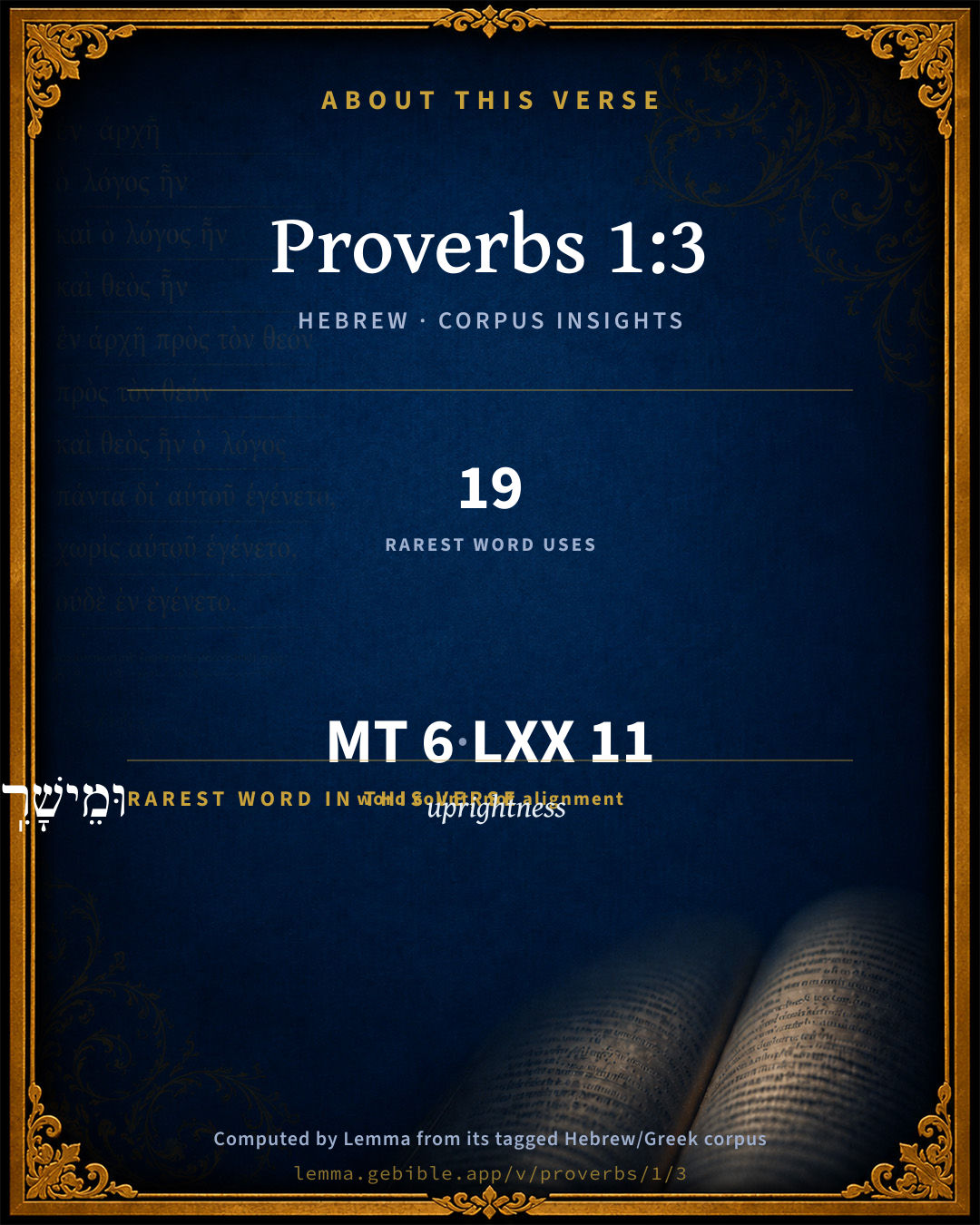
The rarest word here is וּמֵישָׁרִֽים uprightness H4339 — appearing just 19 times in the whole Hebrew Bible.

Shared distinctive vocabulary

וּמֵישָׁרִֽים uprightness H4339 occurs in 19 verses of the Hebrew Bible. Also found in:

Grammatical profile

  • 2 verbs
  • 4 nouns

Verb forms

  • לָ֭קַחַת Qal · Infinitive Construct
  • הַשְׂכֵּ֑ל Hiphil · Infinitive Absolute

Hebrew & Septuagint length

In English translation the verse runs 11 words from the Hebrew and 15 from the Septuagint (LXX English) — closely comparable.

A rough comparison of the two English renderings, which tokenize alike — not a word-level alignment.

Word counts can differ between the Hebrew and the Greek without any difference in meaning — e.g. the Hebrew direct-object marker אֵת has no separate Greek word, and Greek often adds the article ὁ.

In the original languages it is 6 Hebrew tokens and 11 Greek tokens — but the two are counted differently (Hebrew bundles its prefixes and suffixes into one token; the Greek is in lemma form), so that isn’t a like-for-like length.

Cross-references

4

Topical passages linked to Proverbs 1:3 in the Treasury of Scripture Knowledge — connected by theme and wording, ordered by reader-vote popularity; previews shown in the World English Bible.

  • Proverbs 2:1–9 My son, if you will receive my words, And store up my commandments within you;
  • Job 22:22 Please receive instruction from his mouth, And lay up his words in your heart.
  • 1 Kings 3:28 All Israel heard of the judgment which the king had judged; and they feared the king: for they saw that the wisdom of God was in him, to do justice.
  • Proverbs 8:10–11 Receive my instruction rather than silver; Knowledge rather than choice gold.

Cross-references courtesy of OpenBible.info (CC BY 4.0).

Hebrew and Greek witnesses Masoretic Hebrew ↔ Greek Septuagint

The same verse in the two great witnesses to the Old Testament, shown verse-for-verse.

These are two independent witnesses, not word-aligned to each other, and the Septuagint is shown in lemma (dictionary) form.

Hebrew Proverbs 1:3 Masoretic · Westminster Leningrad Codex

לָ֭קַחַת מוּסַ֣ר הַשְׂכֵּ֑ל צֶ֥דֶק וּ֝מִשְׁפָּ֗ט וּמֵישָׁרִֽים

To receive instruction in wise dealing, In righteousness, justice, and equity;

World English Bible · Public Domain

Greek LXX Proverbs 1:3 Septuagint · lemma form

δέχομαι τε στροφή λόγος νοέω τε δικαιοσύνη ἀληθής καί κρίμα καταεὐθύνω

to receive also hard saying, and to understand true justice, and how to direct judgment;

LXX2012 (modern English Septuagint) · Public Domain

On this verse, The Pulpit Commentary discusses the Septuagint’s reading. Read the note in Commentary ↓

Hebrew: Westminster Leningrad Codex (CC BY 4.0). Greek: Septuagint (public domain); English from LXX2012 (modern English Septuagint) (Public Domain). How the Septuagint differs from the Hebrew →

Commentary

Notes on Proverbs 1:3 from classic Christian and Jewish commentators (each source and its license shown beneath its notes). The classic Christian expositions comment on the surrounding passage and are grouped to its opening verse, so a note may address several verses; the Jewish commentaries on the Tanakh (Rashi and others) are per-verse, so they appear only where the commentator wrote on this verse.

Lemma curates 59 commentaries, every one of them public domain or Creative Commons licensed, each selected and text-cleaned for this edition rather than reprinted as found. About our sources →

Trapp's Complete Commentary

John Trapp

Pro 1:3 To receive the instruction of wisdom, justice, and judgment, and equity;

Ver. 3. To receive the instruction.] Tertullian calls the Bible (and the Proverbs by a specialty) nostra digesta, from the lawyers; and others our pandects, {a} from them also. Is there not a thin veil laid over them, which is more ratified by reading, and at last wholly worn away? Surely as by much reading the statute book men grow worldly wise; and as a friend (it is Chrysostom’s comparison) that is acquainted with his friend will get out the meaning of a letter or phrase which another could not that is a stranger, so it is in Scripture. And herein, as one well observeth, the poorest idiot being a sound Christian, goeth beyond the profoundest clerks that are not sanctified, that he hath his own heart instead of a commentary to help him to understand even the most needful points of the Scripture.

{a} A complete body of the laws of any country or of any system of law.

John Trapp, A Commentary or Exposition upon All the Books of the Old and New Testament (1647–1656) — public domain. Text from a community e-Sword module.

The Biblical Illustrator

Joseph S. Exell

Pro_1:3

To receive the instruction of wisdom, justice, and judgment and equity.

Judgment and equity

Judgment is used for discerning right from wrong; for the law, manner, or rule of it; for punishment or execution of judgment. Equity in Hebrew means, straight ways, that go on foreright, and even, like plains; when men go not uphill and downhill in their actions, but proceed in an even course. It signifies also a thing right in Gods or mans eyes, which they approve as just and equal. Some understand by equity moderation, that we use not the extremity of the law, nor do all that we may. Others, integrity of mind in working and discerning. The doctrines suggested are--

1. Matters of practice must not be perceived only, but received. There is a piercing of truth into the understanding, and receiving of it into the judgment.

2. Knowledge is ordinarily received from others.

3. A spiritual wisdom is required to guide all our actions.

4. Every cues right must be preserved.

5. Men must study to know how to judge of interests.

6. Extremity of justice is not always to be used; moderation sometimes is to be exercised. (Francis Taylor.)

The Biblical Illustrator, edited by Joseph S. Exell (c. 1880s–1900s) — public domain. Text from a community e-Sword module.

Geneva Bible (1599)

Geneva Bible translators

To learn to submit ourselves to the correction of those that are wise.

By living justly and rendering to every man that which appertaineth unto him.

Geneva Bible (1599) marginal notes — public domain. Text via Bolls.life.

Jamieson, Fausset & Brown

Robert Jamieson, A. R. Fausset & David Brown

To receive . . . of wisdom--For receiving that discipline which discretion imparts. The Hebrew for "wisdom" differs from that of Pro 1:2, and denotes rather discreet counsel. Compare the opposite traits of the fool (Pro 16:22).

justice . . . equity--all the attributes of one upright in all his relations to God and man.

Jamieson, Fausset & Brown — Commentary Critical and Explanatory on the Whole Bible (1871) — public domain (CC PDM 1.0). Text via the HelloAO Bible API.

Adam Clarke's Commentary

Verse 3. To receive the instruction] השכל haskel, the deliberately weighing of the points contained in the teaching, so as to find out their importance.

Equity] משרים mesharim, rectitude. The pupil is to receive wisdom and instruction, the words of wisdom and understanding, justice and judgment, so perfectly as to excel in all. Wisdom itself, personified, is his teacher; and when God's wisdom teaches, there is no delay in learning.

Adam Clarke's Commentary on the Bible (1810–1826) — public domain. Text from a community e-Sword/MySword module.

Ellicott's Commentary for English Readers

(3) To receive the instruction of wisdom.—To take in, or appropriate, the “discipline” which results in “prudence” (haskçl) or practical wisdom; so David “behaved himself wisely” (1Sa_18:5).

Equity.—Literally, what is straight, so true, honest.

A Bible Commentary for English Readers, edited by Charles John Ellicott (1878–1897) — public domain. Text from a community e-Sword module.

The Cambridge Bible for Schools and Colleges

gen. ed. J. J. S. Perowne

3. the instruction of wisdom] Rather, instruction (or discipline) in wise dealing, R.V. The word is not the same as that rendered wisdom in Pro_1:2; Pro_1:7.

justice] Rather, righteousness, R.V. as a wider word. The three words, righteousness, judgement, equity, may be simply cumulative and comprehensive; or possibly righteousness may denote the abstract and inclusive principle, as it affects the character; judgement, the same principle in action generally; equity (lit. equities, marg.), the varied application of that principle in different cases.

The Cambridge Bible for Schools and Colleges (gen. ed. J. J. S. Perowne; Cambridge University Press, 1878–1918) — public domain. Text from a community e-Sword module.

John Gill's Exposition

To receive the instruction of wisdom,.... Or "prudence" (h); of wise and prudent men; and especially of Christ himself, who bears those names, whose instructions this book is full of; and the design of which is to engage the attention of men to them, and prevail upon them to receive them, and act conformably to them. Which instructions respect the following things; and which are added by way of illustration and amplification, viz.

justice, and judgment, and equity; that which is just in itself, and according to the nature of God and his will; and is judged so by right reason; and is equitable between man and man, and agrees with the law of God. These three, R. Levi Ben Gersom says, signify one and the same thing; true righteousness, doing that which is just to God and man; which the doctrines of grace, or the instructions of wisdom, teach men to do; concerning which many rules may be collected from this book.

(h) "prudentiae", Munster, Vatablus.

John Gill's Exposition of the Whole Bible (1746–1763) — public domain (CC PDM 1.0). Text via the HelloAO Bible API.

Albert Barnes' Notes on the Bible

Wisdom - Not the same word as in Pro 1:2; better, perhaps, thoughtfulness.

Justice - Rather, righteousness. The word in the Hebrew includes the ideas of truth and beneficence as well as “justice.”

Judgment - The teaching of the Proverbs is to lead us to pass a right sentence upon human actions, whether our own or another’s.

Equity - In the Hebrew (see the margin) the plural is used, and expresses the many varying forms and phases of the one pervading principle.

Albert Barnes' Notes on the Bible (1834–1885) — public domain. Text from a community e-Sword/MySword module.

Matthew Poole's English Annotations

To receive the instruction; willingly to receive the counsels of others, which is a good step to wisdom, and a part of it.

Of wisdom; such as is wise, and tends to make men wise and prudent. This is opposed to the instruction of fools and folly, of which Pro 16:22; 19:27. For folly or wickedness hath its school, and multitudes of scholars, that are very apt to learn its lessons.

Justice, and judgment, and equity; which teach men just judgment or equity, to wit, their whole duty, both to God and to others, and to themselves. These three words seem to signify the same thing, and are heaped together to note either the necessity of the precept, or the exactness and diligence which is required in the practice of it.

Matthew Poole's English Annotations on the Holy Bible (1683–1685) — public domain. Text from a community e-Sword/MySword module.

Whedon's Commentary on the Bible

Daniel D. Whedon

3. To receive (acquire) the instruction (discipline) of wisdom — Rather, prudence, thoughtfulness.

Justice — צדק, tsedhek, rightness, rectitude; and judgment, משׁפשׂ, mishpat, a word of comprehensive meaning, including all distinction, regulation, ordering, right, custom. It seems to have special reference to administrative justice, or doing right in official capacity, never trespassing upon the rights of others, but preserving and defending them. Hence it is frequently joined with tsedhek — “justice and judgment.” Perhaps the two terms, when definitely used, may correspond to morality in social and civil relations.

Equity — משׁרים, mesharim, (plural,) equities or rectitudes, straightforwardness, from ישׁר, yashar, to be straight, even, smooth, right. The plural here may indicate that it is used in its most comprehensive sense. The whole may be paraphrased thus: The design of my instructions is to enable you to acquire an intelligent discipline, or habit of prudence in your personal conduct, of morality in your social and civil relations, and of rectitude in all things.

Daniel D. Whedon (gen. ed.), Commentary on the Old and New Testaments (1874–1909) — public domain. Text from a community e-Sword module.

The Pulpit Commentary

To receive the instruction of wisdom. This verse carries on the statement of the design of the Proverbs. To receive; Hebrew, tjql (lakakhath), not the same word as "to know" (tDl), in ver. 2, though regarded as synonymous with it by Delitzsch. Its meaning is well represented by the LXX dexasyai , and the Authorized Version "to receive." The Hebrew, tjql, is infinitive, and means properly "to take, or lay hold of," hence "to receive," Greek, decomai , No doubt it conveys the idea of intellectual reception. (cf. Pro_2:1) The instruction of wisdom; Hebrew, lKech rsWm (musar has"kel); i.e. the discipline or moral training which leads on to reason, intelligence, or wisdom (as Hitzig, Fuerst, Zockler); or discipline full of insight, discernment, or thoughtfulness (as Umbreit, Ewald, Delitzsch). The phrase does not mean the wisdom which instruction imparts. The word musar occurs here in a slightly different sense from its use in ver. 2; there it is objective, here its meaning as a medium for the attainment of wisdom is more distinctly brought out. Wisdom (haskel) is properly "thoughtfulness" (so Umbreit. Ewald, Delitzsch, Plumptre). It is strictly the infinitive absolute of lkc (sakal), "to entwine or involve," and as a substantive it stands for the thinking through of a subject, so "thoughtfulness." The LXX renders this sentence, dexasyai te strofav , which St. Jerome understands as "versutias sermonum et solutiones aenigmatum" ("the cunning or craftiness of words and the explication of enigmas"). Justice, and judgment, and equity. These words seem to be the unfolding of the meaning contained in the expression, "the instruction of wisdom." Holden regards the last four words as objective genitives dependent on "instruction," but wrongly. Cornelius a Laplde states that "justice and judgment and equity" indicate the same thing in different aspects. Justice stands for the thing itself that which is just; judgment in respect of right reason, which says it is just; and equity in respect of its being agreeable to the Law of God." Justice; Hebrew, qdx (tsedek), from the root qdx (tsadak), "to be right, or straight;" in a moral sense it means "rectitude," right," as in Isa_15:2 (Gesenius). The underlying idea is that of straightness. Heidenheim, quoted by Delitzsch, maintains that in tsedek the conception of the justum prevails; but the latter enlarges its meaning, and holds that it also has the idea of a mode of thought and action regulated, not by the letter of the Law, but by love, as in Isa_41:2 Isa_42:6. Plumptre thinks "righteousness" would be a better translation of the word, on the ground that the Hebrew includes the ideas of truth and beneficence. Compare with this the LXX dikaiosunh . Zockler also renders "righteousness," i.e. "that which is in accord with the will and ordinances of God as Supreme Judge." In the Authorized Version, in Pro_2:9, where we have the same collocation of words, tsedek is translated "righteousness;" cf. Pro_12:17, "He who utters truth shows forth righteousness (tsedek). Judgment; Hebrew, fPvm (mish"pat), from the root fPv (shapat), "to adjust, judge," corresponds with the Hebrew in meaning; it is the delivery of a correct judgment on human actions. Compare the LXX krima kateuyunein . Equity; i.e. rectitude in thought and action (Delitzsch), or integrity (Zockler). This quality expresses upright demeanour or honoumble action on one"s own part individually, while "judgment" has regard both to our own and the actions of others. The Hebrew, mesharim ( used only in the plural, is from the root rvy (yashar), "to be straight or even," and is equal to "uprightness." The plural form is reproduced in the marginal reading "equities;" comp. Psa_17:2, "Let thine eyes beheld the things that are equal (mesharim)." The Vulgate reads aequitas and the Syriae rectitudo. The two ideas in judgment and equity appear to be expressed in the LXX by the phrase. krima kateuyunein .

The Pulpit Commentary (1880–1919), ed. H.D.M. Spence-Jones & Joseph S. Exell — public domain. Text from a community e-Sword module.

John Wesley's Explanatory Notes

To receive - Willing to receive the counsels of others. Such as makes men wise and prudent, and to teach just judgments or equity.

John Wesley, Explanatory Notes Upon the Whole Bible (1754–1765) — public domain. Text via the GEBible commentary corpus.

Rashi

Rabbi Shlomo Yitzchaki (Rashi)

righteousness, justice, and equity “Righteousness” denotes charity from his money; “justice” means to judge honestly, and “equity” denotes compromise—the smooth and straight road, equal to this one and to that one.

Rashi on the Tanakh — English translations: “The Judaica Press complete Tanach with Rashi, translated by A. J. Rosenberg” (CC BY 4.0); “Pentateuch with Rashi's commentary by M. Rosenbaum and A.M. Silbermann, 1929-1934” (public domain); “The Metsudah Tanach series, Lakewood, N.J” (CC BY 4.0); and “The Book of Joshua, Metsudah Publications, 1997” (CC BY 4.0). Text via Sefaria.

Lesson kit

Teaching starters — assembled from the data on this page, not authored interpretation. Every prompt links to the verse data it draws on. Edit before teaching.

Proverbs, in the Wisdom, opens this verse with 6 words (6 distinct Hebrew lemmas). Its most distinctive word is mêyshâr (“uprightness”). A historical commentator’s framing appears above. Read the whole chapter for the surrounding context.

Discussion questions

  1. The word mêyshâr carries the sense “uprightness.” How does it shape the verse?
  2. How does 1 Chronicles 29:17, which shares the word «uprightness», read alongside this verse?
  3. These translations render this verse differently. What is at stake in choosing one wording over another?
  4. «לָ֭קַחַת» is a Qal Infinitive Construct verb. How does that grammatical form shape the action described?
  5. Compare how Trapp's Complete Commentary and The Biblical Illustrator read this verse. Where do they agree or differ?

Things to notice

Reading settings

Reading text

Shown beneath each verse's original-language words.

Old Testament
Old Testament edition

Read the OT as the Masoretic Hebrew (MT) or the Greek Septuagint (LXX).

English shown for the Greek Septuagint (in the Hebrew ↔ Greek comparison).

Comparing translations? Open the Compare panel on any verse page to stack up to four side by side.