1 Chronicles 15:13

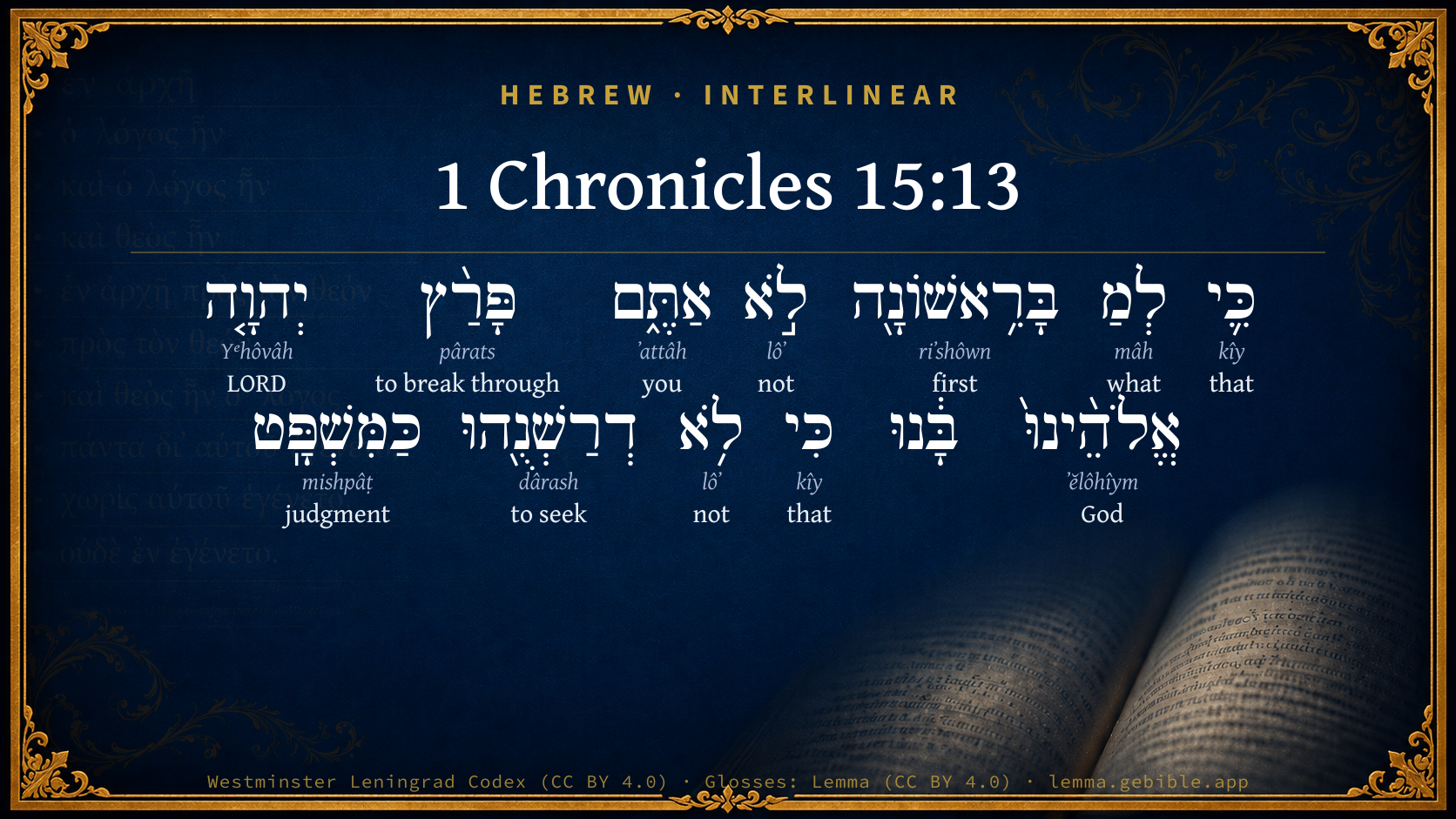
Hebrew (Westminster Leningrad Codex) 1 Chronicles 15:13 appears in the Hebrew Old Testament. The text above is from the Westminster Leningrad Codex. Each word links to its Strong’s number, a concise gloss, and parsing drawn from the Open Scriptures Hebrew Bible morphology. Click any word for its full Brown-Driver-Briggs (BDB) entry.
Download image
Cite this verse

1 Chronicles 15:13 (World English Bible). Public Domain. Lemma interlinear Bible study tool, https://lemma.gebible.app/v/1-chronicles/15/13.

Show BibTeX & RIS
BibTeX
RIS
English Translation
For because you didn't carry it at the first, Yahweh our God made a breach on us, because we didn't seek him according to the ordinance.
World English Bible · Public Domain
Download a study sheet

One document with this verse’s original text, its word-by-word gloss line, the meaning frame, cross-references with their text, attributed commentary, and full source and license credits — printable, and it pastes into notes with its structure intact.

This verse Autodidact and up

Study sheet (.html) Plain text (.txt)

A passage Seminary Student

Up to 50 verses in one chapter. A passage sheet keeps up to 6 commentary sources and 12 cross-references per verse, in the order this page ranks them, and says so on the sheet whenever that leaves anything out. Ask for a single verse and you get the Autodidact verse sheet above.

Everything on this page stays free to read, with no account — the sheet is a download of what is already on screen, not access to it.

Want to remove ads? Support Godless Engineer
Compare translations 3

The same verse in 3 English versions, stacked beneath the original-language interlinear above. Click any original word for its lexicon entry.

Each is an independent rendering of the whole verse — the interlinear is not word-aligned to these translations.

Highlighted words mark where these versions differ — a whole-verse word diff, not a word-by-word alignment.

  • World English Bible Public Domain
    For because you didn't carry it at the first, Yahweh our God made a breach on us, because we didn't seek him according to the ordinance.
  • King James Version Public Domain
    For because ye did it not at the first, the LORD our God made a breach upon us, for that we sought him not after the due order.
  • unfoldingWord Literal Text CC BY-SA 4.0
    For because at the first not you, Yahweh our God broke out against us, for we did not seek him according to the ordinance.”

unfoldingWord Literal Text — © unfoldingWord, licensed CC BY-SA 4.0. Word-aligned USFM3 via Door43 (git.door43.org/unfoldingWord/en_ult).

Versions to compare (up to 4)

3 of 4 selected

Show all 18 translations

Every available English version of this verse, each an independent rendering of the whole verse.

  • World English Bible Public Domain
    For because you didn't carry it at the first, Yahweh our God made a breach on us, because we didn't seek him according to the ordinance.
  • Berean Standard Bible Public Domain
    It was because you Levites were not with us the first time that the LORD our God burst forth in anger against us. For we did not consult Him about the proper order.”
  • Majority Standard Bible Public Domain
    It was because you Levites were not with us the first time that the LORD our God burst forth in anger against us. For we did not consult Him about the proper order.”
  • King James Version Public Domain
    For because ye did it not at the first, the LORD our God made a breach upon us, for that we sought him not after the due order.
  • American Standard Version (1901) Public Domain
    For because ye `bare it' not at the first, Jehovah our God made a breach upon us, for that we sought him not according to the ordinance.
  • Revised Version (1885) Public Domain
    For because ye bare it not at the first, the LORD our God made a breach upon us, for that we sought him not according to the ordinance.
  • Geneva Bible (1599) Public Domain
    For because ye were not there at the first, the Lord our God made a breach among vs: for we sought him not after due order.
  • Douay-Rheims (1899) Public Domain
    Lest as the Lord at first struck us, because you were not present, the same should now also come to pass, by our doing some thing against the law.
  • Young's Literal Translation Public Domain
    because at the first `it was' not ye, Jehovah our God made a breach upon us, because we sought Him not according to the ordinance.'
  • Literal Standard Version CC BY-SA 4.0
    because you [did] not [do it] at the first, our God YHWH made a breach on us, because we did not seek Him according to the ordinance.”
  • Unlocked Literal Bible CC BY-SA 4.0
    You did not carry it the first time. That is why Yahweh our God broke out against us, for we did not seek him or obey his decree.”
  • unfoldingWord Literal Text CC BY-SA 4.0
    For because at the first not you, Yahweh our God broke out against us, for we did not seek him according to the ordinance.”
  • Darby Bible Public Domain
    For because ye did [it] not at the first, Jehovah our God made a breach upon us, for that we sought him not after the due order.
  • World Messianic Bible Public Domain
    For because you didn’t carry it at first, the LORD our God broke out in anger against us, because we didn’t seek him according to the ordinance.”
  • Webster's Bible Public Domain
    For because ye did it not at the first, the LORD our God made a breach upon us, for that we sought him not after the due order.
  • Free Bible Version CC BY-SA 4.0
    Because you weren't there the first time to carry the Ark the Lord our God burst out in violence against us. We didn't treat it in accordance with his instructions.”
  • Bible in Basic English Public Domain
    For because you did not take it at the first, the Lord our God sent punishment on us, because we did not get directions from him in the right way.
  • JPS Tanakh (1917) Public Domain
    For because ye bore it not at the first, the LORD our God made a breach upon us, for that we sought Him not according to the ordinance.'

Literal Standard Version (2020), Covenant Press — licensed CC BY-SA 4.0. Text via the HelloAO Bible API (eBible.org). Unlocked Literal Bible (unfoldingWord) — licensed CC BY-SA 4.0. Text via the HelloAO Bible API (eBible.org). unfoldingWord Literal Text — © unfoldingWord, licensed CC BY-SA 4.0. Word-aligned USFM3 via Door43 (git.door43.org/unfoldingWord/en_ult). Free Bible Version, Dr. Jonathan Gallagher — licensed CC BY-SA 4.0. Text via the HelloAO Bible API (eBible.org).

Word by word

More ways to search: Search by grammar → Find every occurrence → Compare this word →

Practice this passage: Drill this verse → Learn its vocabulary →

פָּרַ֨ץ
pârats
H6555
“to break through”
Verb, Qal, Perfect, 3rd Person, Masculine, Singular
Part of Speech
Verb
Stem
Qal
Form
Perfect
Person
3rd Person
Gender
Masculine
Number
Singular
Full BDB Definition

Origin: a primitive root

TWOT: 1826

to break through or down or over, burst, breach - (Qal) - to break or burst out (from womb or enclosure) - to break through or down, make a breach in - to break into - to break open - to break up, break in pieces - to break out (violently) upon - to break over (limits), increase - to use violence - to burst open - to spread, distribute - (Niphal) to be broken through - (Pual) to be broken down - (Hithpael) to break away
  1. כִּ֛י kîy H3588 “that” Conjunction
  2. לְמַ mâh H4100 “to/for · what” Preposition + Particle, Interrogative
  3. בָּרִ֥אשׁוֹנָ֖ה riʼshôwn H7223 “in/at the · first” Preposition, Determined + Adjective, Adjective, Feminine, Singular, Absolute
  4. לֹ֣א lôʼ H3808 “not” Particle, Negative
  5. אַתֶּ֑ם ʼattâh H859 “you” Pronoun, Personal, 2nd Person, Masculine, Plural
  6. יְהוָ֤ה Yᵉhôvâh H3068 “LORD” Noun, Proper
  7. אֱלֹהֵ֨ינוּ֙ ʼĕlôhîym H430 “God(s) · our” Noun, Common, Masculine, Plural, Construct + Suffix, Personal, 1st Person, Common, Plural
  8. כִּי kîy H3588 “that” Conjunction
  9. לֹ֥א lôʼ H3808 “not” Particle, Negative
  10. דְרַשְׁנֻ֖הוּ dârash H1875 “to seek · him” Verb, Qal, Perfect, 1st Person, Common, Plural + Suffix, Personal, 3rd Person, Masculine, Singular
  11. כַּמִּשְׁפָּֽט mishpâṭ H4941 “like/as the · judgment” Preposition, Determined + Noun, Common, Masculine, Singular, Absolute

About this verse

These counts appear in no published source. They are computed here, from the morphology-tagged text and Lemma’s own curated glosses. What Lemma adds →

13
words
10
distinct lemmas
Historical
section

Shared distinctive vocabulary

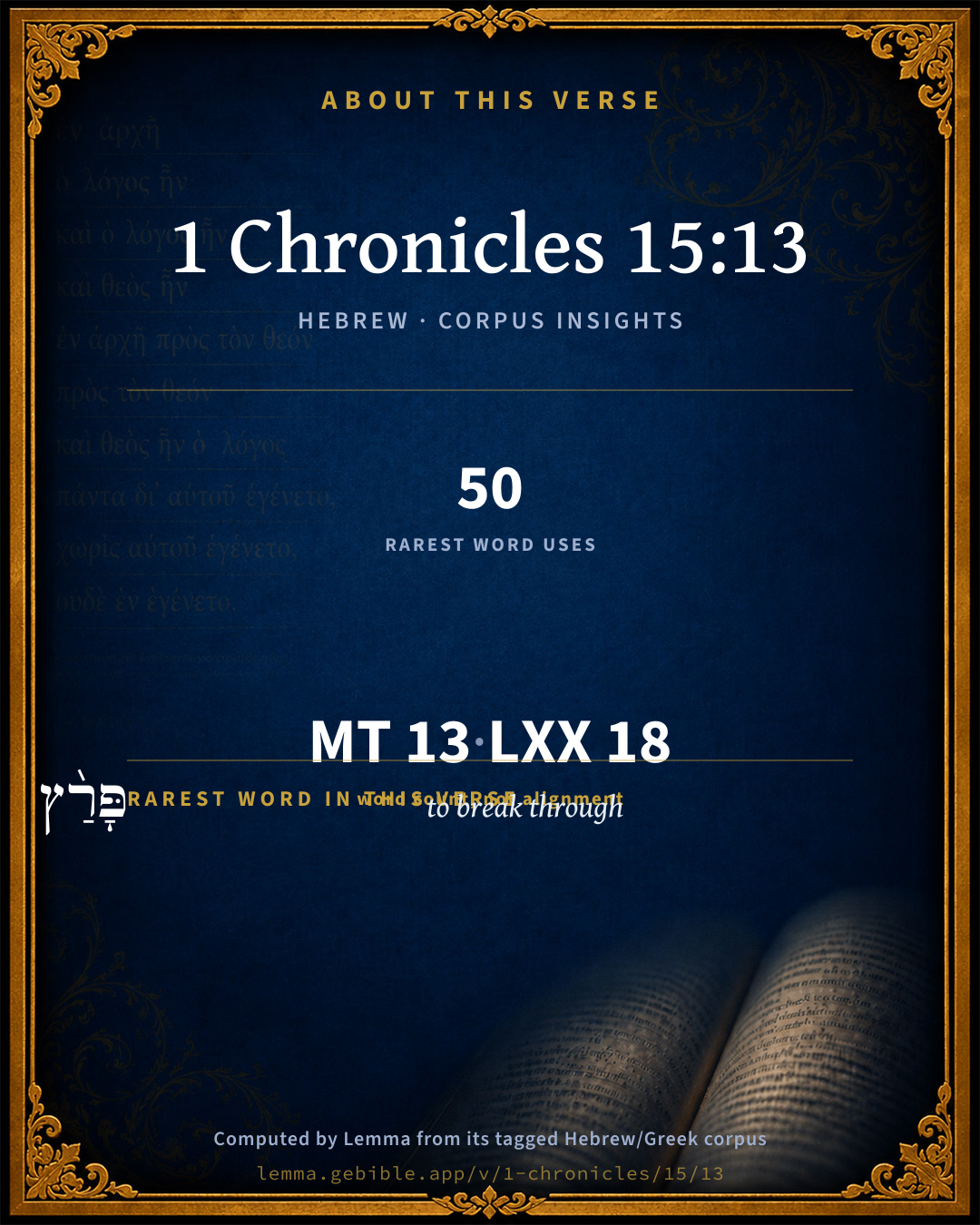
פָּרַ֨ץ to break through H6555 occurs in 48 verses of the Hebrew Bible. Also found in:

Grammatical profile

  • 2 verbs
  • 3 nouns
  • 1 adjective
  • 1 pronoun
  • 1 preposition
  • 2 conjunctions
  • 3 particles

Verb forms

  • פָּרַ֨ץ Qal · Perfect
  • דְרַשְׁנֻ֖הוּ Qal · Perfect

Repetition

Words recur within this verse — often emphatic in Hebrew:

  • כִּ֛י that H3588 ×2
  • לֹ֣א not H3808 ×2

Hebrew & Septuagint length

In English translation the verse runs 26 words from the Hebrew and 25 from the Septuagint (LXX English) — closely comparable.

A rough comparison of the two English renderings, which tokenize alike — not a word-level alignment.

Word counts can differ between the Hebrew and the Greek without any difference in meaning — e.g. the Hebrew direct-object marker אֵת has no separate Greek word, and Greek often adds the article ὁ.

In the original languages it is 13 Hebrew tokens and 18 Greek tokens — but the two are counted differently (Hebrew bundles its prefixes and suffixes into one token; the Greek is in lemma form), so that isn’t a like-for-like length.

Cross-references

12

Topical passages linked to 1 Chronicles 15:13 in the Treasury of Scripture Knowledge — connected by theme and wording, ordered by reader-vote popularity; previews shown in the World English Bible.

  • 2 Samuel 6:3 They set the ark of God on a new cart, and brought it out of the house of Abinadab that was in the hill: and Uzzah and Ahio, the sons of Abinadab, drove the new cart.
  • 1 Corinthians 14:40 Let all things be done decently and in order.
  • 1 Corinthians 11:2 Now I praise you, brothers, that you remember me in all things, and hold firm the traditions, even as I delivered them to you.
  • 1 John 1:8–10 If we say that we have no sin, we deceive ourselves, and the truth is not in us.
  • Numbers 4:15 "When Aaron and his sons have finished covering the sanctuary, and all the furniture of the sanctuary, as the camp moves forward; after that, the sons of Kohath shall come to carry it: but they shall not touch the sanctuary, lest they die. These things are the burden of the sons of Kohath in the Tent of Meeting.
  • Numbers 7:9 But to the sons of Kohath he gave none, because the service of the sanctuary belonged to them; they carried it on their shoulders.
  • Deuteronomy 31:9 Moses wrote this law, and delivered it to the priests the sons of Levi, who bore the ark of the covenant of Yahweh, and to all the elders of Israel.
  • 2 Samuel 6:7–8 The anger of Yahweh was kindled against Uzzah; and God struck him there for his error; and there he died by the ark of God.
  • 1 Chronicles 13:7–11 They carried the ark of God on a new cart, [and brought it] out of the house of Abinadab: and Uzza and Ahio drove the cart.
  • 1 Chronicles 15:2 Then David said, None ought to carry the ark of God but the Levites: for them has Yahweh chosen to carry the ark of God, and to minister to him forever.
  • Proverbs 28:13 He who conceals his sins doesn't prosper, But whoever confesses and renounces them finds mercy.
  • 2 Chronicles 30:17–20 For there were many in the assembly who had not sanctified themselves: therefore the Levites had the charge of killing the Passovers for everyone who was not clean, to sanctify them to Yahweh.

Cross-references courtesy of OpenBible.info (CC BY 4.0).

Hebrew and Greek witnesses Masoretic Hebrew ↔ Greek Septuagint

The same verse in the two great witnesses to the Old Testament, shown verse-for-verse.

These are two independent witnesses, not word-aligned to each other, and the Septuagint is shown in lemma (dictionary) form.

Hebrew 1 Chronicles 15:13 Masoretic · Westminster Leningrad Codex

כִּ֛י לְמַ בָּרִ֥אשׁוֹנָ֖ה לֹ֣א אַתֶּ֑ם פָּרַ֨ץ יְהוָ֤ה אֱלֹהֵ֨ינוּ֙ בָּ֔נוּ כִּי לֹ֥א דְרַשְׁנֻ֖הוּ כַּמִּשְׁפָּֽט

For because you didn't carry it at the first, Yahweh our God made a breach on us, because we didn't seek him according to the ordinance.

World English Bible · Public Domain

Greek LXX 1 Chronicles 15:13 Septuagint · lemma form

ὅτι οὐ ἐν ὁ πρότερον σύ εἰμί διακόπτω ὁ θεός ἐγώ ἐν ἐγώ ὅτι οὐ ζητέω ἐν κρίμα

For because you⌃ were not ready at the first, our God made a breach upon us, because we sought him not according to the ordinance.

LXX2012 (modern English Septuagint) · Public Domain

Hebrew: Westminster Leningrad Codex (CC BY 4.0). Greek: Septuagint (public domain); English from LXX2012 (modern English Septuagint) (Public Domain). How the Septuagint differs from the Hebrew →

Commentary

Notes on 1 Chronicles 15:13 from classic Christian and Jewish commentators (each source and its license shown beneath its notes). The classic Christian expositions comment on the surrounding passage and are grouped to its opening verse, so a note may address several verses; the Jewish commentaries on the Tanakh (Rashi and others) are per-verse, so they appear only where the commentator wrote on this verse.

Lemma curates 59 commentaries, every one of them public domain or Creative Commons licensed, each selected and text-cleaned for this edition rather than reprinted as found. About our sources →

Trapp's Complete Commentary

John Trapp

1Ch 15:13 For because ye [did it] not at the first, the LORD our God made a breach upon us, for that we sought him not after the due order.

Ver. 13. God made a breach upon us.] See on 1Ch 13:9.

For that we sought him not.] David faulteth himself also.

After the due order.] See on 1Ch 13:12.

John Trapp, A Commentary or Exposition upon All the Books of the Old and New Testament (1647–1656) — public domain. Text from a community e-Sword module.

The Biblical Illustrator

Joseph S. Exell

1Ch_15:13

For that ye sought Him not after the due order.

Seeking the Lord

There are historical details connected with these words which we wish you carefully to consider. David had prepared a place for the ark of God, which had been retained by the Philistines from the days of Eli; and for a long period had been banished from the congregation of Israel. He now determined to go down to the house of Obed-edom, where the ark was, and bring up to Jerusalem with all due solemnity this precious emblem of the presence of the Lord. He exhorts the priests and Levites to sanctify themselves, to observe, that is, all the prescribed ceremonial purifications, in order that they might be fitted to carry the ark. This was not the first attempt at bringing back the ark of the Lord. The Philistines, finding that its presence only brought down judgments upon their land, carried the ark into the country of the Israelites, where it remained for many years with Abinadab, in Kirjath-jearim. But when David, after the decease of Saul, had placed himself on the throne, he went down to the house of Abinadab, that he might bring up thence the sacred deposit. The ark of God, you read, was put on a new cart, and Uzza and Ahio, the sons of Abinadab, drove the cart. After proceeding some distance the oxen stumbled; and Uzza put forth his hand and laid hold on the ark to prevent it from falling. Uzza was not a priest; and every other was expressly forbidden to touch the ark. Alarmed at so signal and unexpected an interference of God, David gave vent to his feelings in the exclamation of our text: How shall I bring the ark of God home to me? and determined, that for the present at least, he would make no further endeavour to remove what it was so perilous to touch. In process, however, of time, when he had duly considered the causes of his failure, he set himself again to recovering the ark. Warned by the fate of Uzza he was a little more careful and cautious in the several arrangements. David goes on to address the Levites: Because ye did it not at the first, the Lord our God made a breach upon us, for that we sought Him not after the due order. We have a great lesson to derive from the facts thus briefly set before you. The lesson is, that God may be sought, and yet not be found, because the seeking is not in the way or order which He hath revealed as agreeable to Himself. It was not that David and his people were not sincere and hearty in their desire that the ark of God might be once more amongst them. We are told that while the ark abode in Kirjath-jearim, the time was long, for it was twenty years, and all the house of Israel lamented after the Lord. So that the seeking was not that of the hypocrite. The seeking God in a way of their own notion, and not in that of the Divine appointment; or, rather, the neglecting to observe rigidly what God had prescribed in respect of the manner in which He would be sought--this it was which had been offensive to the Lord. And if where there was sincerity of purpose, there might be this failure through want of exact conformity to the revealed will of God, we are bound to conclude that in our own day and generation it is not the mere striving for masteries; but, as St. Paul has expressed it, the striving lawfully, which will be crowned with any measure of success. Now, we need hardly observe to you, that the right way of seeking God must he the way that God Himself has been pleased to reveal. But there is a twofold revelation--a revelation which God makes of Himself by and through conscience, and a revelation which is contained in the Bible. Let us look at both of these. There may be a due order prescribed by the one, as well as by the other. You will all be prepared to admit that the first step which conscience dictates, when it has roused a man to a sense of his moral condition is, that he break loose from those habits of evil which have been formed during years of carelessness and vice. There is a thorough harmony here between the two revelations. But if we would overcome a habit, we must carefully observe how habits are formed. A habit must be overcome through retracing step by step that very process by which the habit was formed; so that there is a due order to be observed, the neglecting of which will frustrate all our labours. A habit is not formed in a day, neither is a habit to be overcome in a day. Now, if this be the way in which a habit is formed; in what way may that habit be loosened and destroyed? We reply that, as it was formed step by step, so must it be destroyed step by step. And when you have determined that a habit is obnoxious, there will rise a desire, however faint, to pursue a course of conduct which is opposed to this habit. This desire, like the vicious one already considered, will at first be obeyed with difficulty; an effort will be needed, perhaps a painful, and in some cases l most intense effort. But this effort will diminish with every instance of success. This is the due order in dealing with habit, and thus labouring at the reformation which conscience demands. But there may be a neglect of this due order, and then comes that failure which is our chief subject of discourse. If you withstand an evil habit, but take no pains to cultivate an opposite habit, you may produce an external reformation, and yet make no advance towards an internal reformation. The drunkard may force himself into a sober man, without undergoing any moral change. He may impose some powerful restraint upon the evil passion, and thus produce a suspension of the habit; but all the while the tendency remains unsubdued; and if the restraint be withdrawn, the tendency will resume all its power. The man is just what he was in all but the actual indulgence. But our chief attention should be given to the theology of the gospel, though what we have called the theology of conscience occupies a highly important place in reference to moral reformation. It is not unfrequent to find repentance described as a kind of condition to be performed on mans part, in order that he may be fitted to receive the blessings of the gospel. Repentance is spoken of as a preliminary to be accomplished by ourselves, so that when disciplined and penitent we may turn to Christ for forgiveness. But this is not the doctrine of the gospel. This is rather the inversion of the due order prescribed by the gospel. The doctrine of the New Testament is not repentance, and then appeal to Christ. It is appeal at once to Christ in order that you may repent. We know that before the blood of the atonement can be applied to the conscience, and a man have reason to hope himself justified by God, there must be an earnest and hearty resolution to mortify those affections and desires whose indulgence has heretofore done despite unto God. But then we equally know that such a resolution as this is not to be made out of anything which man finds in himself, through the instrumentality of his unaided feelings whether mental or moral. We know that a determination to forsake sin, if it be anything better than a feeble purpose which will give way at the first onset of temptation, must be a determination which is based on hatred of sin as despite to a Benefactor; for such is the construction of our minds, at least in this the eclipse and degradation of man, that we cannot long avoid through mere dread of its consequences what commends itself as desirable to the appetites of our nature. And if it be essential to the resolution in question, that there be hatred of sin as despite to a Benefactor, there is little likelihood of its being fabricated and fastened on the soul, so long as a man is at a distance from Christ. It must be fabricated amid the scenes of crucifixion; it must be fastened by the agonies of the crucified; so that, we again say, that applying to Christ is the first step, and not the second in that due order which is prescribed by the gospel plan for seeking the Lord. The ark of the truth of God, in which is deposited the mysteries and the mercies of redemption how, according to the question of our text--how shall this be brought into the human breast and shrined in the recesses of the soul? Repentance and faith--these, so to speak, are the anointed priesthood who alone may handle, alone move the hallowed treasure. But if we would substitute for that repentance, which is the gift of the interceding Saviour, another, human in its origin, and produced by the workings of our unassisted feelings, what are we doing but placing an Uzza, one not sprung of the consecrated line, to assist in bringing back the sacred and magnificent treasure? The due order is that, stirred by the remonstrances of conscience, by the pleadings of Gods Spirit, we flee straightway to Christ, and entreat of Him to make us penitent; and then to give us pardon. Let him try this method, and it may not be long ere the ark of the living God, weighty with the blessings of eternity, moves majestically into his soul. But we have yet some general remarks to advance upon what David calls seeking God after the due order, or to speak more popularly, going the right way to work in the matter of moral endeavour. When God has once made known His will, the question is not whether there be sincerity of purpose, and earnestness of endeavour, but whether in striving for masteries man strives lawfully--strives in the way which has been revealed. If not, if there be any swerving from this way, it is not the amount of energy which he brings to the effort, nor the devotedness with which he follows out his course, which shall procure him favour with his Maker. He offends by substituting his own way for Gods way; and, certainly, the zeal with which he prosecutes an offence can in no sense repair the offence. The decisions of the intellect are mightily swayed by the dictates of the inclination. An investigation may be carried on with all candour and honesty; yet the judgment has no fair play if there be a lurking wish that the verdict may confirm a preconceived theory. Therefore do we hold a man answerable for his faith, because we hold him answerable for that state of moral feeling which he brings to the search after truth. If a man have himself destroyed or impaired the organ of vision, surely he is answerable for not seeing what God hath made plain. We unequivocally maintain that he who has revelation in his hand, and either rejects, or resists its sayings in regard of the alone mode of salvation, has nothing to expect but that as it was with David and his people, the Lord God will break in anger upon him, because in the matter of his endeavouring to bring home to him the ark of the Lord, he has failed to proceed after the due order. If God hath been pleased to make known a method in which the ark of His presence may be brought into the soul, we are answerable for conforming ourselves to that method with all possible exactness and all possible care. There can be nothing simpler than the directions which are given us in Holy Writ. We are to set ourselves at once to the resisting those known sins which we are sure must grieve the Holy Spirit of God. We are to pray for the influences of His Spirit, that we may be led to Christ for repentance and faith. Our whole dependence is to be placed on the sacrifice and righteousness of the Mediator. Many--vast multitudes--perish in utter indifference; they make no effort to be saved. Others make an effort, but not in the right way; not in the way the Bible prescribes; and they, too, perish--perish through planning for themselves, in place of submitting meekly to the revealed will of God. We are all naturally in the condition of Jerusalem at the time when the solicitudes of its monarch were given to bringing the ark within its precincts. Created in the image of his Maker, the breast of man was designed as a sanctuary in which the Lord God might tabernacle; but the Philistine came down in his strength; the sanctuary was desecrated; and the Lord God withdrew from the polluted abode. And now the question which should interest us, and command our intense consideration--it is, How can the temple be rebuilt and cleansed, and habited again with the indwellings of Deity? The question of our text: How shall I bring the ark of God home to me? is the question which presses hardest on every thinking man, conscious of the corruption which has been woven into his nature, conscious of the immortality to which that nature is heir. We thank God that we are not abandoned to our own conjecture and our own strivings! The ark |s yet in the land, and though none but a priest can presume to touch the mysterious thing, we have a High Priest whose intercession is so rapid and so prevalent, that He can at once purify the temple, and fill it with the long lost treasure. (H. Melvill, B. D.)

The danger of not waiting on God after the due order

God is highly displeased with persons who perform duties, but are careful not to perform them in a right manner. In discoursing which, I shall show--

I. How it comes to pass that men perform duties, but are not careful to perform them in a right manner.

1. Because to perform duty is the easiest part of religion, but to do it in a right manner is very difficult; and few people have a heart to manage the difficulties of religion.

2. Because the bare performance of duties is within the reach of all, the performing of them in a right manner is beyond the reach of the most part. Natural abilities will serve for the one, gracious abilities are necessary for the other (Joh_15:5; Heb_11:4). Nature cannot carry a man above itself, more than the mouth of a river can be higher than the spring-head.

3. By the bare performance of duties, men attain the base and low ends which they propose to themselves in the service of God, viz.,

(1) Peace of mind, such as it is.

(2) It gains a man credit in the world.

4. Because men may get duties done and keep their lusts too. To perform duties in a right manner is inconsistent with peace with our lustre (Psa_66:18).

5. Because most men have low and mean thoughts of God (Mal_1:6-8).

II. How the Lord testifies His displeasure against such persons.

1. By withdrawing from them in religious services. Ordinances are the trysting-places where Christ meets with His people; but if they be not gone about in a right manner, they will be but an empty sepulchre. The living God is not to be found in a dead worship.

2. By rejecting their services (Mal_1:13; Isa_1:11).

3. By spiritual strokes upon their souls (Jer_48:10; Mal_1:14).

4. By strokes upon their bodies.

III. Why is the Lord so highly displeased?

1. Because God commands His service to be done in a right manner, With a perfect heart and a willing mind (1Ch_28:9).

2. Because the doing of a duty in a wrong manner alters the nature of it and makes it sin. If a house be built of never so strong timber, and good stones, yet if it be not well founded and right built, the inhabitant may curse the day he came under the roof of it.

3. Because duties not performed according to the right order, are but the half of the service we owe to God, and the worst half too. The Jews had it written about the doors of their synagogues, Prayer without intention is as a body without a soul.

4. Because duties thus performed are very dishonourable to God. (T. Boston, D. D.)

Importance of small things in religion

You have before you now the picture. I shall want you to look at it--

I. In detail. I observe--

1. That Gods judgment of sin must differ exceedingly from ours.

2. That all changes from the written revelation of God are wrong.

3. Whenever the practices of Christians differ from Scripture they are sure to incur inconvenience.

4. One innovation upon Sacred Writ leads to another.

5. A wrong thing done from right motives is not acceptable with God.

II. As a whole. Here I have two pictures--

1. One for the people of God. Let us be done with everything erroneous. Then will the ark be brought up out of its obscurity into the place of glory. This is what is necessary to bring the kingdom of Christ on earth.

2. The other for the ungodly. It was a right thing for David to wish to bring up the ark, but perhaps he was ignorant of the way to bring it, and see what inconvenience he had to suffer. If you are not clear as to the plan of salvation, you will have many joltings, much shaking, and you will suffer much inconvenience. The plan of salvation is Trust in Jesus. (C. H. Spurgeon.)

The Biblical Illustrator, edited by Joseph S. Exell (c. 1880s–1900s) — public domain. Text from a community e-Sword module.

Tyndale Open Study Notes

Tyndale Open Resources

15:13 See 13:1-10.

Tyndale Open Study Notes — © Tyndale Open Resources, licensed CC BY-SA 4.0. Text via the HelloAO Bible API.

Geneva Bible (1599)

Geneva Bible translators

According as he hath appointed in the law.

Geneva Bible (1599) marginal notes — public domain. Text via Bolls.life.

Ellicott's Commentary for English Readers

(13) For because ye did it not at the first.—The Hebrew seems to mean, for because on the first occasion it was not you (that is, the heads of the Levitical houses)—scil., who carried up the ark, but Uzza and Ahio, sons of Abinadab (2Sa_6:3). The phrase so rendered only occurs here (lĕmabbârîshônâh = “because at the first”).

Our God made a breach.—Broke out upon us; referring to the sudden death of Uzza (1Ch_13:10). (Comp. Exo_19:22; Exo_19:24, same phrase.)

We sought him not (1Ch_13:3) after the due order.—The Ark was carried on a cart, instead of being borne by the sons of Kohath “on their shoulders, with the staves thereon” (1Ch_15:15; Num_4:15). Even the Kohathites themselves were forbidden to “touch any holy thing,” as Uzza had ventured to do. It has been said that the “sanctity of institutions,” as opposed to the “sanctity of a people under the government of a righteous God,” is the leading idea of the Chronicles. It would be difficult to show how the sanctity of a people is to be secured, and how the government of a righteous God is to be realised, except in and through Divine institutions. As there is a “due order” by which God rules the physical world, so is there a corresponding order whereby His will is fulfilled in the spiritual sphere. There are positive institutions in Christianity as well as in Mosaism; and if we abolish the Divine authority of the one, why not of the other also?

A Bible Commentary for English Readers, edited by Charles John Ellicott (1878–1897) — public domain. Text from a community e-Sword module.

The Cambridge Bible for Schools and Colleges

gen. ed. J. J. S. Perowne

13. ye did it not] R.V. ye bare it not.

made a breach] 1Ch_13:11 (cp. R.V.); 1Ch_14:11 (cp. R.V. mg.).

we sought him not] Render, we sought not unto it. Cp. note on 1Ch_13:3.

after the due order] R.V. according to the ordinance. Cp. 1Ch_15:15 for the observance of the ordinance.

The Cambridge Bible for Schools and Colleges (gen. ed. J. J. S. Perowne; Cambridge University Press, 1878–1918) — public domain. Text from a community e-Sword module.

John Gill's Exposition

For because ye did it not at the first,.... Did not sanctify themselves, as the supplement in our version directs; but rather the sense is, ye were not there at first, when the ark was brought from Kirjathjearim as far as the house of Obededom, as they should have been; they were not then employed, as was their business, and therefore

the Lord our God made a breach upon us; by smiting Uzzah with death, who was no Levite, and touched the ark, which is called his "error", and for which God smote him, Sa2 6:7 on which place Lud. Capellus observes, the word "shal", we there render "error", signifies a "disease" in the Arabic language, and might formerly design a sudden one with the Hebrew; as an apoplexy; and so the sense be, that God smote Uzzah with an apoplexy, of which he suddenly died:

for that we sought him not after the due order; but, instead of employing the Levites to carry the ark on their shoulders, it was put upon a cart.

John Gill's Exposition of the Whole Bible (1746–1763) — public domain (CC PDM 1.0). Text via the HelloAO Bible API.

Albert Barnes' Notes on the Bible

The “due order” was that the ark should be borne on the shoulders of Kohathite Levites - not that it should be placed upon a cart, drawn by oxen, and rudely shaken.

Albert Barnes' Notes on the Bible (1834–1885) — public domain. Text from a community e-Sword/MySword module.

Haydock's Catholic Bible Commentary

Struck us. He partakes in the misfortune of Oza. (Haydock) --- The law through ignorance. You must attend and give proper directions. (Menochius) --- Hebrew, "because we did not seek him with judgment," (Du Hamel) or, "after the due order." (Protestants)

George Leo Haydock (1774–1849), Haydock's Catholic Family Bible and Commentary, 1859 edition — public domain. Excludes Psalms (Douay-Rheims chapter numbering differs from Protestant) and Deuterocanonical books (Catholic canon only).

Matthew Poole's English Annotations

Because ye did it not at the first; because you did not sanctify and prepare yourselves by solemn prayer, and seeking counsel from God, and by a serious consideration of God’s will as to the manner of carrying it; which it was your duty more than others to observe and see it executed.

We sought him not: he takes a part of the guilt to himself, because it was his duty, as well as theirs, diligently to read the law and word of God, and to see it executed, and their oversight did not excuse his. After the due order; according to the rules which he appointed.

Matthew Poole's English Annotations on the Holy Bible (1683–1685) — public domain. Text from a community e-Sword/MySword module.

The Pulpit Commentary

This verse purports to say that the Levites had been deficient in their duty in the double sense of not having themselves exclusively undertaken the removal of the ark, and not having executed that removal after the due order.

Due order.

David explained the failure of the former attempt to bring the ark to Jerusalem, by a reference to the neglect by himself and his people of the regulations divinely prescribed and applicable to such a case. In directing the Levites to prepare for their proper service, he acknowledged that, when he had before purposed to bring up the ark to its resting-place, he had acted thoughtlessly and profanely, and had suffered in consequence. This lesson is inculcated by the text God"s order is the due order.

I RELIGION DOES NOT CONSIST IN FORM. Even under the elder dispensation, in which forms and ceremonies were prescribed in abundance, true religion did not consist in such things. The psalmists and the prophets rose altogether above a merely sacrificial and ceremonial religion. And under the new covenant, the letter, the form, sink into insignificance, compared with the spiritual reality they are designed to express and to promote. "God is a Spirit: and they that worship him must worship him in spirit and in truth." We, as Christians, serve him, not in the oldness of the letter, but in the newness of the spirit.

II YET THE MANIFESTATIONS OF RELIGIOUS LIFE AND SERVICE ARE NOT LAWLESS AND DISORDERLY. It would be a bad thing to substitute the form for the reality; but it does not follow that it is a good thing to have no form at all. It is the direction of an inspired apostle: "Let all things be done decently and in order." Our worship should be seemly and reverent; our work should be organized and systematic; our liberality should be upon principle.

III PRESCRIPTIONS AS TO ORDER SHOULD BE CAREFULLY OBSERVED AND OBEYED. If, for instance, it is found that the New Testament lays down certain principles of Church government, prescribes certain ordinances or ministries, spiritual Christianity expects that these will be reverently considered and observed. Obedience is required as homage to the authority of the Lawgiver and Lord. We have no right to set our fancies and preferences above Divine laws.

IV OBSERVANCE OF ORDER BECOMES CONGENIAL AND EASY WHEN INSPIRED BY GRATEFUL LOVE. To a child of God, a friend of Christ, there is nothing harsh or repugnant in compliance with Divine regulations in attention to" due order. T.

The Pulpit Commentary (1880–1919), ed. H.D.M. Spence-Jones & Joseph S. Exell — public domain. Text from a community e-Sword module.

Keil & Delitzsch

C. F. Keil & F. Delitzsch

For because ye did it not at the first,.... Did not sanctify themselves, as the supplement in our version directs; but rather the sense is, ye were not there at first, when the ark was brought from Kirjathjearim as far as the house of Obededom, as they should have been; they were not then employed, as was their business, and therefore

the Lord our God made a breach upon us; by smiting Uzzah with death, who was no Levite, and touched the ark, which is called his "error", and for which God smote him, Sa2 6:7 on which place Lud. Capellus observes, the word "shal", we there render "error", signifies a "disease" in the Arabic language, and might formerly design a sudden one with the Hebrew; as an apoplexy; and so the sense be, that God smote Uzzah with an apoplexy, of which he suddenly died:

for that we sought him not after the due order; but, instead of employing the Levites to carry the ark on their shoulders, it was put upon a cart.

Keil & Delitzsch — Biblical Commentary on the Old Testament (1861–1891) — public domain (CC PDM 1.0). Text via the HelloAO Bible API. (Old Testament only.)

unfoldingWord translationNotes

Door43 World Missions Community

You did not carry it

"You did not carry the ark"

broke out against us

The idiom to "break out against" means to act violently toward someone. AT: "acted violently toward us" or "attacked us" (See: Idiom)

we did not seek him

Here seeking Yahweh means to seek his counsel. AT: "we did not ask him for instructions" (See: Metonymy)

the rules given by the word of Yahweh

The word "word" can be translated with a verb. This can be stated in active form. AT: "the rules that the word of Yahweh had given" or "the rules that Yahweh had spoken" (See: Active or Passive and Abstract Nouns)

translationWords

Yahweh

seek

obey

decree

Levi

consecrate

ark of the covenant

Israel

Moses

command

word of God

unfoldingWord translationNotes — © Distant Shores Media and the Door43 World Missions Community, licensed CC BY-SA 4.0. Source: git.door43.org/Door43/en_tn.

Lesson kit

Teaching starters — assembled from the data on this page, not authored interpretation. Every prompt links to the verse data it draws on. Edit before teaching.

1 Chronicles, in the Historical, opens this verse with 13 words (10 distinct Hebrew lemmas). Its most distinctive word is pârats (“to break through”). A historical commentator’s framing appears above. Read the whole chapter for the surrounding context.

Discussion questions

  1. What does “to break through” (pârats) contribute to the verse as a whole?
  2. How does Genesis 28:14, which shares the word «to break through», read alongside this verse?
  3. What does the repetition of “that” (2× in this one verse) do in this verse?
  4. These translations render this verse differently; the difference is in the English rendering, not the original. What questions does that raise?
  5. «פָּרַ֨ץ» is a Qal Perfect verb. How does that grammatical form shape the action described?
  6. Compare how Trapp's Complete Commentary and The Biblical Illustrator read this verse. Where do they agree or differ?

Things to notice

Reading settings

Reading text

Shown beneath each verse's original-language words.

Old Testament
Old Testament edition

Read the OT as the Masoretic Hebrew (MT) or the Greek Septuagint (LXX).

English shown for the Greek Septuagint (in the Hebrew ↔ Greek comparison).

Comparing translations? Open the Compare panel on any verse page to stack up to four side by side.