
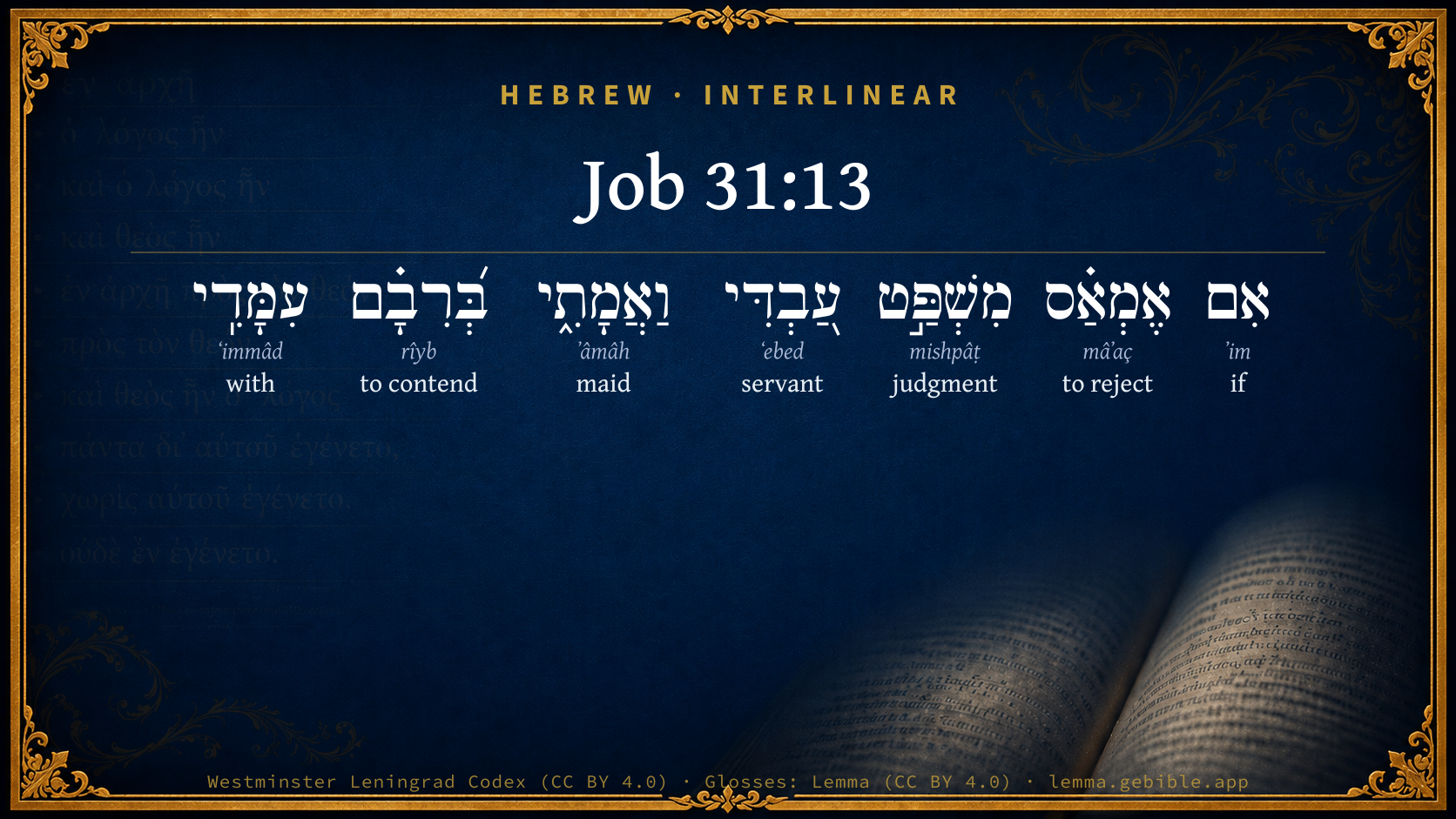
Job 31:13

Hebrew (Westminster Leningrad Codex) Job 31:13 appears in the Hebrew Old Testament. The text above is from the Westminster Leningrad Codex. Each word links to its Strong’s number, a concise gloss, and parsing drawn from the Open Scriptures Hebrew Bible morphology. Click any word for its full Brown-Driver-Briggs (BDB) entry.
Download image
Cite this verse

Job 31:13 (World English Bible). Public Domain. Lemma interlinear Bible study tool, https://lemma.gebible.app/v/job/31/13.

Show BibTeX & RIS
BibTeX
RIS
English Translation
"If I have despised the cause of my man-servant Or of my maid-servant, When they contended with me;
World English Bible · Public Domain
Download a study sheet

One document with this verse’s original text, its word-by-word gloss line, the meaning frame, cross-references with their text, attributed commentary, and full source and license credits — printable, and it pastes into notes with its structure intact.

This verse Autodidact and up

Study sheet (.html) Plain text (.txt)

A passage Seminary Student

Up to 50 verses in one chapter. A passage sheet keeps up to 6 commentary sources and 12 cross-references per verse, in the order this page ranks them, and says so on the sheet whenever that leaves anything out. Ask for a single verse and you get the Autodidact verse sheet above.

Everything on this page stays free to read, with no account — the sheet is a download of what is already on screen, not access to it.

Want to remove ads? Support Godless Engineer
Compare translations 3

The same verse in 3 English versions, stacked beneath the original-language interlinear above. Click any original word for its lexicon entry.

Each is an independent rendering of the whole verse — the interlinear is not word-aligned to these translations.

Highlighted words mark where these versions differ — a whole-verse word diff, not a word-by-word alignment.

  • World English Bible Public Domain
    "If I have despised the cause of my man-servant Or of my maid-servant, When they contended with me;
  • King James Version Public Domain
    If I did despise the cause of my manservant or of my maidservant, when they contended with me;
  • unfoldingWord Literal Text CC BY-SA 4.0
    If I disdained the justice of my male servant or my female servant in their case against me,

unfoldingWord Literal Text — © unfoldingWord, licensed CC BY-SA 4.0. Word-aligned USFM3 via Door43 (git.door43.org/unfoldingWord/en_ult).

Versions to compare (up to 4)

3 of 4 selected

Show all 18 translations

Every available English version of this verse, each an independent rendering of the whole verse.

  • World English Bible Public Domain
    "If I have despised the cause of my man-servant Or of my maid-servant, When they contended with me;
  • Berean Standard Bible Public Domain
    If I have rejected the cause of my manservant or maidservant when they made a complaint against me,
  • Majority Standard Bible Public Domain
    If I have rejected the cause of my manservant or maidservant when they made a complaint against me,
  • King James Version Public Domain
    If I did despise the cause of my manservant or of my maidservant, when they contended with me;
  • American Standard Version (1901) Public Domain
    If I have despised the cause of my man-servant or of my maid-servant, When they contended with me;
  • Revised Version (1885) Public Domain
    If I did despise the cause of my manservant or of my maidservant, when they contended with me:
  • Geneva Bible (1599) Public Domain
    If I did contemne the iudgement of my seruant, and of my mayde, when they did contend with me,
  • Douay-Rheims (1899) Public Domain
    If I have despised to abide judgment with my manservant, or my maidservant, when they had any controversy against me:
  • Young's Literal Translation Public Domain
    If I despise the cause of my man-servant, And of my handmaid, In their contending with me,
  • Literal Standard Version CC BY-SA 4.0
    If I despise the cause of my manservant, || And of my handmaid, || In their contending with me,
  • Unlocked Literal Bible CC BY-SA 4.0
    If I ignored the plea for justice from my male or female servant when they argued with me,
  • unfoldingWord Literal Text CC BY-SA 4.0
    If I disdained the justice of my male servant or my female servant in their case against me,
  • Darby Bible Public Domain
    If I have despised the cause of my bondman or of my bondmaid, when they contended with me,
  • World Messianic Bible Public Domain
    “If I have despised the cause of my male servant or of my female servant, when they contended with me,
  • Webster's Bible Public Domain
    If I despised the cause of my man-servant or of my maid-servant, when they contended with me;
  • Free Bible Version CC BY-SA 4.0
    If I had refused to listen to my menservants or maidservants when they brought their complaints to me,
  • Bible in Basic English Public Domain
    If I did wrong in the cause of my man-servant, or my woman-servant, when they went to law with me;
  • JPS Tanakh (1917) Public Domain
    If I did despise the cause of my man-servant, or of my maid-servant, when they contended with me —

Literal Standard Version (2020), Covenant Press — licensed CC BY-SA 4.0. Text via the HelloAO Bible API (eBible.org). Unlocked Literal Bible (unfoldingWord) — licensed CC BY-SA 4.0. Text via the HelloAO Bible API (eBible.org). unfoldingWord Literal Text — © unfoldingWord, licensed CC BY-SA 4.0. Word-aligned USFM3 via Door43 (git.door43.org/unfoldingWord/en_ult). Free Bible Version, Dr. Jonathan Gallagher — licensed CC BY-SA 4.0. Text via the HelloAO Bible API (eBible.org).

Word by word

More ways to search: Search by grammar → Find every occurrence → Compare this word →

Practice this passage: Drill this verse → Learn its vocabulary →

About this verse

These counts appear in no published source. They are computed here, from the morphology-tagged text and Lemma’s own curated glosses. What Lemma adds →

7
words
7
distinct lemmas
Wisdom
section

Shared distinctive vocabulary

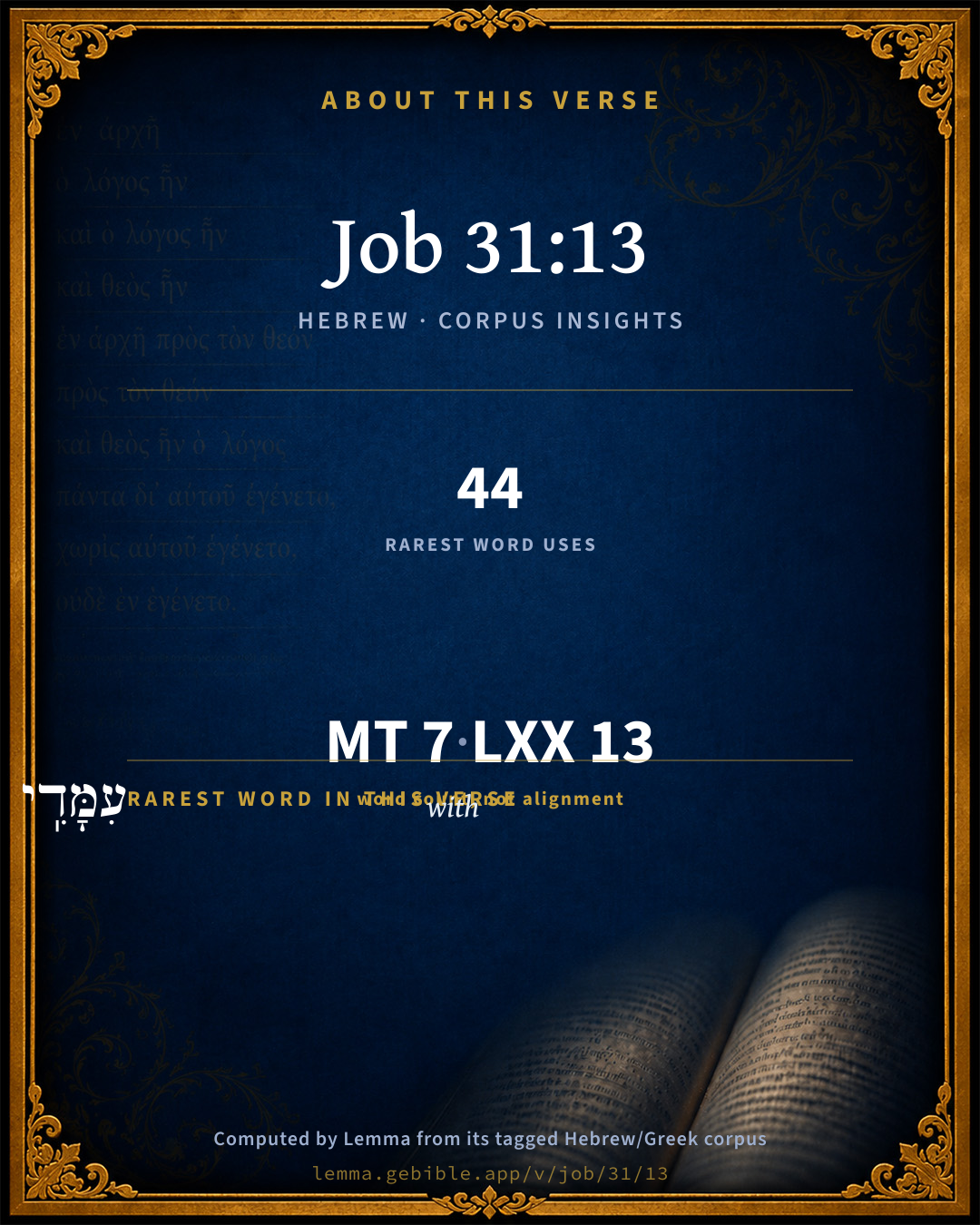
עִמָּדִֽי with H5978 occurs in 44 verses of the Hebrew Bible. Also found in:

Grammatical profile

  • 2 verbs
  • 3 nouns
  • 1 preposition
  • 1 conjunction

Verb forms

  • אֶמְאַ֗ס Qal · Imperfect
  • בְּ֝רִבָ֗ם Niphal · Infinitive Construct

Hebrew & Septuagint length

In English translation the verse runs 18 words from the Hebrew and 18 from the Septuagint (LXX English) — the same length.

A rough comparison of the two English renderings, which tokenize alike — not a word-level alignment.

Word counts can differ between the Hebrew and the Greek without any difference in meaning — e.g. the Hebrew direct-object marker אֵת has no separate Greek word, and Greek often adds the article ὁ.

In the original languages it is 7 Hebrew tokens and 13 Greek tokens — but the two are counted differently (Hebrew bundles its prefixes and suffixes into one token; the Greek is in lemma form), so that isn’t a like-for-like length.

Cross-references

9

Topical passages linked to Job 31:13 in the Treasury of Scripture Knowledge — connected by theme and wording, ordered by reader-vote popularity; previews shown in the World English Bible.

  • Exodus 21:20–21 "If a man strikes his servant or his maid with a rod, and he dies under his hand, he shall surely be punished.
  • Exodus 21:26–27 "If a man strikes his servant's eye, or his maid's eye, and destroys it, he shall let him go free for his eye's sake.
  • Leviticus 25:43 You shall not rule over him with harshness, but shall fear your God.
  • Leviticus 25:46 You may make them an inheritance for your children after you, to hold for a possession; of them may you take your slaves forever: but over your brothers the children of Israel you shall not rule, one over another, with harshness.
  • Deuteronomy 15:12–15 If your brother, a Hebrew man, or a Hebrew woman, be sold to you, and serve you six years; then in the seventh year you shall let him go free from you.
  • Deuteronomy 24:14–15 You shall not oppress a hired servant who is poor and needy, whether he be of your brothers, or of your foreigners who are in your land within your gates:
  • Jeremiah 34:14–17 At the end of seven years you shall let go every man his brother who is a Hebrew, who has been sold to you, and has served you six years, you shall let him go free from you: but your fathers didn't listen to me, neither inclined their ear.
  • Ephesians 6:9 You masters, do the same things to them, and give up threatening, knowing that he who is both their Master and yours is in heaven, and there is no partiality with him.
  • Colossians 4:1 Masters, give to your servants that which is just and equal, knowing that you also have a Master in heaven.

Cross-references courtesy of OpenBible.info (CC BY 4.0).

Hebrew and Greek witnesses Masoretic Hebrew ↔ Greek Septuagint

The same verse in the two great witnesses to the Old Testament, shown verse-for-verse.

These are two independent witnesses, not word-aligned to each other, and the Septuagint is shown in lemma (dictionary) form.

Hebrew Job 31:13 Masoretic · Westminster Leningrad Codex

אִם אֶמְאַ֗ס מִשְׁפַּ֣ט עַ֭בְדִּי וַאֲמָתִ֑י בְּ֝רִבָ֗ם עִמָּדִֽי

"If I have despised the cause of my man-servant Or of my maid-servant, When they contended with me;

World English Bible · Public Domain

Greek LXX Job 31:13 Septuagint · lemma form

εἰ δέ καί φαυλίζω κρίμα θεράπων ἐγώ ἤ θεραπαίνα κρίνω αὐτός πρός ἐγώ

And if too I despised the judgment of my servant or my handmaid, when they pleaded with me;

LXX2012 (modern English Septuagint) · Public Domain

On this verse, Keil & Delitzsch discusses the Septuagint’s reading. Read the note in Commentary ↓

Hebrew: Westminster Leningrad Codex (CC BY 4.0). Greek: Septuagint (public domain); English from LXX2012 (modern English Septuagint) (Public Domain). How the Septuagint differs from the Hebrew →

Commentary

Notes on Job 31:13 from classic Christian and Jewish commentators (each source and its license shown beneath its notes). The classic Christian expositions comment on the surrounding passage and are grouped to its opening verse, so a note may address several verses; the Jewish commentaries on the Tanakh (Rashi and others) are per-verse, so they appear only where the commentator wrote on this verse.

Lemma curates 59 commentaries, every one of them public domain or Creative Commons licensed, each selected and text-cleaned for this edition rather than reprinted as found. About our sources →

The Cambridge Bible for Schools and Colleges

gen. ed. J. J. S. Perowne

13. Job refers to what he might have done in his high position; he might have “despised” or slighted the cause of his servants when they had ground of complaint against him. He treated them not as possessions but as persons, who had rights as well as himself, 14, 15. This treatment of them was forced on him by the feeling that all men, his servant and himself alike, are children of the same one God, who will avenge wrong done to any, whether slave or free; Eph_6:9.

13–23. Job repudiates all misuse of the power which his rank gave him, denying (1) that he treated contemptuously his servants when they had a cause against him, Job_31:13-15; (2) that he was indifferent to the wants of the unprotected, or refused to bestow on them of his own bread and raiment, Job_31:16-20; (3) that he violently wronged any, even though he could have secured a judgment favourable to him before the tribunal, Job_31:21; after which follows the imprecation, Job_31:22-23.

The Cambridge Bible for Schools and Colleges (gen. ed. J. J. S. Perowne; Cambridge University Press, 1878–1918) — public domain. Text from a community e-Sword module.

Trapp's Complete Commentary

John Trapp

Job 31:13 If I did despise the cause of my manservant or of my maidservant, when they contended with me;

Ver. 13. If I did despise the cause of my many, errant, &c.] Servants of old (among the heathen especially) were mere slaves to their masters according to the flesh, who had power to use them at their pleasure, as they did their cattle. A servant (saith Aristotle) is the master’s instrument, and wholly his ολων εκεινου. He might do what he would to them, saith Seneca, even to the taking away of their lives, without danger of law. But Job held with the same Seneca, that posse et nolle nobile est; and that in some cases, Nimis angusta innocentia est, ad legem bonum esse; that utmost right is utmost wrong; and that there will come a reckoning afterwards, the forethought whereof awed him, and swayed him to do his servants right, when he might have oppressed them and tyrannized over them; as now the Turks do over their galley slaves. Of Archbishop Cranmer it is recorded, that he never raged so far with any of his household servants as once to call the meanest of them varlet or knave in anger. Tremellius, who was for a time entertained in his house, saith of it, that it was schola vel palaestra pietatis et literarum, A school or nursery of piety and learning. And therefore what wonder that there was so good accord between him and his family, when there was so careful a performance of domestic duties, and he was not a better man than a master? Think the same of Job, discontents might occur in his house, and complaints might be made, which he heard with patience, and then set all to rights again, taking course that he might be both loved and feared by all about him.

John Trapp, A Commentary or Exposition upon All the Books of the Old and New Testament (1647–1656) — public domain. Text from a community e-Sword module.

Joseph Benson's Commentary

Job 31:13-15. If I did despise the cause of my man-servant — If I used my power over him to overthrow him and his just rights; when they contended with me — Either for requiring more work from them than they could perform, or for not providing for them those supports which their nature and necessity required, or for any other plausible cause. I heard them patiently, considered the matters complained of impartially, and did them right even against myself, if through any misinformation, or fancied provocation, I had done them an injury. What then shall I do when God riseth up? — Namely, to plead the cause of the oppressed against the oppressor, and to execute judgment. I used my servant like one who knew that I myself also was a servant, and had a master in heaven, to whom I was to give an account of my conduct toward my servant and all men. And when he visiteth — That is, when he shall call me to his tribunal, and strictly examine all my actions, and particularly the cause between me and my servant; what shall I answer him? — What apology shall I make for myself? Did not he that made me, &c. — I considered that, though he was my servant, he was my fellow-creature, made by the same God, and therefore one of God’s subjects, whom I could not injure without injustice to the supreme Lord. And did not one fashion us, &c. — With a body and soul of the same nature and quality, a rational and immortal creature, and made after God’s image no less than myself, to whom therefore I owed some respect for God’s sake.

Joseph Benson's Commentary on the Old and New Testaments (1811–1818) — public domain. Text from a community e-Sword module.

Keil & Delitzsch

C. F. Keil & F. Delitzsch

13 If I despised the cause of my servant and my maid,

When they contended with me:

14 What should I do, if God should rise up,

And if He should make search, what should I answer Him?

15 Hath not He who formed me in the womb formed him also,

And hath not One fashioned us in the belly?

It might happen, as Job 31:13 assumes, that his servant or his maid (אמה, Arab. amatun, denotes a maid who is not necessarily a slave, ‛abde, as Job 19:15, whereas שׁפחה does not occur in the book) contended with him, and in fact so that they on their part began the dispute (for, as the Talmud correctly points out, it is not בּריבי עמּם, but בּריבם עמּדי), but he did not then treat them as a despot; they were not accounted as res but personae by him, he allowed them to maintain their personal right in opposition to him. Christopher Scultetus observes here: Gentiles quidem non concedebant jus servo contra dominum, cui etiam vitae necisque potestas in ipsum erat; sed Iob amore justitiae libere se demisit, ut vel per alios judices aut arbitros litem talem curaret decidi vel sibi ipsi sit moderatus, ut juste pronuntiaret. If he were one who despised (אמאס not מאסתּי) his servants' cause: what should he do if God arose and entered into judgment; and if He should appoint an examination (thus Hahn correctly, for the conclusion shows that פקד is here a synon. of בחן Psa 17:3, and חקר Psa 44:22, Arab. fqd, V, VIII, accurate inspicere), what should he answer?

Job 31:15

The same manner of birth, by the same divine creative power and the same human agency, makes both master and servant substantially brethren with equal claims: Has not He who brought me forth in my mother's womb (also) brought forth him (this my servant or my maid), and has not One fashioned us in our mother's belly? אחד, unus, viz., God, is the subj., as Mal 2:10, אחד (אב) אל (for the thought comp. Eph 6:9), as it is also translated by the Targ., Jer., Saad., and Gecat.; whereas the lxx (ἐν τῇ αὐτῇ κοιλίᾳ), Syr., Symm. (as it appears from his translation ἐν ὁμοίῳ τρόπῳ), construe אחד as the adj. to בּרחם, which is also the idea of the accentuation (Rebia mugrasch, Mercha, Silluk). On the other hand, it has been observed (also Norzi) that it ought to be האסחד according to this meaning; but it was not absolutely necessary, vid., Ges. 111, 2, b. אחד also would not be unsuitable in this combination; it would, as e.g., in אחד חלום, not affirm identity of number, but of character. But אחד is far more significant, and as the final word of the strophe more expressive, when referred to God. The form ויכוּננּוּ is to be judged of just like ותּמוּגנוּ, Isa 54:6; either they are forms of an exceptionally transitive (as שׁוּב, Psa 85:5, and in שׁוב שׁבות) use of the Kal of these verbs (vid., e.g., Parchon and Kimchi), or they are syncopated forms of the Pilel for ויכנננּוּ, ותּמגגנוּ, syncopated on account of the same letters coming together, especially in ויכנננו (Ew. 81, a, and most others); but this coincidence is sought elsewhere (e.g., Psa 50:23; Pro 1:28), and not avoided in this manner (e.g., Psa 119:73). Beside this syncope ויכוּננּוּ might also be expected, while according to express testimony the first Nun is raphatum: we therefore prefer to derive these forms from Kal, without regarding them, with Olsh., as errors in writing. The suff. is rightly taken by lxx, Targ., Abulwalid, and almost all expositors,

(Note: Also in the Jerusalem Talmud, where R. Johanan, eating nothing which he did not also share with his slave, refers to these words of Job. Comp. also the story from the Midrash in Guiseppe Levi's Parabeln Legenden und Ged. aus Thalmud und Midrasch, S. 141 (Germ. transl. 1863): The wife of R. Jose began a dispute with her maid. Her husband came up and asked the cause, and when he saw that his wife was in the wrong, told her so in the presence of the maid. The wife said in a rage: Thou sayest I am wrong in the presence of my maid? The Rabbi answered: I do as Job did.)

not as singular (ennu = êhu), but as plural (ennu = ênu); The Babylonian school pointed ויכוּננוּ, like ממנו where it signifies a nobis, ממּנוּ (Psalter ii. 459, and further information in Pinsker's works, Zur Geschichte des Karaismus, and Ueber das sogen. assyrische Punktationssystem). Therefore: One, i.e., one and the same God, has fashioned us in the womb without our co-operation, in an equally animal way, which smites down all pride, in like absolute conditionedness.

Keil & Delitzsch — Biblical Commentary on the Old Testament (1861–1891) — public domain (CC PDM 1.0). Text via the HelloAO Bible API. (Old Testament only.)

Tyndale Open Study Notes

Tyndale Open Resources

31:13-15 unfair to . . . servants: This might refer to violations of the fourth commandment (Deut 5:12-15). • God created both me and my servants: Job extended the implications of being created in God’s image to the poor (Prov 14:31; 22:2) and even to slaves.

Tyndale Open Study Notes — © Tyndale Open Resources, licensed CC BY-SA 4.0. Text via the HelloAO Bible API.

Geneva Bible (1599)

Geneva Bible translators

When they thought themselves evil entreated by me.

Geneva Bible (1599) marginal notes — public domain. Text via Bolls.life.

Jamieson, Fausset & Brown

Robert Jamieson, A. R. Fausset & David Brown

Job affirms his freedom from unfairness towards his servants, from harshness and oppression towards the needy.

despise the cause--refused to do them justice.

Jamieson, Fausset & Brown — Commentary Critical and Explanatory on the Whole Bible (1871) — public domain (CC PDM 1.0). Text via the HelloAO Bible API.

Adam Clarke's Commentary

Verse 13. The cause of my man-servant] In ancient times slaves had no action at law against their owners; they might dispose of them as they did of their cattle, or any other property. The slave might complain; and the owner might hear him if he pleased, but he was not compelled to do so. Job states that he had admitted them to all civil rights; and, far from preventing their case from being heard, he was ready to permit them to complain even against himself, if they had a cause of complaint, and to give them all the benefit of the law.

Adam Clarke's Commentary on the Bible (1810–1826) — public domain. Text from a community e-Sword/MySword module.

Ellicott's Commentary for English Readers

(13) If I did despise.—In Job_22:8, Eliphaz had insinuated that Job had favoured the rich and powerful, but had oppressed and ground down the weak. He now meets this accusation, and affirms that he had regarded his own servants even as brethren, because partakers of a common humanity.

A Bible Commentary for English Readers, edited by Charles John Ellicott (1878–1897) — public domain. Text from a community e-Sword module.

John Gill's Exposition

What then shall I do when God riseth up?.... That is, if he had despised and rejected the cause of his servants, or had neglected, or refused to do them justice; he signifies he should be at the utmost loss to know what to do, what excuse to make, or what to say in his own defence, when God should rise up to defend the cause of the injured; either in a way of Providence in this life, or at the great day of judgment in the world to come, when everything will be brought to account, and masters and servants must stand alike before the judgment seat of God, to receive for the things they have done, whether good or evil:

and when he visiteth, what shall I answer him? when he makes a visitation among men, either in this world, even in a fatherly way, visits transgressions, and reproves and corrects for them; had he been guilty of ill usage of his servants, he must have silently submitted to such visitations and chastisements, having nothing to say for himself why he should not be thus dealt with; or in the world to come, in the great day of visitation, when God shall make inquisition for sin, and seek it out, and call to an account for it; and should this be produced against him, even contempt of the cause of his servants, he was sensible he could not answer him for it, nor for anyone sin of a thousand, as no man will be able to do; but must be speechless, unless he has a better righteousness than his own to answer for him in that time to come. This is Job's first reason which deterred him from using his servants ill; another follows.

John Gill's Exposition of the Whole Bible (1746–1763) — public domain (CC PDM 1.0). Text via the HelloAO Bible API.

Albert Barnes' Notes on the Bible

If I did despise the cause of my man-servant - Job turns to another subject, on which he claimed that his life had been upright. It was in reference to the treatment of his servants. The meaning here is, “I never refused to do strict justice to my servants when they brought their cause before me, or when they complained that my dealings with them had been severe.”

When they contended with me - That is, when they brought their cause before me, and complained that I had not provided for them comfortably, or that their task had been too hard. If in any respect they supposed they had cause of complaint, I listened to them attentively, and endeavored to do right. He did not take advantage of his sower to oppress them, nor did he suppose that they had no rights of any kind. It is evident, from this, that Job had those who sustained to him the relation of servants; but whether they were slaves, or hired servants, is not known. The language here will agree with either supposition, though it cannot be doubted that slavery was known as early as the time of Job. There is no certain evidence that he held any slaves, in the proper sense of the term, nor that he regarded slavery as right; compare the notes at Job 1:3. He here refers to the numerous persons that had been in his employ in the days of his prosperity, and says that he had never taken advantage of his power or rank to do them wrong.

Albert Barnes' Notes on the Bible (1834–1885) — public domain. Text from a community e-Sword/MySword module.

Haydock's Catholic Bible Commentary

Me, in private; as slaves had no redress in the common courts of judicature. We cannot but admire Job’s humility, and noble sentiments of God, (Calmet) whose majesty will eclipse all human grandeur, and place the master and the servant on the same level. (St. Gregory; St. Augustine, City of God x. 25.) (Ephesians vi. 9., and Colossians iv. 1.)

George Leo Haydock (1774–1849), Haydock's Catholic Family Bible and Commentary, 1859 edition — public domain. Excludes Psalms (Douay-Rheims chapter numbering differs from Protestant) and Deuterocanonical books (Catholic canon only).

Matthew Poole's English Annotations

If I did despise the cause of my man-servant; if I used my power over him to overthrow him or his just rights. And seeing it is known that I was so just and kind to them, over whom I had such unlimited power, it is not probable that I should be guilty of such cruelty to others, as you impute to me.

When they contended with me; either for imposing heavier burdens than they could bear; or for not providing for them those supports which their nature and necessity required, or for any other plausible cause. I heard them patiently and indifferently, and did them right even against myself, if by any misinformation or passion I had done them any injury.

Matthew Poole's English Annotations on the Holy Bible (1683–1685) — public domain. Text from a community e-Sword/MySword module.

Whedon's Commentary on the Bible

Daniel D. Whedon

13. The cause of my manservant — The importance of the subject is indicated by the form of oath, if, now for the fourth time introduced. His servants were regarded not as chattels, but as human beings. True nobility of character is as truly displayed in the proper treatment of dependents as in any of the so-called higher relationships of life.

Daniel D. Whedon (gen. ed.), Commentary on the Old and New Testaments (1874–1909) — public domain. Text from a community e-Sword module.

The Pulpit Commentary

If I did despise the cause of my manservant or of my maidservant. Job now disclaims a fourth sin the oppression of his dependents. Eliphaz had taxed him generally with harshness and cruelty in his relations towards those weaker than himself, (Job_22:5-9) but had not specially pointed to this kind of oppressiveness. As, however, this was the commonest form of the vice, Job deems it right to disclaim it, before addressing himself to the several charges brought by Eliphaz. He has not ill used his slaves, either male or female. He has not "despised their cause," but given it full consideration and attention; he has heard them when they contended with him; he has allowed them to "contend;" he has been a just, and not a hard master. The slavery of which he speaks is evidently of a kind under which the slave had certain rights, as was the ease also under the Mosaic Law. (Exo_21:2-11)

The Pulpit Commentary (1880–1919), ed. H.D.M. Spence-Jones & Joseph S. Exell — public domain. Text from a community e-Sword module.

unfoldingWord translationNotes

Door43 World Missions Community

General Information:

Job continues describing situations in which he would deserve God's punishment, but he knows they are not true. (See: Hypothetical Situations)

what then would I do when God rises up to accuse me? When he comes to judge me, how would I answer him?

Job uses these questions to emphasize that if God were to judge him, Job would not be able to make himself appear to be good. AT: "then there would be absolutely nothing I could say to defend myself when God comes to judge me." (See: Rhetorical Question)

Did the one who made me in the womb not make them also? Did not the same one mold us all in the womb?

Job uses these questions to emphasize that he is no different from his servants. He implies that God would be angry if Job were to treat his servants as less valuable than himself. AT: "The one who made me in the womb also made them. He formed us all in the womb." (See: Rhetorical Question)

translationWords

just

servant

raise

accuse

womb

unfoldingWord translationNotes — © Distant Shores Media and the Door43 World Missions Community, licensed CC BY-SA 4.0. Source: git.door43.org/Door43/en_tn.

Lesson kit

Teaching starters — assembled from the data on this page, not authored interpretation. Every prompt links to the verse data it draws on. Edit before teaching.

Job, in the Wisdom, opens this verse with 7 words (7 distinct Hebrew lemmas). Its most distinctive word is ʻimmâd (“with”). A historical commentator’s framing appears above. Read the whole chapter for the surrounding context.

Discussion questions

  1. What does “with” (ʻimmâd) contribute to the verse as a whole?
  2. How does Genesis 3:12, which shares the word «with», read alongside this verse?
  3. These translations render this verse differently. What is at stake in choosing one wording over another?
  4. «אֶמְאַ֗ס» is a Qal Imperfect verb. How does that grammatical form shape the action described?
  5. Compare how The Cambridge Bible for Schools and Colleges and Trapp's Complete Commentary read this verse. Where do they agree or differ?

Things to notice

Reading settings

Reading text

Shown beneath each verse's original-language words.

Old Testament
Old Testament edition

Read the OT as the Masoretic Hebrew (MT) or the Greek Septuagint (LXX).

English shown for the Greek Septuagint (in the Hebrew ↔ Greek comparison).

Comparing translations? Open the Compare panel on any verse page to stack up to four side by side.