
Job 23:4

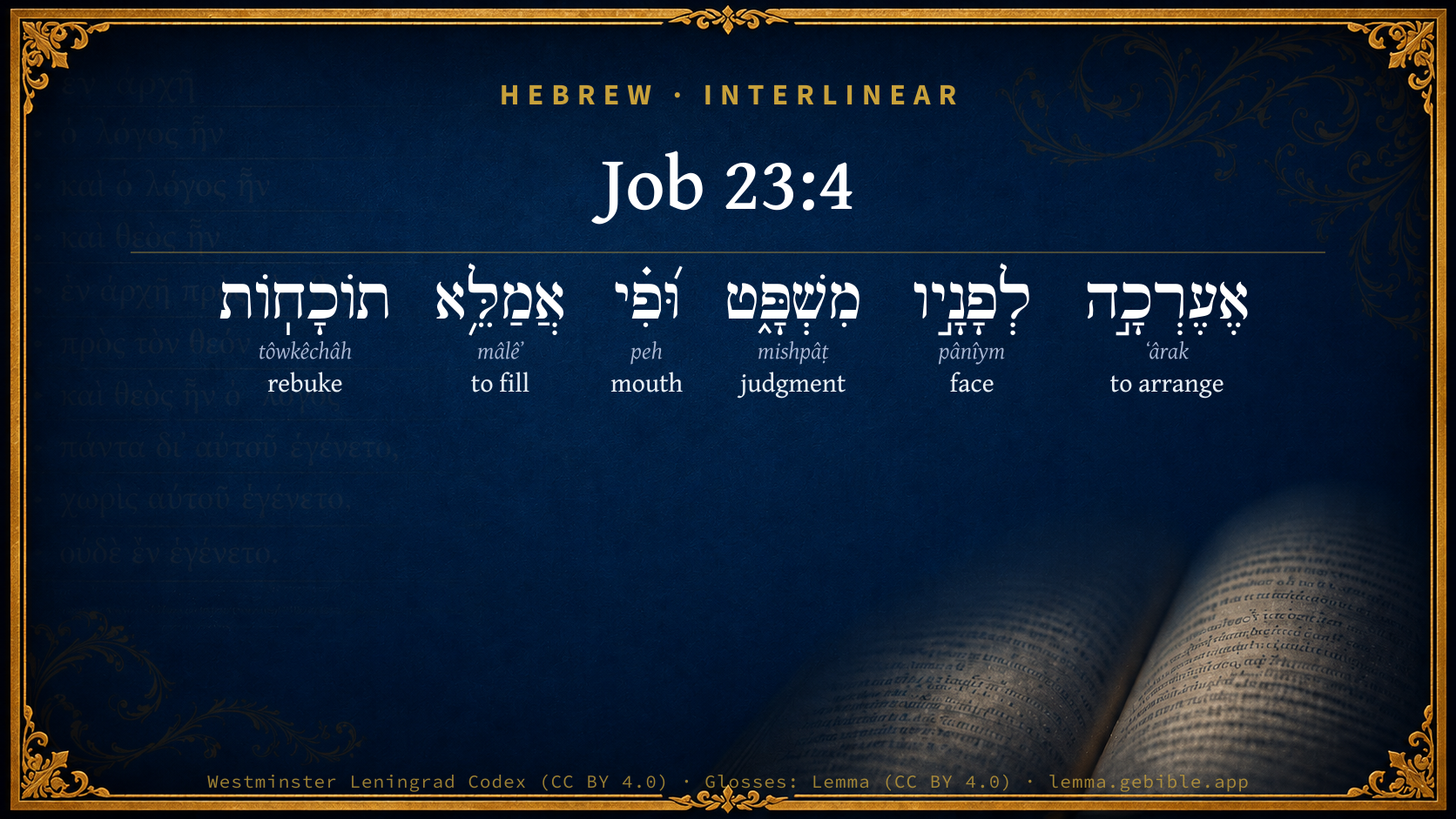
Hebrew (Westminster Leningrad Codex) Job 23:4 appears in the Hebrew Old Testament. The text above is from the Westminster Leningrad Codex. Each word links to its Strong’s number, a concise gloss, and parsing drawn from the Open Scriptures Hebrew Bible morphology. Click any word for its full Brown-Driver-Briggs (BDB) entry.
Download image
Cite this verse

Job 23:4 (World English Bible). Public Domain. Lemma interlinear Bible study tool, https://lemma.gebible.app/v/job/23/4.

Show BibTeX & RIS
BibTeX
RIS
English Translation
I would set my cause in order before him, And fill my mouth with arguments.
World English Bible · Public Domain
Download a study sheet

One document with this verse’s original text, its word-by-word gloss line, the meaning frame, cross-references with their text, attributed commentary, and full source and license credits — printable, and it pastes into notes with its structure intact.

This verse Autodidact and up

Study sheet (.html) Plain text (.txt)

A passage Seminary Student

Up to 50 verses in one chapter. A passage sheet keeps up to 6 commentary sources and 12 cross-references per verse, in the order this page ranks them, and says so on the sheet whenever that leaves anything out. Ask for a single verse and you get the Autodidact verse sheet above.

Everything on this page stays free to read, with no account — the sheet is a download of what is already on screen, not access to it.

Want to remove ads? Support Godless Engineer
Compare translations 3

The same verse in 3 English versions, stacked beneath the original-language interlinear above. Click any original word for its lexicon entry.

Each is an independent rendering of the whole verse — the interlinear is not word-aligned to these translations.

Highlighted words mark where these versions differ — a whole-verse word diff, not a word-by-word alignment.

  • World English Bible Public Domain
    I would set my cause in order before him, And fill my mouth with arguments.
  • King James Version Public Domain
    I would order my cause before him, and fill my mouth with arguments.
  • unfoldingWord Literal Text CC BY-SA 4.0
    I would set forth my case to his face, and I would fill my mouth with arguments.

unfoldingWord Literal Text — © unfoldingWord, licensed CC BY-SA 4.0. Word-aligned USFM3 via Door43 (git.door43.org/unfoldingWord/en_ult).

Versions to compare (up to 4)

3 of 4 selected

Show all 18 translations

Every available English version of this verse, each an independent rendering of the whole verse.

  • World English Bible Public Domain
    I would set my cause in order before him, And fill my mouth with arguments.
  • Berean Standard Bible Public Domain
    I would plead my case before Him and fill my mouth with arguments.
  • Majority Standard Bible Public Domain
    I would plead my case before Him and fill my mouth with arguments.
  • King James Version Public Domain
    I would order my cause before him, and fill my mouth with arguments.
  • American Standard Version (1901) Public Domain
    I would set my cause in order before him, And fill my mouth with arguments.
  • Revised Version (1885) Public Domain
    I would order my cause before him, and fill my mouth with arguments.
  • Geneva Bible (1599) Public Domain
    I would pleade the cause before him, and fill my mouth with arguments.
  • Douay-Rheims (1899) Public Domain
    I would set judgment before him, and would fill my mouth with complaints.
  • Young's Literal Translation Public Domain
    I arrange before Him the cause, And my mouth fill `with' arguments.
  • Literal Standard Version CC BY-SA 4.0
    I arrange the cause before Him, || And fill my mouth [with] arguments.
  • Unlocked Literal Bible CC BY-SA 4.0
    I would lay my case in order before him and fill my mouth with arguments.
  • unfoldingWord Literal Text CC BY-SA 4.0
    I would set forth my case to his face, and I would fill my mouth with arguments.
  • Darby Bible Public Domain
    I would order the cause before him, and fill my mouth with arguments;
  • World Messianic Bible Public Domain
    I would set my cause in order before him, and fill my mouth with arguments.
  • Webster's Bible Public Domain
    I would order my cause before him, and fill my mouth with arguments.
  • Free Bible Version CC BY-SA 4.0
    There I would lay out my case before him and present all my arguments in full.
  • Bible in Basic English Public Domain
    I would put my cause in order before him, and my mouth would be full of arguments.
  • JPS Tanakh (1917) Public Domain
    I would order my cause before Him, and fill my mouth with arguments.

Literal Standard Version (2020), Covenant Press — licensed CC BY-SA 4.0. Text via the HelloAO Bible API (eBible.org). Unlocked Literal Bible (unfoldingWord) — licensed CC BY-SA 4.0. Text via the HelloAO Bible API (eBible.org). unfoldingWord Literal Text — © unfoldingWord, licensed CC BY-SA 4.0. Word-aligned USFM3 via Door43 (git.door43.org/unfoldingWord/en_ult). Free Bible Version, Dr. Jonathan Gallagher — licensed CC BY-SA 4.0. Text via the HelloAO Bible API (eBible.org).

Word by word

More ways to search: Search by grammar → Find every occurrence → Compare this word →

Practice this passage: Drill this verse → Learn its vocabulary →

About this verse

These counts appear in no published source. They are computed here, from the morphology-tagged text and Lemma’s own curated glosses. What Lemma adds →

6
words
6
distinct lemmas
Wisdom
section

Shared distinctive vocabulary

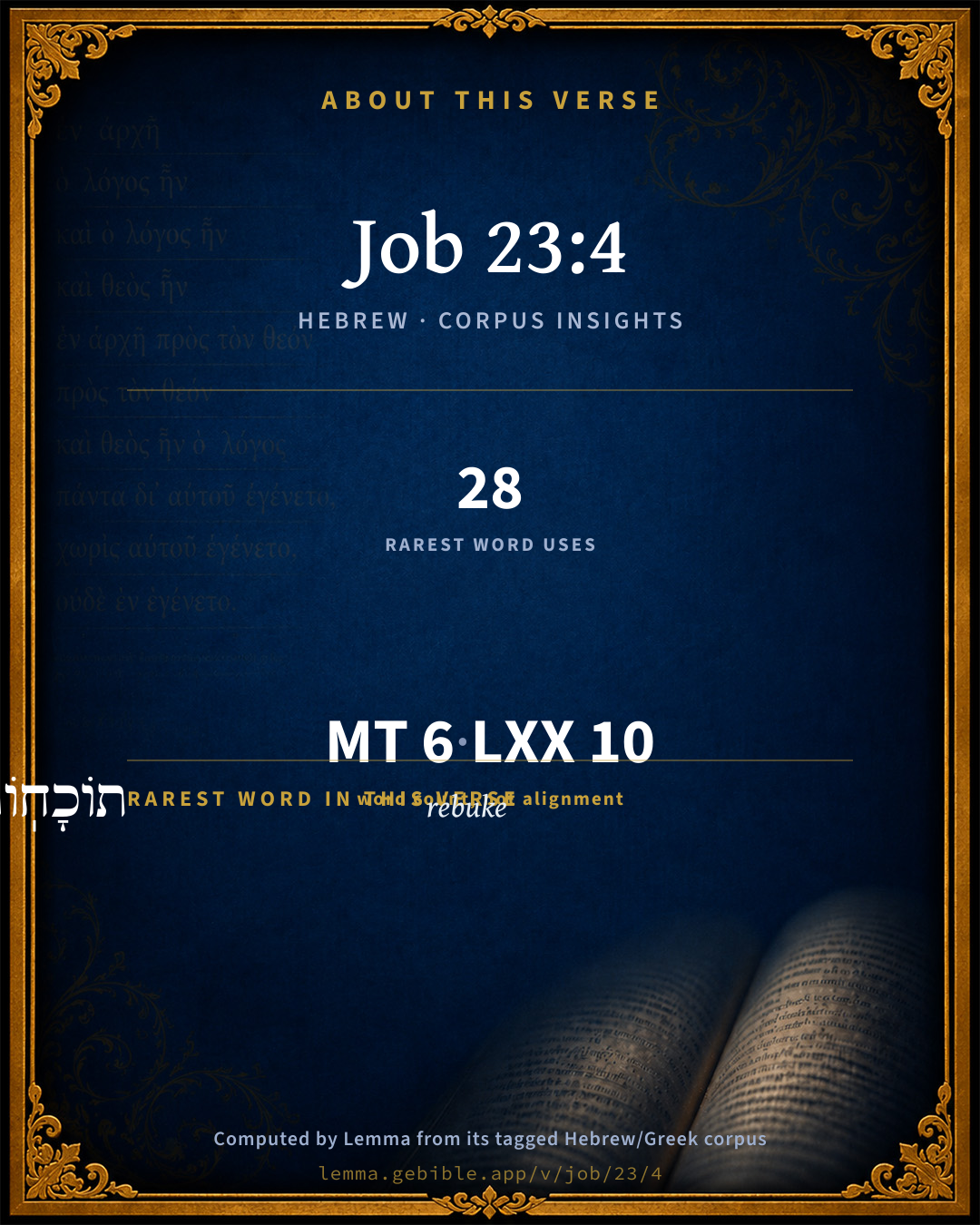
תוֹכָחֽוֹת rebuke H8433 occurs in 28 verses of the Hebrew Bible. Also found in:

Grammatical profile

  • 2 verbs
  • 4 nouns

Verb forms

  • אֶעֶרְכָ֣ה Qal · Cohortative
  • אֲמַלֵּ֥א Piel · Imperfect

Hebrew & Septuagint length

In English translation the verse runs 15 words from the Hebrew and 15 from the Septuagint (LXX English) — the same length.

A rough comparison of the two English renderings, which tokenize alike — not a word-level alignment.

Word counts can differ between the Hebrew and the Greek without any difference in meaning — e.g. the Hebrew direct-object marker אֵת has no separate Greek word, and Greek often adds the article ὁ.

In the original languages it is 6 Hebrew tokens and 10 Greek tokens — but the two are counted differently (Hebrew bundles its prefixes and suffixes into one token; the Greek is in lemma form), so that isn’t a like-for-like length.

Cross-references

11

Topical passages linked to Job 23:4 in the Treasury of Scripture Knowledge — connected by theme and wording, ordered by reader-vote popularity; previews shown in the World English Bible.

  • Job 13:18 See now, I have set my cause in order. I know that I am righteous.
  • Daniel 9:18–19 My God, turn your ear, and hear; open your eyes, and see our desolations, and the city which is called by your name: for we do not present our petitions before you for our righteousness, but for your great mercies' sake.
  • Genesis 18:25–32 Be it far from you to do things like that, to kill the righteous with the wicked, that so the righteous should be as the wicked. May that be far from you. Shouldn't the Judge of all the earth do right?"
  • Genesis 32:12 You said, 'I will surely do you good, and make your seed as the sand of the sea, which can't be numbered because there are so many.'"
  • Exodus 32:12–13 Why should the Egyptians speak, saying, 'He brought them forth for evil, to kill them in the mountains, and to consume them from the surface of the earth?' Turn from your fierce wrath, and repent of this evil against your people.
  • Numbers 14:13–19 Moses said to Yahweh, Then the Egyptians will hear it; for you brought up this people in your might from among them;
  • Joshua 7:8–9 Oh, Lord, what shall I say, after that Israel has turned their backs before their enemies!
  • Job 37:19 Teach us what we shall tell him; For we can't make our case by reason of darkness.
  • Psalms 25:11 For your name's sake, Yahweh, Pardon my iniquity, for it is great.
  • Psalms 43:1 Vindicate me, God, and plead my cause against an ungodly nation. Oh, deliver me from deceitful and wicked men.
  • Isaiah 43:26 Put me in remembrance; let us plead together: set you forth [your cause], that you may be justified.

Cross-references courtesy of OpenBible.info (CC BY 4.0).

Hebrew and Greek witnesses Masoretic Hebrew ↔ Greek Septuagint

The same verse in the two great witnesses to the Old Testament, shown verse-for-verse.

These are two independent witnesses, not word-aligned to each other, and the Septuagint is shown in lemma (dictionary) form.

Hebrew Job 23:4 Masoretic · Westminster Leningrad Codex

אֶעֶרְכָ֣ה לְפָנָ֣יו מִשְׁפָּ֑ט וּ֝פִ֗י אֲמַלֵּ֥א תוֹכָחֽוֹת

I would set my cause in order before him, And fill my mouth with arguments.

World English Bible · Public Domain

Greek LXX Job 23:4 Septuagint · lemma form

εἶπον δέ ἐμαυτοῦ κρίμα ὁ δέ στόμα ἐγώ ἐνπίμπλημι ἔλεγχος

And I would plead my own cause, and he would fill my mouth with arguments.

LXX2012 (modern English Septuagint) · Public Domain

On this verse, The Pulpit Commentary discusses the Septuagint’s reading. Read the note in Commentary ↓

Hebrew: Westminster Leningrad Codex (CC BY 4.0). Greek: Septuagint (public domain); English from LXX2012 (modern English Septuagint) (Public Domain). How the Septuagint differs from the Hebrew →

Commentary

Notes on Job 23:4 from classic Christian and Jewish commentators (each source and its license shown beneath its notes). The classic Christian expositions comment on the surrounding passage and are grouped to its opening verse, so a note may address several verses; the Jewish commentaries on the Tanakh (Rashi and others) are per-verse, so they appear only where the commentator wrote on this verse.

Lemma curates 59 commentaries, every one of them public domain or Creative Commons licensed, each selected and text-cleaned for this edition rather than reprinted as found. About our sources →

Trapp's Complete Commentary

John Trapp

Job 23:4 I would order [my] cause before him, and fill my mouth with arguments.

Ver. 4. I would order my cause before him] I would not stick to approach to his tribunal, there to plead my cause (not against him, as being the supreme Judge, and not either plaintiff or defendant, but) against your false and wrongful accusations, which undoubtedly I would disprove and confute by many forcible and strong arguments (Beza).

And fill my mouth with arguments] Heb. Redargutions (ελεγχος,) increpations, reprehensions. A good orator will first rightly lay down his cause, state the question, as we call it. 2. Confirm it with reasons. 3. Observe what is said to the contrary, and confute it. Job would do all this if he might have audience; but if to God all this, Job was much mistaken. And so at another time, when in a better mind, he could say, "Whom, though I were righteous, yet would I not answer, but I would make supplication to my judge. If I justify myself, mine own mouth shall condemn me," &c., Job 9:15; Job 9:20.

John Trapp, A Commentary or Exposition upon All the Books of the Old and New Testament (1647–1656) — public domain. Text from a community e-Sword module.

Tyndale Open Study Notes

Tyndale Open Resources

23:4 present my arguments: Job wanted to make his case with God (13:3, 18, 22; 16:21; 31:35); Abraham pled directly with God regarding Sodom (Gen 18:25-32), and Moses did the same for Israel (Exod 32:12-13; Num 14:13-19).

Tyndale Open Study Notes — © Tyndale Open Resources, licensed CC BY-SA 4.0. Text via the HelloAO Bible API.

Jamieson, Fausset & Brown

Robert Jamieson, A. R. Fausset & David Brown

order--state methodically (Job 13:18; Isa 43:26).

fill, &c.--I would have abundance of arguments to adduce.

Jamieson, Fausset & Brown — Commentary Critical and Explanatory on the Whole Bible (1871) — public domain (CC PDM 1.0). Text via the HelloAO Bible API.

John Gill's Exposition

I would know the words which he would answer me,.... Being a God hearing and answering prayer, who always hears, and sooner or later answers the petitions of his people in his own way; and which when he does, they know, take notice, and observe it: or then he should know the reason why the Lord contended with him, and what were his sins and transgressions, which were the cause of his afflictions; things he had desired to know, but as yet had no answer, see Job 10:2;

and understand what he would say unto me; what judgment he would pass upon him, what sentence he would pronounce on him, whether guilty or not, and by which judgment he was content to stand or fall; as for men's judgment, the judgment of his friends, or to be judged by them, he required it not, as he did not understand upon what ground they went, or that it was a good one; but the judgment of God he should pay a deference to, as being always according to truth, and the reason of which, when he should have a hearing before him, and a decisive sentence by him, he should clearly perceive; see Co1 4:3.

John Gill's Exposition of the Whole Bible (1746–1763) — public domain (CC PDM 1.0). Text via the HelloAO Bible API.

Albert Barnes' Notes on the Bible

I would order my cause before him - Compare the notes at Isa 43:26. That is, I would arrange my arguments, or plead my cause, as one does in a court of justice. I would suggest the considerations which would show that I am not guilty in the sense charged by my friends, and that notwithstanding my calamities, I am the real friend of God.

And fill my mouth with arguments - Probably he means that he would appeal to the evidence furnished by a life of benevolence and justice, that he was not a hypocrite or a man of distinguished wickedness, as his friends maintained.

Albert Barnes' Notes on the Bible (1834–1885) — public domain. Text from a community e-Sword/MySword module.

Matthew Poole's English Annotations

I would orderly declare the things which concern and prove the right of my cause; not only debating the controversy between my friends and me, concerning my sincerity or hypocrisy before God, as a witness or judge; but also pleading with God as a party, and modestly inquiring whether he doth not deal more rigorously with me than I might reasonably expect, wherein I desire no other judge but himself.

Fill my mouth with arguments, to prove my innocency and sincerity towards God, and consequently that am severely used.

Matthew Poole's English Annotations on the Holy Bible (1683–1685) — public domain. Text from a community e-Sword/MySword module.

Whedon's Commentary on the Bible

Daniel D. Whedon

4. Order — Set in order. Job_13:18. Used also of the drawing up of an army. Jdg_20:22.

Second strophe — Regerminant faith leads Job to trust that God yet would look propitiously upon him, but the hope is dispelled by the counter thought that God hides himself from all human search. Job_23:6-9.

Daniel D. Whedon (gen. ed.), Commentary on the Old and New Testaments (1874–1909) — public domain. Text from a community e-Sword module.

The Pulpit Commentary

I would order my cause before him. Job has put away the feelings of shame and diffidence, which were predominant with him when he said, "How should man be just with God? If he will contend with him, he cannot answer him one of a thousand"; (Job_9:2, Job_9:3) and again, "How much less shall I answer him, and cheese out my words to reason with him? Whom, though I were righteous, yet would I not answer; but I would make my supplication to my Judge". (Job_9:14, Job_9:15) He now wishes to contend and argue and reason. This is quite in accordance with our experience. Many am the moods of man various and conflicting his desires! His mind never continues long in one stay. And fill my mouth with arguments. (comp. Psa_38:14, where our translators render the same word by "reproofs," but where "arguments" or "pleadings" would be more appropriate) The LXX has there elegmoi , and in the present passage elegcoi . The word is forensic.

The Pulpit Commentary (1880–1919), ed. H.D.M. Spence-Jones & Joseph S. Exell — public domain. Text from a community e-Sword module.

Rashi

Rabbi Shlomo Yitzchaki (Rashi)

case [i.e., my] argument.

Rashi on the Tanakh — English translations: “The Judaica Press complete Tanach with Rashi, translated by A. J. Rosenberg” (CC BY 4.0); “Pentateuch with Rashi's commentary by M. Rosenbaum and A.M. Silbermann, 1929-1934” (public domain); “The Metsudah Tanach series, Lakewood, N.J” (CC BY 4.0); and “The Book of Joshua, Metsudah Publications, 1997” (CC BY 4.0). Text via Sefaria.

Lesson kit

Teaching starters — assembled from the data on this page, not authored interpretation. Every prompt links to the verse data it draws on. Edit before teaching.

Job, in the Wisdom, opens this verse with 6 words (6 distinct Hebrew lemmas). Its most distinctive word is tôwkêchâh (“rebuke”). A historical commentator’s framing appears above. Read the whole chapter for the surrounding context.

Discussion questions

  1. The word tôwkêchâh carries the sense “rebuke.” How does it shape the verse?
  2. 2 Kings 19:3 shares the word «rebuke» with this verse. How do the two illuminate each other?
  3. These translations render this verse differently; the difference is in the English rendering, not the original. What questions does that raise?
  4. The verb «אֶעֶרְכָ֣ה» is Qal Cohortative. How does its form color the action?
  5. Reading how Trapp's Complete Commentary and Tyndale Open Study Notes read this verse, where do the two commentators agree and where do they part?

Things to notice

Reading settings

Reading text

Shown beneath each verse's original-language words.

Old Testament
Old Testament edition

Read the OT as the Masoretic Hebrew (MT) or the Greek Septuagint (LXX).

English shown for the Greek Septuagint (in the Hebrew ↔ Greek comparison).

Comparing translations? Open the Compare panel on any verse page to stack up to four side by side.