
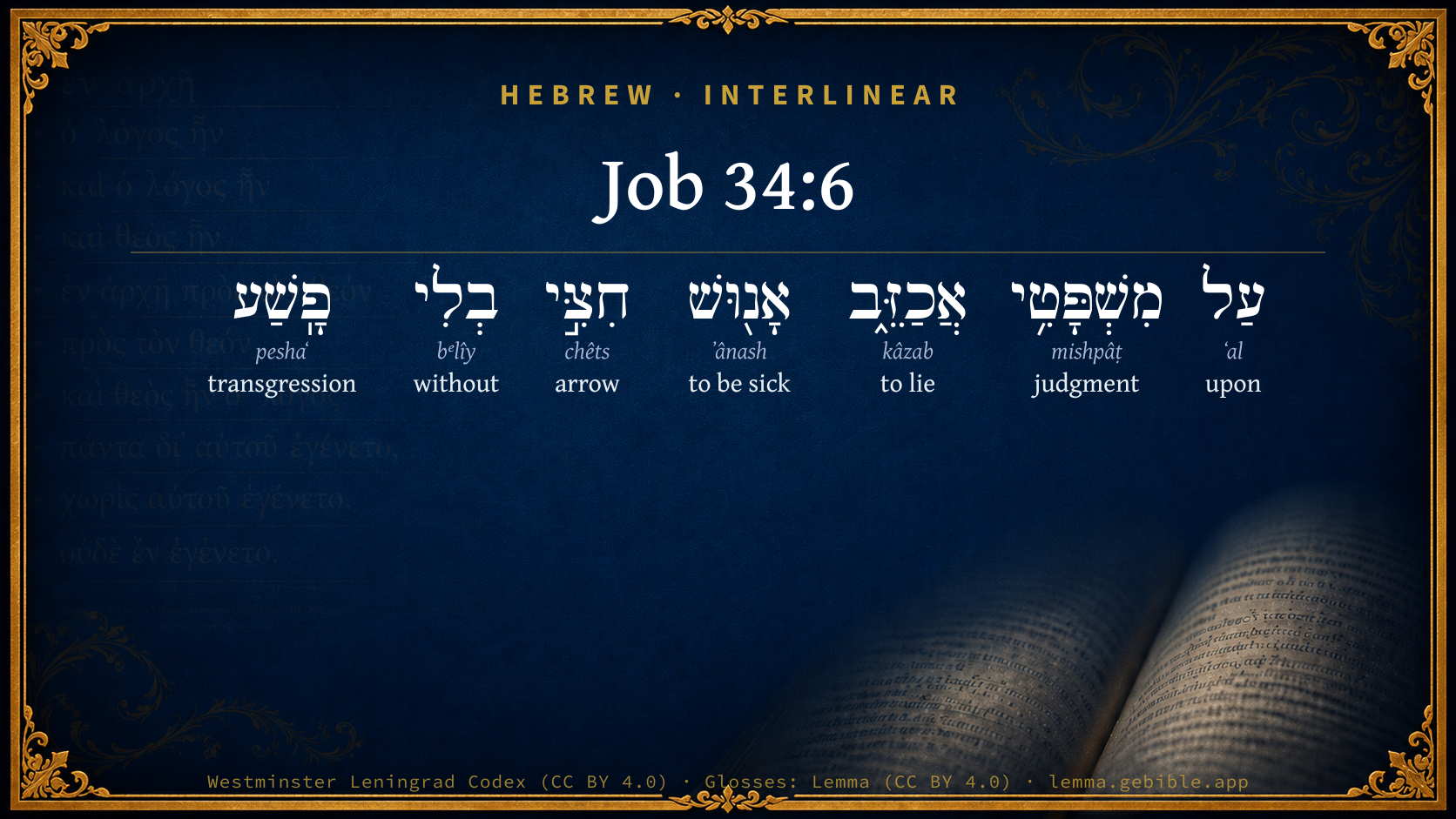
Job 34:6

Hebrew (Westminster Leningrad Codex) Job 34:6 appears in the Hebrew Old Testament. The text above is from the Westminster Leningrad Codex. Each word links to its Strong’s number, a concise gloss, and parsing drawn from the Open Scriptures Hebrew Bible morphology. Click any word for its full Brown-Driver-Briggs (BDB) entry.
Download image
Cite this verse

Job 34:6 (World English Bible). Public Domain. Lemma interlinear Bible study tool, https://lemma.gebible.app/v/job/34/6.

Show BibTeX & RIS
BibTeX
RIS
English Translation
Notwithstanding my right I am considered a liar; My wound is incurable, though I am without disobedience.'
World English Bible · Public Domain
Download a study sheet

One document with this verse’s original text, its word-by-word gloss line, the meaning frame, cross-references with their text, attributed commentary, and full source and license credits — printable, and it pastes into notes with its structure intact.

This verse Autodidact and up

Study sheet (.html) Plain text (.txt)

A passage Seminary Student

Up to 50 verses in one chapter. A passage sheet keeps up to 6 commentary sources and 12 cross-references per verse, in the order this page ranks them, and says so on the sheet whenever that leaves anything out. Ask for a single verse and you get the Autodidact verse sheet above.

Everything on this page stays free to read, with no account — the sheet is a download of what is already on screen, not access to it.

Want to remove ads? Support Godless Engineer
Compare translations 3

The same verse in 3 English versions, stacked beneath the original-language interlinear above. Click any original word for its lexicon entry.

Each is an independent rendering of the whole verse — the interlinear is not word-aligned to these translations.

Highlighted words mark where these versions differ — a whole-verse word diff, not a word-by-word alignment.

  • World English Bible Public Domain
    Notwithstanding my right I am considered a liar; My wound is incurable, though I am without disobedience.'
  • King James Version Public Domain
    Should I lie against my right? my wound is incurable without transgression.
  • unfoldingWord Literal Text CC BY-SA 4.0
    Would I lie about my justice? My arrow is incurable, without transgression.’

unfoldingWord Literal Text — © unfoldingWord, licensed CC BY-SA 4.0. Word-aligned USFM3 via Door43 (git.door43.org/unfoldingWord/en_ult).

Versions to compare (up to 4)

3 of 4 selected

Show all 18 translations

Every available English version of this verse, each an independent rendering of the whole verse.

  • World English Bible Public Domain
    Notwithstanding my right I am considered a liar; My wound is incurable, though I am without disobedience.'
  • Berean Standard Bible Public Domain
    Would I lie about my case? My wound is incurable, though I am without transgression.’
  • Majority Standard Bible Public Domain
    Would I lie about my case? My wound is incurable, though I am without transgression.’
  • King James Version Public Domain
    Should I lie against my right? my wound is incurable without transgression.
  • American Standard Version (1901) Public Domain
    Notwithstanding my right I am `accounted' a liar; My wound is incurable, `though I am' without transgression.
  • Revised Version (1885) Public Domain
    Notwithstanding my right I am accounted a liar; my wound is incurable, though I am without transgression.
  • Geneva Bible (1599) Public Domain
    Should I lye in my right? my wound of the arrowe is grieuous without my sinne.
  • Douay-Rheims (1899) Public Domain
    For in judging me there is a lie: my arrow is violent without any sin.
  • Young's Literal Translation Public Domain
    Against my right do I lie? Mortal `is' mine arrow -- without transgression.'
  • Literal Standard Version CC BY-SA 4.0
    Against my right do I lie? My arrow [is] mortal—without transgression.
  • Unlocked Literal Bible CC BY-SA 4.0
    Regardless of my rights, I am considered to be a liar. My wound is incurable, although I am without sin.'
  • unfoldingWord Literal Text CC BY-SA 4.0
    Would I lie about my justice? My arrow is incurable, without transgression.’
  • Darby Bible Public Domain
    Should I lie against my right? My wound is incurable without transgression.
  • World Messianic Bible Public Domain
    Notwithstanding my right I am considered a liar. My wound is incurable, though I am without disobedience.’
  • Webster's Bible Public Domain
    Should I lie against my right? my wound is incurable without transgression.
  • Free Bible Version CC BY-SA 4.0
    Even though I'm right, I'm treated like a liar; I am dying from my wounds, even though I've done nothing wrong.’
  • Bible in Basic English Public Domain
    Though I am right, still I am in pain; my wound may not be made well, though I have done no wrong.
  • JPS Tanakh (1917) Public Domain
    Notwithstanding my right I am accounted a liar; my wound is incurable, though I am without transgression.'

Literal Standard Version (2020), Covenant Press — licensed CC BY-SA 4.0. Text via the HelloAO Bible API (eBible.org). Unlocked Literal Bible (unfoldingWord) — licensed CC BY-SA 4.0. Text via the HelloAO Bible API (eBible.org). unfoldingWord Literal Text — © unfoldingWord, licensed CC BY-SA 4.0. Word-aligned USFM3 via Door43 (git.door43.org/unfoldingWord/en_ult). Free Bible Version, Dr. Jonathan Gallagher — licensed CC BY-SA 4.0. Text via the HelloAO Bible API (eBible.org).

Word by word

More ways to search: Search by grammar → Find every occurrence → Compare this word →

Practice this passage: Drill this verse → Learn its vocabulary →

About this verse

These counts appear in no published source. They are computed here, from the morphology-tagged text and Lemma’s own curated glosses. What Lemma adds →

7
words
7
distinct lemmas
Wisdom
section

Notable vocabulary

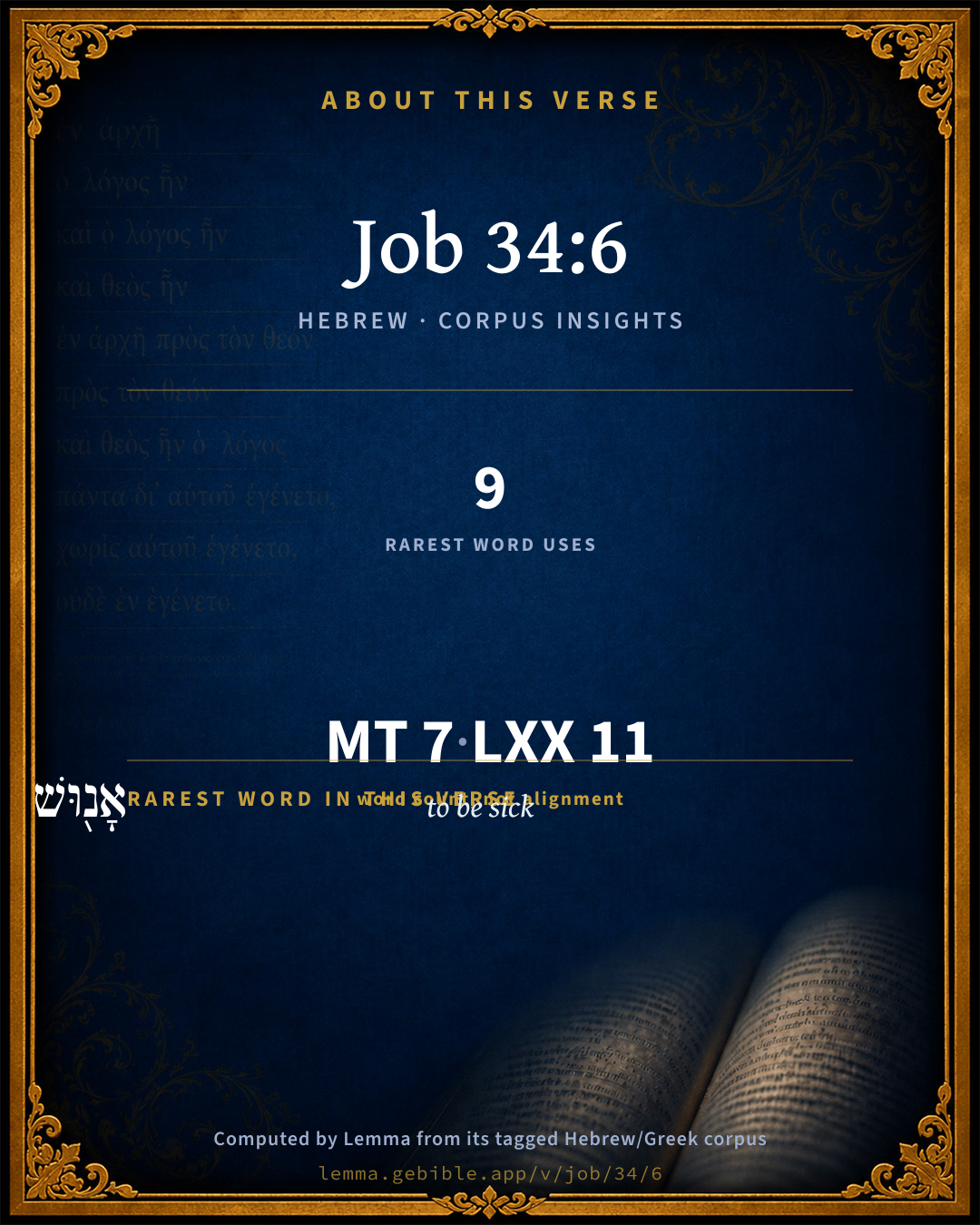
The rarest word here is אָנ֖וּשׁ to be sick H605 — appearing just 9 times in the whole Hebrew Bible.

Shared distinctive vocabulary

אָנ֖וּשׁ to be sick H605 occurs in 9 verses of the Hebrew Bible. Also found in:

Grammatical profile

  • 1 verb
  • 3 nouns
  • 1 adjective
  • 1 preposition
  • 1 particle

Verb forms

  • אֲכַזֵּ֑ב Piel · Imperfect

Hebrew & Septuagint length

In English translation the verse runs 17 words from the Hebrew and 15 from the Septuagint (LXX English) — closely comparable.

A rough comparison of the two English renderings, which tokenize alike — not a word-level alignment.

Word counts can differ between the Hebrew and the Greek without any difference in meaning — e.g. the Hebrew direct-object marker אֵת has no separate Greek word, and Greek often adds the article ὁ.

In the original languages it is 7 Hebrew tokens and 11 Greek tokens — but the two are counted differently (Hebrew bundles its prefixes and suffixes into one token; the Greek is in lemma form), so that isn’t a like-for-like length.

Cross-references

3

Topical passages linked to Job 34:6 in the Treasury of Scripture Knowledge — connected by theme and wording, ordered by reader-vote popularity; previews shown in the World English Bible.

  • Job 6:4 For the arrows of the Almighty are within me, My spirit drinks up their poison. The terrors of God set themselves in array against me.
  • Job 16:13 His archers surround me. He splits my kidneys apart, and does not spare. He pours out my gall on the ground.
  • Job 27:4–6 Surely my lips shall not speak unrighteousness, Neither shall my tongue utter deceit.

Cross-references courtesy of OpenBible.info (CC BY 4.0).

Hebrew and Greek witnesses Masoretic Hebrew ↔ Greek Septuagint

The same verse in the two great witnesses to the Old Testament, shown verse-for-verse.

These are two independent witnesses, not word-aligned to each other, and the Septuagint is shown in lemma (dictionary) form.

Hebrew Job 34:6 Masoretic · Westminster Leningrad Codex

עַל מִשְׁפָּטִ֥י אֲכַזֵּ֑ב אָנ֖וּשׁ חִצִּ֣י בְלִי פָֽשַׁע

Notwithstanding my right I am considered a liar; My wound is incurable, though I am without disobedience.'

World English Bible · Public Domain

Greek LXX Job 34:6 Septuagint · lemma form

ψεύδω δέ ὁ κρίμα ἐγώ βίαιος ὁ βέλος ἐγώ ἄνευ ἀδικία

And he has erred in my judgment: my wound is severe without unrighteousness of mine.

LXX2012 (modern English Septuagint) · Public Domain

On this verse, Albert Barnes' Notes on the Bible discusses the Septuagint’s reading. Read the note in Commentary ↓

Hebrew: Westminster Leningrad Codex (CC BY 4.0). Greek: Septuagint (public domain); English from LXX2012 (modern English Septuagint) (Public Domain). How the Septuagint differs from the Hebrew →

Commentary

Notes on Job 34:6 from classic Christian and Jewish commentators (each source and its license shown beneath its notes). The classic Christian expositions comment on the surrounding passage and are grouped to its opening verse, so a note may address several verses; the Jewish commentaries on the Tanakh (Rashi and others) are per-verse, so they appear only where the commentator wrote on this verse.

Lemma curates 59 commentaries, every one of them public domain or Creative Commons licensed, each selected and text-cleaned for this edition rather than reprinted as found. About our sources →

Trapp's Complete Commentary

John Trapp

Job 34:6 Should I lie against my right? my wound [is] incurable without transgression.

Ver. 6. Should I lie against my right?] Ut meam causam prodam, so as to betray my cause, and yield myself guilty when I know myself innocent (R. Levi). This I will never do, said Job; no more would that peerless Lady Elizabeth, when as a traitor she was laid up in the Tower, and pressed to appeach herself. Better die than lie.

My wound is incurable without transgression] These last words, "without transgression," Elihu spitefully thrusteth in, saith Beza. Others think they may be gathered out of Job 9:17; Job 16:17. Without presumptuous sin (which David calleth the great transgression, the wickedness with a witness) Job might truly say, it may be; for all men are sinners, yet not all alike; though all have a discrasy, yet every man hath not a fever; and though none are without ill humours, yet some have not a leprosy upon them.

John Trapp, A Commentary or Exposition upon All the Books of the Old and New Testament (1647–1656) — public domain. Text from a community e-Sword module.

The Biblical Illustrator

Joseph S. Exell

Job_34:6-9

What man is like Job?

Elihus estimate of Job

It was natural that, with all his reverence for Job, Elihu should be offended by the heat and passion of his words, by the absence of moderation and self-restraint, and tell him that this strained passion did him wrong. No doubt it is easier for a friend on the bank to maintain his composure, than it is for the man who has been swept away by the stream of calamity, and is doing instant battle with its fierce currents and driving waves. Job is not to be overmuch blamed if, under the stress of calamity, and stung by the baseless calumnies of the friends, he now and then lost composure, and grew immoderate both in his resentments and his retorts. Remembering the keen agony he had to endure, we may well pardon an offence for which it is so easy to account; we may cheerfully admit, as Jehovah Himself admitted, that in the main he spoke of God aright; we may even admire the constancy and patience with which, on the whole, he met the provocations and insults of the friends; and yet we cannot but feel that he often pushed his inferences against the Divine justice and providence much too far: as, indeed, he himself confessed that he had, when at last he saw Jehovah face to face, and carried his just resentment against the friends to excess. There are points in the progress of the story where he seems to revel in his sense of wrong, and to lash out wildly against both God and man. With fine moral tact, Elihu had detected this fault in his tone and bearing, and had discovered whither it was leading him. (Samuel Cox, D. D.)

The Biblical Illustrator, edited by Joseph S. Exell (c. 1880s–1900s) — public domain. Text from a community e-Sword module.

Tyndale Open Study Notes

Tyndale Open Resources

34:6 Eliphaz had accused Job of being a liar (15:5), fulfilling Job’s earlier worry (6:28-29). • My suffering (literally My arrow): For the link with the Lord’s arrows, see 6:4; 16:13; Jer 10:19; 15:18; 30:12, 15; Lam 3:12; Mic 1:9; Nah 3:19.

Tyndale Open Study Notes — © Tyndale Open Resources, licensed CC BY-SA 4.0. Text via the HelloAO Bible API.

Geneva Bible (1599)

Geneva Bible translators

Should I say, I am wicked, being an innocent?

I am sorer punished, than my sin deserveth.

Geneva Bible (1599) marginal notes — public domain. Text via Bolls.life.

Jamieson, Fausset & Brown

Robert Jamieson, A. R. Fausset & David Brown

Were I to renounce my right (that is, confess myself guilty), I should die. Job virtually had said so (Job 27:4-5; Job 6:28). MAURER, not so well, "Notwithstanding my right (innocence) I am treated as a liar," by God, by His afflicting me.

my wound--literally, "mine arrow," namely, by which I am pierced. So "my stroke" ("hand," Job 23:2, Margin). My sickness (Job 6:4; Job 16:13).

without transgression--without fault of mine to deserve it (Job 16:17).

Jamieson, Fausset & Brown — Commentary Critical and Explanatory on the Whole Bible (1871) — public domain (CC PDM 1.0). Text via the HelloAO Bible API.

Adam Clarke's Commentary

Verse 6. Should I lie against my right?] Should I acknowledge myself the sinner which they paint me, and thus lie against my right to assert and maintain my innocence?

My wound is incurable without transgression.] If this translation is correct, the meaning of the place is sufficiently evident. In the tribulation which I endure, I am treated as if I were the worst of culprits; and I labour under incurable maladies and privations, though without any cause on my part for such treatment. This was all most perfectly true; it is the testimony which God himself gives of Job, that "he was a perfect and upright man, fearing God and eschewing evil;" and that "Satan had moved the Lord against him, to destroy him, WITHOUT A CAUSE. See Job 1:1; Job 2:3.

The Chaldee translates thus: -

"On account of my judgment, I will make the son of man a liar, who sends forth arrows without sin."

Mr. Good thus :-

"Concerning my cause I am slandered;

He hath reversed my lot without a trespass."

The latter clause is the most deficient, אנוש חצי בלי פשע; Miss Smith's translation of which is the best I have met with: "A man cut off, without transgression." The word חצי chitstsi, which we translate my wound, signifies more literally, my arrow; and if we take it as a contracted noun, חצי chitstsey for חצים chitstsim, it means calamities. אנוש anush, which we translate incurable, may be the noun enosh, wicked, miserable man; and then the whole may be read thus: "A man of calamities without transgression." I suffer the punishment of an enemy to God, while free from transgression of this kind.

Adam Clarke's Commentary on the Bible (1810–1826) — public domain. Text from a community e-Sword/MySword module.

Ellicott's Commentary for English Readers

(6) Should I lie against my right?—Comp. Job_27:2-6.

My wound is incurable.—Literally, my arrow, i.e., the arrow which hath wounded me. (See Job_16:11; Job_17:1, &c.)

Without transgression.—That is to say, on my part. (See Job_16:17.) Some understand the former clause, “Notwithstanding my right, I am accounted a liar,” but the Authorised Version is more probably right.

A Bible Commentary for English Readers, edited by Charles John Ellicott (1878–1897) — public domain. Text from a community e-Sword module.

The Cambridge Bible for Schools and Colleges

gen. ed. J. J. S. Perowne

6. should I lie against my right?] This sense is possible, the meaning being, “shall I admit guilt when I am not guilty but wrongly afflicted”? Perhaps the sense is rather: against (or, notwithstanding) my right I am made to lie: when I affirm my rectitude God’s treatment of me belies my affirmations by making me guilty, and this against my right; comp. ch. Job_9:20, Job_16:8.

my wound] lit. my arrow, the arrow of divine affliction infixed in me, comp. ch. Job_6:4, Job_16:13.

The Cambridge Bible for Schools and Colleges (gen. ed. J. J. S. Perowne; Cambridge University Press, 1878–1918) — public domain. Text from a community e-Sword module.

John Gill's Exposition

What man is like Job,.... This is said as wondering at the part he acted, that a man so wise and good as Job was esteemed to be should behave in such a manner as he did;

who drinketh up scorning like water? For a foolish and wicked man to do so is not strange nor uncommon; but for a man of such sense and grace as Job was to do this was astonishing; to have no more regard to his character than to expose himself to the scorn and ridicule of men: for a man to become a laughing stock to profane and wicked men for his religion and piety, it is no disgrace, but an honour to him; but by unbecoming words and gestures to make himself justly jeered and scoffed at is great indiscretion. Or it may be understood actively of his dealing very freely and frequently in scoffs and jeers, which he poured out very liberally and plentifully, and seemingly with as much delight as a man drinks water when thirsty; see Job 11:3.

John Gill's Exposition of the Whole Bible (1746–1763) — public domain (CC PDM 1.0). Text via the HelloAO Bible API.

Albert Barnes' Notes on the Bible

Should I lie against my right? - These are also quoted as the words of Job, and as a part of the erroneous opinions on which Elihu proposes to comment. These words do not occur, however, as used by Job respecting himself, and Elihu must be understood to refer to what he regarded as the general strain of the argument maintained by him. In regard to the meaning of the words, there have been various opinions. Jerome renders them, “For in judging me there is falsehood - mendacium est; my violent arrow (the painful arrow in me) is without any sin.” The Septuagint, “He the Lord hath been false in my accusation” - ἐψένσατο δὲ τῳ κρίματί μου epseusato de tō krimati mou - “my arrow is heavy without transgression.” Coverdale, “I must needs be a liar, though my cause be right.” Umbreit renders it, “I must lie if I should acknowledge myself to be guilty.”

Noyes, “Though I am innocent, I am made a liar.” Prof. Lee, “Should I lie respecting my case? mine arrow is mortal without transgression.” That is, Job said he could not lie about it; he could use no language that would deceive. He felt that a mortal arrow had reached him without transgression, or without any adequate cause. Rosenmuller renders it, “However just may be my cause, I appear to be a liar.” That is, he was regarded as guilty, and treated accordingly, however conscious he might be of innocence, and however strenuously he might maintain that he was not guilty. The meaning probably is, “I am held to be a liar. I defend myself; go over my past life; state my course of conduct; meet the accusations of my friends, but in all this I am still held to be a liar. My friends so regard me - for they will not credit my statements, and they go on still to argue as if I was the most guilty of mortals. And God also in this holds me to be a liar, for he treats me constantly as if I were guilty. He hears not my vindication, and he inflicts pain and woe upon me as if all that I had said about my own integrity were false, and I were one of the most abandoned of mortals, so that on all hands I am regarded and treated as if I were basely false.” The literal translation of the Hebrew is, “Concerning my judgment (or my cause) I am held to be a liar.”

My wound is incurable - Margin, as in Hebrew “arrow.” The idea is, that a deadly arrow had smitten him, which could not be extracted. So in Virgil:

Haeret lateri letalis arundo. Aeneid iv. 73.

The image is taken from an animal that had been pierced with a deadly arrow.

Without transgression - Without any sin that deserved such treatment. Job did not claim to be absolutely perfect; he maintained only that the sufferings which he endured were no proper proof of his character; compare Job 6:4.

Albert Barnes' Notes on the Bible (1834–1885) — public domain. Text from a community e-Sword/MySword module.

Haydock's Catholic Bible Commentary

There. Septuagint, "he has been deceived;" Greek: epseusato. Hebrew, "I will convict my judge of lying;" or (Calmet) Protestants, "should I lie against my right?" (Haydock) --- Job, in the excess of grief, had expressed himself forcibly, chap. xix. 6., and xxiii. 7. But great deductions must be made from such hyperboles; and he had frequently praised the mercy and justice of God, and his just punishment of the wicked. He had indeed excepted himself from the number; and Eliu ought to have proved that he was wrong in this respect. But he seems to have all along evaded or mistaken the point under dispute. (Calmet) --- Arrow, which pierces me. (Haydock) --- The deferring judgment was not a subversion of it, as Eliu would argue, chap. xxvii. 2. (Worthington)

George Leo Haydock (1774–1849), Haydock's Catholic Family Bible and Commentary, 1859 edition — public domain. Excludes Psalms (Douay-Rheims chapter numbering differs from Protestant) and Deuterocanonical books (Catholic canon only).

Matthew Poole's English Annotations

Should I lie against my right? so Job had said in effect, Job 27:4-6. Should I falsely accuse myself of such sins of which I am no way conscious to myself? Should I betray mine own cause, and deny my integrity, and say that I deserved worse than I have done?

Without transgression, i.e. without any great, or heinous, or crying sin, as this word commonly signifies, which might reasonably bring down such terrible judgments upon my head.

Matthew Poole's English Annotations on the Holy Bible (1683–1685) — public domain. Text from a community e-Sword/MySword module.

Whedon's Commentary on the Bible

Daniel D. Whedon

6. Should I lie against my right, etc. — Though this is not exactly, it is virtually, the language of Job. Compare, for instance, Job_6:4; Job_9:17; Job_9:20; Job_16:8. The sense of the first clause is, according to Schlottmann, “Shall I declare myself guilty while I know myself innocent?” But the reading of Hitzig is more exact and terse: “Against my right I shall lie;” that is, With right on my side I am accounted a liar in maintaining it.

My wound — Literally, My arrow — the cause, by synecdoche, put for the effect. Job_6:4.

Daniel D. Whedon (gen. ed.), Commentary on the Old and New Testaments (1874–1909) — public domain. Text from a community e-Sword module.

The Pulpit Commentary

Should I lie against my right? This was an essential portion of Job"s argument. (see Job_27:4) Against the theory of his secret heinous wickedness put forward by his "comforters," he maintained consistently his freedom from conscious deliberate opposition to the will of God, and refused to make the confessions which they suggested or required, on the ground that they would have been untrue in making them he would have "lied against his right." In this certainly Job "sinned not." But it was essential to the theory of Elihu, no less than to that of Eliphaz and his friends, that Job was suffering on account of past iniquity, whether he were being punished for it in anger or chastised for it in love. (see Job_33:17, Job_33:27) My wound (literally, my arrow; comp. Job_6:4) is incurable without transgression; i.e. without my having committed any transgression to account for it.

The Pulpit Commentary (1880–1919), ed. H.D.M. Spence-Jones & Joseph S. Exell — public domain. Text from a community e-Sword module.

John Wesley's Explanatory Notes

Should I lie - So Job had said in effect, chap. xxvii, 4, 5, 6, should I falsely accuse myself of sins of which I am not guilty? Without transgression - Without any such crying, sin, as might reasonably bring down such terrible judgments upon my head.

John Wesley, Explanatory Notes Upon the Whole Bible (1754–1765) — public domain. Text via the GEBible commentary corpus.

Rashi

Rabbi Shlomo Yitzchaki (Rashi)

I call a liar I accuse my Judge of being a liar, because He did not judge me fairly.

incurable Heb. אנוש, My wound is sore, like (II Sam. 12:15), “and it became mortally ill (ויאנש).”

my wound Heb. חצי [lit. my arrow].

Rashi on the Tanakh — English translations: “The Judaica Press complete Tanach with Rashi, translated by A. J. Rosenberg” (CC BY 4.0); “Pentateuch with Rashi's commentary by M. Rosenbaum and A.M. Silbermann, 1929-1934” (public domain); “The Metsudah Tanach series, Lakewood, N.J” (CC BY 4.0); and “The Book of Joshua, Metsudah Publications, 1997” (CC BY 4.0). Text via Sefaria.

Lesson kit

Teaching starters — assembled from the data on this page, not authored interpretation. Every prompt links to the verse data it draws on. Edit before teaching.

Job, in the Wisdom, opens this verse with 7 words (7 distinct Hebrew lemmas). Its most distinctive word is ʼânash (“to be sick”). A historical commentator’s framing appears above. Read the whole chapter for the surrounding context.

Discussion questions

  1. The word ʼânash carries the sense “to be sick.” How does it shape the verse?
  2. 2 Samuel 12:15 shares the word «to be sick» with this verse. How do the two illuminate each other?
  3. These translations render this verse differently. What is at stake in choosing one wording over another?
  4. The verb «אֲכַזֵּ֑ב» is Piel Imperfect. How does its form color the action?
  5. Reading how Trapp's Complete Commentary and The Biblical Illustrator read this verse, where do the two commentators agree and where do they part?

Things to notice

Reading settings

Reading text

Shown beneath each verse's original-language words.

Old Testament
Old Testament edition

Read the OT as the Masoretic Hebrew (MT) or the Greek Septuagint (LXX).

English shown for the Greek Septuagint (in the Hebrew ↔ Greek comparison).

Comparing translations? Open the Compare panel on any verse page to stack up to four side by side.