
Ezekiel 11:12

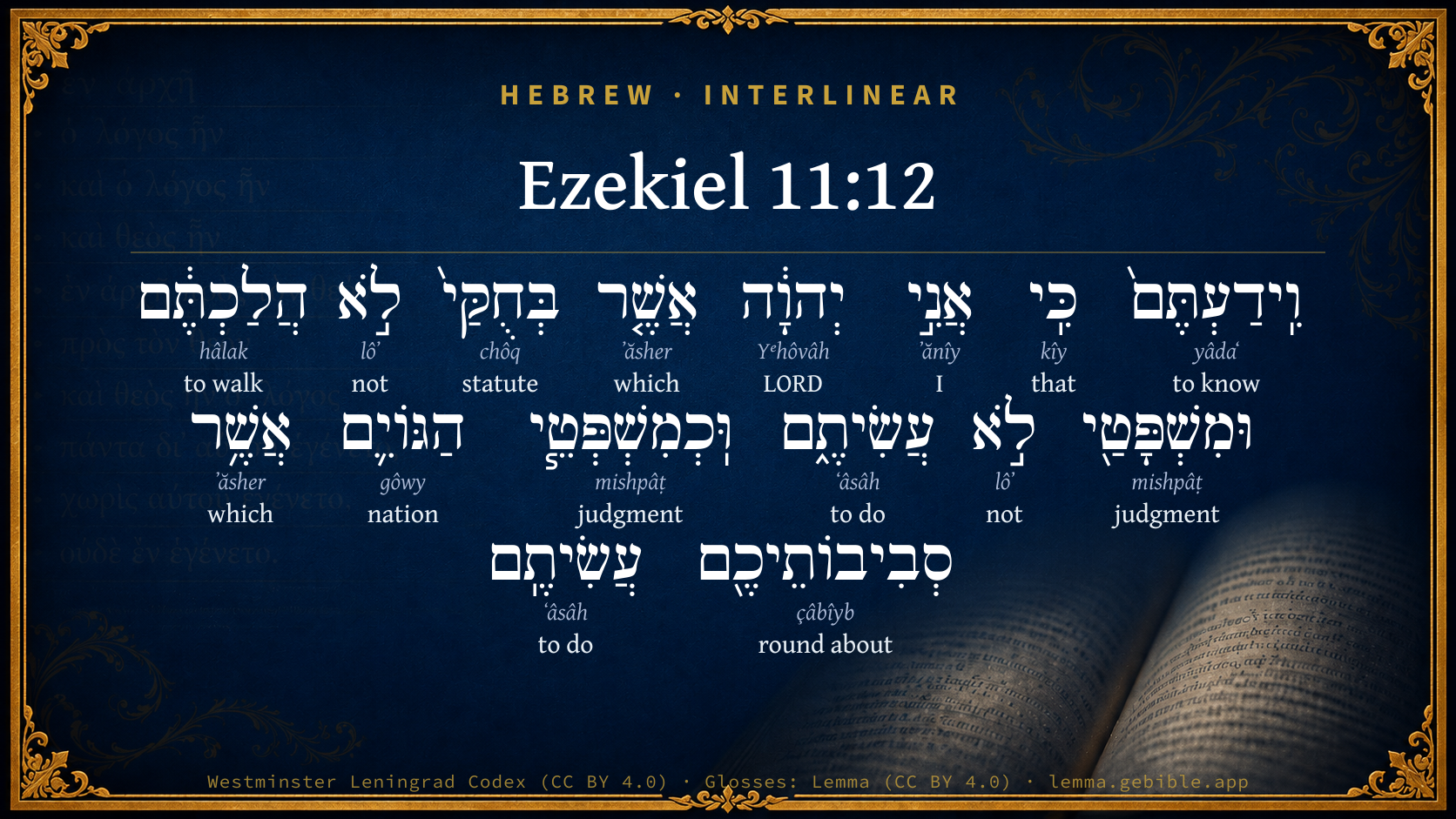
Hebrew (Westminster Leningrad Codex) Ezekiel 11:12 appears in the Hebrew Old Testament. The text above is from the Westminster Leningrad Codex. Each word links to its Strong’s number, a concise gloss, and parsing drawn from the Open Scriptures Hebrew Bible morphology. Click any word for its full Brown-Driver-Briggs (BDB) entry.
Download image
Cite this verse

Ezekiel 11:12 (World English Bible). Public Domain. Lemma interlinear Bible study tool, https://lemma.gebible.app/v/ezekiel/11/12.

Show BibTeX & RIS
BibTeX
RIS
English Translation
and you shall know that I am Yahweh: for you have not walked in my statutes, neither have you executed my ordinances, but have done after the ordinances of the nations that are round about you.
World English Bible · Public Domain
Download a study sheet

One document with this verse’s original text, its word-by-word gloss line, the meaning frame, cross-references with their text, attributed commentary, and full source and license credits — printable, and it pastes into notes with its structure intact.

This verse Autodidact and up

Study sheet (.html) Plain text (.txt)

A passage Seminary Student

Up to 50 verses in one chapter. A passage sheet keeps up to 6 commentary sources and 12 cross-references per verse, in the order this page ranks them, and says so on the sheet whenever that leaves anything out. Ask for a single verse and you get the Autodidact verse sheet above.

Everything on this page stays free to read, with no account — the sheet is a download of what is already on screen, not access to it.

Want to remove ads? Support Godless Engineer
Compare translations 3

The same verse in 3 English versions, stacked beneath the original-language interlinear above. Click any original word for its lexicon entry.

Each is an independent rendering of the whole verse — the interlinear is not word-aligned to these translations.

Highlighted words mark where these versions differ — a whole-verse word diff, not a word-by-word alignment.

  • World English Bible Public Domain
    and you shall know that I am Yahweh: for you have not walked in my statutes, neither have you executed my ordinances, but have done after the ordinances of the nations that are round about you.
  • King James Version Public Domain
    And ye shall know that I am the LORD: for ye have not walked in my statutes, neither executed my judgments, but have done after the manners of the heathen that are round about you.
  • unfoldingWord Literal Text CC BY-SA 4.0
    Then you will know that I am Yahweh, the one whose statutes you have not walked in and whose decrees you have not carried out. Instead, you have carried out the decrees of the nations that surround you.”

unfoldingWord Literal Text — © unfoldingWord, licensed CC BY-SA 4.0. Word-aligned USFM3 via Door43 (git.door43.org/unfoldingWord/en_ult).

Versions to compare (up to 4)

3 of 4 selected

Show all 18 translations

Every available English version of this verse, each an independent rendering of the whole verse.

  • World English Bible Public Domain
    and you shall know that I am Yahweh: for you have not walked in my statutes, neither have you executed my ordinances, but have done after the ordinances of the nations that are round about you.
  • Berean Standard Bible Public Domain
    Then you will know that I am the LORD. For you have neither followed My statutes nor practiced My ordinances, but you have conformed to the ordinances of the nations around you.”
  • Majority Standard Bible Public Domain
    Then you will know that I am the LORD. For you have neither followed My statutes nor practiced My ordinances, but you have conformed to the ordinances of the nations around you.”
  • King James Version Public Domain
    And ye shall know that I am the LORD: for ye have not walked in my statutes, neither executed my judgments, but have done after the manners of the heathen that are round about you.
  • American Standard Version (1901) Public Domain
    and ye shall know that I am Jehovah: for ye have not walked in my statutes, neither have ye executed mine ordinances, but have done after the ordinances of the nations that are round about you.
  • Revised Version (1885) Public Domain
    and ye shall know that I am the LORD: for ye have not walked in my statutes, neither have ye executed my judgments, but have done after the ordinances of the nations that are round about you.
  • Geneva Bible (1599) Public Domain
    And ye shall knowe that I am the Lord: for ye haue not walked in my statutes, neither executed my iudgements, but haue done after the maners of the heathen, that are round about you.
  • Douay-Rheims (1899) Public Domain
    And you shall know that I am the Lord: because you have not walked in my commandments, and have not done my judgments, but you have done according to the judgments of the nations that; are round about you.
  • Young's Literal Translation Public Domain
    And ye have known that I `am' Jehovah, For in My statutes ye have not walked, And My Judgments ye have not done, And according to the judgments of the nations Who are round about you -- ye have done!'
  • Literal Standard Version CC BY-SA 4.0
    And you have known that I [am] YHWH, || For you have not walked in My statutes, || And you have not done My judgments, || And according to the judgments of the nations || Who are around you, you have done!”
  • Unlocked Literal Bible CC BY-SA 4.0
    Then you will know that I am Yahweh, the one whose statutes you have not walked in and whose decrees you have not carried out. Instead, you have carried out the decrees of the nations that surround you.”
  • unfoldingWord Literal Text CC BY-SA 4.0
    Then you will know that I am Yahweh, the one whose statutes you have not walked in and whose decrees you have not carried out. Instead, you have carried out the decrees of the nations that surround you.”
  • Darby Bible Public Domain
    and ye shall know that I [am] Jehovah, in whose statutes ye have not walked, neither have done mine ordinances, but have done after the ordinances of the nations that are round about you.
  • World Messianic Bible Public Domain
    You will know that I am the LORD, for you have not walked in my statutes. You have not executed my ordinances, but have done after the ordinances of the nations that are around you.”’”
  • Webster's Bible Public Domain
    And ye shall know that I am the LORD: for ye have not walked in my statutes, neither executed my judgments, but have done after the manners of the heathen that are around you.
  • Free Bible Version CC BY-SA 4.0
    Then you will know that I am the Lord. For you didn't follow my rules and you didn't keep my laws. Instead you kept the laws of the nations around you.”
  • Bible in Basic English Public Domain
    And you will be certain that I am the Lord: for you have not been guided by my rules or given effect to my orders, but you have been living by the orders of the nations round about you.
  • JPS Tanakh (1917) Public Domain
    and ye shall know that I am the LORD; for ye have not walked in My statutes, neither have ye executed Mine ordinances, but have done after the ordinances of the nations that are round about you.'

Literal Standard Version (2020), Covenant Press — licensed CC BY-SA 4.0. Text via the HelloAO Bible API (eBible.org). Unlocked Literal Bible (unfoldingWord) — licensed CC BY-SA 4.0. Text via the HelloAO Bible API (eBible.org). unfoldingWord Literal Text — © unfoldingWord, licensed CC BY-SA 4.0. Word-aligned USFM3 via Door43 (git.door43.org/unfoldingWord/en_ult). Free Bible Version, Dr. Jonathan Gallagher — licensed CC BY-SA 4.0. Text via the HelloAO Bible API (eBible.org).

Word by word

More ways to search: Search by grammar → Find every occurrence → Compare this word →

Practice this passage: Drill this verse → Learn its vocabulary →

בְּחֻקַּי֙
chôq
H2706
“in/at · statutes · my”
Preposition + Noun, Common, Masculine, Plural, Construct + Suffix, Personal, 1st Person, Common, Singular
Part of Speech
Preposition + Noun
Type
Common
Gender
Masculine
Number
Plural
State
Construct
Full BDB Definition

Origin: from H2710

TWOT: 728a

statute, ordinance, limit, something prescribed, due - prescribed task - prescribed portion - action prescribed (for oneself), resolve - prescribed due - prescribed limit, boundary - enactment, decree, ordinance - specific decree - law in general - enactments, statutes - conditions - enactments - decrees - civil enactments prescribed by God
  1. וִֽידַעְתֶּם֙ yâdaʻ H3045 “and · to know” Conjunction + Verb, Qal, Sequential Perfect, 2nd Person, Masculine, Plural
  2. כִּֽי kîy H3588 “that” Conjunction
  3. אֲנִ֣י ʼănîy H589 “I” Pronoun, Personal, 1st Person, Common, Singular
  4. יְהוָ֔ה Yᵉhôvâh H3068 “LORD” Noun, Proper
  5. אֲשֶׁ֤ר ʼăsher H834 “which” Particle, Relative
  6. לֹ֣א lôʼ H3808 “not” Particle, Negative
  7. הֲלַכְתֶּ֔ם hâlak H1980 “to walk” Verb, Qal, Perfect, 2nd Person, Masculine, Plural
  8. וּמִשְׁפָּטַ֖י mishpâṭ H4941 “and · judgments · my” Conjunction + Noun, Common, Masculine, Plural, Construct + Suffix, Personal, 1st Person, Common, Singular
  9. לֹ֣א lôʼ H3808 “not” Particle, Negative
  10. עֲשִׂיתֶ֑ם ʻâsâh H6213 “to do” Verb, Qal, Perfect, 2nd Person, Masculine, Plural
  11. וּֽכְמִשְׁפְּטֵ֧י mishpâṭ H4941 “and · like/as · judgments of” Conjunction + Preposition + Noun, Common, Masculine, Plural, Construct
  12. הַגּוֹיִ֛ם gôwy H1471 “the · nations” Particle, Definite Article + Noun, Common, Masculine, Plural, Absolute
  13. אֲשֶׁ֥ר ʼăsher H834 “which” Particle, Relative
  14. סְבִיבוֹתֵיכֶ֖ם çâbîyb H5439 “surroundings · your” Noun, Common, Both, Plural, Construct + Suffix, Personal, 2nd Person, Masculine, Plural
  15. עֲשִׂיתֶֽם ʻâsâh H6213 “to do” Verb, Qal, Perfect, 2nd Person, Masculine, Plural

About this verse

These counts appear in no published source. They are computed here, from the morphology-tagged text and Lemma’s own curated glosses. What Lemma adds →

16
words
12
distinct lemmas
Prophets
section

Grammatical profile

  • 4 verbs
  • 6 nouns
  • 1 pronoun
  • 1 conjunction
  • 4 particles

Verb forms

  • וִֽידַעְתֶּם֙ Qal · Sequential Perfect
  • הֲלַכְתֶּ֔ם Qal · Perfect
  • עֲשִׂיתֶ֑ם Qal · Perfect
  • עֲשִׂיתֶֽם Qal · Perfect

Repetition

Words recur within this verse — often emphatic in Hebrew:

  • וּמִשְׁפָּטַ֖י judgment H4941 ×2
  • עֲשִׂיתֶ֑ם to do H6213 ×2
  • אֲשֶׁ֤ר which H834 ×2
  • לֹ֣א not H3808 ×2

Cross-references

31

Topical passages linked to Ezekiel 11:12 in the Treasury of Scripture Knowledge — connected by theme and wording, ordered by reader-vote popularity; previews shown in the World English Bible.

  • Ezekiel 8:10 So I went in and saw; and see, every form of creeping things, and abominable animals, and all the idols of the house of Israel, portrayed on the wall round about.
  • Ezekiel 8:14 Then he brought me to the door of the gate of Yahweh's house which was toward the north; and see, there sat the women weeping for Tammuz.
  • Ezekiel 8:16 He brought me into the inner court of Yahweh's house; and see, at the door of the temple of Yahweh, between the porch and the altar, were about twenty-five men, with their backs toward the temple of Yahweh, and their faces toward the east; and they were worshipping the sun toward the east.
  • Psalms 106:35–39 But mixed themselves with the nations, And learned their works.
  • Leviticus 18:3 You shall not do as they do in the land of Egypt, where you lived: and you shall not do as they do in the land of Canaan, where I am bringing you; neither shall you walk in their statutes.
  • Leviticus 18:24–28 "'Don't defile yourselves in any of these things: for in all these the nations which I am casting out before you were defiled.
  • Leviticus 26:40 "'If they confess their iniquity, and the iniquity of their fathers, in their trespass which they trespassed against me, and also that, because they walked contrary to me,
  • Deuteronomy 12:30–31 take heed to yourself that you not be ensnared to follow them, after that they are destroyed from before you; and that you not inquire after their gods, saying, How do these nations serve their gods? even so will I do likewise.
  • 1 Kings 11:33 because that they have forsaken me, and have worshiped Ashtoreth the goddess of the Sidonians, Chemosh the god of Moab, and Milcom the god of the children of Ammon; and they have not walked in my ways, to do that which is right in my eyes, and [to keep] my statutes and my ordinances, as did David his father.
  • 2 Kings 16:3 But he walked in the way of the kings of Israel, yes, and made his son to pass through the fire, according to the abominations of the nations, whom Yahweh cast out from before the children of Israel.
  • 2 Kings 16:10–11 King Ahaz went to Damascus to meet Tiglath Pileser king of Assyria, and saw the altar that was at Damascus; and king Ahaz sent to Urijah the priest the fashion of the altar, and the pattern of it, according to all the workmanship of it.
  • 2 Kings 17:11–23 and there they burnt incense in all the high places, as did the nations whom Yahweh carried away before them; and they worked wicked things to provoke Yahweh to anger;
  • 2 Kings 18:12 because they didn't obey the voice of Yahweh their God, but transgressed his covenant, even all that Moses the servant of Yahweh commanded, and would not hear it, nor do it.
  • 2 Kings 21:2 He did that which was evil in the sight of Yahweh, after the abominations of the nations whom Yahweh cast out before the children of Israel.
  • 2 Kings 21:22 and he forsook Yahweh, the God of his fathers, and didn't walk in the way of Yahweh.
  • 2 Chronicles 13:9 Haven't you driven out the priests of Yahweh, the sons of Aaron, and the Levites, and made you priests after the manner of the peoples of [other] lands? so that whoever comes to consecrate himself with a young bull and seven rams, the same may be a priest of [those who are] no gods.
  • 2 Chronicles 28:3 Moreover he burnt incense in the valley of the son of Hinnom, and burnt his children in the fire, according to the abominations of the nations whom Yahweh cast out before the children of Israel.
  • 2 Chronicles 33:2–9 He did that which was evil in the sight of Yahweh, after the abominations of the nations whom Yahweh cast out before the children of Israel.
  • 2 Chronicles 36:14 Moreover all the chiefs of the priests, and the people, trespassed very greatly after all the abominations of the nations; and they polluted the house of Yahweh which he had made holy in Jerusalem.
  • Ezra 9:7 Since the days of our fathers we have been exceeding guilty to this day; and for our iniquities have we, our kings, and our priests, been delivered into the hand of the kings of the lands, to the sword, to captivity, and to plunder, and to confusion of face, as it is this day.
  • Nehemiah 9:34 neither have our kings, our princes, our priests, nor our fathers, kept your law, nor listened to your commandments and your testimonies with which you did testify against them.
  • Psalms 78:10 They didn't keep God's covenant, And refused to walk in his law.
  • Jeremiah 6:16 Thus says Yahweh, Stand you in the ways and see, and ask for the old paths, where is the good way; and walk therein, and you shall find rest for your souls: but they said, We will not walk [therein].
  • Jeremiah 10:2 Thus says Yahweh, "Don't learn the way of the nations, and don't be dismayed at the signs of the sky; for the nations are dismayed at them.
  • Ezekiel 11:21 But as for them whose heart walks after the heart of their detestable things and their abominations, I will bring their way on their own heads, says the Lord Yahweh.
  • Ezekiel 16:44–47 Behold, everyone who uses proverbs shall use [this] proverb against you, saying, As is the mother, so is her daughter.
  • Ezekiel 18:9 has walked in my statutes, and has kept my ordinances, to deal truly; he is just, he shall surely live, says the Lord Yahweh.
  • Ezekiel 20:16 because they rejected my ordinances, and didn't walk in my statutes, and profaned my Sabbaths: for their heart went after their idols.
  • Ezekiel 20:21 But the children rebelled against me; they didn't walk in my statutes, neither kept my ordinances to do them, which if a man do, he shall live in them; they profaned my Sabbaths. Then I said I would pour out my wrath on them, to accomplish my anger against them in the wilderness.
  • Ezekiel 20:24 because they had not executed my ordinances, but had rejected my statutes, and had profaned my Sabbaths, and their eyes were after their fathers' idols.
  • Daniel 9:10 neither have we obeyed the voice of Yahweh our God, to walk in his laws, which he set before us by his servants the prophets.

Cross-references courtesy of OpenBible.info (CC BY 4.0).

Hebrew and Greek witnesses Masoretic Hebrew ↔ Greek Septuagint

The same verse in the two great witnesses to the Old Testament, shown verse-for-verse.

These are two independent witnesses, not word-aligned to each other, and the Septuagint is shown in lemma (dictionary) form.

Hebrew Ezekiel 11:12 Masoretic · Westminster Leningrad Codex

וִֽידַעְתֶּם֙ כִּֽי אֲנִ֣י יְהוָ֔ה אֲשֶׁ֤ר בְּחֻקַּי֙ לֹ֣א הֲלַכְתֶּ֔ם וּמִשְׁפָּטַ֖י לֹ֣א עֲשִׂיתֶ֑ם וּֽכְמִשְׁפְּטֵ֧י הַגּוֹיִ֛ם אֲשֶׁ֥ר סְבִיבוֹתֵיכֶ֖ם עֲשִׂיתֶֽם

and you shall know that I am Yahweh: for you have not walked in my statutes, neither have you executed my ordinances, but have done after the ordinances of the nations that are round about you.

World English Bible · Public Domain

Greek LXX Ezekiel 11:12 Septuagint · lemma form

καί ἐπιγιγνώσκω διότι ἐγώ κύριος

No English rendering of this Greek verse — the small residue in the structurally divergent books.

On this verse, Haydock's Catholic Bible Commentary discusses the Septuagint’s reading. Read the note in Commentary ↓

Hebrew: Westminster Leningrad Codex (CC BY 4.0). Greek: Septuagint (public domain); English from a public-domain English Septuagint. How the Septuagint differs from the Hebrew →

Targum (Aramaic paraphrase)

1

The Targum is the ancient Jewish Aramaic paraphrase of the Hebrew Scriptures — an interpretive translation, not the Hebrew text itself. Onkelos (literal) and Pseudo-Jonathan (expansive) render the Torah, and Jonathan the Prophets. Coverage is partial: where no permissively-licensed English translation exists for a verse, only the Aramaic is shown. This is verse-level text, not a word-by-word alignment to the Hebrew.

  1. Targum Jonathan Prophets (Joshua–Malachi)
    וְתֵידְעוּן אֲרֵי אֲנָא יְיָ דִי בִקְיָמַי לָא הַלֵיכְתּוּן וְדִינַי לָא עֲבַדְתּוּן וּכְנִימוּסֵי עַמְמַיָא דִי בְסָחְרָנֵיכוֹן עֲבַדְתּוּן:

    (no public-domain English translation for this verse)

    Targum Jonathan — Aramaic: “Mikraot Gedolot” (public domain). English: “Sefaria Community Translation” (CC0 1.0 (public-domain dedication)); “London "Chaldee Paraphrase," 1871” (public domain). Text via Sefaria.

Commentary

Notes on Ezekiel 11:12 from classic Christian and Jewish commentators (each source and its license shown beneath its notes). The classic Christian expositions comment on the surrounding passage and are grouped to its opening verse, so a note may address several verses; the Jewish commentaries on the Tanakh (Rashi and others) are per-verse, so they appear only where the commentator wrote on this verse.

Lemma curates 59 commentaries, every one of them public domain or Creative Commons licensed, each selected and text-cleaned for this edition rather than reprinted as found. About our sources →

Trapp's Complete Commentary

John Trapp

Eze 11:12 And ye shall know that I [am] the LORD: for ye have not walked in my statutes, neither executed my judgments, but have done after the manners of the heathen that [are] round about you.

Ver. 12. And ye shall know that I am the Lord.] That which ye would not take knowledge of by the words of your prophets, ye shall now be made to know by the swords of your enemies.

For ye have not walked in my statutes.] When God is about to proceed in judgment against evildoers, there is ever a cause for it, and they shall know it.

John Trapp, A Commentary or Exposition upon All the Books of the Old and New Testament (1647–1656) — public domain. Text from a community e-Sword module.

The Biblical Illustrator

Joseph S. Exell

Eze_11:12

But have done after the manners of the heathen that are round about you.

Yielding to ones surroundings

Surely there is nothing walks the earth more contemptible, as well as more certainly evil, than a man who lets himself be made by whatever force may happen to be strongest near him, and fastening up his helm, and unshipping his oars, is content to be blown about by every vagrant wind, and rolled in the trough of each curling wave. (A. Maclaren.)

Do not leg the world mould you

I beseech you all, and especially you young people, not to let the world take and mould you, like a bit of soft clay put into a brick-mould, but to lay a masterful hand upon it, and compel it to help you, by Gods grace, to be nobler, and truer, and purer. (A. Maclaren.)

The Biblical Illustrator, edited by Joseph S. Exell (c. 1880s–1900s) — public domain. Text from a community e-Sword module.

Jamieson, Fausset & Brown

Robert Jamieson, A. R. Fausset & David Brown

(Deu 12:30-31).

Jamieson, Fausset & Brown — Commentary Critical and Explanatory on the Whole Bible (1871) — public domain (CC PDM 1.0). Text via the HelloAO Bible API.

John Calvin's Commentaries

He repeats what he had said, that they would acknowledge too late how impiously and wickedly they had despised the prophecies: because this was to draw down God himself from heaven; for God wishes that reverence which he exacts from us to be given to his own word. Therefore men rage in contempt of his teaching, as if after the manner of giants they wished to draw God down from heaven. But he expresses the cause more clearly: because indeed they have not walked in his law and his precepts; but have entangled themselves in the superstitions of the nations Here we see that God could not possibly be accused of too much rigor, because he executed a judgment so heavy and severe against the Jews. For he had given them the law. This was the greatest ingratitude, to reject the teaching, which ought to be familiar to them, and at the same time to add to it the impious rites of the Gentiles: this was to prefer the devil to God himself with full deliberation. Hence God shows that although he would treat the Jews severely, yet that his wrath was moderate compared with their sins: because nothing was wanting to complete their impiety when they so rejected his law. When therefore he says that they did not walk in the law, he takes this principle for granted, that the law was not given in vain, but that in it the Jews were, faithfully and clearly taught the right way, as also Moses says, “this is the way, walk ye in it.” There is no doubt that Ezekiel referred to that sentence of Moses, when he said,

that the Jews did not walk in the law, and did not perform the judgments of God. (Deuteronomy 5:33; Isaiah 30:21.)

Since therefore God has shown the way, so that they had no excuse for wandering, how great was their ingratitude in leaving the way and willfully casting themselves into wanderings?

Now comparison aggravates their crime, when he says, that they preferred the judgments and rites of the Gentiles which were around them Because they had unbelieving neighbors, God had opposed his law like a rampart to separate them from the profane Gentiles. Since therefore they had so far approached these detestable rites, and that too by rejecting utterly the law of God, do we not perceive that they were worthy of severe punishment? Meanwhile let us observe, when God has borne with us a long time, if we persist in our obstinacy, that nothing else is left but the extinction of the light of doctrine, and that God should show himself in some other manner. For the Prophet’s discourse is like a glass, in which God represents himself. But when we shut our eyes and throw down the glass and break it, then God shows himself in some other manner; that is, he no longer thinks it right to show us his face, but teaches us by his hand, and convinces us of our impious obstinacy by a proof of his power, because we were unwilling to submit to his teaching. It follows —

John Calvin's Commentaries (1540-1563) — public domain. Text from the Calvin Translation Society English edition (1840s-50s) via the Christian Classics Ethereal Library (ccel.org). Calvin's coverage is partial (roughly two-thirds of the Bible); uncommented books and verses are honest gaps, never fabricated. The 19th-century editor's footnotes and remarks are omitted so the notes are faithfully Calvin's own voice.

John Gill's Exposition

And ye shall know that I am the Lord,.... See Gill on Eze 11:10;

for ye have not walked in my statutes, neither executed my judgments; which is the reason why the Lord would judge them on the border of Israel, and deliver them up into the hands of strangers; nor can he be thought to act the severe and cruel part to them, when this their disobedience is observed; since they had his statutes and his judgments made known to them, which were not known to other nations, and yet they regarded them not; wherefore it was but righteous in him to inflict his judgments upon them; and which is the more aggravated by what follows, and which still more clearly shows the justice of the divine proceedings against them:

but have done after the manners of the Heathens that are round about you; or, "the judgments of the Heathens" (h); regarded them, and acted according to them, when they slighted and disobeyed the judgments of the Lord; instead of worshipping of him according to his revealed will, they served the idols of the nations round about them, and gave into all their superstitious rites and ceremonies.

(h) "juxta judicia genitium", Pagninus, Montanus; "secundum jura gentium", Junius & Tremellius; Piscator; "secundum judicia gentium", Cocceius, Starckius.

John Gill's Exposition of the Whole Bible (1746–1763) — public domain (CC PDM 1.0). Text via the HelloAO Bible API.

Haydock's Catholic Bible Commentary

But you. Some copies of Septuagint have, "neither have you done," chap. v. 7.

George Leo Haydock (1774–1849), Haydock's Catholic Family Bible and Commentary, 1859 edition — public domain. Excludes Psalms (Douay-Rheims chapter numbering differs from Protestant) and Deuterocanonical books (Catholic canon only).

Matthew Poole's English Annotations

Ye shall know; though you would not believe my threats, nor fear them, you shall feel them, and then you shall know: thus the wicked learn.

I am the Lord, whom you should have obeyed, feared, and returned to, and who now convinceth you of his and his prophet’s truth in all that was foretold you.

Walked; a Scripture phrase expressive of the course of man’s life.

My statutes; the rules for religious observances.

My judgments refer to the political and civil state, where equity and justice should have been ministered.

After the manners of the heathen; in matters of religion you have turned downright idolaters, and with the, greatest contempt of your God, the only true God, you have changed him for gods of the heathen round about, and taken in their modes and abominations. And as to civil matters, you have been as unjust, oppressive, and perfidious as these nations that know not my law.

Matthew Poole's English Annotations on the Holy Bible (1683–1685) — public domain. Text from a community e-Sword/MySword module.

Lesson kit

Teaching starters — assembled from the data on this page, not authored interpretation. Every prompt links to the verse data it draws on. Edit before teaching.

Ezekiel, in the Prophets, opens this verse with 16 words (12 distinct Hebrew lemmas). Its most distinctive word is chôq (“statute”). A historical commentator’s framing appears above. Read the whole chapter for the surrounding context.

Discussion questions

  1. The word chôq carries the sense “statute.” How does it shape the verse?
  2. Ezekiel 8:10 shares this passage’s theme. How do the two illuminate each other?
  3. “judgment” occurs 2× in this one verse. What is the effect of the repetition?
  4. These translations render this verse differently; the difference is in the English rendering, not the original. What questions does that raise?
  5. The verb «וִֽידַעְתֶּם֙» is Qal Sequential Perfect. How does its form color the action?
  6. Reading how Trapp's Complete Commentary and The Biblical Illustrator read this verse, where do the two commentators agree and where do they part?

Things to notice

Reading settings

Reading text

Shown beneath each verse's original-language words.

Old Testament
Old Testament edition

Read the OT as the Masoretic Hebrew (MT) or the Greek Septuagint (LXX).

English shown for the Greek Septuagint (in the Hebrew ↔ Greek comparison).

Comparing translations? Open the Compare panel on any verse page to stack up to four side by side.