2 Chronicles 4:7

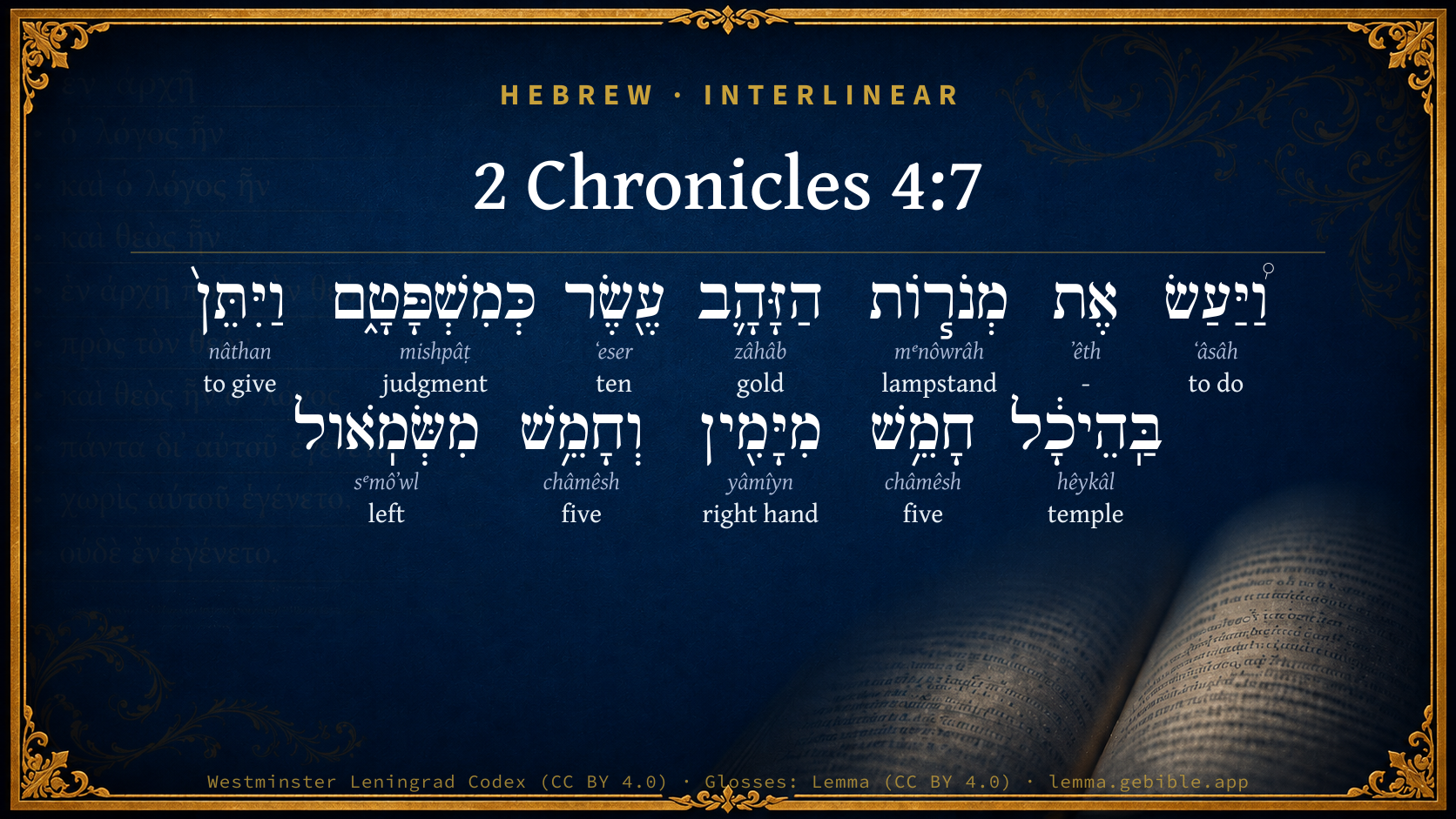
Hebrew (Westminster Leningrad Codex) 2 Chronicles 4:7 appears in the Hebrew Old Testament. The text above is from the Westminster Leningrad Codex. Each word links to its Strong’s number, a concise gloss, and parsing drawn from the Open Scriptures Hebrew Bible morphology. Click any word for its full Brown-Driver-Briggs (BDB) entry.
Download image
Cite this verse

2 Chronicles 4:7 (World English Bible). Public Domain. Lemma interlinear Bible study tool, https://lemma.gebible.app/v/2-chronicles/4/7.

Show BibTeX & RIS
BibTeX
RIS
English Translation
He made the ten lampstands of gold according to the ordinance concerning them; and he set them in the temple, five on the right hand, and five on the left.
World English Bible · Public Domain
Download a study sheet

One document with this verse’s original text, its word-by-word gloss line, the meaning frame, cross-references with their text, attributed commentary, and full source and license credits — printable, and it pastes into notes with its structure intact.

This verse Autodidact and up

Study sheet (.html) Plain text (.txt)

A passage Seminary Student

Up to 50 verses in one chapter. A passage sheet keeps up to 6 commentary sources and 12 cross-references per verse, in the order this page ranks them, and says so on the sheet whenever that leaves anything out. Ask for a single verse and you get the Autodidact verse sheet above.

Everything on this page stays free to read, with no account — the sheet is a download of what is already on screen, not access to it.

Want to remove ads? Support Godless Engineer
Compare translations 3

The same verse in 3 English versions, stacked beneath the original-language interlinear above. Click any original word for its lexicon entry.

Each is an independent rendering of the whole verse — the interlinear is not word-aligned to these translations.

Highlighted words mark where these versions differ — a whole-verse word diff, not a word-by-word alignment.

  • World English Bible Public Domain
    He made the ten lampstands of gold according to the ordinance concerning them; and he set them in the temple, five on the right hand, and five on the left.
  • King James Version Public Domain
    And he made ten candlesticks of gold according to their form, and set them in the temple, five on the right hand, and five on the left.
  • unfoldingWord Literal Text CC BY-SA 4.0
    And he made the 10 lampstands of gold according to their judgment, and he placed in the temple five on the right and five on the left.

unfoldingWord Literal Text — © unfoldingWord, licensed CC BY-SA 4.0. Word-aligned USFM3 via Door43 (git.door43.org/unfoldingWord/en_ult).

Versions to compare (up to 4)

3 of 4 selected

Show all 18 translations

Every available English version of this verse, each an independent rendering of the whole verse.

  • World English Bible Public Domain
    He made the ten lampstands of gold according to the ordinance concerning them; and he set them in the temple, five on the right hand, and five on the left.
  • Berean Standard Bible Public Domain
    He made ten gold lampstands according to their specifications and placed them in the temple, five on the south side and five on the north.
  • Majority Standard Bible Public Domain
    He made ten gold lampstands according to their specifications and placed them in the temple, five on the south side and five on the north.
  • King James Version Public Domain
    And he made ten candlesticks of gold according to their form, and set them in the temple, five on the right hand, and five on the left.
  • American Standard Version (1901) Public Domain
    And he made the ten candlesticks of gold according to the ordinance concerning them; and he set them in the temple, five on the right hand, and five on the left.
  • Revised Version (1885) Public Domain
    And he made the ten candlesticks of gold according to the ordinance concerning them; and he set them in the temple, five on the right hand, and five on the left.
  • Geneva Bible (1599) Public Domain
    And he made ten candlestickes of golde (according to their forme) and put them in the Temple, fiue on the right hand, and fiue on the left.
  • Douay-Rheims (1899) Public Domain
    He made also ten lavers: and he see five on the right hand, and five on the left, to wash in them all such things as they mere to offer for holocausts: but the sea was for the priests to wash in.
  • Young's Literal Translation Public Domain
    And he maketh the ten candlesticks of gold, according to their ordinance, and placeth in the temple, five on the right, and five on the left.
  • Literal Standard Version CC BY-SA 4.0
    And he makes the ten lampstands of gold, according to their ordinance, and places [them] in the temple, five on the right, and five on the left.
  • Unlocked Literal Bible CC BY-SA 4.0
    He made the ten lampstands of gold that were made from the instructions for their design; he placed them in the temple, five on the right hand, and five on the left.
  • unfoldingWord Literal Text CC BY-SA 4.0
    And he made the 10 lampstands of gold according to their judgment, and he placed in the temple five on the right and five on the left.
  • Darby Bible Public Domain
    And he made ten candlesticks of gold according to the ordinance respecting them, and set them in the temple, five on the right hand and five on the left.
  • World Messianic Bible Public Domain
    He made the ten lamp stands of gold according to the ordinance concerning them; and he set them in the temple, five on the right hand and five on the left.
  • Webster's Bible Public Domain
    And he made ten candlesticks of gold according to their form, and set them in the temple, five on the right hand, and five on the left.
  • Free Bible Version CC BY-SA 4.0
    He made ten gold lampstands as had been specified, and placed them in the Temple, five on the south side and five on the north.
  • Bible in Basic English Public Domain
    And he made the ten gold supports for the lights, as directions had been given for them, and he put them in the Temple, five on the right side and five on the left.
  • JPS Tanakh (1917) Public Domain
    And he made the ten candlesticks of gold according to the ordinance concerning them; and he set them in the temple, five on the right hand, and five on the left.

Literal Standard Version (2020), Covenant Press — licensed CC BY-SA 4.0. Text via the HelloAO Bible API (eBible.org). Unlocked Literal Bible (unfoldingWord) — licensed CC BY-SA 4.0. Text via the HelloAO Bible API (eBible.org). unfoldingWord Literal Text — © unfoldingWord, licensed CC BY-SA 4.0. Word-aligned USFM3 via Door43 (git.door43.org/unfoldingWord/en_ult). Free Bible Version, Dr. Jonathan Gallagher — licensed CC BY-SA 4.0. Text via the HelloAO Bible API (eBible.org).

Word by word

More ways to search: Search by grammar → Find every occurrence → Compare this word →

Practice this passage: Drill this verse → Learn its vocabulary →

מְנֹר֧וֹת
mᵉnôwrâh
H4501
“lampstands of”
Noun, Common, Feminine, Plural, Construct
Part of Speech
Noun
Type
Common
Gender
Feminine
Number
Plural
State
Construct
Full BDB Definition

Origin: from H4500 (in the original sense of H5216 )

TWOT: 1333c

lamp stand
  1. וַ֠יַּעַשׂ ʻâsâh H6213 “and · to do” Conjunction + Verb, Qal, Sequential Imperfect, 3rd Person, Masculine, Singular
  2. אֶת ʼêth H853 “-” Particle, Direct Object
  3. הַזָּהָ֛ב zâhâb H2091 “the · gold” Particle, Definite Article + Noun, Common, Masculine, Singular, Absolute
  4. עֶ֖שֶׂר ʻeser H6235 “ten” Adjective, Cardinal number, Feminine, Singular, Absolute
  5. כְּמִשְׁפָּטָ֑ם mishpâṭ H4941 “like/as · judgment · their” Preposition + Noun, Common, Masculine, Singular, Construct + Suffix, Personal, 3rd Person, Masculine, Plural
  6. וַיִּתֵּן֙ nâthan H5414 “and · to give” Conjunction + Verb, Qal, Sequential Imperfect, 3rd Person, Masculine, Singular
  7. בַּֽהֵיכָ֔ל hêykâl H1964 “in/at the · temple” Preposition, Determined + Noun, Common, Masculine, Singular, Absolute
  8. חָמֵ֥שׁ châmêsh H2568 “five” Adjective, Cardinal number, Feminine, Singular, Absolute
  9. מִיָּמִ֖ין yâmîyn H3225 “from · right hand” Preposition + Noun, Common, Feminine, Singular, Absolute
  10. וְחָמֵ֥שׁ châmêsh H2568 “and · five” Conjunction + Adjective, Cardinal number, Feminine, Singular, Absolute
  11. מִשְּׂמֹֽאול sᵉmôʼwl H8040 “from · left” Preposition + Noun, Common, Masculine, Singular, Absolute

About this verse

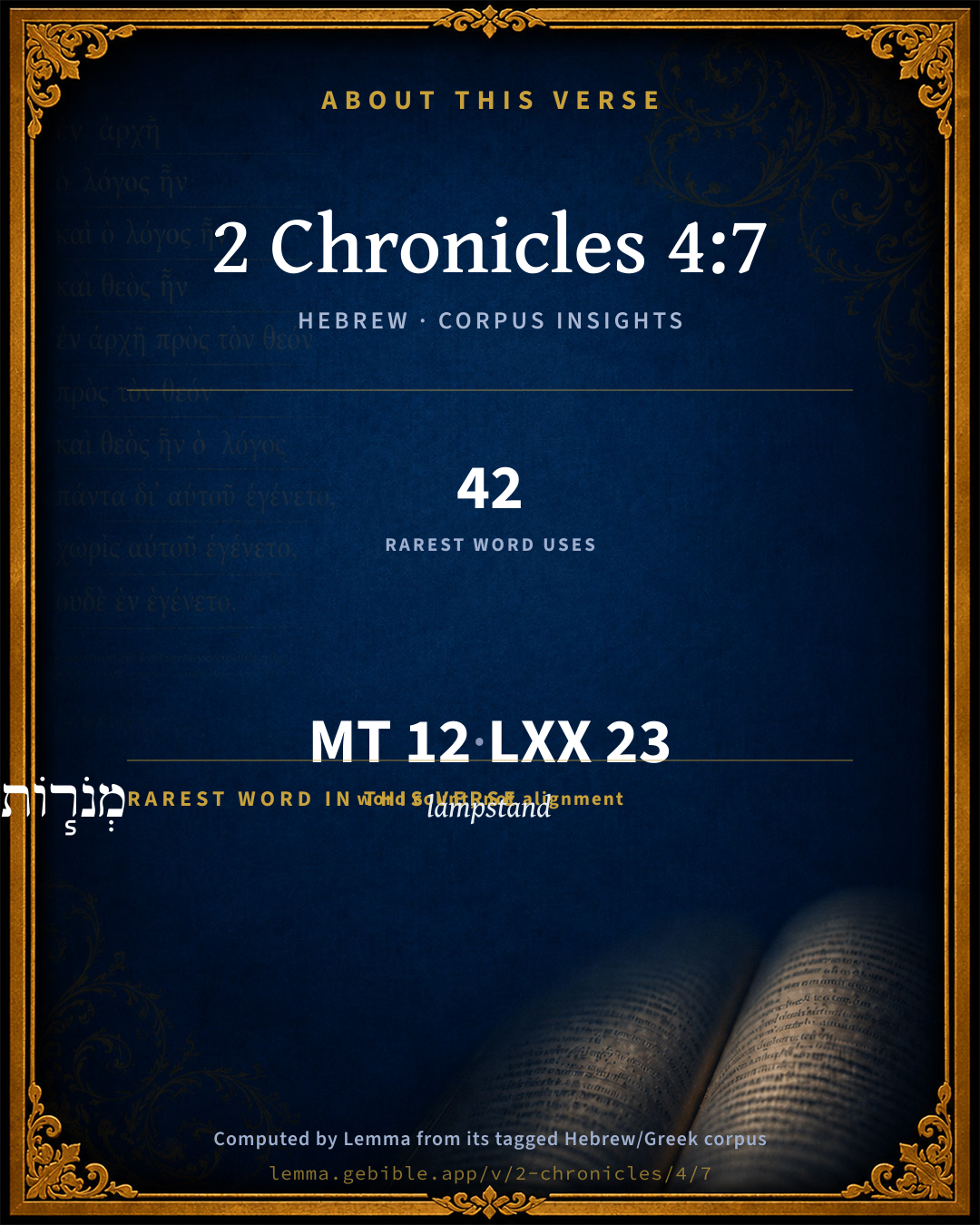
These counts appear in no published source. They are computed here, from the morphology-tagged text and Lemma’s own curated glosses. What Lemma adds →

12
words
11
distinct lemmas
Historical
section

Shared distinctive vocabulary

מְנֹר֧וֹת lampstand H4501 occurs in 31 verses of the Hebrew Bible. Also found in:

Grammatical profile

  • 2 verbs
  • 6 nouns
  • 3 adjectives
  • 1 particle

Verb forms

  • וַ֠יַּעַשׂ Qal · Sequential Imperfect
  • וַיִּתֵּן֙ Qal · Sequential Imperfect

Repetition

A word recurs within this verse — often emphatic in Hebrew:

  • חָמֵ֥שׁ five H2568 ×2

Hebrew & Septuagint length

In English translation the verse runs 30 words from the Hebrew and 28 from the Septuagint (LXX English) — closely comparable.

A rough comparison of the two English renderings, which tokenize alike — not a word-level alignment.

Word counts can differ between the Hebrew and the Greek without any difference in meaning — e.g. the Hebrew direct-object marker אֵת has no separate Greek word, and Greek often adds the article ὁ.

In the original languages it is 12 Hebrew tokens and 23 Greek tokens — but the two are counted differently (Hebrew bundles its prefixes and suffixes into one token; the Greek is in lemma form), so that isn’t a like-for-like length.

Cross-references

11

Topical passages linked to 2 Chronicles 4:7 in the Treasury of Scripture Knowledge — connected by theme and wording, ordered by reader-vote popularity; previews shown in the World English Bible.

  • Exodus 25:31–40 "You shall make a lampstand of pure gold. Of hammered work shall the lampstand be made, even its base, its shaft, its cups, its buds, and its flowers, shall be of one piece with it.
  • 1 Kings 7:49 and the lampstands, five on the right side, and five on the left, before the oracle, of pure gold; and the flowers, and the lamps, and the tongs, of gold;
  • 1 Chronicles 28:12 and the pattern of all that he had by the Spirit, for the courts of the house of Yahweh, and for all the surrounding rooms, for the treasuries of the house of God, and for the treasuries of the dedicated things;
  • John 8:12 Again, therefore, Jesus spoke to them, saying, "I am the light of the world. He who follows me will not walk in the darkness, but will have the light of life."
  • 1 Chronicles 28:15 by weight also for the lampstands of gold, and for the lamps of it, of gold, by weight for every lampstand and for the lamps of it; and for the lampstands of silver, [silver] by weight for [every] lampstand and for the lamps of it, according to the use of every lampstand;
  • 1 Chronicles 28:19 All this, [said David], have I been made to understand in writing from the hand of Yahweh, even all the works of this pattern.
  • Zechariah 4:2–3 He said to me, "What do you see?" I said, "I have seen, and, behold, a lampstand all of gold, with its bowl on the top of it, and its seven lamps thereon; there are seven pipes to each of the lamps, which are on the top of it;
  • Zechariah 4:11–14 Then I asked him, "What are these two olive trees on the right side of the lampstand and on the left side of it?"
  • Matthew 5:14–16 You are the light of the world. A city located on a hill can't be hidden.
  • Hebrews 8:5 who serve a copy and shadow of the heavenly things, even as Moses was warned by God when he was about to make the tabernacle, for he said, "See, you shall make everything according to the pattern that was shown to you on the mountain."
  • Revelation 1:20 the mystery of the seven stars which you saw in my right hand, and the seven golden lampstands. The seven stars are the angels of the seven assemblies. The seven lampstands are seven assemblies.

Cross-references courtesy of OpenBible.info (CC BY 4.0).

Hebrew and Greek witnesses Masoretic Hebrew ↔ Greek Septuagint

The same verse in the two great witnesses to the Old Testament, shown verse-for-verse.

These are two independent witnesses, not word-aligned to each other, and the Septuagint is shown in lemma (dictionary) form.

Hebrew 2 Chronicles 4:7 Masoretic · Westminster Leningrad Codex

וַ֠יַּעַשׂ אֶת מְנֹר֧וֹת הַזָּהָ֛ב עֶ֖שֶׂר כְּמִשְׁפָּטָ֑ם וַיִּתֵּן֙ בַּֽהֵיכָ֔ל חָמֵ֥שׁ מִיָּמִ֖ין וְחָמֵ֥שׁ מִשְּׂמֹֽאול

He made the ten lampstands of gold according to the ordinance concerning them; and he set them in the temple, five on the right hand, and five on the left.

World English Bible · Public Domain

Greek LXX 2 Chronicles 4:7 Septuagint · lemma form

καί ποιέω ὁ λυχνία ὁ χρυσοῦς δέκα κατά ὁ κρίμα αὐτός καί τίθημι ἐν ὁ ναός πέντε ἐκ δεξιός καί πέντε ἐκ ἀριστερός

And he made the ten golden candlesticks according to their pattern, and he put them in the temple, five on the right hand, and five on the left.

LXX2012 (modern English Septuagint) · Public Domain

Hebrew: Westminster Leningrad Codex (CC BY 4.0). Greek: Septuagint (public domain); English from LXX2012 (modern English Septuagint) (Public Domain). How the Septuagint differs from the Hebrew →

Commentary

Notes on 2 Chronicles 4:7 from classic Christian and Jewish commentators (each source and its license shown beneath its notes). The classic Christian expositions comment on the surrounding passage and are grouped to its opening verse, so a note may address several verses; the Jewish commentaries on the Tanakh (Rashi and others) are per-verse, so they appear only where the commentator wrote on this verse.

Lemma curates 59 commentaries, every one of them public domain or Creative Commons licensed, each selected and text-cleaned for this edition rather than reprinted as found. About our sources →

Ellicott's Commentary for English Readers

THE TEN GOLDEN CANDLESTICKS, THE TEN TABLES, THE HUNDRED GOLDEN BOWLS, AND THE COURTS (2Ch_4:7-9).

This section is peculiar to Chronicles.

(7) And he made ten candlesticks of gold according to their form.—And he made the golden lampstands ten, according to their rule, or, prescribed manner. (Comp. 1Ki_7:49; and Exo_25:31-40, where their type is described.) So the Vulg., “secundum speciem quâ jussa erant fieri.” Syriac and Arabic, “according to their laws.” Others explain “as their use required,” which is less likely.

In the temple.—And before the chancel (1Ki_7:49; 2Ch_4:20, infra).

A Bible Commentary for English Readers, edited by Charles John Ellicott (1878–1897) — public domain. Text from a community e-Sword module.

Trapp's Complete Commentary

John Trapp

2Ch 4:7 And he made ten candlesticks of gold according to their form, and set [them] in the temple, five on the right hand, and five on the left.

Ver. 7. And he made ten candlesticks of gold, according to their form.] According to David’s pattern.

Five on the right hand.] See 1Ki 7:49.

John Trapp, A Commentary or Exposition upon All the Books of the Old and New Testament (1647–1656) — public domain. Text from a community e-Sword module.

Keil & Delitzsch

C. F. Keil & F. Delitzsch

The golden furniture of the holy place and the courts. These three verses are not found in the parallel narrative 1 Kings 7, where in Kg1 7:39 the statement as to the position of the brazen sea (Ch2 4:10) follows immediately the statement of the position of the stands with the lavers. The candlesticks and the table of the shew-bread are indeed mentioned in the summary enumeration of the temple furniture, Kg1 7:48 and Kg1 7:49, as in the corresponding passage of the Chronicle (Ch2 4:19, Ch2 4:20) they again occur; and in Kg1 6:36 and Kg1 7:12, in the description of the temple building, the inner court is spoken of, but the outer court is not expressly mentioned. No reason can be given for the omission of these verses in 1 Kings 7; but that they have been omitted or have dropped out, may be concluded from the fact that not only do the whole contents of our fourth chapter correspond to the section 1 Kings 7:23-50, but both passages are rounded off by the same concluding verse (Ch2 5:1 and Kg1 7:51).

Ch2 4:7

He made ten golden candlesticks כּמשׁפּטם, according to their right, i.e., as they should be according to the prescript, or corresponding to the prescript as to the golden candlesticks in the Mosaic sanctuary (Exo 25:31.). משׁפּט is the law established by the Mosaic legislation.

Ch2 4:8

Ten golden tables, corresponding to the ten candlesticks, and, like these, placed five on the right and five on the left side of the holy place. The tables were not intended to bear the candlesticks (Berth.), but for the shew-bread; cf. on Ch2 4:19 and Ch1 28:16. And a hundred golden basins, not for the catching and sprinkling of the blood (Berth.), but, as their connection with the tables for the shew-bread shows, wine flagons, or sacrificial vessels for wine libations, probably corresponding to the מנקּיּות on the table of shew-bread in the tabernacle (Exo 25:29). The signification, wine flagons, for מזרקים, is placed beyond a doubt by Amo 6:6.

Keil & Delitzsch — Biblical Commentary on the Old Testament (1861–1891) — public domain (CC PDM 1.0). Text via the HelloAO Bible API. (Old Testament only.)

Tyndale Open Study Notes

Tyndale Open Resources

4:7 The seven lights of each of the ten gold lampstands might have represented the Pleiades, a cluster of stars symbolized by seven dots in ancient Mesopotamia (cp. Job 9:9; 38:31; Amos 5:8).

Tyndale Open Study Notes — © Tyndale Open Resources, licensed CC BY-SA 4.0. Text via the HelloAO Bible API.

Geneva Bible (1599)

Geneva Bible translators

Even as they should be made.

Geneva Bible (1599) marginal notes — public domain. Text via Bolls.life.

Jamieson, Fausset & Brown

Robert Jamieson, A. R. Fausset & David Brown

ten candlesticks--(See on Kg1 7:49). The increased number was not only in conformity with the characteristic splendor of the edifice, but also a standing emblem to the Hebrews, that the growing light of the word was necessary to counteract the growing darkness in the world [LIGHTFOOT].

Jamieson, Fausset & Brown — Commentary Critical and Explanatory on the Whole Bible (1871) — public domain (CC PDM 1.0). Text via the HelloAO Bible API.

Albert Barnes' Notes on the Bible

According to their form - Rather, “after their manner” (compare 2Ch 4:20). There is no allusion to the shape of the candlesticks, which were made, no doubt, after the pattern of the original candlestick of Moses.

Albert Barnes' Notes on the Bible (1834–1885) — public domain. Text from a community e-Sword/MySword module.

Matthew Poole's English Annotations

According to their form; either,

1. the form which was appointed for them by God, who signified it to David. Or rather,

2. The old form which God prescribed to Moses, Exo 25:31, &c., for so these were made. And this clause seems to be added here, because in many things there was a great variation from the old form, as in the posture of the cherubims, the height of the altar, and divers other things.

Matthew Poole's English Annotations on the Holy Bible (1683–1685) — public domain. Text from a community e-Sword/MySword module.

The Pulpit Commentary

Ten candlesticks of gold. The only allusion to these in the parallel is found later on in part of the forty-ninth verse of 1Ki

7. According to their form. This expression, though so vague, might point to the fact that the form of the old candlestick of the tabernacle was adhered. (Exo_25:31) But considering the recurrence of the same words (ver. 20), there can be no doubt that the phrase is identical in its meaning with the use found in such passages as Lev_5:10 Lev_9:16, and means "according to the prescribed ordinance,

Lights in the world.

There are many difficulties and disagreements about the spiritual significance of the temple furniture; but there is a general agreement as to the meaning of the "candlestick," or of these "ten candlesticks of gold" to which the text refers. As in the "Divine compartment" of the "most holy place" the Shechinah was the symbol of the Divine presence, and spoke of the Lord God of Israel as the one true Light of the world, so in the human department of the "holy place" these lights were the symbol of the Hebrew Church, regarded as the centre and source of light in the midst of surrounding darkness. And such it was. We may well regard

I ISRAEL AS THE SOURCE OF LIGHT. Perhaps rather as the possessor than the source, for communication between neighbouring countries was very much more limited then than it is now; and it was in its later days that the Jew was such a traveller and such a propagandist. But from the time that God made himself and his will known to Moses, down to the birth of Christ, Divine truth was known in Israel as it was not known elsewhere, and "salvation was of the Jews," as our Lord declared. Comparing the theological and ethical ideas of the people of God with those of contemporary peoples, we see how really enlightened they were. And some of the most essential doctrines, on which all Divine wisdom, and all moral excellency, and all national prosperity, and all individual wellbeing must always rest, were carried by the worshippers of Jehovah to Egypt, to Persia, to Rome, to still more distant countries. The light that shone in the sanctuary went forth and illumined a large space.

II THE CHRISTIAN CHURCH AS A SOURCE OF LIGHT. Said the great Teacher to his disciples, and through them to his Church for all time, "Ye are the light of the world." The Apostle Paul wrote to his converts at Ephesus, and through them to us, "Ye are light in the Lord." And it becomes us to do two things.

1. Manifest the great characteristic of light purity. To "walk as children of light, in all goodness and righteousness and truth"; (Eph_5:8, Eph_5:9) as the servants of him who himself "is light, in whom is no darkness at all;" to be "holy as he is holy.

2. Discharge the great function of light to reveal. To "make manifest" (Eph_5:13) those great verities which renew and sustain and ennoble us in heart and life. We are so to let our light shine that men may see our good works, and glorify our Divine Father. It does not take any prolonged study, or any range of experience, or any remarkable talent, to cause men to know the redeeming truths which restore them to God; which give them spiritual rest and abiding joy, and a hope that will not make ashamed; which build them up in manly virtues and in Christian graces; which prepare for the heavenly kingdom. Even the humbler disciples, who claim no rank in the community, may render this valuable service.

(1) By living a trite, faithful, earnest life, day by day, in the love of Christ;

(2) by speaking familiar Christian truth to those who are willing to hear it, this good work can be wrought. C.

The Pulpit Commentary (1880–1919), ed. H.D.M. Spence-Jones & Joseph S. Exell — public domain. Text from a community e-Sword module.

John Wesley's Explanatory Notes

Their form - The old form which God prescribed to Moses.

John Wesley, Explanatory Notes Upon the Whole Bible (1754–1765) — public domain. Text via the GEBible commentary corpus.

unfoldingWord translationNotes

Door43 World Missions Community

He made ... he placed ... He made ... He made

Here "he" refers to Solomon. The readers should understand that Solomon probably commanded other people to do the actual work. AT: "Solomon's workers made ... they placed ... They made ... They made" (See: Metonymy)

that were made from the instructions for their design

This can be stated in active form. AT: "according to the instructions for their design" or "according to how Solomon instructed his workers to design them" (See: Active or Passive)

on the right hand ... on the left

"on the right side ... on the left side" or "on the south side ... on the north side"

one hundred basins

"100 basins" (See: Numbers)

basins

shallow bowls used for washing

translationWords

lampstand

gold

temple

unfoldingWord translationNotes — © Distant Shores Media and the Door43 World Missions Community, licensed CC BY-SA 4.0. Source: git.door43.org/Door43/en_tn.

Rashi

Rabbi Shlomo Yitzchaki (Rashi)

And he made the ten golden candelabra according to their regulations Why is it stated in connection with the candelabra, “according to their regulations”? Because he informs us why he made ten candelabra, and everything he deduced from the Torah: the flowers, the knobs, the almond-shaped cups enumerated in the chapter were seventy, meaning that for each of the ten candelabra were seven lamps. (This is how my mother’s brother, my uncle, Rabbi Klonimos the son of Rabbi Judah explained it, and it is a midrash), and its seven lamps corresponded to the seven planets: Sun, Venus, Mercury, Moon, Saturn, Jupiter, and Mars.

and placed them in the Heichal, five from the right of Moses’ candelabrum.

and five from the left but they were all in the south.

Rashi on the Tanakh — English translations: “The Judaica Press complete Tanach with Rashi, translated by A. J. Rosenberg” (CC BY 4.0); “Pentateuch with Rashi's commentary by M. Rosenbaum and A.M. Silbermann, 1929-1934” (public domain); “The Metsudah Tanach series, Lakewood, N.J” (CC BY 4.0); and “The Book of Joshua, Metsudah Publications, 1997” (CC BY 4.0). Text via Sefaria.

Lesson kit

Teaching starters — assembled from the data on this page, not authored interpretation. Every prompt links to the verse data it draws on. Edit before teaching.

2 Chronicles, in the Historical, opens this verse with 12 words (11 distinct Hebrew lemmas). Its most distinctive word is mᵉnôwrâh (“lampstand”). A historical commentator’s framing appears above. Read the whole chapter for the surrounding context.

Discussion questions

  1. What does “lampstand” (mᵉnôwrâh) contribute to the verse as a whole?
  2. How does Exodus 25:31, which shares the word «lampstand», read alongside this verse?
  3. What does the repetition of “five” (2× in this one verse) do in this verse?
  4. The translations on this page render this verse differently — a whole-verse word diff, not a word-by-word alignment. What might account for the different wordings?
  5. «וַ֠יַּעַשׂ» is a Qal Sequential Imperfect verb. How does that grammatical form shape the action described?
  6. Compare how Ellicott's Commentary for English Readers and Trapp's Complete Commentary read this verse. Where do they agree or differ?

Things to notice

Reading settings

Reading text

Shown beneath each verse's original-language words.

Old Testament
Old Testament edition

Read the OT as the Masoretic Hebrew (MT) or the Greek Septuagint (LXX).

English shown for the Greek Septuagint (in the Hebrew ↔ Greek comparison).

Comparing translations? Open the Compare panel on any verse page to stack up to four side by side.