
Job 35:2

Hebrew (Westminster Leningrad Codex) Job 35:2 appears in the Hebrew Old Testament. The text above is from the Westminster Leningrad Codex. Each word links to its Strong’s number, a concise gloss, and parsing drawn from the Open Scriptures Hebrew Bible morphology. Click any word for its full Brown-Driver-Briggs (BDB) entry.
Download image
Cite this verse

Job 35:2 (World English Bible). Public Domain. Lemma interlinear Bible study tool, https://lemma.gebible.app/v/job/35/2.

Show BibTeX & RIS
BibTeX
RIS
English Translation
"Do you think this to be your right, Or do you say, 'My righteousness is more than God's,'
World English Bible · Public Domain
Download a study sheet

One document with this verse’s original text, its word-by-word gloss line, the meaning frame, cross-references with their text, attributed commentary, and full source and license credits — printable, and it pastes into notes with its structure intact.

This verse Autodidact and up

Study sheet (.html) Plain text (.txt)

A passage Seminary Student

Up to 50 verses in one chapter. A passage sheet keeps up to 6 commentary sources and 12 cross-references per verse, in the order this page ranks them, and says so on the sheet whenever that leaves anything out. Ask for a single verse and you get the Autodidact verse sheet above.

Everything on this page stays free to read, with no account — the sheet is a download of what is already on screen, not access to it.

Want to remove ads? Support Godless Engineer
Compare translations 3

The same verse in 3 English versions, stacked beneath the original-language interlinear above. Click any original word for its lexicon entry.

Each is an independent rendering of the whole verse — the interlinear is not word-aligned to these translations.

Highlighted words mark where these versions differ — a whole-verse word diff, not a word-by-word alignment.

  • World English Bible Public Domain
    "Do you think this to be your right, Or do you say, 'My righteousness is more than God's,'
  • King James Version Public Domain
    Thinkest thou this to be right, that thou saidst, My righteousness is more than God's?
  • unfoldingWord Literal Text CC BY-SA 4.0
    “Do you consider this to justice? You say, ‘I am more righteous than God’!

unfoldingWord Literal Text — © unfoldingWord, licensed CC BY-SA 4.0. Word-aligned USFM3 via Door43 (git.door43.org/unfoldingWord/en_ult).

Versions to compare (up to 4)

3 of 4 selected

Show all 18 translations

Every available English version of this verse, each an independent rendering of the whole verse.

  • World English Bible Public Domain
    "Do you think this to be your right, Or do you say, 'My righteousness is more than God's,'
  • Berean Standard Bible Public Domain
    “Do you think this is just? You say, ‘I am more righteous than God.’
  • Majority Standard Bible Public Domain
    “Do you think this is just? You say, ‘I am more righteous than God.’
  • King James Version Public Domain
    Thinkest thou this to be right, that thou saidst, My righteousness is more than God's?
  • American Standard Version (1901) Public Domain
    Thinkest thou this to be `thy' right, `Or' sayest thou, My righteousness is more than God's,
  • Revised Version (1885) Public Domain
    Thinkest thou this to be thy right, or sayest thou, My righteousness is more than God’s,
  • Geneva Bible (1599) Public Domain
    Thinkest thou this right, that thou hast said, I am more righteous then God?
  • Douay-Rheims (1899) Public Domain
    Doth thy thought seem right to thee, that thou shouldst say: I am more just than God?
  • Young's Literal Translation Public Domain
    This hast thou reckoned for judgment: Thou hast said -- `My righteousness `is' more than God's?'
  • Literal Standard Version CC BY-SA 4.0
    “Have you reckoned this for judgment [when] you have said, || My righteousness [is] more than God’s?
  • Unlocked Literal Bible CC BY-SA 4.0
    “Do you think this is just when you say, 'My right before God'?
  • unfoldingWord Literal Text CC BY-SA 4.0
    “Do you consider this to justice? You say, ‘I am more righteous than God’!
  • Darby Bible Public Domain
    Thinkest thou this to be right, that thou saidst, My righteousness is more than ùGod's?
  • World Messianic Bible Public Domain
    “Do you think this to be your right, or do you say, ‘My righteousness is more than God’s,’
  • Webster's Bible Public Domain
    Thinkest thou this to be right, that thou saidst, My righteousness is more than God's?
  • Free Bible Version CC BY-SA 4.0
    “Do you think it's honest to claim you are right before God?
  • Bible in Basic English Public Domain
    Does it seem to you to be right, and righteousness before God, to say,
  • JPS Tanakh (1917) Public Domain
    Thinkest thou this to be thy right, or sayest thou: 'I am righteousness before God',

Literal Standard Version (2020), Covenant Press — licensed CC BY-SA 4.0. Text via the HelloAO Bible API (eBible.org). Unlocked Literal Bible (unfoldingWord) — licensed CC BY-SA 4.0. Text via the HelloAO Bible API (eBible.org). unfoldingWord Literal Text — © unfoldingWord, licensed CC BY-SA 4.0. Word-aligned USFM3 via Door43 (git.door43.org/unfoldingWord/en_ult). Free Bible Version, Dr. Jonathan Gallagher — licensed CC BY-SA 4.0. Text via the HelloAO Bible API (eBible.org).

Word by word

More ways to search: Search by grammar → Find every occurrence → Compare this word →

Practice this passage: Drill this verse → Learn its vocabulary →

צִדְקִ֥י
tsedeq
H6664
“righteousness · my”
Noun, Common, Masculine, Singular, Construct + Suffix, Personal, 1st Person, Common, Singular
Part of Speech
Noun
Type
Common
Gender
Masculine
Number
Singular
State
Construct
Full BDB Definition

Origin: from H6663

TWOT: 1879a

justice, rightness, righteousness - what is right or just or normal, rightness, justness (of weights and measures) - righteousness (in government) - of judges, rulers, kings - of law - of Davidic king, Messiah - of Jerusalem as seat of just government - of God's attribute - righteousness, justice (in case or cause) - rightness (in speech) - righteousness (as ethically right) - righteousness (as vindicated), justification (in controversy), deliverance, victory, prosperity - of God as covenant-keeping in redemption - in name of Messianic king - of people enjoying salvation - of Cyrus
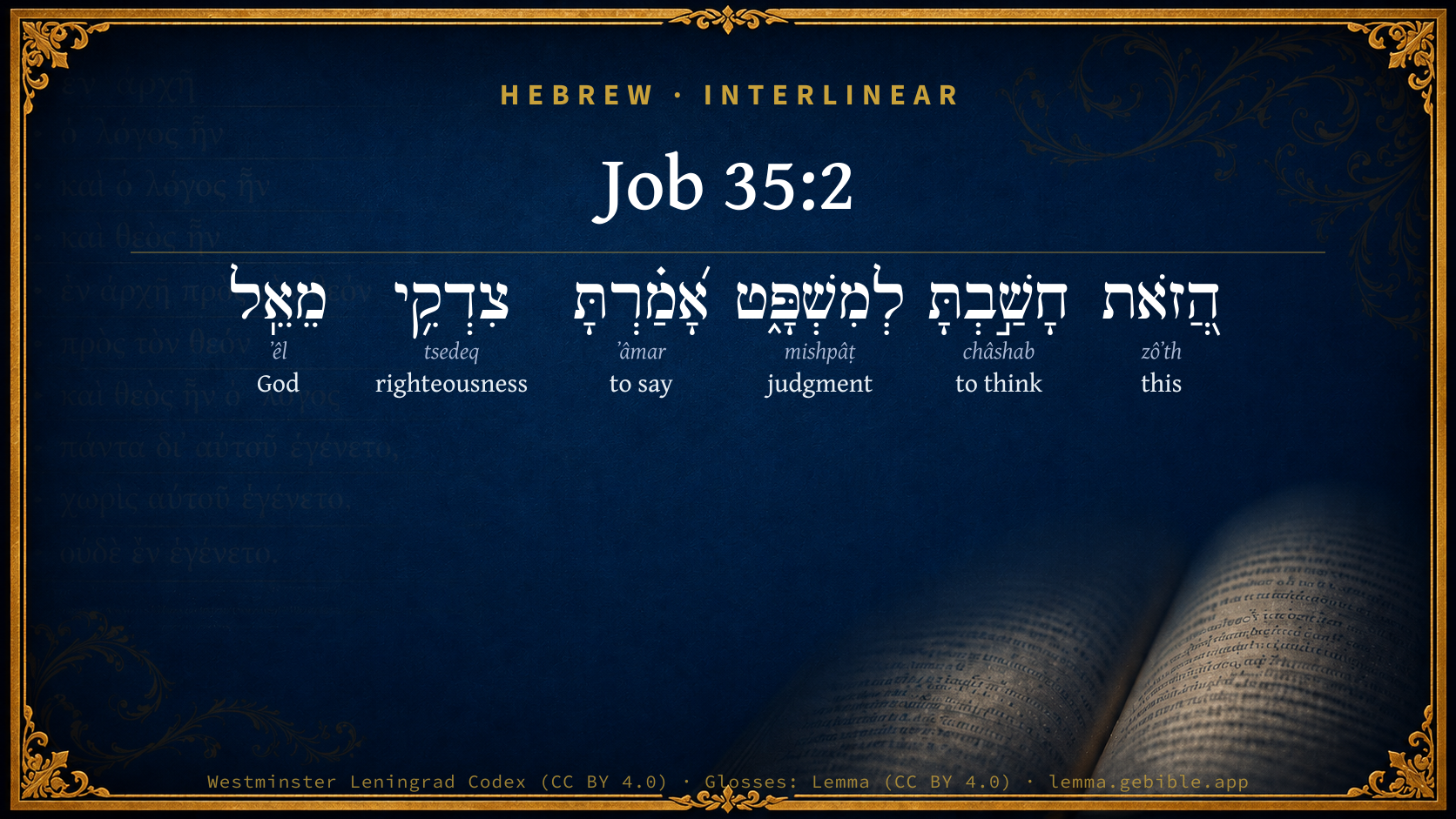
  1. הֲ֭זֹאת zôʼth H2063 “this” Particle, Interrogative + Pronoun, Demonstrative, Feminine, Singular
  2. חָשַׁ֣בְתָּ châshab H2803 “to think” Verb, Qal, Perfect, 2nd Person, Masculine, Singular
  3. לְמִשְׁפָּ֑ט mishpâṭ H4941 “to/for · judgment” Preposition + Noun, Common, Masculine, Singular, Absolute
  4. אָ֝מַ֗רְתָּ ʼâmar H559 “to say” Verb, Qal, Perfect, 2nd Person, Masculine, Singular
  5. מֵאֵֽל ʼêl H410 “from · God” Preposition + Noun, Common, Masculine, Singular, Absolute

About this verse

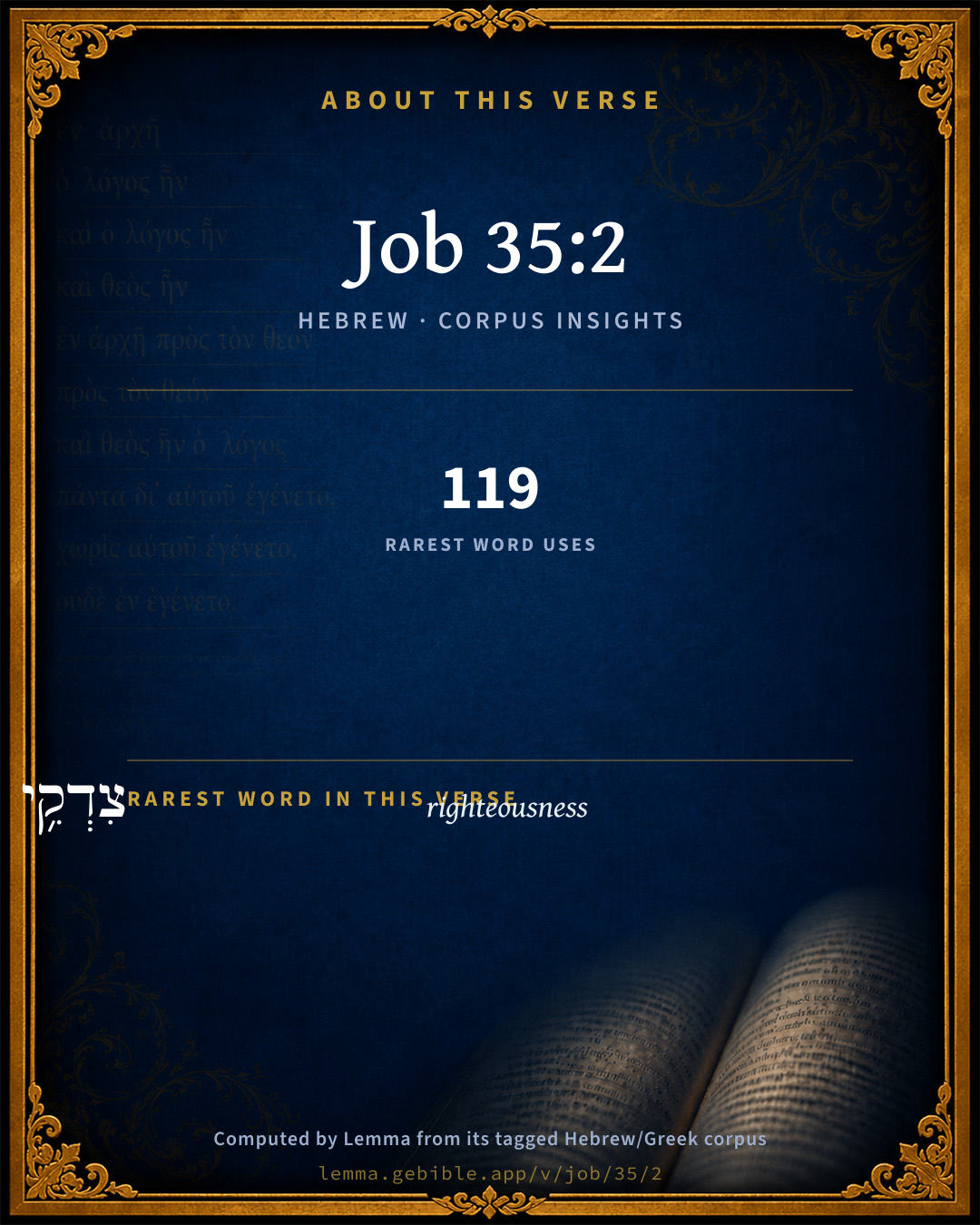
These counts appear in no published source. They are computed here, from the morphology-tagged text and Lemma’s own curated glosses. What Lemma adds →

6
words
6
distinct lemmas
Wisdom
section

Grammatical profile

  • 2 verbs
  • 3 nouns
  • 1 pronoun

Verb forms

  • חָשַׁ֣בְתָּ Qal · Perfect
  • אָ֝מַ֗רְתָּ Qal · Perfect

Hebrew & Septuagint length

In English translation the verse runs 18 words from the Hebrew and 24 from the Septuagint (LXX English) — closely comparable.

A rough comparison of the two English renderings, which tokenize alike — not a word-level alignment.

Word counts can differ between the Hebrew and the Greek without any difference in meaning — e.g. the Hebrew direct-object marker אֵת has no separate Greek word, and Greek often adds the article ὁ.

Cross-references

9

Topical passages linked to Job 35:2 in the Treasury of Scripture Knowledge — connected by theme and wording, ordered by reader-vote popularity; previews shown in the World English Bible.

  • Matthew 12:36–37 I tell you that every idle word that men speak, they will give account of it in the day of judgment.
  • Job 9:17 For he breaks me with a tempest, Multiplies my wounds without cause.
  • Job 10:7 Although you know that I am not wicked, There is no one who can deliver out of your hand.
  • Job 16:17 Although there is no violence in my hands, And my prayer is pure.
  • Job 19:6–7 Know now that God has subverted me, And has surrounded me with his net.
  • Job 27:2–6 "As God lives, who has taken away my right, The Almighty, who has made my soul bitter.
  • Job 34:5 For Job has said, 'I am righteous, God has taken away my right:
  • Job 40:8 Will you even annul my judgment? Will you condemn me, that you may be justified?
  • Luke 19:22 "He said to him, 'Out of your own mouth will I judge you, you wicked servant! You knew that I am an exacting man, taking up that which I didn't lay down, and reaping that which I didn't sow.

Cross-references courtesy of OpenBible.info (CC BY 4.0).

Hebrew and Greek witnesses Masoretic Hebrew ↔ Greek Septuagint

The same verse in the two great witnesses to the Old Testament, shown verse-for-verse.

These are two independent witnesses, not word-aligned to each other, and the Septuagint is shown in lemma (dictionary) form.

Hebrew Job 35:2 Masoretic · Westminster Leningrad Codex

הֲ֭זֹאת חָשַׁ֣בְתָּ לְמִשְׁפָּ֑ט אָ֝מַ֗רְתָּ צִדְקִ֥י מֵאֵֽל

"Do you think this to be your right, Or do you say, 'My righteousness is more than God's,'

World English Bible · Public Domain

Greek LXX Job 35:2 Septuagint · lemma form

τίς οὗτος ἡγέομαι ἐν κρίσις σύ τίς εἰμί ὅτι εἶπον δίκαιος εἰμί ἔναντι κύριος

What is this that you think to be according to right? who are you that you have said, I am righteous before the Lord?

LXX2012 (modern English Septuagint) · Public Domain

On this verse, Whedon's Commentary on the Bible discusses the Septuagint’s reading. Read the note in Commentary ↓

Hebrew: Westminster Leningrad Codex (CC BY 4.0). Greek: Septuagint (public domain); English from LXX2012 (modern English Septuagint) (Public Domain). How the Septuagint differs from the Hebrew →

Commentary

Notes on Job 35:2 from classic Christian and Jewish commentators (each source and its license shown beneath its notes). The classic Christian expositions comment on the surrounding passage and are grouped to its opening verse, so a note may address several verses; the Jewish commentaries on the Tanakh (Rashi and others) are per-verse, so they appear only where the commentator wrote on this verse.

Lemma curates 59 commentaries, every one of them public domain or Creative Commons licensed, each selected and text-cleaned for this edition rather than reprinted as found. About our sources →

The Cambridge Bible for Schools and Colleges

gen. ed. J. J. S. Perowne

2–4. Statement of Job’s charge against God that under His rule of the world to be righteous is no advantage to a man. The verses read,

2. Thinkest thou this to be thy right,

And callest thou it, My just cause against God,

3. That thou sayest, What advantage hast thou?

And, What am I profited more than if I had sinned?

Throughout Elihu’s speeches there runs the idea of a cause or plea between Job and God. Job is regarded by him as maintaining that he has a right or just cause against God. Elihu here asks if Job considers that the rectitude of his cause will appear in his maintaining that godliness profits a man nothing?—the word this in Job_35:2 refers to the questions in Job_35:3. If Job could successfully maintain this contention his cause against God would be good. Therefore Elihu controverts his assertion, contending that righteousness does avail a man, as it must. Both parties conduct the dispute in a somewhat external way, meaning by the “advantage “of religion the possession of outward goods and immunity from suffering. Job does this of necessity, because he is still entangled in the old theory of retribution, though he is breaking through its meshes on one side. And Elihu in his theoretical argument naturally follows him, without referring to the deeper comforts of religion, the joy in God, with which some of the Psalmists delight themselves in affliction, Psa_17:15; Psa_73:23 seq.

The Cambridge Bible for Schools and Colleges (gen. ed. J. J. S. Perowne; Cambridge University Press, 1878–1918) — public domain. Text from a community e-Sword module.

Trapp's Complete Commentary

John Trapp

Job 35:2 Thinkest thou this to be right, [that] thou saidst, My righteousness [is] more than God’s?

Ver. 2. Thinkest thou this to be right?] Heb. Reckonest thou this to be right? q.d. I appeal to thine own conscience. This is a sign of great confidence in the appealer, yet may it be done by men of corrupt minds, destitute of the truth. Witness that bold Anabaptist, that in a solemn disputation at Tigure, appealed to Zuinglius, as if convinced in his own conscience he had inwardly favoured Anabaptism (Scult. Annal.). And those impudent Papists, that report themselves to our consciences, to tell them, Whether our condemnation be not so expressly set down in our own Bibles, and so clear to all the world, that nothing more needs thereto than that they know to read, and to have their eyes in their heads at the opening of our Bible; to tell them, moreover, whether England hath not brought forth within these few years past, to the number of twenty several sorts of Bibles, far different one from another (Gagge of the New Gospel, Preface).

That thou saidst, My righteousness is more than God’s] Heb. My righteousness is before God’s. Diodati rendereth it, My righteousness is from God; that is, I am sure God will justify me, though men condemn me. But it is better to render it, Prae Deo, more than God’s. See a like expression, Heb 12:24, understanding it to be the justice of his cause, and not of his person. But taking it so too, when and where did Job ever say that his righteousness was more than God’s? Nowhere surely in so many words, for then doubtless Satan, and not Job, would have carried away the victory in this conflict. Neither surely could this be rightly gathered out of Job’s words, but distorted and misconstrued. Elihu therefore reproved him with too great austerity, neither can anything be pleaded for him but this, that he pleaded for God; of whose glory he was so very tender, that he could not brook or bear with any syllable of a word that seemed to detract from it.

John Trapp, A Commentary or Exposition upon All the Books of the Old and New Testament (1647–1656) — public domain. Text from a community e-Sword module.

Joseph Benson's Commentary

Job 35:2-3. Thinkest thou this to be right? — Canst thou in thy conscience, upon second thoughts, approve of what thou hast said? My righteousness is more than God’s — Not that Job said this in express terms, but he said those things from which this might seem to follow, as that God had punished him more than he deserved. For thou saidst, &c. — This is produced in proof of the foregoing charge. Job had often affirmed that he was, and still continued to be, righteous, though he had no present benefit by his righteousness, but much bitterness with it; and that God did not act kindly toward him, notwithstanding his former and present piety, but dealt with him as if he had been a most wicked man. Now, Elihu interprets this as implying that he thought himself more righteous than God. Thou saidst, What advantage will it be unto thee — Unto me; such changes of persons being frequent in the Hebrew language. And what profit shall I have, &c. — I have no more present advantage by all my care to please and serve God than wicked men have by their sins against him. God regards my cries no more than theirs, and shows no more kindness or pity to me than he doth to the most profligate wretches. But, it must be remembered, if Job’s words implied any thing of this kind, it was only with reference to his state in the present life. He well knew that he should have much, yea, everlasting advantage from his piety in the life to come.

Joseph Benson's Commentary on the Old and New Testaments (1811–1818) — public domain. Text from a community e-Sword module.

Whedon's Commentary on the Bible

Daniel D. Whedon

JOB’S NOTION THAT MAN IS IN NO WAY BENEFITED BY HIS PIETY IS ERRONEOUS, Job_35:2-16.

First half — MAN’S RIGHTEOUSNESS IS TOO IMPERFECT TO POSTULATE CLAIMS UPON GOD: IF GOD REWARD AT ALL, IT IS A PURE GRATUITY, Job_35:2-8.

a. The thesis already anticipated (Job_34:9) is here formulated by a series of questions, Job_35:2-4. “There (Job_34:9) Elihu censured the complaint as an arraignment of the justice of God. Here he takes it in another point of view, namely, as laying God under obligation.” — Scott.

2. My righteousness is more than God’s — The Septuagint renders this clause, “I am righteous before the Lord.” This accords better with the actual statements of Job, although the English Version agrees with the Vulgate, and is now accepted by many. See note on Job_4:17. Delitzsch makes it a question, “Saidst thou,” etc. The sentiment that Elihu attributes to Job may be, that he had been more just to God than God had been to him.

Daniel D. Whedon (gen. ed.), Commentary on the Old and New Testaments (1874–1909) — public domain. Text from a community e-Sword module.

Geneva Bible (1599)

Geneva Bible translators

Job never spake these words: but because he maintained his innocence, it seemed as though he would say, that God tormented him without just cause.

Geneva Bible (1599) marginal notes — public domain. Text via Bolls.life.

Adam Clarke's Commentary

Verse 2. My righteousness is more than God's?] This would indeed be a blasphemous saying; but Job never said so, neither directly nor constructively: it would be much better to translate the words צדקי מאל tsidki meel, I am righteous BEFORE God. And Job's meaning most certainly was, "Whatever I am in your sight, I know that in the sight of God I am a righteous man;" and he had a right to assume this character, because God himself had given it to him.

Adam Clarke's Commentary on the Bible (1810–1826) — public domain. Text from a community e-Sword/MySword module.

Ellicott's Commentary for English Readers

XXXV.

(2) My righteousness is more than God’s.—See Job_19:6, &c. Job had not in so many words said this, but what he had said was capable of being so represented, and perhaps seemed to involve it. (Comp. Job_9:22; Job_10:15.) Here, again, there was a misrepresentation of what Job had said. He certainly did not mean that he was none the better for being righteous; on the contrary, he had distinctly said, “Let mine enemy be as the wicked,” &c. (Job_27:7, &c.), because he could not delight himself in God; but it was perfectly true that he had said that his righteousness had not delivered him from suffering.

A Bible Commentary for English Readers, edited by Charles John Ellicott (1878–1897) — public domain. Text from a community e-Sword module.

John Gill's Exposition

For thou saidst, what advantage will it be unto thee?.... Meaning that his righteousness, his holy life and conversation, were of no avail to him: he received no more benefit by being righteous than if he was wicked, since God destroyed one as well as another; and since his righteousness did not secure him from afflictions and calamities, it was of no advantage to him; he had not said so in so many words, but it is inferred from what he had said, Job 9:22. Man's own righteousness is of no advantage to him as to justification before God, and acceptance with him, nor in the business of salvation, or with respect to heaven and happiness, so as to give a right and title to it; bat is of great advantage in other respects; is for self-defence against the imputations and calumnies of wicked men; it makes a man honourable and respectable among men, when to live a vicious course of life is scandalous and reproachful; it gives pleasure and satisfaction to the mind, the testimony of a good conscience is matter of rejoicing; and such a man is free from the racks and tortures of an evil conscience others are distressed with; besides, good works are an evidence of the truth and genuineness of faith to others, and ornament the doctrines of the Gospel and a profession of them: and though a righteous man may be afflicted as others, yet in a different manner, in love and not in wrath, and always for his good;

and, what profit shall one have, if I be cleansed from my sin? The words, "if I be cleansed", are a supplement, and seem necessary; so Mr. Broughton supplies. Sin is of a defiling nature, yet man may be cleansed from it, not by anything he can do, but only by the grace of. God and blood of Christ; and from such a cleansing profit arises. This fits a man for the service and worship of God, and for communion with him; gives him peace of mind, and makes him meet for heaven. This Job had not expressly said, and not at all in this sense, but it seems to be inferred from Job 9:29; where he is speaking of outward purity of life, and yet was plunged into the ditch of afflictions. Some render the words to this sense, as if there was no profit "by expiation of atonement for sin" (u); the same word signifying both sin and atonement for it: there is none but by the blood and sacrifice of Christ, and much profit arises from that; pardon of sin proceeds upon it, and this furnishes out much solid peace, joy, and comfort, Rom 5:10. Others, what profit by punishment for sin (w), unless to God? so sin is sometimes put for punishment; or through leaving sin and repenting of it (x). Now though these are not the causes of the pardon of sin, yet it is given and applied to such who do repent of it, confess and forsake it, Pro 28:13. Or by being "without sin" (y): no man is without sin; but a man may be without any gross and enormous crime he is chargeable with, or without living a vicious course of life; and this is profitable, as has been before observed. Jarchi's paraphrase is,

"what shall I profit more by my righteousness than by my sin?''

which sense is followed by others: I may as well be wicked as righteous; I am not the better for it, since I am afflicted in the manner I am: my righteousness is of no profit to me; if to any, it is to God. To this Elihu returns an answer in the following verses.

(u) "de expiatione mea", Mercerus, &c. "in expiando peccatum", Grotius; "pro piaculo venit", Cocceius; so Simeon Bar Tzemach in loc. (w) "Supplicio meo", Junius & Tremellius; "mucta pro illo aut poena", Cocceius; "ex poena peccati mei", Drusius; so Ben Gersom. (x) "Subaudi relicto", so Mercerus, Drusius; "remisso et per poenitentiam diluto", Munster. (y) "Absque peccato", i.e. "ita vivendo ut non perccom"; so some in Michaelis.

John Gill's Exposition of the Whole Bible (1746–1763) — public domain (CC PDM 1.0). Text via the HelloAO Bible API.

Albert Barnes' Notes on the Bible

Thinkest thou this to be right? - This is the point which Elihu now proposes to examine. He, therefore, solemnly appeals to Job himself to determine whether he could himself say that he thought such a sentiment correct.

That thou saidst, My righteousness is more than God’s - Job had nowhere said this in so many words, but Elihu regarded it as the substance of what he had said, or thought that what he had said amounted to the same thing. He had dwelt much on his own sincerity and uprightness of life; he had maintained that he had not been guilty of such crimes as to make these calamities deserved, and he had indulged in severe reflections on the dealings of God with him; compare Job 9:30-35; Job 10:13-15. All this Elihu interprets as equivalent to saying, that he was more righteous than his Maker. It cannot be denied that Job had given occasion for this interpretation to be put on his sentiments, though it cannot be supposed that he would have affirmed this in so many words.

Albert Barnes' Notes on the Bible (1834–1885) — public domain. Text from a community e-Sword/MySword module.

Haydock's Catholic Bible Commentary

God. Eliu being greatly mortified at Job’s silence, uses still more provoking expressions, and pretends to refute one of the holy man’s assertions, which never escaped his lips, though he had complained that God treated him as an enemy, and with more severity than his sins deserved; (chap. vi. 2.; Calmet) or, that his affliction was greater than his sin, chap. xxiii. 7., &c. Eliu therefore calumniates him. (Worthington)

George Leo Haydock (1774–1849), Haydock's Catholic Family Bible and Commentary, 1859 edition — public domain. Excludes Psalms (Douay-Rheims chapter numbering differs from Protestant) and Deuterocanonical books (Catholic canon only).

Matthew Poole's English Annotations

Canst thou in thy conscience, upon second thoughts, approve of what thou hast said? Not that Job said this in express terms, but he said those things from which this might seem to follow, as that God punished him more than he deserved or expected, all things considered; and that if he might be admitted to debate his cause with or before God, he did not doubt to carry it, and to obtain that ease and favour from God, which otherwise God would not afford him. But this charge against Job he proves in the next verse.

Matthew Poole's English Annotations on the Holy Bible (1683–1685) — public domain. Text from a community e-Sword/MySword module.

The Pulpit Commentary

HOMILIES BY W.F. ADENEY Ver. 2. An unjust inference.

Elihu represents Job as saying that his righteousness is greater than God"s, and he asks whether the patriarch thinks it right to use such language.

I IT IS UNJUST TO ASCRIBE TO OUR FELLOW-MEN OPINIONS WHICH THEY HAVE NOT EXPRESSED. Job had not used such blasphemous language as Elihu attributed to him, and he would have repudiated the ideas that it conveyed. His young monitor was rudely asserting what he thought Job meant, what he took to be the underlying opinion of Job. But this was unjust. Half the controversies of the Church would have been avoided if people had not put into the mouths of others words that they never uttered. The only fair way is to listen to a man"s own statement of his case. The common injustice is to charge an opponent with holding all the opinions which we think can be deduced from his confessed beliefs. Thus we make him responsible for our inferences. "Judge not, that ye be not judged.

II WE SHOULD SEE THE NATURAL CONSEQUENCES OF OUR UTTERANCES, Although it was unjust to draw conclusions as Elihu was doing, it might be helpful for Job to see what conclusions were drawn from his hasty words. He would revolt from such ideas with horror. Then the question may well arise Did he not provoke them? Though Elihu did wrong to make his assertion, Job may also have done wrong in speaking words that Elihu could use in such a way. We may learn from the false charges that are brought against us. Possibly these have been provoked by us. They are caricatures of our conduct. Therefore they show up the salient features of that conduct in a strong light. The very exaggeration calls attention to the points that have been unduly magnified. We need to consider the tendencies of what we say, and test the tendencies of our opinions by the inferences that are drawn from them.

III MAN IS TEMPTED TO THINK HIMSELF MORE JUST THAN GOD. He would not own to such an idea openly, nor even in his own private thought. Nevertheless, in the heat of excitement, he acts as though this were his belief. Otherwise, why does he murmur? Why does he rebel? Why is he cast down into despair? We magnify our own opinions and we justify our own actions when these arc counter to the truth and will of God. Virtually this is making ourselves more just than God.

IV THE JUSTICE OF GOD IS THE TYPE OF ALL JUSTICE. Evidently Elihu assumes that what is justice to man is in itself justice to God. This is assumed throughout the Bible, which makes no attempt to escape from the difficulties of providence by means of the "regulative ideas" advocated by Dean Mansel. Here we do not see that justice means one thing in God and another thing in man. But the perfection of justice may be applied to circumstances that are beyond our understanding. Then it may look unjust. Yet, if we knew all, we should see that it is the type and pattern of the very justice we are called to strive after. W.F.A.

The Pulpit Commentary (1880–1919), ed. H.D.M. Spence-Jones & Joseph S. Exell — public domain. Text from a community e-Sword module.

John Wesley's Explanatory Notes

Thou saidst - Not that Job said this in express terms, but he said those things from which this might seem to follow, as that God had punished him more than he deserved.

John Wesley, Explanatory Notes Upon the Whole Bible (1754–1765) — public domain. Text via the GEBible commentary corpus.

Rashi

Rabbi Shlomo Yitzchaki (Rashi)

Elihu’s AddressDo you consider this to be customary that this is the custom of the creatures toward their Creator, what you said—‘My righteousness is greater than that of the Creator’?

Rashi on the Tanakh — English translations: “The Judaica Press complete Tanach with Rashi, translated by A. J. Rosenberg” (CC BY 4.0); “Pentateuch with Rashi's commentary by M. Rosenbaum and A.M. Silbermann, 1929-1934” (public domain); “The Metsudah Tanach series, Lakewood, N.J” (CC BY 4.0); and “The Book of Joshua, Metsudah Publications, 1997” (CC BY 4.0). Text via Sefaria.

Lesson kit

Teaching starters — assembled from the data on this page, not authored interpretation. Every prompt links to the verse data it draws on. Edit before teaching.

Job, in the Wisdom, opens this verse with 6 words (6 distinct Hebrew lemmas). Its most distinctive word is tsedeq (“righteousness”). A historical commentator’s framing appears above. Read the whole chapter for the surrounding context.

Discussion questions

  1. How does “righteousness” (tsedeq) shape what this verse is saying?
  2. How does Matthew 12:36–37, which shares this passage’s theme, read alongside this verse?
  3. These translations render this verse differently; the difference is in the English rendering, not the original. What questions does that raise?
  4. «חָשַׁ֣בְתָּ» is a Qal Perfect verb. How does that grammatical form shape the action described?
  5. Compare how The Cambridge Bible for Schools and Colleges and Trapp's Complete Commentary read this verse. Where do they agree or differ?

Things to notice

Reading settings

Reading text

Shown beneath each verse's original-language words.

Old Testament
Old Testament edition

Read the OT as the Masoretic Hebrew (MT) or the Greek Septuagint (LXX).

English shown for the Greek Septuagint (in the Hebrew ↔ Greek comparison).

Comparing translations? Open the Compare panel on any verse page to stack up to four side by side.