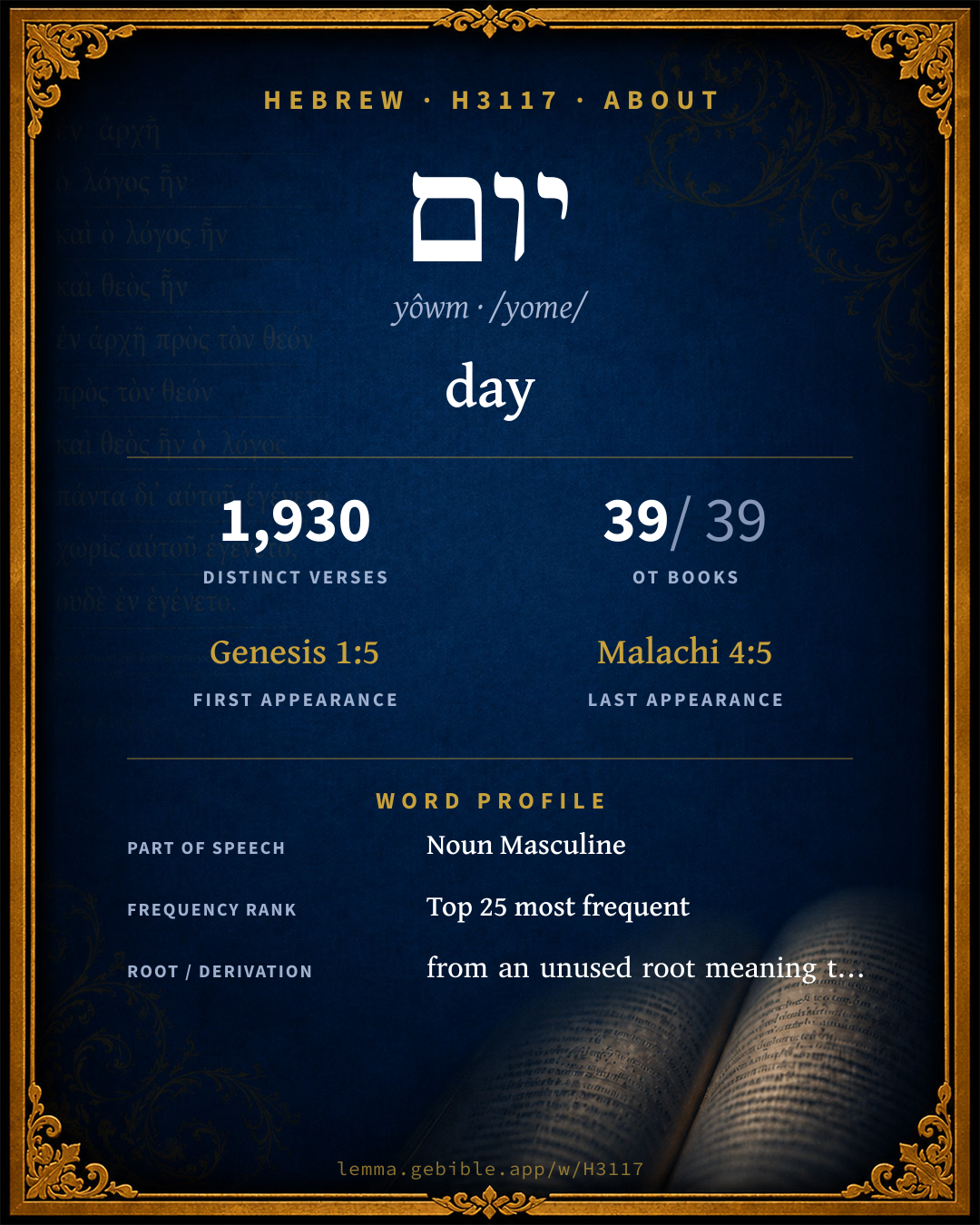
יוֹם
day
also: time, year fuller range ↓
Full lexicon entry — Brown-Driver-Briggs (BDB)
From Brown-Driver-Briggs (BDB)
Where this word appears
See every Absolute-state word in the Hebrew Bible →
Grammar key — what these labels mean
Part of speech
- Noun
- A naming word — a person, place, thing, or idea.
Noun type
- Common
- A common noun — a general class of person, place, or thing (“king,” “city,” “water”), not a specific name.
State
- Absolute
- The independent form of a noun, not bound to a following word.
- Construct
- A noun bound to a following noun in a possessive / “of” relationship (the construct chain).
Gender
- Masculine
- Grammatically masculine.
Number
- Singular
- One.
- Plural
- More than one (in Hebrew, generally three or more).
- Dual
- Exactly two — for natural pairs and some measures of time.
17 verses where H3117 appears in the Construct state in the Book of Exodus. Filtered view — show all forms. Click any verse to open its interlinear word-by-word view. Verse text shown in the World English Bible for context — . Each verse’s Hebrew form is shown with its reference; the English is not keyword-highlighted, since the data carries no word-level English alignment. Use “Compare translations” on any verse to read it across multiple English versions. This concordance covers the Hebrew Bible; Septuagint (Greek Old Testament) occurrences are not indexed here.
Exodus
- Exodus 5:13 י֣וֹם בְּ/יוֹמ֔/וֹ n c ms prep + n c ms cs + sfx pers 3ms The taskmasters were urgent saying, "Fulfill your work quota daily, as when there was straw!"
- Exodus 5:19 י֥וֹם בְּ/יוֹמֽ/וֹ n c ms prep + n c ms cs + sfx pers 3ms The officers of the children of Israel saw that they were in trouble, when it was said, "You shall not diminish anything from your daily quota of bricks!"
- Exodus 10:6 מִ/יּ֗וֹם הַ/יּ֣וֹם prep + n c ms cs ptcl def.art + n c ms Your houses shall be filled, and the houses of all your servants, and the houses of all the Egyptians; as neither your fathers nor your fathers' fathers have seen, since the day that they were on the earth to this day.'" He turned, and went out from Pharaoh.
- Exodus 10:28 בְּ/י֛וֹם prep + n c ms cs Pharaoh said to him, "Get away from me! Be careful to see my face no more; for in the day you see my face you shall die!"
- Exodus 12:15 יָמִים֙ בַּ/יּ֣וֹם מִ/יּ֥וֹם י֥וֹם n c mp prep det + n c ms prep + n c ms cs n c ms cs Seven days shall you eat unleavened bread; even the first day you shall put away yeast out of your houses, for whoever eats leavened bread from the first day until the seventh day, that soul shall be cut off from Israel.
- Exodus 12:18 י֤וֹם י֣וֹם n c ms n c ms cs In the first month, on the fourteenth day of the month at evening, you shall eat unleavened bread, until the twenty first day of the month at evening.
- Exodus 16:4 י֣וֹם בְּ/יוֹמ֔/וֹ n c ms prep + n c ms cs + sfx pers 3ms Then said Yahweh to Moses, "Behold, I will rain bread from the sky for you, and the people shall go out and gather a day's portion every day, that I may test them, whether they will walk in my law, or not.
- Exodus 20:8 י֥וֹם n c ms cs "Remember the Sabbath day, to keep it holy.
- Exodus 20:10 וְ/י֨וֹם֙ conj + n c ms cs but the seventh day is a Sabbath to Yahweh your God. You shall not do any work in it, you, nor your son, nor your daughter, your man-servant, nor your maid-servant, nor your cattle, nor your stranger who is within your gates;
- Exodus 20:11 יָמִים֩ בַּ/יּ֣וֹם י֥וֹם n c mp prep det + n c ms n c ms cs for in six days Yahweh made heaven and earth, the sea, and all that is in them, and rested the seventh day; therefore Yahweh blessed the Sabbath day, and made it holy.
- Exodus 20:12 יָמֶ֔י/ךָ n c mp cs + sfx pers 2ms "Honor your father and your mother, that your days may be long in the land which Yahweh your God gives you.
- Exodus 23:26 יָמֶ֖י/ךָ n c mp cs + sfx pers 2ms No one will miscarry or be barren in your land. I will fulfill the number of your days.
- Exodus 31:15 יָמִים֮ וּ/בַ/יּ֣וֹם בְּ/י֥וֹם n c mp conj + prep det + n c ms prep + n c ms cs Six days shall work be done, but on the seventh day is a Sabbath of solemn rest, holy to Yahweh. Whoever does any work on the Sabbath day shall surely be put to death.
- Exodus 32:34 וּ/בְ/י֣וֹם conj + prep + n c ms cs Now go, lead the people to the place of which I have spoken to you. Behold, my angel shall go before you. Nevertheless in the day when I punish, I will punish them for their sin."
- Exodus 35:3 בְּ/י֖וֹם prep + n c ms cs You shall kindle no fire throughout your habitations on the Sabbath day.'"
- Exodus 40:2 בְּ/יוֹם prep + n c ms cs "On the first day of the first month you shall raise up the tent of the Tent of Meeting.
- Exodus 40:37 י֖וֹם n c ms cs but if the cloud wasn't taken up, then they didn't travel until the day that it was taken up.
About this entry
At a glance — auto-summarized from this page’s data, not written by a person. Every figure links to its source below. This summary describes the numbers; it doesn’t interpret them.
The Hebrew noun יום centers on the idea of “day.” Beyond “day” it also covers “time” and “year” — see its full sense range. The Hebrew Bible uses it across 1,930 verses — among the most common. First canonically at Genesis 1:5, it enters the text early. Related forms include יום, יומם and ים. Dig into 1,930-verse concordance and the renderings breakdown below.
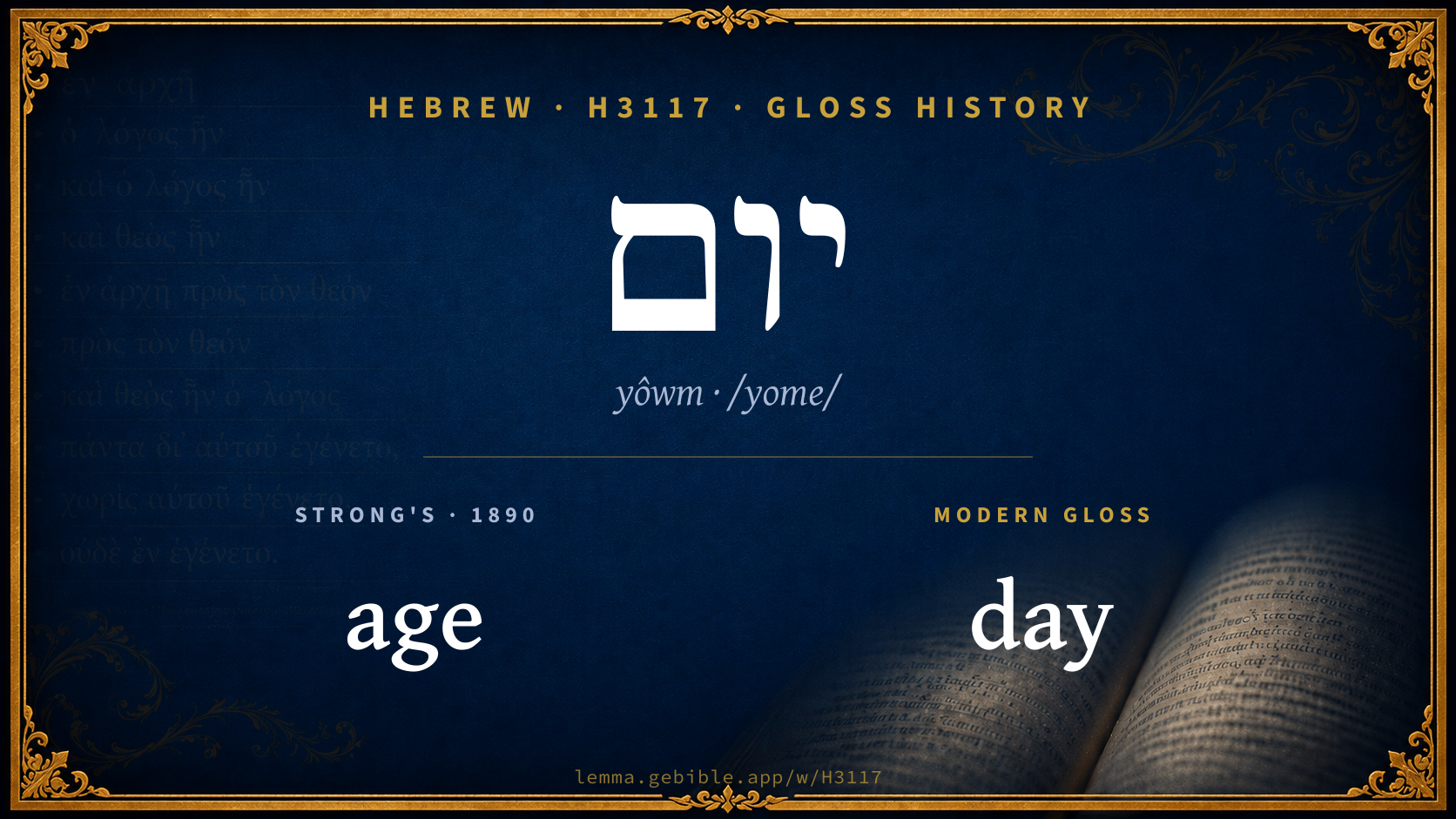
Gloss history
Strong's 1890 vs modern scholarship
About this word
Strong's H3117 catalogs a Hebrew word from the Hebrew Old Testament.
These counts are not copied from any lexicon or concordance. They are computed here, from the morphology-tagged Hebrew Old Testament. What Lemma adds →
- 1,930
- distinct verses
- The word appears in 1,930 distinct verses.
- 39 / 39
- OT books
- The word appears in 39 of 39 Old Testament books.
- #18
- by frequency
- Top 25 most frequent Hebrew words (rank 18 of 8,640 Hebrew words by occurrence).
View all 1,930 occurrences in the concordance →
Most concentrated in
- Deuteronomy 146 verses 8%
- Genesis 139 verses 7%
- 1 Samuel 131 verses 7%
By section of the Old Testament
By traditional corpus
Conventional, traditional groupings — biblical authorship is debated, so this is a traditional corpus grouping, not an authorship claim. Each share is this word’s portion of its verses in that division of the Hebrew canon. Each figure is a share of the word’s 1,930 distinct verses.
- Prophets (Nevi'im) 937 verses · 49%
- Torah (Pentateuch) 542 verses · 28%
- Writings (Ketuvim) 451 verses · 23%
How translations render this word
Counts come from each version’s own published word-to-Strong’s tagging or interlinear alignment — an approximate guide to how each version renders this word, not a word-level alignment the data otherwise carries. Because each total is that version’s own tagged count, the per-version totals vary from one another and need not match the appearance or distinct-verse counts above. These counts may also differ from a printed concordance because Lemma counts each distinctly tagged rendering and does not collapse phrase taggings into a single head-word total. This is a fixed set of word-tagged versions (KJV, ASV, BSB, ULT) and does not change with the reading translation you choose elsewhere. Each version’s license is shown beside its name below (and on Sources).
- King James Version: Day 944×, Days 484×, All the days 57×
- American Standard Version: Day 856×, Days 470×, All the days 55×
- Berean Standard Bible: Day 937×, Days 504×, Today 132×
- unfoldingWord Literal Text: Day 910×, Days 591×, Days of 210×
King James Version Public Domain
Renders H3117 across 2,211 tagged occurrences — most commonly:
Plus other, less common renderings. Plus 239 renderings that appear only once — usually multi-word phrases or single function words the recovered tagging swept in, not distinct renderings. Not rendered by a distinct English word in 76 further occurrences.
American Standard Version Public Domain
Renders H3117 across 2,210 tagged occurrences — most commonly:
Plus other, less common renderings. Plus 298 renderings that appear only once — usually multi-word phrases or single function words the recovered tagging swept in, not distinct renderings.
Berean Standard Bible Public Domain
Renders H3117 across 2,013 tagged occurrences — most commonly:
Plus other, less common renderings. Plus 124 renderings that appear only once — usually multi-word phrases or single function words the recovered tagging swept in, not distinct renderings. Not rendered by a distinct English word in 284 further occurrences.
unfoldingWord Literal Text CC BY-SA 4.0
Renders H3117 across 2,689 tagged occurrences — most commonly:
Plus other, less common renderings. Plus 60 renderings that appear only once — usually multi-word phrases or single function words the recovered tagging swept in, not distinct renderings.
33 senses and sub-senses in the full BDB
What do BDB’s symbols mean?
BDB uses these scholarly abbreviations:
| Symbol | Meaning |
|---|---|
| 𝔊 | the Septuagint (the ancient Greek translation, LXX) |
| 𝔙 | the Vulgate (the Latin translation) |
| 𝔖 | the Syriac version (the Peshitta) |
| 𝔗 | the Targum (the Aramaic translation) |
| ψ | the Psalms |
| √ | root (the underlying root or stem) |
| ‖ | parallel passage (a synonymous or contrasted parallel) |
| † | the dagger: every passage where the word occurs is cited |
The 33 senses and sub-senses the full Brown-Driver-Briggs lexicon distinguishes for this word, in lexicon order (not ranked by frequency), with BDB’s own verbatim wording and sub-sense lettering. Shown in Hebrew script with BDB’s own scholarly abbreviations. The condensed entry is in the Lexicon Entry tab. See also the Forms in the corpus table below.
- 1. day, opp. night, Gn 7:4, 12; 8:22 (all J), 31:39, 40 (E), Ex 24:18; 34:28 Nu 11:32(×2) Jos 10:13 (all JE), Dt 9:9, 11, 18, 25; 10:10 (D), Gn 1:5, 14, 16, 18 (P), 1 S 30:12 Ju 19:8, 9(×2), 11 Am 5:8 1 K 8:29; 19:8 Ne 4:16 Ec 8:16; ‖ לִפְנֵי בוֹא־הַשֶּׁמֶשׁ 2 S 3:35; חֹם הַיּ׳ Gn 18:1 (J) the heat of the day 1 S 11:11 2 S 4:5; עוֹד הַיּ׳ גָּדוֹל Gn 29:7 (J) the day is still high, not near its end; רוּחַ הַיּ׳ 3:8 cool of the day; מִן־הָאוֹר עַד־מַחֲצִית הַיּ׳ Ne 8:3 from dawn until mid-day; so also prob. of mid-day הוֹלך ואור עַד־נְכוֹן הַיּוֹם Pr 4:18 growing lighter and lighter until the full day; note phr. in Ju 19, עַד־נְטוֹת הַיּ׳ Ju 19:8 until the declining of the day; רָפָה הַיּ׳ לַעֲרוֹב v 9 the day hath sunk down to become evening; חֲנוֹת הַיּ׳ v 9 the declining of the day; הַיּ׳ רַד מְאֹד v 11 the day has gone down exceedingly (is far spent). e.g. Genesis 7:4
- 2. Day as division of time:
- a. working-day Ex 20:9, 10 (E) = Dt 5:13, Ex 16:26, 30(×2) (J), 23:12 (JE), 31:15 (P), Lv 23:3 (H); יְמֵי הַמַּעֲשֶׂה Ez 46:1. e.g. Exodus 20:9
- b. דֶּרֶךְ יוֹם a day’s journey Nu 11:31(×2) (JE), 1 K 19:4; מַהֲלַךְ יוֹם אֶחָד Jon 3:4; דֶּרֶךְ שְׁלשֶׁת יָמִים a three days’ journey Gn 30:36 Ex 3:18; 5:3; 8:23 (all J), Nu 10:33(×2) (JE), 33:8 (P); מַהֲלַךְ שְׁלשֶׁת יָמִים Jon 3:3; so seven days’ journey Gn 31:23 (E), 2 K 3:9; without דֶּרֶךְ etc., שְׁלשֶׁת יָמִים Ex 15:22 (E) they went three days, etc. e.g. Numbers 11:31
- c. to denote duration of various other acts or states: seven days Gn 7:4, 10; 8:10, 12; forty days 7:17; 8:6 (all J); 150 days 7:24; 8:3 (both P) 1 S 25:38 1 K 8:65(×2) Je 42:7 Ez 4:5, 6 1 Ch 9:25 Ezr 6:22 Est 1:4 etc. In Est 4:16 1 & 2 are combined: וְאַל־תִּשְׁתּוּ שְׁלשֶׁת יָמִים לַיְלָה וָיוֹם do not eat and do not drink for three days, night or day (v. Zc 14:7 sub 3 infr.) e.g. Genesis 7:4
- d. day as defined by evening and morning Gn 1:5, 8, 13, 19, 23, 31 (all P; cf. further בֹּקֶר, עֶרֶב); v. also 2:2(×2), 3 (P), Ex 20:11(×2) (E), 31:17(×2) (P). e.g. Genesis 1:5
- e. day of month (c. num. ordin.), chiefly P and late: Gn 7:11; 8:4, 14 Ex 12:6, 18(×2) +, 1 K 12:32, 33 Ez 45:21, 25 Zc 1:7 Hg 1:1, 15; 2:18 2 Ch 29:17(×2) Ezr 3:6 Ne 8:2; 9:1 Dn 10:4 Est 3:12; 9:1 +; (יוֹם often om. e.g. Gn 8:5, 13 Ex 12:10 2 K 25:1, 3 Ez 1:1, 2 Hg 2:1, 20 Zc 7:1 2 Ch 3:2 Ezr 6:19 Est 3:13, etc.) e.g. Genesis 7:11
- f. יוֹם defined by subst., inf., or other cl.: cstr. יוֹם הַשֶּׁלֶג = the snowy day 2 S 23:20 = 1 Ch 11:22; יוֹם סַגְרִיר Pr 27:15 = rainy d.; יוֹם קָרָה 25:20 = cold d.; (so, = time יוֹם צָרָתִי Gn 35:3 (E) d. of my distress; Je 18:17 La 1:7 Pr 24:10; 25:19; 27:10); יוֹם מוֹתוֹ etc. Ju 13:7 2 S 6:23 2 K 15:5 + often; cf. יוֹם הֻלֶּדֶת אֶת־פַּרְעֹה Gn 40:20 (E) = Pharaoh’s birthday; כְּיוֹם הִוָֽלְדָהּ Ho 2:5 cf. Ec 7:1 (v. also 7 d infr.; cf. יוֹמוֹ Jb 3:1), יום חֲתֻנָּה Ct 3:11; of day emphat. characterized by proph. and others יוֹם מְהוּמָה וּמְבוּסָה וּמְבוּכָה Is 22:5 (v. מְהוּמָה sub הום); יוֹם צָרָה וְתוֹכֵחָה וּנְאָצָה 37:3 = 2 K 19:3; on the other hand יוֹם רָצוֹן לי׳ Is 58:5 a day of acceptableness to י׳; pl. sq. subst. יְמֵי שָׂכִיר Lv 25:50 (H) the days of an hireling; (מִלֻּאֵיכֶם) יְמֵי Lv 8:33 Nu 6:13; sq. rel. cl. אָרוּר הַיּוֹם אֲשֶׁר יֻלַּדְתִּי בּ֑וֹ יוֹם אֲשֶׂר־יְלָדַתְנִי אִמִּי וגו׳ Je 20:14 cf. Jb 3:3 also ψ 118:24 (v. i). e.g. 2 Samuel 23:20
- g. particular days defined by n.pr.loc.: יוֹם יִזְרְעֶאל Ho 2:2 i.e. of judgment, with implied restoration; v. also Is 9:3 Ez 30:9; יְמֵי הַגִּבְעָה Ho 9:9; 10:9, i.e. of the outrage at Gibeah (Ju 19:22 ff.); יוֹם ירושׁלם ψ 137:7 i.e. of Jerusalem’s calamity, cf. Je 50:27, 31. e.g. Hosea 2:2
- h. c. sf., thy, his, or their day, in sense of (1) day of disaster or death: †בָּא יוֹמְךָ Je 50:31 thy day has come; אוֹ יומו יָבֹא וָמֵת 1 S 26:10; יומו in this sense also Ez 21:30 ψ 37:13 Jb 18:20; †בָּא יוֹמָם Je 50:27 Ez 21:34. e.g. Jeremiah 50:31
- i. specif. a holy day: יוֹם הַשַּׁבָּת the sabbath day (v. also שַׁבָּת), Ex 20:8, 11 (E) = Dt 5:12, 15, Ex 31:15; 35:3 +; = יוֹם קָדְשִׁי Is 58:13; repetition בְּיוֹם הַשַּׁבָּת בְּיוֹם הַשַּׁבָּת Lv 24:8 every sabbath day; also †יוֹם הַכִּפֻּרים Lv 23:27; 25:9; יוֹם כִּפֻּרִים 23:28; יוֹם הַבִּכּוּרִים Nu 28:26; יוֹם חַגֵּנוּ ψ 81:4; יוֹם מַלְכֵּנוּ Ho 7:5; also of false gods, יִמֵי הַבְּעָלִים 2:11. e.g. Exodus 20:8
- 3. יוֹם י׳ day of Yahweh, chiefly as time of his coming in judgment, involving often blessedness for righteous (v. RSProph. 396 f. Dr Is 28); Am 5:18(×2), 20 Is 2:12; 13:6, 9 Zp 1:7 (cf. v 8), v 14(×2) (cf. v 15, 16), Je 46:10 Ez 13:5; 30:3 (cf. 36:33; 39:8, 11, 13), Ob 15 Zc 14:1 Mal 3:23 (cf. Zc 14:7 Mal 3:2, 17, 19(×2), 21), Jo 1:15; 2:1, 11 (cf. v 2(×2)), 3:4; 4:14; יוֹם עֶבְרַת י׳ Zp 1:18; יוֹם עֶבְרָה Pr 11:4; יוֹם חֲרוֹן אַפּוֹ Is 13:13 La 1:12; יוֹם נָקָם Is 34:8; 61:2; 63:4; יוֹם נְקָמָה Je 46:10; יוֹם אף י׳ Zp 2:2, 3 La 2:22; יוֹם אַפּוֹ La 2:1; cf. also Zc 14:7 (where sense of 1 and 2 are combined, cf. Est 4:16 2 c supr.); וְהָיָה יוֹם־אֶחָד הוּא יִּוָּדַע לי׳ לֹא יוֹם וְלֹא לָ֑יְלָה but there shall be one day, known shall it be of י׳, not day and not night; cf. also ביום ההוא 7 g infr. e.g. Amos 5:18
- 4. Pl. days of any one:
- a. = his life, his age Gn 6:3 (J), Dt 22:19, 29; 23:7 Jos 24:31(×2) (D), Ju 2:7(×2), 18 1 S 25:28, etc.; Gn 5:4, 8, 11; 9:29; 11:32 (all P), Jb 7:1(×2), 6, 16; 8:9 ψ 39:5, 6; 90:9, 10, 12, 14; 103:15; כָּל־יְמֵי חַיֶּיךָ Gn 3:14, 17 (J), ψ 23:6, so Pr 31:12; יְמֵי שְׁנֵי חַיִּים 2 S 19:35 Gn 25:7; 47:8, 9 (all P); יְמֵי חַיָּיו Ec 5:17, 19; יְמֵי שָׁנָיו 6:3; יְמֵי שְׁנוֹתֵינוּ ψ 90:10; מִסְפַּר יְמֵי חַיֵּיהֶם Ec 2:3; מִסְפַּר יְמֵי חַיֵּי הֶבְלוֹ 6:12 the number of the days of his vain life, i.e. his empty, fleeting years; כָּל־הַיָּמִים אֲשֶׁר־הֵם חַיִּים עַל־פְּנֵי הָאֲדָמָה 1 K 8:40; יָמִים רַבִּים long life 1 K 3:11 = 2 Ch 1:11; בָּא בַּיָּמִים advanced in days = of advanced age Gn 18:11; 24:1 (both J), Jos 13:1(×2) (JE), 23:1, 2 (D), 1 K 1:1; מִיָּמָיו 1 K 1:6 from his (earliest) days, so מִיָּמֶיךָ 1 S 25:28 (v. Dr), Jb 38:12; שְׂבַע יָמִים Jb 42:17 1 K 8:40; יַאֲרִכוּן יָמֶיךָ Ex 20:12 (JE) that thy days may be long = Dt 5:16, v. further ארך; יָמִים עַל־יְמֵי־מֶלֶךְ תּוֹסִיף ψ 61:7 i.e. prolong the king’s life; outlive is הֶאֱרִיךְ יָמִים אַחֲרֵי Jos 24:31 (D), Ju 2:7; אֹרֶךְ יָמִים וּשְׁנוֹת חַיִּים Pr 3:2 length of days and years of life; אֹרֶךְ יָמִים v 16, כְּיָמֶיךָ דבאך Dt 33:25 according to (the length of) thy life shall be [thy strength? read רבאך?] v. Di VB; rarely sg. e.g. קְשֵׁה־יוֹם Jb 30:25 one hard of day, i.e. whose day (= life) was hard; of life as approaching its end, וַיִּקְרְבוּ יְמֵי ישׂראל לָמוּת Gn 47:29 (J) and the days of Israel drew near for dying, so Dt 31:14 1 K 2:1 (cf. Jb 7:6, 16; 8:9 Ec 2:3 supr.) e.g. Genesis 6:3
- b. (in) the days of (i.e. life-time, reign, or activity of) Gn 10:25 (J) 14:1 Ju 5:6(×2); 8:28 2 S 21:1 1 K 16:34; 21:29(×2); 22:47 2 K 20:19 2 Ch 13:20; 35:18 + often (so MI6.8.8.9.33). e.g. Genesis 10:25
- c. hence in phr. סֵפֶר דִּבְרֵי הַיָּמִים לְ 1 K 14:19, 29 + 31 times K, Ne 12:23 Est 2:23; 10:2; מִסְפַּר דִּבְרֵי הַיָּמִים 1 Ch 27:24; סֵפֶר הַזִּכְרֹנוֹת דִּבְרֵי הַיָּמִים Est 6:1. e.g. 1 Kings 14:19
- 5. Days:
- a. indef.: יָמִים אֲחָדִים some days, a few days † Gn 27:44 (J), 29:20 (E), Dn 11:20; יָמִים alone 40:4 (E) they were days (a certain time) in the prison 1 K 17:15 Ne 1:4; עוּל יָמִים Is 65:20 a suckling of (a few) days; מִיָּמִים Ju 11:4 after a time, 15:1; so מִקֵּץ יָמִים Gn 4:3 (J) after the end of days, 1 K 17:7; יוֹם אוֹ יוֹמַיִם Ex 21:21 (JE) a day or two. יָמִים אוֹ עָשׂוֹר Gn 24:55 (J) some day, or ten (days or a dekad; on question of txt. v. Di). e.g. Genesis 27:44
- b. of long time, זֶה יָמִים אוֹ זֶה שָׁנִים 1 S 29:3 these days or these years; אוֹ יֹמַיִם אוֹ חֹדֶשׁ אוֹ יָמִים Nu 9:22 (P) whether two days or a month or days (an indefinitely long period); יָמִים רַבִּים many days Gn 21:34 (JE) 37:34 (J) +; וַיִּרְבּוּ הַיָּמִים וגו׳ Gn 38:12 (J) and the days were multiplied (= time passed) and Judah’s wife died, 1 S 7:2; אָֽרְכוּ לוֹ שָׁם הַיָּמִים Gn 26:8 (J) the days were long to him there = he had been there a long time; בְּהַאֲרִיךְ הֶעָנָן … יָמִים רַבִּים Nu 9:19 (P) when the cloud prolonged many days (remained a long time) upon the tabern.—Vid. also 6 infr. e.g. 1 Samuel 29:3
- c. days of old, former or ancient times (especially of early period of Isr. hist.): יְמוֹת עוֹלָם Dt 32:7 (poem); יְמֵי עוֹלם Mi 5:1; 7:14 Is 63:9, 11; יְמֵי קֶדֶם Mi 7:20; יָמִים מִקֶּדֶם ψ 77:6; 143:5; cf. הַיָּמִים הָרִאשֹׁנִים Ec 7:10; coming days הַיָּמִים הַבָּאִים Ec 2:16; coming time יוֹם אַחֲרוֹן Pr 31:25; especially (ב)אַחֲרִית הַיָּמִים v. p. 31 supr.; לְקֵץ הַיָּמִין Dn 12:13. e.g. Deuteronomy 32:7
- 6. יוֹם = time;
- a. vividly in gen. sense (v. also 5 supr.): time of harvest Pr 25:13; usually יְמֵי Gn 30:14 (J), Jos 3:15 Nu 13:20(×2) (all JE), Ju 15:1 2 S 21:9; proper time for paying wages Dt 24:15 cf. Jb 14:6; time of parturition וַיִּמְלְאוּ יָמֶיהָ לָלֶדֶת Gn 25:24. e.g. Proverbs 25:13
- b. appos. to other expr. of time (Dr§192(1) DaSynt. §29.d): חֹדֶשׁ יָמִים a month of time Gn 29:14 (J; lit. a month, time), Nu 11:20, 21 (JE); = יֶרַח יָמִים Dt 21:13 2 K 15:13; יָמִים ארבעה חדשׁים Ju 19:2 time, four months (si vera l., v. 1 S 27:7); †שְׁנָתַיִם יָמִים (מִקֵּץ) Gn 41:1 (E) two years (of) time, 2 S 13:23; 14:28 Je 28:3, 11; שְׁלשָׁה שָׁבֻעִים יָמִים Dn 10:2, 3 three weeks (of) time. e.g. Genesis 29:14
- c. pl. in specific sense, appar. = year, lit. יָמִים 1 S 27:7 Lv 25:29 (H); לַיָּמִים Ju 17:10; זֶבַח הַיָּמִים 1 S 1:21; 2:19; 20:6; יָמִים וארבעה חדשׁים 27:7 = a year and four months (cf. Ju 19:2 supr. b); מִיָּמִים יָמִ֫ימָה = from year to year, yearly Ex 13:10 (JE), Ju 11:40 (cf. v b), 21:19 1 S 1:3; 2:19; מִקֵּץ יָמִים לַיָּמִים 2 S 14:26; יֹמַיִם אוֹ חֹדֶשׁ אוֹ־יָמִים Nu 9:22 (P) distrib. Nu 14:34(×2) (P), Ez 4:6(×2); וַיְהִי לְיָמִים מִיָּמִים וּכְעֵת צֵאת הַקֵּץ לְיָמִים שְׁנַיִם 2 Ch 21:19 and it came to pass at days from days (= after some days) even about the time of the outgoing of the end of two (series of) days (i.e. prob. years, v. Be). e.g. 1 Samuel 27:7
- 7. Phrases, without prep. and with, are:
- a. (1) הַיּוֹם=to-day Gn 4:14; 31:43, 48 Ex 13:4 (JE) + often; opp. תְּמוֹל yesterday Ex 5:14 1 S 20:27; opp. מָחָר Ex 19:10; (2) †(בְּ)יוֹם מָחָר = to-morrow Gn 30:33 Is 56:12 Pr 27:1; (3) יוֹם אֶתְמוֹל ψ 90:4; (4) הַיּוֹם שְׁלשֶׁת הַיָּמִים 1 S 9:20 three days ago (v. Dr); = הַיּוֹם שְׁלשָׁה 1 S 30:13; †(5) בַּיּוֹם Ju 13:10 appar. = the other day (v. Be); (6) יוֹם אֶחָד no prep., emphat. = in one day, Gn 27:45 Is 9:13; c. בְּ 10:17; 47:9; for, during, one day Gn 33:13 Nu 11:19; unemphat., one day (= some day) 1 S 27:1; יוֹם אֶחָד לִפְנֵי 9:15 one day, before Saul came. e.g. Genesis 4:14
- b. וַיְהִי הַיּוֹם וַֹ־ and the day came, that (or when) 1 S 1:4 (v. Dr) 2 K 4:8, 11, 18 Jb 1:6, 13; 2:1. e.g. 1 Samuel 1:4
- c. הִנֵּה יָמִים בָּאִים lo! days are coming, when, etc.; especially in Am Je: 1 S 2:31 Am 4:2; 8:11; 9:13 Is 39:6 = 2 K 20:17, Je 7:32 + 13 times Je. e.g. 1 Samuel 2:31
- d. יוֹם in cstr. bef. vbs., both literally, the day of, and (often) in gen. sense = the time of (forcible and pregn., representing the act vividly as that of a single day): (1) bef. inf., †(α) sg. without prep. אֶת־יוֹם צֵאתְךָ Dt 16:3 and thou shalt remember the day of the going out from the land of Egypt, Is 58:5 Ez 39:13 Mal 3:2 cf. Ec 7:1 (מִן compar.); (β) עַד־יוֹם Jos 6:10 Ju 18:30 + 5 times; (γ) בְּיוֹם Gn 2:4, 17; 3:5 + 53 times; † (δ) כְּיוֹם Ho 2:5, 17 Zc 14:3; †(ε) מִיּוֹם 1 S 7:2; 8:8; 29:6, 2 S 13:32 2 K 8:6 Dt 9:24 Lv 23:15 Ez 28:15; †(ζ) לְמִיּוֹם Ju 19:30 2 S 7:6 Is 7:17; †(2) pl. cstr. bef. inf.: (α) כָּל־יְמֵי Ju 18:31 1 S 22:4; 25:7, 16 Lv 26:34, 35 Nu 6:6 2 Ch 36:21; (β) בִּימֵי Ru 1:1 2 Ch 26:5; (γ) כִּימֵי Mi 7:15; †(3) sg. cstr. c. perp. bef. finite vb. in pf.: (α) cf. בְּ, בְּיוֹם דִּבֶּר י׳ Ex 6:28 in the day (when) י׳ spoke, so Nu 3:1 Dt 4:15; also Lv 7:35 2 S 22:1 = ψ 18:1, ψ 138:3 Zc 8:9; (β) מִיּוֹם Je 36:2; †(4) sg. cstr. bef. impf.: בְּיוֹם אֶקְרָא ψ 56:10 in the day (when) I cry, 102:3 La 3:57; also without בְּ, יוֹם אִירָא ψ 56:4 (at the) time (when) I am afraid; †(5) pl. cstr. bef. pf.: כָּל־יְמֵי הִתְהַלַּכְנוּ אִתָּם 1 S 25:15, so Lv 14:46 (prob., v. Di); כִּימוֹת ψ 90:15; †(6) pl. cstr. bef. impf.: כִּימֵי אֱלֹוהַּ יִשְׁמְרֵנִי Jb 29:2; †(7) מִיּוֹם cstr. bef. rel. cl.: מִיּוֹם אֲשֶׁר הָיִיתִי לְפָנֶיךָ 1 S 29:8 since the day when (= as long as) I have been before thee, Ne 5:14; †(8) pl. cstr. bef. rel. cl. כָּל־יְמֵי אֲשֶׁר יִשְׁכֹּן Nu 9:18 as long as the cloud remained, etc. e.g. Deuteronomy 16:3
- e. (1) יוֹם יוֹם day by day Gn 39:10 (J), Ex 16:5 (P), Pr 8:30, 34 ψ 61:9; 68:20 (+ Je 7:25 ψ 13:3 Lag, v. יוֹמָם); so (late) †לְיוֹם בְּיוֹם 2 Ch 24:11; †יוֹם בְּיוֹם 30:21 Ne 8:18; †לְעֶת־יוֹם בְּיוֹם 1 Ch 12:23; עֹלֹת יוֹם בְּיוֹם Ezr 3:4; בִּדְבַר יוֹם בְּיוֹם 2 Ch 8:13; מִיּוֹם אֶל־יוֹם from day to day 1 Ch 16:23 = מִיּוֹם לְיוֹם ψ 96:2 (Est 3:7 v. infr.); †יוֹם וָיוֹם Est 3:4 (very late, v. וְ 1 i (b), p. 253 supr. and DrIntr. 505); בְּכָל־יוֹם וָיוֹם 2:11; †כְּיוֹם בִּיוֹם 1 S 18:10 as daily = according to daily habit; (2) מִיּוֹם לְיוֹם Est 3:7, is in phr. of casting lots for one day after another; (מִיָּמִים יָמִ֫ימָה v. 6 c); (3) of daily duties, observances, etc.: †דְּבַר יוֹם בְּיוֹמוֹ each day’s affair in its day Ex 5:13, 19; 16:4 (all J), Lv 23:37 (H), 1 K 8:59 2 K 25:30 = Je 52:34, Ezr 3:4 Ne 11:23; 12:47 Dn 1:5; לִדְבַר יוֹם בְּיוֹמוֹ 1 Ch 16:37 2 Ch 8:14; 31:16. e.g. Genesis 39:10
- f. †כָּל־הַיָּמִים = always, continually, Gn 43:9; 44:32 (both J), Dt 4:40; 5:26; 6:24; 11:1; 14:23; 18:5; 19:9; 28:29, 33 Jos 4:24 (D), Ju 16:16 1 S 2:32, 35; 18:29; 23:14; 28:2 2 S 13:37; 19:14 Je 31:36; 32:39; 33:18; 35:19; 1 K 5:15; 9:3; 11:36, 39; 12:7; 14:30 2 K 8:19; 13:3; 17:37 2 Ch 7:16; 10:7; 12:15; 21:7 Jb 1:5; also (only in proph. writers and in poetry) †כָּל־הַיּוֹם Gn 6:5 (J), Ho 12:2 Dt 28:32; 33:12 Je 20:7, 8 Is 28:24, 51:13; 52:5 (both תָּמִיד כל־היום), 65:2, 5 La 1:13; 3:3, 14, 62 ψ 25:5; 32:3; 35:28; 37:26; 38:7, 13; 42:4, 11; 44:9, 16, 23; 52:3; 56:2, 3, 6; 71:8, 15, 24; 72:15; 73:14; 74:22; 86:3; 88:18; 89:17; 102:9; 119:97 Pr 21:26; 23:17. e.g. Genesis 43:9
- g. additional phr. c. בְּ = on a particular day: בַּיּוֹם הַחֲמִישִׁי Ju 19:18, so Gn 2:2(×2) + often; בְּכָל־יוֹם every day ψ 7:12; 88:10; 145:2; בַּיּוֹם הַהוּא of definite time in past Gn 15:18; 33:16 + (v. also 3 supr.); cf. הַיּוֹם הַזֶּה (no prep.) 1 S 24:11 (JE); בַּיּוֹם הַהוּא of time defined in subsequent context, 1 S 3:2 at that time when Eli was laid down, i.e. at the particular time of the foll. incident (= at a certain time, on one particular day; cf. Gn 39:11 sub h; see DaSynt.§ 21.e.R. 1, 2 and especially Dr 1 S 1:4; 19:3); בַּיּוֹם הַזֶּה Gn 7:11 +; בְּעֶצֶם הַיּוֹם הַזֶּה on this selfsame day Gn 7:13 + (v. עֶצֶם); בַּיּוֹם הַהוּא also of future 1 S 3:12 Dt 31:17(×2), 18; and very often in proph., as formula in describing what is to come at time of future blessing, retribution, etc., Am 8:3, 9 Ho 2:18, 20, 23 etc., especially Is 2:11, 17, 20; 3:7, 18; 4:1, 2 + often; pl. בַּיָּמִים הָהֵם of past Gn 6:4 (J), Ju 18:1(×2) 19:1; 21:25 1 S 3:1 + often; of future Dt 17:9; 19:17; 26:3. e.g. Judges 19:18
- h. c. כְּ: כַּיּוֹם as or like the day ψ 139:12; כַּיּוֹם הַהוּא Jos 10:14; כְּיוֹם Ho 2:5 as at the day of; כְּיוֹם תָּמִים Jos 10:13 about a whole day; †כַּיּוֹם lit. at (about) to-day = now (v. כְּ 1 S 9:27 1 K 22:5 = 2 Ch 18:4 Is 58:4; so †כְּהַיּוֹם 1 S 9:13 + v 12 We Dr (for MT כי היום), Ne 5:11; †כַּיּוֹם = at once, first of all Gn 25:31, 33 1 S 2:16 1 K 1:51; often c. adj. pron. to point out agreement of result with promise or prediction, †כַּיּוֹם הַזֶּה as it is at this day Gn 50:20 (E), 1 S 22:8, 13, and especially Dt Je and subseq. writings: Dt 2:30; 4:20, 38; 8:18; 10:15; 29:27 Je 11:5; 25:18 (gloss, om. 𝔊, cf. especially KueEinl. § 56. 1), 32:20; 44:6, 23 1 K 3:6; 8:24, 61 1 Ch 28:7 2 Ch 6:15 Dn 9:7, 15; so †כְּהַיּוֹם הַזֶּה Dt 6:24 Je 44:22 Ezr 9:7, 15 Ne 9:10; in Gn 39:11 (J) this phr. = on this particular day (when the incident to be narrated occurred; cf. ביום ההוא g supr.) i. c. לְ: לְיוֹם on, at (lit. with reference to) †Ho 9:5(×2) what will ye do on the day of assembly, etc., Is 10:3; לְיוֹם אֶחָד 1 K 5:2 bread for one day; הַמְּלָאכָה לֹא לְיוֹם אֶחָד וְלֹא לִשְׁנַיִם Ezr 10:13; distrib. phr. נָשִׂיא אֶחָד לַיּוֹם נָשִׂיא אֶחָד לַיּוֹם Nu 7:11 (P), Jb 21:30(×2); cf. לַיּוֹם Mal 3:17; לַיּום against, i.e. in expectation of Ex 19:11, so לְיוֹם קְרָב Jb 38:23 Pr 21:31; לְיוֹם קוּמִי alm. = until Zp 3:8; לִפְנֵי יוֹם Is 48:7 before to-day; late phr. are †לְיָמִים מִיָּמִים 2 Ch 21:19 = in the course of time; לְיָמִים רַבִּים Dn 8:26 at (the end of) many days; לַיּוֹם = for every day, daily, †Ex 29:36, 38 Nu 7:11(×2); 28:3, 24 1 Ch 26:17(×2) Je 37:21 Ez 4:10; 43:25; 45:23(×2); 46:13; לַיּוֹם in exclam. הָהּ לַיּ׳ Ez 30:2 alas for the day! אֲהָהּ לַיּ׳ Jo 1:15. j. c. מִן: מִיּוֹם since the day (time) of (or when), Ex 10:6 Lv 23:15 Dt 9:24 1 S 7:2 etc.; מִיּוֹם הראשׁן Ex 12:15 from the first day (on om. of art. v. Dr§ 209 (1)); מִימֵי השׁפטים 2 K 23:22, etc.; מִיּוֹם = from to day, from this day forth Is 43:13 Ez 48:35; מֵהַיּוֹם הַהוּא וָמָ֑עְלָה 1 S 16:13; 30:25 from that day forward; so מֵהַיּ׳ הַה׳ וָהָ֑לְאָה 1 S 18:9; מִן־הַיּוֹם הַזֶּה וָמָ֑עְלָה Hg 2:15, 18 from this day onward (v. Add. on p. 751b); עַד־הַיּוֹם הַזֶּה Gn 47:26 until now; מִיָּמִים רַבִּים after many days Jos 23:1 Ez 38:8; מִיָּמִים after a time Ju 11:4; 14:8; 15:1; but usually מִקֵּץ י׳, v. קֵץ; מִיֹּמָ֑יִם Ho 6:2 after two days;—מִיָּמִים יָמִ֫ימָה v. e. (4) supr. †k. c. לְמִן (v. לְ ad fin.): לְמִן הַיּוֹם אֲשֶׁר Dt 4:32; 9:7 2 S 7:11 Je 7:25; 32:31 Hg 2:18; twice sq. inf. appos. Ex 9:18 2 S 19:25 (cf. also 2 Ch 8:16; v. DrSm. & § 190, Obs.); לְמִימֵי: למ׳ קֶדֶם 2 K 19:25 since days of old = long ago, cf. Mal 3:7 since the days of your fathers.† 1. עַד (ה)יום: עַד יוֹם הָאֶחָד וגו׳ Ex 12:18 until the 21st day, Lv 19:6 +; עַד־יוֹם מוֹתוֹ Ju 13:7 1 S 15:35 2 S 6:23 +, etc., v. also (sq. inf.) c. supr.; עַד־הַיּוֹם until to-day, denoting especially permanence of a name or situation, or of result of an event, †Gn 19:37, 38 (J), 35:20 (E), 2 K 10:27 Ez 20:31†; more often עַד־הַיּוֹם הַזֶּה until this day Gn 26:33 (J), 31:33 (P or R), 47:26 (J), 48:15 (E), Ex 10:6 Nu 22:30 (both J), Dt 2:22; 3:14; 10:8; 11:4; 29:3 34:6 Jos 4:9; 5:9; 6:25; 7:26(×2); 8:28, 29; 9:27; 13:13; 14:14; 15:63; 16:10 (all JE), 22:3 (D), v 17 (P), 23:8, 9 (D), Ju 1:21, 26; 6:24; 10:4; 15:19; 18:12; 19:30 1 S 5:5; 6:18; 8:8; 12:2; 27:6; 29:3, 6, 8; 30:25 2 S 4:3; 6:8 = 1 Ch 13:11, 2 S 7:6 = 1 Ch 17:5, 2 S 18:13 + often; עַד־עֶצֶם הַיּוֹם הַזֶּה †Jos 10:27 (JE), Ez 2:3 (cf. Lv 23:14 H); עַד־הַיּוֹם הַהוּא †Ju 18:1 Ne 8:17. m. once עַל־יוֹם טוֹב 1 S 25:8 upon a good day, i.e. a day of social cheerfulness, feasting, rejoicing (c. rare עַל temp. cf. Dr; יוֹם טוֹב) also Est 8:17; 9:19, 22, v. טוֹב adj.) e.g. Psalms 139:12
Senses from the full Brown-Driver-Briggs lexicon (Brown, Driver, Briggs; Oxford 1906 — public domain), digitized via Sefaria, supplemented by the OpenScriptures HebrewLexicon (CC BY 4.0). Full attribution on Sources.
Word origin
n.m. Gn 1:5 day (NH id.; Aramaic יומָא, ܝܰܘܡܳܐ; Ph. ים; MI 5 ימן, sf. ימי l.6.9.33, pl. cstr. ימי l.8, sf. 3 ms. ימה l.8; SI3 ים; Zinj. יום DHMSendsch. Gloss; Palm. יום VogNo. 123 a, Oxon. iii,; Arabic يَوْمٌ; Ethiopic ዮም: Sab. יום, ים MordtZMG 1876, 29, יומה DHMZMG 1883, 328 SabDenkm61; Assyrian ummu, ûmu COTGloss; deriv. unknown: on √ and relation of יום to Ph. ימם, Aramaic ימם, ܐܻܝܡܳܡܳܐ, v. NöZMG 1886, 721 BaZMG 1887, 632 f.)—יוֹם abs. Gn 1:5 +; cstr. Gn 2:4 +; sf. יוֹמְךָ Je 50:31; יוֹמוֹ Ex 5:13 + 22 times; יוֹמָם Je 50:27 Ez 21:34; du. †יוֹמַ֫יִם Ex 21:21; יוֹמָ֑יִם Ex 16:29 Nu 11:19; יֹמַ֫יִם 9:22; יֹמָ֑יִם Ho 6:2†; pl. יָמִים Gn 4:3 +; יָמִם Nu 6:5; יָמִין (Aramaic form; Ges§ 87. 1 a) Dn 12:13; מִיָּמִים יָמִ֫ימָה Ex 13:10 + 4 times; cstr. יְמֵי Gn 3:14 +; †יְמוֹת Dt 32:7 ψ 90:15†; sf. יָמַי Jb 7:6 + 9 times; יָמָ֑י Gn 29:21 + 8 times; יָמֵינוּ Je 35:8 + 7 times, etc.;—
— Brown-Driver-Briggs (Oxford 1906, public domain), digitized via Sefaria, supplemented by the OpenScriptures HebrewLexicon (CC BY 4.0). See Sources.
Origin: from an unused root meaning to be hot
Jastrow Dictionary
A second Hebrew/Aramaic lexicon for comparison, covering Aramaic and post-biblical (Talmudic, Targumic, Midrashic) usage that the biblical-Hebrew BDB does not. Matched by lemma rather than by Strong’s number, so a lemma may carry more than one Jastrow headword (shown separately below), and the entries cover usage well beyond the Bible.
יוֹם
- (b. h.) light, day (opp. night); (astronomical) day; trnsf. day of life; time. Gen. R. s. 6 הי׳ והגשמים וכ׳ the noise of the moving light (Yoma 20ᵇ קול גלגל חמה) and the rains &c.; Midr. Sam. ch. IX. Gen. R. l. c. (ref. to Mal. III, 19) י׳ שהוא מלהט וכ׳ it is the day light which will glow the wicked (cmp. נַרְתֵּק). M. Kat. 25ᵇ (ref. to Am. VIII, 9) זה יוֹמוֹ של וכ׳ that means the day of life of Josiah (who was slain in the bloom of manhood). Gen. R. s. 3 (ref. to ib. I, 5) י׳ אחד … ואיזה זה יוה"כ ‘one (distinguished) day’ … that is the Day of Atonement. Ḥull. V, 5 (83ᵃ) הי׳ הולך וכ׳ the day follows the night, i.e. the beginning of the night is the beginning of the new day. Taan. 29ᵃ, v. זַכַּאי; a. v. fr.—י׳ טוב (abbr. יו"ט) Holy Day; festival. R. Hash. IV, 1; a. fr.—Yoma VII, 4 ויו"ט היה וכ׳ and the Highpriest gave a festival to his friends; a. fr.—Yom Tob, name of a treatise of the Tosefta (v. בֵּיצָה).—י׳ הכפורים (abbr. יו"כ, יה"כ) Day of Atonement. Yoma I, 1; a. v. fr.—בֶּן יוֹמוֹ of the same day, not quite one day old, used on the same day. Sabb. 151ᵇ. B. Kam. 65ᵇ; a. fr.—Tanḥ. Kor. 3; ed. Bub. 6; Num. R. s. 18 תינוקות בְּנֵי יוֹמָן (not בן) children just born; a. fr.—Du. יוֹמַיִם. Mekh. Mishp., N’zikin, s. 7; B. Kam. 90ᵃ ישנו בדין יום או י׳ comes under the law of ‘one or two days’ (Ex. XXI, 21); B. Bath. 50ᵃ.—Mekh. l. c. יום שהוא כי׳ וי׳ שהוא כיום a time which counts like two days, and two days which count like a day, which is twenty four hours (from the time of the accident, including part of this and part of the next day).—Snh. 65ᵇ מה יום מיומים (Ms. M. a. Rashi מה היום וכ׳) what difference is there between to-day (Sabbath) and the next day?; Gen. R. s. 11; Yalk. Deut. 918; Yalk. Lev. 617.—Pl. יָמִים; constr. יְמֵי, יְמוֹת. Erub. III, 6 לשני י׳ for both days. Zeb. V, 7 לשני י׳ during two days and one night. Pes. 52ᵃ, a. fr. שני י׳ טובים של גליות, v. גָּלוּת. Taan. IV, 8 לא היו י׳ ט׳ וכ׳ Israel had no days as merry as &c.; a. fr.—Ab. I, 17, a. fr. כל יָמַי all my lifetime.—Esp. יְמוֹת season, period of. י׳ הגשמים, v. גֶּשֶׁם I.—י׳ החמה a) summer season. Toh. VI, 7; a. fr.—b) the solar year. Gen. R. s. 33, end; a. fr.—י׳ הלבנה the lunar year. Ib.; a. fr.—י׳ בגרות, י׳ נערות, v. בַּגְרוּת &c. e.g. Malachi 3:19
יוֹם ²
- Targ. Gen. I, 5. Ib. XXXIX, 11; a. fr.—Targ. Prov. XII, 16 בר יוֹמֵיה (ed. Wil. incorr. כד) on the same day, at once.—Kidd. 39ᵇ דעבדין ליה י׳ טב וי׳ ביש they prepare for him (the righteous man) a good day, and (for the bad man) a bad day (v. Rashi a. Tosaf. a. l.).—Sabb. 134ᵃ; Ḥull. 60ᵃ top להדי י׳ towards the sunlight. Ib. י׳ דחד וכ׳ the sun which is only one of the ministering powers &c. Keth. 106ᵃ וכסי ליה לי׳ and obscured the sun.—Yeb. 72ᵃ י׳ דעיבא a cloudy day; י׳ דשותא a day when a southern wind blows. Erub. 40ᵇ במעלי י׳ דריש וכ׳ on the eve of the New Year’s day.—R. Hash. 21ᵃ י׳ רבה the Great Day, Day of Atonement (also only יומא, v. infra); a. v. fr.—בַּר י׳, בַּת י׳ of the same day, one day old, used the same day. Bets. 4ᵇ, v. בֵּיעָא. Ḥull. 58ᵇ, v. בַּקָּא.—Sabb. 134ᵃ גבינה בת י׳ fresh-made cheese. Ab. Zar. 67ᵇ, a. fr. קדירה בת י׳ a pot used the same day.—Sabb. 49ᵇ bot. ההוא מרבנן בר יוֹמֵיה (omitted in Ms. M.) a student that had just come to college; [oth. opin.: allusion to R. Idi, dubbed בר בי רב דחד י׳ the one day’s student of the college, Ḥag. 5ᵇ].—י׳ חרא, יום מחרא, י׳ מחרן, v. next w.—Pl. יוֹמִין, יוֹמַיָּא, יוֹמֵי. Targ. Gen. VIII, 10. Targ. Esth. I, 2; a. v. fr.—Bets. 4ᵇ עבדינן תרי י׳ we observe two days (as Holy Days). Erub. 65ᵃ השתא … י׳ דאריכי וכ׳ soon will come the days which are long (of duration) and short (of action), when we shall sleep much; a. v. fr.—יוֹמָא (sub רבה, v. supra) Yoma, name of a treatise of the Mishnah, Tosefta (where it is named יום כפורים), Talmud Babli a. Y’rushalmi. Yoma 14ᵇ סדר י׳ the treatise on the order of exercises of the Day of Atonement.—V. יוֹמָנָא, יְמָמָא.
A Dictionary of the Targumim, the Talmud Babli and Yerushalmi, and the Midrashic Literature (Marcus Jastrow; London, Luzac, 1903) — Public Domain. Digitized via Sefaria. Digitized via Sefaria. Full attribution on Sources.
Forms in the corpus
The 381 distinct written forms H3117 takes in the Hebrew Bible, most frequent first — each parse links to that state’s occurrences in the concordance. Hebrew forms include their vowel points and cantillation, so a single lemma takes many written forms.
The 60 most common forms are shown; 321 rarer forms follow in the full concordance.
Same root — word family
Other BDB entries built from the same root as H3117, grouped by Strong’s listed origin. These share a root / origin per the lexicon — not necessarily a shared meaning. Each links to that word’s own entry.
Derived from this word
Proper names from this root
People and places named from this root — a name, not an additional meaning of the word.
Compare all same-root words → Showing 4 of 6 — not the complete family. 2 of the same-root words are proper names (people or places). They share a root, not necessarily a meaning.
Septuagint verse parallels
This word appears in 1,808 verses that also exist in the Greek Old Testament (Septuagint), out of the 1,930 Hebrew verses it occurs in. You can read those verses in Greek by switching the Old Testament edition to the Septuagint.
Read these verses in the Septuagint
- Genesis 1:5
- Exodus 2:11
- Leviticus 6:5
- Numbers 3:1
- Deuteronomy 1:2
- Joshua 1:5
- Judges 1:21
- Ruth 1:1
- 1 Samuel 1:3
- 2 Samuel 1:1
- 1 Kings 1:1
- 2 Kings 1:18
This is a verse-level parallel only — the same verses exist in both the Hebrew and Greek Old Testaments. No word-level Hebrew↔Greek correspondence is claimed: the data carries no such alignment, so no Greek word is shown as this Hebrew word’s translation. Coverage is not total — the Septuagint omits the deuterocanon and renumbers the Psalms, so some Hebrew verses have no direct Greek parallel.