
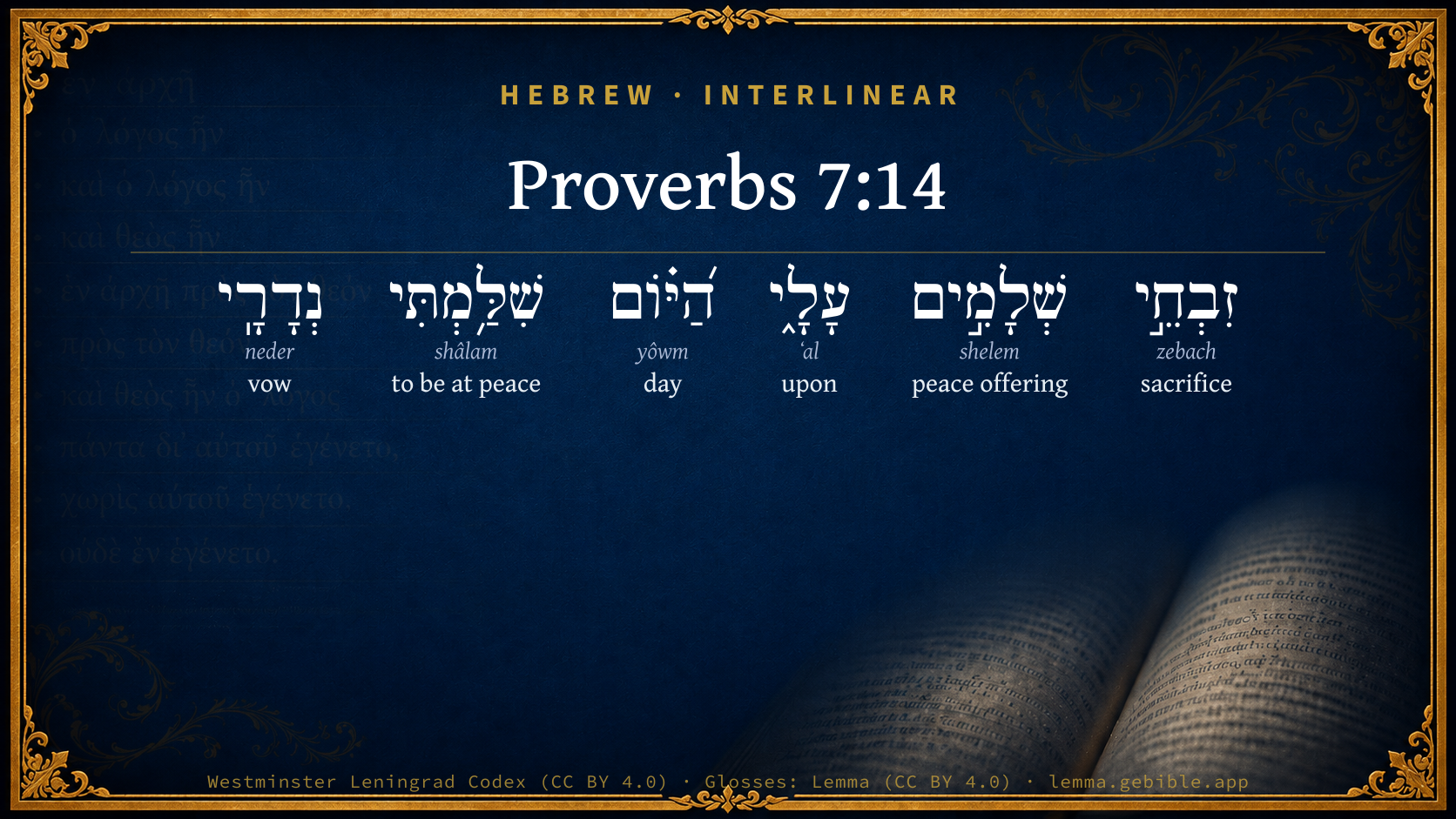
Proverbs 7:14

Hebrew (Westminster Leningrad Codex) Proverbs 7:14 appears in the Hebrew Old Testament. The text above is from the Westminster Leningrad Codex. Each word links to its Strong’s number, a concise gloss, and parsing drawn from the Open Scriptures Hebrew Bible morphology. Click any word for its full Brown-Driver-Briggs (BDB) entry.
Download image
Cite this verse

Proverbs 7:14 (World English Bible). Public Domain. Lemma interlinear Bible study tool, https://lemma.gebible.app/v/proverbs/7/14.

Show BibTeX & RIS
BibTeX
RIS
English Translation
"Sacrifices of peace-offerings are with me. This day I have paid my vows.
World English Bible · Public Domain
Download a study sheet

One document with this verse’s original text, its word-by-word gloss line, the meaning frame, cross-references with their text, attributed commentary, and full source and license credits — printable, and it pastes into notes with its structure intact.

This verse Autodidact and up

Study sheet (.html) Plain text (.txt)

A passage Seminary Student

Up to 50 verses in one chapter. A passage sheet keeps up to 6 commentary sources and 12 cross-references per verse, in the order this page ranks them, and says so on the sheet whenever that leaves anything out. Ask for a single verse and you get the Autodidact verse sheet above.

Everything on this page stays free to read, with no account — the sheet is a download of what is already on screen, not access to it.

Want to remove ads? Support Godless Engineer
Compare translations 3

The same verse in 3 English versions, stacked beneath the original-language interlinear above. Click any original word for its lexicon entry.

Each is an independent rendering of the whole verse — the interlinear is not word-aligned to these translations.

Highlighted words mark where these versions differ — a whole-verse word diff, not a word-by-word alignment.

  • World English Bible Public Domain
    "Sacrifices of peace-offerings are with me. This day I have paid my vows.
  • King James Version Public Domain
    I have peace offerings with me; this day have I payed my vows.
  • unfoldingWord Literal Text CC BY-SA 4.0
    “The sacrifices of peace offerings with me; today I paid my vows.

unfoldingWord Literal Text — © unfoldingWord, licensed CC BY-SA 4.0. Word-aligned USFM3 via Door43 (git.door43.org/unfoldingWord/en_ult).

Versions to compare (up to 4)

3 of 4 selected

Show all 18 translations

Every available English version of this verse, each an independent rendering of the whole verse.

  • World English Bible Public Domain
    "Sacrifices of peace-offerings are with me. This day I have paid my vows.
  • Berean Standard Bible Public Domain
    “I have made my peace offerings; today I have paid my vows.
  • Majority Standard Bible Public Domain
    “I have made my peace offerings; today I have paid my vows.
  • King James Version Public Domain
    I have peace offerings with me; this day have I payed my vows.
  • American Standard Version (1901) Public Domain
    Sacrifices of peace-offerings are with me; This day have I paid my vows.
  • Revised Version (1885) Public Domain
    Sacrifices of peace offerings are with me; this day have I paid my vows.
  • Geneva Bible (1599) Public Domain
    I haue peace offerings: this day haue I payed my vowes.
  • Douay-Rheims (1899) Public Domain
    I vowed victims for prosperity, this day I have paid my vows.
  • Young's Literal Translation Public Domain
    `Sacrifices of peace-offerings `are' by me, To-day I have completed my vows.
  • Literal Standard Version CC BY-SA 4.0
    “Sacrifices of peace-offerings [are] by me, || Today I have completed my vows.
  • Unlocked Literal Bible CC BY-SA 4.0
    “I made my peace offering today, I paid my vows,
  • unfoldingWord Literal Text CC BY-SA 4.0
    “The sacrifices of peace offerings with me; today I paid my vows.
  • Darby Bible Public Domain
    I have peace-offerings with me; this day have I paid my vows:
  • World Messianic Bible Public Domain
    “Sacrifices of peace offerings are with me. Today I have paid my vows.
  • Webster's Bible Public Domain
    I have peace-offerings with me; this day have I paid my vows.
  • Free Bible Version CC BY-SA 4.0
    “I sacrificed my peace offering today, and paid my vows.
  • Bible in Basic English Public Domain
    I have a feast of peace-offerings, for today my oaths have been effected.
  • JPS Tanakh (1917) Public Domain
    'Sacrifices of peace-offerings were due from me; this day have I paid my vows.

Literal Standard Version (2020), Covenant Press — licensed CC BY-SA 4.0. Text via the HelloAO Bible API (eBible.org). Unlocked Literal Bible (unfoldingWord) — licensed CC BY-SA 4.0. Text via the HelloAO Bible API (eBible.org). unfoldingWord Literal Text — © unfoldingWord, licensed CC BY-SA 4.0. Word-aligned USFM3 via Door43 (git.door43.org/unfoldingWord/en_ult). Free Bible Version, Dr. Jonathan Gallagher — licensed CC BY-SA 4.0. Text via the HelloAO Bible API (eBible.org).

Word by word

More ways to search: Search by grammar → Find every occurrence → Compare this word →

Practice this passage: Drill this verse → Learn its vocabulary →

About this verse

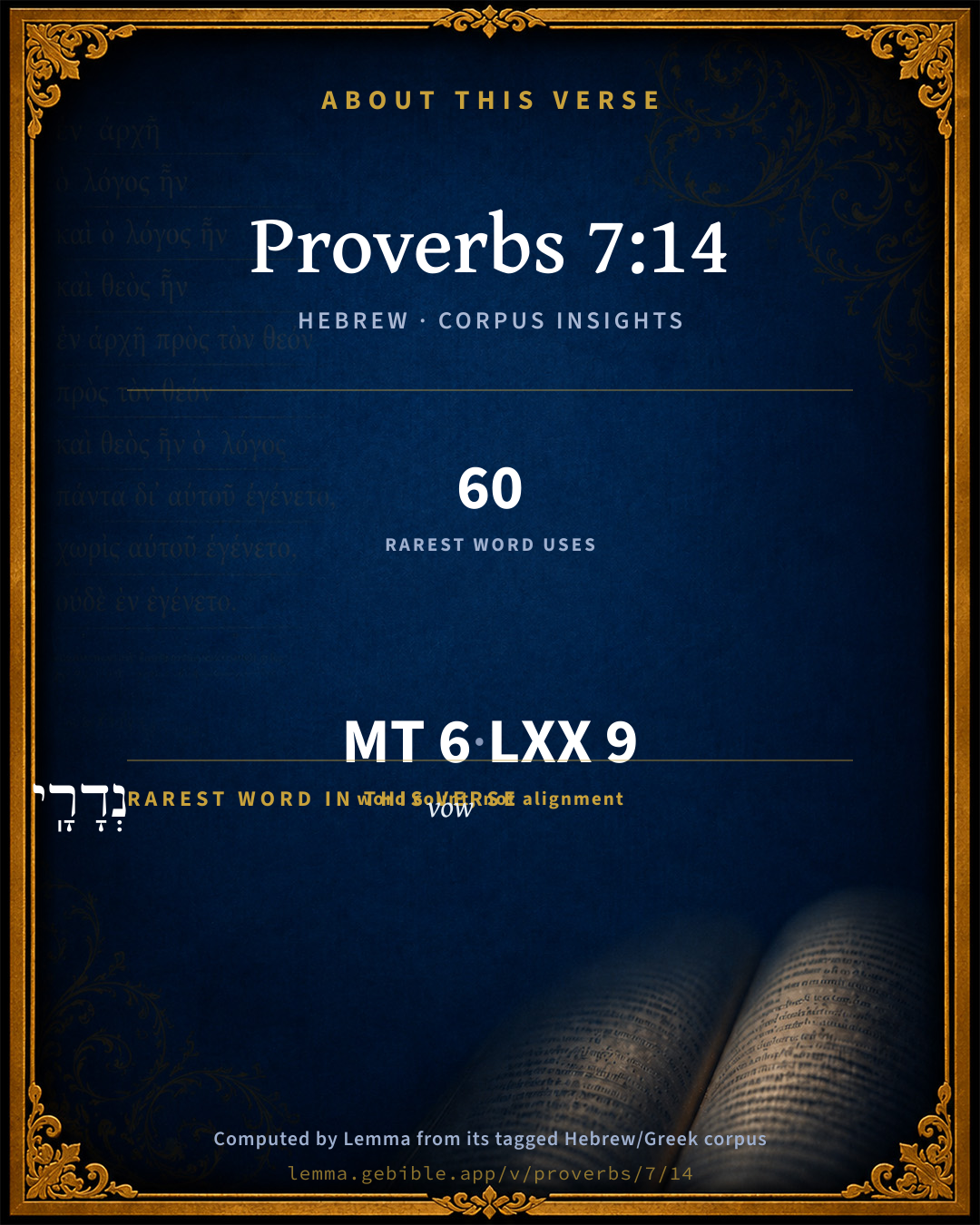
These counts appear in no published source. They are computed here, from the morphology-tagged text and Lemma’s own curated glosses. What Lemma adds →

6
words
6
distinct lemmas
Wisdom
section

Shared distinctive vocabulary

נְדָרָֽי vow H5088 occurs in 57 verses of the Hebrew Bible. Also found in:

Grammatical profile

  • 1 verb
  • 4 nouns
  • 1 preposition

Verb forms

  • שִׁלַּ֥מְתִּי Piel · Perfect

Hebrew & Septuagint length

In English translation the verse runs 13 words from the Hebrew and 9 from the Septuagint (LXX English) — the Septuagint runs noticeably shorter here. See the side-by-side →

A rough comparison of the two English renderings, which tokenize alike — not a word-level alignment.

Word counts can differ between the Hebrew and the Greek without any difference in meaning — e.g. the Hebrew direct-object marker אֵת has no separate Greek word, and Greek often adds the article ὁ.

In the original languages it is 6 Hebrew tokens and 9 Greek tokens — but the two are counted differently (Hebrew bundles its prefixes and suffixes into one token; the Greek is in lemma form), so that isn’t a like-for-like length.

Cross-references

9

Topical passages linked to Proverbs 7:14 in the Treasury of Scripture Knowledge — connected by theme and wording, ordered by reader-vote popularity; previews shown in the World English Bible.

  • Proverbs 21:27 The sacrifice of the wicked is an abomination: How much more, when he brings it with a wicked mind!
  • Leviticus 7:11 "'This is the law of the sacrifice of peace offerings, which one shall offer to Yahweh.
  • Deuteronomy 12:6–7 and there you shall bring your burnt offerings, and your sacrifices, and your tithes, and the heave-offering of your hand, and your vows, and your freewill-offerings, and the firstborn of your herd and of your flock:
  • Proverbs 15:8 The sacrifice made by the wicked is an abomination to Yahweh, But the prayer of the upright is his delight.
  • Proverbs 17:1 Better is a dry morsel with quietness, Than a house full of feasting with strife.
  • John 18:28 They led Jesus therefore from Caiaphas into the Praetorium. It was early, and they themselves didn't enter into the Praetorium, that they might not be defiled, but might eat the Passover.
  • Leviticus 7:15–16 The flesh of the sacrifice of his peace offerings for thanksgiving shall be eaten on the day of his offering. He shall not leave any of it until the morning.
  • 2 Samuel 15:7–9 It happened at the end of forty years, that Absalom said to the king, please let me go and pay my vow, which I have vowed to Yahweh, in Hebron.
  • 1 Kings 21:9–10 She wrote in the letters, saying, Proclaim a fast, and set Naboth on high among the people:

Cross-references courtesy of OpenBible.info (CC BY 4.0).

Hebrew and Greek witnesses Masoretic Hebrew ↔ Greek Septuagint

The same verse in the two great witnesses to the Old Testament, shown verse-for-verse.

Here the Septuagint runs noticeably shorter than the Hebrew — LXX2012 (modern English Septuagint) 9 words vs World English Bible 13. A rough length comparison of the two English translations, not a word-level alignment — read both below.

These are two independent witnesses, not word-aligned to each other, and the Septuagint is shown in lemma (dictionary) form.

Hebrew Proverbs 7:14 Masoretic · Westminster Leningrad Codex

זִבְחֵ֣י שְׁלָמִ֣ים עָלָ֑י הַ֝יּ֗וֹם שִׁלַּ֥מְתִּי נְדָרָֽי

"Sacrifices of peace-offerings are with me. This day I have paid my vows.

World English Bible · Public Domain

Greek LXX Proverbs 7:14 Septuagint · lemma form

θυσία εἰρηνικός ἐγώ εἰμί σήμερον ἀποδίδωμι ὁ εὐχή ἐγώ

I have a peace-offering; today I pay my vows:

LXX2012 (modern English Septuagint) · Public Domain

Hebrew: Westminster Leningrad Codex (CC BY 4.0). Greek: Septuagint (public domain); English from LXX2012 (modern English Septuagint) (Public Domain). How the Septuagint differs from the Hebrew →

Commentary

Notes on Proverbs 7:14 from classic Christian and Jewish commentators (each source and its license shown beneath its notes). The classic Christian expositions comment on the surrounding passage and are grouped to its opening verse, so a note may address several verses; the Jewish commentaries on the Tanakh (Rashi and others) are per-verse, so they appear only where the commentator wrote on this verse.

Lemma curates 59 commentaries, every one of them public domain or Creative Commons licensed, each selected and text-cleaned for this edition rather than reprinted as found. About our sources →

John Gill's Exposition

Therefore came I forth to meet thee,.... Having so much good cheer at home, and none to eat of it with her; and having so fond and affectionate a regard to this young man, as she pretended; he being the only person in her thoughts, whom she hoped to meet with, and whose company she desired, and his only; though, had she met any other, she would have said the same things to them. Aben Ezra, upon Pro 7:14, says, she told him lies; probably that might be true; but this was no doubt a lie; and it is no unusual thing for the whore of Rome to speak lies in hypocrisy, Ti1 4:2;

diligently to seek thy face; which of all faces she desired to see, being most lovely to her; with the comeliness of which she was exceedingly taken and ravished, and got up betimes in the morning, as the word (n) signifies, even before day, to seek for him;

and I have found thee; which she speaks with a rapture and ecstasy of joy; blessing herself on this happy occasion, that she should come out so opportunely, and find him so quickly; intimating, that it was a kind providence, and that the thing was of God: so conversions to the antichristian church, which are the artifice of hell, are ascribed to the divine Being.

(n) "ad quaerendum mane", Montanus.

John Gill's Exposition of the Whole Bible (1746–1763) — public domain (CC PDM 1.0). Text via the HelloAO Bible API.

Trapp's Complete Commentary

John Trapp

Pro 7:14 [I have] peace offerings with me; this day have I payed my vows.

Ver. 14. I have peace offerings.] Sacris abutitur, ut sceleratis mos est; { a} she pretends religion to her filthy practices. So did those wicked women that lay with Eli’s sons at the door of the tabernacle. {1Sa 2:22} So did King Edward IV’s holy whore, as he used to call her, {b} that came to him out of a nunnery when he used to call for her. And such were those kedesheth, or common whores, so called in Hebrew, because such abomination was committed under a pretext of religion. {Gen 38:21 Deu 23:17} But what an odd thing was that of David, that would not lie with Bathsheba till purified! Doth he make conscience of ceremonial, and none of moral purity?

This day have I paid my vows.] A votary then she was, by all means, and so more than ordinarily religious. So was Doeg; why else was he detained "before the Lord?" {1Sa 21:7} A Doeg may set his foot as far into God’s sanctuary as a David. That many Popish votaries are no better than this housewife in the text, see the "Lisbon Nunnery," &c., besides those thousands of infants’ skulls found in the fish pools by Gregory the Great.

{a} Mercer.

{b} Speed.

John Trapp, A Commentary or Exposition upon All the Books of the Old and New Testament (1647–1656) — public domain. Text from a community e-Sword module.

Joseph Benson's Commentary

Pro 7:14. I have peace-offerings with me — “I am a woman happy in many blessings, which God hath bestowed upon me, and for which I have given him solemn thanks this very day; and, as religion and custom bind me, I have provided as good a feast as those sacrifices, which I formerly vowed, and have now paid, would afford, having no want of any thing, but of some good company at home to rejoice with me.” This woman’s conduct was the more abominable, as she covered her lewdness with the mask of piety and devotion. There were three sorts of peace-offerings, as appears by Lev 7:11-16; and Bishop Patrick is of opinion that those here mentioned were offerings of thanksgiving for blessings already obtained, and not of prayer for blessings not yet received, because the woman was so solicitous to have company at her feast upon this very day. It is well known that such sacrifices were to be of the best, either of bullocks, or sheep, or goats, (Lev 3:1; Lev 3:6; Lev 3:12,) and that the greatest part of them fell to the share of the person who offered them that he might feast with God. “It will not appear wonderful,” says Mr. Scott, “that these sacred ordinances should give occasion to carnal feasts attended with every vice, when we reflect how all kinds of sensuality are indulged in,” among professing Christians in our day, “under pretence of commemorating the nativity of Christ, who was manifested to destroy the works of the devil.”

Joseph Benson's Commentary on the Old and New Testaments (1811–1818) — public domain. Text from a community e-Sword module.

Tyndale Open Study Notes

Tyndale Open Resources

7:14 The immoral woman’s observance of religious ritual makes her look good on the surface, but her immoral behavior reveals a corrupt heart.

Tyndale Open Study Notes — © Tyndale Open Resources, licensed CC BY-SA 4.0. Text via the HelloAO Bible API.

Geneva Bible (1599)

Geneva Bible translators

Because that in peace offerings a portion returned to them that offered, she showeth him that she hath meat at home to make good cheer with: or else she would use some cloak of holiness till she had gotten him in her snares.

Which declareth that harlots outwardly will seem holy and religious: both because they may the better deceive others, and also thinking by observing of ceremonies and offerings to make satisfaction for their sins.

Geneva Bible (1599) marginal notes — public domain. Text via Bolls.life.

Adam Clarke's Commentary

Verse 14. I have peace-offerings with me] More literally, "the sacrifices of the peace-offerings are with me." Peace-offerings, shelamim, were offerings the spiritual design of which was to make peace between God and man, to make up the breach between them which sin had occasioned; See Clarke on Le 7:38, where every kind of sacrifice offered under the law is explained. When the blood of these was poured out at the altar, and the fat burnt there, the breast and right shoulder were the priest's portion; but the rest of the carcass belonged to the sacrificer, who might carry it home, and make a feast to his friends. See Le 3:1-11. Much light is cast on this place by the fact that the gods in many parts of the East are actually worshipped in brothels, and fragments of the offerings are divided among the wretches who fall into the snare of the prostitutes.-WARD'S Customs.

Have I payed my vows] She seems to insinuate that she had made a vow for the health and safety of this young man; and having done so, and prepared the sacrificial banquet, came actually out to seek him, that he might partake of it with her, Pr 7:15. But, as she intended to proceed farther than mere friendship, she was obliged to avail herself of the night season, and the absence of her husband.

Adam Clarke's Commentary on the Bible (1810–1826) — public domain. Text from a community e-Sword/MySword module.

Ellicott's Commentary for English Readers

(14) I have peace offerings with me.—Rather, upon me, i.e., I had vowed them, and to-day I have accomplished my vow. The peace-, or thank-offering as it is also rendered, was purely voluntary, in token of thanksgiving for some mercy. The breast and right shoulder of the victim were given to the priest, and the rest belonged to the offerer, who was thus admitted, as it were, to feast with God (Leviticus 3, 7), profanation of this privilege being punished with death. Peace-offerings were accordingly offered on occasions of national rejoicing, as at the inauguration of the covenant (Exo_24:5), at the accession of Saul (1Sa_11:15), and at the bringing up of the ark to Zion (2Sa_6:17), &c. This turning of what should have been a religious festival for the family into an occasion for license, is paralleled by the desecration of the Agapæ at Corinth (1Co_11:20 sqq.) and the history of Church-feasts among ourselves. (For the spiritual interpretation of this passage as symbolising false doctrine, see Bishop Wordsworth; and also Notes on Pro_2:16-19 above.)

A Bible Commentary for English Readers, edited by Charles John Ellicott (1878–1897) — public domain. Text from a community e-Sword module.

The Cambridge Bible for Schools and Colleges

gen. ed. J. J. S. Perowne

14. with me] Lit. upon me, as A.V. marg., which may either and more probably mean, I am, as it were, loaded with them, you have come just when I wanted you, because there is abundance of good cheer in my house; or, they were incumbent upon me, due from me (R.V. marg.).

The flesh of “peace-offerings for thanksgiving” was to be eaten on the day on which it was offered; but if it were “a vow, or a freewill offering,” what remained might be eaten on the morrow (Lev_7:15-16). She would represent him therefore as having happily lighted on her feast-day, when she was looking out and longing for his company.

It is most unnatural to suppose that a foreign woman would thus accommodate herself to Jewish religious customs and seasons, especially when it is remembered that the example of accommodation set by the Court was quite the other way (1Ki_11:1-8). On the other hand, the desecration of sacred Seasons and religious Festivals to secular or even sinful purposes, which was only too common in Israel (Isa_1:11-15; Amo_5:21-22), might only too easily find a parallel in Christian times and countries.

The Cambridge Bible for Schools and Colleges (gen. ed. J. J. S. Perowne; Cambridge University Press, 1878–1918) — public domain. Text from a community e-Sword module.

Albert Barnes' Notes on the Bible

This pretence of a religious feast gives us an insight into some strange features of popular religion under the monarchy of Judah. The harlot uses the technical word Lev 3:1 for the “peace-offerings,” and makes them the starting-point for her sin. They have to be eaten on the same day that they are offered Lev 7:15-16, and she invites her victim to the feast. She who speaks is a “foreigner” who, under a show of conformity to the religion of Israel, still retains her old notions (see Pro 2:16 note), and a feast-day to her is nothing but a time of self-indulgence, which she may invite another to share with her. If we assume, as probable, that these harlots of Jerusalem were mainly of Phoenician origin, the connection of their worship with their sin would be but the continuation of their original “cultus.”

Albert Barnes' Notes on the Bible (1834–1885) — public domain. Text from a community e-Sword/MySword module.

Haydock's Catholic Bible Commentary

Prosperity. Or thy welfare, (Cornelius a Lapide; Tirinus) so great is my love for thee. (Menochius) --- Vows. And therefore I have a feast prepared. People might carry home the greatest part of the victim to eat, if they were clean, Leviticus vii. 29. (Calmet)

George Leo Haydock (1774–1849), Haydock's Catholic Family Bible and Commentary, 1859 edition — public domain. Excludes Psalms (Douay-Rheims chapter numbering differs from Protestant) and Deuterocanonical books (Catholic canon only).

Matthew Poole's English Annotations

I have paid my peace-offerings which I had vowed; whereby she signifies, either,

1. That she was no common harlot, but one of good repute for religion. Or rather,

2. That she had plentiful and excellent provisions at her house for his entertainment. For the peace-offerings were to be of the best flesh, Lev 22:21, and a considerable part of these offerings fell to the offerers’ share, wherewith they used to feast themselves and their friends; see Lev 2:3, &c.; Lev 7:31, &c.; Lev 19:6, &c.; Lev 22:30, &c.; whereas the burnt-offerings where wholly consumed, and the flesh of the sin-offerings and trespass-offerings belonged to the priest.

Matthew Poole's English Annotations on the Holy Bible (1683–1685) — public domain. Text from a community e-Sword/MySword module.

Whedon's Commentary on the Bible

Daniel D. Whedon

14. Peace offerings with me — Most critics prefer, are upon me, or, have been upon me; that is, are due, or have been due, in the fulfillment of vows. Comp. Lev_3:1; Lev_3:3; Lev_3:6; Lev_3:9. Conant prefers peace offerings are by me; the feast is already prepared. Of these peace sacrifices the worshipper partook. The breast and the right shoulder belonged to the priest; the rest of the carcass the worshipper might carry home to enjoy with his friends. It had to be eaten the same day. (See Lev_7:15-16.) This vile woman, whether Hebrew, or, as others suppose, Phoenician, pretends to piety and religious vows; that she had that day offered sacrifices, with a portion of which she had made a rich feast in token of her joy and gratitude for the blessings of providence, and only waited some good company to participate in her pleasant cheer.

Daniel D. Whedon (gen. ed.), Commentary on the Old and New Testaments (1874–1909) — public domain. Text from a community e-Sword module.

The Pulpit Commentary

I have peace offerings with me. Shelamim, "peace or thank offerings," were divided between Jehovah, the priests, and the offerer. Part of the appointed victim was consumed by fire; the breast and right shoulder were allotted to the priests; and the rest of the animal belonged to the person who made the offering, who was to eat it with his household on the same day as a solemn ceremonial feast. (Le 3 Le 7) The adulteress says that certain offerings were due from her, and she had duly made them. This day have I payed my vows. And now (the day being reckoned from one night to the next) the feast was ready, and she invites her paramour to share it. The religious nature of the feast is utterly ignored or forgotten. The shameless woman uses the opportunity simply as a convenience for her sin. If, as is probable, the "strange woman" is a foreigner, she is one who only outwardly conforms to the Mosaic Law, but in her heart cleaves to the impure worship of her heathen hems And doubtless, in lax times, these religious festivals, even in the case of worshippers who were not influenced by idolatrous proclivities, degenerated into self-indulgence and excess. The early Christian agapae were thus misused; (1Co_11:20, etc.) and in modern times religious anniversaries have too often become occasions of licence and debauchery, their solemn origin and pious uses being entirely thrust aside.

The Pulpit Commentary (1880–1919), ed. H.D.M. Spence-Jones & Joseph S. Exell — public domain. Text from a community e-Sword module.

John Wesley's Explanatory Notes

Offerings - I have paid my peace-offerings which I had vowed. Whereby she signifies, that she had plentiful provisions at her house for his entertainment. For the peace-offerings were to be of the best flesh, Lev. xxii, 21, and a considerable part of these offerings fell to the offerer's share.

John Wesley, Explanatory Notes Upon the Whole Bible (1754–1765) — public domain. Text via the GEBible commentary corpus.

Keil & Delitzsch

C. F. Keil & F. Delitzsch

She laid hold on him and kissed him, both of which actions were shameless, and then, assuming the passivity and modesty befitting the woman, and disregarding morality and the law, she said to the youth:

14 "To bring peace-offerings was binding upon me,

To-day have I redeemed my vows.

15 Therefore am I come out to meet thee,

To seek thy face, and have found thee."

We have translated זבחי שׁלמים "peace-offerings," proceeding on the principle that שׁלם (sing. only Amo 5:22, and on the Phoenician altar at Marseilles) denotes contracting friendship with one (from שׁלם, to hold friendly relationship), and then the gifts having this in view; for the idea of this kind of offering is the attestation and confirmation of communion with God. But in view of the derivatives שׁלמנים and שׁלּוּם, it is perhaps more appropriate to combine שׁלם with שׁלּם, to discharge perfectly, and to translate it thank-payment-offering, or with v. Hofmann, a due-offering, where not directly thank-offering; for the proper eucharistic offering, which is the expression of thanks on a particular occasion, is removed from the species of the Shelamim by the addition of the words על־תּודה (Lev 7:12-25). The characteristic of the Shelamim is the division of the flesh of the sacrifice between Jahve and His priests on the one side, and the person (or persons) bringing it on the other side: only one part of the flesh of the sacrifice was Jahve's, consumed by fire (Lev 3:16); the priests received one part; those who brought the offering received back another part as it were from the altar of God, that they might eat it with holy joy along with their household. So here the adulteress says that there was binding upon her, in consequence of a vow she had taken, the duty of presenting peace-offerings, or offerings that were due; to-day (she reckons the day in the sense of the dies civilis from night to night) she has performed her duties, and the שׁלמי נדר have yielded much to her that she might therewith regale him, her true lover; for with על־כּן she means to say that even the prospect of the gay festival which she can prepare for him moved her thus to meet him. This address of the woman affords us a glimpse into the history of the customs of those times. The Shelamim meals degenerated in the same manner as our Kirmsen.

(Note: Kirmse = anniversary of the dedication of a church, village fte.)

Secularization lies doubly near to merrymaking when the law sanctions this, and it can conceal itself behind the mask of piety. Regarding שׁחר, a more exact word for בּקּשׁ, vid., at Pro 1:28. To seek the countenance of one is equivalent to to seek his person, himself, but yet not without reference to the wished-for look [aspectus] of the person.

Keil & Delitzsch — Biblical Commentary on the Old Testament (1861–1891) — public domain (CC PDM 1.0). Text via the HelloAO Bible API. (Old Testament only.)

Rashi

Rabbi Shlomo Yitzchaki (Rashi)

I had to bring peace offerings I prepared a great feast, for today I sacrificed my vows and my peace offering.

Rashi on the Tanakh — English translations: “The Judaica Press complete Tanach with Rashi, translated by A. J. Rosenberg” (CC BY 4.0); “Pentateuch with Rashi's commentary by M. Rosenbaum and A.M. Silbermann, 1929-1934” (public domain); “The Metsudah Tanach series, Lakewood, N.J” (CC BY 4.0); and “The Book of Joshua, Metsudah Publications, 1997” (CC BY 4.0). Text via Sefaria.

Lesson kit

Teaching starters — assembled from the data on this page, not authored interpretation. Every prompt links to the verse data it draws on. Edit before teaching.

Proverbs, in the Wisdom, opens this verse with 6 words (6 distinct Hebrew lemmas). Its most distinctive word is neder (“vow”). The Greek Septuagint runs shorter here. A historical commentator’s framing appears above. Read the whole chapter for the surrounding context.

Discussion questions

  1. The word neder carries the sense “vow.” How does it shape the verse?
  2. How does Genesis 28:20, which shares the word «vow», read alongside this verse?
  3. The Septuagint runs shorter here than the Hebrew. What might account for the difference?
  4. These translations render this verse differently. What is at stake in choosing one wording over another?
  5. «שִׁלַּ֥מְתִּי» is a Piel Perfect verb. How does that grammatical form shape the action described?
  6. Compare how John Gill's Exposition and Trapp's Complete Commentary read this verse. Where do they agree or differ?

Things to notice

Reading settings

Reading text

Shown beneath each verse's original-language words.

Old Testament
Old Testament edition

Read the OT as the Masoretic Hebrew (MT) or the Greek Septuagint (LXX).

English shown for the Greek Septuagint (in the Hebrew ↔ Greek comparison).

Comparing translations? Open the Compare panel on any verse page to stack up to four side by side.