Daniel 1:18

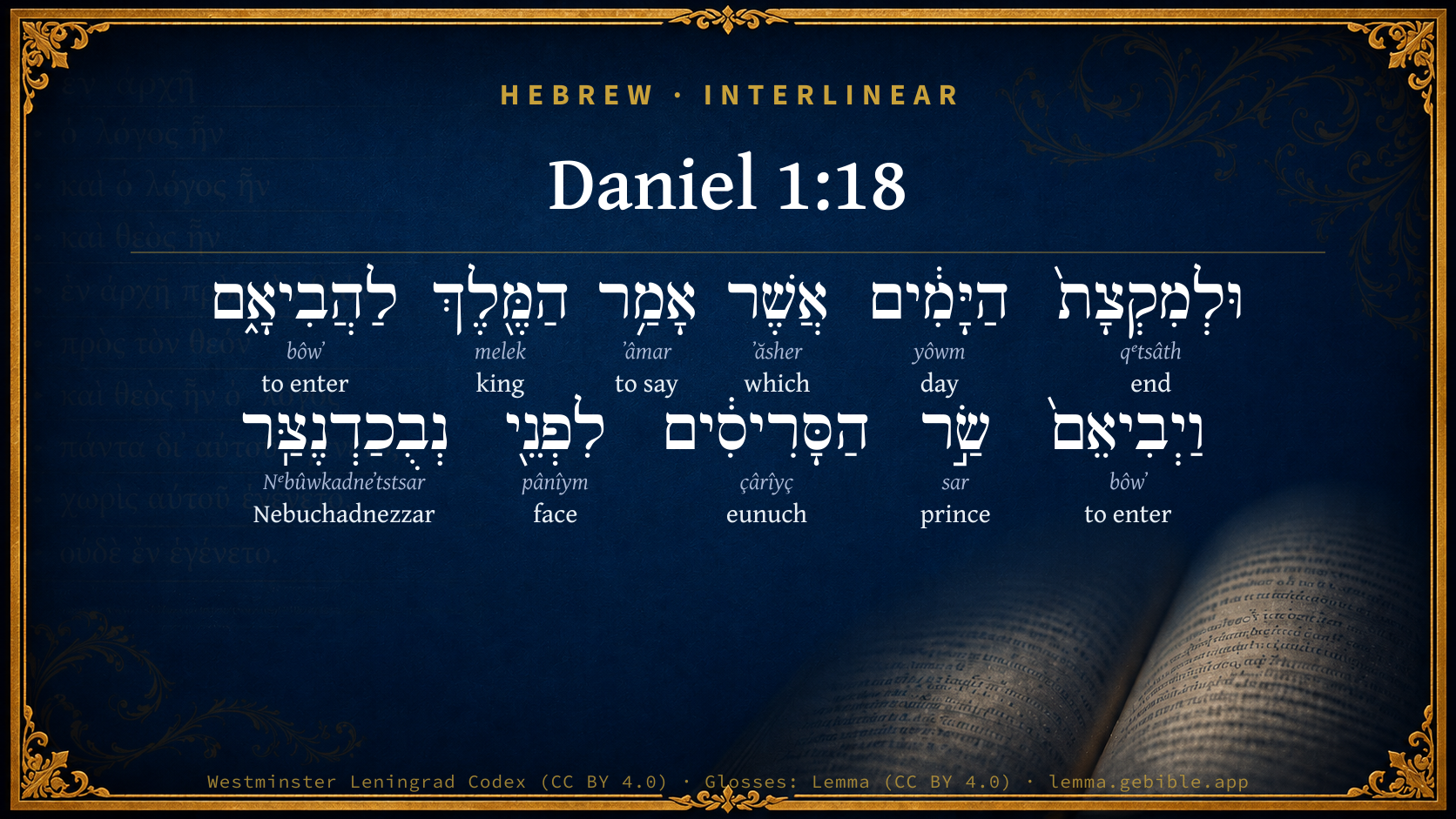
Hebrew (Westminster Leningrad Codex) Daniel 1:18 appears in the Hebrew Old Testament. The text above is from the Westminster Leningrad Codex. Each word links to its Strong’s number, a concise gloss, and parsing drawn from the Open Scriptures Hebrew Bible morphology. Click any word for its full Brown-Driver-Briggs (BDB) entry.
Download image
Cite this verse

Daniel 1:18 (World English Bible). Public Domain. Lemma interlinear Bible study tool, https://lemma.gebible.app/v/daniel/1/18.

Show BibTeX & RIS
BibTeX
RIS
English Translation
At the end of the days which the king had appointed for bringing them in, the prince of the eunuchs brought them in before Nebuchadnezzar.
World English Bible · Public Domain
Download a study sheet

One document with this verse’s original text, its word-by-word gloss line, the meaning frame, cross-references with their text, attributed commentary, and full source and license credits — printable, and it pastes into notes with its structure intact.

This verse Autodidact and up

Study sheet (.html) Plain text (.txt)

A passage Seminary Student

Up to 50 verses in one chapter. A passage sheet keeps up to 6 commentary sources and 12 cross-references per verse, in the order this page ranks them, and says so on the sheet whenever that leaves anything out. Ask for a single verse and you get the Autodidact verse sheet above.

Everything on this page stays free to read, with no account — the sheet is a download of what is already on screen, not access to it.

Want to remove ads? Support Godless Engineer
Compare translations 3

The same verse in 3 English versions, stacked beneath the original-language interlinear above. Click any original word for its lexicon entry.

Each is an independent rendering of the whole verse — the interlinear is not word-aligned to these translations.

Highlighted words mark where these versions differ — a whole-verse word diff, not a word-by-word alignment.

  • World English Bible Public Domain
    At the end of the days which the king had appointed for bringing them in, the prince of the eunuchs brought them in before Nebuchadnezzar.
  • King James Version Public Domain
    Now at the end of the days that the king had said he should bring them in, then the prince of the eunuchs brought them in before Nebuchadnezzar.
  • unfoldingWord Literal Text CC BY-SA 4.0
    At the end of the time, when the king had commanded to bring them in, the chief of the officials brought them in before Nebuchadnezzar.

unfoldingWord Literal Text — © unfoldingWord, licensed CC BY-SA 4.0. Word-aligned USFM3 via Door43 (git.door43.org/unfoldingWord/en_ult).

Versions to compare (up to 4)

3 of 4 selected

Show all 18 translations

Every available English version of this verse, each an independent rendering of the whole verse.

  • World English Bible Public Domain
    At the end of the days which the king had appointed for bringing them in, the prince of the eunuchs brought them in before Nebuchadnezzar.
  • Berean Standard Bible Public Domain
    Now at the end of the time specified by the king, the chief official presented them to Nebuchadnezzar.
  • Majority Standard Bible Public Domain
    Now at the end of the time specified by the king, the chief official presented them to Nebuchadnezzar.
  • King James Version Public Domain
    Now at the end of the days that the king had said he should bring them in, then the prince of the eunuchs brought them in before Nebuchadnezzar.
  • American Standard Version (1901) Public Domain
    And at the end of the days which the king had appointed for bringing them in, the prince of the eunuchs brought them in before Nebuchadnezzar.
  • Revised Version (1885) Public Domain
    And at the end of the days which the king had appointed for bringing them in, the prince of the eunuchs brought them in before Nebuchadnezzar.
  • Geneva Bible (1599) Public Domain
    Nowe when the time was expired, that the King had appoynted to bring them in, the chiefe of the Eunuches brought them before Nebuchad-nezzar.
  • Douay-Rheims (1899) Public Domain
    And when the days were ended, after which the king had ordered they should be brought in: the prince of the eunuchs brought them in before Nabuchodonosor.
  • Young's Literal Translation Public Domain
    And at the end of the days that the king had said to bring them in, bring them in doth the chief of the eunuchs before Nebuchadnezzar.
  • Literal Standard Version CC BY-SA 4.0
    And at the end of the days that the king had said to bring them in, the chief of the eunuchs brings them in before Nebuchadnezzar.
  • Unlocked Literal Bible CC BY-SA 4.0
    At the end of the time set by the king to bring them in, the chief official brought them in before Nebuchadnezzar.
  • unfoldingWord Literal Text CC BY-SA 4.0
    At the end of the time, when the king had commanded to bring them in, the chief of the officials brought them in before Nebuchadnezzar.
  • Darby Bible Public Domain
    And at the end of the days that the king had said he should bring them in, the prince of the eunuchs brought them in before Nebuchadnezzar.
  • World Messianic Bible Public Domain
    At the end of the days which the king had appointed for bringing them in, the prince of the eunuchs brought them in before Nebuchadnezzar.
  • Webster's Bible Public Domain
    Now at the end of the days that the king had said he should bring them in, then the prince of the eunuchs brought them in before Nebuchadnezzar.
  • Free Bible Version CC BY-SA 4.0
    When their time of education ordered by the king was over, the chief eunuch brought all the young men before King Nebuchadnezzar.
  • Bible in Basic English Public Domain
    Now at the end of the time fixed by the king for them to go in, the captain of the unsexed servants took them in to Nebuchadnezzar.
  • JPS Tanakh (1917) Public Domain
    And at the end of the days which the king had appointed for bringing them in, the chief of the officers brought them in before Nebuchadnezzar.

Literal Standard Version (2020), Covenant Press — licensed CC BY-SA 4.0. Text via the HelloAO Bible API (eBible.org). Unlocked Literal Bible (unfoldingWord) — licensed CC BY-SA 4.0. Text via the HelloAO Bible API (eBible.org). unfoldingWord Literal Text — © unfoldingWord, licensed CC BY-SA 4.0. Word-aligned USFM3 via Door43 (git.door43.org/unfoldingWord/en_ult). Free Bible Version, Dr. Jonathan Gallagher — licensed CC BY-SA 4.0. Text via the HelloAO Bible API (eBible.org).

Word by word

More ways to search: Search by grammar → Find every occurrence → Compare this word →

Practice this passage: Drill this verse → Learn its vocabulary →

וּלְמִקְצָת֙
qᵉtsâth
H7117
“and · to/for · from · end of”
Conjunction + Preposition + Preposition + Noun, Common, Feminine, Singular, Construct
Part of Speech
Conjunction + Preposition + Preposition + Noun
Type
Common
Gender
Feminine
Number
Singular
State
Construct
Full BDB Definition

Origin: from H7096

TWOT: 2053e

end, part - end - of corners, of earth - from the end of - at the end of
  1. הַיָּמִ֔ים yôwm H3117 “the · days” Particle, Definite Article + Noun, Common, Masculine, Plural, Absolute
  2. אֲשֶׁר ʼăsher H834 “which” Particle, Relative
  3. אָמַ֥ר ʼâmar H559 “to say” Verb, Qal, Perfect, 3rd Person, Masculine, Singular
  4. הַמֶּ֖לֶךְ melek H4428 “the · king” Particle, Definite Article + Noun, Common, Masculine, Singular, Absolute
  5. לַהֲבִיאָ֑ם bôwʼ H935 “to enter · them” Preposition + Verb, Hiphil, Infinitive Construct + Suffix, Personal, 3rd Person, Masculine, Plural
  6. וַיְבִיאֵם֙ bôwʼ H935 “and · to enter · them” Conjunction + Verb, Hiphil, Sequential Imperfect, 3rd Person, Masculine, Singular + Suffix, Personal, 3rd Person, Masculine, Plural
  7. שַׂ֣ר sar H8269 “prince of” Noun, Common, Masculine, Singular, Construct
  8. הַסָּרִיסִ֔ים çârîyç H5631 “the · eunuchs” Particle, Definite Article + Noun, Common, Masculine, Plural, Absolute
  9. לִפְנֵ֖י pânîym H6440 “to/for · face(s) of” Preposition + Noun, Common, Both, Plural, Construct
  10. נְבֻכַדְנֶצַּֽר Nᵉbûwkadneʼtstsar H5019 “Nebuchadnezzar” Noun, Proper

About this verse

These counts appear in no published source. They are computed here, from the morphology-tagged text and Lemma’s own curated glosses. What Lemma adds →

11
words
10
distinct lemmas
Prophets
section

Notable vocabulary

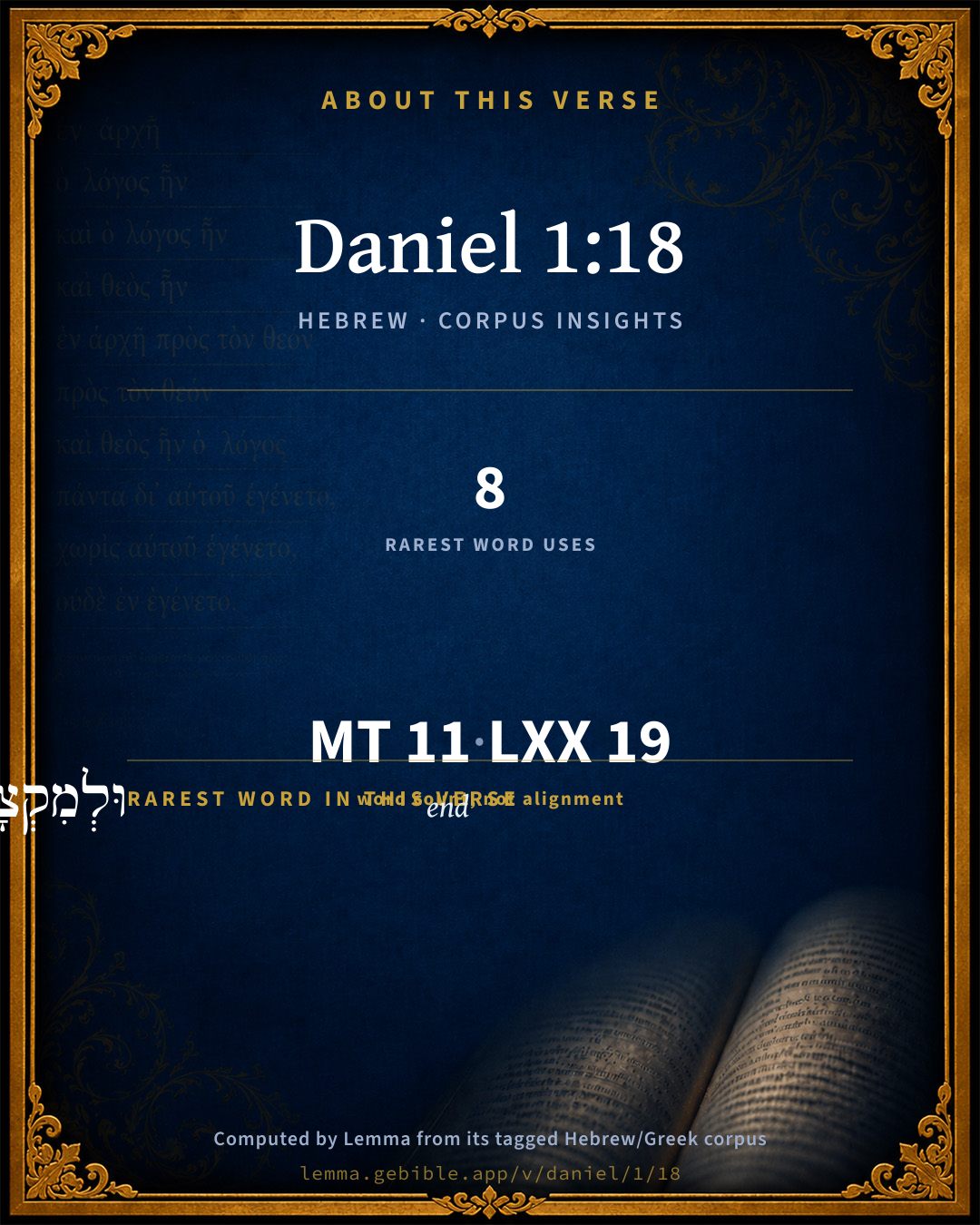
The rarest word here is וּלְמִקְצָת֙ end H7117 — appearing just 8 times in the whole Hebrew Bible.

Shared distinctive vocabulary

וּלְמִקְצָת֙ end H7117 occurs in 8 verses of the Hebrew Bible. Also found in:

Grammatical profile

  • 3 verbs
  • 7 nouns
  • 1 particle

Verb forms

  • אָמַ֥ר Qal · Perfect
  • לַהֲבִיאָ֑ם Hiphil · Infinitive Construct
  • וַיְבִיאֵם֙ Hiphil · Sequential Imperfect

Repetition

A word recurs within this verse — often emphatic in Hebrew:

  • לַהֲבִיאָ֑ם to enter H935 ×2

Hebrew & Septuagint length

In English translation the verse runs 25 words from the Hebrew and 29 from the Septuagint (LXX English) — closely comparable.

A rough comparison of the two English renderings, which tokenize alike — not a word-level alignment.

Word counts can differ between the Hebrew and the Greek without any difference in meaning — e.g. the Hebrew direct-object marker אֵת has no separate Greek word, and Greek often adds the article ὁ.

In the original languages it is 11 Hebrew tokens and 19 Greek tokens — but the two are counted differently (Hebrew bundles its prefixes and suffixes into one token; the Greek is in lemma form), so that isn’t a like-for-like length.

Cross-references

1

Topical passages linked to Daniel 1:18 in the Treasury of Scripture Knowledge — connected by theme and wording, ordered by reader-vote popularity; previews shown in the World English Bible.

  • Daniel 1:5 The king appointed for them a daily portion of the king's dainties, and of the wine which he drank, and that they should be nourished three years; that at the end of it they should stand before the king.

Cross-references courtesy of OpenBible.info (CC BY 4.0).

Hebrew and Greek witnesses Masoretic Hebrew ↔ Greek Septuagint

The same verse in the two great witnesses to the Old Testament, shown verse-for-verse.

These are two independent witnesses, not word-aligned to each other, and the Septuagint is shown in lemma (dictionary) form.

Hebrew Daniel 1:18 Masoretic · Westminster Leningrad Codex

וּלְמִקְצָת֙ הַיָּמִ֔ים אֲשֶׁר אָמַ֥ר הַמֶּ֖לֶךְ לַהֲבִיאָ֑ם וַיְבִיאֵם֙ שַׂ֣ר הַסָּרִיסִ֔ים לִפְנֵ֖י נְבֻכַדְנֶצַּֽר

At the end of the days which the king had appointed for bringing them in, the prince of the eunuchs brought them in before Nebuchadnezzar.

World English Bible · Public Domain

Greek LXX Daniel 1:18 Septuagint · lemma form

μετά δέ ὁ ἡμέρα οὗτος ἐπιτάσσω ὁ βασιλεύς εἰςἄγω αὐτός καί εἰςἄγω ἀπό ὁ ἀρχιευνοῦχος πρός ὁ βασιλεύς ναβουχοδονοσορ

And at the end of the days, after which the king had given orders to bring them in, then the chief of the eunuchs brought them in before Nabuchodonosor.

LXX2012 (modern English Septuagint) · Public Domain

On this verse, The Pulpit Commentary discusses the Septuagint’s reading. Read the note in Commentary ↓

Hebrew: Westminster Leningrad Codex (CC BY 4.0). Greek: Septuagint (public domain); English from LXX2012 (modern English Septuagint) (Public Domain). How the Septuagint differs from the Hebrew →

Commentary

Notes on Daniel 1:18 from classic Christian and Jewish commentators (each source and its license shown beneath its notes). The classic Christian expositions comment on the surrounding passage and are grouped to its opening verse, so a note may address several verses; the Jewish commentaries on the Tanakh (Rashi and others) are per-verse, so they appear only where the commentator wrote on this verse.

Lemma curates 59 commentaries, every one of them public domain or Creative Commons licensed, each selected and text-cleaned for this edition rather than reprinted as found. About our sources →

Trapp's Complete Commentary

John Trapp

Dan 1:18 Now at the end of the days that the king had said he should bring them in, then the prince of the eunuchs brought them in before Nebuchadnezzar.

Ver. 18. Now at the end of the days,] i.e., After three years’ time of studying. See on Dan 1:5. Account is to be exacted of time and profiting. Pliny {a} said to his nephew, when he saw him walk out some hours without studying, Poteras has horas non perdere, You might have spent these hours better. Ignatius, when he heard a clock strike, would say, Here is one hour more now past that I have to answer for. Archbishop Ussher, {b} on his death bed, begged hard of God to pardon his omissions, who yet was never known to omit an hour, but ever employed in his Master’s business, reading, writing, preaching, resolving doubts, &c.

{a} Plin. Epist.

{b} His Life by Dr Bernard.

John Trapp, A Commentary or Exposition upon All the Books of the Old and New Testament (1647–1656) — public domain. Text from a community e-Sword module.

Joseph Benson's Commentary

Dan 1:18-20. Now at the end of the days that the king had said he should bring them in — At the end of three years, see Dan 1:5, the prince of the eunuchs brought them in — According to the king’s command. And the king communed with them — To try their proficiency. This shows the king’s ability and judgment, without which he could not have discerned their fitness for his service, and their excellence above others. He examined all candidates that applied, and preferred those that outstripped the rest. Therefore stood they before the king — They were in continual attendance in the king’s court. The same expression is used of Elijah and Jeremiah, as God’s servants and messengers, 1Ki 17:1; Jer 15:19. And the Levites are said to stand before the congregation to minister to them, Num 16:9. And in all matters of wisdom and understanding — In a general knowledge of things; that the king inquired of them — This is a further confirmation of the king’s noble endowments, and of his great care to choose only proper persons to be in offices of trust, namely, persons well qualified to serve him in the great affairs of the kingdom. He found them ten times better, &c. — Hebrew, עשׂר ידית, ten hands above, all the magicians and astrologers that were in his realm — The words may be understood of those that employed themselves in the lawful search of natural causes and effects, and of the regular motions of the heavenly bodies. For, inasmuch as Daniel made intercession to the captain of the guard, that the wise men of Babylon might not be slain, Dan 2:24, we cannot suppose that all of them were such as studied unlawful arts and sciences, especially as he himself was afterward made master, or head, over them. These names are evidently to be taken in a good sense, as the magi, Mat 2:1; and the astrologers were then nearly, if not altogether, the same as astronomers with us. In short, the words seem to comprehend those persons in general, that were distinguished in the several kinds of learning cultivated among the Chaldees. It cannot, therefore, be collected from these words, that Daniel applied himself to the study of what are called magic arts, but to the sciences of the Chaldees; in the same manner as Moses had, long before, applied himself to the study of the wisdom of Egypt. And in giving Nebuchadnezzar proof that Daniel excelled all the wise men in his realm in these branches of knowledge and wisdom, God poured contempt on the pride of the Chaldeans, and put honour on the low estate of his people.

Joseph Benson's Commentary on the Old and New Testaments (1811–1818) — public domain. Text from a community e-Sword module.

Ibn Ezra

Rabbi Abraham ibn Ezra

[Daniel 1:18] U-le-miketzat (וּלְמִקְצָת - And at the end of): [Meaning] at the end of the three years [mentioned in Daniel 1:5].

[Daniel 1:18] La-havi’am (לַהֲבִיאָם - To bring them): [Meaning:] before the king.

Ibn Ezra on the Tanakh — English translations: “Sefaria Community Translation” (CC0 1.0 (public-domain dedication)); “Yalkut, Sifsei Chachomim Chumash, Metsudah Publications, 2009” (CC BY 4.0); and “Commentary of Ibn Ezra on Isaiah - trans. by M. Friedlander, 1873” (public domain). Text via Sefaria.

Geneva Bible (1599)

Geneva Bible translators

Of the three years above mentioned, verse 5.

Geneva Bible (1599) marginal notes — public domain. Text via Bolls.life.

Jamieson, Fausset & Brown

Robert Jamieson, A. R. Fausset & David Brown

brought them in--that is, not only Daniel and his three friends, but other youths (Dan 1:3, Dan 1:19, "among them all").

Jamieson, Fausset & Brown — Commentary Critical and Explanatory on the Whole Bible (1871) — public domain (CC PDM 1.0). Text via the HelloAO Bible API.

Adam Clarke's Commentary

Verse 18. Now at the end of the days] That is, at the end of three years, Da 1:5.

Adam Clarke's Commentary on the Bible (1810–1826) — public domain. Text from a community e-Sword/MySword module.

John Calvin's Commentaries

Now, Daniel relates how he and his companions were brought forward at a fixed time, since three years was appointed by the king for their instruction in all the science of the Chaldees and on that account the prefect of the eunuchs produces them. He shews how he and his companions were approved by the king, and were preferred to all the rest. By these words he confirms my remark, that the Lord through a long interval had adorned them with much favor, by rendering them conspicuous throughout the royal palace, while the king himself acknowledged something uncommon in them. He, as well as the courtiers, ought all to entertain such an opinion concerning these four youths, as should express his sincere reverence for them. Then God wished to illustrate his own glory, since without doubt the king was compelled to wonder how they could surpass all the Chaldeans. This monarch had spared no expense on his own people, and had not neglected to instruct them; but when he saw foreigners and captives so superior, a spirit of rivalry would naturally spring up within him. But, as I have already said, God wished to extol himself in the person of his servants, so that the king might be compelled to acknowledge something divine in these young men. Whence, then, was this superiority? for the Chaldeans boasted of their wisdom from their birth, and esteemed other nations as barbarians. The Jews, they would argue, are eminent beyond all others; verily the God whom they worship distributes at his will talent and perception, since no one is naturally gifted unless he receives this grace from heaven. God, therefore, must necessarily be glorified, because Daniel and his comrades very far surpassed the Chaldeans. Thus God usually causes his enemies to gaze with wonder on his power, even when they most completely shun the light. For what did King Nebuchadnezzar propose, but to extinguish the very remembrance of God? For he wished to have about him Jews of noble family, who should oppose the very religion in which they were born. But God frustrated this plan of the tyrant’s, and took care to make his own name more illustrious. It now follows.

John Calvin's Commentaries (1540-1563) — public domain. Text from the Calvin Translation Society English edition (1840s-50s) via the Christian Classics Ethereal Library (ccel.org). Calvin's coverage is partial (roughly two-thirds of the Bible); uncommented books and verses are honest gaps, never fabricated. The 19th-century editor's footnotes and remarks are omitted so the notes are faithfully Calvin's own voice.

Ellicott's Commentary for English Readers

(18) At the end of the days, i.e., the three years specified in Dan_1:5. Before the conclusion of this time, it appears (Dan_2:1), Daniel was enabled to give a proof of his wisdom. (See Dan_2:28.)

A Bible Commentary for English Readers, edited by Charles John Ellicott (1878–1897) — public domain. Text from a community e-Sword module.

The Cambridge Bible for Schools and Colleges

gen. ed. J. J. S. Perowne

18. And at the end of the days that the king had appointed (Dan_1:5) for bringing them in (R.V.)] viz. to attend upon the king. ‘Appointed’ is lit. said, i.e. commanded, decreed, a common use in late Hebrew: cf. Dan_1:3. As Dan_1:19 (‘among them all,’ &c.) shews, the pron. them refers, not as the connexion with Dan_1:17 might suggest, to the four Hebrew lads alone, but to the whole number of youths mentioned in Dan_1:3-4.

The Cambridge Bible for Schools and Colleges (gen. ed. J. J. S. Perowne; Cambridge University Press, 1878–1918) — public domain. Text from a community e-Sword module.

John Gill's Exposition

Now at the end of the days that the king had said he should bring them in,.... That is, at the end of three years; which was the time appointed for their education, and when they were to be brought before the king for his examination and approbation:

then the prince of the eunuchs brought them in before Nebuchadnezzar; even all the young men that were taken from among the children of Israel and Judah, as well as the four children before and after mentioned, appears by what follows. This was done by Asphenaz, and not Melzar.

John Gill's Exposition of the Whole Bible (1746–1763) — public domain (CC PDM 1.0). Text via the HelloAO Bible API.

Albert Barnes' Notes on the Bible

Now at the end of the days ... - After three years. See Dan 1:5.

The prince of the eunuchs brought them in - Daniel, his three friends, and the others who had been selected and trained for the same purpose.

Albert Barnes' Notes on the Bible (1834–1885) — public domain. Text from a community e-Sword/MySword module.

Matthew Poole's English Annotations

At the three years’ end, according to the king’s command, which Melzar punctually observed, and brought them in before the king.

Matthew Poole's English Annotations on the Holy Bible (1683–1685) — public domain. Text from a community e-Sword/MySword module.

Whedon's Commentary on the Bible

Daniel D. Whedon

18-20. At the end of a three years’ course of study (Dan_1:5) the examination not only showed the fitness of these youths to stand before the king (Dan_1:19), that is, as royal attendants (Bevan); but when questions were propounded on dark subjects their answers showed more insight than those of the king’s most aged and learned counselors. This statement probably has reference to the events related in chap. 2. This verse is so changed in various translations that Thomson would drop it out altogether as a later interpolation. Wyclif’s translation, though not of critical value, is curious enough to quote: “And eche word of Wysdam and vndirstondyng, that the Kyng axide of him, he fonde in him the tenthe folde ouer alle dyvynours and witch is that everen in alle the rewme of hym.”

Daniel D. Whedon (gen. ed.), Commentary on the Old and New Testaments (1874–1909) — public domain. Text from a community e-Sword module.

The Pulpit Commentary

Now at the end of the clays that the king had said he should bring them in, then the prince of the eunuchs brought them in before Nebuchadnezzar. The Septuagint Version here is shorter and simpler: "After these days the king commanded to bring them in, and they were brought in by the prince of the eunuchs." The only difference is that hl,aeh (haayleh) is read instead of rva ("asher), and the maqqeph dropped. Theodotion is in close accordance with the Massoretic text. The Peshitta is also simpler than the Massoretic text, though founded on it: "And after the completion of the days which the king had arranged, the chief of the eunuchs brought them before Nebuchadnezzar the king." Both the Massoretic and Peshitta texts represent the prince of the eunuchs bringing the youths before King Nebuchadnezzar when the time had elapsed, without any orders from the king himself. According to the Septuagint, it was the king himself that required them to be presented before him. It seems more like the active-minded king, that he should recall his purpose of examining these youths, and command them to be brought in, than that the prince of the eunuchs should bring them trooping in without warning into the royal presence. Such an examination, whether conducted by the king personally, or in his presence, or under his superintendence, would need to be prepared fur; something equivalent to examination papers, test questions, would have to be arranged, or the presentation before the king would be a farce. All this implies that Nebuchadnezzar himself arranged the time of the appearance of those youths before him. We can scarcely imagine the awe with which those young captives must have looked forward to standing before the terrible conqeueror who had swept the army of Egypt before him, and had overthrown all who ventured to oppose him, who had sent home hosts of captives to throng the slave-markets of Babylon. We are not told whether each separately was brought before Nebuchadnezzar, or whether the whole number of the cadets were presented at once. It is the earliest instance of promotion by competitive examination. The clear, sharp eye of the young conqueror was probably worth more than all the questions prepared. While certainly the words used seem to imply that the hostages were called merely to be examined, the occasion may have been the "dream" narrated in the next chapter.

The Pulpit Commentary (1880–1919), ed. H.D.M. Spence-Jones & Joseph S. Exell — public domain. Text from a community e-Sword module.

Rashi

Rabbi Shlomo Yitzchaki (Rashi)

that the king ordered to bring them that they come before him.

Rashi on the Tanakh — English translations: “The Judaica Press complete Tanach with Rashi, translated by A. J. Rosenberg” (CC BY 4.0); “Pentateuch with Rashi's commentary by M. Rosenbaum and A.M. Silbermann, 1929-1934” (public domain); “The Metsudah Tanach series, Lakewood, N.J” (CC BY 4.0); and “The Book of Joshua, Metsudah Publications, 1997” (CC BY 4.0). Text via Sefaria.

Lesson kit

Teaching starters — assembled from the data on this page, not authored interpretation. Every prompt links to the verse data it draws on. Edit before teaching.

Daniel, in the Prophets, opens this verse with 11 words (10 distinct Hebrew lemmas). Its most distinctive word is qᵉtsâth (“end”). A historical commentator’s framing appears above. Read the whole chapter for the surrounding context.

Discussion questions

  1. The word qᵉtsâth carries the sense “end.” How does it shape the verse?
  2. How does Exodus 37:8, which shares the word «end», read alongside this verse?
  3. What does the repetition of “to enter” (2× in this one verse) do in this verse?
  4. These translations render this verse differently; the difference is in the English rendering, not the original. What questions does that raise?
  5. «אָמַ֥ר» is a Qal Perfect verb. How does that grammatical form shape the action described?
  6. Compare how Trapp's Complete Commentary and Joseph Benson's Commentary read this verse. Where do they agree or differ?

Things to notice

Reading settings

Reading text

Shown beneath each verse's original-language words.

Old Testament
Old Testament edition

Read the OT as the Masoretic Hebrew (MT) or the Greek Septuagint (LXX).

English shown for the Greek Septuagint (in the Hebrew ↔ Greek comparison).

Comparing translations? Open the Compare panel on any verse page to stack up to four side by side.