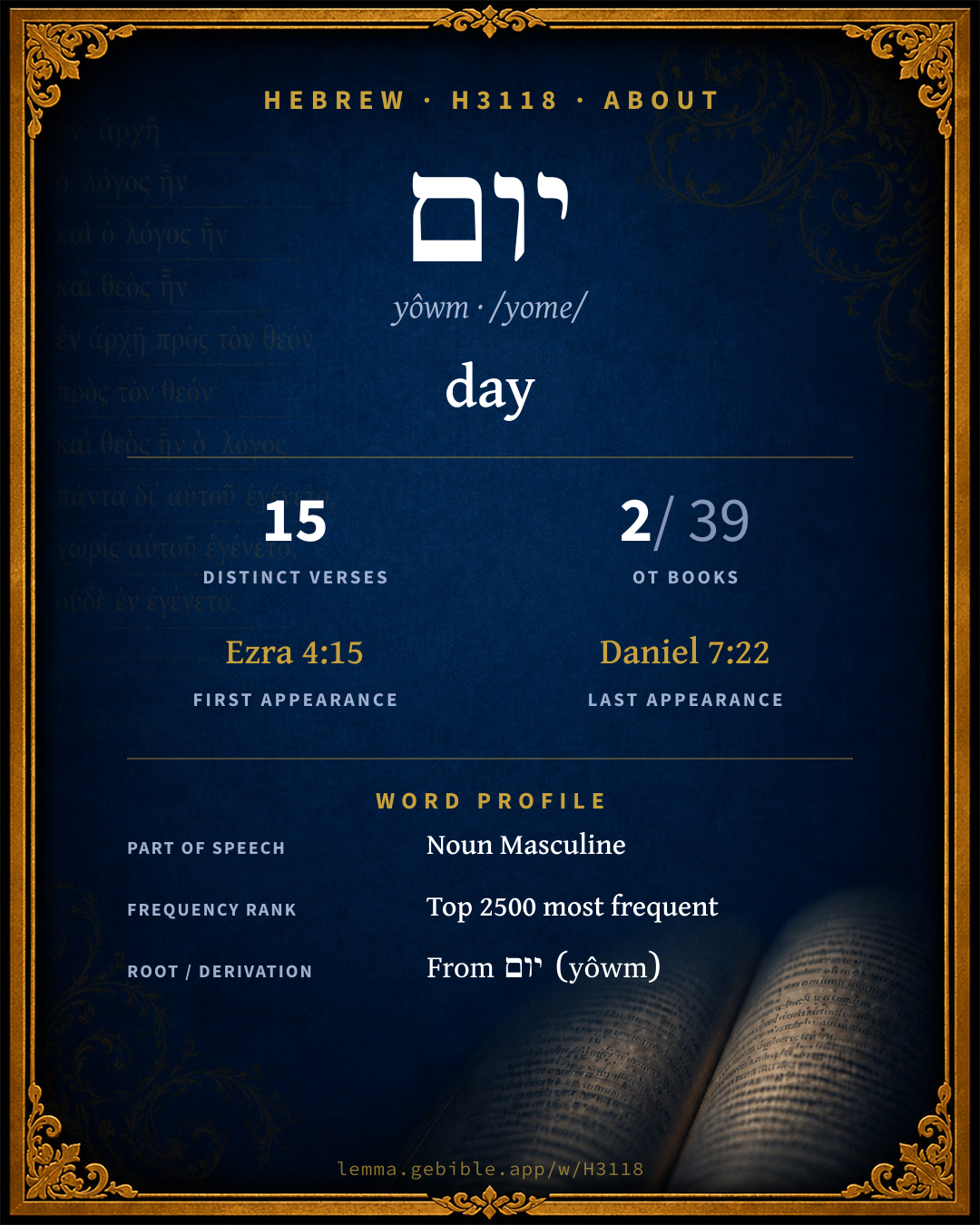
יוֹם
day
‘day’ is one of 2 main senses fuller range ↓
Full lexicon entry — Brown-Driver-Briggs (BDB)
From Brown-Driver-Briggs (BDB)
Where this word appears
See every Absolute-state word in the Hebrew Bible →
Grammar key — what these labels mean
Part of speech
- Noun
- A naming word — a person, place, thing, or idea.
Noun type
- Common
- A common noun — a general class of person, place, or thing (“king,” “city,” “water”), not a specific name.
- Proper
- A name of a specific person, place, or people (e.g. Abraham, Zion, Israel).
State
- Absolute
- The independent form of a noun, not bound to a following word.
- Construct
- A noun bound to a following noun in a possessive / “of” relationship (the construct chain).
Gender
- Masculine
- Grammatically masculine.
Number
- Plural
- More than one (in Hebrew, generally three or more).
- Singular
- One.
Grammatical forms
- Particle, Definite Article 6 times (38%)
- Noun, Common, Masculine, Plural, Construct 4 times (25%)
- Noun, Common, Masculine, Plural, Absolute 3 times (19%)
- Noun, Common, Masculine, Singular, Absolute 2 times (13%)
- Noun, Proper 1 time (6%)
Parsed forms decoded from the imported morphology (morphhb / Westminster Leningrad Codex — WLC text public domain, morphhb tagging CC BY 4.0), counted across 16 parsed occurrences — not distinct verses.
Every verse where H3118 appears — 15 distinct verses across 2 books. Click any verse to open its interlinear word-by-word view. Verse text shown in the World English Bible for context — . Each verse’s Hebrew form is shown with its reference; the English is not keyword-highlighted, since the data carries no word-level English alignment. Use “Compare translations” on any verse to read it across multiple English versions. This concordance covers the Hebrew Bible; Septuagint (Greek Old Testament) occurrences are not indexed here.
Ezra 4 verses
- Ezra 4:15 יוֹמָ֖ת n c mp cs that search may be made in the book of the records of your fathers: so shall you find in the book of the records, and know that this city is a rebellious city, and hurtful to kings and provinces, and that they have moved sedition within the same of old time; for which cause was this city laid waste.
- Ezra 4:19 יוֹמָת֙ n c mp cs I decreed, and search has been made, and it is found that this city of old time has made insurrection against kings, and that rebellion and sedition have been made therein.
- Ezra 6:9 י֥וֹם בְּ/י֖וֹם n c ms prep + n Proper That which they have need of, both young bulls, and rams, and lambs, for burnt offerings to the God of heaven; [also] wheat, salt, wine, and oil, according to the word of the priests who are at Jerusalem, let it be given them day by day without fail;
- Ezra 6:15 י֥וֹם n c ms This house was finished on the third day of the month Adar, which was in the sixth year of the reign of Darius the king.
Daniel 11 verses
- Daniel 2:28 יוֹמַיָּ֑/א n c mp det + ptcl def.art but there is a God in heaven who reveals secrets, and he has made known to the king Nebuchadnezzar what shall be in the latter days. Your dream, and the visions of your head on your bed, are these:
- Daniel 2:44 וּֽ/בְ/יוֹמֵי/ה֞וֹן conj + prep + n c mp cs + sfx pers 3mp In the days of those kings shall the God of heaven set up a kingdom which shall never be destroyed, nor shall the sovereignty of it be left to another people; but it shall break in pieces and consume all these kingdoms, and it shall stand forever.
- Daniel 4:34 יֽוֹמַיָּ/ה֩ n c mp det + ptcl def.art At the end of the days I, Nebuchadnezzar, lifted up my eyes to heaven, and my understanding returned to me, and I blessed the Most High, and I praised and honored him who lives forever; for his dominion is an everlasting dominion, and his kingdom from generation to generation.
- Daniel 5:11 וּ/בְ/יוֹמֵ֣י conj + prep + n c mp cs There is a man in your kingdom, in whom is the spirit of the holy gods; and in the days of your father light and understanding and wisdom, like the wisdom of the gods, were found in him; and the king Nebuchadnezzar your father, the king, [I say], your father, made him master of the magicians, enchanters, Chaldeans, and soothsayers;
- Daniel 6:7 יוֹמִ֣ין n c mp All the presidents of the kingdom, the deputies and the satraps, the counselors and the governors, have consulted together to establish a royal statute, and to make a strong interdict, that whoever shall ask a petition of any god or man for thirty days, save of you, O king, he shall be cast into the den of lions.
- Daniel 6:10 בְ/יוֹמָ֜/א prep + n c mp det + ptcl def.art When Daniel knew that the writing was signed, he went into his house (now his windows were open in his chamber toward Jerusalem) and he kneeled on his knees three times a day, and prayed, and gave thanks before his God, as he did before.
- Daniel 6:12 יוֹמִ֣ין n c mp Then they came near, and spoke before the king concerning the king's interdict: Haven't you signed an interdict, that every man who shall make petition to any god or man within thirty days, save to you, O king, shall be cast into the den of lions? The king answered, The thing is true, according to the law of the Medes and Persians, which doesn't alter.
- Daniel 6:13 בְּ/יוֹמָ֔/א prep + n c ms det + ptcl def.art Then answered they and said before the king, That Daniel, who is of the children of the captivity of Judah, doesn't regard you, O king, nor the interdict that you have signed, but makes his petition three times a day.
- Daniel 7:9 יוֹמִ֖ין n c mp I saw until thrones were placed, and one who was ancient of days sat: his clothing was white as snow, and the hair of his head like pure wool; his throne was fiery flames, [and] the wheels of it burning fire.
- Daniel 7:13 יֽוֹמַיָּ/א֙ n c mp det + ptcl def.art I saw in the night-visions, and, behold, there came with the clouds of the sky one like a son of man, and he came even to the ancient of days, and they brought him near before him.
- Daniel 7:22 יֽוֹמַיָּ֔/א n Proper + ptcl def.art until the ancient of days came, and judgment was given to the saints of the Most High, and the time came that the saints possessed the kingdom.
About this entry
At a glance — auto-summarized from this page’s data, not written by a person. Every figure links to its source below. This summary describes the numbers; it doesn’t interpret them.
יום — transliterated yôwm — is a Hebrew noun carrying the sense “day.” More than two-thirds of its appearances fall in Daniel. The Hebrew Bible uses it across 15 verses — uncommon. Debuting at Ezra 4:15, it then recurs through the corpus. BDB distinguishes 2 senses for it. See the sense tree, 15-verse concordance, and the renderings breakdown below.
Gloss history
Strong's 1890 vs modern scholarship
About this word
Strong's H3118 catalogs a Hebrew word from the Hebrew Old Testament.
These counts are not copied from any lexicon or concordance. They are computed here, from the morphology-tagged Hebrew Old Testament. What Lemma adds →
- 15
- distinct verses
- The word appears in 15 distinct verses.
- 2 / 39
- OT books
- The word appears in 2 of 39 Old Testament books.
- #1,752
- by frequency
- Top 2500 most frequent Hebrew words (rank 1,752 of 8,640 Hebrew words by occurrence).
View all 15 occurrences in the concordance →
By traditional corpus
Conventional, traditional groupings — biblical authorship is debated, so this is a traditional corpus grouping, not an authorship claim. Each share is this word’s portion of its verses in that division of the Hebrew canon. Each figure is a share of the word’s 15 distinct verses.
- Writings (Ketuvim) 15 verses · 100%
How translations render this word
Counts come from each version’s own published word-to-Strong’s tagging or interlinear alignment — an approximate guide to how each version renders this word, not a word-level alignment the data otherwise carries. Because each total is that version’s own tagged count, the per-version totals vary from one another and need not match the appearance or distinct-verse counts above. These counts may also differ from a printed concordance because Lemma counts each distinctly tagged rendering and does not collapse phrase taggings into a single head-word total. This is a fixed set of word-tagged versions (KJV, ASV, BSB, ULT) and does not change with the reading translation you choose elsewhere. Each version’s license is shown beside its name below (and on Sources).
- King James Version: Days 9×, Day 5×, Time 2×
- American Standard Version: Days 9×, Day 5×, Time 2×
- Berean Standard Bible: Days 9×, Day 3×, Times 2×
- unfoldingWord Literal Text: Days 10×, Day 5×, The 2×
King James Version Public Domain
Renders H3118 across 16 tagged occurrences — most commonly:
American Standard Version Public Domain
Renders H3118 across 16 tagged occurrences — most commonly:
Berean Standard Bible Public Domain
Renders H3118 across 15 tagged occurrences — most commonly:
Plus 1 rendering that appears only once — usually multi-word phrases or single function words the recovered tagging swept in, not distinct renderings. Not rendered by a distinct English word in 1 further occurrence.
unfoldingWord Literal Text CC BY-SA 4.0
Renders H3118 across 18 tagged occurrences — most commonly:
Plus 1 rendering that appears only once — usually multi-word phrases or single function words the recovered tagging swept in, not distinct renderings.
Senses in BDB
The 2 senses BDB distinguishes for this word, in lexicon order (not ranked by frequency or importance). The full entry — with sub-senses — is in the Lexicon Entry tab.
- day
- day always refers to a twenty-four hour period when the word is modified by a definite or cardinal number
Word origin
Derived from יום (yôwm) (H3117) — day.
Jastrow Dictionary
A second Hebrew/Aramaic lexicon for comparison, covering Aramaic and post-biblical (Talmudic, Targumic, Midrashic) usage that the biblical-Hebrew BDB does not. Matched by lemma rather than by Strong’s number, so a lemma may carry more than one Jastrow headword (shown separately below), and the entries cover usage well beyond the Bible.
יוֹם
- (b. h.) light, day (opp. night); (astronomical) day; trnsf. day of life; time. Gen. R. s. 6 הי׳ והגשמים וכ׳ the noise of the moving light (Yoma 20ᵇ קול גלגל חמה) and the rains &c.; Midr. Sam. ch. IX. Gen. R. l. c. (ref. to Mal. III, 19) י׳ שהוא מלהט וכ׳ it is the day light which will glow the wicked (cmp. נַרְתֵּק). M. Kat. 25ᵇ (ref. to Am. VIII, 9) זה יוֹמוֹ של וכ׳ that means the day of life of Josiah (who was slain in the bloom of manhood). Gen. R. s. 3 (ref. to ib. I, 5) י׳ אחד … ואיזה זה יוה"כ ‘one (distinguished) day’ … that is the Day of Atonement. Ḥull. V, 5 (83ᵃ) הי׳ הולך וכ׳ the day follows the night, i.e. the beginning of the night is the beginning of the new day. Taan. 29ᵃ, v. זַכַּאי; a. v. fr.—י׳ טוב (abbr. יו"ט) Holy Day; festival. R. Hash. IV, 1; a. fr.—Yoma VII, 4 ויו"ט היה וכ׳ and the Highpriest gave a festival to his friends; a. fr.—Yom Tob, name of a treatise of the Tosefta (v. בֵּיצָה).—י׳ הכפורים (abbr. יו"כ, יה"כ) Day of Atonement. Yoma I, 1; a. v. fr.—בֶּן יוֹמוֹ of the same day, not quite one day old, used on the same day. Sabb. 151ᵇ. B. Kam. 65ᵇ; a. fr.—Tanḥ. Kor. 3; ed. Bub. 6; Num. R. s. 18 תינוקות בְּנֵי יוֹמָן (not בן) children just born; a. fr.—Du. יוֹמַיִם. Mekh. Mishp., N’zikin, s. 7; B. Kam. 90ᵃ ישנו בדין יום או י׳ comes under the law of ‘one or two days’ (Ex. XXI, 21); B. Bath. 50ᵃ.—Mekh. l. c. יום שהוא כי׳ וי׳ שהוא כיום a time which counts like two days, and two days which count like a day, which is twenty four hours (from the time of the accident, including part of this and part of the next day).—Snh. 65ᵇ מה יום מיומים (Ms. M. a. Rashi מה היום וכ׳) what difference is there between to-day (Sabbath) and the next day?; Gen. R. s. 11; Yalk. Deut. 918; Yalk. Lev. 617.—Pl. יָמִים; constr. יְמֵי, יְמוֹת. Erub. III, 6 לשני י׳ for both days. Zeb. V, 7 לשני י׳ during two days and one night. Pes. 52ᵃ, a. fr. שני י׳ טובים של גליות, v. גָּלוּת. Taan. IV, 8 לא היו י׳ ט׳ וכ׳ Israel had no days as merry as &c.; a. fr.—Ab. I, 17, a. fr. כל יָמַי all my lifetime.—Esp. יְמוֹת season, period of. י׳ הגשמים, v. גֶּשֶׁם I.—י׳ החמה a) summer season. Toh. VI, 7; a. fr.—b) the solar year. Gen. R. s. 33, end; a. fr.—י׳ הלבנה the lunar year. Ib.; a. fr.—י׳ בגרות, י׳ נערות, v. בַּגְרוּת &c. e.g. Malachi 3:19
יוֹם ²
- Targ. Gen. I, 5. Ib. XXXIX, 11; a. fr.—Targ. Prov. XII, 16 בר יוֹמֵיה (ed. Wil. incorr. כד) on the same day, at once.—Kidd. 39ᵇ דעבדין ליה י׳ טב וי׳ ביש they prepare for him (the righteous man) a good day, and (for the bad man) a bad day (v. Rashi a. Tosaf. a. l.).—Sabb. 134ᵃ; Ḥull. 60ᵃ top להדי י׳ towards the sunlight. Ib. י׳ דחד וכ׳ the sun which is only one of the ministering powers &c. Keth. 106ᵃ וכסי ליה לי׳ and obscured the sun.—Yeb. 72ᵃ י׳ דעיבא a cloudy day; י׳ דשותא a day when a southern wind blows. Erub. 40ᵇ במעלי י׳ דריש וכ׳ on the eve of the New Year’s day.—R. Hash. 21ᵃ י׳ רבה the Great Day, Day of Atonement (also only יומא, v. infra); a. v. fr.—בַּר י׳, בַּת י׳ of the same day, one day old, used the same day. Bets. 4ᵇ, v. בֵּיעָא. Ḥull. 58ᵇ, v. בַּקָּא.—Sabb. 134ᵃ גבינה בת י׳ fresh-made cheese. Ab. Zar. 67ᵇ, a. fr. קדירה בת י׳ a pot used the same day.—Sabb. 49ᵇ bot. ההוא מרבנן בר יוֹמֵיה (omitted in Ms. M.) a student that had just come to college; [oth. opin.: allusion to R. Idi, dubbed בר בי רב דחד י׳ the one day’s student of the college, Ḥag. 5ᵇ].—י׳ חרא, יום מחרא, י׳ מחרן, v. next w.—Pl. יוֹמִין, יוֹמַיָּא, יוֹמֵי. Targ. Gen. VIII, 10. Targ. Esth. I, 2; a. v. fr.—Bets. 4ᵇ עבדינן תרי י׳ we observe two days (as Holy Days). Erub. 65ᵃ השתא … י׳ דאריכי וכ׳ soon will come the days which are long (of duration) and short (of action), when we shall sleep much; a. v. fr.—יוֹמָא (sub רבה, v. supra) Yoma, name of a treatise of the Mishnah, Tosefta (where it is named יום כפורים), Talmud Babli a. Y’rushalmi. Yoma 14ᵇ סדר י׳ the treatise on the order of exercises of the Day of Atonement.—V. יוֹמָנָא, יְמָמָא.
A Dictionary of the Targumim, the Talmud Babli and Yerushalmi, and the Midrashic Literature (Marcus Jastrow; London, Luzac, 1903) — Public Domain. Digitized via Sefaria. Digitized via Sefaria. Full attribution on Sources.
Forms in the corpus
The 14 distinct written forms H3118 takes in the Hebrew Bible, most frequent first — each parse links to that state’s occurrences in the concordance. Hebrew forms include their vowel points and cantillation, so a single lemma takes many written forms.
| Form | Parsing | Example | Uses |
|---|---|---|---|
| י֥וֹם | Noun, Common, Masculine, Singular, Absolute | Ezra 6:9 | 2 |
| יוֹמִ֣ין | Noun, Common, Masculine, Plural, Absolute | Daniel 6:7 | 2 |
| בְ/יוֹמָ֜/א | Particle, Definite Article | Daniel 6:10 | 1 |
| בְּ/י֖וֹם | Noun, Proper | Ezra 6:9 | 1 |
| בְּ/יוֹמָ֔/א | Particle, Definite Article | Daniel 6:13 | 1 |
| וּ/בְ/יוֹמֵ֣י | Noun, Common, Masculine, Plural, Construct | Daniel 5:11 | 1 |
| וּֽ/בְ/יוֹמֵי/ה֞וֹן | Noun, Common, Masculine, Plural, Construct | Daniel 2:44 | 1 |
| יֽוֹמַיָּ/א֙ | Particle, Definite Article | Daniel 7:13 | 1 |
| יֽוֹמַיָּ/ה֩ | Particle, Definite Article | Daniel 4:34 | 1 |
| יֽוֹמַיָּ֔/א | Particle, Definite Article | Daniel 7:22 | 1 |
| יוֹמִ֖ין | Noun, Common, Masculine, Plural, Absolute | Daniel 7:9 | 1 |
| יוֹמַיָּ֑/א | Particle, Definite Article | Daniel 2:28 | 1 |
| יוֹמָ֖ת | Noun, Common, Masculine, Plural, Construct | Ezra 4:15 | 1 |
| יוֹמָת֙ | Noun, Common, Masculine, Plural, Construct | Ezra 4:19 | 1 |
Same root — word family
Other BDB entries built from the same root as H3118, grouped by Strong’s listed origin. These share a root / origin per the lexicon — not necessarily a shared meaning. Each links to that word’s own entry.
Derives from
Shares the same root
Proper names from this root
People and places named from this root — a name, not an additional meaning of the word.
Compare all same-root words → Showing 4 of 6 — not the complete family. 2 of the same-root words are proper names (people or places). They share a root, not necessarily a meaning.
Septuagint verse parallels
This word appears in 14 verses that also exist in the Greek Old Testament (Septuagint), out of the 15 Hebrew verses it occurs in. You can read those verses in Greek by switching the Old Testament edition to the Septuagint.
Read these verses in the Septuagint
This is a verse-level parallel only — the same verses exist in both the Hebrew and Greek Old Testaments. No word-level Hebrew↔Greek correspondence is claimed: the data carries no such alignment, so no Greek word is shown as this Hebrew word’s translation. Coverage is not total — the Septuagint omits the deuterocanon and renumbers the Psalms, so some Hebrew verses have no direct Greek parallel.