Psalms 139:12

Hebrew (Westminster Leningrad Codex) Psalms 139:12 appears in the Hebrew Old Testament. The text above is from the Westminster Leningrad Codex. Each word links to its Strong’s number, a concise gloss, and parsing drawn from the Open Scriptures Hebrew Bible morphology. Click any word for its full Brown-Driver-Briggs (BDB) entry.
Download image
Cite this verse

Psalms 139:12 (World English Bible). Public Domain. Lemma interlinear Bible study tool, https://lemma.gebible.app/v/psalms/139/12.

Show BibTeX & RIS
BibTeX
RIS
English Translation
Even the darkness doesn't hide from you, But the night shines as the day. The darkness is like light to you.
World English Bible · Public Domain
Download a study sheet

One document with this verse’s original text, its word-by-word gloss line, the meaning frame, cross-references with their text, attributed commentary, and full source and license credits — printable, and it pastes into notes with its structure intact.

This verse Autodidact and up

Study sheet (.html) Plain text (.txt)

A passage Seminary Student

Up to 50 verses in one chapter. A passage sheet keeps up to 6 commentary sources and 12 cross-references per verse, in the order this page ranks them, and says so on the sheet whenever that leaves anything out. Ask for a single verse and you get the Autodidact verse sheet above.

Everything on this page stays free to read, with no account — the sheet is a download of what is already on screen, not access to it.

Want to remove ads? Support Godless Engineer
Compare translations 3

The same verse in 3 English versions, stacked beneath the original-language interlinear above. Click any original word for its lexicon entry.

Each is an independent rendering of the whole verse — the interlinear is not word-aligned to these translations.

Highlighted words mark where these versions differ — a whole-verse word diff, not a word-by-word alignment.

  • World English Bible Public Domain
    Even the darkness doesn't hide from you, But the night shines as the day. The darkness is like light to you.
  • King James Version Public Domain
    Yea, the darkness hideth not from thee; but the night shineth as the day: the darkness and the light are both alike to thee.
  • unfoldingWord Literal Text CC BY-SA 4.0
    Even darkness does not make it dark to you, and the night shines like the day; like darkness, like light.

unfoldingWord Literal Text — © unfoldingWord, licensed CC BY-SA 4.0. Word-aligned USFM3 via Door43 (git.door43.org/unfoldingWord/en_ult).

Versions to compare (up to 4)

3 of 4 selected

Show all 17 translations

Every available English version of this verse, each an independent rendering of the whole verse.

  • World English Bible Public Domain
    Even the darkness doesn't hide from you, But the night shines as the day. The darkness is like light to you.
  • Berean Standard Bible Public Domain
    even the darkness is not dark to You, but the night shines like the day, for darkness is as light to You.
  • Majority Standard Bible Public Domain
    even the darkness is not dark to You, but the night shines like the day, for darkness is as light to You.
  • King James Version Public Domain
    Yea, the darkness hideth not from thee; but the night shineth as the day: the darkness and the light are both alike to thee.
  • American Standard Version (1901) Public Domain
    Even the darkness hideth not from thee, But the night shineth as the day: The darkness and the light are both alike `to thee'.
  • Revised Version (1885) Public Domain
    Even the darkness hideth not from thee, but the night shineth as the day: the darkness and the light are both alike to thee.
  • Geneva Bible (1599) Public Domain
    Yea, the darkenes hideth not from thee: but the night shineth as the day: the darkenes and light are both alike.
  • Young's Literal Translation Public Domain
    Also darkness hideth not from Thee, And night as day shineth, as `is' darkness so `is' light.
  • Literal Standard Version CC BY-SA 4.0
    Also darkness does not hide from You, || And night shines as day, || As [is] darkness so [is] light.
  • Unlocked Literal Bible CC BY-SA 4.0
    even the darkness would not be dark to you. The night would shine like the day, for the darkness and the light are both alike to you.
  • unfoldingWord Literal Text CC BY-SA 4.0
    Even darkness does not make it dark to you, and the night shines like the day; like darkness, like light.
  • Darby Bible Public Domain
    Even darkness hideth not from thee, and the night shineth as the day: the darkness is as the light.
  • World Messianic Bible Public Domain
    even the darkness doesn’t hide from you, but the night shines as the day. The darkness is like light to you.
  • Webster's Bible Public Domain
    Yes, the darkness hideth not from thee; but the night shineth as the day: the darkness and the light are both alike to thee.
  • Free Bible Version CC BY-SA 4.0
    Even darkness would not be dark for you, and the night would be bright as day, for darkness is like light to you.
  • Bible in Basic English Public Domain
    Even the dark is not dark to you; the night is as bright as the day: for dark and light are the same to you.
  • JPS Tanakh (1917) Public Domain
    Even the darkness is not too dark for Thee, but the night shineth as the day; the darkness is even as the light.

Literal Standard Version (2020), Covenant Press — licensed CC BY-SA 4.0. Text via the HelloAO Bible API (eBible.org). Unlocked Literal Bible (unfoldingWord) — licensed CC BY-SA 4.0. Text via the HelloAO Bible API (eBible.org). unfoldingWord Literal Text — © unfoldingWord, licensed CC BY-SA 4.0. Word-aligned USFM3 via Door43 (git.door43.org/unfoldingWord/en_ult). Free Bible Version, Dr. Jonathan Gallagher — licensed CC BY-SA 4.0. Text via the HelloAO Bible API (eBible.org).

Word by word

More ways to search: Search by grammar → Find every occurrence → Compare this word →

Practice this passage: Drill this verse → Learn its vocabulary →

כָּאוֹרָֽה
ʼôwrâh
H219
“like/as the · light”
Preposition, Determined + Noun, Common, Feminine, Singular, Absolute
Part of Speech
Preposition + Noun
Type
Common
Gender
Feminine
Number
Singular
State
Absolute
Full BDB Definition

Origin: f of H216

TWOT: 52b

light - light of joy and happiness (figuratively)
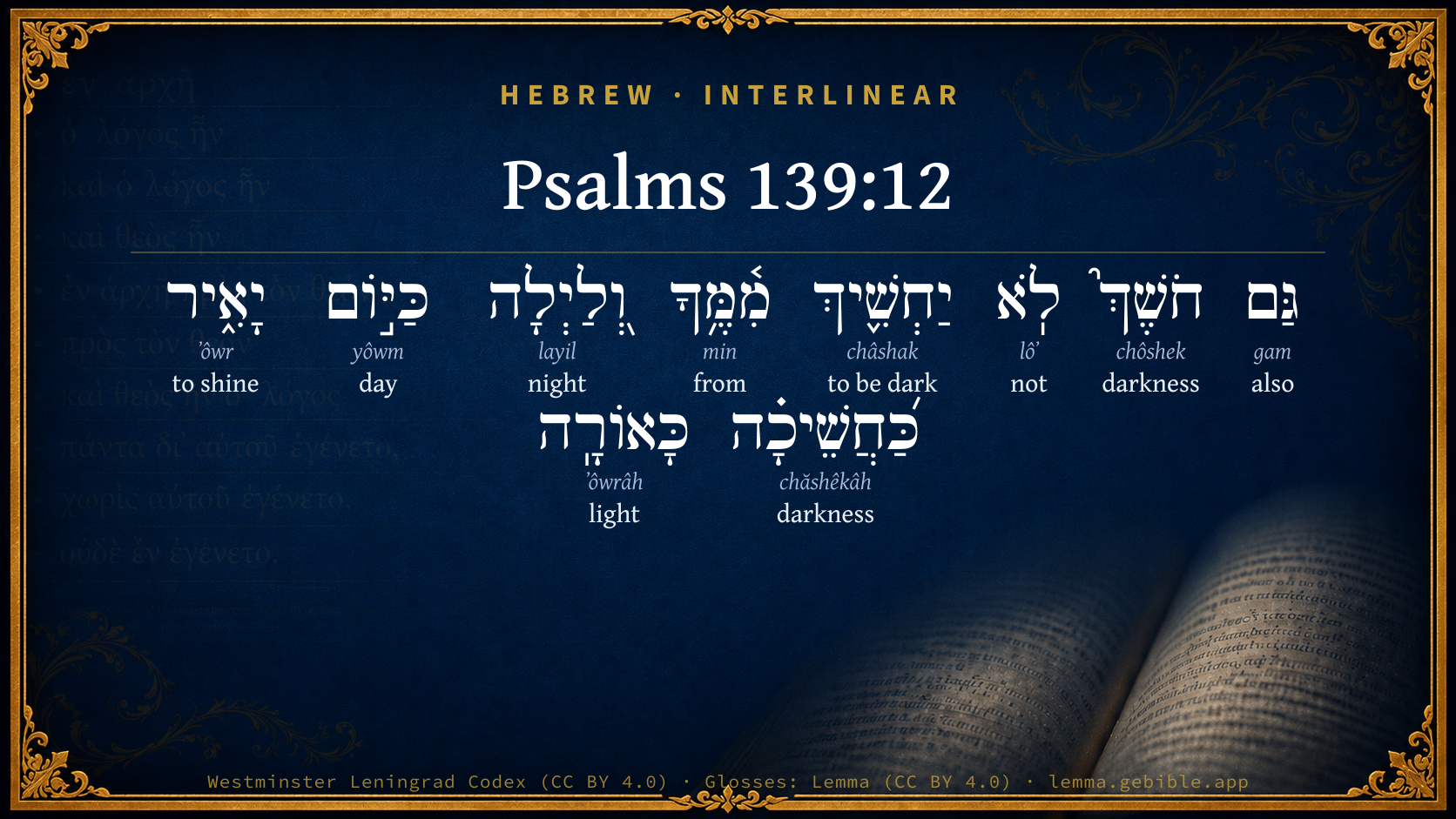
  1. גַּם gam H1571 “also” Particle, Accusative
  2. חֹשֶׁךְ֮ chôshek H2822 “darkness” Noun, Common, Masculine, Singular, Absolute
  3. לֹֽא lôʼ H3808 “not” Particle, Negative
  4. יַחְשִׁ֪יךְ châshak H2821 “to be dark” Verb, Hiphil, Imperfect, 3rd Person, Masculine, Singular
  5. מִ֫מֶּ֥ךָ min H4480 “from · you” Preposition + Suffix, Personal, 2nd Person, Masculine, Singular
  6. וְ֭לַיְלָה layil H3915 “and · night” Conjunction + Noun, Common, Masculine, Singular, Absolute
  7. כַּיּ֣וֹם yôwm H3117 “like/as the · day” Preposition, Determined + Noun, Common, Masculine, Singular, Absolute
  8. יָאִ֑יר ʼôwr H215 “to shine” Verb, Hiphil, Imperfect, 3rd Person, Masculine, Singular
  9. כַּ֝חֲשֵׁיכָ֗ה chăshêkâh H2825 “like/as · darkness” Preposition + Noun, Common, Feminine, Singular, Absolute

About this verse

These counts appear in no published source. They are computed here, from the morphology-tagged text and Lemma’s own curated glosses. What Lemma adds →

10
words
10
distinct lemmas
Wisdom
section

Notable vocabulary

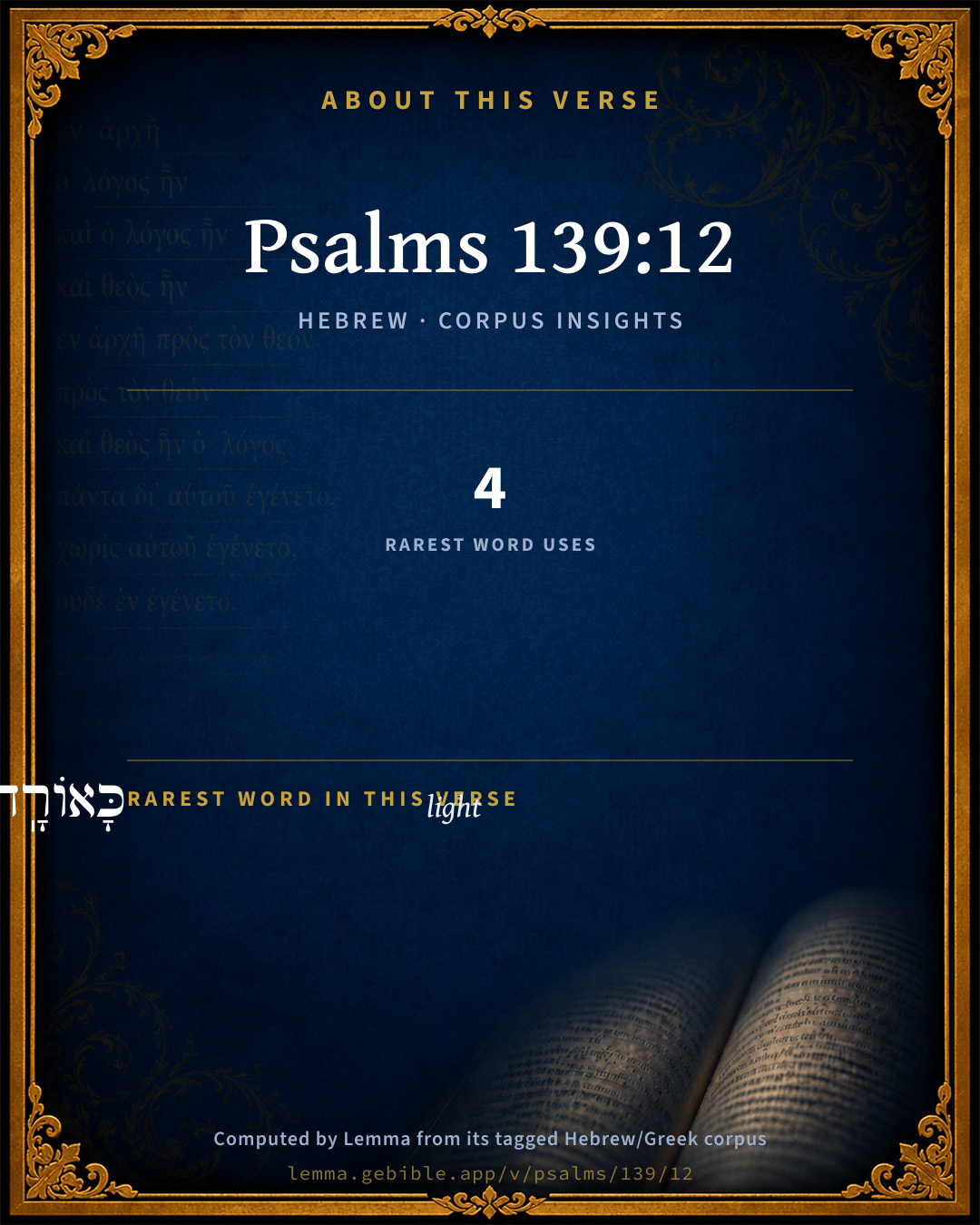
The rarest word here is כָּאוֹרָֽה light H219 — appearing just 4 times in the whole Hebrew Bible.

Shared distinctive vocabulary

כָּאוֹרָֽה light H219 occurs in 4 verses of the Hebrew Bible. Also found in:

Grammatical profile

  • 2 verbs
  • 5 nouns
  • 1 preposition
  • 2 particles

Verb forms

  • יַחְשִׁ֪יךְ Hiphil · Imperfect
  • יָאִ֑יר Hiphil · Imperfect

Hebrew & Septuagint length

In English translation the verse runs 21 words from the Hebrew and 25 from the Septuagint (LXX English) — closely comparable.

A rough comparison of the two English renderings, which tokenize alike — not a word-level alignment.

Word counts can differ between the Hebrew and the Greek without any difference in meaning — e.g. the Hebrew direct-object marker אֵת has no separate Greek word, and Greek often adds the article ὁ.

Cross-references

6

Topical passages linked to Psalms 139:12 in the Treasury of Scripture Knowledge — connected by theme and wording, ordered by reader-vote popularity; previews shown in the World English Bible.

  • Daniel 2:22 he reveals the deep and secret things; he knows what is in the darkness, and the light dwells with him.
  • Job 34:22 There is no darkness, nor thick gloom, Where the workers of iniquity may hide themselves.
  • Exodus 20:21 The people stayed at a distance, and Moses drew near to the thick darkness where God was.
  • Hebrews 4:13 There is no creature that is hidden from his sight, but all things are naked and laid open before the eyes of him with whom we have to do.
  • Job 26:6 Sheol is naked before God, And Abaddon has no covering.
  • Exodus 14:20 It came between the camp of Egypt and the camp of Israel; and there was the cloud and the darkness, yet gave it light by night: and the one didn't come near the other all the night.

Cross-references courtesy of OpenBible.info (CC BY 4.0).

Hebrew and Greek witnesses Masoretic Hebrew ↔ Greek Septuagint

The same verse in the two great witnesses to the Old Testament, shown verse-for-verse.

You’re reading Greek Psalm 138 (Hebrew Psalm 139). The Septuagint counts the superscription, so verse numbers can differ from the Hebrew — chapter-level alignment, not verse-by-verse. Numbering follows Rahlfs.

These are two independent witnesses, not word-aligned to each other, and the Septuagint is shown in lemma (dictionary) form.

Hebrew Psalms 139:12 Masoretic · Westminster Leningrad Codex

גַּם חֹשֶׁךְ֮ לֹֽא יַחְשִׁ֪יךְ מִ֫מֶּ֥ךָ וְ֭לַיְלָה כַּיּ֣וֹם יָאִ֑יר כַּ֝חֲשֵׁיכָ֗ה כָּאוֹרָֽה

Even the darkness doesn't hide from you, But the night shines as the day. The darkness is like light to you.

World English Bible · Public Domain

Greek LXX Greek Psalm 138:12 Septuagint · lemma form

ὅτι σκότος οὐ σκοτίζω ἀπό σύ καί νύξ ὡς ἡμέρα φωτίζω ὡς ὁ σκότος αὐτός οὕτως καί ὁ φῶς αὐτός

For darkness will not be darkness with you; but night will be light as day: as its darkness, so shall its light be to you.

LXX2012 (modern English Septuagint) · Public Domain

Hebrew: Westminster Leningrad Codex (CC BY 4.0). Greek: Septuagint (public domain); English from LXX2012 (modern English Septuagint) (Public Domain). How the Septuagint differs from the Hebrew →

Commentary

Notes on Psalms 139:12 from classic Christian and Jewish commentators (each source and its license shown beneath its notes). The classic Christian expositions comment on the surrounding passage and are grouped to its opening verse, so a note may address several verses; the Jewish commentaries on the Tanakh (Rashi and others) are per-verse, so they appear only where the commentator wrote on this verse.

Lemma curates 59 commentaries, every one of them public domain or Creative Commons licensed, each selected and text-cleaned for this edition rather than reprinted as found. About our sources →

Trapp's Complete Commentary

John Trapp

Psa 139:12 Yea, the darkness hideth not from thee; but the night shineth as the day: the darkness and the light [are] both alike [to thee].

Ver. 12. Yea, the darkness hideth not] Heb. darkeneth not from thee, because thine eyes are fiery, Rev 1:14, such as need no outward light; they are more light and radiant than the sun in his strength.

The darkness and the light, &c.] Deo obscura clarent, muta respondent, silentium confitetur, saith an ancient; Night will convert itself into noon before God, and silence prove a speaking evidence.

John Trapp, A Commentary or Exposition upon All the Books of the Old and New Testament (1647–1656) — public domain. Text from a community e-Sword module.

The Biblical Illustrator

Joseph S. Exell

Psa_139:12

The darkness and the light.

The changes of the sky

What is the lesson conveyed by the great alternate changes of the sky? Now it is sweetly luminous, and now a solemn darkness. Strictly speaking, as we all know, there is no change in the sky at all. It is always an infinite darkness, and always lit up by myriads of stupendous suns. But we should not know this if the earth did not turn on her axis, and successively face the sun, and again turn away from him. To the turning of our planet from the sun we owe our knowledge of the universe. In the symbolism of its darkness and light we have our sublimest revelation of God. Light which is called God, and is God, issues for ever from the Infinite Bosom of His darkness. Darkness and light are both alike to Him; for He is as much one as the other. The Son of God, the only-begotten Light, reveals the Father of Lights, as suns reveal the ether. God presents Himself in the light, but also conceals Himself; as we both present ourselves, and hide ourselves, in our garment. Thou coverest Thyself with light as with a garment. As the infinite ether is hidden by the daylight, even so is God hidden by the light of the angelic heavens which reveal Him. Therefore, all those who dwell in the Eternal Light worship the unseen God, and live as seeing the invisible. They know that light is but His effluence. They worship the Light as God, and, again, with silent, ineffable adoration, they worship what is behind the Light. (John Pulsforal, D. D.)

The Biblical Illustrator, edited by Joseph S. Exell (c. 1880s–1900s) — public domain. Text from a community e-Sword module.

J. A. Alexander on Psalms

Joseph Addison Alexander

12. (Psa 139:12) Even darkness does not make (it) dark to him, and night like dayshines; as the darkness, so the light. The interpretation given of the foregoing verse does not necessarily affect the sense of this, which still meanspledge that nothing can prevent God's seeing either sin or suffering, either the danger of his people or the malice of their enemies. Make dark, as in Psa 105:28. To thee, literally from thee, i.e. so as to conceal from thee.

Joseph Addison Alexander, The Psalms Translated and Explained (1850) — public domain. Text from a community e-Sword module.

Adam Clarke's Commentary

Verse 12. Yea, the darkness hideth not from thee] Darkness and light, ignorance and knowledge, are things that stand in relation to us; God sees equally in darkness as in light; and knows as perfectly, however man is enveloped in ignorance, as if all were intellectual brightness. What is to us hidden by darkness, or unknown through ignorance, is perfectly seen and known by God; because he is all sight, all hearing, all feeling, all soul, all spirit-all in ALL, and infinite in himself. He lends to every thing; receives nothing from any thing. Though his essence be unimpartible, yet his influence is diffusible through time and through eternity. Thus God makes himself known, seen, heard, felt; yet, in the infinity of his essence, neither angel, nor spirit, nor man can see him; nor can any creature comprehend him, or form any idea of the mode of his existence. And yet vain man would be wise, and ascertain his foreknowledge, eternal purposes, infinite decrees, with all operations of infinite love and infinite hatred, and their objects specifically and nominally, from all eternity, as if himself had possessed a being and powers co-extensive with the Deity! O ye wise fools! Jehovah, the fountain of eternal perfection and love, is as unlike your creeds, as he is unlike yourselves, forgers of doctrines to prove that the source of infinite benevolence is a streamlet of capricious love to thousands, while he is an overflowing, eternal, and irresistible tide of hatred to millions of millions both of angels and men! The antiproof of such doctrines is this: he bears with such blasphemies, and does not consume their abettors. "But nobody holds these doctrines." Then I have written against nobody; and have only to add the prayer, May no such doctrines ever disgrace the page of history; or farther dishonour, as they have done, the annals of the Church!

Adam Clarke's Commentary on the Bible (1810–1826) — public domain. Text from a community e-Sword/MySword module.

Ellicott's Commentary for English Readers

(12) Hideth not.—Better to keep as near as possible to the original maketh not dark. Others render cannot be too dark for thee. The highest development of the psalmist’s thought is of course to be found in St. John’s declaration, “God is light and in Him is no darkness at all.”

Shineth.—Or, giveth light.

The darkness . . .—Literally, as darkness, so light.

“God is the light which, never seen itself, makes all things visible, and clothes itself in colours.”—RICHTER.

A Bible Commentary for English Readers, edited by Charles John Ellicott (1878–1897) — public domain. Text from a community e-Sword module.

John Gill's Exposition

For thou hast possessed my reins,.... His thoughts and counsels, the reins being the seat of instruction and counsel; hence God is called the trier of the reins, and searcher of the hearts of the children of men; he is the possessor or master of their most secret thoughts, and thoroughly knows them; see Psa 7:9; they are also the seat of the affections, which are naturally sinful and inordinate, and set upon carnal and earthly things; but the Lord possesses and engrosses the affections of his people in the best sense, Psa 73:25; moreover the reins are the seat of lust, the bed in which it is conceived and brought forth, and God knows the first motions of it there; and that the imagination of the thought of man's heart is evil continually, Gen 6:5;

thou hast covered me in my mother's womb; with the secundine, or afterbirth, in which he carefully wrapped him, a proof of his knowledge of him, and care for him in the womb; or with skin and flesh he covered his bones with as they grew there; see Job 10:11; or the sense is, he protected and defended him in his embryo state, and when ripe for birth took him out from thence, and held him up ever since, Psa 22:9; he had his eye on him when no other eye could see him, not even his mother that bare him, and before ever he himself saw light. The Targum is,

"thou hast founded me in my mother's womb.''

John Gill's Exposition of the Whole Bible (1746–1763) — public domain (CC PDM 1.0). Text via the HelloAO Bible API.

Albert Barnes' Notes on the Bible

Yea, the darkness hideth not from thee - Margin, as in Hebrew, “darkeneth not.” Darkness does not make darkness to thee. It makes things dark to us; not to him. So it is in natural darkness; so in moral darkness ness. It seems dark to us; it is not so to him. Things appear dark to us - disappointment, bereavement, trouble, care, losses; but all is light to God. The existence of sin and suffering on the earth seems dark to us; not to him, for he sees the reasons and the end of all.

But the night shineth as the day - One is as bright and clear to him as the other.

The darkness and the light are both alike to thee - Margin, as in Hebrew, “As is the darkness so is the light.” To thee there is no difference. All is light.

Albert Barnes' Notes on the Bible (1834–1885) — public domain. Text from a community e-Sword/MySword module.

Matthew Poole's English Annotations

Shineth, or enlighteneth, as this word is used, Psa 19:8; Pro 29:13, &c.; discovereth me and all mine actions.

The darkness and the light are both alike to thee: this is repeated so oft to reprove and confute the ridiculous conceits of many ungodly men, who flatter themselves with hopes of secrecy and impunity for those sins which they commit in the dark. See Isa 29:15.

Matthew Poole's English Annotations on the Holy Bible (1683–1685) — public domain. Text from a community e-Sword/MySword module.

The Treasury of David

Charles H. Spurgeon

Ver. 12. Yea, of a surety, beyond all denial.

The darkness hideth not from thee; it veils nothing, it is not the medium of concealment in any degree what ever. It hides from men, but not from God.

But the night shineth as the day: it is but another form of day: it shines, revealing all; it "shineth as the day", quite as clearly and distinctly manifesting all that is done.

The darkness and the light are both alike to thee. This sentence seems to sum up all that went before, and most emphatically puts the negative upon the faintest idea of hiding under the cover of night. Men cling to this notion, because it is easier and less expensive to hide under darkness than to journey to remote places; and therefore the foolish thought is here beaten to pieces by statements which in their varied forms effectually batter it. Yet the ungodly are still duped by their grovelling notions of God, and enquire, "How doth God know?" They must fancy that he is as limited in his powers of observation as they are, and yet if they would but consider for a moment they would conclude that he who could not see in the dark could not be God, and he who is not present everywhere could not be the Almighty Creator. Assuredly God is in all places, at all times, and nothing can by any possibility be kept away from his all observing, all comprehending mind. The Great Spirit comprehends within himself all time and space, and yet he is infinitely greater than these, or aught else that he has made.

Ver. 12. The darkness hideth not from thee. Though the place where we sin be to men as dark as Egypt, yet to God it is as light as Goshen. William Secker.

Psalms 139:13*

Charles H. Spurgeon's The Treasury of David (1869–1885) — public domain. Psalms only. Text from a community e-Sword/MySword module.

Rashi

Rabbi Shlomo Yitzchaki (Rashi)

Even there I have no asylum, for no darkness will obscure [anything] from You.

as darkness, so is the light Both are the same to You.

Rashi on the Tanakh — English translations: “The Judaica Press complete Tanach with Rashi, translated by A. J. Rosenberg” (CC BY 4.0); “Pentateuch with Rashi's commentary by M. Rosenbaum and A.M. Silbermann, 1929-1934” (public domain); “The Metsudah Tanach series, Lakewood, N.J” (CC BY 4.0); and “The Book of Joshua, Metsudah Publications, 1997” (CC BY 4.0). Text via Sefaria.

Lesson kit

Teaching starters — assembled from the data on this page, not authored interpretation. Every prompt links to the verse data it draws on. Edit before teaching.

Psalms, in the Wisdom, opens this verse with 10 words (10 distinct Hebrew lemmas). Its most distinctive word is ʼôwrâh (“light”). A historical commentator’s framing appears above. Read the whole chapter for the surrounding context.

Discussion questions

  1. The word ʼôwrâh carries the sense “light.” How does it shape the verse?
  2. 2 Kings 4:39 shares the word «light» with this verse. How do the two illuminate each other?
  3. These translations render this verse differently; the difference is in the English rendering, not the original. What questions does that raise?
  4. The verb «יַחְשִׁ֪יךְ» is Hiphil Imperfect. How does its form color the action?
  5. Reading how Trapp's Complete Commentary and The Biblical Illustrator read this verse, where do the two commentators agree and where do they part?

Things to notice

Reading settings

Reading text

Shown beneath each verse's original-language words.

Old Testament
Old Testament edition

Read the OT as the Masoretic Hebrew (MT) or the Greek Septuagint (LXX).

English shown for the Greek Septuagint (in the Hebrew ↔ Greek comparison).

Comparing translations? Open the Compare panel on any verse page to stack up to four side by side.