
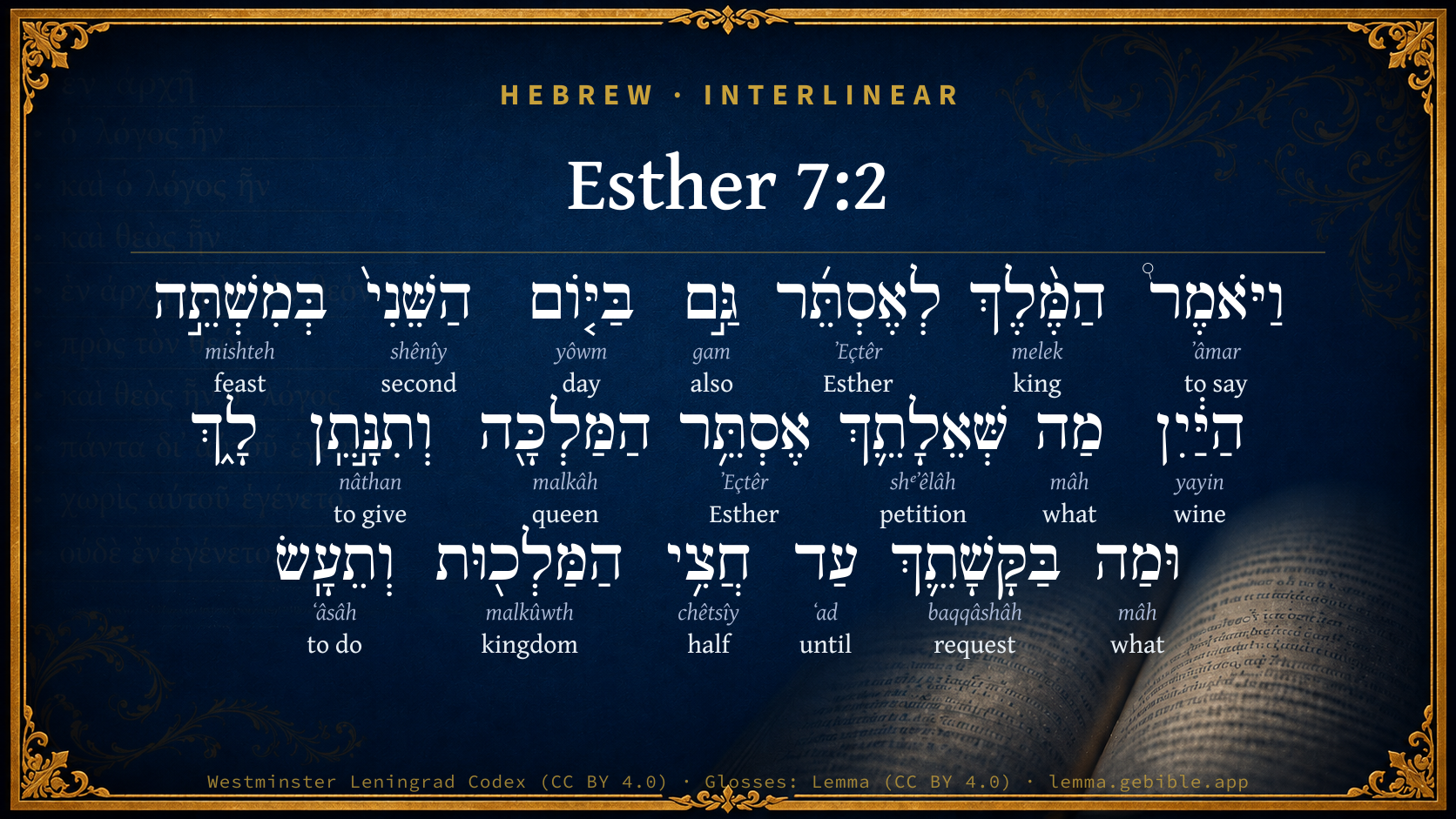
Esther 7:2

Hebrew (Westminster Leningrad Codex) Esther 7:2 appears in the Hebrew Old Testament. The text above is from the Westminster Leningrad Codex. Each word links to its Strong’s number, a concise gloss, and parsing drawn from the Open Scriptures Hebrew Bible morphology. Click any word for its full Brown-Driver-Briggs (BDB) entry.
Download image
Cite this verse

Esther 7:2 (World English Bible). Public Domain. Lemma interlinear Bible study tool, https://lemma.gebible.app/v/esther/7/2.

Show BibTeX & RIS
BibTeX
RIS
English Translation
The king said again to Esther on the second day at the banquet of wine, What is your petition, queen Esther? and it shall be granted you: and what is your request? even to the half of the kingdom it shall be performed.
World English Bible · Public Domain
Download a study sheet

One document with this verse’s original text, its word-by-word gloss line, the meaning frame, cross-references with their text, attributed commentary, and full source and license credits — printable, and it pastes into notes with its structure intact.

This verse Autodidact and up

Study sheet (.html) Plain text (.txt)

A passage Seminary Student

Up to 50 verses in one chapter. A passage sheet keeps up to 6 commentary sources and 12 cross-references per verse, in the order this page ranks them, and says so on the sheet whenever that leaves anything out. Ask for a single verse and you get the Autodidact verse sheet above.

Everything on this page stays free to read, with no account — the sheet is a download of what is already on screen, not access to it.

Want to remove ads? Support Godless Engineer
Compare translations 3

The same verse in 3 English versions, stacked beneath the original-language interlinear above. Click any original word for its lexicon entry.

Each is an independent rendering of the whole verse — the interlinear is not word-aligned to these translations.

Highlighted words mark where these versions differ — a whole-verse word diff, not a word-by-word alignment.

  • World English Bible Public Domain
    The king said again to Esther on the second day at the banquet of wine, What is your petition, queen Esther? and it shall be granted you: and what is your request? even to the half of the kingdom it shall be performed.
  • King James Version Public Domain
    And the king said again unto Esther on the second day at the banquet of wine, What is thy petition, queen Esther? and it shall be granted thee: and what is thy request? and it shall be performed, even to the half of the kingdom.
  • unfoldingWord Literal Text CC BY-SA 4.0
    And the king said to Esther again on the second day during the banquet of wine, “What is your petition, Esther the queen? And let it be given to you. And what is your request? As much as half of the kingdom, and let it be done.”

unfoldingWord Literal Text — © unfoldingWord, licensed CC BY-SA 4.0. Word-aligned USFM3 via Door43 (git.door43.org/unfoldingWord/en_ult).

Versions to compare (up to 4)

3 of 4 selected

Show all 18 translations

Every available English version of this verse, each an independent rendering of the whole verse.

  • World English Bible Public Domain
    The king said again to Esther on the second day at the banquet of wine, What is your petition, queen Esther? and it shall be granted you: and what is your request? even to the half of the kingdom it shall be performed.
  • Berean Standard Bible Public Domain
    and as they drank their wine on that second day, the king asked once more, “Queen Esther, what is your petition? It will be given to you. What is your request? Even up to half the kingdom, it will be fulfilled.”
  • Majority Standard Bible Public Domain
    and as they drank their wine on that second day, the king asked once more, “Queen Esther, what is your petition? It will be given to you. What is your request? Even up to half the kingdom, it will be fulfilled.”
  • King James Version Public Domain
    And the king said again unto Esther on the second day at the banquet of wine, What is thy petition, queen Esther? and it shall be granted thee: and what is thy request? and it shall be performed, even to the half of the kingdom.
  • American Standard Version (1901) Public Domain
    And the king said again unto Esther on the second day at the banquet of wine, What is thy petition, queen Esther? and it shall be granted thee: and what is thy request? even to the half of the kingdom it shall be performed.
  • Revised Version (1885) Public Domain
    And the king said again unto Esther on the second day at the banquet of wine, What is thy petition, queen Esther? and it shall he granted thee: and what is thy request? even to the half of the kingdom it shall be performed.
  • Geneva Bible (1599) Public Domain
    And the King said againe vnto Ester on the second day at the banket of wine, What is thy petition, Queene Ester, that it may be giue thee? and what is thy request? It shalbe euen perfourmed vnto the halfe of the kingdome.
  • Douay-Rheims (1899) Public Domain
    And the king said to her again the second day, after he was warm with wine: What is thy petition, Esther, that it may be granted thee? and what wilt thou have done: although thou ask the half of my kingdom, thou shalt have it.
  • Young's Literal Translation Public Domain
    and the king saith to Esther also on the second day, during the banquet of wine, `What `is' thy petition, Esther, O queen? and it is given to thee; and what thy request? unto the half of the kingdom -- and it is done.'
  • Literal Standard Version CC BY-SA 4.0
    and the king says to Esther also on the second day, during the banquet of wine, “What [is] your petition, Esther, O queen? And it is given to you; and what [is] your request? To the half of the kingdom—and it is done.”
  • Unlocked Literal Bible CC BY-SA 4.0
    On this second day, while they were serving wine, the king said to Esther, “What is your petition, Queen Esther? It will be granted to you. What is your request? Up to half of the kingdom, and it will be granted.”
  • unfoldingWord Literal Text CC BY-SA 4.0
    And the king said to Esther again on the second day during the banquet of wine, “What is your petition, Esther the queen? And let it be given to you. And what is your request? As much as half of the kingdom, and let it be done.”
  • Darby Bible Public Domain
    And the king said again to Esther on the second day, at the banquet of wine, What is thy petition, queen Esther? and it shall be granted thee; and what is thy request? even to the half of the kingdom it shall be done.
  • World Messianic Bible Public Domain
    The king said again to Esther on the second day at the banquet of wine, “What is your petition, queen Esther? It shall be granted you. What is your request? Even to the half of the kingdom it shall be performed.”
  • Webster's Bible Public Domain
    And the king said again to Esther on the second day at the banquet of wine, What is thy petition, queen Esther? and it shall be granted thee: and what is thy request? and it shall be performed, even to the half of the kingdom.
  • Free Bible Version CC BY-SA 4.0
    At this second dinner, as they were drinking wine, the king asked Esther again, “What are you really asking for, Queen Esther? It will be given to you. What do you want? You shall have it, as much as half my empire!”
  • Bible in Basic English Public Domain
    And the king said to Esther again on the second day, while they were drinking, What is your prayer, Queen Esther? for it will be given to you; and what is your request? for it will be done, even to the half of my kingdom.
  • JPS Tanakh (1917) Public Domain
    And the king said again unto Esther on the second day at the banquet of wine: 'Whatever thy petition, queen Esther, it shall be granted thee; and whatever thy request, even to the half of the kingdom, it shall be performed.'

Literal Standard Version (2020), Covenant Press — licensed CC BY-SA 4.0. Text via the HelloAO Bible API (eBible.org). Unlocked Literal Bible (unfoldingWord) — licensed CC BY-SA 4.0. Text via the HelloAO Bible API (eBible.org). unfoldingWord Literal Text — © unfoldingWord, licensed CC BY-SA 4.0. Word-aligned USFM3 via Door43 (git.door43.org/unfoldingWord/en_ult). Free Bible Version, Dr. Jonathan Gallagher — licensed CC BY-SA 4.0. Text via the HelloAO Bible API (eBible.org).

Word by word

More ways to search: Search by grammar → Find every occurrence → Compare this word →

Practice this passage: Drill this verse → Learn its vocabulary →

בַּקָּשָׁתֵ֛ךְ
baqqâshâh
H1246
“request · your”
Noun, Common, Feminine, Singular, Construct + Suffix, Personal, 2nd Person, Feminine, Singular
Part of Speech
Noun
Type
Common
Gender
Feminine
Number
Singular
State
Construct
Full BDB Definition

Origin: from H1245

TWOT: 276a

request, entreaty, petition
  1. וַיֹּאמֶר֩ ʼâmar H559 “and · to say” Conjunction + Verb, Qal, Sequential Imperfect, 3rd Person, Masculine, Singular
  2. הַמֶּ֨לֶךְ melek H4428 “the · king” Particle, Definite Article + Noun, Common, Masculine, Singular, Absolute
  3. לְאֶסְתֵּ֜ר ʼEçtêr H635 “to/for · Esther” Preposition + Noun, Proper
  4. גַּ֣ם gam H1571 “also” Particle, Accusative
  5. בַּיּ֤וֹם yôwm H3117 “in/at the · day” Preposition, Determined + Noun, Common, Masculine, Singular, Absolute
  6. הַשֵּׁנִי֙ shênîy H8145 “the · second” Particle, Definite Article + Adjective, Ordinal number, Masculine, Singular, Absolute
  7. בְּמִשְׁתֵּ֣ה mishteh H4960 “in/at · feast of” Preposition + Noun, Common, Masculine, Singular, Construct
  8. הַיַּ֔יִן yayin H3196 “the · wine” Particle, Definite Article + Noun, Common, Masculine, Singular, Absolute
  9. מַה mâh H4100 “what” Particle, Interrogative
  10. שְּׁאֵלָתֵ֛ךְ shᵉʼêlâh H7596 “petition · your” Noun, Common, Feminine, Singular, Construct + Suffix, Personal, 2nd Person, Feminine, Singular
  11. אֶסְתֵּ֥ר ʼEçtêr H635 “Esther” Noun, Proper
  12. הַמַּלְכָּ֖ה malkâh H4436 “the · queen” Particle, Definite Article + Noun, Common, Feminine, Singular, Absolute
  13. וְתִנָּ֣תֵֽן nâthan H5414 “and · to give” Conjunction + Verb, Niphal, Imperfect, 3rd Person, Feminine, Singular
  14. וּמַה mâh H4100 “and · what” Conjunction + Particle, Interrogative
  15. עַד ʻad H5704 “until” Preposition
  16. חֲצִ֥י chêtsîy H2677 “half of” Noun, Common, Masculine, Singular, Construct
  17. הַמַּלְכ֖וּת malkûwth H4438 “the · kingdom” Particle, Definite Article + Noun, Common, Feminine, Singular, Absolute
  18. וְתֵעָֽשׂ ʻâsâh H6213 “and · to do” Conjunction + Verb, Niphal, Jussive, 3rd Person, Feminine, Singular

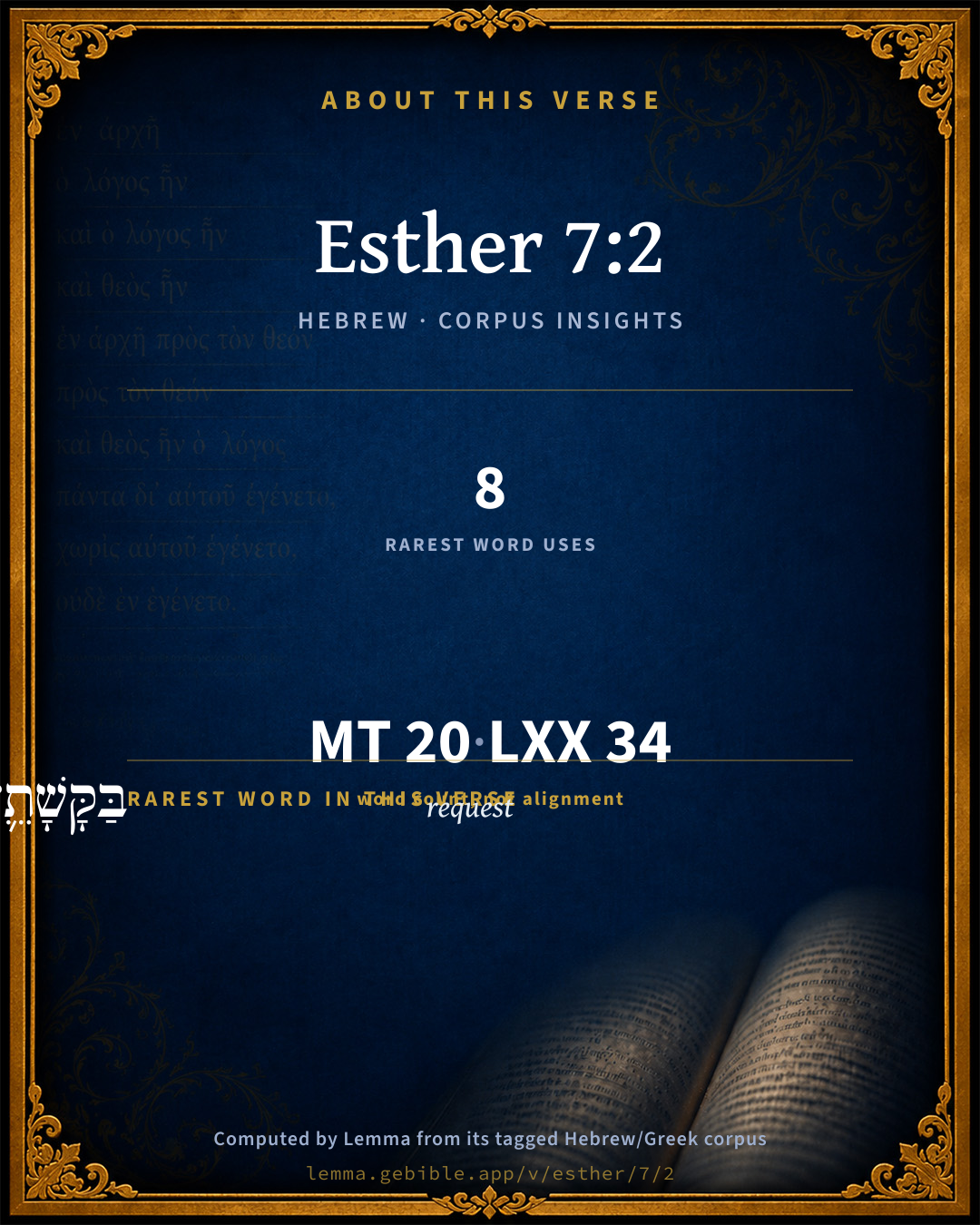
About this verse

These counts appear in no published source. They are computed here, from the morphology-tagged text and Lemma’s own curated glosses. What Lemma adds →

20
words
17
distinct lemmas
Historical
section

Notable vocabulary

The rarest word here is בַּקָּשָׁתֵ֛ךְ request H1246 — appearing just 8 times in the whole Hebrew Bible.

Shared distinctive vocabulary

בַּקָּשָׁתֵ֛ךְ request H1246 occurs in 8 verses of the Hebrew Bible. Also found in:

Grammatical profile

  • 3 verbs
  • 11 nouns
  • 1 adjective
  • 2 prepositions
  • 3 particles

Verb forms

  • וַיֹּאמֶר֩ Qal · Sequential Imperfect
  • וְתִנָּ֣תֵֽן Niphal · Imperfect
  • וְתֵעָֽשׂ Niphal · Jussive

Repetition

Words recur within this verse — often emphatic in Hebrew:

  • לְאֶסְתֵּ֜ר Esther H635 ×2
  • מַה what H4100 ×2

Hebrew & Septuagint length

In English translation the verse runs 43 words from the Hebrew and 41 from the Septuagint (LXX English) — closely comparable.

A rough comparison of the two English renderings, which tokenize alike — not a word-level alignment.

Word counts can differ between the Hebrew and the Greek without any difference in meaning — e.g. the Hebrew direct-object marker אֵת has no separate Greek word, and Greek often adds the article ὁ.

In the original languages it is 20 Hebrew tokens and 34 Greek tokens — but the two are counted differently (Hebrew bundles its prefixes and suffixes into one token; the Greek is in lemma form), so that isn’t a like-for-like length.

Cross-references

4

Topical passages linked to Esther 7:2 in the Treasury of Scripture Knowledge — connected by theme and wording, ordered by reader-vote popularity; previews shown in the World English Bible.

  • John 16:24 Until now, you have asked nothing in my name. Ask, and you will receive, that your joy may be made full.
  • Esther 5:3 Then said the king to her, What will you, queen Esther? and what is your request? it shall be given you even to the half of the kingdom.
  • Esther 9:12 The king said to Esther the queen, The Jews have slain and destroyed five hundred men in Shushan the palace, and the ten sons of Haman; what then have they done in the rest of the king's provinces! Now what is your petition? and it shall be granted you: or what is your request further? and it shall be done.
  • Esther 5:6 The king said to Esther at the banquet of wine, What is your petition? and it shall be granted you: and what is your request? even to the half of the kingdom it shall be performed.

Cross-references courtesy of OpenBible.info (CC BY 4.0).

Hebrew and Greek witnesses Masoretic Hebrew ↔ Greek Septuagint

The same verse in the two great witnesses to the Old Testament, shown verse-for-verse.

These are two independent witnesses, not word-aligned to each other, and the Septuagint is shown in lemma (dictionary) form.

Hebrew Esther 7:2 Masoretic · Westminster Leningrad Codex

וַיֹּאמֶר֩ הַמֶּ֨לֶךְ לְאֶסְתֵּ֜ר גַּ֣ם בַּיּ֤וֹם הַשֵּׁנִי֙ בְּמִשְׁתֵּ֣ה הַיַּ֔יִן מַה שְּׁאֵלָתֵ֛ךְ אֶסְתֵּ֥ר הַמַּלְכָּ֖ה וְתִנָּ֣תֵֽן לָ֑ךְ וּמַה בַּקָּשָׁתֵ֛ךְ עַד חֲצִ֥י הַמַּלְכ֖וּת וְתֵעָֽשׂ

The king said again to Esther on the second day at the banquet of wine, What is your petition, queen Esther? and it shall be granted you: and what is your request? even to the half of the kingdom it shall be performed.

World English Bible · Public Domain

Greek LXX Esther 7:2 Septuagint · lemma form

εἶπον δέ ὁ βασιλεύς εσθηρ ὁ δεύτερος ἡμέρα ἐν ὁ πότος τίς εἰμί εσθηρ βασίλισσα καί τίς ὁ αἴτημα σύ καί τίς ὁ ἀξίωμα σύ καί εἰμί σύ ἕως ὁ ἥμισυς ὁ βασιλεία ἐγώ

And the king said to Esther at the banquet on the second day, What is it, queen Esther? and what is your request, and what is your petition? and it shall be done for you, to the half of my kingdom.

LXX2012 (modern English Septuagint) · Public Domain

Hebrew: Westminster Leningrad Codex (CC BY 4.0). Greek: Septuagint (public domain); English from LXX2012 (modern English Septuagint) (Public Domain). How the Septuagint differs from the Hebrew →

Commentary

Notes on Esther 7:2 from classic Christian and Jewish commentators (each source and its license shown beneath its notes). The classic Christian expositions comment on the surrounding passage and are grouped to its opening verse, so a note may address several verses; the Jewish commentaries on the Tanakh (Rashi and others) are per-verse, so they appear only where the commentator wrote on this verse.

Lemma curates 59 commentaries, every one of them public domain or Creative Commons licensed, each selected and text-cleaned for this edition rather than reprinted as found. About our sources →

Trapp's Complete Commentary

John Trapp

Est 7:2 And the king said again unto Esther on the second day at the banquet of wine, What [is] thy petition, queen Esther? and it shall be granted thee: and what [is] thy request? and it shall be performed, [even] to the half of the kingdom.

Ver. 2. And the king said again unto Esther] He was very desirous to know what her suit was; and with thought thereof, as it may seem, could not rest the night before. He pursueth his desires, not a little edged by her delays; neither was he of those lusks, who

Remque aliquam exoptant, intahescuntque relieta.

His love to Esther made him ask again, What is thy petition, and what is thy request? &c. He presseth her to speak out; so doth God his suppliants: "Hitherto ye have asked nothing: ask, that your joy may be full." Pray, that ye may joy; ye are not straitened in me, but in your own bowels; as if no water come by the conduit, it is not because there is none in the spring, but because the pipes are broken. {See Trapp on "Est 5:6"}

John Trapp, A Commentary or Exposition upon All the Books of the Old and New Testament (1647–1656) — public domain. Text from a community e-Sword module.

Joseph Benson's Commentary

Est 7:2. The king said again to Esther, What is thy petition, Queen Esther? &c. — If the king had now forgot that Esther had an errand to him, and had not again asked what it was, she could scarce have known how to renew it herself; but he was mindful of it, and now was bound with the three-fold cord of a promise, thrice made, to favour her.

Joseph Benson's Commentary on the Old and New Testaments (1811–1818) — public domain. Text from a community e-Sword module.

Geneva Bible (1599)

Geneva Bible translators

Read Esther 5:6.

Geneva Bible (1599) marginal notes — public domain. Text via Bolls.life.

Adam Clarke's Commentary

Verse 2. At the banquet of wine] Postquam vino incaluerat, after he had been heated with wine, says the Vulgate. In such a state the king was more likely to come into the measures of the queen.

Adam Clarke's Commentary on the Bible (1810–1826) — public domain. Text from a community e-Sword/MySword module.

Ellicott's Commentary for English Readers

VII.

(2) What is thy petition?—The king takes for granted that Esther’s invitations to her banquets do not constitute her real request, but merely prepare the way for it.

A Bible Commentary for English Readers, edited by Charles John Ellicott (1878–1897) — public domain. Text from a community e-Sword module.

The Cambridge Bible for Schools and Colleges

gen. ed. J. J. S. Perowne

2. gave it unto Mordecai] See on Est_3:10.

set Mordecai over] entrusted him with the administration of Haman’s property. Haman is represented as possessed of great wealth (Est_5:11).

The Cambridge Bible for Schools and Colleges (gen. ed. J. J. S. Perowne; Cambridge University Press, 1878–1918) — public domain. Text from a community e-Sword module.

John Gill's Exposition

And the king said again to Esther on the second day, at the banquet of wine,.... This was the third time he put the following question to her, being very desirous of knowing what she had to ask of him; and it was of God that this was kept upon his mind, and he was moved to solicit her petition, or otherwise it would not have been so easy for her to have introduced it:

what is thy petition, Queen Esther? and it shall be granted thee: and what is thy request? and it shall be performed, even to the half of my kingdom; see Est 5:3.

John Gill's Exposition of the Whole Bible (1746–1763) — public domain (CC PDM 1.0). Text via the HelloAO Bible API.

Matthew Poole's English Annotations

The banquet of wine; so it is called, to note that it was not designed for a feast to fill their bellies, but rather for a banquet to delight and please their palates with wine and other delicacies: See Poole "Est 5:8".

Matthew Poole's English Annotations on the Holy Bible (1683–1685) — public domain. Text from a community e-Sword/MySword module.

Whedon's Commentary on the Bible

Daniel D. Whedon

HAMAN CONVICTED AND HANGED, Est_7:1-10.

2. The king said again — Compare Est_5:6, note.

Daniel D. Whedon (gen. ed.), Commentary on the Old and New Testaments (1874–1909) — public domain. Text from a community e-Sword module.

The Pulpit Commentary

And the king said again. Esther had promised to let her real request be known at this banquet. (Est_5:8) The king therefore once more gives her the opportunity. On the second day. On the second occasion of being entertained by Esther.

The Pulpit Commentary (1880–1919), ed. H.D.M. Spence-Jones & Joseph S. Exell — public domain. Text from a community e-Sword module.

Lesson kit

Teaching starters — assembled from the data on this page, not authored interpretation. Every prompt links to the verse data it draws on. Edit before teaching.

Esther, in the Historical, opens this verse with 20 words (17 distinct Hebrew lemmas). Its most distinctive word is baqqâshâh (“request”). A historical commentator’s framing appears above. Read the whole chapter for the surrounding context.

Discussion questions

  1. How does “request” (baqqâshâh) shape what this verse is saying?
  2. Ezra 7:6 shares the word «request» with this verse. How do the two illuminate each other?
  3. “Esther” occurs 2× in this one verse. What is the effect of the repetition?
  4. These translations render this verse differently; the difference is in the English rendering, not the original. What questions does that raise?
  5. The verb «וַיֹּאמֶר֩» is Qal Sequential Imperfect. How does its form color the action?
  6. Reading how Trapp's Complete Commentary and Joseph Benson's Commentary read this verse, where do the two commentators agree and where do they part?

Things to notice

Reading settings

Reading text

Shown beneath each verse's original-language words.

Old Testament
Old Testament edition

Read the OT as the Masoretic Hebrew (MT) or the Greek Septuagint (LXX).

English shown for the Greek Septuagint (in the Hebrew ↔ Greek comparison).

Comparing translations? Open the Compare panel on any verse page to stack up to four side by side.