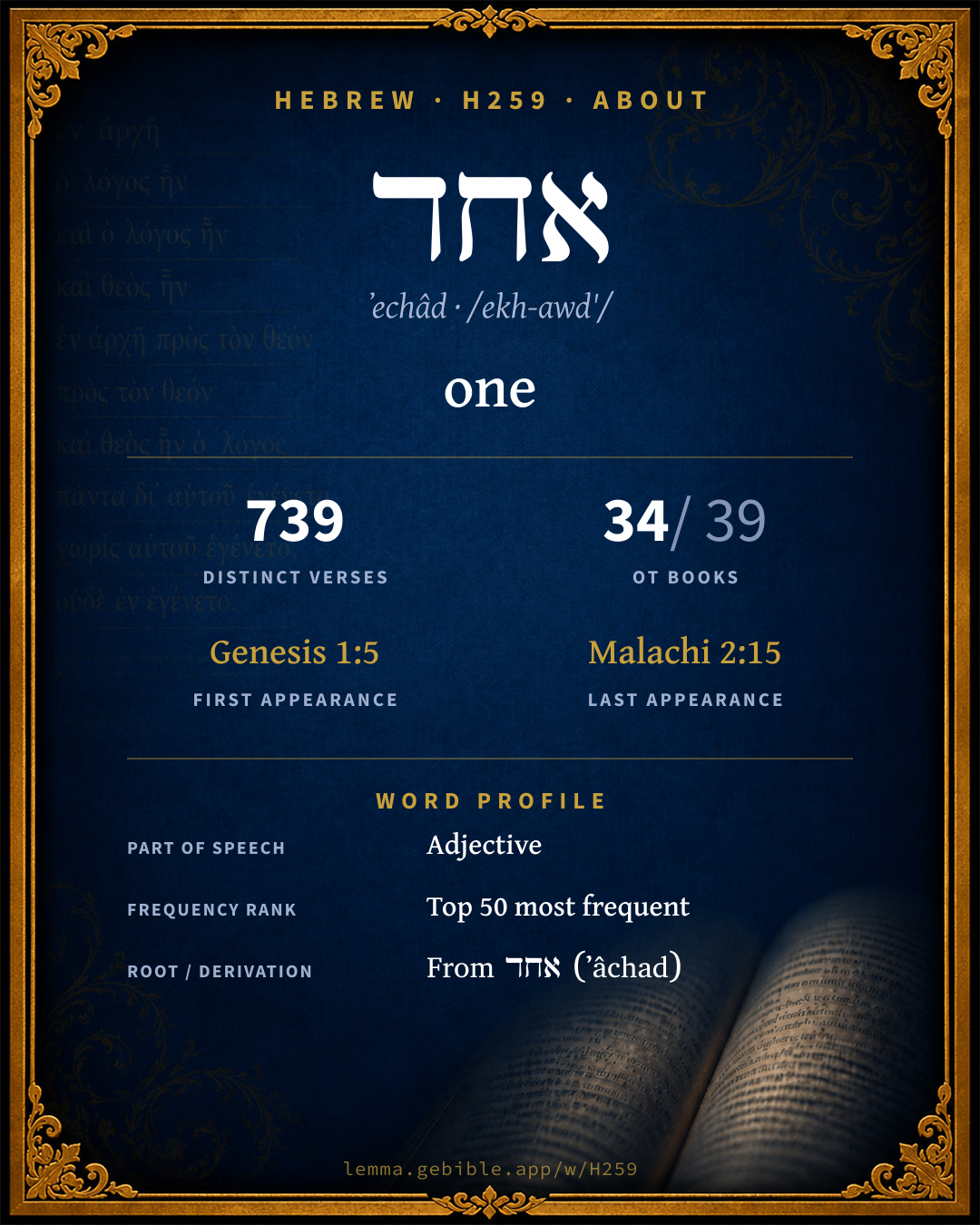
אֶחָד
one
‘one’ is one of 8 main senses fuller range ↓
Full lexicon entry — Brown-Driver-Briggs (BDB)
From Brown-Driver-Briggs (BDB)
Where this word appears
See every Absolute-state word in the Hebrew Bible →
Grammar key — what these labels mean
Part of speech
- Adjective
- A word that describes or qualifies a noun.
State
- Absolute
- The independent form of a noun, not bound to a following word.
- Construct
- A noun bound to a following noun in a possessive / “of” relationship (the construct chain).
Gender
- Masculine
- Grammatically masculine.
- Feminine
- Grammatically feminine.
Number
- Singular
- One.
- Plural
- More than one (in Hebrew, generally three or more).
31 verses where H259 appears in the Absolute state in the Book of 1 Samuel. Filtered view — show all forms. Click any verse to open its interlinear word-by-word view. Verse text shown in the World English Bible for context — . Each verse’s Hebrew form is shown with its reference; the English is not keyword-highlighted, since the data carries no word-level English alignment. Use “Compare translations” on any verse to read it across multiple English versions. This concordance covers the Hebrew Bible; Septuagint (Greek Old Testament) occurrences are not indexed here.
1 Samuel
- 1 Samuel 1:1 אֶחָ֜ד adj Cardinal number ms Now there was a certain man of Ramathaim Zophim, of the hill-country of Ephraim, and his name was Elkanah, the son of Jeroham, the son of Elihu, the son of Tohu, the son of Zuph, an Ephraimite:
- 1 Samuel 1:2 אַחַת֙ adj Cardinal number fs and he had two wives; the name of the one was Hannah, and the name of other Peninnah: and Peninnah had children, but Hannah had no children.
- 1 Samuel 1:5 אַחַ֖ת adj Cardinal number fs but to Hannah he gave a double portion; for he loved Hannah, but Yahweh had shut up her womb.
- 1 Samuel 1:24 אַחַ֥ת adj Cardinal number fs When she had weaned him, she took him up with her, with three bulls, and one ephah of meal, and a bottle of wine, and brought him to the house of Yahweh in Shiloh: and the child was young.
- 1 Samuel 2:34 אֶחָ֖ד adj Cardinal number ms This shall be the sign to you, that shall come on your two sons, on Hophni and Phinehas: in one day they shall die both of them.
- 1 Samuel 2:36 אַחַ֥ת adj Cardinal number fs It shall happen, that everyone who is left in your house shall come and bow down to him for a piece of silver and a loaf of bread, and shall say, Please put me into one of the priests' offices, that I may eat a morsel of bread.
- 1 Samuel 6:4 אַחַ֛ת adj Cardinal number fs Then they said, "What shall be the trespass-offering which we shall return to him?" They said, "Five golden tumors, and five golden mice, [according to] the number of the lords of the Philistines; for one plague was on you all, and on your lords.
- 1 Samuel 6:7 אֶחָ֔ת adj Cardinal number fs Now therefore take and prepare yourselves a new cart, and two milk cattle, on which there has come no yoke; and tie the cattle to the cart, and bring their calves home from them;
- 1 Samuel 6:12 אַחַ֗ת adj Cardinal number fs The cattle took the straight way by the way to Beth-shemesh; they went along the highway, lowing as they went, and didn't turn aside to the right hand or to the left; and the lords of the Philistines went after them to the border of Beth-shemesh.
- 1 Samuel 6:17 אֶחָ֜ד אֶחָד֙ אֶחָ֔ד אֶחָ֖ד אֶחָֽד adj Cardinal number ms adj Cardinal number ms adj Cardinal number ms adj Cardinal number ms adj Cardinal number ms These are the golden tumors which the Philistines returned for a trespass-offering to Yahweh: for Ashdod one, for Gaza one, for Ashkelon one, for Gath one, for Ekron one;
- 1 Samuel 7:9 אֶחָ֔ד adj Cardinal number ms Samuel took a sucking lamb, and offered it for a whole burnt-offering to Yahweh: and Samuel cried to Yahweh for Israel; and Yahweh answered him.
- 1 Samuel 7:12 אַחַ֗ת adj Cardinal number fs Then Samuel took a stone, and set it between Mizpah and Shen, and called the name of it Ebenezer, saying, Hitherto has Yahweh helped us.
- 1 Samuel 9:3 אַחַ֣ד adj Cardinal number ms The donkeys of Kish, Saul's father, were lost. Kish said to Saul his son, Take now one of the servants with you, and arise, go seek the donkeys.
- 1 Samuel 9:15 אֶחָ֔ד adj Cardinal number ms Now Yahweh had revealed to Samuel a day before Saul came, saying,
- 1 Samuel 10:3 אֶחָ֞ד וְ/אֶחָד֙ וְ/אֶחָ֥ד adj Cardinal number ms conj + Adjective Cardinal number ms conj + Adjective Cardinal number ms Then shall you go on forward from there, and you shall come to the oak of Tabor; and there shall meet you there three men going up to God to Bethel, one carrying three kids, and another carrying three loaves of bread, and another carrying a bottle of wine:
- 1 Samuel 11:7 אֶחָֽד adj Cardinal number ms He took a yoke of oxen, and cut them in pieces, and sent them throughout all the borders of Israel by the hand of messengers, saying, Whoever doesn't come forth after Saul and after Samuel, so shall it be done to his oxen. The dread of Yahweh fell on the people, and they came out as one man.
- 1 Samuel 13:17 אֶחָ֥ד adj Cardinal number ms The spoilers came out of the camp of the Philistines in three companies: one company turned to the way that leads to Ophrah, to the land of Shual;
- 1 Samuel 13:18 אֶחָד֙ אֶחָ֤ד adj Cardinal number ms adj Cardinal number ms and another company turned the way to Beth Horon; and another company turned the way of the border that looks down on the valley of Zeboim toward the wilderness.
- 1 Samuel 14:4 הָֽ/אֶחָד֙ הָ/אֶחָ֖ד ptcl def.art + Adjective Cardinal number ms ptcl def.art + Adjective Cardinal number ms Between the passes, by which Jonathan sought to go over to the Philistines' garrison, there was a rocky crag on the one side, and a rocky crag on the other side: and the name of the one was Bozez, and the name of the other Seneh.
- 1 Samuel 14:5 הָ/אֶחָ֛ד וְ/הָ/אֶחָ֥ד ptcl def.art + Adjective Cardinal number ms conj + ptcl def.art + Adjective Cardinal number ms The one crag rose up on the north in front of Michmash, and the other on the south in front of Geba.
- 1 Samuel 14:40 אֶחָ֔ד אֶחָ֑ד adj Cardinal number ms adj Cardinal number ms Then said he to all Israel, Be you on one side, and I and Jonathan my son will be on the other side. The people said to Saul, Do what seems good to you.
- 1 Samuel 16:18 אֶחָ֨ד adj Cardinal number ms Then answered one of the young men, and said, Behold, I have seen a son of Jesse the Bethlehemite, who is skillful in playing, and a mighty man of valor, and a man of war, and prudent in speech, and a comely person; and Yahweh is with him.
- 1 Samuel 16:20 אֶחָ֑ד adj Cardinal number ms Jesse took a donkey loaded with bread, and a bottle of wine, and a kid, and sent them by David his son to Saul.
- 1 Samuel 22:20 אֶחָ֗ד adj Cardinal number ms One of the sons of Ahimelech, the son of Ahitub, named Abiathar, escaped, and fled after David.
- 1 Samuel 24:14 אֶחָֽד adj Cardinal number ms After whom is the king of Israel come out? after whom do you pursue? after a dead dog, after a flea.
- 1 Samuel 25:14 אֶחָ֛ד adj Cardinal number ms But one of the young men told Abigail, Nabal's wife, saying, Behold, David sent messengers out of the wilderness to Greet our master; and he railed at them.
- 1 Samuel 26:8 אַחַ֔ת adj Cardinal number fs Then said Abishai to David, God has delivered up your enemy into your hand this day: now therefore please let me strike him with the spear to the earth at one stroke, and I will not strike him the second time.
- 1 Samuel 26:15 אַחַ֣ד adj Cardinal number ms David said to Abner, Aren't you a [valiant] man? and who is like you in Israel? why then have you not kept watch over your lord, the king? for there came one of the people in to destroy the king your lord.
- 1 Samuel 26:20 אֶחָ֔ד adj Cardinal number ms Now therefore, don't let my blood fall to the earth away from the presence of Yahweh: for the king of Israel is come out to seek a flea, as when one does hunt a partridge in the mountains.
- 1 Samuel 26:22 אֶחָ֥ד adj Cardinal number ms David answered, Behold the spear, O king! let then one of the young men come over and get it.
- 1 Samuel 27:1 אֶחָ֖ד adj Cardinal number ms David said in his heart, I shall now perish one day by the hand of Saul: there is nothing better for me than that I should escape into the land of the Philistines; and Saul will despair of me, to seek me any more in all the borders of Israel: so shall I escape out of his hand.
About this entry
At a glance — auto-summarized from this page’s data, not written by a person. Every figure links to its source below. This summary describes the numbers; it doesn’t interpret them.
At its core, אחד (ʼechâd) means “one.” Not a single-sense word: explore its full sense range. Spanning 739 verses in 34 books, it ranks among the most common words of the Hebrew Bible. It first appears in Genesis 1:5. Sharing its root, it stands alongside אחד, חד and אחוד. Each statement above links to its evidence; the full detail follows below.
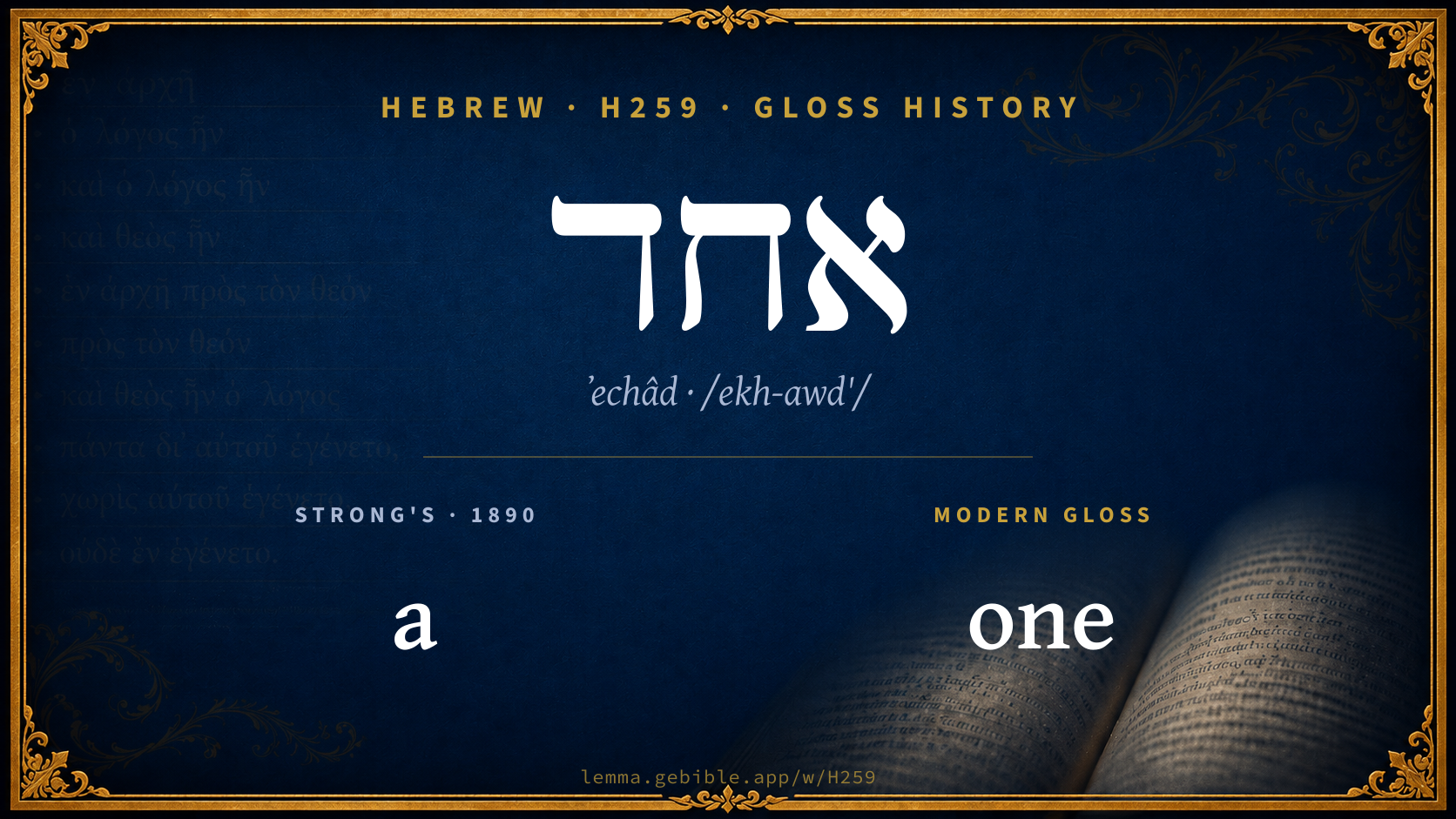
Gloss history
Strong's 1890 vs modern scholarship
About this word
Strong's H259 catalogs a Hebrew word from the Hebrew Old Testament.
These counts are not copied from any lexicon or concordance. They are computed here, from the morphology-tagged Hebrew Old Testament. What Lemma adds →
- 739
- distinct verses
- The word appears in 739 distinct verses.
- 34 / 39
- OT books
- The word appears in 34 of 39 Old Testament books.
- #43
- by frequency
- Top 50 most frequent Hebrew words (rank 43 of 8,640 Hebrew words by occurrence).
View all 739 occurrences in the concordance →
By section of the Old Testament
By traditional corpus
Conventional, traditional groupings — biblical authorship is debated, so this is a traditional corpus grouping, not an authorship claim. Each share is this word’s portion of its verses in that division of the Hebrew canon. Each figure is a share of the word’s 739 distinct verses.
- Prophets (Nevi'im) 324 verses · 44%
- Torah (Pentateuch) 295 verses · 40%
- Writings (Ketuvim) 120 verses · 16%
How translations render this word
Counts come from each version’s own published word-to-Strong’s tagging or interlinear alignment — an approximate guide to how each version renders this word, not a word-level alignment the data otherwise carries. Because each total is that version’s own tagged count, the per-version totals vary from one another and need not match the appearance or distinct-verse counts above. These counts may also differ from a printed concordance because Lemma counts each distinctly tagged rendering and does not collapse phrase taggings into a single head-word total. This is a fixed set of word-tagged versions (KJV, ASV, BSB, ULT) and does not change with the reading translation you choose elsewhere. Each version’s license is shown beside its name below (and on Sources).
- King James Version: One 519×, A 35×, Other 29×
- American Standard Version: One 469×, Other 30×, A 27×
- Berean Standard Bible: One 410×, Each 55×, A 53×
- unfoldingWord Literal Text: One 691×, One of 38×, First 29×
King James Version Public Domain
Renders H259 across 942 tagged occurrences — most commonly:
Plus other, less common renderings. Plus 127 renderings that appear only once — usually multi-word phrases or single function words the recovered tagging swept in, not distinct renderings. Not rendered by a distinct English word in 10 further occurrences.
American Standard Version Public Domain
Renders H259 across 943 tagged occurrences — most commonly:
Plus other, less common renderings. Plus 141 renderings that appear only once — usually multi-word phrases or single function words the recovered tagging swept in, not distinct renderings. Not rendered by a distinct English word in 1 further occurrence.
Berean Standard Bible Public Domain
Renders H259 across 852 tagged occurrences — most commonly:
Plus other, less common renderings. Plus 77 renderings that appear only once — usually multi-word phrases or single function words the recovered tagging swept in, not distinct renderings. Not rendered by a distinct English word in 114 further occurrences.
unfoldingWord Literal Text CC BY-SA 4.0
Renders H259 across 1,000 tagged occurrences — most commonly:
Plus other, less common renderings. Plus 46 renderings that appear only once — usually multi-word phrases or single function words the recovered tagging swept in, not distinct renderings. Not rendered by a distinct English word in 16 further occurrences.
10 senses and sub-senses in the full BDB
What do BDB’s symbols mean?
BDB uses these scholarly abbreviations:
| Symbol | Meaning |
|---|---|
| 𝔊 | the Septuagint (the ancient Greek translation, LXX) |
| 𝔙 | the Vulgate (the Latin translation) |
| 𝔖 | the Syriac version (the Peshitta) |
| 𝔗 | the Targum (the Aramaic translation) |
| ψ | the Psalms |
| √ | root (the underlying root or stem) |
| ‖ | parallel passage (a synonymous or contrasted parallel) |
| † | the dagger: every passage where the word occurs is cited |
The 10 senses and sub-senses the full Brown-Driver-Briggs lexicon distinguishes for this word, in lexicon order (not ranked by frequency), with BDB’s own verbatim wording and sub-sense lettering. Shown in Hebrew script with BDB’s own scholarly abbreviations. The condensed entry is in the Lexicon Entry tab. See also the Forms in the corpus table below.
- 1. one Gn 1:9; 27:38, 45 Ex 12:49 Jos 23:10 1 S 1:24 2 S 12:3 +, Zc 14:9 Mal 2:10 Jb 31:15 +, so also (emph.) 2 S 17:3 for MT אֲשֶׁר 𝔊 We Dr; one or two לֹא לְיוֹם אֶחָד וְלֹא לִשְׁנַיִם Ezr 10:13; as subst. sq. מִן Gn 2:21 Lv 4:2, 13 Is 34:16 +; הָא׳ Gn 19:9; 42:13, 32 2 K 6:3, 5 +; one and the same Gn 40:5 Jb 31:15; pl. דְּבָרִים אֲחָדִים †Gn 11:1 cf. Ez 37:17 (abs.), but v. Co; = few, a few יָמִים א׳ †Gn 27:44; 29:20 Dn 11:20; כְּאִישׁ אֶחָד as one man, together Ju 20:8 1 S 11:7; also כְּאֶחָד late = Aramaic כַּחֲדָא †Ezr 2:64 (= Ne 7:66) 3:9; 6:20 Ec 11:6; v. especially Is 65:25 (‖ earlier יַחְדָּו 11:6, 7). e.g. Genesis 1:9
- 2. = each, every Ex 36:30 Nu 7:3, 85; 28:21 1 K 4:7 2 K 15:20 +; also repeated, distrib. sense Nu 7:11; 13:2; 17:21 Jos 3:12; 4:2, 4. e.g. Exodus 36:30
- 3. = a certain 1 S 1:1 2 S 18:10 2 K 4:1 Est 3:8 + cf. 2 S 17:9 v. Dr 1 S 1:1; hence e.g. 1 Samuel 1:1
- 4. = indef. art. 1 S 6:7; 24:15; 26:20 (but del. 𝔊 We Dr) 1 K 19:4, 5 +. e.g. 1 Samuel 6:7
- 5. only 1 K 4:19, & (fem.) once 2 K 6:10 ψ 62:12; 89:36 (once for all); אַחַת לְשָׁלוֹשׁ שָׁנִים 2 Ch 9:21, א׳ בַּשָּׁנָה Lv 16:34 cf. Jb 40:5, פַּעַם אֶחָ֑ת Jos 6:3, 11 cf. v 14, בְּאַחַת Nu 10:4 בְּאַחַת is rather ‘in one (of the trumpets)’ Jb 33:14 it = in one way; at once בְּאֶחָ֑ת Pr 28:18 read prob. with 𝔖 Lag Dys Bi בַּשָּׁ֑חַת cf. וְאִנָּֽקְמָה נְקַם־אַחַת Ju 16:28 is rather ‘vengeance for one of my two eyes’ (v. GFM). Je 10:8 בְּאַחַת prob. = in one, altogether. e.g. 1 Kings 4:19
- 6. one … another, the one … the other א׳ … א׳ Ex 17:12; 18:3, 4 Am 4:7 2 S 12:1 Je 24:2 2 Ch 3:17 Ne 4:11 +; … הא׳ א׳ Lv 14:22; 15:15 2 S 14:6 read הָאֶחָד אֶת־אָחִיו 𝔊 We Dr; one after another, one by one, לְאַחַד אֶחָד Is 27:12 cf. Ec 7:27. e.g. Exodus 17:12
- 7. as ordinal, first (mostly P & late) Gn 1:5 (P) 2:11 (J) Ex 39:10 (P) Ez 10:14 Jb 42:14; of first day of month Ex 40:2 (P) Ezr 3:6; 10:16, 17 Ne 8:2 Hg 1:1; first year, שְׁנַת אַחַת 2 Ch 36:22 Ezr 1:1 Dn 1:21; 9:1, 2; 11:1; cf. first (day, יוֹם om.) Gn 8:5, 13 בְּאֶחָד לַחֹדֶשׁ; so Ex 40:17 Lv 23:24 Nu 1:1, 18; 29:1; 33:38 (all P) Dt 1:3 2 Ch 29:17 Ezr 7:9(×2) Ez 26:1; 29:17; 31:1; 32:1; 45:18. e.g. Genesis 1:5
- 8. in combin.,
- a. אַחַד עָשָׂר eleven (cf. עָשָׂר, עַשְׁתֵּי) Gn 32:23; 37:9 (JE) Dt 1:2; so אַחַת־עֶשְׂרֵה Jos 15:51 (P) 2 K 23:36; 24:18 2 Ch 36:5, 11 Je 52:1 (precedes noun, except Jos 15:51); as ordinal, eleventh אַחַת עֶשְׁרֵה שָׁנָה Ez 30:20; 31:1 cf. 1 K 6:38 2 K 9:29; e.g. Genesis 32:23
- b. with other numerals, as cardinal אֶחָד וְאַרְבָּעִים אֶלֶף וַחֲמֵשׁ מֵאוֹת Nu 1:41 cf. 2:16, 28; 31:34, 39 (all P; א׳ precedes other numeral); but אַרְבָּעִים וְאַחַת שָׁנָה (א׳ following) 1 K 14:21; 15:10 2 K 14:23 2 Ch 12:13 cf. 2 K 22:1 = 2 Ch 34:1; 2 K 24:18 = Je 52:1 = 2 Ch 36:11; Jose 12:24 (D) Is 30:17 Ezr 2:26 = Ne 7:30 cf. v 37; Dn 10:13; as ordinal בְּאַחַת וְשֵׁשׁ מֵאוֹת שָׁנָה Gn 8:13 (P) Ex 12:18 (P), 1 Ch 24:17; 25:28 2 Ch 16:13 (א׳ preceding); but 1 K 16:23 Hg 2:1 (א׳ following). e.g. Numbers 1:41
Senses from the full Brown-Driver-Briggs lexicon (Brown, Driver, Briggs; Oxford 1906 — public domain), digitized via Sefaria, supplemented by the OpenScriptures HebrewLexicon (CC BY 4.0). Full attribution on Sources.
Word origin
adj.num. one (Ph. אחד, Sab. id., cf. DHMZMG 1876, 707, Arabic أَحَدٌ, Ethiopic አሐዱ Aramaic חַד,ܚܰܕ; on Assyrian êdu, aḫadu, cf. DlW No. 139)—abs. א׳ Gn 1:5 + cstr. אַחַ֫ד Gn 21:15 +; so even bef. prep. 1 S 9:3 al. v. Dr; f. abs. אַחַ֫ת Gn 2:21 +; אֶחָ֑ת Gn 11:1 +; cstr. אַחַ֫ת Dt 13:13 +; pl. m. אֲחָדִים Gn 11:1 + 4 times; חַד Ez 33:30 del. Co cf. 𝔊;—
— Brown-Driver-Briggs (Oxford 1906, public domain), digitized via Sefaria, supplemented by the OpenScriptures HebrewLexicon (CC BY 4.0). See Sources.
Derived from אחד (ʼâchad) (H258) — to be sharp.
Jastrow Dictionary
A second Hebrew/Aramaic lexicon for comparison, covering Aramaic and post-biblical (Talmudic, Targumic, Midrashic) usage that the biblical-Hebrew BDB does not. Matched by lemma rather than by Strong’s number, so a lemma may carry more than one Jastrow headword (shown separately below), and the entries cover usage well beyond the Bible.
אֶחָד
- , אַחַת f. (b. h.; v. next w., one. [Freq. represented by א׳.] Kidd. 50ᵇ, a. fr. בבת אחת simultaneously, v. בַּת III. Peah III, 3 המחליק מאחת יד וכ׳ (Ms. M. בא׳) he who takes out onions with a unity of hand, i.e. all of them for one purpose. Ber. 61ᵇ, a. fr. על אחת כמה וכמה (abbr. עאכ"ו) how much against one, i.e. how much the more.—אחד … אחד both … as well as. Tem. I, 1 א׳ האנשים וכ׳ both, men as well as women. Y. Keth. V, 29ᵈ top אחת זו ואחתֹ זו the one as well as the other; a. fr.—כְּאֶחָד, כְּאַחַת at the same time. Tosef. Neg. I, 11; sq. Sot. 8ᵃ; a. fr.—Yoma I, 7 והפג אחת and cool thyself for once, for a change, v. חֲדַת.—Pl. אֲחָדִים
- 1. singular, unique. Yalk. Gen. 62 (ref. to דברים אחדים Gen. XI, 1) they spoke words על שני א׳ against two only ones (ref. to אחד Ezek. XXXIII, 24 a. Deut. VI, 4) [corr. acc. Gen. R. s. 38]. e.g. Genesis 11:1
- 2. (cmp. אֲחַד) closed up, mysterious. Gen. R. l. c. (Yalk. l. c. אֲחוּדִים v. next w.).
אָחַד
- (sec. r. of חוּד, v. חוּד I) to join, close. Part. pass. אָחוּד, pl. אֲחוּדִים
- 1. closed up, mysterious. Yalk. Gen. 62, v. foreg.
- 2. joined, united. Gen. R. s. 38 (ref. to Gen. XI, 1, v. foreg.) דברים א׳ common goods, communism. e.g. Genesis 11:1
אֲחַד
- , Pa. אָחֵיד, אַחֵד ch. (v. foreg.)
- 1. (corresp. to h. סגר a. תפש; cmp. h. אחז) to close (the door), to lock up; to seize, capture. Targ. Is. XXII, 22 אָחֵיד. Ib. יֵיחוֹד, יִיחוֹד (fut.).—Targ. Deut. XXI, 19 יְאַ׳ = יַחֲדוּן (Pa.; Var. יֶחֱדוּן = יֶאֶח׳ Pe.). Targ. Am. III, 5; a. fr.—Snh. 26ᵃ bot., a. e. אחדיה לדשא locked the door. Pes. 111ᵇ ליה רוחא אחדא a spirit (demon, disease) seizes him.—Part. pass. אֲחִיד a) locked up. Targ. Josh. VI, 1; a. e.—b) (v. אָחוּז, s. v. אָחַז) holding. Targ. Am. II, 15; a. fr.—Part. pass. Pa. מְאַחַד locked up, hidden. Targ. Job. XXVI, 9.
- 2. to devote, v. אֲחִיד.
- to seize. Targ. Ps. LXXIII, 23.
- 1. to be seized. Targ. Ez. XIX, 4; a. fr.
- 2. to be locked up, joined. Targ. Is. XXIV, 10 את אחידו … (read אתאחידו). Ib. LIX, 10 Rashi (ed. אתא חד corr. acc.). Targ. Job XLI, 9 (8); a. e.—אִתְּחִיד. Ḥull. 52ᵇ א׳ דשא the door was locked.
A Dictionary of the Targumim, the Talmud Babli and Yerushalmi, and the Midrashic Literature (Marcus Jastrow; London, Luzac, 1903) — Public Domain. Digitized via Sefaria. Digitized via Sefaria. Full attribution on Sources.
Forms in the corpus
The 165 distinct written forms H259 takes in the Hebrew Bible, most frequent first — each parse links to that state’s occurrences in the concordance. Hebrew forms include their vowel points and cantillation, so a single lemma takes many written forms.
The 60 most common forms are shown; 105 rarer forms follow in the full concordance.
Same root — word family
Other BDB entries built from the same root as H259, grouped by Strong’s listed origin. These share a root / origin per the lexicon — not necessarily a shared meaning. Each links to that word’s own entry.
Derives from
Derived from this word
Proper names from this root
People and places named from this root — a name, not an additional meaning of the word.
Compare all same-root words → 1 of the same-root words is a proper name (a person or place). They share a root, not necessarily a meaning.
Septuagint verse parallels
This word appears in 716 verses that also exist in the Greek Old Testament (Septuagint), out of the 739 Hebrew verses it occurs in. You can read those verses in Greek by switching the Old Testament edition to the Septuagint.
Read these verses in the Septuagint
- Genesis 1:5
- Exodus 1:15
- Leviticus 4:2
- Numbers 1:1
- Deuteronomy 1:2
- Joshua 3:12
- Judges 4:16
- Ruth 1:4
- 1 Samuel 1:1
- 2 Samuel 1:15
- 1 Kings 2:16
- 2 Kings 2:16
This is a verse-level parallel only — the same verses exist in both the Hebrew and Greek Old Testaments. No word-level Hebrew↔Greek correspondence is claimed: the data carries no such alignment, so no Greek word is shown as this Hebrew word’s translation. Coverage is not total — the Septuagint omits the deuterocanon and renumbers the Psalms, so some Hebrew verses have no direct Greek parallel.