Genesis 41:25

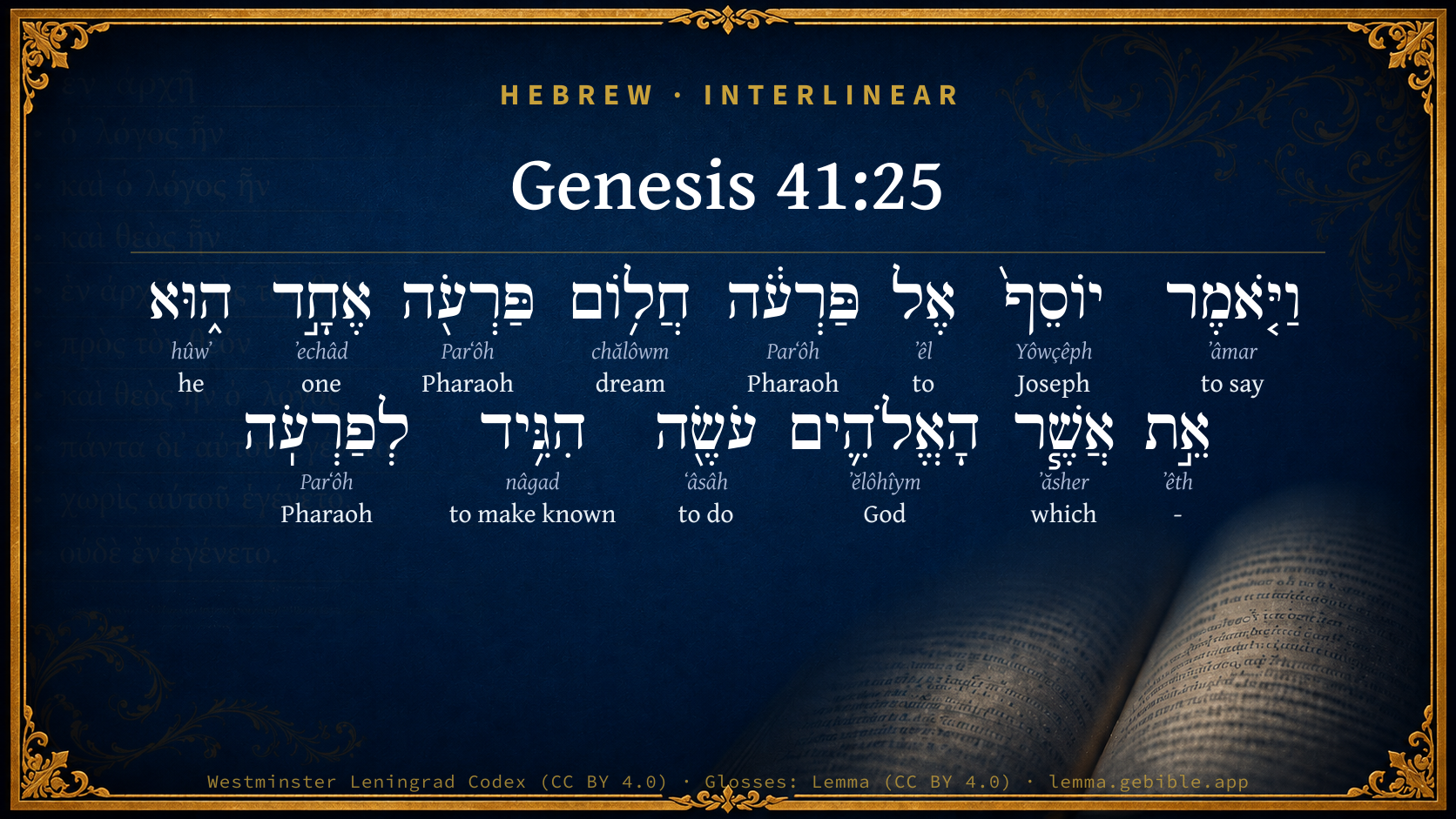
Hebrew (Westminster Leningrad Codex) Genesis 41:25 appears in the Hebrew Old Testament. The text above is from the Westminster Leningrad Codex. Each word links to its Strong’s number, a concise gloss, and parsing drawn from the Open Scriptures Hebrew Bible morphology. Click any word for its full Brown-Driver-Briggs (BDB) entry.
Download image
Cite this verse

Genesis 41:25 (World English Bible). Public Domain. Lemma interlinear Bible study tool, https://lemma.gebible.app/v/genesis/41/25.

Show BibTeX & RIS
BibTeX
RIS
English Translation
Joseph said to Pharaoh, "The dream of Pharaoh is one. What God is about to do he has declared to Pharaoh.
World English Bible · Public Domain
Download a study sheet

One document with this verse’s original text, its word-by-word gloss line, the meaning frame, cross-references with their text, attributed commentary, and full source and license credits — printable, and it pastes into notes with its structure intact.

This verse Autodidact and up

Study sheet (.html) Plain text (.txt)

A passage Seminary Student

Up to 50 verses in one chapter. A passage sheet keeps up to 6 commentary sources and 12 cross-references per verse, in the order this page ranks them, and says so on the sheet whenever that leaves anything out. Ask for a single verse and you get the Autodidact verse sheet above.

Everything on this page stays free to read, with no account — the sheet is a download of what is already on screen, not access to it.

Want to remove ads? Support Godless Engineer
Compare translations 3

The same verse in 3 English versions, stacked beneath the original-language interlinear above. Click any original word for its lexicon entry.

Each is an independent rendering of the whole verse — the interlinear is not word-aligned to these translations.

Highlighted words mark where these versions differ — a whole-verse word diff, not a word-by-word alignment.

  • World English Bible Public Domain
    Joseph said to Pharaoh, "The dream of Pharaoh is one. What God is about to do he has declared to Pharaoh.
  • King James Version Public Domain
    And Joseph said unto Pharaoh, The dream of Pharaoh is one: God hath showed Pharaoh what he is about to do.
  • unfoldingWord Literal Text CC BY-SA 4.0
    Then Joseph said to Pharaoh, “Pharaoh’s dreams one. What God is doing, he has shown to Pharaoh.

unfoldingWord Literal Text — © unfoldingWord, licensed CC BY-SA 4.0. Word-aligned USFM3 via Door43 (git.door43.org/unfoldingWord/en_ult).

Versions to compare (up to 4)

3 of 4 selected

Show all 18 translations

Every available English version of this verse, each an independent rendering of the whole verse.

  • World English Bible Public Domain
    Joseph said to Pharaoh, "The dream of Pharaoh is one. What God is about to do he has declared to Pharaoh.
  • Berean Standard Bible Public Domain
    At this, Joseph said to Pharaoh, “The dreams of Pharaoh are one and the same. God has revealed to Pharaoh what He is about to do.
  • Majority Standard Bible Public Domain
    At this, Joseph said to Pharaoh, “The dreams of Pharaoh are one and the same. God has revealed to Pharaoh what He is about to do.
  • King James Version Public Domain
    And Joseph said unto Pharaoh, The dream of Pharaoh is one: God hath showed Pharaoh what he is about to do.
  • American Standard Version (1901) Public Domain
    And Joseph said unto Pharaoh, The dream of Pharaoh is one: what God is about to do he hath declared unto Pharaoh.
  • Revised Version (1885) Public Domain
    And Joseph said unto Pharaoh, The dream of Pharaoh is one: what God is about to do he hath declared unto Pharaoh.
  • Geneva Bible (1599) Public Domain
    Then Ioseph answered Pharaoh, Both Pharaohs dreames are one. God hath shewed Pharaoh, what he is about to doe.
  • Douay-Rheims (1899) Public Domain
    Other seven also thin and blasted, sprung of the stock:
  • Young's Literal Translation Public Domain
    And Joseph saith unto Pharaoh, `The dream of Pharaoh is one: that which God is doing he hath declared to Pharaoh;
  • Literal Standard Version CC BY-SA 4.0
    And Joseph says to Pharaoh, “The dream of Pharaoh is one: that which God is doing he has declared to Pharaoh;
  • Unlocked Literal Bible CC BY-SA 4.0
    Joseph said to Pharaoh, “The dreams of Pharaoh are the same. What God is about to do, he has declared to Pharaoh.
  • unfoldingWord Literal Text CC BY-SA 4.0
    Then Joseph said to Pharaoh, “Pharaoh’s dreams one. What God is doing, he has shown to Pharaoh.
  • Darby Bible Public Domain
    And Joseph said to Pharaoh, The dream of Pharaoh is one. What God will do he has made known to Pharaoh.
  • World Messianic Bible Public Domain
    Joseph said to Pharaoh, “The dream of Pharaoh is one. What God is about to do he has declared to Pharaoh.
  • Webster's Bible Public Domain
    And Joseph said to Pharaoh, The dream of Pharaoh is one; God hath showed Pharaoh what he is about to do.
  • Free Bible Version CC BY-SA 4.0
    “Pharaoh's dreams mean the same thing,” Joseph responded. “God is telling Pharaoh what he is going to do.
  • Bible in Basic English Public Domain
    Then Joseph said, These two dreams have the same sense: God has made clear to Pharaoh what he is about to do.
  • JPS Tanakh (1917) Public Domain
    And Joseph said unto Pharaoh: 'The dream of Pharaoh is one; what God is about to do He hath declared unto Pharaoh.

Literal Standard Version (2020), Covenant Press — licensed CC BY-SA 4.0. Text via the HelloAO Bible API (eBible.org). Unlocked Literal Bible (unfoldingWord) — licensed CC BY-SA 4.0. Text via the HelloAO Bible API (eBible.org). unfoldingWord Literal Text — © unfoldingWord, licensed CC BY-SA 4.0. Word-aligned USFM3 via Door43 (git.door43.org/unfoldingWord/en_ult). Free Bible Version, Dr. Jonathan Gallagher — licensed CC BY-SA 4.0. Text via the HelloAO Bible API (eBible.org).

Word by word

More ways to search: Search by grammar → Find every occurrence → Compare this word →

Practice this passage: Drill this verse → Learn its vocabulary →

חֲל֥וֹם
chălôwm
H2472
“dream of”
Noun, Common, Masculine, Singular, Construct
Part of Speech
Noun
Type
Common
Gender
Masculine
Number
Singular
State
Construct
Full BDB Definition

Origin: from H2492

TWOT: 663a

dream - dream (ordinary) - dream (with prophetic meaning)
  1. וַיֹּ֤אמֶר ʼâmar H559 “and · to say” Conjunction + Verb, Qal, Sequential Imperfect, 3rd Person, Masculine, Singular
  2. יוֹסֵף֙ Yôwçêph H3130 “Joseph” Noun, Proper
  3. אֶל ʼêl H413 “to” Preposition
  4. פַּרְעֹ֔ה Parʻôh H6547 “Pharaoh” Noun, Proper
  5. פַּרְעֹ֖ה Parʻôh H6547 “Pharaoh” Noun, Proper
  6. אֶחָ֣ד ʼechâd H259 “one” Adjective, Cardinal number, Masculine, Singular, Absolute
  7. ה֑וּא hûwʼ H1931 “he” Pronoun, Personal, 3rd Person, Masculine, Singular
  8. אֵ֣ת ʼêth H853 “-” Particle, Direct Object
  9. אֲשֶׁ֧ר ʼăsher H834 “which” Particle, Relative
  10. הָאֱלֹהִ֛ים ʼĕlôhîym H430 “the · God(s)” Particle, Definite Article + Noun, Common, Masculine, Plural, Absolute
  11. עֹשֶׂ֖ה ʻâsâh H6213 “doing” Verb, Qal, Participle Active, Masculine, Singular, Absolute
  12. הִגִּ֥יד nâgad H5046 “to make known” Verb, Hiphil, Perfect, 3rd Person, Masculine, Singular
  13. לְפַרְעֹֽה Parʻôh H6547 “to/for · Pharaoh” Preposition + Noun, Proper

About this verse

These counts appear in no published source. They are computed here, from the morphology-tagged text and Lemma’s own curated glosses. What Lemma adds →

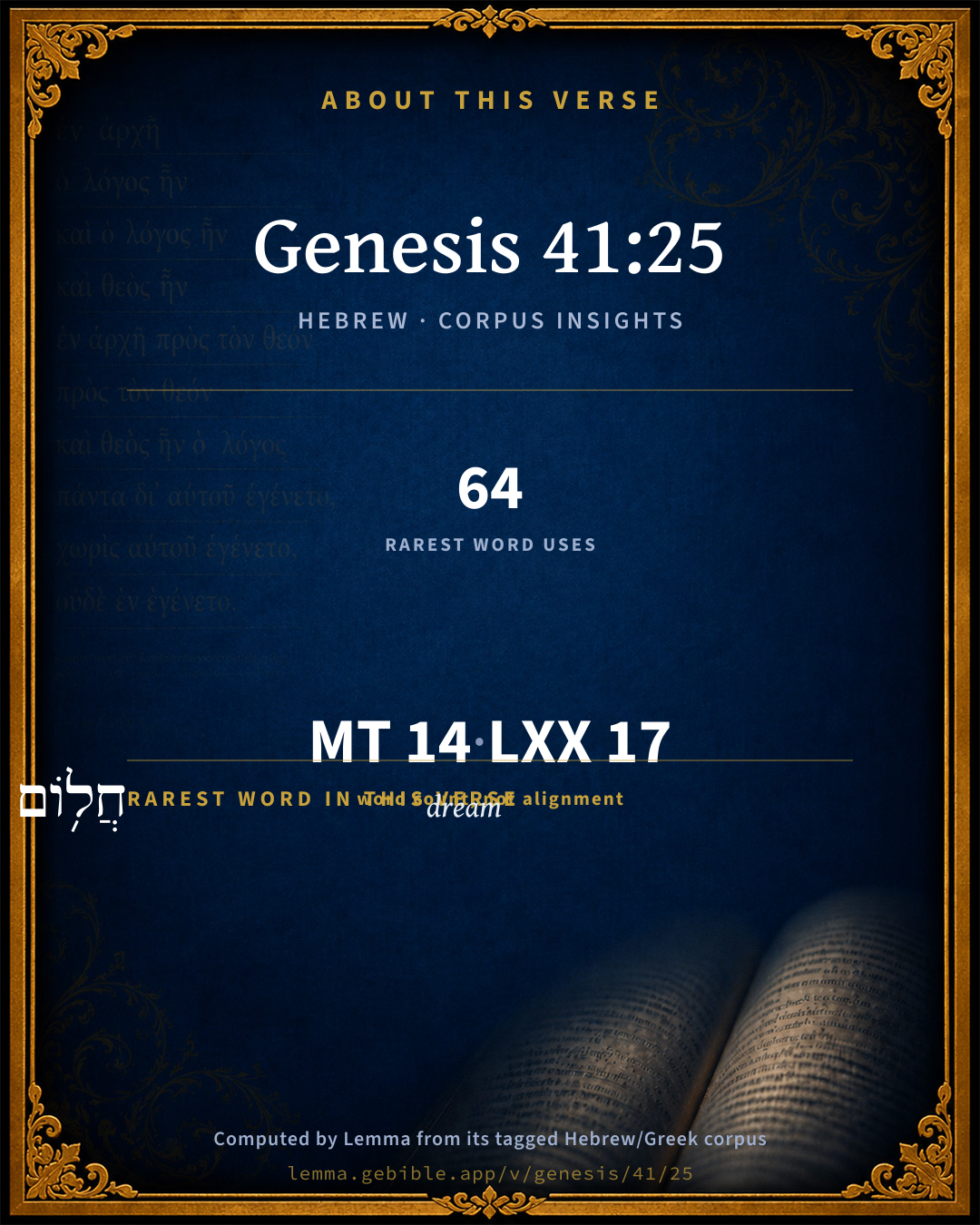
14
words
12
distinct lemmas
Pentateuch
section

Grammatical profile

  • 3 verbs
  • 6 nouns
  • 1 adjective
  • 1 pronoun
  • 1 preposition
  • 2 particles

Verb forms

  • וַיֹּ֤אמֶר Qal · Sequential Imperfect
  • עֹשֶׂ֖ה Qal · Participle Active
  • הִגִּ֥יד Hiphil · Perfect

Repetition

A word recurs within this verse — often emphatic in Hebrew:

  • פַּרְעֹ֔ה Pharaoh H6547 ×3

Hebrew & Septuagint length

In English translation the verse runs 21 words from the Hebrew and 19 from the Septuagint (LXX English) — closely comparable.

A rough comparison of the two English renderings, which tokenize alike — not a word-level alignment.

Word counts can differ between the Hebrew and the Greek without any difference in meaning — e.g. the Hebrew direct-object marker אֵת has no separate Greek word, and Greek often adds the article ὁ.

In the original languages it is 14 Hebrew tokens and 17 Greek tokens — but the two are counted differently (Hebrew bundles its prefixes and suffixes into one token; the Greek is in lemma form), so that isn’t a like-for-like length.

Cross-references

14

Topical passages linked to Genesis 41:25 in the Treasury of Scripture Knowledge — connected by theme and wording, ordered by reader-vote popularity; previews shown in the World English Bible.

  • Daniel 2:45 Because you saw that a stone was cut out of the mountain without hands, and that it broke in pieces the iron, the brass, the clay, the silver, and the gold; the great God has made known to the king what shall happen hereafter: and the dream is certain, and the interpretation of it sure.
  • Revelation 4:1 After these things I looked and saw a door opened in heaven, and the first voice that I heard, like a trumpet speaking with me, was one saying, "Come up here, and I will show you the things which must happen after this."
  • Daniel 2:28–29 but there is a God in heaven who reveals secrets, and he has made known to the king Nebuchadnezzar what shall be in the latter days. Your dream, and the visions of your head on your bed, are these:
  • Genesis 41:16 Joseph answered Pharaoh, saying, "It isn't in me. God will give Pharaoh an answer of peace."
  • Joshua 11:6 Yahweh said to Joshua, Don't be afraid because of them; for tomorrow at this time will I deliver them up all slain before Israel: you shall hamstring their horses, and burn their chariots with fire.
  • Psalms 98:2 Yahweh has made known his salvation. He has openly shown his righteousness in the sight of the nations.
  • Isaiah 41:22–23 Let them bring forth, and declare to us what shall happen: declare you the former things, what they are, that we may consider them, and know the latter end of them; or show us things to come.
  • Isaiah 43:9 Let all the nations be gathered together, and let the peoples be assembled: who among them can declare this, and show us former things? let them bring their witnesses, that they may be justified; or let them hear, and say, It is truth.
  • Daniel 2:47 The king answered to Daniel, and said, Of a truth your God is the God of gods, and the Lord of kings, and a revealer of secrets, seeing you have been able to reveal this secret.
  • Amos 3:7 Surely the Lord Yahweh will do nothing, Unless he reveals his secret to his servants the prophets.
  • Matthew 24:40 Then two men will be in the field: one will be taken and one will be left;
  • Mark 13:23 But you watch. "Behold, I have told you all things beforehand.
  • Ephesians 1:17 that the God of our Lord Jesus Christ, the Father of glory, may give to you a spirit of wisdom and revelation in the knowledge of him;
  • Exodus 9:14 For this time I will send all my plagues against your heart, against your officials, and against your people; that you may know that there is none like me in all the earth.

Cross-references courtesy of OpenBible.info (CC BY 4.0).

Hebrew and Greek witnesses Masoretic Hebrew ↔ Greek Septuagint

The same verse in the two great witnesses to the Old Testament, shown verse-for-verse.

These are two independent witnesses, not word-aligned to each other, and the Septuagint is shown in lemma (dictionary) form.

Hebrew Genesis 41:25 Masoretic · Westminster Leningrad Codex

וַיֹּ֤אמֶר יוֹסֵף֙ אֶל פַּרְעֹ֔ה חֲל֥וֹם פַּרְעֹ֖ה אֶחָ֣ד ה֑וּא אֵ֣ת אֲשֶׁ֧ר הָאֱלֹהִ֛ים עֹשֶׂ֖ה הִגִּ֥יד לְפַרְעֹֽה

Joseph said to Pharaoh, "The dream of Pharaoh is one. What God is about to do he has declared to Pharaoh.

World English Bible · Public Domain

Greek LXX Genesis 41:25 Septuagint · lemma form

καί εἶπον ιωσηφ ὁ φαραώ ὁ ἐνύπνιον φαραώ εἷς εἰμί ὅσος ὁ θεός ποιέω δεικνύω ὁ φαραώ

And Joseph said to Pharao, The dream of Pharao is one; whatever God does, he has shown to Pharao.

LXX2012 (modern English Septuagint) · Public Domain

Hebrew: Westminster Leningrad Codex (CC BY 4.0). Greek: Septuagint (public domain); English from LXX2012 (modern English Septuagint) (Public Domain). How the Septuagint differs from the Hebrew →

Targum (Aramaic paraphrase)

2

The Targum is the ancient Jewish Aramaic paraphrase of the Hebrew Scriptures — an interpretive translation, not the Hebrew text itself. Onkelos (literal) and Pseudo-Jonathan (expansive) render the Torah, and Jonathan the Prophets. Coverage is partial: where no permissively-licensed English translation exists for a verse, only the Aramaic is shown. This is verse-level text, not a word-by-word alignment to the Hebrew.

  1. Targum Onkelos Torah (Genesis–Deuteronomy)
    וַאֲמַר יוֹסֵף לְפַרְעֹה חֶלְמָא דְפַּרְעֹה חַד הוּא יָת דִּי יְיָ עָתִיד לְמֶעְבַּד חַוִּי לְפַרְעֹה

    (no public-domain English translation for this verse)

    Targum Onkelos — Aramaic: “Onkelos Genesis” (public domain); “Onkelos Exodus” (public domain); “Onkelos Leviticus” (public domain); “Onkelos Numbers” (public domain); “Onkelos Deuteronomy” (public domain). English: “Sefaria Community Translation” (CC0 1.0 (public-domain dedication)); “J.W. Etheridge. The Targums of Onkelos and Jonathan Ben Uzziel on the Pentateuch. London: Longmans, Green, 1862” (public domain). Text via Sefaria.

  2. Targum Pseudo-Jonathan Torah (Genesis–Deuteronomy)
    וַאֲמַר יוֹסֵף לְפַרְעה חֵילְמָא דְפַרְעה חַד הוּא מַה דַיְיָ עָתִיד לְמֶעֱבַד תָּנֵי לְפַרְעה

    And Joseph said to Pharoh, The dream of Pharoh is one. That which the Lord is about to do He showeth to Pharoh.

    Targum Pseudo-Jonathan — Aramaic: “Targum Jonathan on Genesis” (public domain); “Targum Jonathan on Exodus” (public domain); “Targum Jonathan on Leviticus” (public domain); “Targum Jonathan on Numbers” (public domain); “Targum Jonathan on Deuteronomy” (public domain). English: “The Targum of Jonathan ben Uzziel, trans. J. W. Etheridge, London, 1862” (public domain). Text via Sefaria.

Commentary

Notes on Genesis 41:25 from classic Christian and Jewish commentators (each source and its license shown beneath its notes). The classic Christian expositions comment on the surrounding passage and are grouped to its opening verse, so a note may address several verses; the Jewish commentaries on the Tanakh (Rashi and others) are per-verse, so they appear only where the commentator wrote on this verse.

Lemma curates 59 commentaries, every one of them public domain or Creative Commons licensed, each selected and text-cleaned for this edition rather than reprinted as found. About our sources →

Jamieson, Fausset & Brown

Robert Jamieson, A. R. Fausset & David Brown

JOSEPH INTERPRETS PHARAOH'S DREAMS. (Gen 41:25-36)

Joseph said, . . . The dream . . . is one--They both pointed to the same event--a remarkable dispensation of seven years of unexampled abundance, to be followed by a similar period of unparalleled dearth. The repetition of the dream in two different forms was designed to show the absolute certainty and speedy arrival of this public crisis; the interpretation was accompanied by several suggestions of practical wisdom for meeting so great an emergency as was impending.

Jamieson, Fausset & Brown — Commentary Critical and Explanatory on the Whole Bible (1871) — public domain (CC PDM 1.0). Text via the HelloAO Bible API.

Trapp's Complete Commentary

John Trapp

Gen 41:25 And Joseph said unto Pharaoh, The dream of Pharaoh [is] one: God hath shewed Pharaoh what he [is] about to do.

Ver. 25. The dream of Pharaoh is one.] One in signification, but diverse in respect of vision. Why it was doubled, {Gen 41:32} Repetitions in Scripture are not tautologies, but serve to set forth to us the necessity, excellency, or difficulty of the thing so reinforced. "To write" to the Philippians "the same things," to St Paul, "it is not grievous, and for them it is safe." {Php 3:1} Nunquam satis dicitur, quod nunquam satis discitur. {a} Away then with those nice novelists that can abide to hear nothing but what is new minted. Ministers meet with many that are slow of heart and dull of hearing; these must have "precept upon precept, line upon line," &c.; many also of brawny breasts and horny heart strings; that, as ducklings stoop and dive at any little stone thrown by a man at them, yet shrink not at the heaven’s great thunder, &c. Here a minister must beat and inculcate; turn himself into all fashions of spirit and speech, to win and work upon his hearers. He must so long pursue and stand upon one and the same point, saith Austin, till, by the gesture and countenance of his auditors, he perceives they understand and assent to it. {b} "Hear this, all ye people; give ear, all ye inhabitants of the world," saith the Psalmist; "both low and high, rich and poor, together." {Psa 49:1-2} Quid dignum tanto feret hle promissor hiatu, {c} will some proud spirit say? what so great matter is there delivered in this Psalm, that so much attention is called for? Is it not an ordinary argument, such as we have heard of a hundred times - viz., the happy and secure estate of the saints, though in trouble, and the miserable and slippery condition of the wicked, though they prosper in the world? True, saith the Holy Ghost; this is the subject of this Psalm; and this, how common a theme soever, is the great wisdom, and the dark saying, that I will here open unto you, and that calls for your utmost attention.

{a} Seneca. Occidit miseros crambe repetita magistros. - Juven.

{b} Aug., De Doct. Christ, and, in Psalm. x.

{c} Horat.

John Trapp, A Commentary or Exposition upon All the Books of the Old and New Testament (1647–1656) — public domain. Text from a community e-Sword module.

Tyndale Open Study Notes

Tyndale Open Resources

41:25-32 Both dreams predicted that seven years of abundant crops would be followed by seven years of severe famine.

Tyndale Open Study Notes — © Tyndale Open Resources, licensed CC BY-SA 4.0. Text via the HelloAO Bible API.

Geneva Bible (1599)

Geneva Bible translators

Both his dreams tend to one end.

Geneva Bible (1599) marginal notes — public domain. Text via Bolls.life.

Adam Clarke's Commentary

Verse 25. God hath showed Pharaoh what he is about to do.] Joseph thus shows the Egyptian king that though the ordinary cause of plenty or want is the river Nile, yet its inundations are under the direction of God: the dreams are sent by him, not only to signify beforehand the plenty and want, but to show also that all these circumstances, however fortuitous they may appear to man, are under the direction of an overruling Providence.

Adam Clarke's Commentary on the Bible (1810–1826) — public domain. Text from a community e-Sword/MySword module.

The Cambridge Bible for Schools and Colleges

gen. ed. J. J. S. Perowne

25. is about to do] Lit. “is doing.” Lat. facturus est. Joseph’s interpretation of the two dreams is the same.

The Cambridge Bible for Schools and Colleges (gen. ed. J. J. S. Perowne; Cambridge University Press, 1878–1918) — public domain. Text from a community e-Sword module.

John Gill's Exposition

This is the thing which I have spoken unto Pharaoh,.... As an interpretation of his dreams:

what God is about to do, he sheweth unto Pharaoh: the events of fourteen years with respect to plenty and sterility.

John Gill's Exposition of the Whole Bible (1746–1763) — public domain (CC PDM 1.0). Text via the HelloAO Bible API.

Matthew Poole's English Annotations

The dream of Pharaoh is one, to wit, in its design and signification; both dreams portend the same thing.

Matthew Poole's English Annotations on the Holy Bible (1683–1685) — public domain. Text from a community e-Sword/MySword module.

Whedon's Commentary on the Bible

Daniel D. Whedon

25. The dream… is one — That is, the two dreams are really but one dream, and convey one great prophecy.

God hath showed — The Hebrew here and in Gen_41:28; Gen_41:32 has the article before the name God. It is the one true God who thus graciously foretells to Pharaoh what he is about to do.

Daniel D. Whedon (gen. ed.), Commentary on the Old and New Testaments (1874–1909) — public domain. Text from a community e-Sword module.

The Pulpit Commentary

And Joseph said unto Pharaoh (the inability of the magicians to read the dream of Pharaoh was the best proof that Joseph spoke from inspiration), The dream of Pharaoh is one (i.e. the two dreams have the same significance): God hath showed Pharaoh what he is about to do (literally, what the Elohim is doing, i.e. is about to do, he causeth to be seen by Pharaoh).

The Pulpit Commentary (1880–1919), ed. H.D.M. Spence-Jones & Joseph S. Exell — public domain. Text from a community e-Sword module.

Kretzmann's Popular Commentary

Paul E. Kretzmann

Joseph Interprets the Dreams

v. 25. And Joseph said unto Pharaoh, The dream of Pharaoh is one, the two dream-pictures have the same meaning; God hath showed Pharaoh what He is about to do; He is revealing His intentions of the near future.

v. 26. The seven good kine are seven years; and the seven good ears are seven years; the dream is one. They indicate seven years of great fruitfulness and plenty.

v. 27. And the seven thin and ill-favored kine that came up after them are seven years; and the seven empty ears blasted with the east wind shall be seven years of famine. The very clearness and simplicity of Joseph’s explanation sets it aside from the heathen oracles.

v. 28. This is the thing which I have spoken unto Pharaoh: What God is about to do He showeth unto Pharaoh. He refers to the statement which he made even before Pharaoh had related his dreams, always directing the attention of the king to the Lord.

v. 29. Behold, there come seven years of great plenty throughout all the land of Egypt;

v. 30. and there shall arise after them seven years of famine; and all the plenty shall be forgotten in the land of Egypt; and the famine shall consume the land;

v. 31. and the plenty shall not be known in the land by reason of that famine following; for it shall be very grievous.

v. 32. And for that the dream was doubled unto Pharaoh twice, it is because the thing is established, fully determined upon,by God, and God will shortly bring it to pass. Joseph purposely emphasized the grievousness of the years of famine, that they would be so had as to make people forget the unusually fertile years that had gone before, just as we are inclined to feel any distress very severely and to forget the great blessings of goodness that are ours continually. Joseph’s entire manner of speaking, particularly when compared with the helplessness of the Egyptian magicians, was bound to make a deep impression upon the king.

v. 33. Now, therefore, let Pharaoh look out a man discreet and wise, and set him over the land of Egypt, one who has great wisdom and executive ability, combined with a good understanding of the situation and the necessary tact.

v. 34. Let Pharaoh do this, and let him appoint officers over the land, the chief overseer was to be given assistants, and take up the fifth part of the land of Egypt, of the yield of the land, in the seven plenteous years, in the years of great fertility.

v. 35. And let them gather all the food of those good years that come, and lay up corn under the hand of Pharaoh, and let them keep food in the cities. His advice is that royal store-houses, or granaries, be erected in all the chief cities, to be kept for provision against the lean years.

v. 36. And that food shall be for store to the land against the seven years of famine, which shall be in the land of Egypt, to tide the inhabitants over the critical period; that the land perish not through the famine. This counsel was not an act of presumption on the part of Joseph, but a bit of advice which the Lord gave to Pharaoh by his mouth. God blesses, protects, and keeps a whole country for the sake of the believers that may be living in it.

Paul E. Kretzmann, Popular Commentary of the Bible (1921–1924) — public domain. Text from a community e-Sword module.

unfoldingWord translationNotes

Door43 World Missions Community

The dreams of Pharaoh are the same

It is implied that the meanings are the same. AT: "Both dreams mean the same thing" (See: Assumed Knowledge and Implicit Information)

What God is about to do, he has declared to Pharaoh

Joseph speaks to Pharaoh in the third person. This is a way of showing respect. It can be stated in the second person. AT: "God is showing you what he will soon do" (See: First, Second, or Third Person)

seven good heads

The words "of grain" are understood. AT: "seven good heads of grain" (See: Ellipsis)

translationWords

Joseph (OT)

Pharaoh

dream

God

declare

good

cow

year

unfoldingWord translationNotes — © Distant Shores Media and the Door43 World Missions Community, licensed CC BY-SA 4.0. Source: git.door43.org/Door43/en_tn.

Lesson kit

Teaching starters — assembled from the data on this page, not authored interpretation. Every prompt links to the verse data it draws on. Edit before teaching.

Genesis, in the Pentateuch, opens this verse with 14 words (12 distinct Hebrew lemmas). Its most distinctive word is chălôwm (“dream”). A historical commentator’s framing appears above. Read the whole chapter for the surrounding context.

Discussion questions

  1. The word chălôwm carries the sense “dream.” How does it shape the verse?
  2. Daniel 2:45 shares this passage’s theme. How do the two illuminate each other?
  3. “Pharaoh” occurs 3× in this one verse. What is the effect of the repetition?
  4. The translations on this page render this verse differently — a whole-verse word diff, not a word-by-word alignment. What might account for the different wordings?
  5. The verb «וַיֹּ֤אמֶר» is Qal Sequential Imperfect. How does its form color the action?
  6. Reading how Jamieson, Fausset & Brown and Trapp's Complete Commentary read this verse, where do the two commentators agree and where do they part?

Things to notice

Reading settings

Reading text

Shown beneath each verse's original-language words.

Old Testament
Old Testament edition

Read the OT as the Masoretic Hebrew (MT) or the Greek Septuagint (LXX).

English shown for the Greek Septuagint (in the Hebrew ↔ Greek comparison).

Comparing translations? Open the Compare panel on any verse page to stack up to four side by side.