
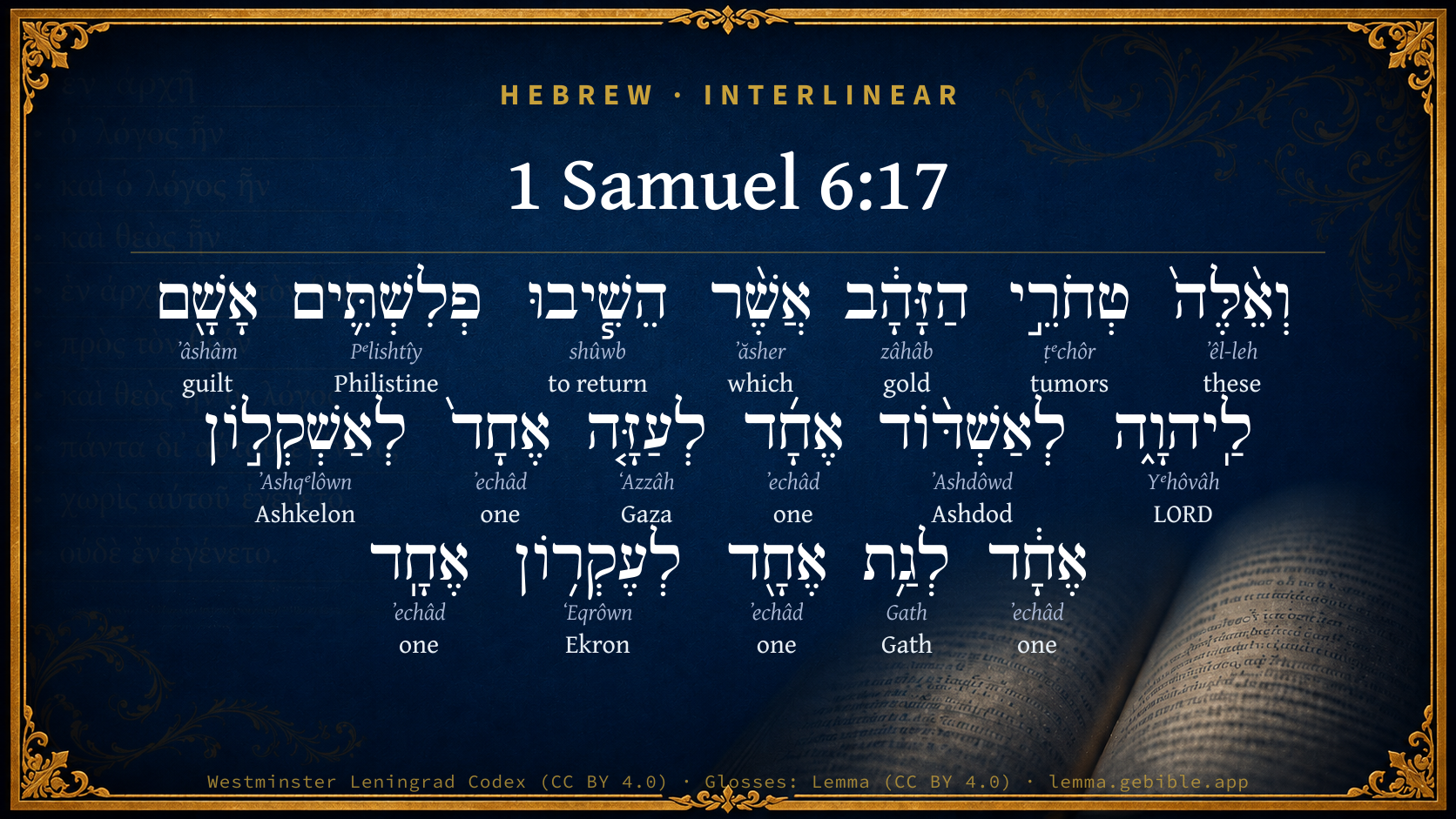
1 Samuel 6:17

Hebrew (Westminster Leningrad Codex) 1 Samuel 6:17 appears in the Hebrew Old Testament. The text above is from the Westminster Leningrad Codex. Each word links to its Strong’s number, a concise gloss, and parsing drawn from the Open Scriptures Hebrew Bible morphology. Click any word for its full Brown-Driver-Briggs (BDB) entry.
Download image
Cite this verse

1 Samuel 6:17 (World English Bible). Public Domain. Lemma interlinear Bible study tool, https://lemma.gebible.app/v/1-samuel/6/17.

Show BibTeX & RIS
BibTeX
RIS
English Translation
These are the golden tumors which the Philistines returned for a trespass-offering to Yahweh: for Ashdod one, for Gaza one, for Ashkelon one, for Gath one, for Ekron one;
World English Bible · Public Domain
Download a study sheet

One document with this verse’s original text, its word-by-word gloss line, the meaning frame, cross-references with their text, attributed commentary, and full source and license credits — printable, and it pastes into notes with its structure intact.

This verse Autodidact and up

Study sheet (.html) Plain text (.txt)

A passage Seminary Student

Up to 50 verses in one chapter. A passage sheet keeps up to 6 commentary sources and 12 cross-references per verse, in the order this page ranks them, and says so on the sheet whenever that leaves anything out. Ask for a single verse and you get the Autodidact verse sheet above.

Everything on this page stays free to read, with no account — the sheet is a download of what is already on screen, not access to it.

Want to remove ads? Support Godless Engineer
Compare translations 3

The same verse in 3 English versions, stacked beneath the original-language interlinear above. Click any original word for its lexicon entry.

Each is an independent rendering of the whole verse — the interlinear is not word-aligned to these translations.

Highlighted words mark where these versions differ — a whole-verse word diff, not a word-by-word alignment.

  • World English Bible Public Domain
    These are the golden tumors which the Philistines returned for a trespass-offering to Yahweh: for Ashdod one, for Gaza one, for Ashkelon one, for Gath one, for Ekron one;
  • King James Version Public Domain
    And these are the golden emerods which the Philistines returned for a trespass offering unto the LORD; for Ashdod one, for Gaza one, for Askelon one, for Gath one, for Ekron one;
  • unfoldingWord Literal Text CC BY-SA 4.0
    And these the tumors of gold that the Philistines returned a guilt offering to Yahweh: for Ashdod, one; for Gaza, one; for Ashkelon, one; for Gath, one; for Ekron, one.

unfoldingWord Literal Text — © unfoldingWord, licensed CC BY-SA 4.0. Word-aligned USFM3 via Door43 (git.door43.org/unfoldingWord/en_ult).

Versions to compare (up to 4)

3 of 4 selected

Show all 18 translations

Every available English version of this verse, each an independent rendering of the whole verse.

  • World English Bible Public Domain
    These are the golden tumors which the Philistines returned for a trespass-offering to Yahweh: for Ashdod one, for Gaza one, for Ashkelon one, for Gath one, for Ekron one;
  • Berean Standard Bible Public Domain
    As a guilt offering to the LORD, the Philistines had sent back one gold tumor for each city: Ashdod, Gaza, Ashkelon, Gath, and Ekron.
  • Majority Standard Bible Public Domain
    As a guilt offering to the LORD, the Philistines had sent back one gold tumor for each city: Ashdod, Gaza, Ashkelon, Gath, and Ekron.
  • King James Version Public Domain
    And these are the golden emerods which the Philistines returned for a trespass offering unto the LORD; for Ashdod one, for Gaza one, for Askelon one, for Gath one, for Ekron one;
  • American Standard Version (1901) Public Domain
    And these are the golden tumors which the Philistines returned for a trespass-offering unto Jehovah: for Ashdod one, for Gaza one, for Ashkelon one, for Gath one, for Ekron one;
  • Revised Version (1885) Public Domain
    And these are the golden tumours which the Philistines returned for a guilt offering unto the LORD; for Ashdod one, for Gaza one, for Ashkelon one, for Gath one, for Ekron one;
  • Geneva Bible (1599) Public Domain
    So these are the golden emerods, which the Philistims gaue for a sinne offering to the Lord: for Ashdod one, for Gaza one, for Askelon one, for Gath one, and for Ekron one,
  • Douay-Rheims (1899) Public Domain
    And these are the golden emerods, which the Philistines returned for sin to the Lord: For Azotus one, for Gaza one, for Ascalon one, for Geth one, for Accaron one:
  • Young's Literal Translation Public Domain
    And these `are' the golden emerods which the Philistines have sent back -- a guilt-offering to Jehovah: for Ashdod one, for Gaza one, for Ashkelon one, for Gath one, for Ekron one;
  • Literal Standard Version CC BY-SA 4.0
    And these [are] the golden lumps which the Philistines have sent back—a guilt-offering to YHWH: one for Ashdod, one for Gaza, one for Ashkelon, one for Gath, one for Ekron;
  • Unlocked Literal Bible CC BY-SA 4.0
    These are the golden tumors which the Philistines returned for a guilt offering to Yahweh—one for Ashdod, one for Gaza, one for Ashkelon, one for Gath, and one for Ekron.
  • unfoldingWord Literal Text CC BY-SA 4.0
    And these the tumors of gold that the Philistines returned a guilt offering to Yahweh: for Ashdod, one; for Gaza, one; for Ashkelon, one; for Gath, one; for Ekron, one.
  • Darby Bible Public Domain
    And these are the golden sores which the Philistines returned as a trespass-offering to Jehovah: for Ashdod one, for Gazah one, for Ashkelon one, for Gath one, for Ekron one;
  • World Messianic Bible Public Domain
    These are the golden tumors which the Philistines returned for a trespass offering to the LORD: for Ashdod one, for Gaza one, for Ashkelon one, for Gath one, for Ekron one;
  • Webster's Bible Public Domain
    And these are the golden emerods which the Philistines returned for a trespass-offering to the LORD; for Ashdod one, for Gaza one, for Askelon one, for Gath one, for Ekron one;
  • Free Bible Version CC BY-SA 4.0
    The five gold models of swellings sent by the Philistines as a guilt offering to the Lord were from the rulers of Ashdod, Gaza, Ashkelon, Gath, and Ekron.
  • Bible in Basic English Public Domain
    Now these are the gold images which the Philistines sent as a sin-offering to the Lord; one for Ashdod, one for Gaza, one for Ashkelon, one for Gath, one for Ekron;
  • JPS Tanakh (1917) Public Domain
    And these are the golden emerods which the Philistines returned for a guilt-offering unto the LORD: for Ashdod one, for Gaza one, for Ashkelon one, for Gath one, for Ekron one;

Literal Standard Version (2020), Covenant Press — licensed CC BY-SA 4.0. Text via the HelloAO Bible API (eBible.org). Unlocked Literal Bible (unfoldingWord) — licensed CC BY-SA 4.0. Text via the HelloAO Bible API (eBible.org). unfoldingWord Literal Text — © unfoldingWord, licensed CC BY-SA 4.0. Word-aligned USFM3 via Door43 (git.door43.org/unfoldingWord/en_ult). Free Bible Version, Dr. Jonathan Gallagher — licensed CC BY-SA 4.0. Text via the HelloAO Bible API (eBible.org).

Word by word

More ways to search: Search by grammar → Find every occurrence → Compare this word →

Practice this passage: Drill this verse → Learn its vocabulary →

טְחֹרֵ֣י
ṭᵉchôr
H2914
“tumors of”
Noun, Common, Masculine, Plural, Construct
Part of Speech
Noun
Type
Common
Gender
Masculine
Number
Plural
State
Construct
Full BDB Definition

Origin: from an unused root meaning to burn

TWOT: 803a

tumours, haemorrhoids
  1. וְאֵ֨לֶּה֙ ʼêl-leh H428 “and · these” Conjunction + Pronoun, Demonstrative, Common, Plural
  2. הַזָּהָ֔ב zâhâb H2091 “the · gold” Particle, Definite Article + Noun, Common, Masculine, Singular, Absolute
  3. אֲשֶׁ֨ר ʼăsher H834 “which” Particle, Relative
  4. הֵשִׁ֧יבוּ shûwb H7725 “to return” Verb, Hiphil, Perfect, 3rd Person, Common, Plural
  5. פְלִשְׁתִּ֛ים Pᵉlishtîy H6430 “Philistines” Noun, Gentilic, Masculine, Plural, Absolute
  6. אָשָׁ֖ם ʼâshâm H817 “guilt” Noun, Common, Masculine, Singular, Absolute
  7. לַֽיהוָ֑ה Yᵉhôvâh H3068 “to/for · LORD” Preposition + Noun, Proper
  8. לְאַשְׁדּ֨וֹד ʼAshdôwd H795 “to/for · Ashdod” Preposition + Noun, Proper
  9. אֶחָ֜ד ʼechâd H259 “one” Adjective, Cardinal number, Masculine, Singular, Absolute
  10. לְעַזָּ֤ה ʻAzzâh H5804 “to/for · Gaza” Preposition + Noun, Proper
  11. אֶחָד֙ ʼechâd H259 “one” Adjective, Cardinal number, Masculine, Singular, Absolute
  12. לְאַשְׁקְל֣וֹן ʼAshqᵉlôwn H831 “to/for · Ashkelon” Preposition + Noun, Proper
  13. אֶחָ֔ד ʼechâd H259 “one” Adjective, Cardinal number, Masculine, Singular, Absolute
  14. לְגַ֥ת Gath H1661 “to/for · Gath” Preposition + Noun, Proper
  15. אֶחָ֖ד ʼechâd H259 “one” Adjective, Cardinal number, Masculine, Singular, Absolute
  16. לְעֶקְר֥וֹן ʻEqrôwn H6138 “to/for · Ekron” Preposition + Noun, Proper
  17. אֶחָֽד ʼechâd H259 “one” Adjective, Cardinal number, Masculine, Singular, Absolute

About this verse

These counts appear in no published source. They are computed here, from the morphology-tagged text and Lemma’s own curated glosses. What Lemma adds →

18
words
14
distinct lemmas
Historical
section

Notable vocabulary

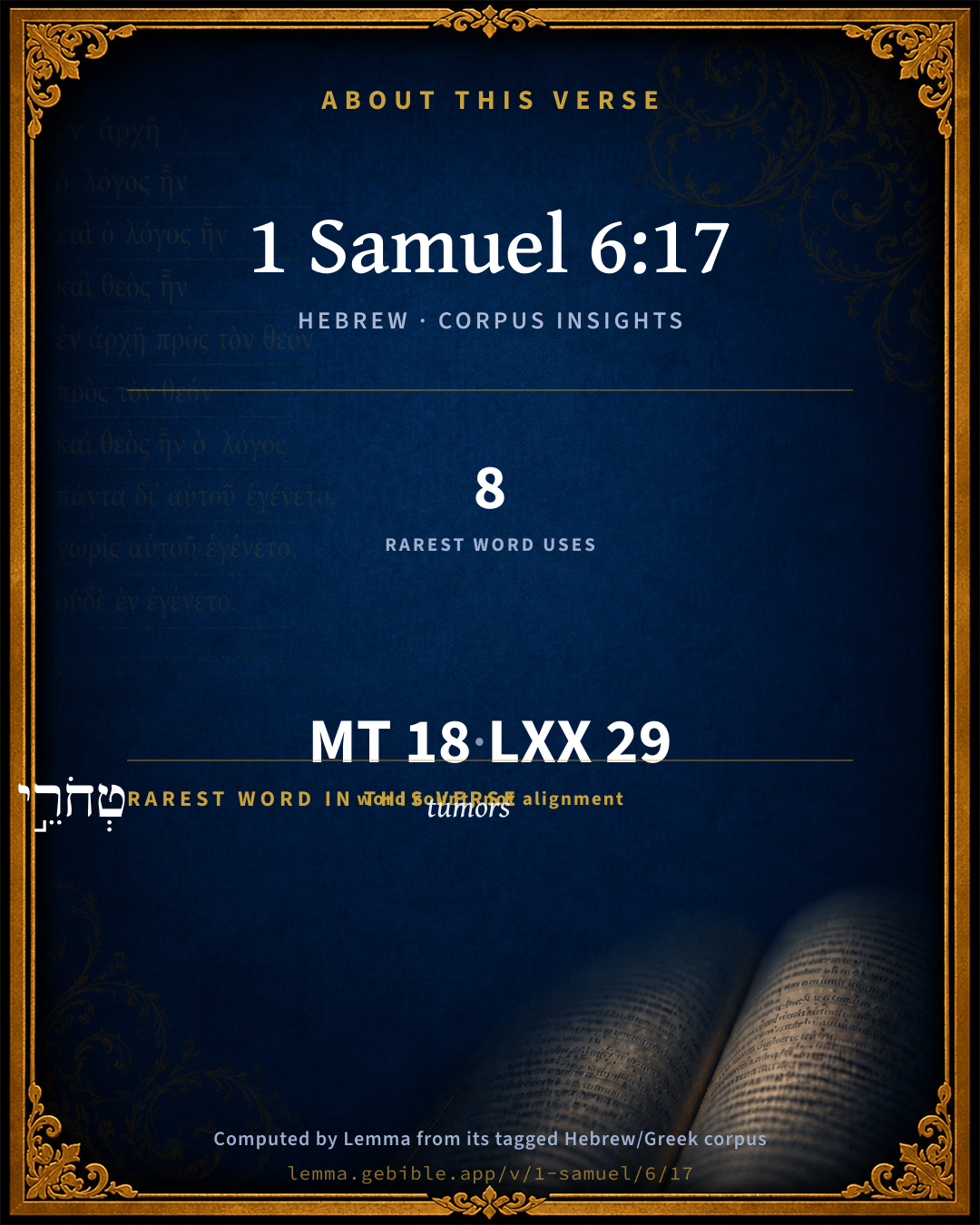
The rarest word here is טְחֹרֵ֣י tumors H2914 — appearing just 8 times in the whole Hebrew Bible.

Shared distinctive vocabulary

טְחֹרֵ֣י tumors H2914 occurs in 8 verses of the Hebrew Bible. Also found in:

Grammatical profile

  • 1 verb
  • 10 nouns
  • 5 adjectives
  • 1 pronoun
  • 1 particle

Verb forms

  • הֵשִׁ֧יבוּ Hiphil · Perfect

Repetition

A word recurs within this verse — often emphatic in Hebrew:

  • אֶחָ֜ד one H259 ×5

Hebrew & Septuagint length

In English translation the verse runs 29 words from the Hebrew and 34 from the Septuagint (LXX English) — closely comparable.

A rough comparison of the two English renderings, which tokenize alike — not a word-level alignment.

Word counts can differ between the Hebrew and the Greek without any difference in meaning — e.g. the Hebrew direct-object marker אֵת has no separate Greek word, and Greek often adds the article ὁ.

In the original languages it is 18 Hebrew tokens and 29 Greek tokens — but the two are counted differently (Hebrew bundles its prefixes and suffixes into one token; the Greek is in lemma form), so that isn’t a like-for-like length.

Cross-references

15

Topical passages linked to 1 Samuel 6:17 in the Treasury of Scripture Knowledge — connected by theme and wording, ordered by reader-vote popularity; previews shown in the World English Bible.

  • 2 Samuel 1:20 Don't tell it in Gath, Don't publish it in the streets of Ashkelon; Lest the daughters of the Philistines rejoice, Lest the daughters of the uncircumcised triumph.
  • Judges 1:18 Also Judah took Gaza with the border of it, and Ashkelon with the border of it, and Ekron with the border of it.
  • Judges 16:1 Samson went to Gaza, and saw there a prostitute, and went in to her.
  • Judges 16:21 The Philistines laid hold on him, and put out his eyes; and they brought him down to Gaza, and bound him with fetters of brass; and he did grind in the prison-house.
  • 1 Samuel 5:1 Now the Philistines had taken the ark of God, and they brought it from Ebenezer to Ashdod.
  • 1 Samuel 5:8 They sent therefore and gathered all the lords of the Philistines to them, and said, What shall we do with the ark of the God of Israel? They answered, Let the ark of the God of Israel be carried about to Gath. They carried the ark of the God of Israel [there].
  • 1 Samuel 5:10 So they sent the ark of God to Ekron. It happened, as the ark of God came to Ekron, that the Ekronites cried out, saying, They have brought about the ark of the God of Israel to us, to kill us and our people.
  • 1 Samuel 6:4 Then they said, "What shall be the trespass-offering which we shall return to him?" They said, "Five golden tumors, and five golden mice, [according to] the number of the lords of the Philistines; for one plague was on you all, and on your lords.
  • 2 Samuel 21:22 These four were born to the giant in Gath; and they fell by the hand of David, and by the hand of his servants.
  • 2 Kings 1:2 Ahaziah fell down through the lattice in his upper chamber that was in Samaria, and was sick: and he sent messengers, and said to them, Go, inquire of Baal Zebub, the god of Ekron, whether I shall recover of this sickness.
  • 2 Chronicles 26:6 He went forth and warred against the Philistines, and broke down the wall of Gath, and the wall of Jabneh, and the wall of Ashdod; and he built cities in [the country of] Ashdod, and among the Philistines.
  • Jeremiah 25:20 and all the mixed people, and all the kings of the land of the Uz, and all the kings of the Philistines, and Ashkelon, and Gaza, and Ekron, and the remnant of Ashdod;
  • Amos 1:7–8 But I will send a fire on the wall of Gaza, And it will devour its palaces.
  • Amos 6:2 Go to Calneh, and see; And from there go to Hamath the great; Then go down to Gath of the Philistines. Are they better than these kingdoms? Or is their border greater than your border?
  • Zechariah 9:5–6 Ashkelon will see it, and fear; Gaza also, and will writhe in agony; As will Ekron, for her expectation will be disappointed; And the king will perish from Gaza, And Ashkelon will not be inhabited.

Cross-references courtesy of OpenBible.info (CC BY 4.0).

Hebrew and Greek witnesses Masoretic Hebrew ↔ Greek Septuagint

The same verse in the two great witnesses to the Old Testament, shown verse-for-verse.

These are two independent witnesses, not word-aligned to each other, and the Septuagint is shown in lemma (dictionary) form.

Hebrew 1 Samuel 6:17 Masoretic · Westminster Leningrad Codex

וְאֵ֨לֶּה֙ טְחֹרֵ֣י הַזָּהָ֔ב אֲשֶׁ֨ר הֵשִׁ֧יבוּ פְלִשְׁתִּ֛ים אָשָׁ֖ם לַֽיהוָ֑ה לְאַשְׁדּ֨וֹד אֶחָ֜ד לְעַזָּ֤ה אֶחָד֙ לְאַשְׁקְל֣וֹן אֶחָ֔ד לְגַ֥ת אֶחָ֖ד לְעֶקְר֥וֹן אֶחָֽד

These are the golden tumors which the Philistines returned for a trespass-offering to Yahweh: for Ashdod one, for Gaza one, for Ashkelon one, for Gath one, for Ekron one;

World English Bible · Public Domain

Greek LXX 1 Samuel 6:17 Septuagint · lemma form

καί οὗτος ὁ ἕδρα ὁ χρυσοῦς ὅς ἀποδίδωμι ὁ ἀλλόφυλος ὁ βάσανος ὁ κύριος ὁ ἄζωτος εἷς ὁ γάζα εἷς ὁ ἀσκαλών εἷς ὁ γεθ εἷς ὁ ακκαρων εἷς

And these are the golden tumors which the lords of the Philistines gave as a trespass-offering to the Lord; for Azotus one, for Gaza one, for Ascalon one, for Geth one, for Accaron one.

LXX2012 (modern English Septuagint) · Public Domain

On this verse, The Pulpit Commentary discusses the Septuagint’s reading. Read the note in Commentary ↓

Hebrew: Westminster Leningrad Codex (CC BY 4.0). Greek: Septuagint (public domain); English from LXX2012 (modern English Septuagint) (Public Domain). How the Septuagint differs from the Hebrew →

Targum (Aramaic paraphrase)

1

The Targum is the ancient Jewish Aramaic paraphrase of the Hebrew Scriptures — an interpretive translation, not the Hebrew text itself. Onkelos (literal) and Pseudo-Jonathan (expansive) render the Torah, and Jonathan the Prophets. Coverage is partial: where no permissively-licensed English translation exists for a verse, only the Aramaic is shown. This is verse-level text, not a word-by-word alignment to the Hebrew.

  1. Targum Jonathan Prophets (Joshua–Malachi)
    וְאִלֵין טְחוֹרֵי דַהֲבָא דַאֲתִיבוּ פְלִשְׁתָּאֵי קֻרְבַן אֲשָׁמָא קֳדָם יְיָ דְאַשְׁדוֹד חַד דְעַזָה חַד דְאַשְׁקְלוֹן חַד דְגַת חַד דְעֶקְרוֹן חַד:

    (no public-domain English translation for this verse)

    Targum Jonathan — Aramaic: “Mikraot Gedolot” (public domain). English: “Sefaria Community Translation” (CC0 1.0 (public-domain dedication)); “London "Chaldee Paraphrase," 1871” (public domain). Text via Sefaria.

Commentary

Notes on 1 Samuel 6:17 from classic Christian and Jewish commentators (each source and its license shown beneath its notes). The classic Christian expositions comment on the surrounding passage and are grouped to its opening verse, so a note may address several verses; the Jewish commentaries on the Tanakh (Rashi and others) are per-verse, so they appear only where the commentator wrote on this verse.

Lemma curates 59 commentaries, every one of them public domain or Creative Commons licensed, each selected and text-cleaned for this edition rather than reprinted as found. About our sources →

Trapp's Complete Commentary

John Trapp

1Sa 6:17 And these [are] the golden emerods which the Philistines returned [for] a trespass offering unto the LORD; for Ashdod one, for Gaza one, for Askelon one, for Gath one, for Ekron one;

Ver. 17. And these are the golden emerods.] These the Israelites either kept whole for monuments and memorials, as they did the censors of Korah and his complices; or else they made golden vessels of them for the sanctuary.

John Trapp, A Commentary or Exposition upon All the Books of the Old and New Testament (1647–1656) — public domain. Text from a community e-Sword module.

Tyndale Open Study Notes

Tyndale Open Resources

6:17 guilt offering: See study note on 6:3. • Ashdod, Gaza, Ashkelon, Gath, and Ekron: These five major Philistine cities were located on or near the Great Trunk Road. This major ancient trade route connected Egypt with Mesopotamia via the coastal plain of Canaan. Each city was governed by a king-like ruler (6:16).

Tyndale Open Study Notes — © Tyndale Open Resources, licensed CC BY-SA 4.0. Text via the HelloAO Bible API.

Geneva Bible (1599)

Geneva Bible translators

These were the five principal cities of the Philistines, which were not all conquered unto the time of David.

Geneva Bible (1599) marginal notes — public domain. Text via Bolls.life.

Jamieson, Fausset & Brown

Robert Jamieson, A. R. Fausset & David Brown

And these are the golden emerods . . . and the mice--There were five representative images of the emerods, corresponding to the five principal cities of the Philistines. But the number of the golden mice must have been greater, for they were sent from the walled towns as well as the country villages.

Jamieson, Fausset & Brown — Commentary Critical and Explanatory on the Whole Bible (1871) — public domain (CC PDM 1.0). Text via the HelloAO Bible API.

Adam Clarke's Commentary

Verse 17. These are the golden emerods] Each of these cities, in what may be called its corporate capacity, sent a golden emerod.

Adam Clarke's Commentary on the Bible (1810–1826) — public domain. Text from a community e-Sword/MySword module.

Ellicott's Commentary for English Readers

(17) The golden emerods.—The offering of the golden emerods (or tumours), including one for each of the five principal cities. In the preceding chapter only Ashdod, Gath, and Ekron are mentioned as abiding places of the Ark, but there is no doubt that during the “seven months” the sacred chest was for a long or short period located in each of the five towns, in the Dagon temple which each of the cities possessed.

A Bible Commentary for English Readers, edited by Charles John Ellicott (1878–1897) — public domain. Text from a community e-Sword module.

The Cambridge Bible for Schools and Colleges

gen. ed. J. J. S. Perowne

17, 18. We have here a specific description of the propitiatory offering actually sent; (a) a golden “boil” for each chief city: (b) a golden mouse for each city and village throughout the whole country. The apparent discrepancy between the latter statement and 1Sa_6:4 vanishes if we regard 1Sa_6:4 as merely the proposal of the priests, and 1Sa_6:18 as a description of what was actually done. The reason for the offering of mice from the whole country probably was that the plague of mice had ravaged the whole country, while the pestilence was chiefly confined to the great cities.

fenced cities] Fortified or walled cities, contrasted with the “country villages” or unwalled towns. Cp. Deu_3:5.

even unto the great [stone of] Abel] If the present Heb. text is correct, Abel (= “lamentation”) must be regarded as a proper name given to the great stone in Joshua’s field from the lamentation for the disaster recorded in 1Sa_6:19. But there is no mention of such a name having been given to it: it is scarcely natural that this stone should be taken as the boundary of the land of the Philistines: and the sentence as it stands is ungrammatical. It seems best to follow the Targum and Sept. in reading “stone” instead of Abel, and to make a slight further alteration of the text, by which we obtain good sense and grammar: either (a) “And the great stone whereon they set down the ark of the Lord is a witness unto this day in the field of Joshua the Beth-shemeshite.” (Cp. Gen_31:52): or (b) “The great stone … remaineth unto this day.”

The Cambridge Bible for Schools and Colleges (gen. ed. J. J. S. Perowne; Cambridge University Press, 1878–1918) — public domain. Text from a community e-Sword module.

John Gill's Exposition

And these are the golden emerods, which the Philistines returned for a trespass offering unto the Lord,.... Along with the ark:

for Ashdod one, for Gaza one, for Ashkelon, one, for Gath one, for Ekron one; which were the five principalities of the Philistines that belonged to the five lords before mentioned; and each of these were at the expense of a golden emerod, and sent it along with the ark to make atonement for the offence they had been guilty of in taking and detaining it.

John Gill's Exposition of the Whole Bible (1746–1763) — public domain (CC PDM 1.0). Text via the HelloAO Bible API.

The Pulpit Commentary

Vers. 17, 18. The golden emerods. We have here and in ver. 18 an enumeration of the gifts differing from, without being at variance with, that in ver. 4. They are still five golden emerods, for which the name here is not ophalim, but tehorim, the word always read in the synagogue. (see 1Sa_5:6) From its use in the cognate languages it is pretty certain that it is rightly translated in our version. But besides these there were golden mice, according to the number of all the cities, etc. The priests had named only five mice, one for each of the lords of the Philistines; but the eagerness of the people outran their suggestion, and not only the fenced towns, but even the unwalled villages sent their offering, lest they should still be chastised. Country villages. Literally, "the village" or "hamlet of the Perazi." The Septuagint, a trustworthy authority in such matters, makes the Perazi the same as the Perizzite. Both words really signify "the inhabitant of the lowland," i.e. of the plain country of Phoenicia; but from Zec_2:4, where Perazoth is translated "towns without walls," and Eze_38:11, where it is rendered "unwalled villages," we may conclude that it had come popularly to mean an open village, though literally, in both these places, it means "the hamlets of the lowland." Even unto the great stone of Abel, etc. All this part of the verse is exceedingly corrupt, and requires large interpolations to obtain from it any meaning. Both the Vulgate and the Syriac retain the unmeaning word Abel; but the Septuagint gives us what is probably the true reading: "and the great stone whereon they set the ark of Jehovah, which is in the field of Joshua the Beth-shemeshite, is a witness unto this day". (comp. Gen_31:52; Isa_30:8)

Vers. 17-21.

Trophies and chastisement.

The facts are

1. An enumeration by the Israelites of the golden images sent with the ark.

2. A terrible chastisement on the men of Beth-shemesh for their profane curiosity.

3. An effort to send the ark away, consequent on the terror created. Theseclosing incidents of the restoration introduce for consideration

I The TROPHIES WON IN THE CONFLICT WITH foes of the Church of God. The golden emerods and mice were expressions of pagan superstition, and yet of submission to the superior power of Jehovah. In so far as they represented the five lords of the country, they were, in the eyes of Israel, evidence of the extent to which the might of Jehovah had been recognised. As the pot of manna and Aaron"s rod were kept as memorials of what God had done, and prophetic of what he would do, so these images were noted in the annals of the time as signs of the same power in conquest. The remembrance of them would inspire courage, and also suggest due fear. The Church of Christ has won many trophies. Christ himself has led "captivity captive." He has in many instances snatched learning, science, art, statesmanship, and literature from the hand of the enemy, and made them contribute to the splendour of his kingdom. The extent to which trophies have been gathered deserves a register as truly as that given of the offerings of the Philistine lords. A calm reflection on this subject will inspire the Church for new efforts, and awaken gratitude for the past.

II CHASTISEMENT FOR SINS OF PROFANITY. The joy of restoration was soon beclouded by the sorrow of death. The death of seventy men for the sin of treating the ark of God profanely raises the question of what there can be in such sins to merit so severe a chastisement. A general answer to such a question is that we are not in a position to determine for God the form, time, or extent of punishment due to sin. None can adjudge sin correctly but the perfectly holy One. There may be far more in an act than comes to the surface. Hence a reverent spirit is mostly concerned to know the fact. But there are a few considerations which may throw a little light on the apparent severity of the chastisement.

1. The essential evil of the sin. Much difficulty arises from not considering that some sins, and this especially, are a most virulent moral poison. They are at the very antipodes to the true spirit of love and obedience. Hence the dire consequences of their prevalence come more sharply into view when we remember the special contagion of example in such cases as these; for profanity of spirit is easily caught from example, and at once lowers the entire nature of a man.

2. The liability to fall into it. Not only is the sin heinous, and spread by example, but there is a predisposition to it which gives to the slightest encouragement from without double power. The evil already in man is good soil for such seed. If a sinful nature means aversion to a holy God, then it requires only a small encouragement to turn that aversion into the positive form of disregard of the Divine presence.

3. The privileges of the transgressors. Punishment is always proportionate to privilege abused. As officials in the service of God, the Levites were doubly criminal. Those who grow up amidst the sanctities and quiet reverence of the sanctuary or pious home commit deadly sin when they think or act towards God profanely. Had we all the details of the behaviour of the men of Beth-shemesh, no doubt the grossness of their conduct would stand out in fearful contrast with the privileges they had enjoyed as servants of the altar.

4. The bearing on ages to come. Every sin bears on the future, and so does its punishment. The deterrent effect of punishment is important; and its infliction with this reference is equitable, seeing that the sin acts on others and in ages to come. The effect of the death of the men at Beth-shemesh was seen in the salutary fear that came on all. "This holy Lord God! It was a great gain to the world to have driven home this great truth. Nor would the effect end there. God has taught the entire world by the terrible things in righteousness which have been recorded. Here is one of the means of the education of the future race. Men are more reverent for what they read in the Old Testament.

5. The infliction of death is a prerogative of God. God sets the appointed time. Temporal death is not less of God when it comes gradually. Its direct infliction is the form in which he marks his disfavour and impresses his creatures. If seventy men sin, and commit in the civil religious state of Israel a capital crime, (Num_4:5, Num_4:15, Num_4:20) they of course must pay the prescribed penalty. It is an awful thing to die by the sudden stroke of God, but a more awful thing to be in a state of mind to deserve it. Practical lessons:

1. Let us keep watch over the first risings of a spirit of levity.

2. Cultivate in young and old, by all conceivable means, reverence for allthings connected with the worship of God.

3. Remember that the severity of God is really mercy to his creatures as awhole.

The Pulpit Commentary (1880–1919), ed. H.D.M. Spence-Jones & Joseph S. Exell — public domain. Text from a community e-Sword module.

unfoldingWord translationNotes

Door43 World Missions Community

tumors

Possible meanings are 1) painful swelling under the skin or 2) hemorrhoids. See how you translated this in 1 Samuel 5:6.

mice

Translated this as in 1 Samuel 6:4.

fortified cities

These are cities with high walls around them to protect the people inside from attack by their enemies.

The great stone ... remains a witness

The stone is referred to as if it is a person who can see. AT: "The great stone ... is still there, and people remember what happened on it" (See: Personification)

Joshua

man's name (See: How to Translate Names)

the Bethshemite

This is what a person from Beth Shemesh is called. AT: "from Beth Shemesh" (See: How to Translate Names)

to this day

to the time at which the writer wrote the book

translationWords

guilt offering

Ashdod

Gaza

Ashkelon

Gath

Ekron

stronghold

testimony

unfoldingWord translationNotes — © Distant Shores Media and the Door43 World Missions Community, licensed CC BY-SA 4.0. Source: git.door43.org/Door43/en_tn.

Lesson kit

Teaching starters — assembled from the data on this page, not authored interpretation. Every prompt links to the verse data it draws on. Edit before teaching.

1 Samuel, in the Historical, opens this verse with 18 words (14 distinct Hebrew lemmas). Its most distinctive word is ṭᵉchôr (“tumors”). A historical commentator’s framing appears above. Read the whole chapter for the surrounding context.

Discussion questions

  1. What does “tumors” (ṭᵉchôr) contribute to the verse as a whole?
  2. Deuteronomy 28:27 shares the word «tumors» with this verse. How do the two illuminate each other?
  3. “one” occurs 5× in this one verse. What is the effect of the repetition?
  4. The translations on this page render this verse differently — a whole-verse word diff, not a word-by-word alignment. What might account for the different wordings?
  5. The verb «הֵשִׁ֧יבוּ» is Hiphil Perfect. How does its form color the action?
  6. Reading how Trapp's Complete Commentary and Tyndale Open Study Notes read this verse, where do the two commentators agree and where do they part?

Things to notice

Reading settings

Reading text

Shown beneath each verse's original-language words.

Old Testament
Old Testament edition

Read the OT as the Masoretic Hebrew (MT) or the Greek Septuagint (LXX).

English shown for the Greek Septuagint (in the Hebrew ↔ Greek comparison).

Comparing translations? Open the Compare panel on any verse page to stack up to four side by side.