1 Samuel 22:20

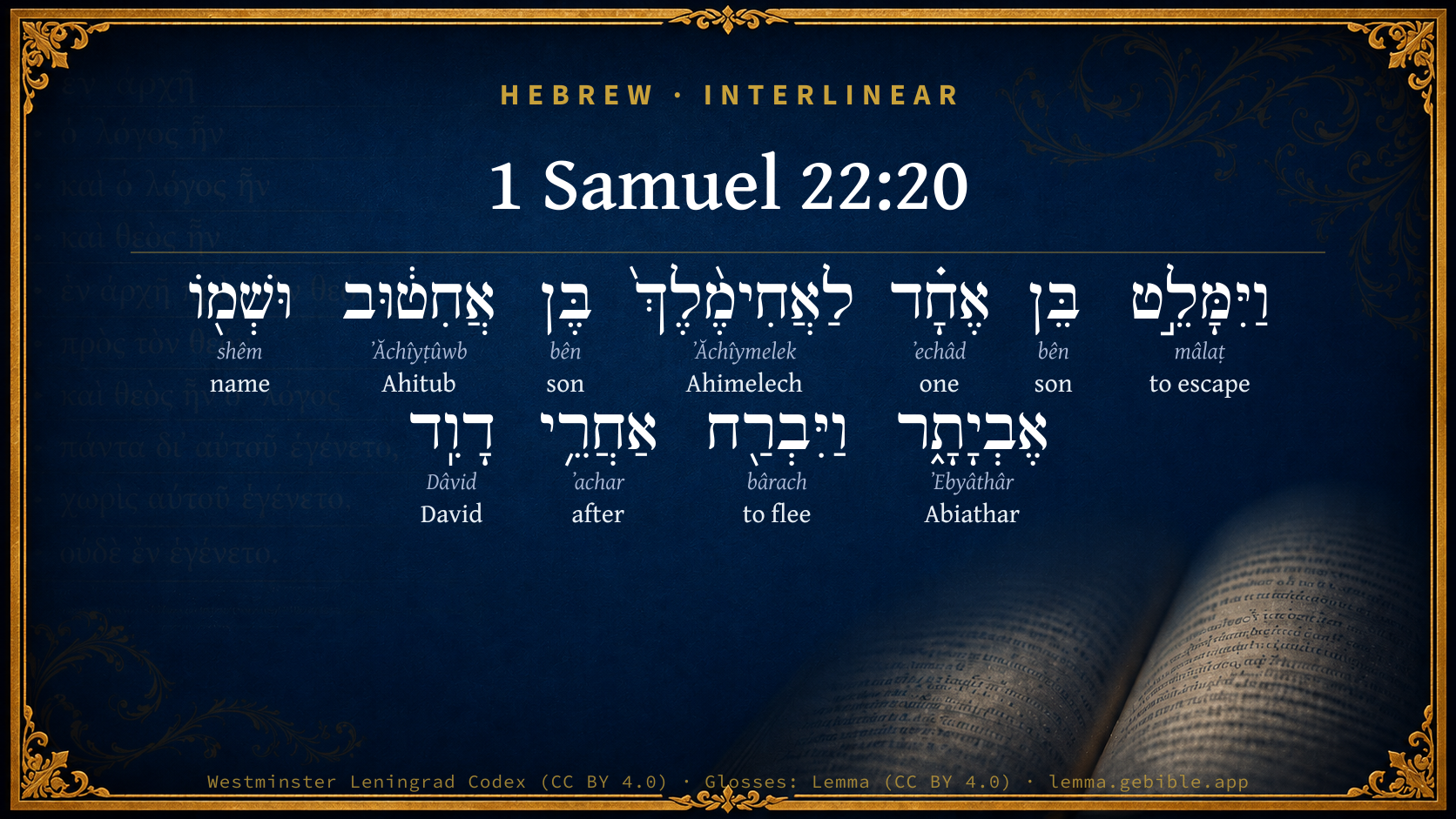
Hebrew (Westminster Leningrad Codex) 1 Samuel 22:20 appears in the Hebrew Old Testament. The text above is from the Westminster Leningrad Codex. Each word links to its Strong’s number, a concise gloss, and parsing drawn from the Open Scriptures Hebrew Bible morphology. Click any word for its full Brown-Driver-Briggs (BDB) entry.
Download image
Cite this verse

1 Samuel 22:20 (World English Bible). Public Domain. Lemma interlinear Bible study tool, https://lemma.gebible.app/v/1-samuel/22/20.

Show BibTeX & RIS
BibTeX
RIS
English Translation
One of the sons of Ahimelech, the son of Ahitub, named Abiathar, escaped, and fled after David.
World English Bible · Public Domain
Highlights
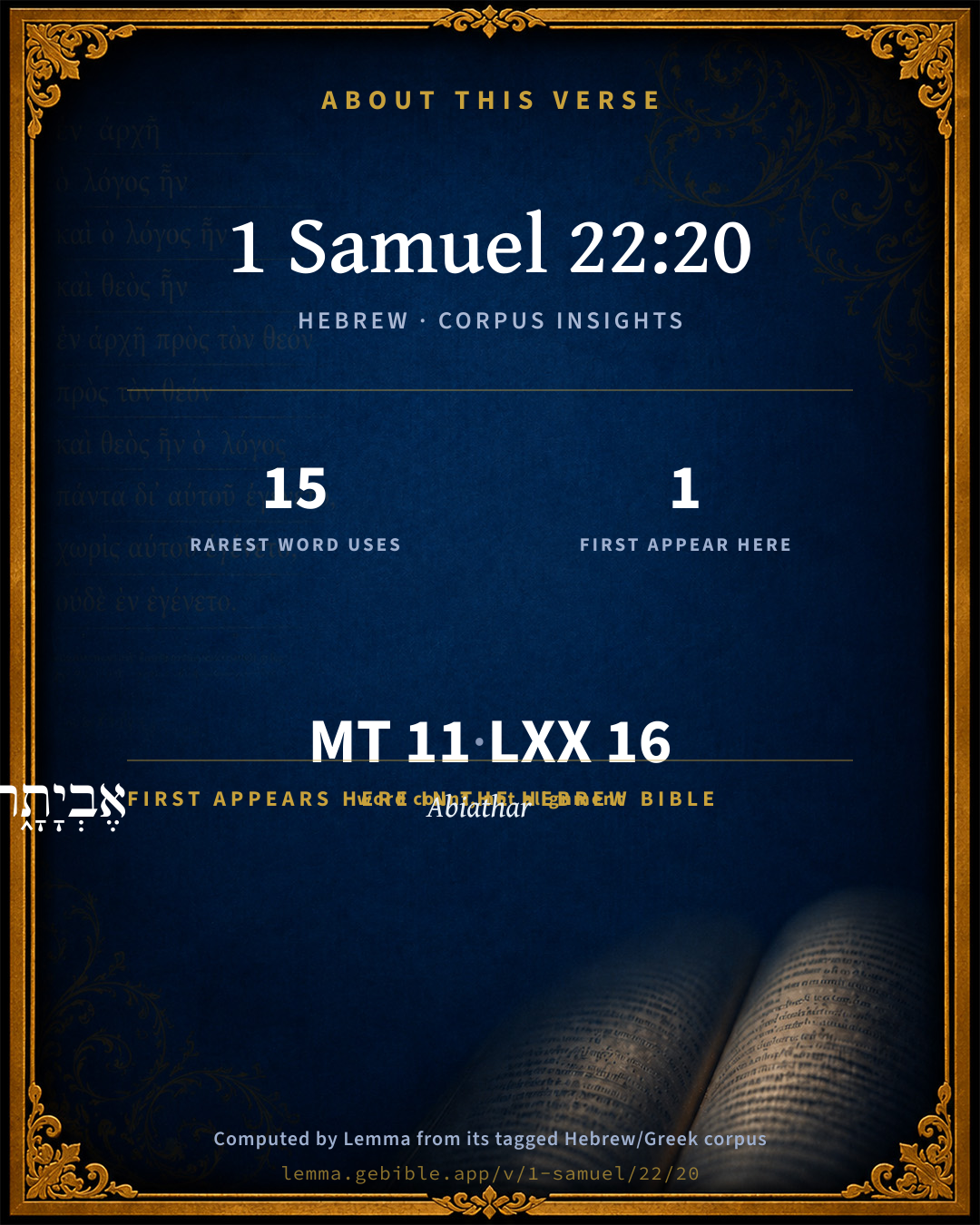
  • 1 first appearance in the Hebrew Bible
Full analysis ↓
Download a study sheet

One document with this verse’s original text, its word-by-word gloss line, the meaning frame, cross-references with their text, attributed commentary, and full source and license credits — printable, and it pastes into notes with its structure intact.

This verse Autodidact and up

Study sheet (.html) Plain text (.txt)

A passage Seminary Student

Up to 50 verses in one chapter. A passage sheet keeps up to 6 commentary sources and 12 cross-references per verse, in the order this page ranks them, and says so on the sheet whenever that leaves anything out. Ask for a single verse and you get the Autodidact verse sheet above.

Everything on this page stays free to read, with no account — the sheet is a download of what is already on screen, not access to it.

Want to remove ads? Support Godless Engineer
Compare translations 3

The same verse in 3 English versions, stacked beneath the original-language interlinear above. Click any original word for its lexicon entry.

Each is an independent rendering of the whole verse — the interlinear is not word-aligned to these translations.

Highlighted words mark where these versions differ — a whole-verse word diff, not a word-by-word alignment.

  • World English Bible Public Domain
    One of the sons of Ahimelech, the son of Ahitub, named Abiathar, escaped, and fled after David.
  • King James Version Public Domain
    And one of the sons of Ahimelech the son of Ahitub, named Abiathar, escaped, and fled after David.
  • unfoldingWord Literal Text CC BY-SA 4.0
    But a son of one to Ahimelech, the son of Ahitub, escaped, and his name Abiathar. And he fled after David.

unfoldingWord Literal Text — © unfoldingWord, licensed CC BY-SA 4.0. Word-aligned USFM3 via Door43 (git.door43.org/unfoldingWord/en_ult).

Versions to compare (up to 4)

3 of 4 selected

Show all 18 translations

Every available English version of this verse, each an independent rendering of the whole verse.

  • World English Bible Public Domain
    One of the sons of Ahimelech, the son of Ahitub, named Abiathar, escaped, and fled after David.
  • Berean Standard Bible Public Domain
    But one of the sons of Ahimelech son of Ahitub escaped. His name was Abiathar, and he fled to David.
  • Majority Standard Bible Public Domain
    But one of the sons of Ahimelech son of Ahitub escaped. His name was Abiathar, and he fled to David.
  • King James Version Public Domain
    And one of the sons of Ahimelech the son of Ahitub, named Abiathar, escaped, and fled after David.
  • American Standard Version (1901) Public Domain
    And one of the sons of Ahimelech, the son of Ahitub, named Abiathar, escaped, and fled after David.
  • Revised Version (1885) Public Domain
    And one of the sons of Ahimelech the son of Ahitub, named Abiathar, escaped, and fled after David.
  • Geneva Bible (1599) Public Domain
    But one of the sonnes of Ahimelech the sonne of Ahitub (whose name was Abiathar) escaped and fled after Dauid.
  • Douay-Rheims (1899) Public Domain
    But one of the sons of Achimelech the son of Achitob, whose name was Abiathar, escaped, and fled to David,
  • Young's Literal Translation Public Domain
    And there escapeth one son of Ahimelech, son of Ahitub, and his name `is' Abiathar, and he fleeth after David,
  • Literal Standard Version CC BY-SA 4.0
    And one son of Ahimelech, son of Ahitub, escapes, and his name [is] Abiathar, and he flees after David,
  • Unlocked Literal Bible CC BY-SA 4.0
    But one of the sons of Ahimelech son of Ahitub, named Abiathar, escaped and fled after David.
  • unfoldingWord Literal Text CC BY-SA 4.0
    But a son of one to Ahimelech, the son of Ahitub, escaped, and his name Abiathar. And he fled after David.
  • Darby Bible Public Domain
    And one of the sons of Ahimelech the son of Ahitub, named Abiathar, escaped, and fled after David.
  • World Messianic Bible Public Domain
    One of the sons of Ahimelech the son of Ahitub, named Abiathar, escaped and fled after David.
  • Webster's Bible Public Domain
    And one of the sons of Ahimelech the son of Ahitub, named Abiathar, escaped, and fled after David.
  • Free Bible Version CC BY-SA 4.0
    But one of the sons of Ahimelech, son of Ahitub, managed to escape. His name was Abiathar, and he ran away and joined David.
  • Bible in Basic English Public Domain
    And Abiathar, one of the sons of Ahimelech, the son of Ahitub, got away and went in flight after David;
  • JPS Tanakh (1917) Public Domain
    And one of the sons of Ahimelech the son of Ahitub, named Abiathar, escaped, and fled after David.

Literal Standard Version (2020), Covenant Press — licensed CC BY-SA 4.0. Text via the HelloAO Bible API (eBible.org). Unlocked Literal Bible (unfoldingWord) — licensed CC BY-SA 4.0. Text via the HelloAO Bible API (eBible.org). unfoldingWord Literal Text — © unfoldingWord, licensed CC BY-SA 4.0. Word-aligned USFM3 via Door43 (git.door43.org/unfoldingWord/en_ult). Free Bible Version, Dr. Jonathan Gallagher — licensed CC BY-SA 4.0. Text via the HelloAO Bible API (eBible.org).

Word by word

More ways to search: Search by grammar → Find every occurrence → Compare this word →

Practice this passage: Drill this verse → Learn its vocabulary →

אֲחִט֔וּב
ʼĂchîyṭûwb
H285
“Ahitub”
Noun, Proper
Part of Speech
Noun
Type
Proper
Full BDB Definition

Origin: from H251 and H2898

TWOT: None

Ahitub = "my brother is good (goodness)" - a grandson of Eli - the father of Zadok the priest
  1. וַיִּמָּלֵ֣ט mâlaṭ H4422 “and · to escape” Conjunction + Verb, Niphal, Sequential Imperfect, 3rd Person, Masculine, Singular
  2. בֵּן bên H1121 “son” Noun, Common, Masculine, Singular, Absolute
  3. אֶחָ֗ד ʼechâd H259 “one” Adjective, Cardinal number, Masculine, Singular, Absolute
  4. לַאֲחִימֶ֨לֶךְ֙ ʼĂchîymelek H288 “to/for · Ahimelech” Preposition + Noun, Proper
  5. בֶּן bên H1121 “son of” Noun, Common, Masculine, Singular, Construct
  6. וּשְׁמ֖וֹ shêm H8034 “and · name · his” Conjunction + Noun, Common, Masculine, Singular, Construct + Suffix, Personal, 3rd Person, Masculine, Singular
  7. אֶבְיָתָ֑ר ʼEbyâthâr H54 “Abiathar” Noun, Proper
  8. וַיִּבְרַ֖ח bârach H1272 “and · to flee” Conjunction + Verb, Qal, Sequential Imperfect, 3rd Person, Masculine, Singular
  9. אַחֲרֵ֥י ʼachar H310 “after” Preposition
  10. דָוִֽד Dâvid H1732 “David” Noun, Proper

About this verse

These counts appear in no published source. They are computed here, from the morphology-tagged text and Lemma’s own curated glosses. What Lemma adds →

11
words
10
distinct lemmas
Historical
section

Notable vocabulary

The rarest word here is אֲחִט֔וּב Ahitub H285 — appearing just 15 times in the whole Hebrew Bible.

First appearance in Scripture

This word makes its first canonical appearance in the Hebrew Bible here:

  • אֶבְיָתָ֑ר Abiathar H54

Shared distinctive vocabulary

אֲחִט֔וּב Ahitub H285 occurs in 15 verses of the Hebrew Bible. Also found in:

Grammatical profile

  • 2 verbs
  • 7 nouns
  • 1 adjective
  • 1 preposition

Verb forms

  • וַיִּמָּלֵ֣ט Niphal · Sequential Imperfect
  • וַיִּבְרַ֖ח Qal · Sequential Imperfect

Repetition

A word recurs within this verse — often emphatic in Hebrew:

Hebrew & Septuagint length

In English translation the verse runs 17 words from the Hebrew and 19 from the Septuagint (LXX English) — closely comparable.

A rough comparison of the two English renderings, which tokenize alike — not a word-level alignment.

Word counts can differ between the Hebrew and the Greek without any difference in meaning — e.g. the Hebrew direct-object marker אֵת has no separate Greek word, and Greek often adds the article ὁ.

In the original languages it is 11 Hebrew tokens and 16 Greek tokens — but the two are counted differently (Hebrew bundles its prefixes and suffixes into one token; the Greek is in lemma form), so that isn’t a like-for-like length.

Cross-references

9

Topical passages linked to 1 Samuel 22:20 in the Treasury of Scripture Knowledge — connected by theme and wording, ordered by reader-vote popularity; previews shown in the World English Bible.

  • 1 Samuel 23:6 It happened, when Abiathar the son of Ahimelech fled to David to Keilah, that he came down with an ephod in his hand.
  • 1 Samuel 30:7 David said to Abiathar the priest, the son of Ahimelech, Please bring me here the ephod. Abiathar brought there the ephod to David.
  • 1 Samuel 2:33 The man of yours, [whom] I shall not cut off from my altar, [shall be] to consume your eyes, and to grieve your heart; and all the increase of your house shall die in the flower of their age.
  • 1 Samuel 23:9 David knew that Saul was devising mischief against him; and he said to Abiathar the priest, Bring here the ephod.
  • 1 Kings 2:26–27 To Abiathar the priest said the king, Get you to Anathoth, to your own fields; for you are worthy of death: but I will not at this time put you to death, because you bear the ark of the Lord Yahweh before David my father, and because you were afflicted in all in which my father was afflicted.
  • 1 Samuel 4:12 There ran a man of Benjamin out of the army, and came to Shiloh the same day, with his clothes torn, and with earth on his head.
  • Job 1:19 and, behold, there came a great wind from the wilderness, and struck the four corners of the house, and it fell on the young men, and they are dead. I alone have escaped to tell you."
  • 2 Samuel 20:25 and Sheva was scribe; and Zadok and Abiathar were priests;
  • Job 1:15–17 and the Sabeans attacked, and took them away. Yes, they have killed the servants with the edge of the sword, and I alone have escaped to tell you."

Cross-references courtesy of OpenBible.info (CC BY 4.0).

Hebrew and Greek witnesses Masoretic Hebrew ↔ Greek Septuagint

The same verse in the two great witnesses to the Old Testament, shown verse-for-verse.

These are two independent witnesses, not word-aligned to each other, and the Septuagint is shown in lemma (dictionary) form.

Hebrew 1 Samuel 22:20 Masoretic · Westminster Leningrad Codex

וַיִּמָּלֵ֣ט בֵּן אֶחָ֗ד לַאֲחִימֶ֨לֶךְ֙ בֶּן אֲחִט֔וּב וּשְׁמ֖וֹ אֶבְיָתָ֑ר וַיִּבְרַ֖ח אַחֲרֵ֥י דָוִֽד

One of the sons of Ahimelech, the son of Ahitub, named Abiathar, escaped, and fled after David.

World English Bible · Public Domain

Greek LXX 1 Samuel 22:20 Septuagint · lemma form

καί διασώζω υἱός εἷς ὁ αβιμελεχ υἱός αχιτωβ καί ὄνομα αὐτός αβιαθαρ καί φεύγω ὀπίσω δαυίδ

And one son of Abimelech son of Achitob escapes, and his name was Abiathar, and he fled after David.

LXX2012 (modern English Septuagint) · Public Domain

On this verse, The Pulpit Commentary discusses the Septuagint’s reading. Read the note in Commentary ↓

Hebrew: Westminster Leningrad Codex (CC BY 4.0). Greek: Septuagint (public domain); English from LXX2012 (modern English Septuagint) (Public Domain). How the Septuagint differs from the Hebrew →

Targum (Aramaic paraphrase)

1

The Targum is the ancient Jewish Aramaic paraphrase of the Hebrew Scriptures — an interpretive translation, not the Hebrew text itself. Onkelos (literal) and Pseudo-Jonathan (expansive) render the Torah, and Jonathan the Prophets. Coverage is partial: where no permissively-licensed English translation exists for a verse, only the Aramaic is shown. This is verse-level text, not a word-by-word alignment to the Hebrew.

  1. Targum Jonathan Prophets (Joshua–Malachi)
    וְאִשְׁתֵּיזֵיב בְּרָא חֲדָא לַאֲחִימֶלֶךְ בַּר אֲחִטוּב וּשְׁמֵיהּ אֶבְיָתָר וַעֲרַק בָּתַר דָוִד:

    (no public-domain English translation for this verse)

    Targum Jonathan — Aramaic: “Mikraot Gedolot” (public domain). English: “Sefaria Community Translation” (CC0 1.0 (public-domain dedication)); “London "Chaldee Paraphrase," 1871” (public domain). Text via Sefaria.

Commentary

Notes on 1 Samuel 22:20 from classic Christian and Jewish commentators (each source and its license shown beneath its notes). The classic Christian expositions comment on the surrounding passage and are grouped to its opening verse, so a note may address several verses; the Jewish commentaries on the Tanakh (Rashi and others) are per-verse, so they appear only where the commentator wrote on this verse.

Lemma curates 59 commentaries, every one of them public domain or Creative Commons licensed, each selected and text-cleaned for this edition rather than reprinted as found. About our sources →

Matthew Henry's Commentary

Here is, 1. The escape of Abiathar, the son of Ahimelech, out of the desolations of the priests' city. Probably when his father went to appear, upon Saul's summons, he was left at home to attend the altar, by which means he escaped the first execution, and, before Doeg and his bloodhounds came to Nob, he had intelligence of the danger, and had time to shift for his own safety. And whither should he go but to David? Sa1 22:20. Let those that suffer for the Son of David commit the keeping of their souls to him, Pe1 4:19. 2. David's resentment of the melancholy tidings he brought. He gave David an account of the bloody work Saul had made among the priests of the Lord (Sa1 22:21), as the disciples of John, when their master was beheaded, went and told Jesus, Mat 14:12. And David greatly lamented the calamity itself, but especially his being accessory to it: I have occasioned the death of all the persons of thy father's house, Sa1 22:22. Note, It is a great trouble to a good man to find himself in any way an occasion of the calamities of the church and ministry. David knew Doeg's character so well that he feared he would do some such mischief as this when he saw him at the sanctuary: I knew he would tell Saul. He calls him Doeg the Edomite, because he retained the heart of an Edomite, though, by embracing the profession of the Jewish religion, he had put on the mask of an Israelite. 3. The protection he granted to Abiathar. He perceived him to be terrified, as he had reason to be, and therefore bade him not to fear, he would be as careful for him as for himself: With me thou shalt be in safeguard, Sa1 22:23. David, having now time to recollect himself, speaks with assurance of his own safety, and promises that Abiathar shall have the full benefit of his protection. It is promised to the Son of David that God will hide him in the shadow of his hand (Isa 49:2), and, with him, all that are his may be sure that they shall be in safeguard, Psa 91:1. David had now not only a prophet, but a priest, a high-priest, with him, to whom he was a blessing and they to him, and both a happy omen of his success. Yet it appears (by Psa 28:6) that Saul had a high priest too, for he had a urim to consult: it is supposed that he preferred Ahitub the father of Zadok, of the family of Eleazar (Ch1 6:8), for even those that hate the power of godliness yet will not be without the form. It must not be forgotten here that David at this time penned Psa 52:1-9, as appears by the title of that psalm, wherein he represents Doeg not only as malicious and spiteful, but as false and deceitful, because though what he said was, for the substance of it, true, yet he put false colours upon it, with a design to do mischief. Yet even then, when the priesthood had become as a withered branch, he looks upon himself as a green olive-tree in the house of God, Psa 52:8. In this great hurry and distraction that David was continually in, yet he found both time and a heart for communion with God, and found comfort in it.

Matthew Henry's Commentary on the Whole Bible (1708–1710) — public domain (CC PDM 1.0). Text via the HelloAO Bible API.

Jamieson, Fausset & Brown

Robert Jamieson, A. R. Fausset & David Brown

ABIATHAR ESCAPES AND FLEES AFTER DAVID. (Sa1 22:20-23)

one of the sons of Ahimelech . . . escaped--This was Abiathar, who repaired to David in the forest of Hareth, rescuing, with his own life, the high priest's vestments (Sa1 23:6, Sa1 23:9). On hearing his sad tale, David declared that he had dreaded such a fatal result from the malice and intriguing ambition of Doeg; and, accusing himself as having been the occasion of all the disaster to Abiathar's family, David invited him to remain, because, firmly trusting himself in the accomplishment of the divine promise, David could guarantee protection to him.

Next: 1 Samuel Chapter 23

Jamieson, Fausset & Brown — Commentary Critical and Explanatory on the Whole Bible (1871) — public domain (CC PDM 1.0). Text via the HelloAO Bible API.

Ellicott's Commentary for English Readers

(20) Abiathar.—Of those who dwelt at Nob, only one single priest, Abiathar, Ahimelech’s son, seems to have escaped this general massacre. It has been suggested that when his father and the whole body of priests went to Gibeah, in accordance with the summons of King Saul, Abiathar remained behind to perform the necessary functions in the sanctuary, and when he heard of the death of his father and his brother priests, he made his escape, and eventually joined David. The exact period of his coming to the exiled band under David is uncertain; in many of the recitals in this Book no note of time is given. It is, therefore, probable that the meeting and interview with David—related in 1Sa_22:20 and following verses—did not take place immediately after the massacre at Gibeah, nor even directly after the destruction of Nob. From the statement in 1Sa_22:6 of 1 Samuel 23, it would appear that Abiathar only joined David at Keilah. From that time, however, Abiathar, who became after his father’s death high priest, occupies an important place in the story of David’s life. Throughout his reign he continued his faithful friend, and seems to have been a worthy holder of his important office. The close of his life, however, was a melancholy one. In the troubles which arose about the succession, in the last days of David’s reign, he espoused the side of Adonijah, and was in consequence deposed by the successful Solomon from the high priesthood, and sent into banishment to Anathoth. (See 1Ki_2:26.)

A Bible Commentary for English Readers, edited by Charles John Ellicott (1878–1897) — public domain. Text from a community e-Sword module.

Trapp's Complete Commentary

John Trapp

1Sa 22:20 And one of the sons of Ahimelech the son of Ahitub, named Abiathar, escaped, and fled after David.

Ver. 20. And one of the sons of Ahimelech.] So Merlin the admiral’s chaplain, was by a strange providence preserved in the Parisian massacre, and nourished for serveral days in a hay mow, by a hen that laid her eggs there.

John Trapp, A Commentary or Exposition upon All the Books of the Old and New Testament (1647–1656) — public domain. Text from a community e-Sword module.

Joseph Benson's Commentary

1Sa 22:20. Abiathar escaped and fled after David — He, by his father’s death, was now high-priest, and is the person referred to Mar 2:26, where we find him described by an office which he did not bear till after the event alluded to, Ahimelech, as we have seen, being high-priest when David took the show-bread.

In what has been just related we have a remarkable instance of God’s turning the worst devices of the wicked to the purposes of his providence; for in all this was fulfilled the threatening denounced by the Lord against the house of Eli; because his sons made themselves vile, and he restrained them not; see 1Sa 2:31; and 1Sa 3:13.

Joseph Benson's Commentary on the Old and New Testaments (1811–1818) — public domain. Text from a community e-Sword module.

Whedon's Commentary on the Bible

Daniel D. Whedon

ABIATHAR’S ESCAPE, 1Sa_22:20-23.

20. Escaped and fled after David — This occurred probably at the time David was in the forest of Hareth. Abiathar continued with David during all his wanderings, received divine communications for him, (1Sa_23:2; 1Sa_30:8; 2Sa_2:1,) and remained in honour until deposed by Solomon. 1Ki_2:26.

Daniel D. Whedon (gen. ed.), Commentary on the Old and New Testaments (1874–1909) — public domain. Text from a community e-Sword module.

Tyndale Open Study Notes

Tyndale Open Resources

22:20 Abiathar became an adviser to David, providing guidance from the Lord through the ephod (23:2-12; 2 Sam 15:24-36). Later, he conspired with Adonijah against David and Solomon (1 Kgs 1–2).

Tyndale Open Study Notes — © Tyndale Open Resources, licensed CC BY-SA 4.0. Text via the HelloAO Bible API.

Geneva Bible (1599)

Geneva Bible translators

This was God’s providence, who according to his promise preserved some of the house of Eli, 1 Sam. 2:33.

Geneva Bible (1599) marginal notes — public domain. Text via Bolls.life.

Adam Clarke's Commentary

Verse 20. Abiathar, escaped] This man carried with him his sacerdotal garments, as we find from 1Sa 23:6; 1Sa 23:9.

Adam Clarke's Commentary on the Bible (1810–1826) — public domain. Text from a community e-Sword/MySword module.

The Cambridge Bible for Schools and Colleges

gen. ed. J. J. S. Perowne

20–23. Abiathar’s escape to David

20. Abiathar] Possibly Abiathar had remained at Nob in charge of the Tabernacle, and got timely warning of the approach of Doeg’s ruffians. Henceforward he was the companion of David’s wanderings, and helped him by “inquiring of the Lord” for him (1Sa_23:9, 1Sa_30:7; 2Sa_2:1, &c.). He held the office of high-priest till the close of David’s reign, when by some strange infatuation, after remaining faithful through Absalom’s rebellion, and “being afflicted in all wherein David was afflicted,” he took part in Adonijah’s rebellion, and was in consequence deposed by Solomon (1Ki_2:26-27).

The Cambridge Bible for Schools and Colleges (gen. ed. J. J. S. Perowne; Cambridge University Press, 1878–1918) — public domain. Text from a community e-Sword module.

John Gill's Exposition

And one of the sons of Ahimelech, the son of Ahitub, named Abiathar, escaped,.... Who very probably was left by his father to take care of the sanctuary, and the holy things in it, when he and the rest of the priests were summoned to appear before Saul; who having heard of his bloody execution of them, before his messengers could get to Nob, took, the ephod, with the Urim and Thummim, and made his escape, as appears from Sa1 23:6; this man succeeded his father in the high priesthood, and continued in it until the times of Solomon:

and fled after David; who was now removed, or removing from the forest of Hareth to Keilah, whither Abiathar followed him, and came to him there, Sa1 23:6, and with whom only he could be safe, and therefore it was right to flee unto him.

John Gill's Exposition of the Whole Bible (1746–1763) — public domain (CC PDM 1.0). Text via the HelloAO Bible API.

Albert Barnes' Notes on the Bible

Abiathar - He may have remained at Nob to take care of the sanctuary when the other priests went to Saul, and so escaped. He continued David’s faithful friend throughout his reign 1Sa 23:9; 1Sa 30:7; 2Sa 15:24, 2Sa 15:29, 2Sa 15:35, but gave offence by taking Adonijah’s part against Solomon 1Ki 1:7, 1Ki 1:19, 1Ki 1:42, and in consequence was deprived of the high priesthood 1Ki 2:26-27. In Mar 2:26, he is spoken of as the High Priest who gave the showbread to David. Perhaps he was the instigator of this act of kindness to David; and for this cause, as well as his constancy to David, is mentioned by our Lord instead of Ahimelech. It is also possible that, as sagan to his father, he may have performed most of the priestly functions, as Hophni and Phinehas did in the lifetime of Eli. Abiathar did not actually join David until he went to Keilah (marginal reference).

Albert Barnes' Notes on the Bible (1834–1885) — public domain. Text from a community e-Sword/MySword module.

Haydock's Catholic Bible Commentary

Escaped. He had perhaps remained at Nobe, to do duty. (Menochius) --- God was pleased to reserve him, (Calmet) to convey the sacred ornaments of the high priest to David. (Haydock) --- St. Bachiarius looks upon the slaughtered priests as martyrs. (Tirinus)

George Leo Haydock (1774–1849), Haydock's Catholic Family Bible and Commentary, 1859 edition — public domain. Excludes Psalms (Douay-Rheims chapter numbering differs from Protestant) and Deuterocanonical books (Catholic canon only).

Matthew Poole's English Annotations

Abiathar, by his father’s death, was now high priest,

Fled after David, to Keilah, 1Sa 23:6,7.

Matthew Poole's English Annotations on the Holy Bible (1683–1685) — public domain. Text from a community e-Sword/MySword module.

The Pulpit Commentary

ESCAPE OF ABIATHAR TO DAVID (vers. 20-23).

Vers. 20-23. Abiathar escaped. Probably he was left in charge of the sanctuary when Ahimelech and the rest were summoned into the king"s presence, and on news being brought of Saul"s violence, at once made his escape, Naturally, as representing a family who, though originally Saul"s friends, had suffered so much for David, he was kindly received, and a friendship commenced which lasted all David"s life; but, taking at last Adonijah"s side, he was deprived by Solomon of the high priesthood, and sent into honourable banishment at Anathoth. (1Ki_2:26) On hearing of the terrible tragedy from which Abiathar had escaped, David, with characteristic tenderness of conscience, accuses himself of being the cause of all this bloodshed. Perhaps he felt that when he saw Doeg at Nob he ought at once to have gone away, without implicating Ahimelech in his cause; but he could never have imagined that Saul would have treated innocent men so barbarously, and may have supposed that their sacred character as well as their guiltlessness would have secured them from more than temporary displeasure. David now warmly promises Abiathar safety and friendship, and possibly the inversion of the natural order, he that seeketh my life seeketh thy life (where the my and thy are transposed by the Septuagint in one of its usual improvements of the Hebrew text), is meant to express this entire oneness and close union henceforward of the two friends. As to the question when and where Abiathar joined David, see 1Sa_23:6.

Vers. 20-22. (THE FOREST OF HARETH.)

Conscience.

Conscience is the consciousness a man has of himself in relation to the standard of right which he recognises. It is at once a judgment of his conformity or otherwise to that standard, and a corresponding feeling of approbation or disapprobation. It is the crowning faculty of the soul. "The whole world is under a solemn economy of government and judgment. A mighty spirit of judgment is in sovereign exercise over all; discerning, estimating, approving or condemning. And it is the office of conscience to recognise this authority and to represent it in the soul. It communicates with something mysteriously great without the soul, and above it, and everywhere. It is the sense (more explicit or obscure) of standing in judgment before the Almighty" (J. Foster). Its operation appears in what is here said of David as

1. Uttering a warning against sin. "I knew it that day," etc. Conscience is not only reflective, but prospective in its operations. The sight of Doeg led him to see and feel that the course which he was about to take in deceiving Ahimelech was wrong, and would be productive of evil consequences. But under the pressure of urgent need he neglected the premonition.

2. Inflicting remorse on account of sin. "I am guilty as to every soul (life) of the house of thy father." The information he received called his conscience into the highest activity. He judged himself strictly. He felt his sin deeply. And most gladly would he recall the evil he had done if he could. But that was impossible. "The lie had gone forth from him; and having done so, it was no longer under his control, but would go on producing its diabolical fruits" (W.M. Taylor).

3. Constraining to the confession of sin. He did not (as Saul had done) seek to conceal or palliate his transgression, hut freely and fully acknowledged it, renounced it, and sought its forgiveness. (Psa_32:5)

4. Inciting to reparation for sin. "Abide thou with me," etc. It was little that he could do for this purpose: but what was in his power he did. It is evident that, notwithstanding he had yielded to temptation, he possessed a tender conscience. (Act_24:16) "And wouldst thou be faithful to that work which God hath appointed thee to do in this world for his name?

Then make much of a trembling heart and conscience; for although the word be the line and rule whereby we must govern and order all our actions, yet a breaking heart and tender conscience is of absolute necessity for so doing. A hard heart can do nothing with the word of Jesus Christ. Keep then thy conscience awake with wrath and grace, with heaven and hell. But let.grace and heaven bear sway" (Bunyan).

O clear conscience and upright! How doth a little failing wound thee sore. D.

The Pulpit Commentary (1880–1919), ed. H.D.M. Spence-Jones & Joseph S. Exell — public domain. Text from a community e-Sword module.

John Wesley's Explanatory Notes

Abiathar - Who by his father's death was now high-priest.

John Wesley, Explanatory Notes Upon the Whole Bible (1754–1765) — public domain. Text via the GEBible commentary corpus.

Keil & Delitzsch

C. F. Keil & F. Delitzsch

The only one of the whole body of priests who escaped this bloody death was a son of Ahimelech, named Abiathar, who "fled after David," i.e., to David the fugitive, and informed him of the barbarous vengeance which Saul had taken upon the priests of the Lord. Then David recognised and confessed his guilt. "I knew that day that the Edomite Doeg was there, that he (i.e., that as the Edomite Doeg was there, he) would tell Saul: I am the cause of all the souls of thy father's house," i.e., of their death. סבב is used here in the sense of being the cause of a thing, which is one of the meanings of the verb in the Arabic and Talmudic (vid., Ges. Lex. s. v.). "Stay with me, fear not; for he who seeks my life seeks thy life: for thou art safe with me." The abstract mishmereth, protection, keeping (Exo 12:6; Exo 16:33-34), is used for the concrete, in the sense of protected, well kept. The thought is the following: As no other is seeking thy life than Saul, who also wants to kill me, thou mayest stay with me without fear, as I am sure of divine protection. David spoke thus in the firm belief that the Lord would deliver him from his foe, and give him the kingdom. The action of Saul, which had just been reported to him, could only strengthen him in this belief, as it was a sign of the growing hardness of Saul, which must accelerate his destruction.

Keil & Delitzsch — Biblical Commentary on the Old Testament (1861–1891) — public domain (CC PDM 1.0). Text via the HelloAO Bible API. (Old Testament only.)

unfoldingWord translationNotes

Door43 World Missions Community

Abiathar

man's name. (See: How to Translate Names)

translationWords

David

Saul (OT)

Yahweh

priest

unfoldingWord translationNotes — © Distant Shores Media and the Door43 World Missions Community, licensed CC BY-SA 4.0. Source: git.door43.org/Door43/en_tn.

Lesson kit

Teaching starters — assembled from the data on this page, not authored interpretation. Every prompt links to the verse data it draws on. Edit before teaching.

1 Samuel, in the Historical, opens this verse with 11 words (10 distinct Hebrew lemmas). Its most distinctive word is ʼĂchîyṭûwb (“Ahitub”). A historical commentator’s framing appears above. Read the whole chapter for the surrounding context.

Discussion questions

  1. The word ʼĂchîyṭûwb carries the sense “Ahitub.” How does it shape the verse?
  2. The word “Abiathar” first appears here in Scripture. What is being introduced at this debut?
  3. 1 Samuel 14:3 shares the word «Ahitub» with this verse. How do the two illuminate each other?
  4. “son” occurs 2× in this one verse. What is the effect of the repetition?
  5. The translations on this page render this verse differently — a whole-verse word diff, not a word-by-word alignment. What might account for the different wordings?
  6. The verb «וַיִּמָּלֵ֣ט» is Niphal Sequential Imperfect. How does its form color the action?
  7. Reading how Matthew Henry's Commentary and Jamieson, Fausset & Brown read this verse, where do the two commentators agree and where do they part?

Things to notice

Reading settings

Reading text

Shown beneath each verse's original-language words.

Old Testament
Old Testament edition

Read the OT as the Masoretic Hebrew (MT) or the Greek Septuagint (LXX).

English shown for the Greek Septuagint (in the Hebrew ↔ Greek comparison).

Comparing translations? Open the Compare panel on any verse page to stack up to four side by side.