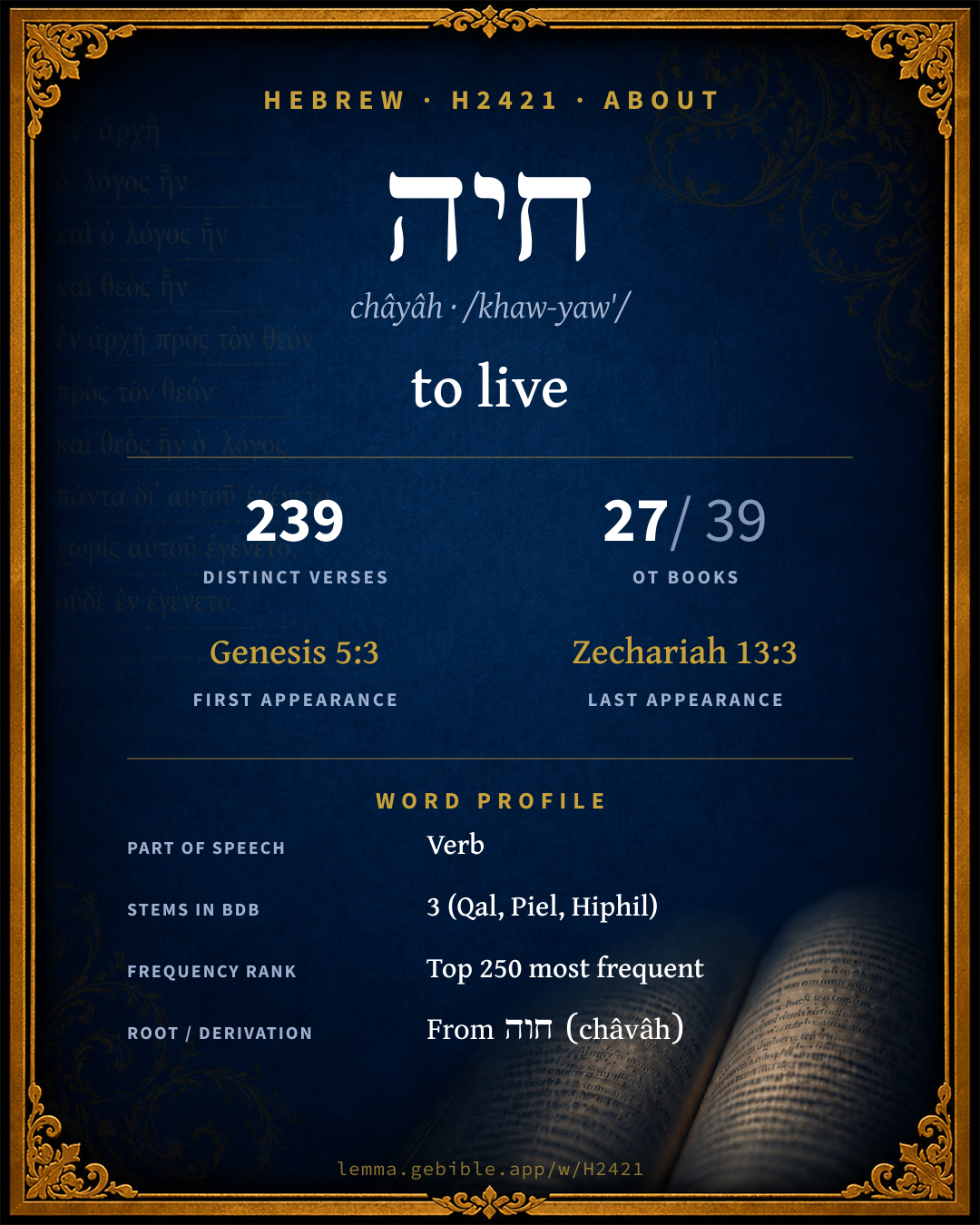
חָיָה
to live
also: have life, remain alive, sustain life, live prosperously fuller range ↓
Full lexicon entry — Brown-Driver-Briggs (BDB)
From Brown-Driver-Briggs (BDB)
Where this word appears
See every Qal verb in the Hebrew Bible →
Grammar key — what these labels mean
Part of speech
- Verb
- An action or state-of-being word.
Stem
- Qal
- The basic, simple active stem — the plain form of the verb (“he wrote”). Here: ‘live’
- Piel
- An intensive or resultative active stem. Here: ‘preserve alive’
- Hiphil
- The causative active stem (“he caused / brought about”). Here: ‘preserve alive’
Form
- Sequential Imperfect
- An imperfect with prefixed waw — the standard past-narrative form (waw-consecutive imperfect).
- Imperfect
- An incomplete, ongoing, or future action (“he will / would write”).
- Infinitive Absolute
- An unbound verbal noun, often intensifying or standing in for a finite verb.
- Jussive
- A third- or second-person volitional form expressing wish or command (“let him write”).
- Sequential Perfect
- A perfect with prefixed waw continuing a preceding imperfect or command (waw-consecutive perfect).
- Imperative
- A direct command (“write!”).
- Infinitive Construct
- A bound verbal noun, frequently with prepositions (“to write / in writing”).
- Perfect
- A completed action or state — Hebrew marks aspect (completeness) more than strict tense (“he wrote”).
- Participle Active
- A verbal adjective expressing ongoing or characteristic action (“writing / one who writes”).
- Cohortative
- A first-person volitional form expressing wish or resolve (“let me / let us write”).
State
- Absolute
- The independent form of a noun, not bound to a following word.
Person
- 3rd Person
- The one spoken about (“he / she / it / they”).
- 2nd Person
- The one addressed (“you”).
- 1st Person
- The speaker (“I / we”).
Gender
- Masculine
- Grammatically masculine.
- Common
- Either gender — not distinguished for this form.
- Feminine
- Grammatically feminine.
Number
- Singular
- One.
- Plural
- More than one (in Hebrew, generally three or more).
27 verses where H2421 appears in the Qal stem in the Book of Ezekiel. Filtered view — show all forms. Click any verse to open its interlinear word-by-word view. Verse text shown in the World English Bible for context — . Each verse’s Hebrew form is shown with its reference; the English is not keyword-highlighted, since the data carries no word-level English alignment. Use “Compare translations” on any verse to read it across multiple English versions. This concordance covers the Hebrew Bible; Septuagint (Greek Old Testament) occurrences are not indexed here.
Ezekiel
- Ezekiel 3:21 חָי֤וֹ יִֽחְיֶה֙ Qal inf.abs Qal impf 3ms Nevertheless if you warn the righteous man, that the righteous not sin, and he does not sin, he shall surely live, because he took warning; and you have delivered your soul.
- Ezekiel 13:19 וּ/לְ/חַיּ֥וֹת תִֽחְיֶ֑ינָה conj + prep + Piel inf.cs Qal impf 3fp You have profaned me among my people for handfuls of barley and for pieces of bread, to kill the souls who should not die, and to save the souls alive who should not live, by your lying to my people who listen to lies.
- Ezekiel 16:6 חֲיִ֔י חֲיִֽי Qal impv 2fs Qal impv 2fs When I passed by you, and saw you weltering in your blood, I said to you, [Though you are] in your blood, live; yes, I said to you, [Though you are] in your blood, live.
- Ezekiel 18:9 חָיֹ֣ה יִֽחְיֶ֔ה Qal inf.abs Qal impf 3ms has walked in my statutes, and has kept my ordinances, to deal truly; he is just, he shall surely live, says the Lord Yahweh.
- Ezekiel 18:13 יִֽחְיֶ֗ה Qal impf 3ms has given forth on interest, and has taken increase; shall he then live? he shall not live: he has done all these abominations; he shall surely die; his blood shall be on him.
- Ezekiel 18:17 חָיֹ֥ה יִחְיֶֽה Qal inf.abs Qal impf 3ms who has withdrawn his hand from the poor, who has not received interest nor increase, has executed my ordinances, has walked in my statutes; he shall not die for the iniquity of his father, he shall surely live.
- Ezekiel 18:19 חָיֹ֥ה יִחְיֶֽה Qal inf.abs Qal impf 3ms Yet say you, Why does not the son bear the iniquity of the father? when the son has done that which is lawful and right, and has kept all my statutes, and has done them, he shall surely live.
- Ezekiel 18:21 חָיֹ֥ה יִחְיֶ֖ה Qal inf.abs Qal impf 3ms But if the wicked turn from all his sins that he has committed, and keep all my statutes, and do that which is lawful and right, he shall surely live, he shall not die.
- Ezekiel 18:22 יִֽחְיֶֽה Qal impf 3ms None of his transgressions that he has committed shall be remembered against him: in his righteousness that he has done he shall live.
- Ezekiel 18:23 וְ/חָיָֽה conj + Qal wpf 3ms Have I any pleasure in the death of the wicked? says the Lord Yahweh; and not rather that he should return from his way, and live?
- Ezekiel 18:28 חָי֥וֹ יִחְיֶ֖ה Qal inf.abs Qal impf 3ms Because he considers, and turns away from all his transgressions that he has committed, he shall surely live, he shall not die.
- Ezekiel 18:32 וִֽ/חְיֽוּ conj + Qal impv 2mp For I have no pleasure in the death of him who dies, says the Lord Yahweh: therefore turn yourselves, and live.
- Ezekiel 20:25 יִֽחְי֖וּ Qal impf 3mp Moreover also I gave them statutes that were not good, and ordinances in which they should not live;
- Ezekiel 33:10 נִֽחְיֶֽה Qal impf 1cp You, son of man, tell the house of Israel: Thus you speak, saying, Our transgressions and our sins are on us, and we pine away in them; how then can we live?
- Ezekiel 33:11 וְ/חָיָ֑ה conj + Qal wpf 3ms Tell them, As I live, says the Lord Yahweh, I have no pleasure in the death of the wicked; but that the wicked turn from his way and live: turn you, turn you from your evil ways; for why will you die, house of Israel?
- Ezekiel 33:12 לִֽ/חְי֥וֹת prep + Qal inf.cs You, son of man, tell the children of your people, The righteousness of the righteous shall not deliver him in the day of his disobedience; and as for the wickedness of the wicked, he shall not fall thereby in the day that he turns from his wickedness; neither shall he who is righteous be able to live thereby in the day that he sins.
- Ezekiel 33:13 חָיֹ֣ה יִֽחְיֶ֔ה Qal inf.abs Qal impf 3ms When I tell the righteous, that he shall surely live; if he trust to his righteousness, and commit iniquity, none of his righteous deeds shall be remembered; but in his iniquity that he has committed, therein shall he die.
- Ezekiel 33:15 חָי֥וֹ יִֽחְיֶ֖ה Qal inf.abs Qal impf 3ms if the wicked restore the pledge, give again that which he had taken by robbery, walk in the statutes of life, committing no iniquity; he shall surely live, he shall not die.
- Ezekiel 33:16 חָי֥וֹ יִֽחְיֶֽה Qal inf.abs Qal impf 3ms None of his sins that he has committed shall be remembered against him: he has done that which is lawful and right; he shall surely live.
- Ezekiel 33:19 יִֽחְיֶֽה Qal impf 3ms When the wicked turns from his wickedness, and does that which is lawful and right, he shall live thereby.
- Ezekiel 37:3 הֲ/תִחְיֶ֖ינָה ptcl inter + Qal impf 3fp He said to me, Son of man, can these bones live? I answered, Lord Yahweh, you know.
- Ezekiel 37:5 וִ/חְיִיתֶֽם conj + Qal wpf 2mp Thus says the Lord Yahweh to these bones: Behold, I will cause breath to enter into you, and you shall live.
- Ezekiel 37:6 וִ/חְיִיתֶ֑ם conj + Qal wpf 2mp I will lay sinews on you, and will bring up flesh on you, and cover you with skin, and put breath in you, and you shall live; and you shall know that I am Yahweh.
- Ezekiel 37:9 וְ/יִֽחְיֽוּ conj + Qal impf 3mp Then said he to me, Prophesy to the wind, prophesy, son of man, and tell the wind, Thus says the Lord Yahweh: Come from the four winds, breath, and breathe on these slain, that they may live.
- Ezekiel 37:10 וַ/יִּֽחְי֗וּ conj + Qal wimpf 3mp So I prophesied as he commanded me, and the breath came into them, and they lived, and stood up on their feet, an exceeding great army.
- Ezekiel 37:14 וִ/חְיִיתֶ֔ם conj + Qal wpf 2mp I will put my Spirit in you, and you shall live, and I will place you in your own land: and you shall know that I, Yahweh, have spoken it and performed it, says Yahweh.
- Ezekiel 47:9 יִֽחְיֶ֔ה Qal impf 3ms It shall happen, that every living creature which swarms, in every place where the rivers come, shall live; and there shall be a very great multitude of fish; for these waters are come there, and [the waters of the sea] shall be healed, and everything shall live wherever the river comes.
About this entry
At a glance — auto-summarized from this page’s data, not written by a person. Every figure links to its source below. This summary describes the numbers; it doesn’t interpret them.
חיה (châyâh) is a Hebrew verb most often rendered “to live.” It first appears in Genesis 5:3. It turns up in 239 verses across 27 books, a common footprint. The verb spans 3 stems, from Qal to Piel. From the same root come חוה, אחוה and חוא. The sections below give every sense, occurrence, and version rendering.
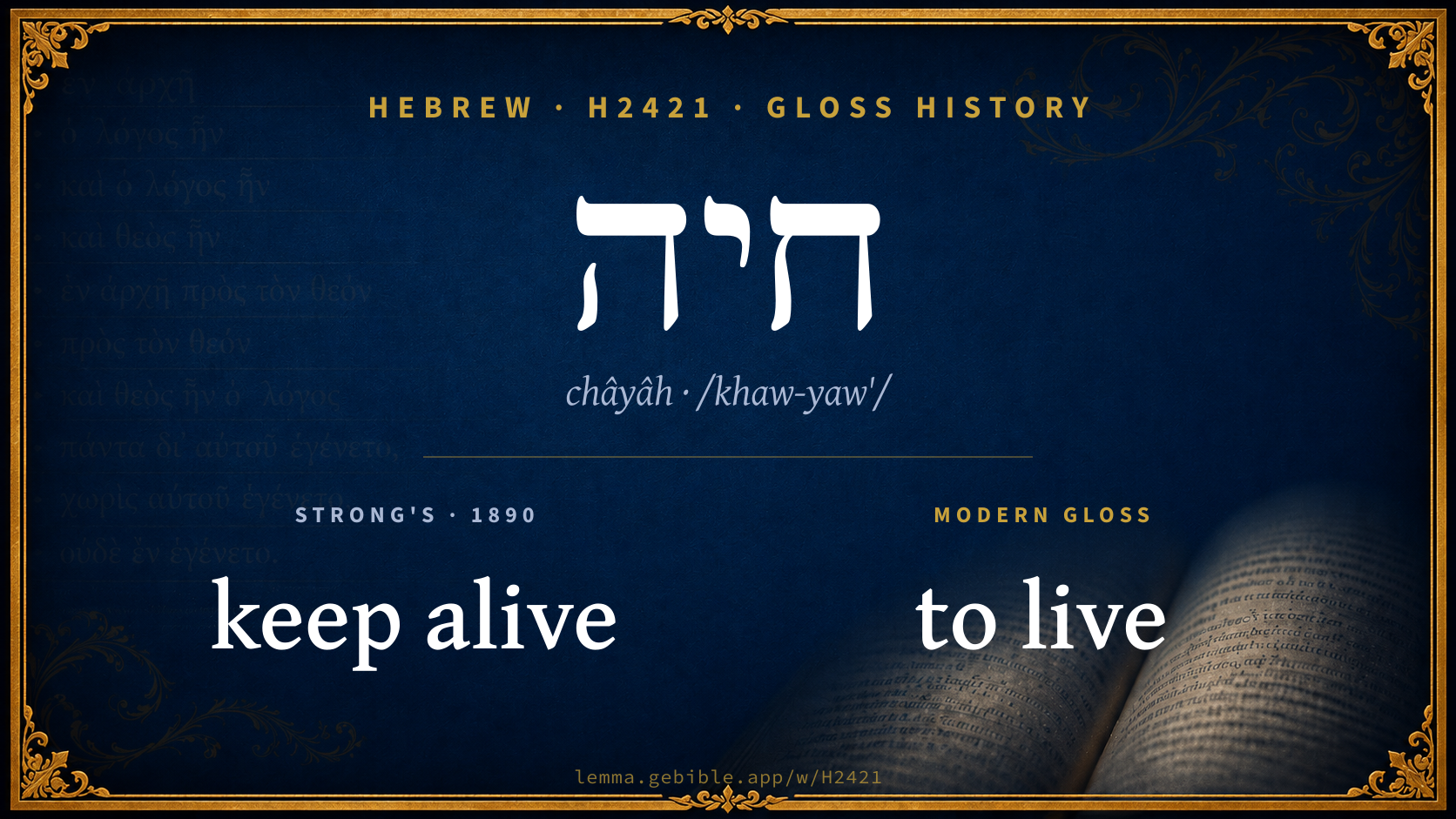
Gloss history
Strong's 1890 vs modern scholarship
About this word
Strong's H2421 catalogs a Hebrew word from the Hebrew Old Testament.
These counts are not copied from any lexicon or concordance. They are computed here, from the morphology-tagged Hebrew Old Testament. What Lemma adds →
- 239
- distinct verses
- The word appears in 239 distinct verses.
- 27 / 39
- OT books
- The word appears in 27 of 39 Old Testament books.
- #186
- by frequency
- Top 250 most frequent Hebrew words (rank 186 of 8,640 Hebrew words by occurrence).
View all 239 occurrences in the concordance →
By section of the Old Testament
By traditional corpus
Conventional, traditional groupings — biblical authorship is debated, so this is a traditional corpus grouping, not an authorship claim. Each share is this word’s portion of its verses in that division of the Hebrew canon. Each figure is a share of the word’s 239 distinct verses.
- Prophets (Nevi'im) 102 verses · 43%
- Torah (Pentateuch) 82 verses · 34%
- Writings (Ketuvim) 55 verses · 23%
How translations render this word
Counts come from each version’s own published word-to-Strong’s tagging or interlinear alignment — an approximate guide to how each version renders this word, not a word-level alignment the data otherwise carries. Because each total is that version’s own tagged count, the per-version totals vary from one another and need not match the appearance or distinct-verse counts above. These counts may also differ from a printed concordance because Lemma counts each distinctly tagged rendering and does not collapse phrase taggings into a single head-word total. This is a fixed set of word-tagged versions (KJV, ASV, BSB, ULT) and does not change with the reading translation you choose elsewhere. Each version’s license is shown beside its name below (and on Sources).
- King James Version: Lived 37×, Live 35×, Shall live 14×
- American Standard Version: Lived 36×, Live 31×, Alive 11×
- Berean Standard Bible: Live 28×, Lived 22×, Was 17×
- unfoldingWord Literal Text: Live 66×, Lived 40×, And 24×
King James Version Public Domain
Renders H2421 across 270 tagged occurrences — most commonly:
Plus other, less common renderings. Plus 91 renderings that appear only once — usually multi-word phrases or single function words the recovered tagging swept in, not distinct renderings. Not rendered by a distinct English word in 1 further occurrence.
American Standard Version Public Domain
Renders H2421 across 270 tagged occurrences — most commonly:
Plus other, less common renderings. Plus 91 renderings that appear only once — usually multi-word phrases or single function words the recovered tagging swept in, not distinct renderings.
Berean Standard Bible Public Domain
Renders H2421 across 265 tagged occurrences — most commonly:
Plus other, less common renderings. Plus 93 renderings that appear only once — usually multi-word phrases or single function words the recovered tagging swept in, not distinct renderings. Not rendered by a distinct English word in 17 further occurrences.
unfoldingWord Literal Text CC BY-SA 4.0
Renders H2421 across 346 tagged occurrences — most commonly:
Plus other, less common renderings. Plus 89 renderings that appear only once — usually multi-word phrases or single function words the recovered tagging swept in, not distinct renderings.
25 senses and sub-senses in the full BDB
Hebrew verbs can shift meaning by stem (binyan): Qal is the basic action, Niphal is often passive or reflexive, Piel often intensifies or makes it factitive, and Hiphil is typically causative. The senses below are grouped under the stem BDB assigns to each.
What do BDB’s symbols mean?
BDB uses these scholarly abbreviations:
| Symbol | Meaning |
|---|---|
| 𝔊 | the Septuagint (the ancient Greek translation, LXX) |
| 𝔙 | the Vulgate (the Latin translation) |
| 𝔖 | the Syriac version (the Peshitta) |
| 𝔗 | the Targum (the Aramaic translation) |
| ψ | the Psalms |
| √ | root (the underlying root or stem) |
| ‖ | parallel passage (a synonymous or contrasted parallel) |
| † | the dagger: every passage where the word occurs is cited |
The 25 senses and sub-senses the full Brown-Driver-Briggs lexicon distinguishes for this word, in lexicon order (not ranked by frequency), with BDB’s own verbatim wording and sub-sense lettering. Shown in Hebrew script with BDB’s own scholarly abbreviations. The condensed entry is in the Lexicon Entry tab. See also the Forms in the corpus table below.
Qal
- Pf. חָיָה Ec 6:6 + 4 times; יְ֯חָיָה Je 21:9; 38:2; חַי Gn 5:5 + 23 times (this and the following form are treated as ע״ע, the original weakness of the stem final י admitting of either ל״ה or ע״ע, Ges§ 761); וְחֵי Lv 25:36 (Bö§ 1181); 3 fs. חָֽיְתָה Gn 12:13 Je 38:17; וָחָ֑יָה Ex 1:16 (for חַיָּה Bö§ 1123 (3), Sam. חיתה); 2 ms. חָיִיתָ Dt 30:16, חָיִתָה Je 38:17; 3 m. pl. תָיוּ Nu 14:38, וְחָיוּ consec. Nu 4:19 + Zc 10:9 (where read Pi. וְתִיּוּ StaZAW i, 1881, 22 so 𝔊), וִחְיִיתֶם Ez 37:5 + 2 times; Impf. יִחְיֶה Gn 17:18 + 27 times; יְחִי Dt 33:6 + 10 times; וִיתִי ψ 49:10 + 2 times; וְיֶ֑חִי Is 38:21, וַיְחִי Gn 5:3 + 37 times; וַיֶּ֑חִי Dt 4:33 + 4 times; 3 fs. תִּחְיַה Jos 6:17, תְּחִי Gn 19:20 + 5 times; 2 ms. תִּחְיֶה Gn 27:40 + 7 times; 2 fs. תִּחְיִי 2 K 4:7; 1 s. אֶחְיֶה 2 K 1:2 + 8 times; 3 mpl. יִחְיוּ Jos 9:21 + 8 times; 3 fpl. תִּחְיֶינָה Ez 13:19; 37:3; 2 mpl. תִּחְיוּ Dt 4:1 + 2 times; תִּחְיוּן Dt 5:30; 8:1; 1 pl. נִחְיֶה 2 K 7:4 + 7 times; Imv. וֶחְיֵה Gn 20:7 Pr 4:4, וֶחְיֶ֯ה Pr 7:2; fs. חֲיִי Ez 16:6(×2); mpl. וִחְיוּ Gn 42:18 + 7 times; Inf. abs. חָיֹה 2 K 8:10 + 6 times; חָיוֹ Ez 3:21 + 3 times; cstr. לִחְיוֹת Ez 33:12, sf. חֲיוֹתָם Jos 5:8;— e.g. Ecclesiastes 6:6
- 1. live:
- a. have life, Gn 31:32(E), Ex 33:20(J), Nu 4:19 (P), Dt 30:16 +; also in phrase וַיְחִי and he lived (so many years) with acc. of time, Gn 5:3–30 (16 times) 9:28; 11:11–26 (14 times) 47:28 (all P), 50:22 (E), 2 K 14:17 = 2 Ch 25:25 Jb 42:16. e.g. Genesis 31:32
- b. continue in life, remain alive Gn 20:7 (E), Lv 25:36 2 S 12:22 +; also †ח׳ נפשׁ live, of the soul or the self Gn 12:13; 19:20 (J), 1 K 20:32 ψ 119:175 Je 38:2, 17, 20 Is 55:3; וְחַי הַיָּ֑לֶד and the boy may live 2 S 12:22; †ח׳ לִפְנֵי live in the presence of Gn 17:18 (P) Ho 6:2; †ח׳ ב׳ live among La 4:20. e.g. Genesis 20:7
- c. sustain life, live on or upon (על), of the animal life, by the sword Gn 27:40 (J), by bread Dt 8:3; elsewhere in pregnant sense of fulness of life in divine favour, sustained by (על) everything that issueth out of the mouth of י׳ Dt 8:3; his promises (?) Is 38:16; of wicked man, by repentance Ez 33:19; c. בְּ by the statutes and judgments of י׳ if a man do them, Lv 18:5 (H) Ez 20:11, 13, 21, 25 Ne 9:29; צַדִּיק בֶּאֱמוּנָתוֹ יִחְיֶה a righteous man by his faithfulness shall live Hb 2:4. e.g. Genesis 27:40
- d. live(prosperously) יְחִי הַמֶּלֶך may the king live 1 S 10:24 2 S 16:16(×2) 1 K 1:25, 31, 34, 39 2 K 11:12 2 Ch 23:11; יְחִי לְבַבְכֶם ψ 22:27; 69:33; המלך לעולם יחיה Ne 2:3. e.g. 1 Samuel 10:24
- 2. be quickened, revive:
- a. from sickness Nu 21:8, 9 Jos 5:8 (E) 2 K 1:2; 8:8, 9, 10, 14; 2 K 20:1, 7 = Is 38:1, 9, 21. e.g. Numbers 21:8
- b. from discouragement of the spirit Gn 45:27 (E). e.g. Genesis 45:27
- c. from faintness Ju 15:19. e.g. Judges 15:19
- d. from death 2 K 13:21 Jb 14:14 Is 26:14, 19; by return of נפשׁ 1 K 17:22, of רוּחַ Ez 37:3, 5, 6, 9, 10, 14 (and so Ju 15:19 c). e.g. 2 Kings 13:21
Piel
- Pf. 3 ms. חִיָּה ψ 22:30; 3 fs. sf. חִיָּ֑תְנִי ψ 119:50; 2 ms. sf. חִיִּיתַנִי ψ 30:4; חִיִּיתָ֑נִי ψ 119:93; 3 pl. חִיּוּ Ju 21:14, הַחִיִּיתֶם Nu 31:15; Impf. יְחַיֶּה 1 S 27:9 +, etc.; Imv. sf. חַיֵּנִי ψ 119:25 + 8 times, חַיֵּיהוּ Hb 3:2; Inf. cstr. חַיּוֹת Gn 7:3 Ez 13:19; sf. חַיֹּתֵנוּ Dt 6:24 +, etc.; Pt. מְחַיֶּה Ne 9:6 1 S 2:6;— e.g. Psalms 22:30
- 1. preserve alive, let live Ex 1:17, 18, 22; 22:17 Jos 9:15 (JE), Gn 12:12 (J), Nu 31:15 (P), Dt 6:24; 20:16 Ju 21:14 1 S 27:9, 11 1 K 18:5 2 K 7:4 Je 49:11 Ez 3:18 Hb 3:2 Jb 36:6 ψ 30:4; 33:19; 41:3; 138:7; ח׳ נפשׁ preserve oneself alive ψ 22:30 Ez 18:27, or preserve persons alive Ex 13:18, 19, or preserve life 1 K 20:31; ח׳ זרע preserve seed alive Gn 7:3; 19:32, 34 (J); keep in existence heaven and earth Ne 9:6; nourish, young cow Is 7:21, lamb 2 S 12:3. e.g. Exodus 1:17
- 2. give life, to man when created Jb 33:4. e.g. Job 33:4
- 3. quicken, revive, refresh:
- a. restore to life, the dead 1 S 2:6 Dt 32:39 Ho 6:2; the dying ψ 71:20. e.g. 1 Samuel 2:6
- b. cause to grow, grain Ho 14:8. e.g. Hosea 14:8
- c. restore, a ruined city 1 Ch 11:8, stones destroyed by fire Ne 3:34. e.g. 1 Chronicles 11:8
- d. revive, the people of י׳ by י׳ himself with fulness of life in his favour ψ 80:19; 85:7; 119:25, 37, 40, 50, 88, 93, 107, 149, 154, 156, 159; 143:11 Ec 7:12. e.g. Psalms 80:19
Hiphil
- Pf. הֶחֱיָה Jos 6:25 + 5 times; 2 ms. sf. הֶחֱיִתָנוּ Gn 47:25; 1 s. הֶחֱיֵיתִי Nu 22:33, הַחֲיִתֶם Jos 2:13 Ju 8:19; Imv. sf. הַחֲיֵינִי Is 38:16; הַחֲיוּ Nu 31:18; Inf. abs. הַחֲיֵה Jos 9:20; cstr. הַחֲיוֹת Gn 6:20 + 6 times; הַחֲיֹת Gn 6:19; 50:20; sf. הַחֲיֹתוֹ Ez 13:22;— e.g. Joshua 6:25
- 1. preserve alive, let live Gn 45:7; 50:20 (E) 47:25 Nu 22:33 Jos 2:13; 6:25 (all J), 14:10 (D); Gn 6:19, 20 Nu 31:18 Jos 9:20 (P), Ju 8:19 2 S 8:2 Ez 13:22; with נפשׁ Gn 19:19 (J). e.g. Genesis 45:7
- 2. quicken, revive:
- a. restore to health, a leper 2 K 5:7, Hezekiah Is 38:16. e.g. 2 Kings 5:7
- b. revive the לֵב and רוּחַ Is 57:15(×2). e.g. Isaiah 57:15
- c. restore to life, the dead 2 K 8:1, 5(×3). e.g. 2 Kings 8:1
Senses from the full Brown-Driver-Briggs lexicon (Brown, Driver, Briggs; Oxford 1906 — public domain), digitized via Sefaria, supplemented by the OpenScriptures HebrewLexicon (CC BY 4.0). Full attribution on Sources.
Word origin
vb. live (NH Ph. id.; Arabic حَىَّ, حَيِىَ; Sab. חיו MordtZMG 1876, 28; Ethiopic ሐይወ Aramaic ܚܝܳܐ, חֲיָא; Palm. חיי life, life-time, Vog 32, 74)—
— Brown-Driver-Briggs (Oxford 1906, public domain), digitized via Sefaria, supplemented by the OpenScriptures HebrewLexicon (CC BY 4.0). See Sources.
Derived from חוה (châvâh) (H2331) — to declare.
Jastrow Dictionary
A second Hebrew/Aramaic lexicon for comparison, covering Aramaic and post-biblical (Talmudic, Targumic, Midrashic) usage that the biblical-Hebrew BDB does not. Matched by lemma rather than by Strong’s number, so a lemma may carry more than one Jastrow headword (shown separately below), and the entries cover usage well beyond the Bible.
חָיָה
- , v. חיי
חַיָּה I
- 1. (adj.) v. חַי.
- 2. animal, esp. beast of chase, deer &c., contrad. to בְּהֵמָה. Ḥull. VI, 1 ונוהג בח׳ ובעוף and applies to beasts of chase and birds; a. fr.—Ab. V, 9, a. fr. ח׳ רעה the plague of wild beasts. Ex. R. s. 35 (ref. to Ps. LXVIII, 31) ח׳ הדרה וכ׳ the beast that lives between the reeds (Rome).—Sabb. 151ᵇ; Snh. 38ᵇ, a. e. אין ח׳ רעה שולטת וכ׳ no wild beast has power over man, unless he appears to it to resemble a brute creature; a. fr.—Pl. חַיּוֹת. Taan. 8ᵃ לע"ל … כל הח׳ וכ׳ in the future all the wild beasts shall gather and come to the serpent &c. Bets. 25ᵇ כלב בח׳ the dog (is the most irrepressible) among the wild beasts. Ber. 61ᵇ פקח שבח׳ the shrewdest of all animals; a. v. fr.—Esp. Ḥayoth, legendary celestial creatures (Ez. I, 5). Ḥag. 13ᵃ; a. fr. e.g. Psalms 68:31
חַיָּה II
- (חָיָה)
- 1. [recovering,] lying-in woman, woman in confinement. Yoma VIII, 1 הח׳ תנעול וכ׳ a woman after confinement may wear shoes (on the Day of Atonement). Ber. 54ᵇ חולה ח׳ וכ׳ a sick person, a lying-in &c.; a. fr.—Pl. חַיּוֹת. Y. Kil. IX, 32ᵇ bot.; Gen. R. s. 96, end אי לכם ח׳ וכ׳ woe to you, lying-in women in Palestine; a. fr.
- 2. [physician,] midwife. Tosef. B. Bath. VII, 2 נאמנת ח׳ וכ׳ the midwife is an admissible witness as to which (of twins) was the first-born; Y. Kidd. IV, 69ᵈ bot.; Y. B. Bath. III, beg. 13ᵈ הח׳ בשעה וכ׳ the midwife (is an admissible witness) only as long as she is seated by the obstetric chair (not after she left the mother). Y. Yeb. XVI, end, 16ᵃ עשו אותו כח׳ וכ׳ they place him in the same category as a midwife whose testimony is valid on the spot; a. e.—Pl. as ab. Cant. R. to IV, 5 מרים … חַיּוֹתֵיהֶן וכ׳ Miriam … were the midwives of Israel; a. fr.
חיי
- (b. h.)
- 1. to live. Tam. 32ᵃ מה … ויִחְיֶה what must man do in order to live (long)?; a. v. fr.—Part. חָי (v. חַי).—Keth. I, 6 לא מפיה אנו חָיִין we do not live on what comes from her lips, i.e. we do not go by her evidence. Y. ib. II, 26ᶜ bot. אנו כחיין מפיה we (the court) are again in the condition of dependence on her own evidence. Y. Shebi. II, 34ᵃ top שהן חָיִין מִמֵּי וכ׳ they live (draw nourishment) from the waters of last year; ib. (הוא חָיָיה) הוא חָיָה it draws &c.—Snh. 108ᵃ לא חיין ולא נידונין they have no share in the resurrection nor will they be judged; a. fr.
- 2. to heal; to recover, regain health. Keth. 6ᵃ, a. e. עד שתִּחְיֶה המכה until the wound is healed up. Ḥull. 7ᵇ וחָיָה and did recover; וחָיָת and it (the wound) healed up; a. fr. [Y. Maasr. I, 48ᵈ חיתה; Y. Shebi. IV, 35ᵇ bot. חייתה, v. חוּת.]
- to be recalled to life, to resurrect. Ab. IV, 22 והמתים להֵחָיוֹת and the dead are destined to be revived. Snh. 90ᵇ שעתיד להחיות that he (Aaron) will resurrect.
- 1. to keep alive, sustain. Tam. 32ᵃ יְחַיֶּה את עצמו let him feed himself (his passions, be selfish). Yoma 71ᵃ מְחַיֶּה חיים He who sustains the living; a. fr.
- 2. to recall to life, to revive. Snh. l. c. הקב"ה מְחַיֶּיה מתים the Lord revives the dead. Ib. מה שאני ממית אני מְחַיֶּה what I put to death, I revive again; a. fr.
- same. Ib. 92ᵇ מתים שה׳ יחזקאל the dead whom Ezekiel revived (Ez. XXXVII). Ib. והַחֲיֵיה מתים וכ׳ and revive the dead in the valley of Dura; a. fr.
A Dictionary of the Targumim, the Talmud Babli and Yerushalmi, and the Midrashic Literature (Marcus Jastrow; London, Luzac, 1903) — Public Domain. Digitized via Sefaria. Digitized via Sefaria. Full attribution on Sources.
Forms in the corpus
The 178 distinct written forms H2421 takes in the Hebrew Bible, most frequent first — each parse links to that stem’s occurrences in the concordance. Hebrew forms include their vowel points and cantillation, so a single lemma takes many written forms.
The 60 most common forms are shown; 118 rarer forms follow in the full concordance.
Same root — word family
Other BDB entries built from the same root as H2421, grouped by Strong’s listed origin. These share a root / origin per the lexicon — not necessarily a shared meaning. Each links to that word’s own entry.
Derives from
Shares the same root
Derived from this word
- חי chay H2416 living
- חיא chăyâʼ H2418 to live
- חיה châyeh H2422 lively
- חיות chayûwth H2424 living
- חיי châyay H2425 to live
- מחיה michyâh H4241 sustenance
Proper names from this root
People and places named from this root — a name, not an additional meaning of the word.
Compare all same-root words → Showing 4 of 13 — not the complete family. 3 of the same-root words are proper names (people or places). They share a root, not necessarily a meaning.
Septuagint verse parallels
This word appears in 211 verses that also exist in the Greek Old Testament (Septuagint), out of the 239 Hebrew verses it occurs in. You can read those verses in Greek by switching the Old Testament edition to the Septuagint.
Read these verses in the Septuagint
- Genesis 5:3
- Exodus 1:17
- Leviticus 25:35
- Numbers 4:19
- Deuteronomy 4:1
- Joshua 2:13
- Judges 8:19
- 1 Samuel 2:6
- 2 Samuel 1:10
- 1 Kings 1:25
- 2 Kings 1:2
- 1 Chronicles 11:8
This is a verse-level parallel only — the same verses exist in both the Hebrew and Greek Old Testaments. No word-level Hebrew↔Greek correspondence is claimed: the data carries no such alignment, so no Greek word is shown as this Hebrew word’s translation. Coverage is not total — the Septuagint omits the deuterocanon and renumbers the Psalms, so some Hebrew verses have no direct Greek parallel.