
Ezekiel 37:6

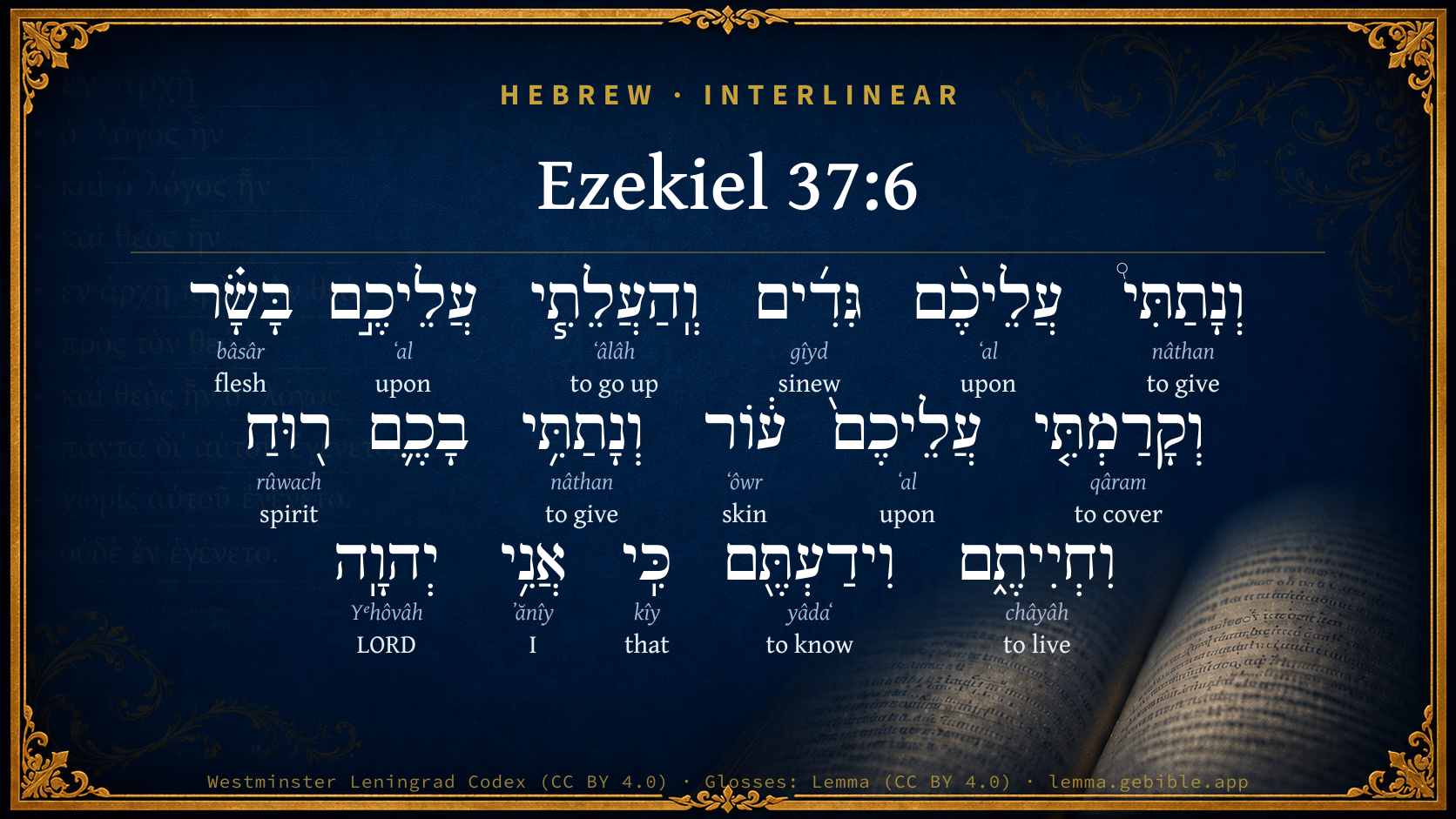
Hebrew (Westminster Leningrad Codex) Ezekiel 37:6 appears in the Hebrew Old Testament. The text above is from the Westminster Leningrad Codex. Each word links to its Strong’s number, a concise gloss, and parsing drawn from the Open Scriptures Hebrew Bible morphology. Click any word for its full Brown-Driver-Briggs (BDB) entry.
Download image
Cite this verse

Ezekiel 37:6 (World English Bible). Public Domain. Lemma interlinear Bible study tool, https://lemma.gebible.app/v/ezekiel/37/6.

Show BibTeX & RIS
BibTeX
RIS
English Translation
I will lay sinews on you, and will bring up flesh on you, and cover you with skin, and put breath in you, and you shall live; and you shall know that I am Yahweh.
World English Bible · Public Domain
Highlights
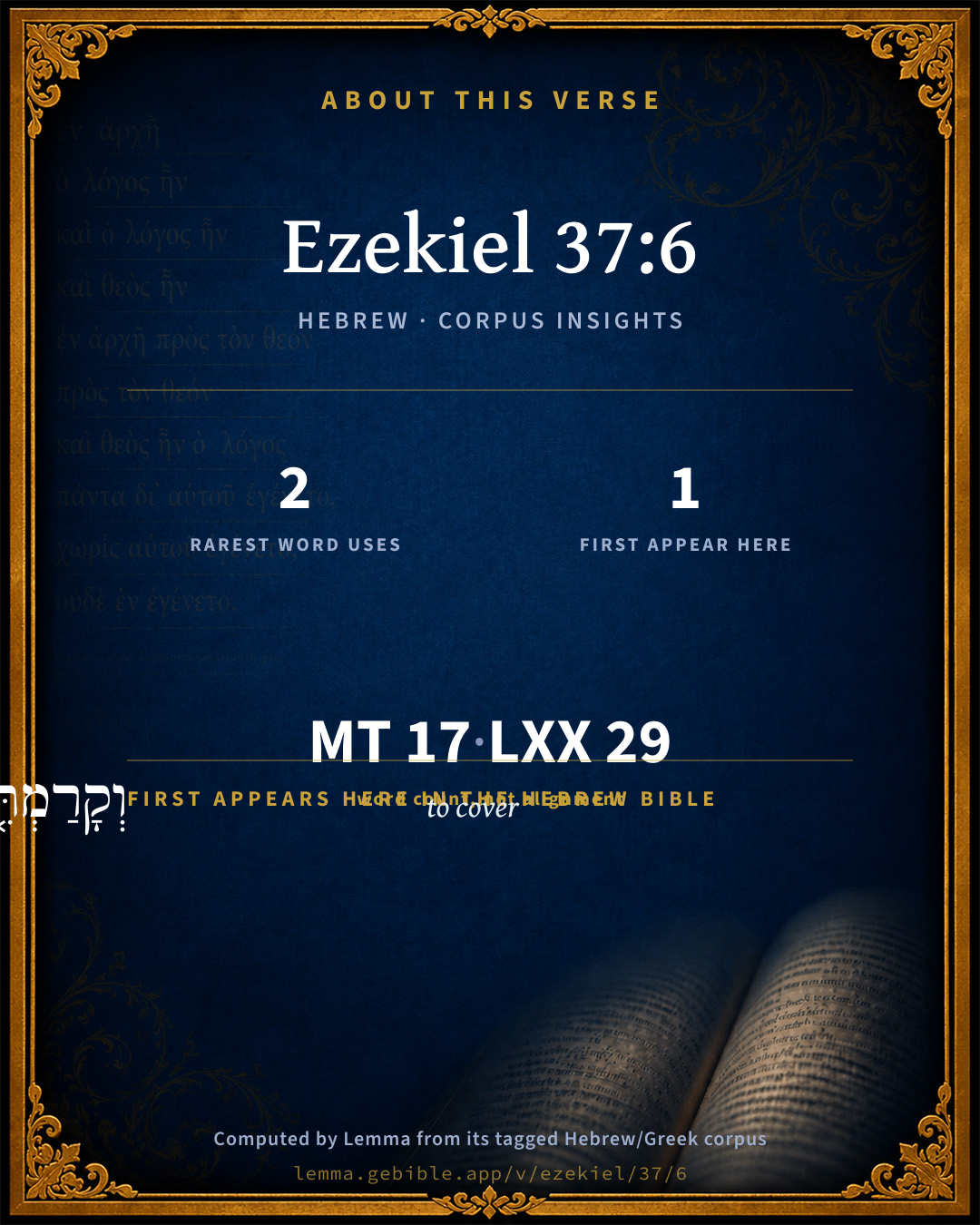
  • 1 first appearance in the Hebrew Bible
Full analysis ↓
Download a study sheet

One document with this verse’s original text, its word-by-word gloss line, the meaning frame, cross-references with their text, attributed commentary, and full source and license credits — printable, and it pastes into notes with its structure intact.

This verse Autodidact and up

Study sheet (.html) Plain text (.txt)

A passage Seminary Student

Up to 50 verses in one chapter. A passage sheet keeps up to 6 commentary sources and 12 cross-references per verse, in the order this page ranks them, and says so on the sheet whenever that leaves anything out. Ask for a single verse and you get the Autodidact verse sheet above.

Everything on this page stays free to read, with no account — the sheet is a download of what is already on screen, not access to it.

Want to remove ads? Support Godless Engineer
Compare translations 3

The same verse in 3 English versions, stacked beneath the original-language interlinear above. Click any original word for its lexicon entry.

Each is an independent rendering of the whole verse — the interlinear is not word-aligned to these translations.

Highlighted words mark where these versions differ — a whole-verse word diff, not a word-by-word alignment.

  • World English Bible Public Domain
    I will lay sinews on you, and will bring up flesh on you, and cover you with skin, and put breath in you, and you shall live; and you shall know that I am Yahweh.
  • King James Version Public Domain
    And I will lay sinews upon you, and will bring up flesh upon you, and cover you with skin, and put breath in you, and ye shall live; and ye shall know that I am the LORD.
  • unfoldingWord Literal Text CC BY-SA 4.0
    I will place sinews over you and bring flesh onto you. I will cover you with skin and put breath within you so you will live. Then you will know that I am Yahweh.’”

unfoldingWord Literal Text — © unfoldingWord, licensed CC BY-SA 4.0. Word-aligned USFM3 via Door43 (git.door43.org/unfoldingWord/en_ult).

Versions to compare (up to 4)

3 of 4 selected

Show all 18 translations

Every available English version of this verse, each an independent rendering of the whole verse.

  • World English Bible Public Domain
    I will lay sinews on you, and will bring up flesh on you, and cover you with skin, and put breath in you, and you shall live; and you shall know that I am Yahweh.
  • Berean Standard Bible Public Domain
    I will attach tendons to you and make flesh grow upon you and cover you with skin. I will put breath within you so that you will come to life. Then you will know that I am the LORD.’”
  • Majority Standard Bible Public Domain
    I will attach tendons to you and make flesh grow upon you and cover you with skin. I will put breath within you so that you will come to life. Then you will know that I am the LORD.’”
  • King James Version Public Domain
    And I will lay sinews upon you, and will bring up flesh upon you, and cover you with skin, and put breath in you, and ye shall live; and ye shall know that I am the LORD.
  • American Standard Version (1901) Public Domain
    And I will lay sinews upon you, and will bring up flesh upon you, and cover you with skin, and put breath in you, and ye shall live; and ye shall know that I am Jehovah.
  • Revised Version (1885) Public Domain
    And I will lay sinews upon you, and will bring up flesh upon you, and cover you with skin, and put breath in you, and ye shall live; and ye shall know that I am the LORD.
  • Geneva Bible (1599) Public Domain
    And I will lay sinewes vpon you, and make flesh growe vpon you, and couer you with skinne, and put breath in you, that ye may liue, and yee shall know that I am the Lord.
  • Douay-Rheims (1899) Public Domain
    And I will lay sinews upon you, and will cause flesh to grow over you, and will cover you with skin: and I will give you spirit and you shall live, and you shall know that I am the Lord.
  • Young's Literal Translation Public Domain
    and I have given on you sinews, and cause flesh to come up upon you, and covered you over with skin, and given in you a spirit, and ye have lived, and ye have known that I `am' Jehovah.'
  • Literal Standard Version CC BY-SA 4.0
    and I have given sinews on you, and cause flesh to come up on you, and covered you over with skin, and given a spirit in you, and you have lived, and you have known that I [am] YHWH.”
  • Unlocked Literal Bible CC BY-SA 4.0
    I will place sinews over you and bring flesh onto you. I will cover you with skin and put breath within you so you will live. Then you will know that I am Yahweh.'”
  • unfoldingWord Literal Text CC BY-SA 4.0
    I will place sinews over you and bring flesh onto you. I will cover you with skin and put breath within you so you will live. Then you will know that I am Yahweh.’”
  • Darby Bible Public Domain
    And I will put sinews upon you, and will bring up flesh upon you, and cover you with skin, and put breath in you, and ye shall live: and ye shall know that I [am] Jehovah.
  • World Messianic Bible Public Domain
    I will lay sinews on you, and will bring up flesh on you, and cover you with skin, and put breath in you, and you will live. Then you will know that I am the LORD.”’”
  • Webster's Bible Public Domain
    And I will lay sinews upon you, and will bring up flesh upon you, and cover you with skin, and put breath in you, and ye shall live; and ye shall know that I am the LORD.
  • Free Bible Version CC BY-SA 4.0
    I will give you tendons and have flesh grow over you and cover you with skin. I will breathe into you so that you will come back to life. Then you will know that I am the Lord.”
  • Bible in Basic English Public Domain
    And I will put muscles on you and make flesh come on you, and put skin over you, and breath into you, so that you may have life; and you will be certain that I am the Lord.
  • JPS Tanakh (1917) Public Domain
    And I will lay sinews upon you, and will bring up flesh upon you, and cover you with skin, and put breath in you, and ye shall live; and ye shall know that I am the LORD.'

Literal Standard Version (2020), Covenant Press — licensed CC BY-SA 4.0. Text via the HelloAO Bible API (eBible.org). Unlocked Literal Bible (unfoldingWord) — licensed CC BY-SA 4.0. Text via the HelloAO Bible API (eBible.org). unfoldingWord Literal Text — © unfoldingWord, licensed CC BY-SA 4.0. Word-aligned USFM3 via Door43 (git.door43.org/unfoldingWord/en_ult). Free Bible Version, Dr. Jonathan Gallagher — licensed CC BY-SA 4.0. Text via the HelloAO Bible API (eBible.org).

Word by word

More ways to search: Search by grammar → Find every occurrence → Compare this word →

Practice this passage: Drill this verse → Learn its vocabulary →

וְקָרַמְתִּ֤י
qâram
H7159
“and · to cover”
Conjunction + Verb, Qal, Sequential Perfect, 1st Person, Common, Singular
Part of Speech
Conjunction + Verb
Stem
Qal
Form
Sequential Perfect
Person
1st Person
Gender
Common
Number
Singular
Full BDB Definition

Origin: a primitive root

TWOT: 2071

to spread or lay something over, cover, spread over - (Qal) to be spread over
  1. וְנָתַתִּי֩ nâthan H5414 “and · to give” Conjunction + Verb, Qal, Sequential Perfect, 1st Person, Common, Singular
  2. עֲלֵיכֶ֨ם ʻal H5921 “upon · you” Preposition + Suffix, Personal, 2nd Person, Masculine, Plural
  3. גִּדִ֜ים gîyd H1517 “sinews” Noun, Common, Masculine, Plural, Absolute
  4. וְֽהַעֲלֵתִ֧י ʻâlâh H5927 “and · to go up” Conjunction + Verb, Hiphil, Sequential Perfect, 1st Person, Common, Singular
  5. עֲלֵיכֶ֣ם ʻal H5921 “upon · you” Preposition + Suffix, Personal, 2nd Person, Masculine, Plural
  6. בָּשָׂ֗ר bâsâr H1320 “flesh” Noun, Common, Masculine, Singular, Absolute
  7. עֲלֵיכֶם֙ ʻal H5921 “upon · you” Preposition + Suffix, Personal, 2nd Person, Masculine, Plural
  8. ע֔וֹר ʻôwr H5785 “skin” Noun, Common, Masculine, Singular, Absolute
  9. וְנָתַתִּ֥י nâthan H5414 “and · to give” Conjunction + Verb, Qal, Sequential Perfect, 1st Person, Common, Singular
  10. ר֖וּחַ rûwach H7307 “spirit” Noun, Common, Both, Singular, Absolute
  11. וִחְיִיתֶ֑ם châyâh H2421 “and · to live” Conjunction + Verb, Qal, Sequential Perfect, 2nd Person, Masculine, Plural
  12. וִידַעְתֶּ֖ם yâdaʻ H3045 “and · to know” Conjunction + Verb, Qal, Sequential Perfect, 2nd Person, Masculine, Plural
  13. כִּֽי kîy H3588 “that” Conjunction
  14. אֲנִ֥י ʼănîy H589 “I” Pronoun, Personal, 1st Person, Common, Singular
  15. יְהוָֽה Yᵉhôvâh H3068 “LORD” Noun, Proper

About this verse

These counts appear in no published source. They are computed here, from the morphology-tagged text and Lemma’s own curated glosses. What Lemma adds →

17
words
13
distinct lemmas
Prophets
section

Notable vocabulary

The rarest word here is וְקָרַמְתִּ֤י to cover H7159 — appearing just 2 times in the whole Hebrew Bible.

First appearance in Scripture

This word makes its first canonical appearance in the Hebrew Bible here:

  • וְקָרַמְתִּ֤י to cover H7159

Shared distinctive vocabulary

וְקָרַמְתִּ֤י to cover H7159 occurs in 2 verses of the Hebrew Bible. Also found in:

Grammatical profile

  • 6 verbs
  • 5 nouns
  • 1 pronoun
  • 4 prepositions
  • 1 conjunction

Verb forms

  • וְנָתַתִּי֩ Qal · Sequential Perfect
  • וְֽהַעֲלֵתִ֧י Hiphil · Sequential Perfect
  • וְקָרַמְתִּ֤י Qal · Sequential Perfect
  • וְנָתַתִּ֥י Qal · Sequential Perfect
  • וִחְיִיתֶ֑ם Qal · Sequential Perfect
  • וִידַעְתֶּ֖ם Qal · Sequential Perfect

Repetition

Words recur within this verse — often emphatic in Hebrew:

  • עֲלֵיכֶ֨ם upon H5921 ×3
  • וְנָתַתִּי֩ to give H5414 ×2

Hebrew & Septuagint length

In English translation the verse runs 35 words from the Hebrew and 40 from the Septuagint (LXX English) — closely comparable.

A rough comparison of the two English renderings, which tokenize alike — not a word-level alignment.

Word counts can differ between the Hebrew and the Greek without any difference in meaning — e.g. the Hebrew direct-object marker אֵת has no separate Greek word, and Greek often adds the article ὁ.

In the original languages it is 17 Hebrew tokens and 29 Greek tokens — but the two are counted differently (Hebrew bundles its prefixes and suffixes into one token; the Greek is in lemma form), so that isn’t a like-for-like length.

Cross-references

23

Topical passages linked to Ezekiel 37:6 in the Treasury of Scripture Knowledge — connected by theme and wording, ordered by reader-vote popularity; previews shown in the World English Bible.

  • Joel 2:27 You will know that I am in the midst of Israel, And that I am Yahweh, your God, and there is no one else; And my people will never again be disappointed.
  • Isaiah 49:23 Kings shall be your nursing fathers, and their queens your nursing mothers: they shall bow down to you with their faces to the earth, and lick the dust of your feet; and you shall know that I am Yahweh; and those who wait for me shall not be disappointed.
  • Joel 3:17 "So you will know that I am Yahweh, your God, Dwelling in Zion, my holy mountain. Then Jerusalem will be holy, And no strangers will pass through her any more.
  • Ezekiel 37:14 I will put my Spirit in you, and you shall live, and I will place you in your own land: and you shall know that I, Yahweh, have spoken it and performed it, says Yahweh.
  • 1 Kings 20:28 A man of God came near and spoke to the king of Israel, and said, Thus says Yahweh, Because the Syrians have said, Yahweh is a god of the hills, but he is not a god of the valleys; therefore will I deliver all this great multitude into your hand, and you shall know that I am Yahweh.
  • Ezekiel 6:7 The slain shall fall in the midst of you, and you shall know that I am Yahweh.
  • Ezekiel 34:27 The tree of the field shall yield its fruit, and the earth shall yield its increase, and they shall be secure in their land; and they shall know that I am Yahweh, when I have broken the bars of their yoke, and have delivered them out of the hand of those who made slaves of them.
  • Ezekiel 35:9 I will make you a perpetual desolation, and your cities shall not be inhabited; and you shall know that I am Yahweh.
  • Ezekiel 35:12 You shall know that I, Yahweh, have heard all your insults which you have spoken against the mountains of Israel, saying, They are laid desolate, they are given us to devour.
  • Ezekiel 38:23 I will magnify myself, and sanctify myself, and I will make myself known in the eyes of many nations; and they shall know that I am Yahweh.
  • Ezekiel 39:6 I will send a fire on Magog, and on those who dwell securely in the isles; and they shall know that I am Yahweh.
  • Deuteronomy 29:6 You have not eaten bread, neither have you drunk wine or strong drink; that you may know that I am Yahweh your God.
  • Ezekiel 6:13 You shall know that I am Yahweh, when their slain men shall be among their idols round about their altars, on every high hill, on all the tops of the mountains, and under every green tree, and under every thick oak, the places where they offered sweet savor to all their idols.
  • Ezekiel 7:4 My eye shall not spare you, neither will I have pity; but I will bring your ways on you, and your abominations shall be in the midst of you: and you shall know that I am Yahweh.
  • Ezekiel 7:9 My eye shall not spare, neither will I have pity: I will bring on you according to your ways; and your abominations shall be in the midst of you; and you shall know that I, Yahweh, do strike.
  • Ezekiel 11:10 You shall fall by the sword; I will judge you in the border of Israel; and you shall know that I am Yahweh.
  • Ezekiel 11:12 and you shall know that I am Yahweh: for you have not walked in my statutes, neither have you executed my ordinances, but have done after the ordinances of the nations that are round about you.
  • Ezekiel 20:38 and I will purge out from among you the rebels, and those who disobey against me; I will bring them forth out of the land where they sojourn, but they shall not enter into the land of Israel: and you shall know that I am Yahweh.
  • Ezekiel 28:22–26 and say, Thus says the Lord Yahweh: Behold, I am against you, Sidon; and I will be glorified in the midst of you; and they shall know that I am Yahweh, when I shall have executed judgments in her, and shall be sanctified in her.
  • Ezekiel 35:15 As you did rejoice over the inheritance of the house of Israel, because it was desolate, so will I do to you: you shall be desolate, Mount Seir, and all Edom, even all of it; and they shall know that I am Yahweh.
  • Ezekiel 39:22 So the house of Israel shall know that I am Yahweh their God, from that day and forward.
  • Ezekiel 39:28 They shall know that I am Yahweh their God, in that I caused them to go into captivity among the nations, and have gathered them to their own land; and I will leave none of them any more there;
  • Ezekiel 32:15 When I shall make the land of Egypt desolate and waste, a land destitute of that of which it was full, when I shall strike all those who dwell therein, then shall they know that I am Yahweh.

Cross-references courtesy of OpenBible.info (CC BY 4.0).

Hebrew and Greek witnesses Masoretic Hebrew ↔ Greek Septuagint

The same verse in the two great witnesses to the Old Testament, shown verse-for-verse.

These are two independent witnesses, not word-aligned to each other, and the Septuagint is shown in lemma (dictionary) form.

Hebrew Ezekiel 37:6 Masoretic · Westminster Leningrad Codex

וְנָתַתִּי֩ עֲלֵיכֶ֨ם גִּדִ֜ים וְֽהַעֲלֵתִ֧י עֲלֵיכֶ֣ם בָּשָׂ֗ר וְקָרַמְתִּ֤י עֲלֵיכֶם֙ ע֔וֹר וְנָתַתִּ֥י בָכֶ֛ם ר֖וּחַ וִחְיִיתֶ֑ם וִידַעְתֶּ֖ם כִּֽי אֲנִ֥י יְהוָֽה

I will lay sinews on you, and will bring up flesh on you, and cover you with skin, and put breath in you, and you shall live; and you shall know that I am Yahweh.

World English Bible · Public Domain

Greek LXX Ezekiel 37:6 Septuagint · lemma form

καί δίδωμι ἐπί σύ νεῦρον καί ἀναἄγω ἐπί σύ σάρξ καί ἐκτείνω ἐπί σύ δέρμα καί δίδωμι πνεῦμα ἐγώ εἰς σύ καί ζάω καί γιγνώσκω ὅτι ἐγώ εἰμί κύριος

and I will lay sinews upon you, and will bring up flesh upon you, and will spread skin upon you, and will put my Spirit into you, and you⌃ shall live; and you⌃ shall know that I am the Lord.

LXX2012 (modern English Septuagint) · Public Domain

Hebrew: Westminster Leningrad Codex (CC BY 4.0). Greek: Septuagint (public domain); English from LXX2012 (modern English Septuagint) (Public Domain). How the Septuagint differs from the Hebrew →

Targum (Aramaic paraphrase)

1

The Targum is the ancient Jewish Aramaic paraphrase of the Hebrew Scriptures — an interpretive translation, not the Hebrew text itself. Onkelos (literal) and Pseudo-Jonathan (expansive) render the Torah, and Jonathan the Prophets. Coverage is partial: where no permissively-licensed English translation exists for a verse, only the Aramaic is shown. This is verse-level text, not a word-by-word alignment to the Hebrew.

  1. Targum Jonathan Prophets (Joshua–Malachi)
    וְאֶתֵּן עֲלֵיכוֹן גִידִין וְאַסֵיק עֲלֵיכוֹן בִּסְרָא וְאֶקְרוֹם עֲלֵיכוֹן מַשְׁכָא וְאֶתֵּן בְּכוֹן רוּחָא וְתֵיחוּן וְתֵידְעוּן אֲרֵי אֲנָא יְיָ:

    (no public-domain English translation for this verse)

    Targum Jonathan — Aramaic: “Mikraot Gedolot” (public domain). English: “Sefaria Community Translation” (CC0 1.0 (public-domain dedication)); “London "Chaldee Paraphrase," 1871” (public domain). Text via Sefaria.

Commentary

Notes on Ezekiel 37:6 from classic Christian and Jewish commentators (each source and its license shown beneath its notes). The classic Christian expositions comment on the surrounding passage and are grouped to its opening verse, so a note may address several verses; the Jewish commentaries on the Tanakh (Rashi and others) are per-verse, so they appear only where the commentator wrote on this verse.

Lemma curates 59 commentaries, every one of them public domain or Creative Commons licensed, each selected and text-cleaned for this edition rather than reprinted as found. About our sources →

Trapp's Complete Commentary

John Trapp

Eze 37:6 And I will lay sinews upon you, and will bring up flesh upon you, and cover you with skin, and put breath in you, and ye shall live; and ye shall know that I [am] the LORD.

Ver. 6. And cover you with skin.] Superindam; that the flesh may not look ghastly. The word rendered cover is Chaldee, and found only here and Eze 37:8.

And put breath in you, and ye shall live.] As when man was first created. {Gen 2:7} And cannot God as easily remake us of something as at first he made us of nothing?

John Trapp, A Commentary or Exposition upon All the Books of the Old and New Testament (1647–1656) — public domain. Text from a community e-Sword module.

Jamieson, Fausset & Brown

Robert Jamieson, A. R. Fausset & David Brown

ye shall know that I am the Lord--by the actual proof of My divinity which I will give in reviving Israel.

Jamieson, Fausset & Brown — Commentary Critical and Explanatory on the Whole Bible (1871) — public domain (CC PDM 1.0). Text via the HelloAO Bible API.

Adam Clarke's Commentary

Verse 6. I will lay sinews upon you] Observe the progress:

1. Here are the bones.

2. The ligaments, called here sinews, are to be added in order to unite the bones, that the skeleton might be complete.

3. The flesh (the whole muscular system, the subjacent and superjacent muscles, including the arterial and venous system) clothes this skeleton.

4. The skin (the dermis and epidermis, or cutis and cuticle) envelopes the whole of these muscles or flesh; and now these bodies are in the state that the body of Adam was before it received the animal and intellectual principle from God.

5. There was no breath in them-they had not yet received their souls.

6. The wind, רוח ruach, the soul, came into them. They were endued with animal and intellectual life; and they arose and evidenced a complete restoration to life, and began to perform its functions, Eze 37:10.

Adam Clarke's Commentary on the Bible (1810–1826) — public domain. Text from a community e-Sword/MySword module.

The Cambridge Bible for Schools and Colleges

gen. ed. J. J. S. Perowne

6. Then follow the details of their becoming actual men of flesh and blood.

Eze_37:7-10. As the prophet spoke there was a great sound and the bones came together, bone to his bone, and they became clothed with flesh; but as yet there was no breath of life in them.

The Cambridge Bible for Schools and Colleges (gen. ed. J. J. S. Perowne; Cambridge University Press, 1878–1918) — public domain. Text from a community e-Sword module.

John Gill's Exposition

And I will lay sinews upon you, and I will bring up flesh upon you,.... That is, before he should cause breath to enter into them; for though it is first mentioned, it is the last done: this is the orderly process; first sinews are laid to join the bones together; then flesh is laid to cover them, and fill up all vacancies, and form muscles to make the bones capable of motion:

and cover you with skin; both bones, sinews, and flesh; for this is uppermost of all, and which makes the whole smooth and beautiful. Job expresses his formation in much such language, "thou hast clothed me with skin and flesh, and hast fenced me with bones and sinews", Job 10:11,

and put breath in you, and ye shall live; which is repeated for the confirmation of it:

and ye shall know that I am the Lord; the Lord God omnipotent, the Lord gracious and merciful, and your Lord and God: so men, when they are called by grace, know the Lord, they did not before; having an experience of his powerful and efficacious grace upon their hearts, they know him to be theirs and own and acknowledge him, and profess him before men.

John Gill's Exposition of the Whole Bible (1746–1763) — public domain (CC PDM 1.0). Text via the HelloAO Bible API.

Matthew Poole's English Annotations

Sinews tie the bones together.

Flesh fills up the hollownesses, and being full of muscles helps motion.

Skin, as the upper silken garment, covers all with a clear and blushing colour.

Breath lastly must be added. All this God declares he will do, and I suppose these promises are what the prophet is to declare to these bones that they may revive.

Matthew Poole's English Annotations on the Holy Bible (1683–1685) — public domain. Text from a community e-Sword/MySword module.

The Pulpit Commentary

The process of revivification is now divided into two stages a preliminary stage which should effect the reconstruction of the external skeleton, by bringing together its different parts and clothing them with sinews, flesh, and skin; (comp. Job_10:11) and a finishing stage, whichshould consist in animating, or "putting breath in" the reconstructed skeleton; corresponding so the two stages into which the process of man"s original creation was divided. (Gen_2:7) The result would be that the resurrected and reanimated bones, like newly made man, would know the Lord.

The Pulpit Commentary (1880–1919), ed. H.D.M. Spence-Jones & Joseph S. Exell — public domain. Text from a community e-Sword module.

Rashi

Rabbi Shlomo Yitzchaki (Rashi)

And I will lay sinews upon you, etc. But in the Book of Job it says (10:11): “You clothe me with skin and flesh” first, and afterwards, “and You cover me with bones and sinews.” But to what were these similar? To a man who undresses and then dresses [himself] again, in which case, what he took off last he puts on first, whereas at the beginning of the creation of the fetus, skin and flesh come first and afterwards bones and sinews.

and cover you [Heb. וְקָרַמְתִי,] from the word for skin (קְרוּם) ecro(s) ter in Old French, and I shall encrust (with skin).

Rashi on the Tanakh — English translations: “The Judaica Press complete Tanach with Rashi, translated by A. J. Rosenberg” (CC BY 4.0); “Pentateuch with Rashi's commentary by M. Rosenbaum and A.M. Silbermann, 1929-1934” (public domain); “The Metsudah Tanach series, Lakewood, N.J” (CC BY 4.0); and “The Book of Joshua, Metsudah Publications, 1997” (CC BY 4.0). Text via Sefaria.

Lesson kit

Teaching starters — assembled from the data on this page, not authored interpretation. Every prompt links to the verse data it draws on. Edit before teaching.

Ezekiel, in the Prophets, opens this verse with 17 words (13 distinct Hebrew lemmas). Its most distinctive word is qâram (“to cover”). A historical commentator’s framing appears above. Read the whole chapter for the surrounding context.

Discussion questions

  1. How does “to cover” (qâram) shape what this verse is saying?
  2. This is the first place “to cover” appears in Scripture (first appears here). What does its debut here establish?
  3. How does Ezekiel 37:8, which shares the word «to cover», read alongside this verse?
  4. What does the repetition of “upon” (3× in this one verse) do in this verse?
  5. These translations render this verse differently. What is at stake in choosing one wording over another?
  6. «וְנָתַתִּי֩» is a Qal Sequential Perfect verb. How does that grammatical form shape the action described?
  7. Compare how Trapp's Complete Commentary and Jamieson, Fausset & Brown read this verse. Where do they agree or differ?

Things to notice

Reading settings

Reading text

Shown beneath each verse's original-language words.

Old Testament
Old Testament edition

Read the OT as the Masoretic Hebrew (MT) or the Greek Septuagint (LXX).

English shown for the Greek Septuagint (in the Hebrew ↔ Greek comparison).

Comparing translations? Open the Compare panel on any verse page to stack up to four side by side.