
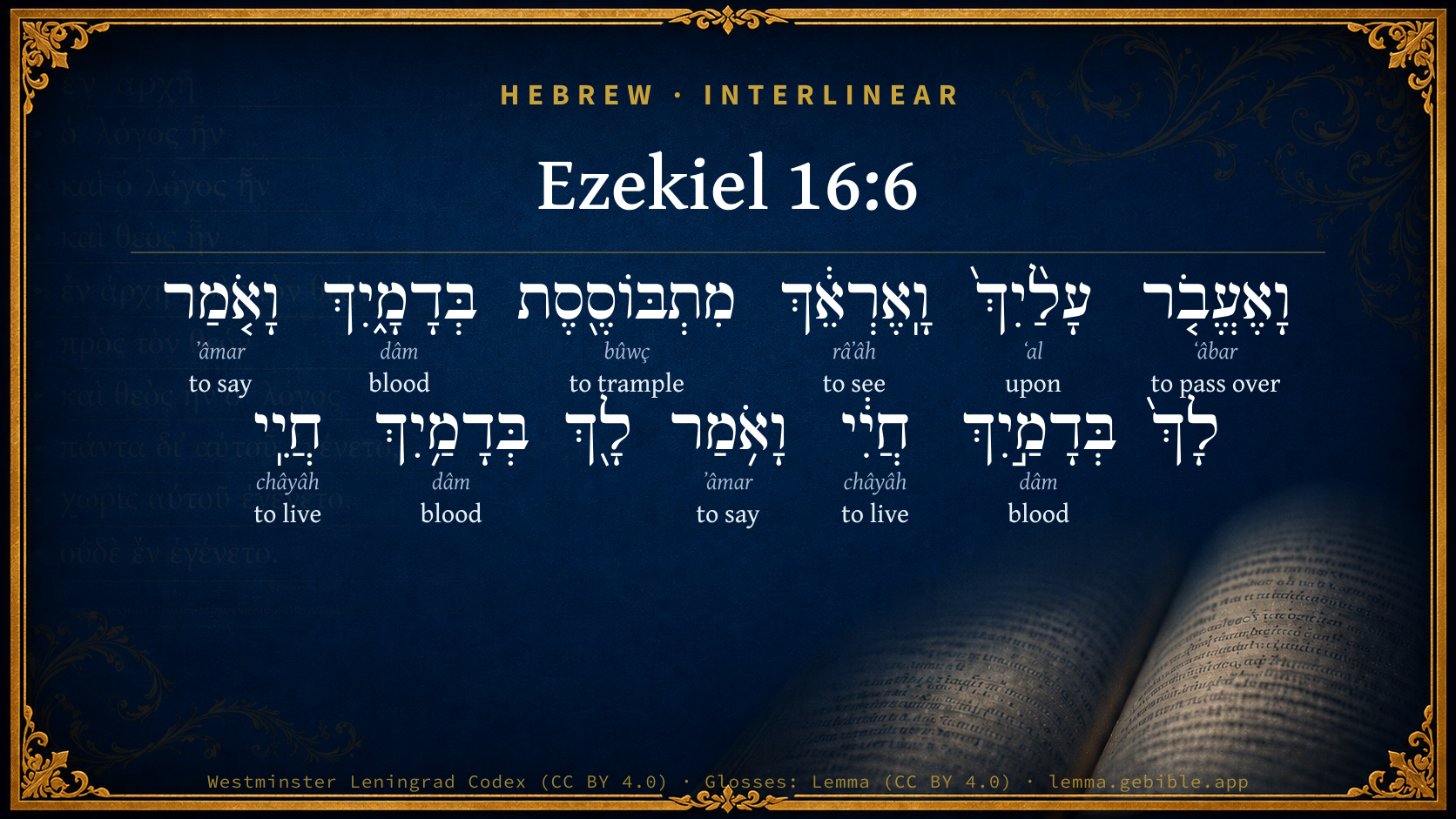
Ezekiel 16:6

Hebrew (Westminster Leningrad Codex) Ezekiel 16:6 appears in the Hebrew Old Testament. The text above is from the Westminster Leningrad Codex. Each word links to its Strong’s number, a concise gloss, and parsing drawn from the Open Scriptures Hebrew Bible morphology. Click any word for its full Brown-Driver-Briggs (BDB) entry.
Download image
Cite this verse

Ezekiel 16:6 (World English Bible). Public Domain. Lemma interlinear Bible study tool, https://lemma.gebible.app/v/ezekiel/16/6.

Show BibTeX & RIS
BibTeX
RIS
English Translation
When I passed by you, and saw you weltering in your blood, I said to you, [Though you are] in your blood, live; yes, I said to you, [Though you are] in your blood, live.
World English Bible · Public Domain
Download a study sheet

One document with this verse’s original text, its word-by-word gloss line, the meaning frame, cross-references with their text, attributed commentary, and full source and license credits — printable, and it pastes into notes with its structure intact.

This verse Autodidact and up

Study sheet (.html) Plain text (.txt)

A passage Seminary Student

Up to 50 verses in one chapter. A passage sheet keeps up to 6 commentary sources and 12 cross-references per verse, in the order this page ranks them, and says so on the sheet whenever that leaves anything out. Ask for a single verse and you get the Autodidact verse sheet above.

Everything on this page stays free to read, with no account — the sheet is a download of what is already on screen, not access to it.

Want to remove ads? Support Godless Engineer
Compare translations 3

The same verse in 3 English versions, stacked beneath the original-language interlinear above. Click any original word for its lexicon entry.

Each is an independent rendering of the whole verse — the interlinear is not word-aligned to these translations.

Highlighted words mark where these versions differ — a whole-verse word diff, not a word-by-word alignment.

  • World English Bible Public Domain
    When I passed by you, and saw you weltering in your blood, I said to you, [Though you are] in your blood, live; yes, I said to you, [Though you are] in your blood, live.
  • King James Version Public Domain
    And when I passed by thee, and saw thee polluted in thine own blood, I said unto thee when thou wast in thy blood, Live; yea, I said unto thee when thou wast in thy blood, Live.
  • unfoldingWord Literal Text CC BY-SA 4.0
    But I passed by you, and I saw you writhing in your own blood; so I said to you in your blood, “Live!” I said to you in your blood, “Live!”

unfoldingWord Literal Text — © unfoldingWord, licensed CC BY-SA 4.0. Word-aligned USFM3 via Door43 (git.door43.org/unfoldingWord/en_ult).

Versions to compare (up to 4)

3 of 4 selected

Show all 18 translations

Every available English version of this verse, each an independent rendering of the whole verse.

  • World English Bible Public Domain
    When I passed by you, and saw you weltering in your blood, I said to you, [Though you are] in your blood, live; yes, I said to you, [Though you are] in your blood, live.
  • Berean Standard Bible Public Domain
    Then I passed by and saw you wallowing in your blood, and as you lay there in your blood I said to you, ‘Live!’ There I said to you, ‘Live!’
  • Majority Standard Bible Public Domain
    Then I passed by and saw you wallowing in your blood, and as you lay there in your blood I said to you, ‘Live!’ There I said to you, ‘Live!’
  • King James Version Public Domain
    And when I passed by thee, and saw thee polluted in thine own blood, I said unto thee when thou wast in thy blood, Live; yea, I said unto thee when thou wast in thy blood, Live.
  • American Standard Version (1901) Public Domain
    And when I passed by thee, and saw thee weltering in thy blood, I said unto thee, `Though thou art' in thy blood, live; yea, I said unto thee, `Though thou art' in thy blood, live.
  • Revised Version (1885) Public Domain
    And when I passed by thee, and saw thee weltering in thy blood, I said unto thee, Though thou art in thy blood, live; yea, I said unto thee, Though thou art in thy blood, live.
  • Geneva Bible (1599) Public Domain
    And when I passed by thee, I saw thee polluted in thine owne blood, and I said vnto thee, whe thou wast in thy blood, Thou shalt liue: euen when thou wast in thy blood, I saide vnto thee, Thou shalt liue.
  • Douay-Rheims (1899) Public Domain
    And passing by thee, I saw that thou wast trodden under foot in thy own blood. and I said to thee when thou wast in thy blood: Live: I have said to thee: Live in thy blood.
  • Young's Literal Translation Public Domain
    And I do pass over by thee, And I see thee trodden down in thy blood, And I say to thee in thy blood, Live, And I say to thee in thy blood, Live.
  • Literal Standard Version CC BY-SA 4.0
    And I pass over by you, || And I see you trodden down in your blood, || And I say to you in your blood, Live! Indeed, I say to you in your blood, Live!
  • Unlocked Literal Bible CC BY-SA 4.0
    But I passed by you, and I saw you writhing in your own blood; so I said to you in your blood, “Live!” I said to you in your blood, “Live!”
  • unfoldingWord Literal Text CC BY-SA 4.0
    But I passed by you, and I saw you writhing in your own blood; so I said to you in your blood, “Live!” I said to you in your blood, “Live!”
  • Darby Bible Public Domain
    And I passed by thee, and saw thee weltering in thy blood, and I said unto thee, in thy blood, Live! yea, I said unto thee, in thy blood, Live!
  • World Messianic Bible Public Domain
    “‘“When I passed by you, and saw you wallowing in your blood, I said to you, ‘Though you are in your blood, live!’ Yes, I said to you, ‘Though you are in your blood, live!’
  • Webster's Bible Public Domain
    And when I passed by thee, and saw thee polluted in thy own blood, I said to thee when thou wast in thy blood, Live; yes, I said to thee when thou wast in thy blood, Live.
  • Free Bible Version CC BY-SA 4.0
    But I passed by and saw you kicking, covered in your own blood. As you were lying there in your blood I told you, ‘I want you to live!’ I said to you right there, ‘I want you to live!’
  • Bible in Basic English Public Domain
    And when I went past you and saw you stretched out in your blood, I said to you, Though you are stretched out in your blood, have life;
  • JPS Tanakh (1917) Public Domain
    And when I passed by thee, and saw thee wallowing in thy blood, I said unto thee: In thy blood, live; yea, I said unto thee: In thy blood, live;

Literal Standard Version (2020), Covenant Press — licensed CC BY-SA 4.0. Text via the HelloAO Bible API (eBible.org). Unlocked Literal Bible (unfoldingWord) — licensed CC BY-SA 4.0. Text via the HelloAO Bible API (eBible.org). unfoldingWord Literal Text — © unfoldingWord, licensed CC BY-SA 4.0. Word-aligned USFM3 via Door43 (git.door43.org/unfoldingWord/en_ult). Free Bible Version, Dr. Jonathan Gallagher — licensed CC BY-SA 4.0. Text via the HelloAO Bible API (eBible.org).

Word by word

More ways to search: Search by grammar → Find every occurrence → Compare this word →

Practice this passage: Drill this verse → Learn its vocabulary →

מִתְבּוֹסֶ֖סֶת
bûwç
H947
“trampling”
Verb, Hithpolel, Participle Active, Feminine, Singular, Absolute
Part of Speech
Verb
Stem
Hithpolel
Form
Participle Active
Gender
Feminine
Number
Singular
State
Absolute
Full BDB Definition

Origin: a primitive root

TWOT: 216

to tread down, reject, trample down - (Qal) - to tread down, trample (of warriors) - of rejection (figuratively) - (Polel) - to tread down (in bad sense) - to desecrate - (Hithpolel) - to tread - to kick out - of infants' blind movements - of Jerusalem (figuratively) - (Hophal) to be trodden down
  1. וָאֶעֱבֹ֤ר ʻâbar H5674 “and · to pass over” Conjunction + Verb, Qal, Sequential Imperfect, 1st Person, Common, Singular
  2. עָלַ֨יִךְ֙ ʻal H5921 “upon · you” Preposition + Suffix, Personal, 2nd Person, Feminine, Singular
  3. וָֽאֶרְאֵ֔ךְ râʼâh H7200 “and · to see · you” Conjunction + Verb, Qal, Sequential Imperfect, 1st Person, Common, Singular + Suffix, Personal, 2nd Person, Feminine, Singular
  4. בְּדָמָ֑יִךְ dâm H1818 “in/at · blood · your” Preposition + Noun, Common, Masculine, Plural, Construct + Suffix, Personal, 2nd Person, Feminine, Singular
  5. וָאֹ֤מַר ʼâmar H559 “and · to say” Conjunction + Verb, Qal, Sequential Imperfect, 1st Person, Common, Singular
  6. בְּדָמַ֣יִךְ dâm H1818 “in/at · blood · your” Preposition + Noun, Common, Masculine, Plural, Construct + Suffix, Personal, 2nd Person, Feminine, Singular
  7. חֲיִ֔י châyâh H2421 “live” Verb, Qal, Imperative, 2nd Person, Feminine, Singular
  8. וָאֹ֥מַר ʼâmar H559 “and · to say” Conjunction + Verb, Qal, Sequential Imperfect, 1st Person, Common, Singular
  9. בְּדָמַ֥יִךְ dâm H1818 “in/at · blood · your” Preposition + Noun, Common, Masculine, Plural, Construct + Suffix, Personal, 2nd Person, Feminine, Singular
  10. חֲיִֽי châyâh H2421 “live” Verb, Qal, Imperative, 2nd Person, Feminine, Singular

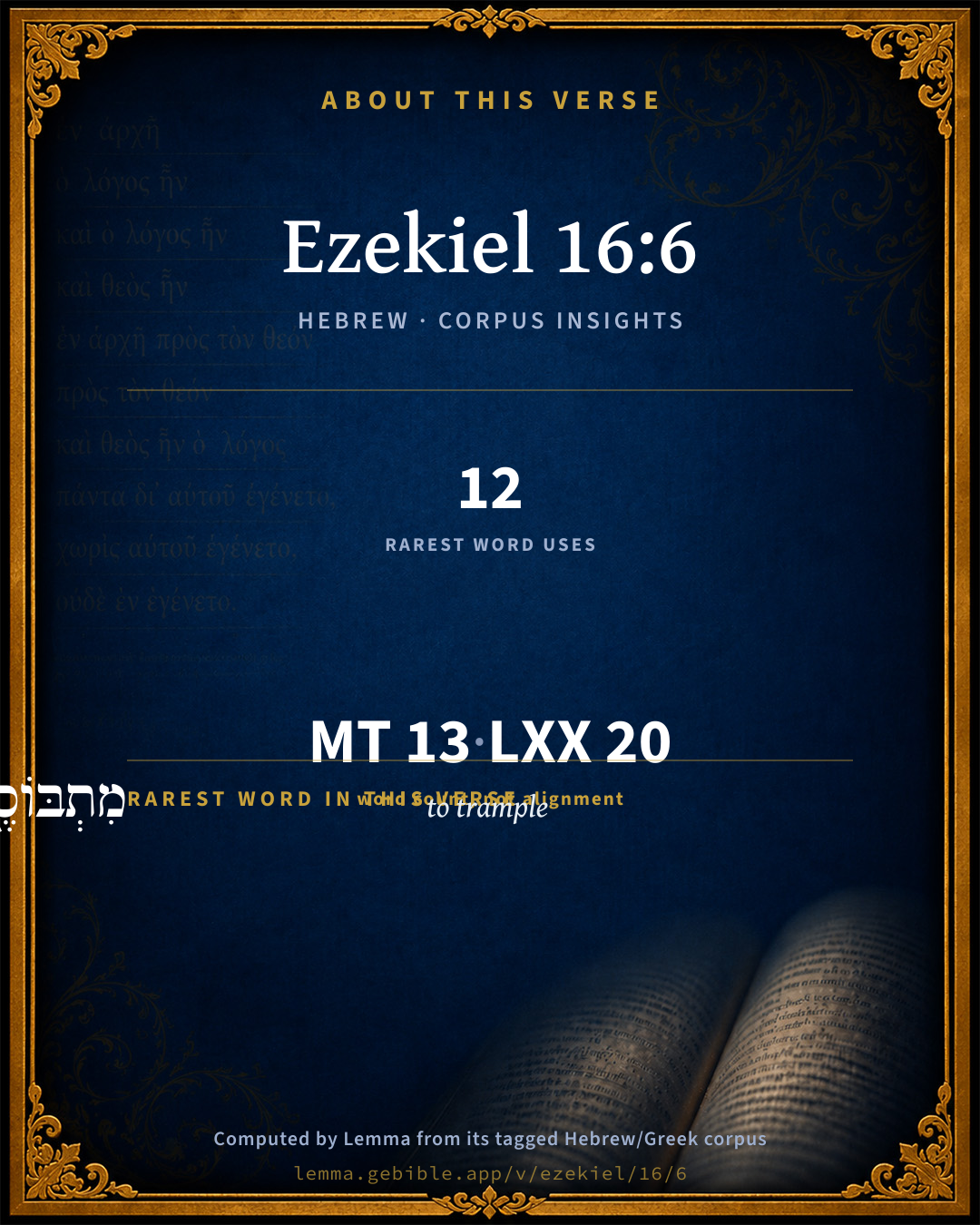
About this verse

These counts appear in no published source. They are computed here, from the morphology-tagged text and Lemma’s own curated glosses. What Lemma adds →

13
words
7
distinct lemmas
Prophets
section

Notable vocabulary

The rarest word here is מִתְבּוֹסֶ֖סֶת to trample H947 — appearing just 12 times in the whole Hebrew Bible.

Shared distinctive vocabulary

מִתְבּוֹסֶ֖סֶת to trample H947 occurs in 12 verses of the Hebrew Bible. Also found in:

Grammatical profile

  • 7 verbs
  • 3 nouns
  • 3 prepositions

Verb forms

  • וָאֶעֱבֹ֤ר Qal · Sequential Imperfect
  • וָֽאֶרְאֵ֔ךְ Qal · Sequential Imperfect
  • מִתְבּוֹסֶ֖סֶת Hithpolel · Participle Active
  • וָאֹ֤מַר Qal · Sequential Imperfect
  • חֲיִ֔י Qal · Imperative
  • וָאֹ֥מַר Qal · Sequential Imperfect
  • חֲיִֽי Qal · Imperative

Repetition

Words recur within this verse — often emphatic in Hebrew:

  • בְּדָמָ֑יִךְ blood H1818 ×3
  • וָאֹ֤מַר to say H559 ×2
  • חֲיִ֔י to live H2421 ×2

Hebrew & Septuagint length

In English translation the verse runs 35 words from the Hebrew and 26 from the Septuagint (LXX English) — closely comparable.

A rough comparison of the two English renderings, which tokenize alike — not a word-level alignment.

Word counts can differ between the Hebrew and the Greek without any difference in meaning — e.g. the Hebrew direct-object marker אֵת has no separate Greek word, and Greek often adds the article ὁ.

In the original languages it is 13 Hebrew tokens and 20 Greek tokens — but the two are counted differently (Hebrew bundles its prefixes and suffixes into one token; the Greek is in lemma form), so that isn’t a like-for-like length.

Cross-references

18

Topical passages linked to Ezekiel 16:6 in the Treasury of Scripture Knowledge — connected by theme and wording, ordered by reader-vote popularity; previews shown in the World English Bible.

  • Ephesians 2:4–5 But God, being rich in mercy, for his great love with which he loved us,
  • John 5:25 Most assuredly, I tell you, the hour comes, and now is, when the dead will hear the Son of God's voice; and those who hear will live.
  • Titus 3:3–7 For we were also once foolish, disobedient, deceived, serving various lusts and pleasures, living in malice and envy, hateful, and hating one another.
  • Acts 7:34 I have surely seen the affliction of my people that is in Egypt, and have heard their groaning. I have come down to deliver them. Now come, I will send you into Egypt.'
  • Exodus 19:4–6 'You have seen what I did to the Egyptians, and how I bore you on eagles' wings, and brought you to myself.
  • Matthew 5:13 "You are the salt of the earth, but if the salt has lost its flavor, with what will it be salted? It is then good for nothing, but to be cast out and trodden under the feet of men.
  • Exodus 2:24–25 God heard their groaning, and God remembered his covenant with Abraham, with Isaac, and with Jacob.
  • Exodus 3:7–8 Yahweh said, "I have surely seen the affliction of my people who are in Egypt, and have heard their cry because of their taskmasters, for I know their sorrows.
  • Deuteronomy 9:4 Don't speak in your heart, after that Yahweh your God has thrust them out from before you, saying, For my righteousness Yahweh has brought me in to possess this land; whereas for the wickedness of these nations Yahweh does drive them out from before you.
  • Psalms 105:10–15 And confirmed the same to Jacob for a statute; To Israel for an everlasting covenant,
  • Isaiah 51:23 and I will put it into the hand of those who afflict you, who have said to your soul, Bow down, that we may go over; and you have laid your back as the ground, and as the street, to those who go over.
  • Micah 7:10 Then my enemy will see it, And shame will cover her who said to me, Where is Yahweh your God? Then my enemy will see me and will cover her shame. Now she will be trodden down like the mire of the streets.
  • Psalms 105:26–37 He sent Moses, his servant, And Aaron, whom he had chosen.
  • Romans 9:15 For he said to Moses, "I will have mercy on whom I have mercy, and I will have compassion on whom I have compassion."
  • Ezekiel 20:5–10 and tell them, Thus says the Lord Yahweh: In the day when I chose Israel, and swore to the seed of the house of Jacob, and made myself known to them in the land of Egypt, when I swore to them, saying, I am Yahweh your God;
  • Hebrews 10:29 How much worse punishment, do you think, will he be judged worthy of, who has trodden under foot the Son of God, and has counted the blood of the covenant with which he was sanctified an unholy thing, and has insulted the Spirit of grace?
  • Revelation 14:20 The winepress was trodden outside of the city, and blood came out from the winepress, even to the bridles of the horses, as far as one thousand six hundred stadia.
  • Isaiah 14:19 But you are cast forth away from your tomb like an abominable branch, clothed with the slain, who are thrust through with the sword, who go down to the stones of the pit; as a dead body trodden under foot.

Cross-references courtesy of OpenBible.info (CC BY 4.0).

Hebrew and Greek witnesses Masoretic Hebrew ↔ Greek Septuagint

The same verse in the two great witnesses to the Old Testament, shown verse-for-verse.

These are two independent witnesses, not word-aligned to each other, and the Septuagint is shown in lemma (dictionary) form.

Hebrew Ezekiel 16:6 Masoretic · Westminster Leningrad Codex

וָאֶעֱבֹ֤ר עָלַ֨יִךְ֙ וָֽאֶרְאֵ֔ךְ מִתְבּוֹסֶ֖סֶת בְּדָמָ֑יִךְ וָאֹ֤מַר לָךְ֙ בְּדָמַ֣יִךְ חֲיִ֔י וָאֹ֥מַר לָ֖ךְ בְּדָמַ֥יִךְ חֲיִֽי

When I passed by you, and saw you weltering in your blood, I said to you, [Though you are] in your blood, live; yes, I said to you, [Though you are] in your blood, live.

World English Bible · Public Domain

Greek LXX Ezekiel 16:6 Septuagint · lemma form

καί διαἔρχομαι ἐπί σύ καί ὁράω σύ φύρομαι ἐν ὁ αἷμα σύ καί εἶπον σύ ἐκ ὁ αἷμα σύ ζωή

And I passed by to you, and saw you polluted in your blood; and I said to you, Let there be life out of your blood:

LXX2012 (modern English Septuagint) · Public Domain

On this verse, Keil & Delitzsch discusses the Septuagint’s reading. Read the note in Commentary ↓

Hebrew: Westminster Leningrad Codex (CC BY 4.0). Greek: Septuagint (public domain); English from LXX2012 (modern English Septuagint) (Public Domain). How the Septuagint differs from the Hebrew →

Targum (Aramaic paraphrase)

1

The Targum is the ancient Jewish Aramaic paraphrase of the Hebrew Scriptures — an interpretive translation, not the Hebrew text itself. Onkelos (literal) and Pseudo-Jonathan (expansive) render the Torah, and Jonathan the Prophets. Coverage is partial: where no permissively-licensed English translation exists for a verse, only the Aramaic is shown. This is verse-level text, not a word-by-word alignment to the Hebrew.

  1. Targum Jonathan Prophets (Joshua–Malachi)
    וְעַל דָכְרָן קְיָם אֲבָהַתְכוֹן קֳדָמֵי אִתְגְלֵיתִי לְמִפְרַקְכוֹן אֲרֵי גְלֵי קֳדָמֵי אֲרֵי אַתּוּן מְעַנַן בְּשִׁעְבּוּדְכוֹן וַאֲמָרִית לְכוֹן בִּדְמָא דְמָהוּלִתָּא אָחוֹס עֲלֵיכוֹן וַאֲמַרֵית לְכוֹן בְּדַם פִּסְחָא אֶפְרוֹק יַתְכוֹן:

    And for the memory of the ancestral covenant before Me, I revealed Myself to liberate you, for it was revealed before Me that you were afflicted and enslaved, and I said to you, "In the blood of the circumcision I will have mercy on you," and I said to you, "In the blood of the paschal-sacrifice I will liberate you."

    Targum Jonathan — Aramaic: “Mikraot Gedolot” (public domain). English: “Sefaria Community Translation” (CC0 1.0 (public-domain dedication)); “London "Chaldee Paraphrase," 1871” (public domain). Text via Sefaria.

Commentary

Notes on Ezekiel 16:6 from classic Christian and Jewish commentators (each source and its license shown beneath its notes). The classic Christian expositions comment on the surrounding passage and are grouped to its opening verse, so a note may address several verses; the Jewish commentaries on the Tanakh (Rashi and others) are per-verse, so they appear only where the commentator wrote on this verse.

Lemma curates 59 commentaries, every one of them public domain or Creative Commons licensed, each selected and text-cleaned for this edition rather than reprinted as found. About our sources →

Matthew Henry's Commentary

In there verses we have an account of the great things which God did for the Jewish nation in raising them up by degrees to be very considerable. 1. God saved them from the ruin they were upon the brink of in Egypt (Eze 16:6): "When I passed by thee, and saw thee polluted in thy own blood, loathed and abandoned, and appointed to die, as sheep for the slaughter, then I said unto thee, Live. I designed thee for life when thou wast doomed to destruction, and resolved to save thee from death." Those shall live to whom God commands life. God looked upon the world of mankind as thus cast off, thus cast out, thus polluted, thus weltering in blood, and his thoughts towards it were thoughts of good, designing it life, and that more abundantly. By converting grace, he says to the soul, Live. 2. He looked upon them with kindness and a tender affection, not only pitied them, but set his love upon them, which was unaccountable, for there was nothing lovely in them; but I looked upon thee, and, behold, thy time was the time of love, Eze 16:8. It was the kindness and love of God our Saviour that sent Christ to redeem us, that sends the Spirit to sanctify us, that brought us out of a state of nature into a state of grace. That was a time of love indeed, distinguishing love, when God manifested his love to us, and courted our love to him. Then was I in his eyes as one that found favour, Sol 8:10. 3. He took them under his protection: "I spread my skirt over thee, to shelter thee from wind and weather, and to cover thy nakedness, that the shame of it might not appear." Boaz spread his skirt over Ruth, in token of the special favour he designed her, Rut 3:9. God took them into his care, as an eagle bears her young ones upon her wings, Deu 32:11, Deu 32:12. When God owned them for his people, and sent Moses to Egypt to deliver them, which was an expression of the good-will of him that dwelt in the bush, then he spread his skirt over them. 4. He cleared them from the reproachful character which their bondage in Egypt laid them under (Eze 16:9): "Then washed I thee with water, to make thee clean, and anointed thee with oil, to make thee sweet and supple thee." All the disgrace of their slavery was rolled away when they were brought, with a high hand and a stretched-out arm, into the glorious liberty of the children of God. When God said, Israel is my son, my first-born - Let my people go, that they may serve me, that word, backed as it was with so many works of wonder, thoroughly washed away their blood; and when God led them under the convoy of the pillar of cloud and fire he spread his skirt over them. 5. He multiplied them and built them up into a people. This is here mentioned (Eze 16:7) before his spreading his skirt over them, because their numbers increased exceedingly while they were yet bond-slaves in Egypt. They multiplied as the bud of the field in spring time; they waxed great, exceedingly mighty, Exo 1:7. 20. Their breasts were fashioned when they were formed into distinct tribes and had officers of their own (Exo 5:19); their hair grew when they grew numerous, whereas they had been naked and bare, very few and therefore contemptible. 6. He admitted them into covenant with himself. See what glorious nuptials this poor forlorn infant is preferred to at last. How she is dignified who at first had scarcely her life given her for a prey: I swore unto thee and entered into covenant with thee. This was done at Mount Sinai: "when the covenant between God and Israel was sealed and ratified then thou becamest mine." God called them his people, and himself the God of Israel. Note, Those to whom God gives spiritual life he takes into covenant with himself; by that covenant they become his subjects and servants, which intimates their duty - his portion, his treasure, which intimates their privilege; and it is confirmed with an oath, that we might have strong consolation. 7. He beautified and adorned them. This maid cannot forget her ornaments, and she is gratified with abundance of them, Eze 16:10-13. We need not be particular in the application of these. Her wardrobe was well furnished with rich apparel; they had embroidered work to wear, shoes of fine badgers' skins, linen girdles, and silk veils, bracelets and necklaces, jewels and ear-rings, and even a beautiful crown, or coronet. Perhaps this may refer to the jewels and other rich goods which they took from the Egyptians, which might well be spoken of thus long after as a merciful circumstance of their deliverance, when it was spoken of long before, Gen 15:14. They shall come out with great substance. Or it may be taken figuratively for all those blessings of heaven which adorned both their church and state. In a little time they came to excellent ornaments, Eze 16:7. The laws and ordinances which God gave them were to them as ornaments of grace to the head and chains about the neck, Pro 1:9. God's sanctuary, which he set up among them, was a beautiful crown upon their head; it was the beauty of holiness. 8. He fed them with abundance, with plenty, with dainty: Thou didst eat fine flour, and honey, and oil - manna, angels' food - honey out of the rock, oil out of the flinty rock. In Canaan they did eat bread to the full, the finest of the wheat, Deu 32:13, Deu 32:14. Those whom God takes into covenant with himself are fed with the bread of life, clothed with the robe of righteousness, adorned with the graces and comforts of the spirit. The hidden man of the heart is that which is incorruptible. 9. He gave them great reputation among their neighbours, and made them considerable, acceptable to their friends and allies and formidable to their adversaries: Thou didst prosper into a kingdom (Eze 16:13), which speaks both dignity and dominion; and, They renown went forth among the heathen for thy beauty, Eze 16:14. The nations about had their eye upon them, and admired them for the excellent laws by which they were governed, the privilege they had of access to God, Deu 4:7, Deu 4:8. Solomon's wisdom, and Solomon's temple, were very much the renown of that nation; and, if we put all the privileges of the Jewish church and kingdom together, we must own that it was the most accomplished beauty of all the nations of the earth. The beauty of it was perfect; you could not name the thing that would be the honour of a people but it was to be found in Israel, in David's and Solomon's time, when that kingdom was in its zenith-piety, learning, wisdom, justice, victory, peace, wealth, and all sure to continue if they had kept close to God. It was perfect, saith God, through my comeliness which I had put upon thee, through the beauty of their holiness, as they were a people set apart for God, and devoted to him, to be to him for a name, and for a praise, and for a glory. It was this that put a lustre upon all their other honours and was indeed the perfection of their beauty. We may apply this spiritually. Sanctified souls are truly beautiful; they are so in God's sight, and they themselves may take the comfort of it. But God must have all the glory, for they were by nature deformed and polluted, and, whatever comeliness they have, it is that which God has put upon them and beautified them with, and he will be well pleased with the work of his own hands.

Matthew Henry's Commentary on the Whole Bible (1708–1710) — public domain (CC PDM 1.0). Text via the HelloAO Bible API.

Trapp's Complete Commentary

John Trapp

Eze 16:6 And when I passed by thee, and saw thee polluted in thine own blood, I said unto thee [when thou wast] in thy blood, Live; yea, I said unto thee [when thou wast] in thy blood, Live.

Ver. 6. And when I passed by thee.] Not by chance, {as Luk 10:31} but of free choice, and according to mine eternal purpose.

And saw thee in thy blood.] In this deplorable condition. Blood is in this verse thrice mentioned, to set forth the greatness of man’s misery in his pure, or rather impure, natural state, and the freeness of God’s grace toward him all along. {Mat 11:26}

I said unto thee, Live,] God speaketh spiritual life to his poor people, {Isa 55:3} and often repeateth to them his precious promises, whereby they come to "partake of the divine nature, having escaped the corruption that is in the world through lust." {2Pe 1:4}

John Trapp, A Commentary or Exposition upon All the Books of the Old and New Testament (1647–1656) — public domain. Text from a community e-Sword module.

Joseph Benson's Commentary

Eze 16:6-7. And when I passed by thee — While as yet no body took so much care of thee as to wash thee from thy native filthiness, I took pity on thee; as a traveller that passes by and sees an infant lie exposed; and I provided all things necessary for thy support. God here speaks after the manner of men. I said unto thee, Live — This is such a command as sends forth a power to effect what is commanded: he gave that life: he spake, and it was done. I caused thee to multiply, &c. — The prophet in this verse describes the Israelites increasing in Egypt, under the metaphor of a female child growing up to maturity: compare Exo 1:7. Thou art come to excellent ornaments — Hebrew, כעדי עדיים, to ornaments of ornaments, that is, thou wast adorned with the choicest blessings of Divine Providence. Or, as Dr. Waterland renders it, “Thou didst arrive to the perfection of beauty.” Thy breasts were fashioned, &c. — Thou didst come to woman’s estate.

Joseph Benson's Commentary on the Old and New Testaments (1811–1818) — public domain. Text from a community e-Sword module.

Keil & Delitzsch

C. F. Keil & F. Delitzsch

Israel therefore owes its preservation and exaltation to honour and glory to the Lord its God alone. - Eze 16:6. Then I passed by thee, and saw thee stamping in thy blood, and said to thee, In thy blood live! and said to thee, In thy blood live! Eze 16:7. I made thee into myriads as the growth of the field, and thou grewest and becamest tall, and camest to ornament of cheeks. The breasts expanded, and thy hair grew, whereas thou wast naked and bare. Eze 16:8. And I passed by thee, and saw thee, and, behold, it was thy time, the time of love; and I spread my wing over thee, and covered thy nakedness; and I swore to thee, and entered into covenant with thee, is the saying of the Lord Jehovah, and thou becamest mine. Eze 16:9. And I bathed thee in water, and rinsed thy blood from thee, and anointed thee with oil. Eze 16:10. And I clothed thee with embroidered work, and shod thee with morocco, and wrapped thee round with byssus, and covered thee with silk. Eze 16:11. I adorned thee with ornaments, and put bracelets upon thy hands, and a chain around thy neck. Eze 16:12. And I gave thee a ring in thy nose, and earrings in thine ears, and a splendid crown upon thy head. Eze 16:13. And thou didst adorn thyself with gold and silver; and thy clothing was byssus, and silk, and embroidery. Wheaten-flour, and honey, and oil thou didst eat; and thou wast very beautiful; and didst thrive to regal dignity. Eze 16:14. Thy name went forth among the nations on account of thy beauty; for it was perfect through my glory, which I put upon thee, is the saying of the Lord Jehovah. - The description of what the Lord did for Israel in His compassionate love is divided into two sections by the repetition of the phrase "I passed by thee" (Eze 16:6 and Eze 16:8). The first embraces what God had done for the preservation and increase of the nation; the second, what He had done for the glorification of Israel, by adopting it as the people of His possession. When Israel was lying in the field as a neglected new-born child, the Lord passed by and adopted it, promising it life, and giving it strength to live. To bring out the magnitude of the compassion of God, the fact that the child was lying in its blood is mentioned again and again. The explanation to be given of מתבּוססת (the Hithpolel of בּוּס, to trample upon, tread under foot) is doubtful, arising from the difficulty of deciding whether the Hithpolel is to be taken in a passive or a reflective sense. The passive rendering, "trampled upon" (Umbreit), or ad conculcandum projectus, thrown down, to be trodden under foot (Gesenius, etc.), is open to the objection that the Hophal is used for this. We therefore prefer the reflective meaning, treading oneself, or stamping; as the objection offered to this, namely, that a new-born child thrown into a field would not be found stamping with the feet, has no force in an allegorical description. In the clause Eze 16:6, which is written twice, the question arises whether בּדמיך is to be taken with חיי or with ואמר : I said to thee, "In thy blood live;" or, "I said to thee in thy blood, 'Live.' " We prefer the former, because it gives a more emphatic sense. בּדמיך is a concise expression; for although lying in thy blood, in which thou wouldst inevitably bleed to death, yet thou shalt live. Hitzig's proposal to connect בּדמיך in the first clause with חיי , and in the second with אמר, can hardly be entertained. A double construction of this kind is not required either by the repetition of אמר לך, or by the uniform position of בדמיך before חיי in both clauses, as compared with Kg1 20:18 and Isa 27:5.

In Eze 16:7 the description of the real fact breaks through the allegory. The word of God חיי, live, was visibly fulfilled in the innumerable multiplication of Israel. But the allegory is resumed immediately. The child grew (רבה, as in Gen 21:20; Deu 30:16), and came into ornament of cheeks (בּוא with בּ, to enter into a thing, as in Eze 16:8; not to proceed in, as Hitzig supposes). עדי, not most beautiful ornament, or highest charms, for עדיים is not the plural of עדי; but according to the Chetib and most of the editions, with the tone upon the penultima, is equivalent to עדיים, a dual form; so that עדי cannot mean ornament in this case, but, as in Psa 39:9 and Psa 103:5, "the cheek," which is the traditional meaning (cf. Ges. Thes. p. 993). Ornament of cheeks is youthful freshness and beauty of face. The clauses which follow describe the arrival of puberty. נכון, when applied to the breasts, means to expand, lit., to raise oneself up. שׂער = שׂער רגלים, pubes. The description given in these verses refers to the preservation and marvellous multiplication of Israel in Egypt, where the sons of Israel grew into a nation under the divine blessing. Still it was quite naked and bare (ערם and עריה are substantives in the abstract sense of nakedness and bareness, used in the place of adjective to give greater emphasis). Naked and bare are figurative expressions for still destitute of either clothing or ornaments. This implies something more than "the poverty of the people in the wilderness attached to Egypt" (Hitzig). Nakedness represents deprivation of all the blessings of salvation with which the Lord endowed Israel and made it glorious, after He had adopted it as the people of His possession. In Egypt, Israel was living in a state of nature, destitute of the gracious revelations of God.

Eze 16:8-14

The Lord then went past again, and chose for His bride the virgin, who had already grown up to womanhood, and with whom He contracted marriage by the conclusion of the covenant at Sinai. עתּך, thy time, is more precisely defined as עת דּדים, the time of conjugal love. I spread my wing over thee, i.e., the lappet of my garment, which also served as a counterpane; in other words, I married thee (cf. Ruth. Eze 3:9), and thereby covered thy nakedness. "I swore to thee," sc. love and fidelity (cf. Hos 2:21-22), and entered into a covenant with thee, i.e., into that gracious connection formed by the adoption of Israel as the possession of Jehovah, which is represented as a marriage covenant (compare Exo 24:8 and Exo 19:5-6, and Deu 5:2 : - אתך for אתּך). Eze 16:9. describe how Jehovah provided for the purification, clothing, adorning, and maintenance of His wife. As the bride prepares herself for the wedding by washing and anointing, so did the Lord cleanse Israel from the blemishes and impurities which adhered to it from its birth. The rinsing from the blood must not be understood as specially referring either to the laws of purification given to the nation (Hitzig), or as relating solely to the purification effected by the covenant sacrifice (Hvernick). It embraces all that the Lord did for the purifying of the people from the pollution of sin, i.e., for its sanctification. The anointing with oil indicates the powers of the Spirit of God, which flowed to Israel from the divine covenant of grace. The clothing with costly garments, and adorning with all the jewellery of a wealthy lady or princess, points to the equipment of Israel with all the gifts that promote the beauty and glory of life. The clothing is described as made of the costliest materials with which queens were accustomed to clothe themselves. רקמה, embroidered cloth (Psa 45:15). תּחשׁ, probably the sea-cow, Manati (see the comm. on Exo 25:5). The word is used here for a fine description of leather of which ornamental sandals were made; a kind of morocco. "I bound thee round with byssus:" this refers to the headband; for חבשׁ is the technical expression for the binding or winding round of the turban-like headdress (cf. Eze 24:17; Exo 29:9; Lev 8:13), and is applied by the Targum to the headdress of the priests. Consequently covering with משׁי, as distinguished from clothing, can only refer to covering with the veil, one of the principal articles of a woman's toilet. The ἁπ. λεγ. משׁי (Eze 16:10 and Eze 16:13) is explained by the Rabbins as signifying silk. The lxx render it τρίχαπτον. According to Jerome, this is a word formed by the lxx: quod tantae subtilitatis fuerit vestimentum, ut pilorum et capillorum tenuitatem habere credatur. The jewellery included not only armlets, nose-rings, and ear-rings, which the daughters of Israel were generally accustomed to wear, but also necklaces and a crown, as ornaments worn by princesses and queens. For רביד, see comm. on Gen 41:42. Eze 16:13 sums up the contents of Eze 16:9-12. Sheeshiy שׁשׁי is made to conform to משׁי; the food is referred to once more; and the result of the whole is said to have been, that Jerusalem became exceedingly beautiful, and flourished even to royal dignity. The latter cannot be taken as referring simply to the establishment of the monarchy under David, any more than merely to the spiritual sovereignty for which Israel was chosen from the very beginning (Exo 19:5-6). The expression includes both, viz., the call of Israel to be a kingdom of priests, and the historical realization of this call through the Davidic sovereignty. The beauty, i.e., glory, of Israel became so great, that the name of fame of Israel sounded abroad in consequence among the nations. It was perfect, because the Lord had put His glory upon His Church. This, too, we must not restrict (as Hvernick does) to the far-sounding fame of Israel on its departure from Egypt (Exo 15:14.); it refers pre-eminently to the glory of the theocracy under David and Solomon, the fame of which spread into all lands. - Thus had Israel been glorified by its God above all the nations, but it did not continue in fellowship with its God.

Keil & Delitzsch — Biblical Commentary on the Old Testament (1861–1891) — public domain (CC PDM 1.0). Text via the HelloAO Bible API. (Old Testament only.)

Tyndale Open Study Notes

Tyndale Open Resources

16:6-7 While Jerusalem was in a helpless and hopeless condition, the Lord intervened with his life-giving word. Without that, she would certainly have died. The Lord had no obligation to rescue this abandoned child, for she would simply have been one among many facing such a fate. Yet out of his grace and mercy, the Lord enabled her not merely to survive but to thrive. Instead of dying in the field, she grew up like a plant into maturity and beauty. The city of Jerusalem prospered before becoming an Israelite city, and it was the Lord’s doing.

Tyndale Open Study Notes — © Tyndale Open Resources, licensed CC BY-SA 4.0. Text via the HelloAO Bible API.

Geneva Bible (1599)

Geneva Bible translators

Being thus in thy filthiness and forsaken of all men, I took thee and gave thee life: whereby is meant that before God wash his Church, and give life, there is nothing but filthiness and death.

Geneva Bible (1599) marginal notes — public domain. Text via Bolls.life.

Jamieson, Fausset & Brown

Robert Jamieson, A. R. Fausset & David Brown

when I passed by--as if a traveller.

polluted in . . . blood--but PISCATOR, "ready to be trodden on."

I said--In contrast to Israel's helplessness stands God's omnipotent word of grace which bids the outcast little one "live."

in thy blood--Though thou wast foul with blood, I said, "Live" [GROTIUS]. "Live in thy blood," that is, Live, but live a life exposed to many deaths, as was the case in the beginnings of Israel's national existence, in order to magnify the grace of God [CALVIN]. The former view is preferable. Spiritually, till the sinner is made sensible of his abject helplessness, he will not appreciate the provisions of God's grace.

Jamieson, Fausset & Brown — Commentary Critical and Explanatory on the Whole Bible (1871) — public domain (CC PDM 1.0). Text via the HelloAO Bible API.

Adam Clarke's Commentary

Verse 6. I said - Live] I received the exposed child from the death that awaited it, while in such a state as rendered it at once an object of horror, and also of compassion.

_________________ Modo primos

Edere vagitus, et adhuc a matre rubentem.

Adam Clarke's Commentary on the Bible (1810–1826) — public domain. Text from a community e-Sword/MySword module.

John Calvin's Commentaries

I have already explained the time to which the Prophet alludes, when the seed of Abraham began to be tyrannically oppressed by the Egyptians. For God here assumes the character of a traveler when he says that he passed by. For he had said that the Jews and all the Israelites were like a girl cast forth and deserted. Now, therefore, he adds, that this spectacle met him as he passed by: as those who travel cast their eyes on either side, and if anything unusual occurs they attend and consider it; meanwhile God declares that he was taking care of his people. And truly the matter is sufficiently evident, since he seemed to have neglected those wretched ones, while he had wonderfully assisted them. For they might have perished a hundred times a-day, and if he had not taken notice of them, they had not dragged out their life to the end. That celebrated sentence is well known — I have seen, I have seen, the affliction of my people. When he sent for Moses and commanded him to liberate the people, he prefaces it in this way, I have seen, I have seen. (Exodus 3:7) Hence he had long ago seen, though he seemed to despise them by shutting his eyes. There is no doubt that the doubling of the word here means that God always watched for the safety of this desperate people, although he did not assist them directly: he now means the same thing when he says, that he passed by: I passed by, then, near thee, and saw thee defiled with blood. That spectacle could not turn away God’s eyes; for whatever is contrary to nature excites horror. God therefore here shows how compassionate he was towards the people, because he was not horrified by that disgraceful foulness, when he saw the infant so immersed in its own gore without any shape. As to the following phrase, I said to thee, he does not mean that he spoke openly so that the people heard his voice, but he announces what he had determined concerning the people. The expression, live in thy blood, may indeed be taken contemptuously, as if God had grudged moving his hand, lest the very touch should prove contagious; for we do not willingly touch any putrid gore. The words, live in thy blood, may be thus explained, since at first God did not deign to take care of the people. But it is evident from the context, that God here expresses the secret virtue by which the people was preserved contrary to the common feelings. For if we consider what has been previously said, the people surely had not lived a single day, unless it had received rigor from this voice of God. For if a new-born child is cast out, how can it bear the cold of the night? surely it will instantly expire: and I have already said that death is prepared for infants, unless their navel-string be cut. Since therefore a hundred deaths encompassed the people, they could never have continued alive, had not the secret voice of God sustained them.

God therefore in commanding them to live, already shows that he was willingly and wonderfully preserving them amidst various kinds of death. As it is said in the 68th psalm, (Psalm 68:20,) “In his hands are the issues of death,” so that death is converted into life: since he is the sovereign and lord of both. But this phrase is doubled, since the people were afflicted in Egypt for no short period. But if that tyranny had endured only a few years, they must have been consumed. But their slavery was protracted to many years: whence that remarkable wonder occurred, that their remembrance and their name were not often cut off. We see then that God has reason enough to speak that sentence in which the safety of the people was included, live in thy bloods, live in thy bloods. The fact itself shows the people to have been preserved, since it pleased God. The history which Moses relates in the book of Exodus is a glass in which we may behold the living image of that life of which we have made mention as drawing its whole vigor from the secret good pleasure of God. Now the reason is asked why God did not openly and directly take up his people, and treat them as kindly as he did during their youth? The reason is sufficiently manifest, since if the people had been freed at the very first, the memory of the benefit would have by and by vanished away, and God’s power would have been more obscure. For we know that men, unless thoroughly convinced of their own misery, never acknowledge that they have obtained safety through God’s pity. The people then thought so to live, as always to have death before their eyes — nay, as if they were bound by the chains of death. It lived, then, in bloods, that is, in the tomb, like a carcass remaining in its own putridness, and its life in the meantime lying hid: so it happened to the sons of Abraham. Now then we understand God’s intention why he did not raise up the children of Abraham with grandeur from the beginning, but suffered them to drag out a miserable life, and to be steeped in the very pollution of death. It now follows —

John Calvin's Commentaries (1540-1563) — public domain. Text from the Calvin Translation Society English edition (1840s-50s) via the Christian Classics Ethereal Library (ccel.org). Calvin's coverage is partial (roughly two-thirds of the Bible); uncommented books and verses are honest gaps, never fabricated. The 19th-century editor's footnotes and remarks are omitted so the notes are faithfully Calvin's own voice.

Ellicott's Commentary for English Readers

(6) Live.—While they were in this condition, God took pity on them. He delivered them from their oppressors; He raised up a leader for them , He gave them a law and a Church, with its priesthood and its sacraments; He led them into the land of promise, delivered them from their enemies, and constituted them a nation under the most favourable circumstances for their growth and development in all righteousness. The sense is well expressed in our version; but the original does not contain the word when, nor words corresponding to the words in italics. The connection shows that “in thy blood” is to be taken with “I said,” and not with “live;” it was while Israel was in its unclean and neglected condition that the gracious word “live” was spoken. The Chaldee paraphrast has adopted the other connection, and ingeniously explained, “I revealed myself that I might redeem you, because I saw that you were afflicted in your bondage; and I said unto you, In the blood of circumcision I will pity you. and I said unto you, In the blood of the passover I will redeem you.” The word polluted is better rendered by the margin, trodden under foot, referring to their oppressed condition in Egypt.

A Bible Commentary for English Readers, edited by Charles John Ellicott (1878–1897) — public domain. Text from a community e-Sword module.

The Cambridge Bible for Schools and Colleges

gen. ed. J. J. S. Perowne

6. And when I passed] More pathetic in the Heb. order: and I passed by thee and saw thee.

polluted] weltering; wallowing or struggling.

when thou wast in thy blood] The meaning may be: “I said unto thee, In thy blood live!” i.e. in spite of thy blood; although unclean and loathsome, live! Jehovah’s pitying eye looked through that which might repel, and saved. The repetition (which LXX., however, omits) may emphasise the great act of Jehovah’s pity.

The Cambridge Bible for Schools and Colleges (gen. ed. J. J. S. Perowne; Cambridge University Press, 1878–1918) — public domain. Text from a community e-Sword module.

John Gill's Exposition

I have caused thee to multiply as the bud of the field,.... Or, "made thee millions" (m); like the spires of grass in the field. This refers to the multiplication of the children of Israel in Egypt, especially after the death of Joseph, and even while they were sorely afflicted, and likewise in later times. Jacob went down to Egypt with seventy five persons only, but when his posterity returned from thence, they were above six hundred thousand that were able to go forth to war, Gen 46:27; see Exo 1:7;

and thou hast increased and waxed great; and became large families, kindreds, and tribes, as the Targum interprets it; as a child grows up, and becomes adult:

and thou art come to excellent ornaments; or, "ornament of ornaments" (n); as a young woman, when she is grown up, comes to wear better and finer clothes than in infancy; perhaps there is an allusion to the jewels the Israelites brought out of Egypt with them: this may be applied to the laws, statutes, and ordinances given them, which were an "ornament of grace" unto them, Pro 1:9;

thy breasts are fashioned; swelled and stood out; were come to a proper size and shape, as in persons grown and marriageable; see Sol 8:10;

and thine hair is grown; an euphemism, expressive of puberty, which in females was at twelve years of age:

whereas thou wast naked and bare; in a state of infancy. Jarchi and Kimchi interpret this of the Israelites being without the commandments. The whole of what is here said, may be applied to quickened and converted persons, who grow in grace, and increase in spiritual knowledge; and are adorned with the ornaments of grace and good works; and attend to the word and ordinances, which are the church's breasts; who, while in their nature state, were naked and destitute of righteousness and grace.

(m) "millia dedi", Pagninus, Montanus; "in multa millia", Tigurine version; "in myriadem te auxi", Piscator; so Ben Melech. (n) "ornamenta ornamentorum", Pagninus, Montanus; "in ornamentum ornamentorum", Calvin; "pulchritudinem pulchritudiuum", Starckius; so Ben Melech; "elegantiam elegantiarum", Cocceius.

John Gill's Exposition of the Whole Bible (1746–1763) — public domain (CC PDM 1.0). Text via the HelloAO Bible API.

Albert Barnes' Notes on the Bible

Or, Then I passed by thee ... and I said.

Polluted - wallowing, “treading upon oneself.”

In thy blood - may be connected either with “I said” or with “Live.” In the latter case, the state of blood and defilement is made the very cause of life, because it called forth the pity of Him who gave life. Since in the Mosaic Law “blood” was especially defiling, so was it also the special instrument of purification.

Albert Barnes' Notes on the Bible (1834–1885) — public domain. Text from a community e-Sword/MySword module.

Haydock's Catholic Bible Commentary

Thy blood, unwashed after being born, ver. 4. (Calmet) --- The Jews were solicitous to increase their numbers, and exposed none. (Tacitus, Hist. v.) --- But other nations did, if they thought the child would be troublesome, or a disgrace. (Calmet) --- The prophet sends this admonition from Chaldea, and shews how God had selected his people from among the barbarous nations, and decorated them with many privileges of the law, sacrifices, &c. (Worthington)

George Leo Haydock (1774–1849), Haydock's Catholic Family Bible and Commentary, 1859 edition — public domain. Excludes Psalms (Douay-Rheims chapter numbering differs from Protestant) and Deuterocanonical books (Catholic canon only).

Matthew Poole's English Annotations

After the manner of man God here speaks, alluding to some traveller or walker abroad, like Pharaoh’s daughter, or the good Samaritan that lighted on this poor forlorn infant.

Saw thee, in such manner as to pity and consider how to relieve. To Omniscience every thing is seen, but here compassion is included in this seeing, this was the only eye that pitied.

Polluted in thine own blood; most exact emblem of man’s sinful and miserable state, his filthiness and death arising from himself, as the death and filthiness of one wallowing in his own blood.

I said unto thee; I purposed to save thy life, I declared my purpose, and wrought the effect; I took care of thee, that thou mightest not die.

Yea, I said: this is repeated, both to set forth the freeness and abundance of God’s love, and to work our heart to a suitable resentment thereof, and to intimate the stability and stedfastness of the purposes and effects of grace.

Live; it sounds like a command, but it is such a command as sends forth a power accompanying it to effect what is commanded; he gave that life; he spake, and it was done.

Matthew Poole's English Annotations on the Holy Bible (1683–1685) — public domain. Text from a community e-Sword/MySword module.

Whedon's Commentary on the Bible

Daniel D. Whedon

6. Polluted — R.V., “weltering.” When thou wast in thy blood — Rather, though thou art in thy blood. That is, it was in spite of her uncleanness and loathsomeness, and even after the parents cast her off, that Jehovah defended her.

I said unto thee… Live — Here begins the proof that the love of God for his people surpasses the love of father or mother. It was Jehovah who gave life to the Hebrew nation. This was historically true. The fountain of life for Israel was in Jehovah, the merciful and gracious One, long-suffering and abundant in goodness and truth (Exo_3:14; Exo_6:2; Exo_33:14; Exo_33:19; Exo_34:6-7; Deu_5:33). The entire religious, political, and social life of Israel, so far as it differed from surrounding nations, can be traced back to the national thought of and connection with Jehovah. (See especially Piepenbring.)

Daniel D. Whedon (gen. ed.), Commentary on the Old and New Testaments (1874–1909) — public domain. Text from a community e-Sword module.

The Pulpit Commentary

For polluted, read, with the Revised Version, weltering, the primary meaning of the verb being that of stamping or treading, and omit "when thou wast," as weakening the condensed force of the original. The marvel of that unlooked for pity is emphasized by the iteration of the word of mercy, Live. The commentary of the Chaldee Targum is sufficiently curious to be quoted: "And the memory of my covenant with your fathers came into my mind, and I was revealed that I might redeem you, because it was manifest to me that ye were afflicted in your bondage, and I said unto you, "I will have compassion on you in the blood of circumcision," and I said unto you, "I will redeem you by the blood of the Passover (Rosenmuller). The thought underlying this strange interpretation is that blood might be the means of life as well as of pollution, and in that thought there is a significance at once poetical and profound, almost, as it were, anticipating the later thoughts that the blood of Jesus cleanseth from all sin (1Jn_1:7; Rev_1:5) that we make our robes white in the blood of the Lamb. (Rev_7:14) There is no reason, however, for believing that such thoughts were present to the prophet"s mind.

The Pulpit Commentary (1880–1919), ed. H.D.M. Spence-Jones & Joseph S. Exell — public domain. Text from a community e-Sword module.

John Wesley's Explanatory Notes

When I passed by - God here speaks after the manner of men. Live - This is such a command as sends forth a power to effect what is commanded; he gave that life: he spake, and it was done.

John Wesley, Explanatory Notes Upon the Whole Bible (1754–1765) — public domain. Text via the GEBible commentary corpus.

unfoldingWord translationNotes

Door43 World Missions Community

General Information:

Yahweh continues to speak about Jerusalem as if the city were an infant. The city represents the people who live there. (See: Metaphor and Metonymy)

But I passed by you

Yahweh is walking near the newborn baby.

I said to you in your blood

The implicit information can be supplied from the previous phrase. AT: "I said to you as you were lying in your blood" (See: Ellipsis)

I made you grow like a plant in a field

Here Yahweh compares growing quickly with the way a plant grows quickly. (See: Simile)

You multiplied and became great

These two phrases share similar meanings. They both refer to her growing and becoming taller. AT: "You matured and grew taller" (See: Doublet)

you became the jewel of jewels

Here the woman, who represents Jerusalem, is spoken of as if she had become the finest of all jewels, that is, as if she had become the most beautiful of all women. (See: Metaphor)

you became the jewel of jewels

Some modern versions translate "You became old enough to wear jewels."

naked and bare

These two words mean the same thing. AT: "completely naked" (See: Doublet)

translationWords

blood

life

unfoldingWord translationNotes — © Distant Shores Media and the Door43 World Missions Community, licensed CC BY-SA 4.0. Source: git.door43.org/Door43/en_tn.

Rashi

Rabbi Shlomo Yitzchaki (Rashi)

downtrodden Heb. מִתְבּוֹסֶסֶת, downtrodden, as (Ps. 60:14): “and He will trample (יָבוּס) our adversaries.”

With your blood, live Even with this loathsomeness of yours you shall not die. He repeats this a second time because they were redeemed with the blood of the Passover sacrifice and the blood of circumcision (Pirke d’Rabbi Eliezer, chapter 29). Another explanation of מִתְבּוֹסֶסת: souillee in French, soiled, sullied.

Rashi on the Tanakh — English translations: “The Judaica Press complete Tanach with Rashi, translated by A. J. Rosenberg” (CC BY 4.0); “Pentateuch with Rashi's commentary by M. Rosenbaum and A.M. Silbermann, 1929-1934” (public domain); “The Metsudah Tanach series, Lakewood, N.J” (CC BY 4.0); and “The Book of Joshua, Metsudah Publications, 1997” (CC BY 4.0). Text via Sefaria.

Lesson kit

Teaching starters — assembled from the data on this page, not authored interpretation. Every prompt links to the verse data it draws on. Edit before teaching.

Ezekiel, in the Prophets, opens this verse with 13 words (7 distinct Hebrew lemmas). Its most distinctive word is bûwç (“to trample”). A historical commentator’s framing appears above. Read the whole chapter for the surrounding context.

Discussion questions

  1. The word bûwç carries the sense “to trample.” How does it shape the verse?
  2. Psalms 44:5 shares the word «to trample» with this verse. How do the two illuminate each other?
  3. “blood” occurs 3× in this one verse. What is the effect of the repetition?
  4. These translations render this verse differently; the difference is in the English rendering, not the original. What questions does that raise?
  5. The verb «וָאֶעֱבֹ֤ר» is Qal Sequential Imperfect. How does its form color the action?
  6. Reading how Matthew Henry's Commentary and Trapp's Complete Commentary read this verse, where do the two commentators agree and where do they part?

Things to notice

Reading settings

Reading text

Shown beneath each verse's original-language words.

Old Testament
Old Testament edition

Read the OT as the Masoretic Hebrew (MT) or the Greek Septuagint (LXX).

English shown for the Greek Septuagint (in the Hebrew ↔ Greek comparison).

Comparing translations? Open the Compare panel on any verse page to stack up to four side by side.