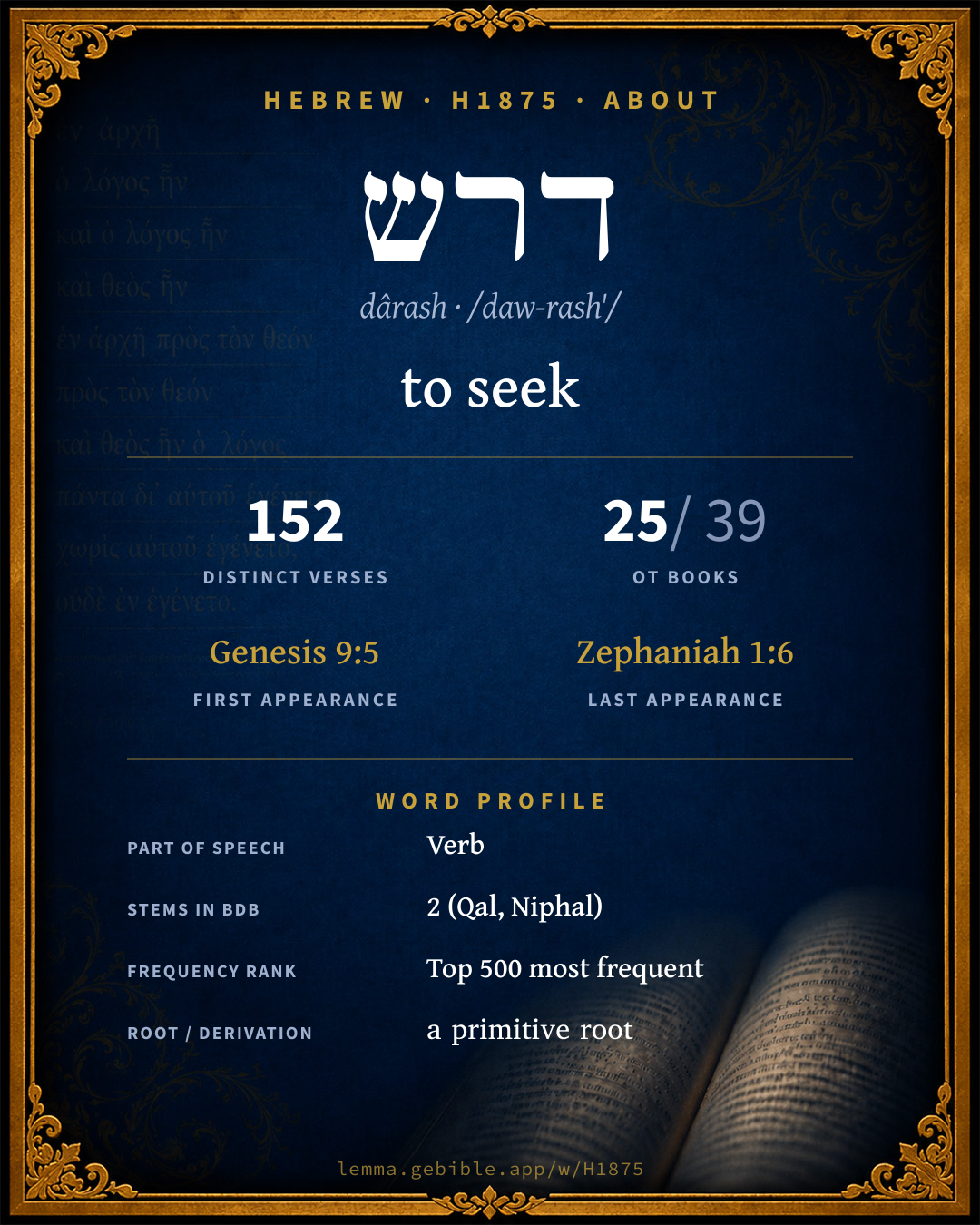
דָּרַשׁ
to seek
‘to seek’ is one of 12 main senses fuller range ↓
Full lexicon entry — Brown-Driver-Briggs (BDB)
From Brown-Driver-Briggs (BDB)
Where this word appears
Grammar key — what these labels mean
Part of speech
- Verb
- An action or state-of-being word.
Stem
- Qal
- The basic, simple active stem — the plain form of the verb (“he wrote”). Here: ‘seek’
- Niphal
- Usually the simple passive or reflexive of the Qal (“he was written”). Here: ‘let oneself be inquired of’
Form
- Infinitive Construct
- A bound verbal noun, frequently with prepositions (“to write / in writing”).
- Participle Active
- A verbal adjective expressing ongoing or characteristic action (“writing / one who writes”).
- Imperative
- A direct command (“write!”).
- Imperfect
- An incomplete, ongoing, or future action (“he will / would write”).
- Perfect
- A completed action or state — Hebrew marks aspect (completeness) more than strict tense (“he wrote”).
- Sequential Perfect
- A perfect with prefixed waw continuing a preceding imperfect or command (waw-consecutive perfect).
- Cohortative
- A first-person volitional form expressing wish or resolve (“let me / let us write”).
- Sequential Imperfect
- An imperfect with prefixed waw — the standard past-narrative form (waw-consecutive imperfect).
- Infinitive Absolute
- An unbound verbal noun, often intensifying or standing in for a finite verb.
- Jussive
- A third- or second-person volitional form expressing wish or command (“let him write”).
- Participle Passive
- A verbal adjective expressing action received (“written”).
State
- Absolute
- The independent form of a noun, not bound to a following word.
- Construct
- A noun bound to a following noun in a possessive / “of” relationship (the construct chain).
Person
- 2nd Person
- The one addressed (“you”).
- 1st Person
- The speaker (“I / we”).
- 3rd Person
- The one spoken about (“he / she / it / they”).
Gender
- Masculine
- Grammatically masculine.
- Common
- Either gender — not distinguished for this form.
- Feminine
- Grammatically feminine.
Number
- Singular
- One.
- Plural
- More than one (in Hebrew, generally three or more).
Every verse where H1875 appears in the Book of 2 Chronicles — 28 distinct verses. Click any verse to open its interlinear word-by-word view. Verse text shown in the World English Bible for context — . Each verse’s Hebrew form is shown with its reference; the English is not keyword-highlighted, since the data carries no word-level English alignment. Use “Compare translations” on any verse to read it across multiple English versions. This concordance covers the Hebrew Bible; Septuagint (Greek Old Testament) occurrences are not indexed here.
2 Chronicles
- 2 Chronicles 1:5 וַ/יִּדְרְשֵׁ֥/הוּ conj + Qal wimpf 3ms + sfx pers 3ms Moreover the brazen altar, that Bezalel the son of Uri, the son of Hur, had made, was there before the tent of Yahweh: and Solomon and the assembly sought to it.
- 2 Chronicles 12:14 לִ/דְר֖וֹשׁ prep + Qal inf.cs He did that which was evil, because he didn't set his heart to seek Yahweh.
- 2 Chronicles 14:4 לִ/דְר֕וֹשׁ prep + Qal inf.cs and commanded Judah to seek Yahweh, the God of their fathers, and to do the law and the commandment.
- 2 Chronicles 14:7 דָרַ֨שְׁנוּ֙ דָּרַ֕שְׁנוּ Qal pf 1cp Qal pf 1cp For he said to Judah, Let us build these cities, and make about them walls, and towers, gates, and bars; the land is yet before us, because we have sought Yahweh our God; we have sought him, and he has given us rest on every side. So they built and prospered.
- 2 Chronicles 15:2 תִּדְרְשֻׁ֨/הוּ֙ Qal impf 2mp + sfx pers 3ms and he went out to meet Asa, and said to him, Hear you me, Asa, and all Judah and Benjamin: Yahweh is with you, while you are with him; and if you seek him, he will be found of you; but if you forsake him, he will forsake you.
- 2 Chronicles 15:12 לִ/דְר֕וֹשׁ prep + Qal inf.cs They entered into the covenant to seek Yahweh, the God of their fathers, with all their heart and with all their soul;
- 2 Chronicles 15:13 יִדְרֹ֛שׁ Qal impf 3ms and that whoever would not seek Yahweh, the God of Israel, should be put to death, whether small or great, whether man or woman.
- 2 Chronicles 16:12 דָרַ֣שׁ Qal pf 3ms In the thirty-ninth year of his reign Asa was diseased in his feet; his disease was exceeding great: yet in his disease he didn't seek Yahweh, but to the physicians.
- 2 Chronicles 17:3 דָרַ֖שׁ Qal pf 3ms Yahweh was with Jehoshaphat, because he walked in the first ways of his father David, and didn't seek the Baals,
- 2 Chronicles 17:4 דָּרָ֔שׁ Qal pf 3ms but sought to the God of his father, and walked in his commandments, and not after the doings of Israel.
- 2 Chronicles 18:4 דְּרָשׁ Qal impv 2ms Jehoshaphat said to the king of Israel, Please inquire first for the word of Yahweh.
- 2 Chronicles 18:6 וְ/נִדְרְשָׁ֖ה conj + Qal coh 1cp But Jehoshaphat said, Isn't there here a prophet of Yahweh besides, that we may inquire of him?
- 2 Chronicles 18:7 לִ/דְרוֹשׁ֩ prep + Qal inf.cs The king of Israel said to Jehoshaphat, There is yet one man by whom we may inquire of Yahweh: but I hate him; for he never prophesies good concerning me, but always evil: the same is Micaiah the son of Imla. Jehoshaphat said, Don't let the king say so.
- 2 Chronicles 19:3 לִ/דְרֹ֥שׁ prep + Qal inf.cs Nevertheless there are good things found in you, in that you have put away the Asheroth out of the land, and have set your heart to seek God.
- 2 Chronicles 20:3 לִ/דְר֣וֹשׁ prep + Qal inf.cs Jehoshaphat feared, and set himself to seek to Yahweh; and he proclaimed a fast throughout all Judah.
- 2 Chronicles 22:9 דָּרַ֥שׁ Qal pf 3ms He sought Ahaziah, and they caught him (now he was hiding in Samaria), and they brought him to Jehu, and killed him; and they buried him, for they said, He is the son of Jehoshaphat, who sought Yahweh with all his heart. The house of Ahaziah had no power to hold the kingdom.
- 2 Chronicles 24:6 דָרַ֣שְׁתָּ Qal pf 2ms The king called for Jehoiada the chief, and said to him, Why haven't you required of the Levites to bring in out of Judah and out of Jerusalem the tax of Moses the servant of Yahweh, and of the assembly of Israel, for the tent of the testimony?
- 2 Chronicles 24:22 וְ/יִדְרֹֽשׁ conj + Qal impf 3ms Thus Joash the king didn't remember the kindness which Jehoiada his father had done to him, but killed his son. When he died, he said, Yahweh look on it, and require it.
- 2 Chronicles 25:15 דָרַ֨שְׁתָּ֙ Qal pf 2ms Therefore the anger of Yahweh was kindled against Amaziah, and he sent to him a prophet, who said to him, Why have you sought after the gods of the people, which have not delivered their own people out of your hand?
- 2 Chronicles 25:20 דָֽרְשׁ֔וּ Qal pf 3cp But Amaziah would not hear; for it was of God, that he might deliver them into the hand [of their enemies], because they had sought after the gods of Edom.
- 2 Chronicles 26:5 לִ/דְרֹ֣שׁ דָּרְשׁ֣/וֹ prep + Qal inf.cs Qal inf.cs + sfx pers 3ms He set himself to seek God in the days of Zechariah, who had understanding in the vision of God: and as long as he sought Yahweh, God made him to prosper.
- 2 Chronicles 30:19 לִ/דְר֛וֹשׁ prep + Qal inf.cs who sets his heart to seek God, Yahweh, the God of his fathers, though not [cleansed] according to the purification of the sanctuary.
- 2 Chronicles 31:9 וַ/יִּדְרֹ֣שׁ conj + Qal wimpf 3ms Then Hezekiah questioned the priests and the Levites concerning the heaps.
- 2 Chronicles 31:21 לִ/דְרֹ֖שׁ prep + Qal inf.cs In every work that he began in the service of the house of God, and in the law, and in the commandments, to seek his God, he did it with all his heart, and prospered.
- 2 Chronicles 32:31 לִ/דְרֹ֗שׁ prep + Qal inf.cs However in [the business of] the ambassadors of the princes of Babylon, who sent to him to inquire of the wonder that was done in the land, God left him, to try him, that he might know all that was in his heart.
- 2 Chronicles 34:3 לִ/דְר֕וֹשׁ prep + Qal inf.cs For in the eighth year of his reign, while he was yet young, he began to seek after the God of David his father; and in the twelfth year he began to purge Judah and Jerusalem from the high places, and the Asherim, and the engraved images, and the molten images.
- 2 Chronicles 34:21 דִרְשׁ֨וּ Qal impv 2mp Go you, inquire of Yahweh for me, and for those who are left in Israel and in Judah, concerning the words of the book that is found; for great is the wrath of Yahweh that is poured out on us, because our fathers have not kept the word of Yahweh, to do according to all that is written in this book.
- 2 Chronicles 34:26 לִ/דְר֣וֹשׁ prep + Qal inf.cs But to the king of Judah, who sent you to inquire of Yahweh, thus shall you tell him, Thus says Yahweh, the God of Israel: As touching the words which you have heard,
About this entry
At a glance — auto-summarized from this page’s data, not written by a person. Every figure links to its source below. This summary describes the numbers; it doesn’t interpret them.
The Hebrew verb דרש centers on the idea of “to seek.” The King James Version also renders it “enquire,” a usage modern versions have dropped for “seek” — see the renderings breakdown. It appears 152 verses across 25 books of the Hebrew Bible, among its common vocabulary. Debuting at Genesis 9:5, it then recurs through the corpus. Across 2 stems, its meaning turns on the binyan (Qal, Niphal). For the data behind this summary, explore the sense tree and the renderings breakdown below.
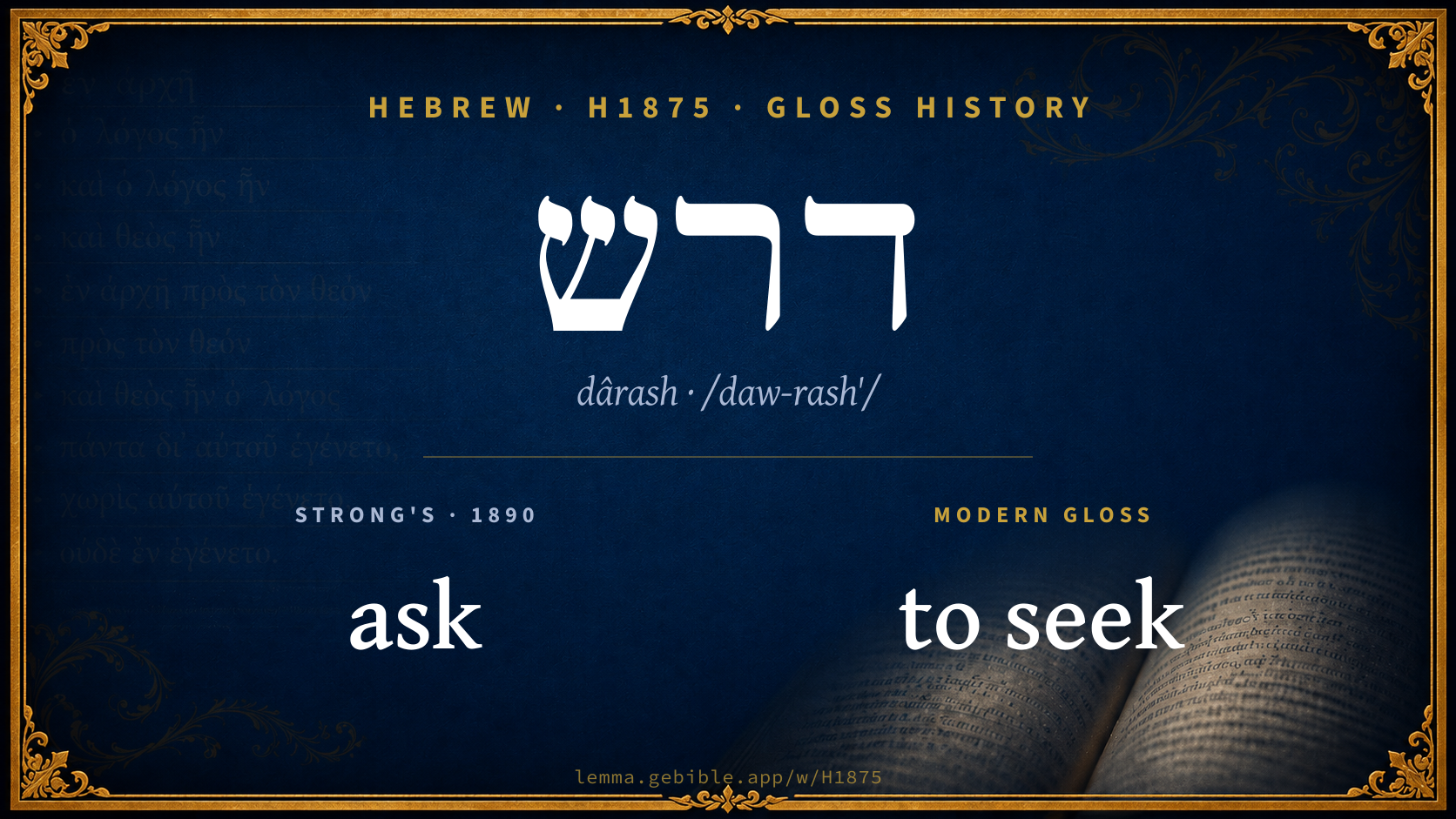
Gloss history
Strong's 1890 vs modern scholarship
About this word
Strong's H1875 catalogs a Hebrew word from the Hebrew Old Testament.
These counts are not copied from any lexicon or concordance. They are computed here, from the morphology-tagged Hebrew Old Testament. What Lemma adds →
- 152
- distinct verses
- The word appears in 152 distinct verses.
- 25 / 39
- OT books
- The word appears in 25 of 39 Old Testament books.
- #277
- by frequency
- Top 500 most frequent Hebrew words (rank 277 of 8,640 Hebrew words by occurrence).
View all 152 occurrences in the concordance →
Most concentrated in
- 2 Chronicles 28 verses 18%
- Psalms 24 verses 16%
- Deuteronomy 13 verses 9%
By section of the Old Testament
By traditional corpus
Conventional, traditional groupings — biblical authorship is debated, so this is a traditional corpus grouping, not an authorship claim. Each share is this word’s portion of its verses in that division of the Hebrew canon. Each figure is a share of the word’s 152 distinct verses.
- Writings (Ketuvim) 76 verses · 50%
- Prophets (Nevi'im) 58 verses · 38%
- Torah (Pentateuch) 18 verses · 12%
How translations render this word
Counts come from each version’s own published word-to-Strong’s tagging or interlinear alignment — an approximate guide to how each version renders this word, not a word-level alignment the data otherwise carries. Because each total is that version’s own tagged count, the per-version totals vary from one another and need not match the appearance or distinct-verse counts above. These counts may also differ from a printed concordance because Lemma counts each distinctly tagged rendering and does not collapse phrase taggings into a single head-word total. This is a fixed set of word-tagged versions (KJV, ASV, BSB, ULT) and does not change with the reading translation you choose elsewhere. Each version’s license is shown beside its name below (and on Sources).
BDB lists this Strong’s number as 2 distinct words (homographs). Each count above pools all of them and is not split by sense — see the Senses section below. A low-frequency rendering may belong to a different one of those words, not the primary meaning.
- King James Version†: Seek 34×, Enquire 21×, Sought 5×
- American Standard Version†: Seek 32×, Inquire 16×, Sought 4×
- Berean Standard Bible†: Seek 27×, Inquire 20×, Seeking 5×
- unfoldingWord Literal Text†: Seek 46×, Inquire 7×, Seeking 6×
King James Version Public Domain
Renders H1875 across 163† tagged occurrences — most commonly:
Plus other, less common renderings. Plus 63 renderings that appear only once — usually multi-word phrases or single function words the recovered tagging swept in, not distinct renderings. Not rendered by a distinct English word in 1 further occurrence.
American Standard Version Public Domain
Renders H1875 across 164† tagged occurrences — most commonly:
Plus other, less common renderings. Plus 73 renderings that appear only once — usually multi-word phrases or single function words the recovered tagging swept in, not distinct renderings.
Berean Standard Bible Public Domain
Renders H1875 across 160† tagged occurrences — most commonly:
Plus other, less common renderings. Plus 73 renderings that appear only once — usually multi-word phrases or single function words the recovered tagging swept in, not distinct renderings. Not rendered by a distinct English word in 4 further occurrences.
unfoldingWord Literal Text CC BY-SA 4.0
Renders H1875 across 185† tagged occurrences — most commonly:
Plus other, less common renderings. Plus 65 renderings that appear only once — usually multi-word phrases or single function words the recovered tagging swept in, not distinct renderings.
18 senses and sub-senses in the full BDB
Hebrew verbs can shift meaning by stem (binyan): Qal is the basic action, Niphal is often passive or reflexive, Piel often intensifies or makes it factitive, and Hiphil is typically causative. The senses below are grouped under the stem BDB assigns to each.
What do BDB’s symbols mean?
BDB uses these scholarly abbreviations:
| Symbol | Meaning |
|---|---|
| 𝔊 | the Septuagint (the ancient Greek translation, LXX) |
| 𝔙 | the Vulgate (the Latin translation) |
| 𝔖 | the Syriac version (the Peshitta) |
| 𝔗 | the Targum (the Aramaic translation) |
| ψ | the Psalms |
| √ | root (the underlying root or stem) |
| ‖ | parallel passage (a synonymous or contrasted parallel) |
| † | the dagger: every passage where the word occurs is cited |
The 18 senses and sub-senses the full Brown-Driver-Briggs lexicon distinguishes for this word, in lexicon order (not ranked by frequency), with BDB’s own verbatim wording and sub-sense lettering. Shown in Hebrew script with BDB’s own scholarly abbreviations. The condensed entry is in the Lexicon Entry tab. See also the Forms in the corpus table below.
דרש I Ezr 10
דרש II resort to, seek (cf. Arabic دَرَسَ rub over, efface (a site), tread (wheat), fig. read repeatedly, study
Qal
- Pf. 1 Ch 10:14; Impf. יִדְרֹשׁ ψ 10:4 +, אֶדְרְשָׁה 1 S 28:7, נִדְרְשָׁה 1 K 22:7 +, יִדְרְשׁוּן Is 55:2; Imv. דְּרָשׁ־ 1 K 22:5 +; Inf. abs. דָּרֹשׁ Lv 10:16 Dt 23:22; cstr. דְּרֹשׁ Dt 22:2 + לִדְרָשׁ־ Ez 14:7, לְדַרְיוֹשׁ (scribal error for לִדְרוֹשׁ Ew§ 239 a Ol§ 245 g) Ezr 10:16; Pt. דֹּרֵשׁ Dt 11:12 + 10 times, דּוֹרֵשׁ 1 Ch 28:9 + 3 times; pass. דְּרוּשִׁים ψ 111:2, דְּרוּשָׁה Is 62:12; syn. בקשׁ;— e.g. 1 Chronicles 10:14
- 1. (tread a place,) resort to, frequent, with religious obj., c. acc. loc. Am 5:5 2 Ch 1:5, אֶל־ loc. Dt 12:5. e.g. Amos 5:5
- 2. seek, consult, inquire of:
- a. acc. י׳, אֱלֹהִים Gn 25:22 (J) Ex 18:15 (E) 1 S 9:9 1 K 22:8 2 K 3:11; 8:8; 22:13, 18 1 Ch 15:13; 21:30 2 Ch 18:7; 34:21 ψ 24:6; 78:34 Je 21:2; 37:7 Ez 20:1, 3; the ark of God 1 Ch 13:3; word of Yahweh 1 K 22:5 (= 2 Ch 18:4) cf. 1 K 14:5; with בְּ Yahweh 1 Ch 10:14 2 Ch 34:26 Ez 14:7; his word 2 K 1:16; with אֶל, אֶל־אֵל Jb 5:8; their God Is 8:19, Messianic king Is 11:10; מֵעַל־סֵפֶר י׳ out of the book of י׳ Is 34:16 (in gloss, according to CheJQ Jan. 1892, 332); c. מֵאוֹתוֹ of a נָבִיא לי׳ 1 K 22:7 (= 2 Ch 18:6) cf. (supr.) v 8 2 K 3:11 and 1 K 14:5 (מֵעִמְּךָ). e.g. Genesis 25:22
- b. heathen gods and necromancers, הַדֹּרֵשׁ the inquirer Ez 14:10; with בְּ, בַּעֲלַת אוֹב 1 S 28:7, בָּאוֹב 1 Ch 10:13, בְּבַעַל זְבוּב 2 K 1:2, 3, 6, 16; with אֶל, אֶל־הָאֹבוֹת Is 8:19, אֶל־הַמֵּתִים Dt 18:11, אֶל־הָאֱלִילִים Is 19:3. e.g. Ezekiel 14:10
- 3. seek deity in prayer and worship:
- a. the true God (cf. בקשׁ 3) דרשׁ י׳ Dt 4:29; Ho 10:12; Am 5:4, 6; Is 9:12; 31:1; 55:6; 58:2; 65:10; Je 10:21; 29:13; Zp 1:6; La 3:25; 1 Ch 16:11 (= ψ 105:4) 28:9; 2 Ch 12:14; 14:3, 6; 15:2, 12; 16:12; 22:9; 26:5; ψ 9:11; 22:27; 34:5, 11; 119:2, 10; דרשׁ (ה)אלהים 2 Ch 19:3; 26:5; 30:19 ψ 14:2 (= 53:3) 69:33; אֲדֹנָי ד׳ ψ 77:3; with לְ, only in Chronicler, ליהוה 1 Ch 22:19 2 Ch 15:13; 20:3 Ezr 6:21; לאלהים 2 Ch 17:4; 31:21; 34:3 Ezr 4:2; DrIntr. 503 finds in Chr weakened meaning, revere. e.g. Deuteronomy 4:29
- b. seek heathen deities, c. acc. Je 8:2 2 Ch 25:15, 20; with לְ, Dt 12:30 2 Ch 17:3. e.g. Jeremiah 8:2
- 4.
- a. seek, with idea of demanding, require (בקשׁ is seek, simply), with acc. lost sheep Dt 22:2 Ez 34:6, 8, 11; goat Lv 10:16(×2) (P); with אחר, after green fodder Jb 39:8. e.g. Deuteronomy 22:2
- b. inquire, investigate, abs. Ju 6:29 Dt 13:15; 17:4, 9; 19:18; with acc. Ezr 10:16; כָּל־לְבָבוֹת דּוֹרֵשׁ י׳ all hearts Yahweh searches 1 Ch 28:9, לִדְרשׁ הַמּוֹפֵת to inquire into the wonder 2 Ch 32:31; with לְ, to inquire about 2 S 11:3 Jb 10:6; sq. עַל pers. + inf. 2 Ch 24:6 apply to the Levites to bring, etc., cf. 31:9 (עַל both pers. and rei). e.g. Judges 6:29
- 5. ask for, require, demand, c. acc. rei Ez 20:40; + מִן pers. Dt 23:22 Mi 6:8; exact, often with collat. idea of avenging, מֵעִם Dt 18:19, so with מִיַּד Ez 34:10, דָּרַשׁ דָּם מִיַּד Gn 9:5 (P) Ez 33:6; acc. only, דֹּרֵשׁ דמים ψ 9:13, ד׳ רִשְׁעוֹ 10:15; abs. v 4, 13 2 Ch 24:22. e.g. Ezekiel 20:40
- 6. seek with application, study, follow, practise, abs. by wisdom Ec 1:13; with acc. ד׳ מִשְׁפָּט study or practise justice Is 1:17; 16:5; מַעֲשֵׂי י׳ ψ 111:2; טוֹב וְאַל־רַע Am 5:14; commands of God ψ 119:45, 94, 155 1 Ch 28:8; the law Ezr 7:10; †ד׳ שׁלום seek or study the peace, welfare of any one Dt 23:7 Je 29:7 Ezr 9:12, לשׁלום Je 38:4, ד׳ טוב Est 10:3, ד׳ רעה Pr 11:27 ψ 38:13 (cf. בקשׁ 2, where this use is more common). e.g. Ecclesiastes 1:13
- 7. seek with care, care for, ארץ אשׁר יהוה אלהיך דֹּרֵשׁ אתהּ land which Yahweh thy God careth for Dt 11:12; אַל־יִדְרְשֵׁהוּ אֱלוֹהַּ let not Eloah care for it Jb 3:4; אוֹתָךְ לֹא יִד׳ Je 30:14; דָּֽרְשָׁה צֶמֶר Pr 31:13; with לְ Je 30:17; אֵין דּוֹרֵשׁ לְנַפְשִׁי no one careth for me ψ 142:5; but in both these לְ perhaps belongs to אֵין, cf. ‖ אֵין לִי מַכִּיר ψ 142:5, also La 4:4 etc.; דְּרוּשָׁה cared for (of Jerus.) Is 62:12. e.g. Deuteronomy 11:12
Niphal
- Pf. נִדְרָ֑שׁ Gn 42:22, נִדְרַשְׁתִּי Is 65:1, נִדְרָ֑שׁוּ 1 Ch 26:31; Impf. אִדָּרֵשׁ Ez 14:3; 20:3, 31(×2); 36:37; Inf. abs. הַאִדָּרֹשׁ Ez 14:3 (for ההדרשׁ);— e.g. Genesis 42:22
- 1. let oneself be inquired of, consulted, only of God Ez 14:3(×2); 20:3, 31(×2); 36:37 Is 65:1. e.g. Ezekiel 14:3
- 2. be sought out 1 Ch 26:31. e.g. 1 Chronicles 26:31
- 3. be required, of blood (cf. Qal 5 Gn 42:22 (E). e.g. Genesis 42:22
- —וְדָרְשׁוּ מֵחָרְבוֹתֵיהֶם and beg out of their desolate places ψ 109:10 (Ki al. wedŏršu, vid. Baer); many MSS. read דָּֽרְשׁוּ, so most interpr.; 𝔊 Hup Bi Che read גֹּרְשׁוּ be driven from. e.g. Psalms 109:10
Senses from the full Brown-Driver-Briggs lexicon (Brown, Driver, Briggs; Oxford 1906 — public domain), digitized via Sefaria, supplemented by the OpenScriptures HebrewLexicon (CC BY 4.0). Full attribution on Sources.
Word origin
vb. resort to, seek (cf. Arabic دَرَسَ rub over, efface (a site), tread (wheat), fig. read repeatedly, study; ܕܪܰܫ beat (a path), discuss, Pa. practise in; NH search out (a meaning), expound)—
— Brown-Driver-Briggs (Oxford 1906, public domain), digitized via Sefaria, supplemented by the OpenScriptures HebrewLexicon (CC BY 4.0). See Sources.
Origin: a primitive root
Jastrow Dictionary
A second Hebrew/Aramaic lexicon for comparison, covering Aramaic and post-biblical (Talmudic, Targumic, Midrashic) usage that the biblical-Hebrew BDB does not. Matched by lemma rather than by Strong’s number, so a lemma may carry more than one Jastrow headword (shown separately below), and the entries cover usage well beyond the Bible.
דָּרַשׁ
- (b. h.)
- 1. to examine, question. Denom. דְּרִישָׁה.
- 2. to expound, interpret. Ber. I, 5 עד שדְּרָשָׁהּ בן זומא until Ben Zoma found an intimation of it in the Biblical wording. Taan. 5ᵇ מקרא אני דוֹרֵשׁ I find it intimated in a Bible verse. B. Mets. 104ᵃ היה ד׳ לשון הדיוט interpreted the popular (Chaldaic) wording used in documents. Pes. 22ᵇ, v. אֵת; a. v. fr.—Part. pass. דָּרוּשׁ, f. דְּרוּשָׁה. Y. Yeb. VIII, 8ᵈ top והלא ד׳ הוא has not the word ממנו been employed for interpretation?, opp. מופנה.—Denom. דְּרִישָׁה, מִדְרָשׁ.
- 3. (in gen.) to teach, lecture. Ḥag. II, 1 אין דֹּורְשִׁין ב־ you must not lecture on &c. Snh. 99ᵇ ודורש בהגדות וכ׳ lectured on topics with the object of fault-finding; a. v. fr.—דֹּורֵשׁ lecturer. Ex. R. s. 42, beg. אבא הַדֹּ׳ Abba, the lecturer. Ex. R. s. 8, end, v. אֲמוֹרָא.—Pl. דֹּורְשִׁים. Snh. 38ᵇ; Ab. Zar. 5ᵃ דור דור ודוֹרְשָׁיו every generation with its preachers. דֹּורְשֵׁי חמורות, v. חוֹמֶר; ד׳ רשומות, v. רְשׁוּמָה. [M. Kat. II, 5 (13ᵇ) דורשין Ms. M. (ed. עושין), read דֹּושְׁשִׁין.]
- to be interpreted, expounded. Sifra, introd. rules שהתורה נִדְרֶשֶׁת בהן by which the Law is interpreted. Y. Peah II, 17ᵃ דברים הַנִּדְרָשִׁין מן הכתב things which are derived by interpretation from the written code (Torah); הנדרשין מן הפה derived from the oral code (Mishnah). Y. Meg. I, 70ᵃ top נתנה להִידָּרֵשׁ is a legitimate object of interpretation.
- same. Y. Keth. III, 27ᵈ top מִתְדָּרֵשׁ (מִתְדָּרְשָׁה) ולו וכ׳ the words v’lo &c. are open for interpretation, v. גְּזֵרָה.
דְּרַשׁ
- [Targ. Jer. XLVIII, 26, some ed., ידרשון, v. דְּשַׁשׁ.] Targ. Jud. V, 9.—Succ. 51ᵇ bot. קרא אשכחו ודָרוּשׁ they found a Bible verse and interpreted it. Arakh. 30ᵇ איכא למִידְרְשִׁינְהוּ וכ׳ it may be interpreted in favor of a lenient practice &c.—Sot. 21ᵃ דַּרְשַׁיה … להאי קרא R. … interpreted this verse. Ib. מאי דָרוּשׁ what verse did they interpret (to guide them in their action)?—Bets. 28ᵃ דַּרְשִׁינָן משמך we taught in thy name. Yeb. 94ᵃ הוה ליה … למִידְרַשׁ וכ׳ R. El. might have given a valuable interpretation &c., v. מַרְגְּנִיתָא. Lev. R. s. 9 עד דיחסל מִמִּדְרַשׁ until he ended his lecture. Ber. 28ᵃ נִדְרוֹשׁ מר וכ׳ shall this teacher lecture one Sabbath, and the other &c.? Ib. לִדְרוֹשׁ ר׳ (v. Rabb. D. S. a. l. note); a. v. fr.—דָּרֵישׁ lecturer. Y. Yeb. XII, 13ᵃ top ד׳ ודיין וכ׳ to serve as lecturer, judge &c.
- to be interpreted. Ber. 63ᵃ האי קרא … מִדְּרִישׁ וכ׳ this verse (Ps. CXIX, 126) can be interpreted in its regular order (it is time to work &c., because people neglect the law) or in inverted order (the teachers ignore the letter of the law, because it is time to work for the Lord by guarding its spirit); ib. 60ᵃ; Snh. 70ᵃ e.g. Psalms 119:126
A Dictionary of the Targumim, the Talmud Babli and Yerushalmi, and the Midrashic Literature (Marcus Jastrow; London, Luzac, 1903) — Public Domain. Digitized via Sefaria. Digitized via Sefaria. Full attribution on Sources.
Forms in the corpus
The 132 distinct written forms H1875 takes in the Hebrew Bible, most frequent first — each parse links to that stem’s occurrences in the concordance. Hebrew forms include their vowel points and cantillation, so a single lemma takes many written forms.
The 60 most common forms are shown; 72 rarer forms follow in the full concordance.
Same root — word family
Other BDB entries built from the same root as H1875, grouped by Strong’s listed origin. These share a root / origin per the lexicon — not necessarily a shared meaning. Each links to that word’s own entry.
Derived from this word
Compare all same-root words → They share a root, not necessarily a meaning.
Septuagint verse parallels
This word appears in 141 verses that also exist in the Greek Old Testament (Septuagint), out of the 152 Hebrew verses it occurs in. You can read those verses in Greek by switching the Old Testament edition to the Septuagint.
Read these verses in the Septuagint
- Genesis 9:5
- Exodus 18:15
- Leviticus 10:16
- Deuteronomy 4:29
- Judges 6:29
- 1 Samuel 9:9
- 2 Samuel 11:3
- 1 Kings 14:5
- 2 Kings 1:2
- 1 Chronicles 10:13
- 2 Chronicles 1:5
- Ezra 4:2
This is a verse-level parallel only — the same verses exist in both the Hebrew and Greek Old Testaments. No word-level Hebrew↔Greek correspondence is claimed: the data carries no such alignment, so no Greek word is shown as this Hebrew word’s translation. Coverage is not total — the Septuagint omits the deuterocanon and renumbers the Psalms, so some Hebrew verses have no direct Greek parallel.