2 Chronicles 25:20

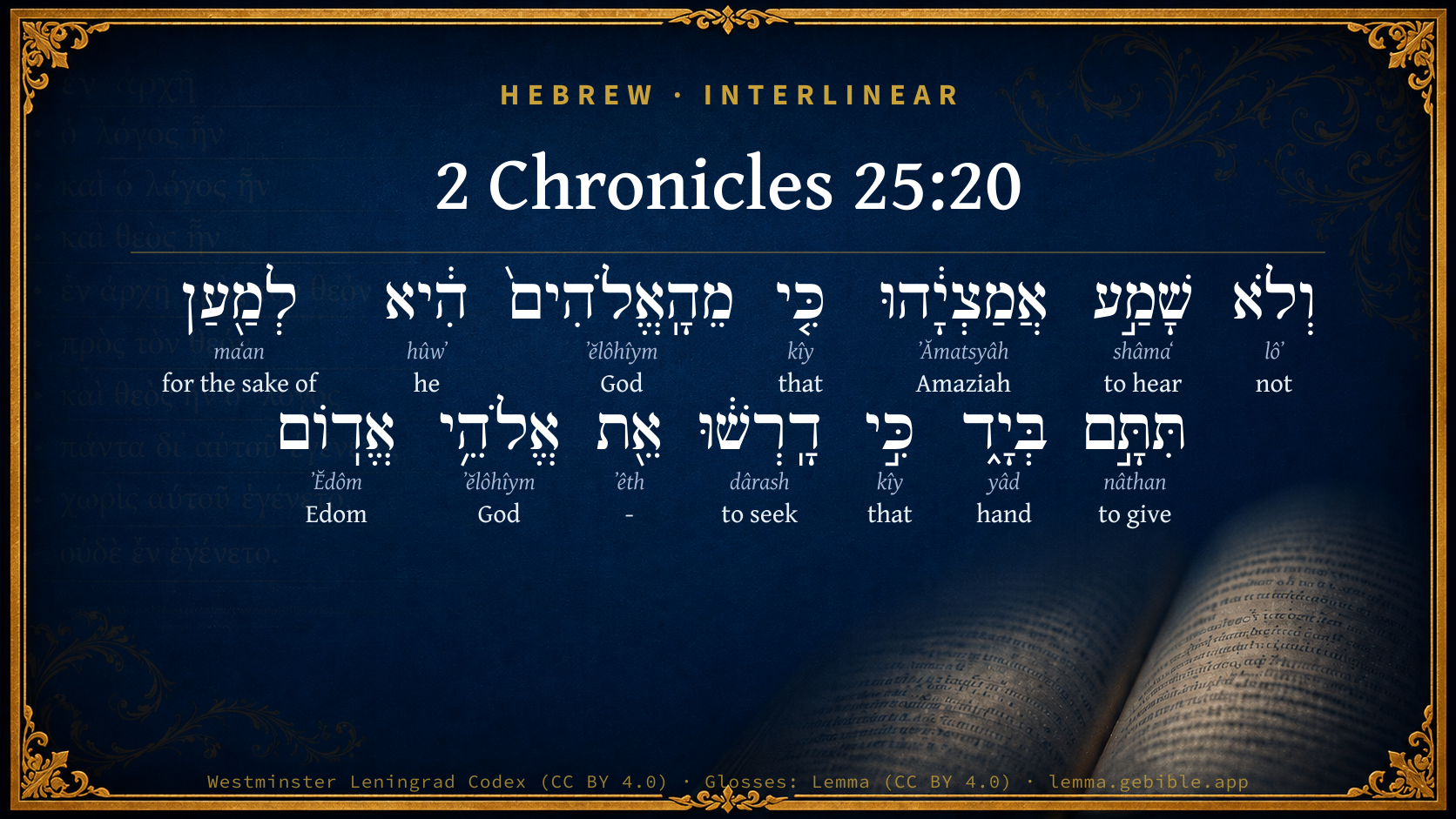
Hebrew (Westminster Leningrad Codex) 2 Chronicles 25:20 appears in the Hebrew Old Testament. The text above is from the Westminster Leningrad Codex. Each word links to its Strong’s number, a concise gloss, and parsing drawn from the Open Scriptures Hebrew Bible morphology. Click any word for its full Brown-Driver-Briggs (BDB) entry.
Download image
Cite this verse

2 Chronicles 25:20 (World English Bible). Public Domain. Lemma interlinear Bible study tool, https://lemma.gebible.app/v/2-chronicles/25/20.

Show BibTeX & RIS
BibTeX
RIS
English Translation
But Amaziah would not hear; for it was of God, that he might deliver them into the hand [of their enemies], because they had sought after the gods of Edom.
World English Bible · Public Domain
Download a study sheet

One document with this verse’s original text, its word-by-word gloss line, the meaning frame, cross-references with their text, attributed commentary, and full source and license credits — printable, and it pastes into notes with its structure intact.

This verse Autodidact and up

Study sheet (.html) Plain text (.txt)

A passage Seminary Student

Up to 50 verses in one chapter. A passage sheet keeps up to 6 commentary sources and 12 cross-references per verse, in the order this page ranks them, and says so on the sheet whenever that leaves anything out. Ask for a single verse and you get the Autodidact verse sheet above.

Everything on this page stays free to read, with no account — the sheet is a download of what is already on screen, not access to it.

Want to remove ads? Support Godless Engineer
Compare translations 3

The same verse in 3 English versions, stacked beneath the original-language interlinear above. Click any original word for its lexicon entry.

Each is an independent rendering of the whole verse — the interlinear is not word-aligned to these translations.

Highlighted words mark where these versions differ — a whole-verse word diff, not a word-by-word alignment.

  • World English Bible Public Domain
    But Amaziah would not hear; for it was of God, that he might deliver them into the hand [of their enemies], because they had sought after the gods of Edom.
  • King James Version Public Domain
    But Amaziah would not hear; for it came of God, that he might deliver them into the hand of their enemies, because they sought after the gods of Edom.
  • unfoldingWord Literal Text CC BY-SA 4.0
    But Amaziah did not listen, because from God it was, in order to give them into the hand because they sought the gods of Edom.

unfoldingWord Literal Text — © unfoldingWord, licensed CC BY-SA 4.0. Word-aligned USFM3 via Door43 (git.door43.org/unfoldingWord/en_ult).

Versions to compare (up to 4)

3 of 4 selected

Show all 18 translations

Every available English version of this verse, each an independent rendering of the whole verse.

  • World English Bible Public Domain
    But Amaziah would not hear; for it was of God, that he might deliver them into the hand [of their enemies], because they had sought after the gods of Edom.
  • Berean Standard Bible Public Domain
    But Amaziah would not listen, for this had come from God in order to deliver them into the hand of Jehoash, because they had sought the gods of Edom.
  • Majority Standard Bible Public Domain
    But Amaziah would not listen, for this had come from God in order to deliver them into the hand of Jehoash, because they had sought the gods of Edom.
  • King James Version Public Domain
    But Amaziah would not hear; for it came of God, that he might deliver them into the hand of their enemies, because they sought after the gods of Edom.
  • American Standard Version (1901) Public Domain
    But Amaziah would not hear; for it was of God, that he might deliver them into the hand `of their enemies', because they had sought after the gods of Edom.
  • Revised Version (1885) Public Domain
    But Amaziah would not hear; for it was of God, that he might deliver them into the hand of their enemies, because they had sought after the gods of Edom.
  • Geneva Bible (1599) Public Domain
    But Amaziah would not heare: for it was of God, that he might deliuer them into his had, because they had sought the gods of Edom.
  • Douay-Rheims (1899) Public Domain
    Amasias would not hearken to him, because it was the Lord's will that he should be delivered into the hands of enemies, because of the gods of Edom.
  • Young's Literal Translation Public Domain
    And Amaziah hath not hearkened, for from God it `is' in order to give them into hand, because they have sought the gods of Edom;
  • Literal Standard Version CC BY-SA 4.0
    And Amaziah has not listened, for it [is] from God in order to give them into [their] hand, because they have sought the gods of Edom;
  • Unlocked Literal Bible CC BY-SA 4.0
    But Amaziah would not listen, because this event was from God, so he might put the people of Judah into the hand of their enemies, because they had sought advice from the gods of Edom.
  • unfoldingWord Literal Text CC BY-SA 4.0
    But Amaziah did not listen, because from God it was, in order to give them into the hand because they sought the gods of Edom.
  • Darby Bible Public Domain
    But Amaziah would not hear; for it was of God, that he might deliver them into [the enemy's] hand, because they had sought after the gods of Edom.
  • World Messianic Bible Public Domain
    But Amaziah would not listen; for it was of God, that he might deliver them into the hand of their enemies, because they had sought after the gods of Edom.
  • Webster's Bible Public Domain
    But Amaziah would not hear; for it came from God, that he might deliver them into the hand of their enemies, because they sought after the gods of Edom.
  • Free Bible Version CC BY-SA 4.0
    But Amaziah didn't listen, for God was going to hand him over to his enemies because he had chosen to worship the gods of Edom.
  • Bible in Basic English Public Domain
    But Amaziah gave no attention; and this was the purpose of God, so that he might give them up into the hands of Joash, because they had gone after the gods of Edom.
  • JPS Tanakh (1917) Public Domain
    But Amaziah would not hear; for it was of God, that He might deliver them into the hand of their enemies, because they had sought after the gods of Edom.

Literal Standard Version (2020), Covenant Press — licensed CC BY-SA 4.0. Text via the HelloAO Bible API (eBible.org). Unlocked Literal Bible (unfoldingWord) — licensed CC BY-SA 4.0. Text via the HelloAO Bible API (eBible.org). unfoldingWord Literal Text — © unfoldingWord, licensed CC BY-SA 4.0. Word-aligned USFM3 via Door43 (git.door43.org/unfoldingWord/en_ult). Free Bible Version, Dr. Jonathan Gallagher — licensed CC BY-SA 4.0. Text via the HelloAO Bible API (eBible.org).

Word by word

More ways to search: Search by grammar → Find every occurrence → Compare this word →

Practice this passage: Drill this verse → Learn its vocabulary →

אֲמַצְיָ֔הוּ
ʼĂmatsyâh
H558
“Amaziah”
Noun, Proper
Part of Speech
Noun
Type
Proper
Full BDB Definition

Origin: from H553 and H3050

TWOT: None

Amaziah = "Jehovah is mighty" - a king of Judah, son Joash, father of Azariah - a priest of Bethel under Jeroboam II - father of Joshah, of the tribe of Simeon - a Levite tabernacle singer in David's day
  1. וְלֹא lôʼ H3808 “and · not” Conjunction + Particle, Negative
  2. שָׁמַ֣ע shâmaʻ H8085 “to hear” Verb, Qal, Perfect, 3rd Person, Masculine, Singular
  3. כִּ֤י kîy H3588 “that” Conjunction
  4. מֵהָֽאֱלֹהִים֙ ʼĕlôhîym H430 “from · the · God(s)” Preposition + Particle, Definite Article + Noun, Common, Masculine, Plural, Absolute
  5. הִ֔יא hûwʼ H1931 “he” Pronoun, Personal, 3rd Person, Feminine, Singular
  6. לְמַ֖עַן maʻan H4616 “for the sake of” Preposition
  7. תִּתָּ֣ם nâthan H5414 “to give · them” Verb, Qal, Infinitive Construct + Suffix, Personal, 3rd Person, Masculine, Plural
  8. בְּיָ֑ד yâd H3027 “in/at · hand” Preposition + Noun, Common, Both, Singular, Absolute
  9. כִּ֣י kîy H3588 “that” Conjunction
  10. דָֽרְשׁ֔וּ dârash H1875 “to seek” Verb, Qal, Perfect, 3rd Person, Common, Plural
  11. אֵ֖ת ʼêth H853 “-” Particle, Direct Object
  12. אֱלֹהֵ֥י ʼĕlôhîym H430 “God(s) of” Noun, Common, Masculine, Plural, Construct
  13. אֱדֽוֹם ʼĔdôm H123 “Edom” Noun, Proper

About this verse

These counts appear in no published source. They are computed here, from the morphology-tagged text and Lemma’s own curated glosses. What Lemma adds →

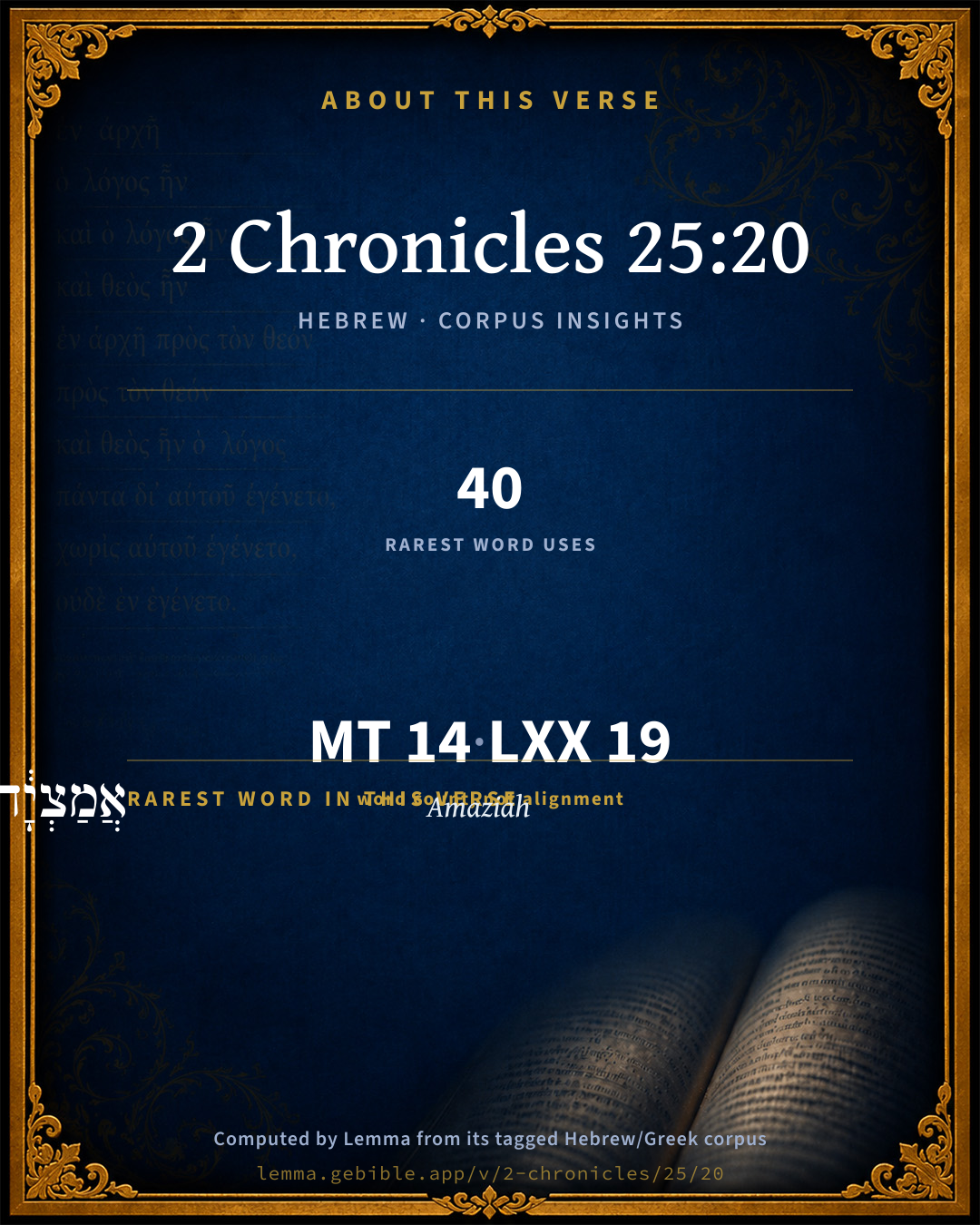
14
words
12
distinct lemmas
Historical
section

Shared distinctive vocabulary

אֲמַצְיָ֔הוּ Amaziah H558 occurs in 39 verses of the Hebrew Bible. Also found in:

Grammatical profile

  • 3 verbs
  • 5 nouns
  • 1 pronoun
  • 1 preposition
  • 2 conjunctions
  • 2 particles

Verb forms

  • שָׁמַ֣ע Qal · Perfect
  • תִּתָּ֣ם Qal · Infinitive Construct
  • דָֽרְשׁ֔וּ Qal · Perfect

Repetition

Words recur within this verse — often emphatic in Hebrew:

  • מֵהָֽאֱלֹהִים֙ God H430 ×2
  • כִּ֤י that H3588 ×2

Hebrew & Septuagint length

In English translation the verse runs 30 words from the Hebrew and 26 from the Septuagint (LXX English) — closely comparable.

A rough comparison of the two English renderings, which tokenize alike — not a word-level alignment.

Word counts can differ between the Hebrew and the Greek without any difference in meaning — e.g. the Hebrew direct-object marker אֵת has no separate Greek word, and Greek often adds the article ὁ.

In the original languages it is 14 Hebrew tokens and 19 Greek tokens — but the two are counted differently (Hebrew bundles its prefixes and suffixes into one token; the Greek is in lemma form), so that isn’t a like-for-like length.

Cross-references

7

Topical passages linked to 2 Chronicles 25:20 in the Treasury of Scripture Knowledge — connected by theme and wording, ordered by reader-vote popularity; previews shown in the World English Bible.

  • 1 Kings 12:15 So the king didn't listen to the people; for it was a thing brought about of Yahweh, that he might establish his word, which Yahweh spoke by Ahijah the Shilonite to Jeroboam the son of Nebat.
  • 2 Chronicles 22:7 Now the destruction of Ahaziah was of God, in that he went to Joram: for when he was come, he went out with Jehoram against Jehu the son of Nimshi, whom Yahweh had anointed to cut off the house of Ahab.
  • 2 Chronicles 25:16 It happened, as he talked with him, that [the king] said to him, Have we made you of the king's counsel? Stop! Why should you be struck down? Then the prophet stopped, and said, I know that God has determined to destroy you, because you have done this, and have not listened to my counsel.
  • Psalms 81:11–12 But my people didn't listen to my voice. Israel desired none of me.
  • Acts 28:25–27 When they didn't agree among themselves, they departed after Paul had spoken one word, "The Holy Spirit spoke rightly through Isaiah, the prophet, to our fathers,
  • 2 Thessalonians 2:9–11 even he whose coming is according to the working of Satan with all power and signs and lying wonders,
  • 1 Peter 2:8 and, "A stone of stumbling, and a rock of offense." For they stumble at the word, being disobedient, whereunto also they were appointed.

Cross-references courtesy of OpenBible.info (CC BY 4.0).

Hebrew and Greek witnesses Masoretic Hebrew ↔ Greek Septuagint

The same verse in the two great witnesses to the Old Testament, shown verse-for-verse.

These are two independent witnesses, not word-aligned to each other, and the Septuagint is shown in lemma (dictionary) form.

Hebrew 2 Chronicles 25:20 Masoretic · Westminster Leningrad Codex

וְלֹא שָׁמַ֣ע אֲמַצְיָ֔הוּ כִּ֤י מֵהָֽאֱלֹהִים֙ הִ֔יא לְמַ֖עַן תִּתָּ֣ם בְּיָ֑ד כִּ֣י דָֽרְשׁ֔וּ אֵ֖ת אֱלֹהֵ֥י אֱדֽוֹם

But Amaziah would not hear; for it was of God, that he might deliver them into the hand [of their enemies], because they had sought after the gods of Edom.

World English Bible · Public Domain

Greek LXX 2 Chronicles 25:20 Septuagint · lemma form

καί οὐ ἀκούω αμασιας ὅτι παρά κύριος γίγνομαι ὁ παραδίδωμι αὐτός εἰς χείρ ὅτι ἐκζητέω ὁ θεός ὁ ιδουμαία

Nevertheless Amasias listened not, for it was of the Lord to deliver him into the enemy's hands, because he sought after the gods of the Idumeans.

LXX2012 (modern English Septuagint) · Public Domain

On this verse, Ellicott's Commentary for English Readers discusses the Septuagint’s reading. Read the note in Commentary ↓

Hebrew: Westminster Leningrad Codex (CC BY 4.0). Greek: Septuagint (public domain); English from LXX2012 (modern English Septuagint) (Public Domain). How the Septuagint differs from the Hebrew →

Commentary

Notes on 2 Chronicles 25:20 from classic Christian and Jewish commentators (each source and its license shown beneath its notes). The classic Christian expositions comment on the surrounding passage and are grouped to its opening verse, so a note may address several verses; the Jewish commentaries on the Tanakh (Rashi and others) are per-verse, so they appear only where the commentator wrote on this verse.

Lemma curates 59 commentaries, every one of them public domain or Creative Commons licensed, each selected and text-cleaned for this edition rather than reprinted as found. About our sources →

Joseph Benson's Commentary

2Ch 25:20. For it came of God — Who gave him up to his own error and passion, in order to his ruin.

Joseph Benson's Commentary on the Old and New Testaments (1811–1818) — public domain. Text from a community e-Sword module.

Tyndale Open Study Notes

Tyndale Open Resources

25:20 Amaziah’s pride was manifested in his failure to seek God. While he seriously overestimated his military capability after defeating Edom, his decision to go to war against Jehoash was actually the result of trusting other gods and of ignoring God’s judgment that followed (cp. 18:9-34; 2 Thes 2:11).

Tyndale Open Study Notes — © Tyndale Open Resources, licensed CC BY-SA 4.0. Text via the HelloAO Bible API.

Geneva Bible (1599)

Geneva Bible translators

Thus God oft times plagueth by those means wherein men most trust, to teach them to have their recourse only to him, and to show his judgments, moveth their hearts to follow that which shall be their destruction.

Geneva Bible (1599) marginal notes — public domain. Text via Bolls.life.

Ellicott's Commentary for English Readers

(20) But Amaziah would not hear.—And Amaziah hearkened not.

For it came of God . . . gods of Edom.—This remark is added by the chronicler, accounting for the infatuation of Joash by reference to the divine predetermination of events. (Comp. 2Ch_25:16; and 2Ch_24:24; 2Ch_10:15; the Syr. and Arab. omit.)

That he might deliver them into the hand.—Heb., into hand; LXX., “into hands;” Vulg., “into the hands of the enemy.” Perhaps the original reading was, into his hand, i.e., the hand of Joash.

Because they sought.—For they had sought.

A Bible Commentary for English Readers, edited by Charles John Ellicott (1878–1897) — public domain. Text from a community e-Sword module.

The Cambridge Bible for Schools and Colleges

gen. ed. J. J. S. Perowne

20. for it was of God] Not in Kings. This turn is characteristic of the Chronicler; cp. 2Ch_10:15; 2Ch_22:7.

The Cambridge Bible for Schools and Colleges (gen. ed. J. J. S. Perowne; Cambridge University Press, 1878–1918) — public domain. Text from a community e-Sword module.

Haydock's Catholic Bible Commentary

It. Prot. "it came of God, that he might deliver them into the hand of their enemies, because they sought after the gods of Edom." H. --- The king was permitted to give ear to evil counsellors. C. --- "Jupiter deprives those of understanding, whom he means to destroy." Homer --- The heart is hardened on account of former sins. W.

George Leo Haydock (1774–1849), Haydock's Catholic Family Bible and Commentary, 1859 edition — public domain. Excludes Psalms (Douay-Rheims chapter numbering differs from Protestant) and Deuterocanonical books (Catholic canon only).

Matthew Poole's English Annotations

It came of God, who gave him up to his own error and passion, in order to his ruin.

Matthew Poole's English Annotations on the Holy Bible (1683–1685) — public domain. Text from a community e-Sword/MySword module.

The Pulpit Commentary

The whole of the religious reflection, with its special post-Captivity significance of this verse, is wanting in the parallel, and finds no suggestion either thence or from common authorities. The parallel shows the statement, But Amaziah would not hear, followed up immediately by "Therefore Jehoash went up." Our own verse, in the use of the plural pronoun them, and again they, takes some slight amount of the weight of guilt in the matter of the idolatry from the shoulders of the king, that it may be shared by the people, and no doubt chiefly again by the "princes". (2Ch_24:17)

The Pulpit Commentary (1880–1919), ed. H.D.M. Spence-Jones & Joseph S. Exell — public domain. Text from a community e-Sword module.

John Wesley's Explanatory Notes

Of God - Who gave him up to his own error and passion, in order to his ruin.

John Wesley, Explanatory Notes Upon the Whole Bible (1754–1765) — public domain. Text via the GEBible commentary corpus.

unfoldingWord translationNotes

Door43 World Missions Community

this event was from God

"God wanted this event to happen"

into the hand of their enemies

Here "hand" refers to power to defeat. AT: "into the power of their enemies" or "so their enemies could defeat them" (See: Metonymy)

met each other face to face

This idiom means they were both at the battle in person, rather than only sending other people to fight. See how you translated a similar phrase in 2 Chronicles 25:17. AT: "met each other in person" (See: Idiom)

Beth Shemesh, which belongs to Judah

The city of Beth Shemesh was located in Judah.

Judah was struck down before Israel

Here "Judah" and "Israel" are metonyms for the soldiers of Judah and Israel, and "struck down" is an idiom that means "defeated." This can be stated in active form. AT: "The soldiers of Israel defeated the soldiers of Judah" (See: Metonymy and Idiom and Active or Passive)

every man

This is a generalization that refers to the soldiers of Judah who survived the battle. AT: "the surviving soldiers of Judah" (See: Hyperbole and Generalization)

translationWords

God

hand

adversary

Beth Shemesh

unfoldingWord translationNotes — © Distant Shores Media and the Door43 World Missions Community, licensed CC BY-SA 4.0. Source: git.door43.org/Door43/en_tn.

Rashi

Rabbi Shlomo Yitzchaki (Rashi)

because this was from God in order to deliver them into their hands i.e., into their hands, as above (verse 16): “I know that God has given counsel to destroy you.”

Rashi on the Tanakh — English translations: “The Judaica Press complete Tanach with Rashi, translated by A. J. Rosenberg” (CC BY 4.0); “Pentateuch with Rashi's commentary by M. Rosenbaum and A.M. Silbermann, 1929-1934” (public domain); “The Metsudah Tanach series, Lakewood, N.J” (CC BY 4.0); and “The Book of Joshua, Metsudah Publications, 1997” (CC BY 4.0). Text via Sefaria.

Lesson kit

Teaching starters — assembled from the data on this page, not authored interpretation. Every prompt links to the verse data it draws on. Edit before teaching.

2 Chronicles, in the Historical, opens this verse with 14 words (12 distinct Hebrew lemmas). Its most distinctive word is ʼĂmatsyâh (“Amaziah”). A historical commentator’s framing appears above. Read the whole chapter for the surrounding context.

Discussion questions

  1. How does “Amaziah” (ʼĂmatsyâh) shape what this verse is saying?
  2. How does 2 Kings 12:21, which shares the word «Amaziah», read alongside this verse?
  3. What does the repetition of “God” (2× in this one verse) do in this verse?
  4. These translations render this verse differently; the difference is in the English rendering, not the original. What questions does that raise?
  5. «שָׁמַ֣ע» is a Qal Perfect verb. How does that grammatical form shape the action described?
  6. Compare how Joseph Benson's Commentary and Tyndale Open Study Notes read this verse. Where do they agree or differ?

Things to notice

Reading settings

Reading text

Shown beneath each verse's original-language words.

Old Testament
Old Testament edition

Read the OT as the Masoretic Hebrew (MT) or the Greek Septuagint (LXX).

English shown for the Greek Septuagint (in the Hebrew ↔ Greek comparison).

Comparing translations? Open the Compare panel on any verse page to stack up to four side by side.