
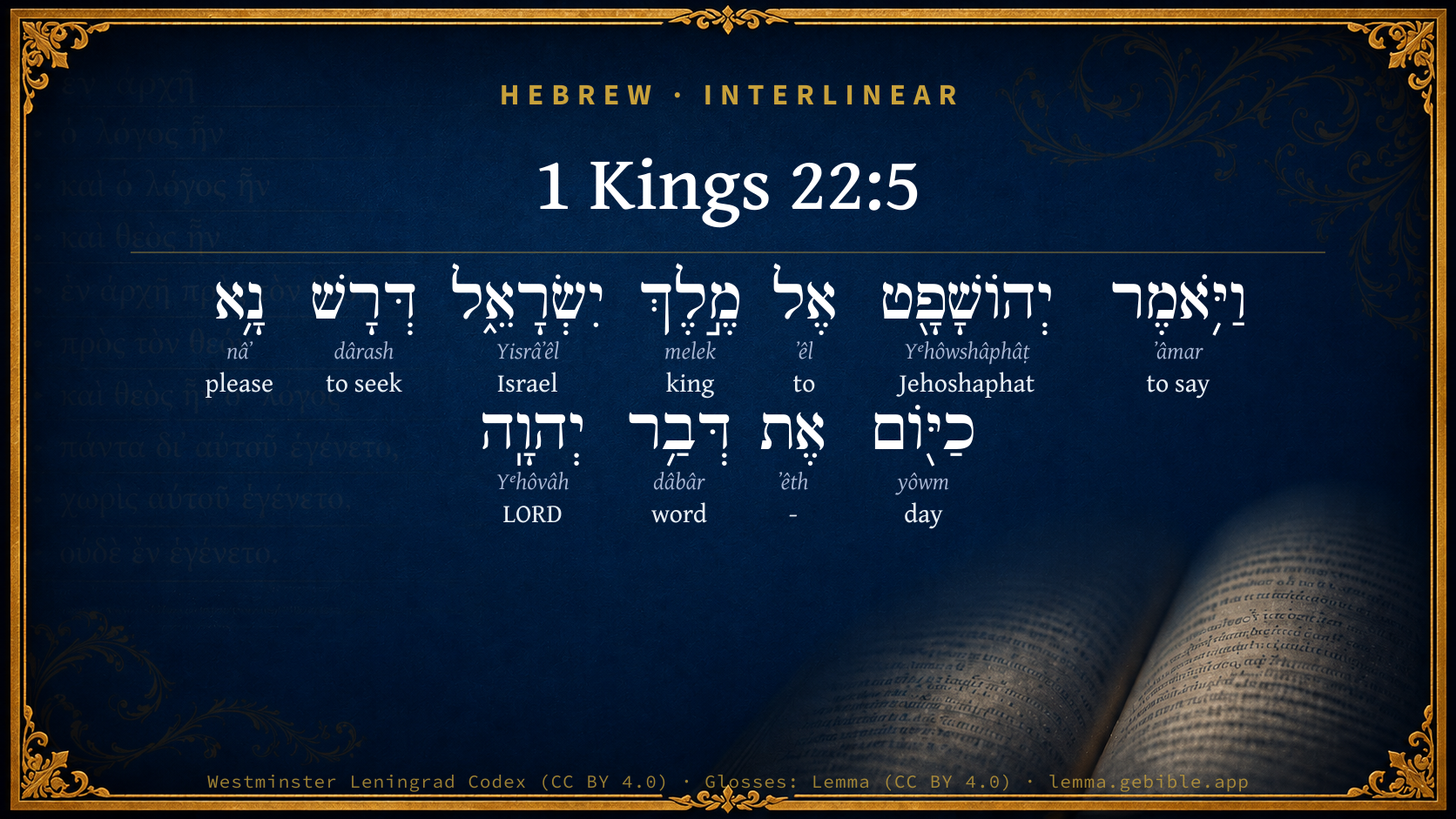
1 Kings 22:5

Hebrew (Westminster Leningrad Codex) 1 Kings 22:5 appears in the Hebrew Old Testament. The text above is from the Westminster Leningrad Codex. Each word links to its Strong’s number, a concise gloss, and parsing drawn from the Open Scriptures Hebrew Bible morphology. Click any word for its full Brown-Driver-Briggs (BDB) entry.
Download image
Cite this verse

1 Kings 22:5 (World English Bible). Public Domain. Lemma interlinear Bible study tool, https://lemma.gebible.app/v/1-kings/22/5.

Show BibTeX & RIS
BibTeX
RIS
English Translation
Jehoshaphat said to the king of Israel, Please inquire first for the word of Yahweh.
World English Bible · Public Domain
Download a study sheet

One document with this verse’s original text, its word-by-word gloss line, the meaning frame, cross-references with their text, attributed commentary, and full source and license credits — printable, and it pastes into notes with its structure intact.

This verse Autodidact and up

Study sheet (.html) Plain text (.txt)

A passage Seminary Student

Up to 50 verses in one chapter. A passage sheet keeps up to 6 commentary sources and 12 cross-references per verse, in the order this page ranks them, and says so on the sheet whenever that leaves anything out. Ask for a single verse and you get the Autodidact verse sheet above.

Everything on this page stays free to read, with no account — the sheet is a download of what is already on screen, not access to it.

Want to remove ads? Support Godless Engineer
Compare translations 3

The same verse in 3 English versions, stacked beneath the original-language interlinear above. Click any original word for its lexicon entry.

Each is an independent rendering of the whole verse — the interlinear is not word-aligned to these translations.

Highlighted words mark where these versions differ — a whole-verse word diff, not a word-by-word alignment.

  • World English Bible Public Domain
    Jehoshaphat said to the king of Israel, Please inquire first for the word of Yahweh.
  • King James Version Public Domain
    And Jehoshaphat said unto the king of Israel, Enquire, I pray thee, at the word of the LORD to day.
  • unfoldingWord Literal Text CC BY-SA 4.0
    And Jehoshaphat said to the king of Israel, “Please seek as today the word of Yahweh.”

unfoldingWord Literal Text — © unfoldingWord, licensed CC BY-SA 4.0. Word-aligned USFM3 via Door43 (git.door43.org/unfoldingWord/en_ult).

Versions to compare (up to 4)

3 of 4 selected

Show all 18 translations

Every available English version of this verse, each an independent rendering of the whole verse.

  • World English Bible Public Domain
    Jehoshaphat said to the king of Israel, Please inquire first for the word of Yahweh.
  • Berean Standard Bible Public Domain
    But Jehoshaphat also said to the king of Israel, “Please inquire first for the word of the LORD.”
  • Majority Standard Bible Public Domain
    But Jehoshaphat also said to the king of Israel, “Please inquire first for the word of the LORD.”
  • King James Version Public Domain
    And Jehoshaphat said unto the king of Israel, Enquire, I pray thee, at the word of the LORD to day.
  • American Standard Version (1901) Public Domain
    And Jehoshaphat said unto the king of Israel, Inquire first, I pray thee, for the word of Jehovah.
  • Revised Version (1885) Public Domain
    And Jehoshaphat said unto the king of Israel, Inquire, I pray thee, at the word of the LORD today.
  • Geneva Bible (1599) Public Domain
    Then Iehoshaphat saide vnto the King of Israel, Aske counsaile, I pray thee, of the Lord to day.
  • Douay-Rheims (1899) Public Domain
    And Josaphat said to the king of Israel: As I am, so art thou: my people and thy people are one: and my horsemen, thy horsemen. And Josaphat said to the king of Israel: Inquire, I beseech thee, this day, the word of the Lord.
  • Young's Literal Translation Public Domain
    And Jehoshaphat saith unto the king of Israel, `Seek, I pray thee, to-day, the word of Jehovah;'
  • Literal Standard Version CC BY-SA 4.0
    And Jehoshaphat says to the king of Israel, “Please seek the word of YHWH today”;
  • Unlocked Literal Bible CC BY-SA 4.0
    Jehoshaphat said to the king of Israel, “Please seek direction from the word of Yahweh for what you should do first.”
  • unfoldingWord Literal Text CC BY-SA 4.0
    And Jehoshaphat said to the king of Israel, “Please seek as today the word of Yahweh.”
  • Darby Bible Public Domain
    And Jehoshaphat said to the king of Israel, Inquire, I pray thee, this day of the word of Jehovah.
  • World Messianic Bible Public Domain
    Jehoshaphat said to the king of Israel, “Please inquire first for the LORD’s word.”
  • Webster's Bible Public Domain
    And Jehoshaphat said to the king of Israel, Inquire, I pray thee, at the word of the LORD to-day.
  • Free Bible Version CC BY-SA 4.0
    Then Jehoshaphat said to the king of Israel, “But first though, please find out what the Lord says.”
  • Bible in Basic English Public Domain
    Then Jehoshaphat said to the king of Israel, Let us now get directions from the Lord.
  • JPS Tanakh (1917) Public Domain
    And Jehoshaphat said unto the king of Israel: 'Inquire, I pray thee, at the word of the LORD today.'

Literal Standard Version (2020), Covenant Press — licensed CC BY-SA 4.0. Text via the HelloAO Bible API (eBible.org). Unlocked Literal Bible (unfoldingWord) — licensed CC BY-SA 4.0. Text via the HelloAO Bible API (eBible.org). unfoldingWord Literal Text — © unfoldingWord, licensed CC BY-SA 4.0. Word-aligned USFM3 via Door43 (git.door43.org/unfoldingWord/en_ult). Free Bible Version, Dr. Jonathan Gallagher — licensed CC BY-SA 4.0. Text via the HelloAO Bible API (eBible.org).

Word by word

More ways to search: Search by grammar → Find every occurrence → Compare this word →

Practice this passage: Drill this verse → Learn its vocabulary →

יְהוֹשָׁפָ֖ט
Yᵉhôwshâphâṭ
H3092
“Jehoshaphat”
Noun, Proper
Part of Speech
Noun
Type
Proper
Full BDB Definition

Origin: from H3068 and H8199

TWOT: None

Jehoshaphat = "Jehovah has judged" - son of king Asa and himself king of Judah for 25 years; one of the best, most pious, and prosperous kings of Judah (noun proper masculine) - son of Nimshi and father of king Jehu of the northern kingdom of Israel (noun proper masculine) - son of Ahilud and chronicler under David and Solomon (noun proper masculine) - son of Paruah and one of the 12 commissary officers under Solomon (noun proper masculine) - a priest and trumpeter in the time of David (noun proper masculine) - symbolical name of a valley near Jerusalem which is the place of ultimate judgment; maybe the deep ravine which separates Jerusalem from the Mount of Olives through which the Kidron flowed (noun proper locative)
  1. וַיֹּ֥אמֶר ʼâmar H559 “and · to say” Conjunction + Verb, Qal, Sequential Imperfect, 3rd Person, Masculine, Singular
  2. אֶל ʼêl H413 “to” Preposition
  3. מֶ֣לֶךְ melek H4428 “king of” Noun, Common, Masculine, Singular, Construct
  4. יִשְׂרָאֵ֑ל Yisrâʼêl H3478 “Israel” Noun, Proper
  5. דְּרָשׁ dârash H1875 “seek” Verb, Qal, Imperative, 2nd Person, Masculine, Singular
  6. נָ֥א nâʼ H4994 “please” Particle, Exhortation
  7. כַיּ֖וֹם yôwm H3117 “like/as the · day” Preposition, Determined + Noun, Common, Masculine, Singular, Absolute
  8. אֶת ʼêth H853 “-” Particle, Direct Object
  9. דְּבַ֥ר dâbâr H1697 “word of” Noun, Common, Masculine, Singular, Construct
  10. יְהוָֽה Yᵉhôvâh H3068 “LORD” Noun, Proper

About this verse

These counts appear in no published source. They are computed here, from the morphology-tagged text and Lemma’s own curated glosses. What Lemma adds →

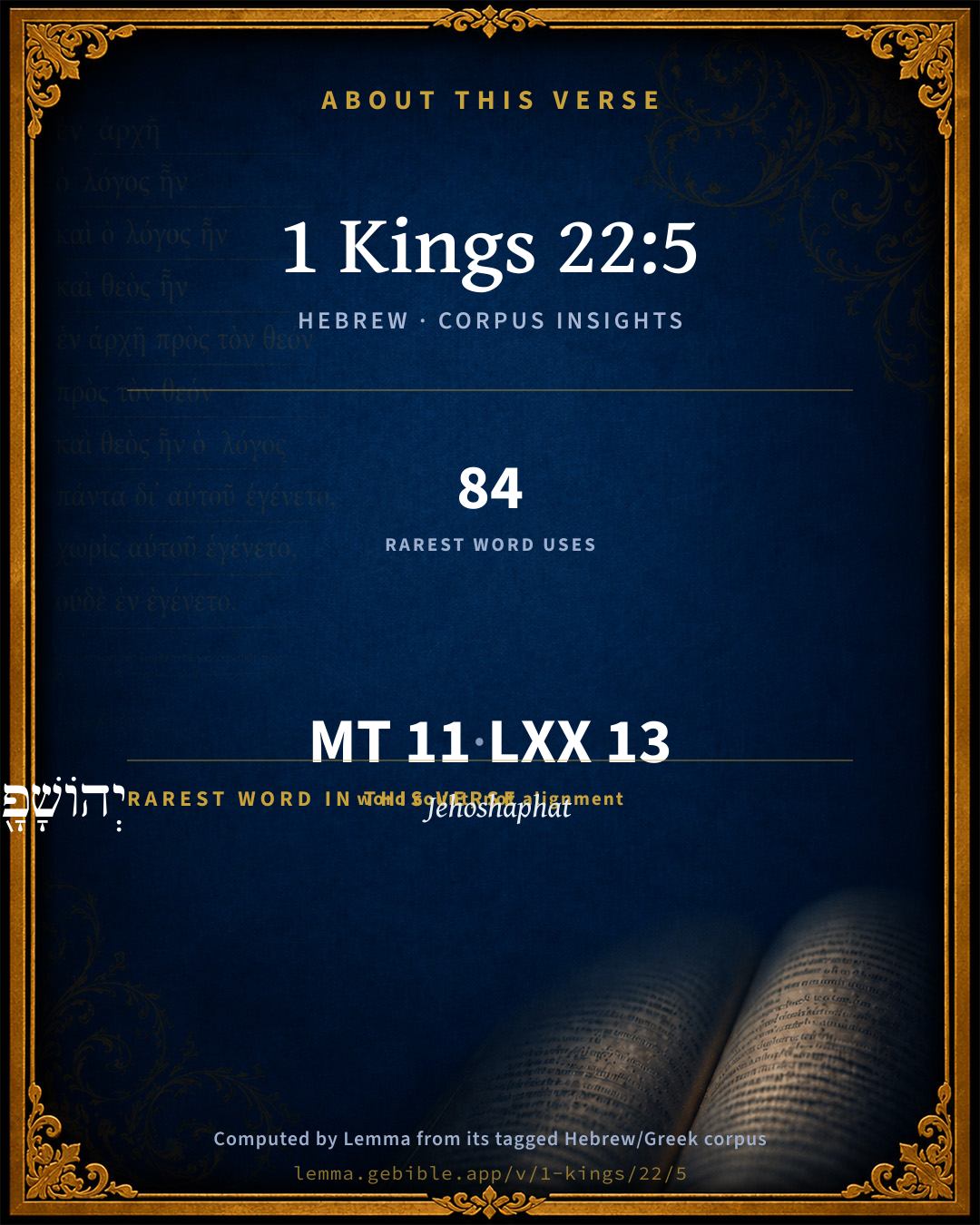
11
words
11
distinct lemmas
Historical
section

Grammatical profile

  • 2 verbs
  • 6 nouns
  • 1 preposition
  • 2 particles

Verb forms

  • וַיֹּ֥אמֶר Qal · Sequential Imperfect
  • דְּרָשׁ Qal · Imperative

Hebrew & Septuagint length

In English translation the verse runs 15 words from the Hebrew and 43 from the Septuagint (LXX English) — the Septuagint runs noticeably longer here. See the side-by-side →

A rough comparison of the two English renderings, which tokenize alike — not a word-level alignment.

Word counts can differ between the Hebrew and the Greek without any difference in meaning — e.g. the Hebrew direct-object marker אֵת has no separate Greek word, and Greek often adds the article ὁ.

In the original languages it is 11 Hebrew tokens and 13 Greek tokens — but the two are counted differently (Hebrew bundles its prefixes and suffixes into one token; the Greek is in lemma form), so that isn’t a like-for-like length.

Cross-references

20

Topical passages linked to 1 Kings 22:5 in the Treasury of Scripture Knowledge — connected by theme and wording, ordered by reader-vote popularity; previews shown in the World English Bible.

  • Proverbs 3:5–6 Trust in Yahweh with all your heart, And don't lean on your own understanding.
  • 2 Chronicles 18:4–5 Jehoshaphat said to the king of Israel, Please inquire first for the word of Yahweh.
  • 2 Kings 3:11 But Jehoshaphat said, Isn't there here a prophet of Yahweh, that we may inquire of Yahweh by him? One of the king of Israel's servants answered, Elisha the son of Shaphat is here, who poured water on the hands of Elijah.
  • Jeremiah 21:2 Please inquire of Yahweh for us; for Nebuchadrezzar king of Babylon makes war against us: peradventure Yahweh will deal with us according to all his wondrous works, that he may go up from us.
  • Jeremiah 42:2–6 and said to Jeremiah the prophet, Let, we pray you, our supplication be presented before you, and pray for us to Yahweh your God, even for all this remnant; for we are left but a few of many, as your eyes do see us:
  • Numbers 27:21 He shall stand before Eleazar the priest, who shall inquire for him by the judgment of the Urim before Yahweh: at his word shall they go out, and at his word they shall come in, both he, and all the children of Israel with him, even all the congregation.
  • Ezekiel 20:1–3 It happened in the seventh year, in the fifth [month], the tenth [day] of the month, that certain of the elders of Israel came to inquire of Yahweh, and sat before me.
  • Joshua 9:14 The men took of their provision, and didn't ask counsel at the mouth of Yahweh.
  • Judges 1:1 It happened after the death of Joshua, the children of Israel asked of Yahweh, saying, Who shall go up for us first against the Canaanites, to fight against them?
  • Judges 20:18 The children of Israel arose, and went up to Bethel, and asked counsel of God; and they said, Who shall go up for us first to battle against the children of Benjamin? Yahweh said, Judah [shall go up] first.
  • Judges 20:23 The children of Israel went up and wept before Yahweh until even; and they asked of Yahweh, saying, Shall I again draw near to battle against the children of Benjamin my brother? Yahweh said, Go up against him.
  • Judges 20:29 Israel set liers-in-wait against Gibeah round about.
  • 1 Samuel 14:18 Saul said to Ahijah, Bring here the ark of God. For the ark of God was [there] at that time with the children of Israel.
  • 1 Samuel 23:2 Therefore David inquired of Yahweh, saying, Shall I go and strike these Philistines? Yahweh said to David, Go, and strike the Philistines, and save Keilah.
  • 1 Samuel 23:4 Then David inquired of Yahweh yet again. Yahweh answered him, and said, Arise, go down to Keilah; for I will deliver the Philistines into your hand.
  • 1 Samuel 23:9–12 David knew that Saul was devising mischief against him; and he said to Abiathar the priest, Bring here the ephod.
  • 1 Samuel 30:8 David inquired of Yahweh, saying, If I pursue after this troop, shall I overtake them? He answered him, Pursue; for you shall surely overtake [them], and shall without fail recover [all].
  • 2 Kings 1:3 But the angel of Yahweh said to Elijah the Tishbite, Arise, go up to meet the messengers of the king of Samaria, and tell them, Is it because there is no God in Israel, that you go to inquire of Baal Zebub, the god of Ekron?
  • 1 Chronicles 10:13 So Saul died for his trespass which he committed against Yahweh, because of the word of Yahweh, which he didn't keep; and also because he asked counsel of one who had a familiar spirit, to inquire [thereby],
  • Ezekiel 14:3 Son of man, these men have taken their idols into their heart, and put the stumbling block of their iniquity before their face: should I be inquired of at all by them?

Cross-references courtesy of OpenBible.info (CC BY 4.0).

Hebrew and Greek witnesses Masoretic Hebrew ↔ Greek Septuagint

The same verse in the two great witnesses to the Old Testament, shown verse-for-verse.

Here the Septuagint runs noticeably longer than the Hebrew — LXX2012 (modern English Septuagint) 43 words vs World English Bible 15. A rough length comparison of the two English translations, not a word-level alignment — read both below.

These are two independent witnesses, not word-aligned to each other, and the Septuagint is shown in lemma (dictionary) form.

Hebrew 1 Kings 22:5 Masoretic · Westminster Leningrad Codex

וַיֹּ֥אמֶר יְהוֹשָׁפָ֖ט אֶל מֶ֣לֶךְ יִשְׂרָאֵ֑ל דְּרָשׁ נָ֥א כַיּ֖וֹם אֶת דְּבַ֥ר יְהוָֽה

Jehoshaphat said to the king of Israel, Please inquire first for the word of Yahweh.

World English Bible · Public Domain

Greek LXX 1 Kings 22:5 Septuagint · lemma form

καί εἶπον ιωσαφατ βασιλεύς ιουδα πρός βασιλεύς ἰσραήλ ἐπιἐρωτάω δή σήμερον ὁ κύριος

And Josaphat said, As I am, so are you also; as my people, so is your people; as my horses, so are your horses. And Josaphat king of Juda said to the king of Israel, Enquire, I pray you, of the Lord today.

LXX2012 (modern English Septuagint) · Public Domain

Hebrew: Westminster Leningrad Codex (CC BY 4.0). Greek: Septuagint (public domain); English from LXX2012 (modern English Septuagint) (Public Domain). How the Septuagint differs from the Hebrew →

Targum (Aramaic paraphrase)

1

The Targum is the ancient Jewish Aramaic paraphrase of the Hebrew Scriptures — an interpretive translation, not the Hebrew text itself. Onkelos (literal) and Pseudo-Jonathan (expansive) render the Torah, and Jonathan the Prophets. Coverage is partial: where no permissively-licensed English translation exists for a verse, only the Aramaic is shown. This is verse-level text, not a word-by-word alignment to the Hebrew.

  1. Targum Jonathan Prophets (Joshua–Malachi)
    וַאֲמַר יְהוֹשָׁפָט לְמַלְכָּא דְיִשְׂרָאֵל תְּבַע כְּעַן כְּיוֹמָא דֵין יַת פִּתְגָמָא דַיָי:

    (no public-domain English translation for this verse)

    Targum Jonathan — Aramaic: “Mikraot Gedolot” (public domain). English: “Sefaria Community Translation” (CC0 1.0 (public-domain dedication)); “London "Chaldee Paraphrase," 1871” (public domain). Text via Sefaria.

Commentary

Notes on 1 Kings 22:5 from classic Christian and Jewish commentators (each source and its license shown beneath its notes). The classic Christian expositions comment on the surrounding passage and are grouped to its opening verse, so a note may address several verses; the Jewish commentaries on the Tanakh (Rashi and others) are per-verse, so they appear only where the commentator wrote on this verse.

Lemma curates 59 commentaries, every one of them public domain or Creative Commons licensed, each selected and text-cleaned for this edition rather than reprinted as found. About our sources →

Trapp's Complete Commentary

John Trapp

1Ki 22:5 And Jehoshaphat said unto the king of Israel, Enquire, I pray thee, at the word of the LORD to day.

Ver. 5. Inquire, I pray thee.] Ahab never thought of this, belike. God was not in all his thoughts. {Psa 10:4} And yet Scipio went first to the capitol, and then to the senate. {a} And the Romans called a sacrifice hostia ; because, when they went against the enemies, they offered it. {b}

At the word of the Lord.] Some think that Jehoshaphat, hearing of Ahab’s late humiliation, mistook him for a true convert, and therefore thus bespake him, and thought he might lawfully join with him in so just a war.

Today.] Josephus saith that this was done when the armies were now met, and were ready to march.

{a} Liv., lib. xxvi.

{b} Gel., lib. vii., chap. 1.

John Trapp, A Commentary or Exposition upon All the Books of the Old and New Testament (1647–1656) — public domain. Text from a community e-Sword module.

The Biblical Illustrator

Joseph S. Exell

1Ki_22:5

Enquire, I pray thee, at the word of the Lord to-day.

Appeal to the prophets in time of crisis

It has been noted, that in ancient Grecian national affairs, when all theories that are called practical break down, it is the once-despised and suspected philosophers that come into strange public importance. If an important embassy to a hostile nation is to be sent, it is to Xenocrates that they entrust it, though the man was never seen in the assembly. If Antigonus wants a safe officer to hold the Accorrinthus, he chooses Perseus the Stoic. When Alexander in his despair at the murder of Clitus sits in dust and ashes, and will not eat or drink, they send two philosophers to bring him to reason. The men whose lives are devoted to thought are now regarded as peace-makers and politicians above the ordinary level.

The Biblical Illustrator, edited by Joseph S. Exell (c. 1880s–1900s) — public domain. Text from a community e-Sword module.

Joseph Benson's Commentary

1Ki 22:5. Jehoshaphat said, Inquire, I pray thee, &c. — By some prophet; that we may know the mind of God in this matter, and what success we may expect. A good man, wherever he goes, will take God along with him, will acknowledge him in all his ways, and look to him for success: and, wherever he goes, he ought to take his religion along with him; and not be ashamed to own it, even among those who have no kindness for it.

Joseph Benson's Commentary on the Old and New Testaments (1811–1818) — public domain. Text from a community e-Sword module.

Tyndale Open Study Notes

Tyndale Open Resources

22:5-9 In accordance with ancient Near Eastern custom, Jehoshaphat requested that the two kings determine the will of the Lord before going into battle. Examples of this custom are common in Aramean, Moabite, and Assyrian inscriptions as well as in the Old Testament (1 Sam 23:2-4; 2 Sam 5:19-25). Despite Ahab’s misgivings, Jehoshaphat insisted on summoning Micaiah, a genuine prophet of the Lord.

Tyndale Open Study Notes — © Tyndale Open Resources, licensed CC BY-SA 4.0. Text via the HelloAO Bible API.

Geneva Bible (1599)

Geneva Bible translators

He seemed that he would not go to the war, except God reproved it, yet when Micaiah counseled the contrary, he would not obey.

Geneva Bible (1599) marginal notes — public domain. Text via Bolls.life.

The Cambridge Bible for Schools and Colleges

gen. ed. J. J. S. Perowne

5. Inquire, I pray thee, at the word of the Lord] The persuasion has gained from him a promise, but Jehoshaphat would still find out whether the proposed expedition has the sanction of Jehovah. It is clear from his request that he expected to find a true prophet of Jehovah at hand in Israel. The national apostasy cannot therefore have been complete, even in the dark days of Ahab.

to day] The Hebrew word is the same which is found in Gen_25:31; Gen_25:33, where on the margin of R.V. the alternative rendering, ‘first of all,’ is given. This sense is very appropriate both there and here, and will often explain what ‘to day’ in O. Test. diction signifies. Cf. above, 1Ki_1:51.

The Cambridge Bible for Schools and Colleges (gen. ed. J. J. S. Perowne; Cambridge University Press, 1878–1918) — public domain. Text from a community e-Sword module.

John Gill's Exposition

And Jehoshaphat said, is there not here a prophet of the Lord besides, that we might inquire of him? He suspected these to be false prophets, though he would not call them so; nor suggest that they were not the prophets of the Lord, because he would not affront Ahab, who had an opinion of them; and therefore asks, if there were no other that went under the character of a prophet of the Lord, that he might inquire of him for his further satisfaction.

And Jehoshaphat said, is there not here a prophet of the Lord besides, that we might inquire of him? He suspected these to be false prophets, though he would not call them so; nor suggest that they were not the prophets of the Lord, because he would not affront Ahab, who had an opinion of them; and therefore asks, if there were no other that went under the character of a prophet of the Lord, that he might inquire of him for his further satisfaction.

1 Kings 22:8

kg1 22:8

kg1 22:8

kg1 22:8And the king of Israel said unto Jehoshaphat, there is yet one man (Micaiah the son of Imlah), by whom we may inquire of the Lord,.... And but one in Samaria; Elijah and Elisha were elsewhere:

but I hate him, for he doth not prophesy of good concerning me, but evil; who is thought to be the same that was several times with him when engaged in the war with the king of Syria, Kg1 20:13 and each time, excepting the last, he brought him good tidings; but because, in his last message, he told him, that, since he had let Benhadad go, his life should go for his life, and his people for his people, for that he hated him:

and Jehoshaphat said, let not the king say so; which was very modestly, though perhaps too gently, said; suggesting that the prophets of the Lord should be heard, respected, and honoured, let their message be as it would, since they spake not of their own mind and will, but what they were moved unto by the Spirit of God.

John Gill's Exposition of the Whole Bible (1746–1763) — public domain (CC PDM 1.0). Text via the HelloAO Bible API.

Albert Barnes' Notes on the Bible

Jehoshaphat, with characteristic piety 1Ki 22:43 takes advantage of his position as Ahab’s friend and ally, to suggest inquiry of the Lord (Yahweh) before the expedition is undertaken. Lest Ahab should consent in word and put off the inquiry in act, he asks to have the prophets called in at once: “today.”

Albert Barnes' Notes on the Bible (1834–1885) — public domain. Text from a community e-Sword/MySword module.

Haydock's Catholic Bible Commentary

One, in concord, (Haydock) and ready to march against the same enemy. --- Lord. This was rather late, if (Menochius) the army was already receiving its pay under the walls of Samaria. (Josephus, [Antiquities?] viii. 15.) --- God ought to have been consulted at first. (Menochius)

George Leo Haydock (1774–1849), Haydock's Catholic Family Bible and Commentary, 1859 edition — public domain. Excludes Psalms (Douay-Rheims chapter numbering differs from Protestant) and Deuterocanonical books (Catholic canon only).

Matthew Poole's English Annotations

By some prophet; that we may know the mind of God in it, and what success we may expect. This was the practice of the godly. See Jdg 1:1; 20:28; 1Sa 23:2.

Matthew Poole's English Annotations on the Holy Bible (1683–1685) — public domain. Text from a community e-Sword/MySword module.

Whedon's Commentary on the Bible

Daniel D. Whedon

5. Jehoshaphat said — The king of Judah shows a piety superior to that of Ahab. He doubtless knew that Ahab’s former successes against the Syrians were predicted by a prophet of the Lord, (1Ki_20:13; 1Ki_12:28;) and he would seek a like encouragement again.

Daniel D. Whedon (gen. ed.), Commentary on the Old and New Testaments (1874–1909) — public domain. Text from a community e-Sword module.

The Pulpit Commentary

And Jehoshaphat said unto the king of Israel, Inquire, I pray thee, at This word is redundant the word of the Lord today. hardly conveys that "he asks to have the prophets called in at once," "lest Ahab should consent in word and put off the inquiry in act" (Rawlinson); but rather means, "at this crisis," "under these circumstances." This request agrees well with what we learn elsewhere as to Jehoshaphat"s piety (2Ch_17:4-9 2Ch_19:5-7, etc.) And, remembering how Ahab"s late victories had been foretold by a prophet, and had been won by the help of Jehovah, Jehoshaphat might well suppose that his new ally would be eager to know the word of the Lord.

The Pulpit Commentary (1880–1919), ed. H.D.M. Spence-Jones & Joseph S. Exell — public domain. Text from a community e-Sword module.

John Wesley's Explanatory Notes

Inquire - A good man, wherever he goes, will take God along with him, will acknowledge him in all his ways, and look to him for success. And wherever he goes, he ought to take his religion along with him: and not be ashamed to own it, even among those who have no kindness for it.

John Wesley, Explanatory Notes Upon the Whole Bible (1754–1765) — public domain. Text via the GEBible commentary corpus.

unfoldingWord translationNotes

Door43 World Missions Community

four hundred men

"400 men" (See: Numbers)

for the Lord will give it into the hand of the king

Here the word "hand" refers to power. AT: "for the Lord will allow the king to capture Ramoth Gilead" (See: Metonymy)

translationWords

word of God

prophet

lord

unfoldingWord translationNotes — © Distant Shores Media and the Door43 World Missions Community, licensed CC BY-SA 4.0. Source: git.door43.org/Door43/en_tn.

Lesson kit

Teaching starters — assembled from the data on this page, not authored interpretation. Every prompt links to the verse data it draws on. Edit before teaching.

1 Kings, in the Historical, opens this verse with 11 words (11 distinct Hebrew lemmas). Its most distinctive word is Yᵉhôwshâphâṭ (“Jehoshaphat”). The Greek Septuagint runs longer here. A historical commentator’s framing appears above. Read the whole chapter for the surrounding context.

Discussion questions

  1. What does “Jehoshaphat” (Yᵉhôwshâphâṭ) contribute to the verse as a whole?
  2. Proverbs 3:5–6 shares this passage’s theme. How do the two illuminate each other?
  3. Compared with the Hebrew, the Septuagint runs longer here. What questions does that raise?
  4. The translations on this page render this verse differently — a whole-verse word diff, not a word-by-word alignment. What might account for the different wordings?
  5. The verb «וַיֹּ֥אמֶר» is Qal Sequential Imperfect. How does its form color the action?
  6. Reading how Trapp's Complete Commentary and The Biblical Illustrator read this verse, where do the two commentators agree and where do they part?

Things to notice

Reading settings

Reading text

Shown beneath each verse's original-language words.

Old Testament
Old Testament edition

Read the OT as the Masoretic Hebrew (MT) or the Greek Septuagint (LXX).

English shown for the Greek Septuagint (in the Hebrew ↔ Greek comparison).

Comparing translations? Open the Compare panel on any verse page to stack up to four side by side.