2 Chronicles 15:12

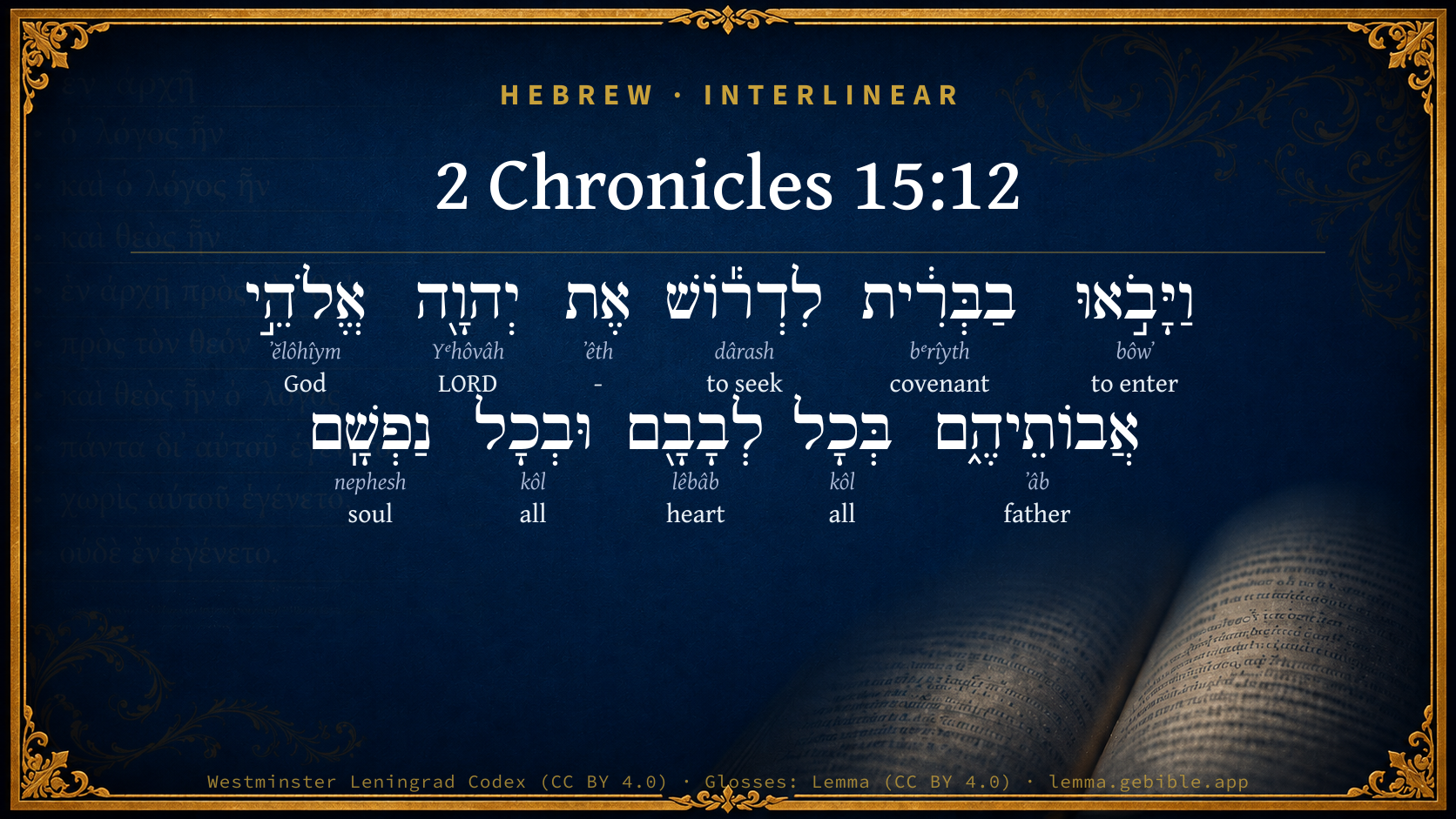
Hebrew (Westminster Leningrad Codex) 2 Chronicles 15:12 appears in the Hebrew Old Testament. The text above is from the Westminster Leningrad Codex. Each word links to its Strong’s number, a concise gloss, and parsing drawn from the Open Scriptures Hebrew Bible morphology. Click any word for its full Brown-Driver-Briggs (BDB) entry.
Download image
Cite this verse

2 Chronicles 15:12 (World English Bible). Public Domain. Lemma interlinear Bible study tool, https://lemma.gebible.app/v/2-chronicles/15/12.

Show BibTeX & RIS
BibTeX
RIS
English Translation
They entered into the covenant to seek Yahweh, the God of their fathers, with all their heart and with all their soul;
World English Bible · Public Domain
Download a study sheet

One document with this verse’s original text, its word-by-word gloss line, the meaning frame, cross-references with their text, attributed commentary, and full source and license credits — printable, and it pastes into notes with its structure intact.

This verse Autodidact and up

Study sheet (.html) Plain text (.txt)

A passage Seminary Student

Up to 50 verses in one chapter. A passage sheet keeps up to 6 commentary sources and 12 cross-references per verse, in the order this page ranks them, and says so on the sheet whenever that leaves anything out. Ask for a single verse and you get the Autodidact verse sheet above.

Everything on this page stays free to read, with no account — the sheet is a download of what is already on screen, not access to it.

Want to remove ads? Support Godless Engineer
Compare translations 3

The same verse in 3 English versions, stacked beneath the original-language interlinear above. Click any original word for its lexicon entry.

Each is an independent rendering of the whole verse — the interlinear is not word-aligned to these translations.

Highlighted words mark where these versions differ — a whole-verse word diff, not a word-by-word alignment.

  • World English Bible Public Domain
    They entered into the covenant to seek Yahweh, the God of their fathers, with all their heart and with all their soul;
  • King James Version Public Domain
    And they entered into a covenant to seek the LORD God of their fathers with all their heart and with all their soul;
  • unfoldingWord Literal Text CC BY-SA 4.0
    And they entered into a covenant to seek Yahweh, the God of their fathers, with all their heart and with all their being.

unfoldingWord Literal Text — © unfoldingWord, licensed CC BY-SA 4.0. Word-aligned USFM3 via Door43 (git.door43.org/unfoldingWord/en_ult).

Versions to compare (up to 4)

3 of 4 selected

Show all 18 translations

Every available English version of this verse, each an independent rendering of the whole verse.

  • World English Bible Public Domain
    They entered into the covenant to seek Yahweh, the God of their fathers, with all their heart and with all their soul;
  • Berean Standard Bible Public Domain
    Then they entered into a covenant to seek the LORD, the God of their fathers, with all their heart and soul.
  • Majority Standard Bible Public Domain
    Then they entered into a covenant to seek the LORD, the God of their fathers, with all their heart and soul.
  • King James Version Public Domain
    And they entered into a covenant to seek the LORD God of their fathers with all their heart and with all their soul;
  • American Standard Version (1901) Public Domain
    And they entered into the covenant to seek Jehovah, the God of their fathers, with all their heart and with all their soul;
  • Revised Version (1885) Public Domain
    And they entered into the covenant to seek the LORD, the God of their fathers, with all their heart and with all their soul;
  • Geneva Bible (1599) Public Domain
    And they made a couenant to seeke the Lord God of their fathers, with all their heart, and with all their soule.
  • Douay-Rheims (1899) Public Domain
    And he went in to confirm as usual the covenant, that they should seek the Lord the God of their fathers with all their heart, and with all their soul.
  • Young's Literal Translation Public Domain
    and they enter into a covenant to seek Jehovah, God of their fathers, with all their heart, and with all their soul,
  • Literal Standard Version CC BY-SA 4.0
    and they enter into a covenant to seek YHWH, God of their fathers, with all their heart and with all their soul,
  • Unlocked Literal Bible CC BY-SA 4.0
    They entered into a covenant to seek Yahweh, the God of their ancestors, with all their heart and with all their soul.
  • unfoldingWord Literal Text CC BY-SA 4.0
    And they entered into a covenant to seek Yahweh, the God of their fathers, with all their heart and with all their being.
  • Darby Bible Public Domain
    And they entered into a covenant to seek Jehovah the God of their fathers, with all their heart, and with all their soul,
  • World Messianic Bible Public Domain
    They entered into the covenant to seek the LORD, the God of their fathers, with all their heart and with all their soul;
  • Webster's Bible Public Domain
    And they entered into a covenant to seek the LORD God of their fathers with all their heart and with all their soul;
  • Free Bible Version CC BY-SA 4.0
    Then they made an agreement to conscientiously and completely follow the Lord, the God of their forefathers.
  • Bible in Basic English Public Domain
    And they made an agreement to be true to the Lord, the God of their fathers, with all their heart and all their soul;
  • JPS Tanakh (1917) Public Domain
    And they entered into the covenant to seek the LORD, the God of their fathers, with all their heart and with all their soul;

Literal Standard Version (2020), Covenant Press — licensed CC BY-SA 4.0. Text via the HelloAO Bible API (eBible.org). Unlocked Literal Bible (unfoldingWord) — licensed CC BY-SA 4.0. Text via the HelloAO Bible API (eBible.org). unfoldingWord Literal Text — © unfoldingWord, licensed CC BY-SA 4.0. Word-aligned USFM3 via Door43 (git.door43.org/unfoldingWord/en_ult). Free Bible Version, Dr. Jonathan Gallagher — licensed CC BY-SA 4.0. Text via the HelloAO Bible API (eBible.org).

Word by word

More ways to search: Search by grammar → Find every occurrence → Compare this word →

Practice this passage: Drill this verse → Learn its vocabulary →

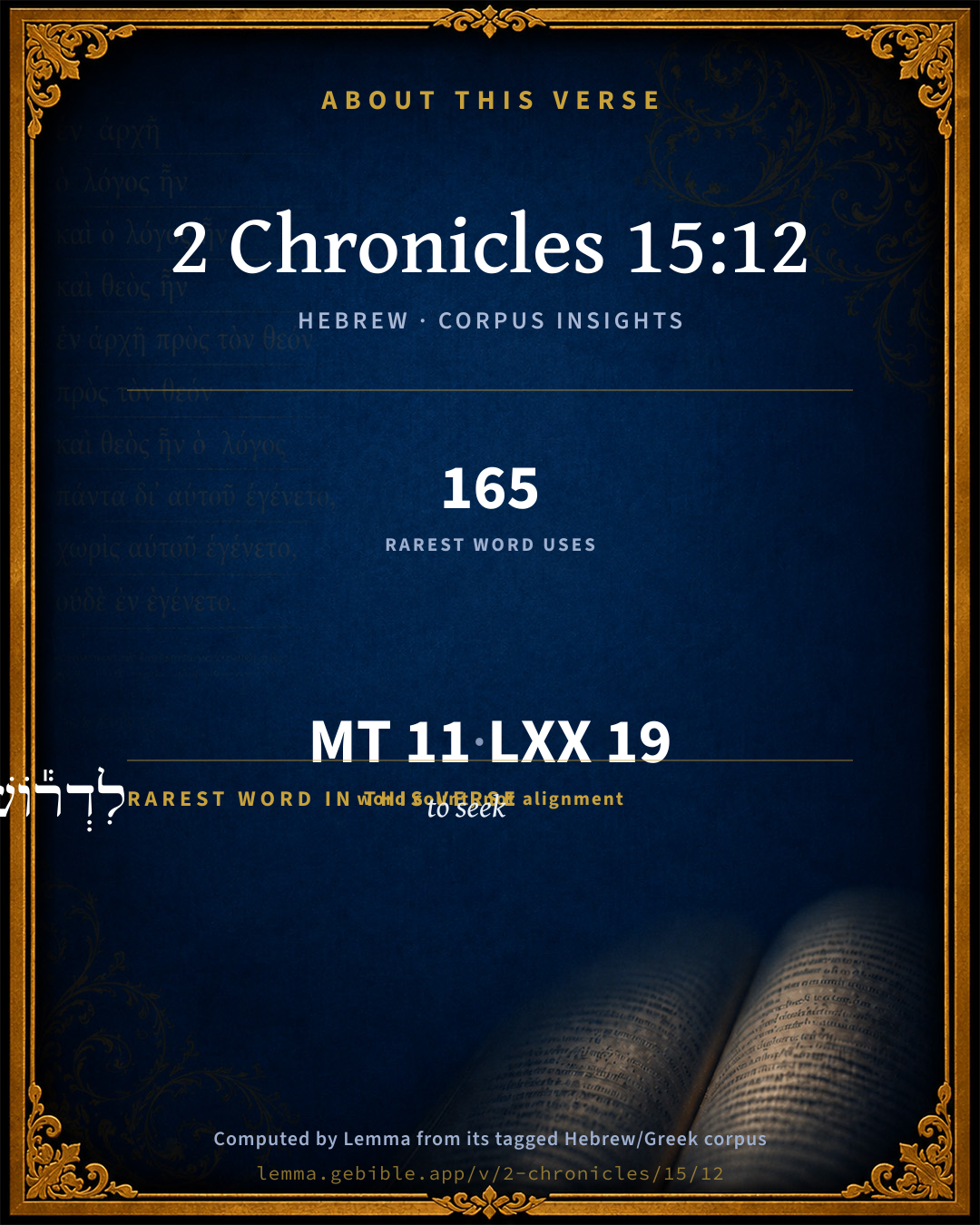
לִדְר֕וֹשׁ
dârash
H1875
“to seek”
Preposition + Verb, Qal, Infinitive Construct
Part of Speech
Preposition + Verb
Stem
Qal
Form
Infinitive Construct
Full BDB Definition

Origin: a primitive root

TWOT: 455

to resort to, seek, seek with care, enquire, require - (Qal) - to resort to, frequent (a place), (tread a place) - to consult, enquire of, seek - of God - of heathen gods, necromancers - to seek deity in prayer and worship - God - heathen deities - to seek (with a demand), demand, require - to investigate, enquire - to ask for, require, demand - to practice, study, follow, seek with application - to seek with care, care for - (Niphal) - to allow oneself to be enquired of, consulted (only of God) - to be sought, be sought out - to be required (of blood)

  1. וַיָּבֹ֣אוּ bôwʼ H935 “and · to enter” Conjunction + Verb, Qal, Sequential Imperfect, 3rd Person, Masculine, Plural
  2. בַבְּרִ֔ית bᵉrîyth H1285 “in/at the · covenant” Preposition, Determined + Noun, Common, Feminine, Singular, Absolute
  3. אֶת ʼêth H853 “-” Particle, Direct Object
  4. יְהוָ֖ה Yᵉhôvâh H3068 “LORD” Noun, Proper
  5. אֱלֹהֵ֣י ʼĕlôhîym H430 “God(s) of” Noun, Common, Masculine, Plural, Construct
  6. אֲבוֹתֵיהֶ֑ם ʼâb H1 “fathers · their” Noun, Common, Masculine, Plural, Construct + Suffix, Personal, 3rd Person, Masculine, Plural
  7. בְּכָל kôl H3605 “in/at · all of” Preposition + Noun, Common, Masculine, Singular, Construct
  8. לְבָבָ֖ם lêbâb H3824 “heart · their” Noun, Common, Masculine, Singular, Construct + Suffix, Personal, 3rd Person, Masculine, Plural
  9. וּבְכָל kôl H3605 “and · in/at · all of” Conjunction + Preposition + Noun, Common, Masculine, Singular, Construct
  10. נַפְשָֽׁם nephesh H5315 “soul · their” Noun, Common, Both, Singular, Construct + Suffix, Personal, 3rd Person, Masculine, Plural

About this verse

These counts appear in no published source. They are computed here, from the morphology-tagged text and Lemma’s own curated glosses. What Lemma adds →

11
words
10
distinct lemmas
Historical
section

Grammatical profile

  • 2 verbs
  • 8 nouns
  • 1 particle

Verb forms

  • וַיָּבֹ֣אוּ Qal · Sequential Imperfect
  • לִדְר֕וֹשׁ Qal · Infinitive Construct

Repetition

A word recurs within this verse — often emphatic in Hebrew:

  • בְּכָל all H3605 ×2

Hebrew & Septuagint length

In English translation the verse runs 22 words from the Hebrew and 25 from the Septuagint (LXX English) — closely comparable.

A rough comparison of the two English renderings, which tokenize alike — not a word-level alignment.

Word counts can differ between the Hebrew and the Greek without any difference in meaning — e.g. the Hebrew direct-object marker אֵת has no separate Greek word, and Greek often adds the article ὁ.

In the original languages it is 11 Hebrew tokens and 19 Greek tokens — but the two are counted differently (Hebrew bundles its prefixes and suffixes into one token; the Greek is in lemma form), so that isn’t a like-for-like length.

Cross-references

16

Topical passages linked to 2 Chronicles 15:12 in the Treasury of Scripture Knowledge — connected by theme and wording, ordered by reader-vote popularity; previews shown in the World English Bible.

  • Acts 24:14 But this I confess to you, that after the Way, which they call a sect, so I serve the God of our fathers, believing all things which are according to the law, and which are written in the prophets;
  • Deuteronomy 10:12 Now, Israel, what does Yahweh your God require of you, but to fear Yahweh your God, to walk in all his ways, and to love him, and to serve Yahweh your God with all your heart and with all your soul,
  • 2 Chronicles 23:16 Jehoiada made a covenant between himself, and all the people, and the king, that they should be Yahweh's people.
  • 2 Chronicles 29:10 Now it is in my heart to make a covenant with Yahweh, the God of Israel, that his fierce anger may turn away from us.
  • Deuteronomy 4:29 But from there you shall seek Yahweh your God, and you shall find him, when you search after him with all your heart and with all your soul.
  • Deuteronomy 29:1 These are the words of the covenant which Yahweh commanded Moses to make with the children of Israel in the land of Moab, besides the covenant which he made with them in Horeb.
  • Deuteronomy 29:12 that you may enter into the covenant of Yahweh your God, and into his oath, which Yahweh your God makes with you this day;
  • 1 Kings 8:48 if they return to you with all their heart and with all their soul in the land of their enemies, who carried them captive, and pray to you toward their land, which you gave to their fathers, the city which you have chosen, and the house which I have built for your name:
  • 2 Kings 23:3 The king stood by the pillar, and made a covenant before Yahweh, to walk after Yahweh, and to keep his commandments, and his testimonies, and his statutes, with all [his] heart, and all [his] soul, to confirm the words of this covenant that were written in this book: and all the people stood to the covenant.
  • 2 Chronicles 15:4 But when in their distress they turned to Yahweh, the God of Israel, and sought him, he was found of them.
  • 2 Chronicles 34:31–32 The king stood in his place, and made a covenant before Yahweh, to walk after Yahweh, and to keep his commandments, and his testimonies, and his statutes, with all his heart, and with all his soul, to perform the words of the covenant that were written in this book.
  • Nehemiah 9:38 Yet for all this we make a sure covenant, and write it; and our princes, our Levites, [and] our priests, seal to it.
  • Nehemiah 10:29 They joined with their brothers, their nobles, and entered into a curse, and into an oath, to walk in God's law, which was given by Moses the servant of God, and to observe and do all the commandments of Yahweh our Lord, and his ordinances and his statutes;
  • Jeremiah 29:12–13 You shall call on me, and you shall go and pray to me, and I will listen to you.
  • Jeremiah 50:5 They shall inquire concerning Zion with their faces turned toward it, [saying], Come you, and join yourselves to Yahweh in an everlasting covenant that shall not be forgotten.
  • 2 Corinthians 8:5 This was not as we had hoped, but first they gave their own selves to the Lord, and to us through the will of God.

Cross-references courtesy of OpenBible.info (CC BY 4.0).

Hebrew and Greek witnesses Masoretic Hebrew ↔ Greek Septuagint

The same verse in the two great witnesses to the Old Testament, shown verse-for-verse.

These are two independent witnesses, not word-aligned to each other, and the Septuagint is shown in lemma (dictionary) form.

Hebrew 2 Chronicles 15:12 Masoretic · Westminster Leningrad Codex

וַיָּבֹ֣אוּ בַבְּרִ֔ית לִדְר֕וֹשׁ אֶת יְהוָ֖ה אֱלֹהֵ֣י אֲבוֹתֵיהֶ֑ם בְּכָל לְבָבָ֖ם וּבְכָל נַפְשָֽׁם

They entered into the covenant to seek Yahweh, the God of their fathers, with all their heart and with all their soul;

World English Bible · Public Domain

Greek LXX 2 Chronicles 15:12 Septuagint · lemma form

καί διαἔρχομαι ἐν διαθήκη ζητέω κύριος θεός ὁ πατήρ αὐτός ἐκ ὅλος ὁ καρδία καί ἐκ ὅλος ὁ ψυχή

And he entered into a covenant that they should seek the Lord God of their fathers with all their heart and with all their soul.

LXX2012 (modern English Septuagint) · Public Domain

On this verse, Haydock's Catholic Bible Commentary discusses the Septuagint’s reading. Read the note in Commentary ↓

Hebrew: Westminster Leningrad Codex (CC BY 4.0). Greek: Septuagint (public domain); English from LXX2012 (modern English Septuagint) (Public Domain). How the Septuagint differs from the Hebrew →

Commentary

Notes on 2 Chronicles 15:12 from classic Christian and Jewish commentators (each source and its license shown beneath its notes). The classic Christian expositions comment on the surrounding passage and are grouped to its opening verse, so a note may address several verses; the Jewish commentaries on the Tanakh (Rashi and others) are per-verse, so they appear only where the commentator wrote on this verse.

Lemma curates 59 commentaries, every one of them public domain or Creative Commons licensed, each selected and text-cleaned for this edition rather than reprinted as found. About our sources →

Trapp's Complete Commentary

John Trapp

2Ch 15:12 And they entered into a covenant to seek the LORD God of their fathers with all their heart and with all their soul;

Ver. 12. And they entered into a covenant.] As well knowing the fickleness of their own hearts, they do hereby think good to bind them to the good abearance; a commendable practice, by holy vows to bind ourselves to the performance of bounden duties.

John Trapp, A Commentary or Exposition upon All the Books of the Old and New Testament (1647–1656) — public domain. Text from a community e-Sword module.

The Biblical Illustrator

Joseph S. Exell

2Ch_15:12-15

And they entered into a covenant to seek the Lord God of their fathers.

The covenant renewed

Entering into a covenant is what we name a revival; they made it a national act, we separate it entirely from political affairs.

I. The preparations for revival.

1. The persons who led. A faithful prophet and an obedient king. Of Azariah we know nothing beyond the short record of this chapter. This suggests that a man is important to the world only for the work he does. The king was ready to learn from this obscure prophet and to lead the people to consecration. Happy the pastor who finds the wealth, authority, and zeal of his Church willing to receive the sacred message humbly from his lips and faithfully lead where he points the way.

2. The truths they used. The same that inspire every true revival (verse 2). Divine faithfulness, human responsibility, mercy for the penitent, punishment for the hardened.

II. The revival. In this blessed work there was--

1. Repentance.

2. Atonement (verse 11).

3. Consecration.

III. The joy of reconciliation (verse 15). Lessons:

1. The reformer must begin at his own house.

2. Service for God may cost pain.

3. The true leader is called of God.

4. Every true leader is a rallying-point for others (verse 9). (Monday Club Sermons.)

A revival

I. We see here that the heart of a revival lies in a renewal of the covenant of the Church with God. An awakened Church is the pioneer of an awakened world,

2. A second feature in this ancient revival of religion was a public proclamtion of a revived faith before the world. Religious men are too much in earnest to be still about it. They are moved by a great power. It will express itself as becomes a great power. It is the instinct of religious faith to bear its witness to the world.

III. The old Jewish revival was attended with a great influx of converts from without. So commonly works a pure revival upon the world. Very rare is the exception in which the heart of the world does not respond to the heart of the Church.

IV. A fourth feature of a true revival of religion is a thorough reformation of public and private morals. To put away idolatrous worship was what we should call a reformation in morals. Idolatry was immorality concentrated in its most hideous forms. No religious zeal could have been genuine in a monarch which did not sweep the land clean of them.

V. Such awakenings are often followed by periods of temporal prosperity. The Lord gave them rest round about. No other civilising power equals that of true religion. It never hurts a man for any of the right uses of this world to make a Christian of him. (A. Phelps.)

A revival: an imperious necessity

The text gives an account of the ancient revival of religion under King Asa. Other revivals are portrayed by the sacred writers. From these we learn--

I. That revivals are by no means new things. Nor are they things of modern invention.

II. That the progress of religion is not in a uniform steady line.

III. That revivals of religion ordinarily commence in humble and obscure ways, and are ordinarily helped on by the humblest instrumentality.

IV. That they are ordinarily accompanied by a great deal of what people are pleased to term excitement.

V. That true revival of religion are marked by marvellous transformations of character and reformations in the life. (G. E. Reed.)

And all Judah rejoiced at the oath.

Judahs solemn engagement

I. The solemn engagement into which they entered, and the temper they manifested therein.

1. They bound themselves to nothing new. It was to seek the Lord God of their fathers.

2. They swore to do this.

3. They entered into this engagement with great sincerity and with great cheerfulness.

II. The happy consequence of judahs solemn engagement. The Lord was found of them. (Job Orton.)

And He was found of them.--The search that always finds:--

I. The seeking. The highest bliss is to find God, the next highest is to seek Him.

1. Our text lays emphasis on the whole-heartedness of the peoples seeking after God. One reason why the great mass of professing Christians make so little of their religion is because they are only half-hearted in it. If you divide a river into two streams the force of each is less than half the power of the original current; and the chances are that you will make a stagnant marsh where there used to be a flowing stream. All in all or not at all is the rule for life in all departments.

2. They sought; Him with all their heart. That does not mean that there are to be no other desires, for it is a great mistake to pit religion against other things which are meant to be its instruments and its helps.

3. The one token of seeking God is casting out idols. There must be detachment if there is to be attachment. If some climbing plant, for instance, has twisted itself round the unprofitable thorns in the hedge, the gardener, before he can get it to go up the support that it is meant to encircle, has carefully to detach it from the stays to which it has wantonly clung, taking care that in the process he does not break its tendrils and destroy its power of growth. The heart must be emptied of base liquors if the new wine of the kingdom is to be poured into it.

II. The finding which crowns such seeking.

1. Anything is possible rather than that a whole-hearted search after God should be a vain search. For there are in that search two seekers--God is seeking for us more truly than we are seeking for Him.

2. This is the only direction for a mans desires and aims in which disappointment is an impossibility.

3. Our wisdom is to make this search. What would you think of a company of gold-seekers, hunting about in some exhausted claim for hypothetical grains--ragged, starving--and all the while in the next gully were lying lumps of gold for the picking up? And that figure fairly represents what people do and suffer who seek for good and do not seek after God.

II. The rest which ensues on finding God. We have no immunity from toil and conflict, but disturbance around is a very small matter if there be a better thing--rest within. A vessel with an outer casing and a layer of air between may be kept at a temperature above that of the external atmosphere. So we may have conflict and strife, and yet a better rest than that of my text may be ours. (A. Maclaren, D.D.)

Happy earnestness

This verse represents well the happy combination of sacrament and life. It brings before us whole-heartedness for God, with special regard to two of its features.

I. Joy. And all Judah rejoiced at the oath, etc. A wholeness of devotedness to God is consistent with every department of activity and every form of interest which is not in itself sinful. It is as a soul to the body of all secular occupation, however absorbing. The wide onward lift of the tidal wave in mid-ocean does not more interfere with the commerce of the countries, the heightening sun of the springtime does not more embarrass the progress of the land over which it smiles, than the full-hearted service of God breaks in upon the lawful interests of a man among the engagements of his every-day existence. This joy implies--

1. Enthusiasm. This may be reckoned the atmosphere which surrounds the joy of whole-heartedness for God.

2. Willingness. A wide compliance with a competent and kindly force that presses on us from without. Predominant willingness contributes largely to a Christian mans joy.

3. Rightness. The approval of conscience.

4. Undividedness of affection.

II. Prosperousness. And He was found of them: and Jehovah gave them rest round about. This signifies--

1. That we find what we seek. There are neighbourhoods where the mists lie so often and so long upon the grand outlines of the landscape, that a clear day is in some sense a day of discovery, of finding, though nothing is there then which was not there always. There have been those who for years have looked through a filmy dimness of eyesight upon those they loved, whose movements were to them like the movements of featureless shades; when the films were one day purged from the eyes was it not almost more than a figure of speech they spoke when they said they had found those loved faces and forms again? So this energising of the heart for God restores vision, and vision restores reality. God in Christ becomes near.

2. That we miss much that we had hitherto found. Hostile movements from around are comparatively allayed, and the hush that has fallen upon these reflects itself upon the soul in restfulness. (J. A. Kerr Bain, M.A.)

The Biblical Illustrator, edited by Joseph S. Exell (c. 1880s–1900s) — public domain. Text from a community e-Sword module.

Adam Clarke's Commentary

Verse 12. They entered into a covenant] The covenant consisted of two parts:

1. We will seek the God of our fathers with all our heart, and with all our soul.

2. Whosoever, great or small, man or woman, will not worship the true God, and serve him alone, shall be put to death. Thus no toleration was given to idolatry, so that it must be rooted out: and that this covenant might be properly binding, they confirmed it with an oath; and God accepted them and their services.

Adam Clarke's Commentary on the Bible (1810–1826) — public domain. Text from a community e-Sword/MySword module.

Ellicott's Commentary for English Readers

(12) And they entered into a (the) covenant.—Jer_34:10. The phrase means that they bound themselves by an oath (2Ch_15:14). Comp. Neh_10:30.

To seek the Lord . . . with all their heart . . .—See the same phrase in Deu_4:29.

A Bible Commentary for English Readers, edited by Charles John Ellicott (1878–1897) — public domain. Text from a community e-Sword module.

The Cambridge Bible for Schools and Colleges

gen. ed. J. J. S. Perowne

12. they entered into a covenant] Cp. 2Ch_29:10; 2Ki_23:3.

The Cambridge Bible for Schools and Colleges (gen. ed. J. J. S. Perowne; Cambridge University Press, 1878–1918) — public domain. Text from a community e-Sword module.

John Gill's Exposition

And they entered into a covenant,.... Asa and all his people; that is, as Piscator remarks, they went between the pieces of the calf cut asunder, for the confirmation of the covenant, see Jer 34:18,

to seek the Lord God of their fathers, with all their heart, and with all their soul; to serve and worship him most truly, sincerely, and cordially.

John Gill's Exposition of the Whole Bible (1746–1763) — public domain (CC PDM 1.0). Text via the HelloAO Bible API.

Albert Barnes' Notes on the Bible

Solemn renewals of the original covenant which God made with their fathers in the wilderness Exo 24:3-8 occur from time to time in the history of the Jews, following upon intervals of apostasy. This renewal in the reign of Asa is the first on record. The next falls 300 years later in the reign of Josiah. There is a third in the time of Nehemiah (see the marginal references). On such occasions, the people bound themselves by a solem oath to observe all the directions of the Law, and called down God’s curse upon them if they forsook it.

Albert Barnes' Notes on the Bible (1834–1885) — public domain. Text from a community e-Sword/MySword module.

Haydock's Catholic Bible Commentary

He went. Hebrew and Septuagint, "They proceeded, according to the covenant, to seek." (Haydock) --- They swore upon the altar, or passed between the divided victims, Genesis xv. 9, 17. (Calmet) --- This solemn act was usual, and more necessary in times of trouble. (Menochius)

George Leo Haydock (1774–1849), Haydock's Catholic Family Bible and Commentary, 1859 edition — public domain. Excludes Psalms (Douay-Rheims chapter numbering differs from Protestant) and Deuterocanonical books (Catholic canon only).

Matthew Poole's English Annotations

They entered into a covenant; they engaged themselves by a serious and solemn covenant before the Lord and this great assembly.

Matthew Poole's English Annotations on the Holy Bible (1683–1685) — public domain. Text from a community e-Sword/MySword module.

Whedon's Commentary on the Bible

Daniel D. Whedon

12. They entered into a covenant — Compare a like event in the time of Josiah, 2Ch_34:31; 2Ki_23:3; and in the time of Nehemiah, Neh_10:28-29.

Daniel D. Whedon (gen. ed.), Commentary on the Old and New Testaments (1874–1909) — public domain. Text from a community e-Sword module.

The Pulpit Commentary

They entered into a covenant. For the original, see Exo_24:6-8; Deu_4:29; for two other solemn renewals of it, see 2Ki_23:1-3; 2Ch_34:29-33; where, however, the stringent engagement of the following verse, though sufficiently to be inferred, is not notified. To seek; Hebrew, vwOrd (for similar use of l, with infinitive after, etc., see Neh_10:30; Jer_34:10)

The Pulpit Commentary (1880–1919), ed. H.D.M. Spence-Jones & Joseph S. Exell — public domain. Text from a community e-Sword module.

John Wesley's Explanatory Notes

Into covenant - The matter of this covenant was nothing but what they were before obliged to. And tho' no promise could lay any higher obligation upon them, than they were already under, yet it would help to increase their sense of the obligation, and to arm them against temptations. And by joining all together in this, they strengthened the hands of each other

John Wesley, Explanatory Notes Upon the Whole Bible (1754–1765) — public domain. Text via the GEBible commentary corpus.

Keil & Delitzsch

C. F. Keil & F. Delitzsch

And they entered into the covenant, i.e., they renewed the covenant, bound themselves by a promise on oath (שׁבוּעה, Ch2 15:14) to hold the covenant, viz., to worship Jahve the God of the fathers with their whole heart and soul; cf. Deu 4:29. With בּבּרית בּוא, cf. Jer 34:10.

Keil & Delitzsch — Biblical Commentary on the Old Testament (1861–1891) — public domain (CC PDM 1.0). Text via the HelloAO Bible API. (Old Testament only.)

unfoldingWord translationNotes

Door43 World Missions Community

with all their heart and with all their soul

Together, these two phrases form an idiomatic expression that refers to a person's entire being. AT: "with all their beings" or "wholeheartedly" (See: Idiom and Doublet)

be put to death

This can be stated in active form. AT: "should die" (See: Active or Passive)

whether the person was small or great

Possible meanings are 1) a person's importance within the community is spoken of as if the person were small or great. AT: "whether the person was important or not" or 2) a young person is spoken of as if he were small and an old person is spoken of as if he were great. AT: "whether the person was young or old" (See: Metaphor)

translationWords

covenant

heart

soul

die

unfoldingWord translationNotes — © Distant Shores Media and the Door43 World Missions Community, licensed CC BY-SA 4.0. Source: git.door43.org/Door43/en_tn.

Lesson kit

Teaching starters — assembled from the data on this page, not authored interpretation. Every prompt links to the verse data it draws on. Edit before teaching.

2 Chronicles, in the Historical, opens this verse with 11 words (10 distinct Hebrew lemmas). Its most distinctive word is dârash (“to seek”). A historical commentator’s framing appears above. Read the whole chapter for the surrounding context.

Discussion questions

  1. What does “to seek” (dârash) contribute to the verse as a whole?
  2. How does Acts 24:14, which shares this passage’s theme, read alongside this verse?
  3. What does the repetition of “all” (2× in this one verse) do in this verse?
  4. These translations render this verse differently. What is at stake in choosing one wording over another?
  5. «וַיָּבֹ֣אוּ» is a Qal Sequential Imperfect verb. How does that grammatical form shape the action described?
  6. Compare how Trapp's Complete Commentary and The Biblical Illustrator read this verse. Where do they agree or differ?

Things to notice

Reading settings

Reading text

Shown beneath each verse's original-language words.

Old Testament
Old Testament edition

Read the OT as the Masoretic Hebrew (MT) or the Greek Septuagint (LXX).

English shown for the Greek Septuagint (in the Hebrew ↔ Greek comparison).

Comparing translations? Open the Compare panel on any verse page to stack up to four side by side.