
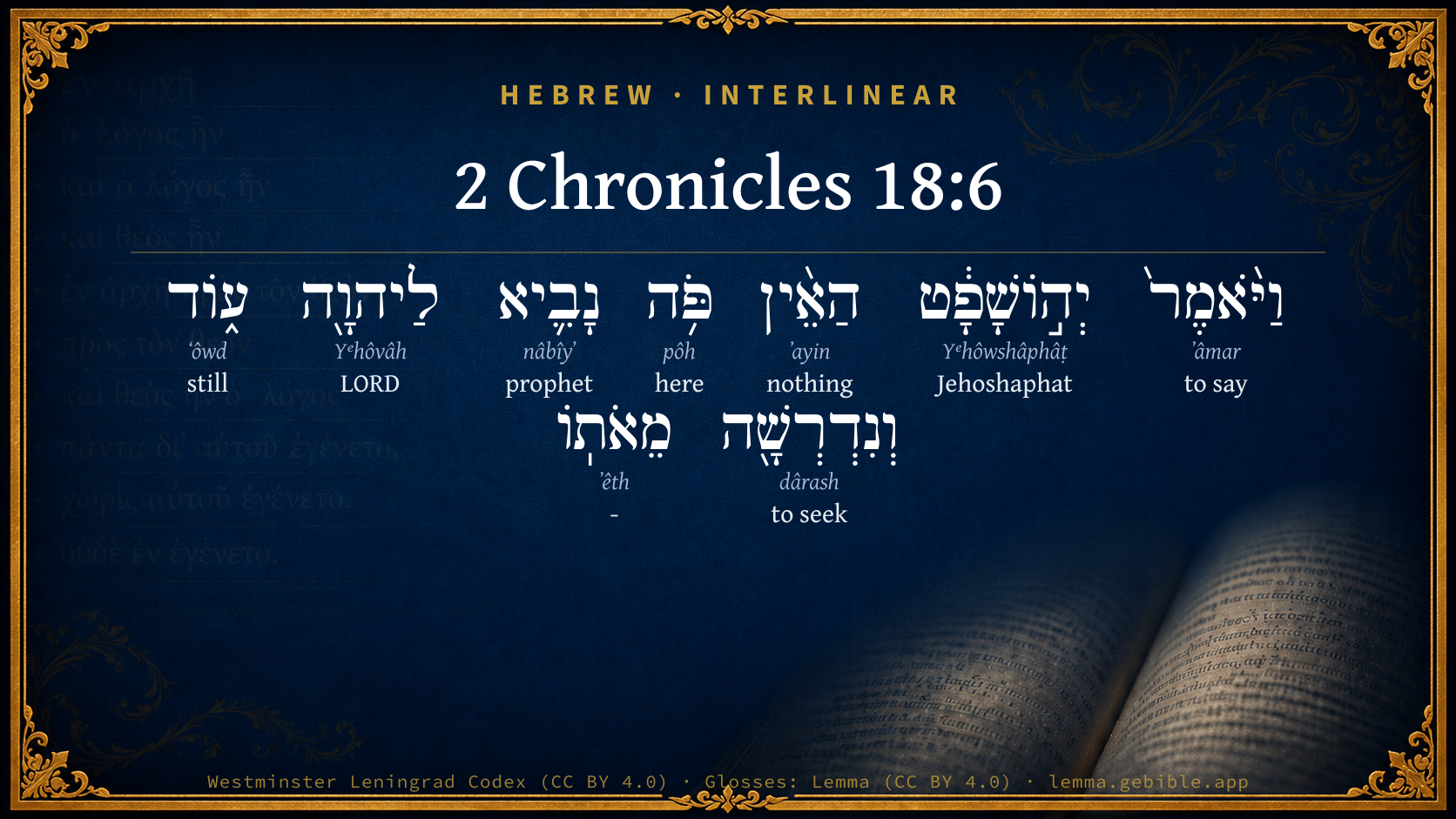
2 Chronicles 18:6

Hebrew (Westminster Leningrad Codex) 2 Chronicles 18:6 appears in the Hebrew Old Testament. The text above is from the Westminster Leningrad Codex. Each word links to its Strong’s number, a concise gloss, and parsing drawn from the Open Scriptures Hebrew Bible morphology. Click any word for its full Brown-Driver-Briggs (BDB) entry.
Download image
Cite this verse

2 Chronicles 18:6 (World English Bible). Public Domain. Lemma interlinear Bible study tool, https://lemma.gebible.app/v/2-chronicles/18/6.

Show BibTeX & RIS
BibTeX
RIS
English Translation
But Jehoshaphat said, Isn't there here a prophet of Yahweh besides, that we may inquire of him?
World English Bible · Public Domain
Download a study sheet

One document with this verse’s original text, its word-by-word gloss line, the meaning frame, cross-references with their text, attributed commentary, and full source and license credits — printable, and it pastes into notes with its structure intact.

This verse Autodidact and up

Study sheet (.html) Plain text (.txt)

A passage Seminary Student

Up to 50 verses in one chapter. A passage sheet keeps up to 6 commentary sources and 12 cross-references per verse, in the order this page ranks them, and says so on the sheet whenever that leaves anything out. Ask for a single verse and you get the Autodidact verse sheet above.

Everything on this page stays free to read, with no account — the sheet is a download of what is already on screen, not access to it.

Want to remove ads? Support Godless Engineer
Compare translations 3

The same verse in 3 English versions, stacked beneath the original-language interlinear above. Click any original word for its lexicon entry.

Each is an independent rendering of the whole verse — the interlinear is not word-aligned to these translations.

Highlighted words mark where these versions differ — a whole-verse word diff, not a word-by-word alignment.

  • World English Bible Public Domain
    But Jehoshaphat said, Isn't there here a prophet of Yahweh besides, that we may inquire of him?
  • King James Version Public Domain
    But Jehoshaphat said, Is there not here a prophet of the LORD besides, that we might enquire of him?
  • unfoldingWord Literal Text CC BY-SA 4.0
    And Jehoshaphat said, “Is there not here another prophet of Yahweh, that we might seek from him?”

unfoldingWord Literal Text — © unfoldingWord, licensed CC BY-SA 4.0. Word-aligned USFM3 via Door43 (git.door43.org/unfoldingWord/en_ult).

Versions to compare (up to 4)

3 of 4 selected

Show all 18 translations

Every available English version of this verse, each an independent rendering of the whole verse.

  • World English Bible Public Domain
    But Jehoshaphat said, Isn't there here a prophet of Yahweh besides, that we may inquire of him?
  • Berean Standard Bible Public Domain
    But Jehoshaphat asked, “Is there not still a prophet of the LORD here of whom we can inquire?”
  • Majority Standard Bible Public Domain
    But Jehoshaphat asked, “Is there not still a prophet of the LORD here of whom we can inquire?”
  • King James Version Public Domain
    But Jehoshaphat said, Is there not here a prophet of the LORD besides, that we might enquire of him?
  • American Standard Version (1901) Public Domain
    But Jehoshaphat said, Is there not here a prophet of Jehovah besides, that we may inquire of him?
  • Revised Version (1885) Public Domain
    But Jehoshaphat said, Is there not here besides a prophet of the LORD, that we might inquire of him?
  • Geneva Bible (1599) Public Domain
    But Iehoshaphat sayde, Is there heere neuer a Prophet more of the Lord that wee might inquire of him?
  • Douay-Rheims (1899) Public Domain
    And Josaphat said: Is there not here a prophet of the Lord, that we may inquire also of him?
  • Young's Literal Translation Public Domain
    And Jehoshaphat saith, `Is there not here a prophet of Jehovah still, and we seek from him?'
  • Literal Standard Version CC BY-SA 4.0
    And Jehoshaphat says, “[Is there] not still a prophet of YHWH here, and we seek from him?”
  • Unlocked Literal Bible CC BY-SA 4.0
    But Jehoshaphat said, “Is there not here still another prophet of Yahweh with whom we might seek advice?”
  • unfoldingWord Literal Text CC BY-SA 4.0
    And Jehoshaphat said, “Is there not here another prophet of Yahweh, that we might seek from him?”
  • Darby Bible Public Domain
    But Jehoshaphat said, Is there not here a prophet of Jehovah besides, that we might inquire of him?
  • World Messianic Bible Public Domain
    But Jehoshaphat said, “Isn’t there here a prophet of the LORD besides, that we may inquire of him?”
  • Webster's Bible Public Domain
    But Jehoshaphat said, Is there not here a prophet of the LORD besides, that we may inquire of him?
  • Free Bible Version CC BY-SA 4.0
    But Jehoshaphat asked, “Isn't there another prophet of the Lord here that we can ask?”
  • Bible in Basic English Public Domain
    But Jehoshaphat said, Is there no other prophet of the Lord here from whom we may get directions?
  • JPS Tanakh (1917) Public Domain
    But Jehoshaphat said: 'Is there not here besides a prophet of the LORD, that we might inquire of him?'

Literal Standard Version (2020), Covenant Press — licensed CC BY-SA 4.0. Text via the HelloAO Bible API (eBible.org). Unlocked Literal Bible (unfoldingWord) — licensed CC BY-SA 4.0. Text via the HelloAO Bible API (eBible.org). unfoldingWord Literal Text — © unfoldingWord, licensed CC BY-SA 4.0. Word-aligned USFM3 via Door43 (git.door43.org/unfoldingWord/en_ult). Free Bible Version, Dr. Jonathan Gallagher — licensed CC BY-SA 4.0. Text via the HelloAO Bible API (eBible.org).

Word by word

More ways to search: Search by grammar → Find every occurrence → Compare this word →

Practice this passage: Drill this verse → Learn its vocabulary →

About this verse

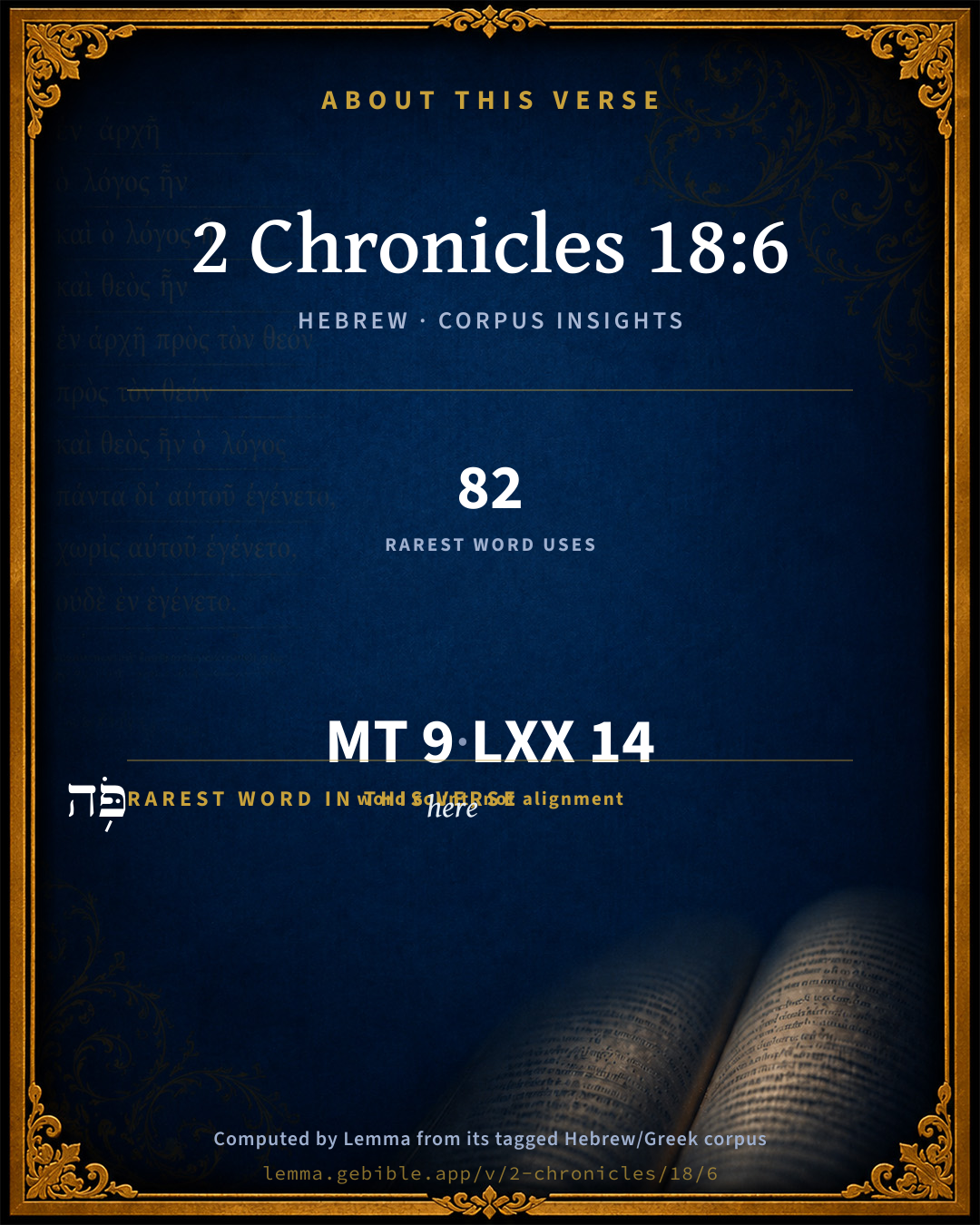
These counts appear in no published source. They are computed here, from the morphology-tagged text and Lemma’s own curated glosses. What Lemma adds →

9
words
9
distinct lemmas
Historical
section

Grammatical profile

  • 2 verbs
  • 3 nouns
  • 2 adverbs
  • 2 particles

Verb forms

  • וַיֹּ֨אמֶר֙ Qal · Sequential Imperfect
  • וְנִדְרְשָׁ֖ה Qal · Cohortative

Hebrew & Septuagint length

In English translation the verse runs 17 words from the Hebrew and 19 from the Septuagint (LXX English) — closely comparable.

A rough comparison of the two English renderings, which tokenize alike — not a word-level alignment.

Word counts can differ between the Hebrew and the Greek without any difference in meaning — e.g. the Hebrew direct-object marker אֵת has no separate Greek word, and Greek often adds the article ὁ.

In the original languages it is 9 Hebrew tokens and 14 Greek tokens — but the two are counted differently (Hebrew bundles its prefixes and suffixes into one token; the Greek is in lemma form), so that isn’t a like-for-like length.

Cross-references

2

Topical passages linked to 2 Chronicles 18:6 in the Treasury of Scripture Knowledge — connected by theme and wording, ordered by reader-vote popularity; previews shown in the World English Bible.

  • 1 Kings 22:7–9 But Jehoshaphat said, Isn't there here a prophet of Yahweh besides, that we may inquire of him?
  • 2 Kings 3:11–13 But Jehoshaphat said, Isn't there here a prophet of Yahweh, that we may inquire of Yahweh by him? One of the king of Israel's servants answered, Elisha the son of Shaphat is here, who poured water on the hands of Elijah.

Cross-references courtesy of OpenBible.info (CC BY 4.0).

Hebrew and Greek witnesses Masoretic Hebrew ↔ Greek Septuagint

The same verse in the two great witnesses to the Old Testament, shown verse-for-verse.

These are two independent witnesses, not word-aligned to each other, and the Septuagint is shown in lemma (dictionary) form.

Hebrew 2 Chronicles 18:6 Masoretic · Westminster Leningrad Codex

וַיֹּ֨אמֶר֙ יְה֣וֹשָׁפָ֔ט הַאֵ֨ין פֹּ֥ה נָבִ֛יא לַיהוָ֖ה ע֑וֹד וְנִדְרְשָׁ֖ה מֵאֹתֽוֹ

But Jehoshaphat said, Isn't there here a prophet of Yahweh besides, that we may inquire of him?

World English Bible · Public Domain

Greek LXX 2 Chronicles 18:6 Septuagint · lemma form

καί εἶπον ιωσαφατ οὐ εἰμί ὧδε προφήτης ὁ κύριος ἔτι καί ἐπιζητέω παρά αὐτός

And Josaphat said, Is there not here a prophet of the Lord besides, that we may enquire of him?

LXX2012 (modern English Septuagint) · Public Domain

Hebrew: Westminster Leningrad Codex (CC BY 4.0). Greek: Septuagint (public domain); English from LXX2012 (modern English Septuagint) (Public Domain). How the Septuagint differs from the Hebrew →

Commentary

Notes on 2 Chronicles 18:6 from classic Christian and Jewish commentators (each source and its license shown beneath its notes). The classic Christian expositions comment on the surrounding passage and are grouped to its opening verse, so a note may address several verses; the Jewish commentaries on the Tanakh (Rashi and others) are per-verse, so they appear only where the commentator wrote on this verse.

Lemma curates 59 commentaries, every one of them public domain or Creative Commons licensed, each selected and text-cleaned for this edition rather than reprinted as found. About our sources →

The Biblical Illustrator

Joseph S. Exell

2Ch_18:6-7

There is yet one man, by whom we may enquire of the Lord: but I hate him.

Micaiah the son of Imla

Jehoshaphats is the wise and reverent question to ask, amid the illusions of every fashionable opinion, amid all smooth and flattering promises. It marks the devout habit of looking behind the outward show and of searching every matter to its depths in the fear of God. Let us notice the frame of mind revealed in Ahabs reply.

I. Note the significance of that one obdurate voice, rising clearly above the four hundred unanimous in their approval.

1. That is a voice which we hear again and again in our life; we hear it most loudly at special crises of our career.

2. When one solitary voice flatly contradicts the voice of a multitude, and contradicts it on matters of serious moment--which voice are we to believe? Sometimes the question is practically decided, as in Ahabs case, by the mood with which we come to think of the unsilenced prophet. I hate him.

(1) That tribute of hatred sprang from Ahabs conscience. It is the precise method by which weak and cruel men are wont to confess that not the man, but the message has found them out.

(2) Notice also Ahabs device for suppressing an unwelcome truth.

II. This narrative symbolises mans frequent attitude towards the truth. It is a test case.

1. Young men and women starting in life with abundant promise, amid the acclamation of hosts of friends, you may be irritated by perhaps one grim, dissenting voice, critical, dissatisfied, implacable, which sadly challenges the place in this universe to which general opinion reads your title clear. Be very careful how you treat that voice! It may be the voice of an ignorant, envious, churlish man, but, on the other hand, it may be the voice of one who has pierced to the secret of your inner life, and who, if you would only listen, might spare you an idle journey, might rescue you from misery and shame.

2. Again, there are books or teachers whom we have to deal with, and who sadly irritate us, and we say, like Marguerite to Faust, but often, alas, without her simplicity: Thou art not a Christian. Let us patiently ask: are we really angry in the name of the Lord of hosts? or, are we angry because these books or voices spoil our own theories, wound our prejudices, smile at our favourite catch-words, wither our ideas of success, and are, in the name of the Truth of God, relentless amid our flatterers? Do they simply offend our self-love, and rebuke our calculated prudence? Let us be careful. These books and voices may be wrong; if so, theirs the loss and the penalty. But, very often, conscience would tell us there is a possibility that they are right.

3. There is one solemn application of this incident which has, no doubt, occurred to us already. In every human heart disobedient to Christ, impenitent and unreconciled, there is a voice as of Micaiah the son of Imla; but it is really the voice of the Lord Himself, speaking to that heart, amid all its distractions and its earthly pleasures, the message of evil and not of good. And men may come to chafe so angrily under that patient, ever-haunting warning, and appeal, that finally they may cry: I hate it, I hate it! If that be so, remember Ahabs doom. (T. Rhys Evans.)

Virtues necessary far religious warkers

Close sympathy with his kind, personal lowliness, self-suppression pushed even to pathetic extremes, unshakable loyalty to the teaching of the Spirit of God, and calm indifference to fashionable moods of flattery or disapproval--these are virtues necessary to every religious worker. If he deferentially consults the noble of this world what message he may utter; if he asks the man of affairs, whose difficult lifo reminds him always, not only of Jacobs wrestling, but also of Jacobs subtlety, and who is fiercely tempted to give his vote for a gospel of compromise; if he asks the poor and becomes spokesman, not of their wrongs, but of a maddened despair which does not represent their truer self, he passes from the side of Micaiah to that of the four hundred. (T. Rhys Evans)

The faithful prophet

I. The estimation in which he was held. I hate him. Hatred, inveterate and strong, often the reward of fidelity. Am I then become your enemy because I tell you the truth?

II. The stand which he takes (2Ch_18:13).

1. Dependence upon God.

2. Expectation of Gods help (Mat_10:18-19).

3. Determination to utter Gods Word.

III. The pleas urged to move from this stand.

1. The opinion of the majority.

2. The difficulty of judging who is right. Which way went the Spirit of the

Lord from me to thee?

3. The employment of physical force. (J. Wolfendale.)

Hated for the truths sake

I. What an appalling illustration is this of the fact that men love to be flattered and encouraged even at the expense of everything holy and true. A wonderful and horrible thing is come to pass in the land; the prophets prophesy falsely, and the priests bear rule by their means; and My people love to have it so.

II. What a vivid illustration is this of the sublime function of an incorruptible truth-teller! This is not Micaiahs first appearance before the king. He had established his reputation as a God-fearing and truth-speaking man, and Ahabs denunciation was in reality Micaiahs highest praise.

1. No wicked man should be quite easy in the sanctuary.

2. Do you suppose that it is pleasant for a minister to be always opposing any man?

3. A man is not your enemy because he tells you the truth. Opposition will come. (J. Parker, D.D.)

Truth awakens enmity

As the Turk taunted some Christians at Constantinople, who said that they came thither to suffer for the truth, telling them that they needed not to have come so far for that; for had they but told the truth at home, they could not have missed suffering for it. Telling truth needs not travel far for enmity; enmity will encounter it at home, wheresoever it be. Hence is that definition that Luther made of preaching, Proedicare nihil eat quam derivare in se furorem, etc.--that to preach, and preach home, as he did, was nothing else but to stir up the furies of hell about their ears. (J. Spencer.)

Ministers not to accommodate their message to the likings of men

Suppose a number of persons were to call on a minister on the Sabbath-day morning, and being admitted into his study, one of them should say to him, I hope, sir, you do not mean to-day to be severe against avarice, for I love money, and my heart goes after my covetousness. Suppose another should say, I trust you will not be severe against backbiting, for my tongue walketh with slanderers, and I consider scandal to be the seasoning of all conversation. Suppose another should say, Do not represent implacability as being inconsistent,, with Divine goodness, for I never did forgive such an one, and I never will. And so of the rest. What would this minister say to these men? Why, if he were in a proper state of mind he would say, Oh, thou child of the devil, thou enemy of all righteousness, wilt thou not cease to pervert the right ways of the Lord? (W. Jay.)

The Biblical Illustrator, edited by Joseph S. Exell (c. 1880s–1900s) — public domain. Text from a community e-Sword module.

Ellicott's Commentary for English Readers

(6) But—And. So 1Ki_22:7, literally.

A Bible Commentary for English Readers, edited by Charles John Ellicott (1878–1897) — public domain. Text from a community e-Sword module.

The Cambridge Bible for Schools and Colleges

gen. ed. J. J. S. Perowne

6. Is there not here a prophet of the Lord besides] Or, Hath not the LORD here yet another prophet. The unanimity of the four hundred prophets aroused the suspicion of Jehoshaphat.

The Cambridge Bible for Schools and Colleges (gen. ed. J. J. S. Perowne; Cambridge University Press, 1878–1918) — public domain. Text from a community e-Sword module.

The Pulpit Commentary

The Revised Version well at-ranges the words of this verse, "Is there not here besides a prophet of the Lord?" The conscience of Ahab successfully made a coward of him, that he took so quietly this pronounced slight put on his kingdom s prophets (prophetae vitulorum) by his brother-king Jehoshaphat!

Vers. 6-27.

Speaking for God.

We may take Micaiah as the type of the true prophet, i.e. of the man who speaks for God; he is not merely the man who has a vision of the future that is the smaller part of his function; he is the one who is charged with a Divine message, and who faithfully delivers it, however it may be received. Thus regarding him, we learn that the spokesman for God must be

I UNCONCERNED ABOUT NUMBERS. There may be "four hundred men" on one side (ver. 5), and only one on the other; or see 1Ki_18:19. The prophet of the Lord may be in a most honourable but mostdecisive minority, but he must not consider that. "Truth cannot be put to the vote "and carried by a majority. Many a time it has been overwhelmingly outnumbered, and yet ultimately triumphant. We must not count heads when we undertake to speak for the Eternal. "A man with truth on his side can never be in a smaller minority than Almighty God and himself.

II INACCESSIBLE TO HUMAN BLANDISHMENTS, The messenger that summoned Micaiah and attended him to the king seems to have employed his opportunity in trying to persuade the prophet to give a pleasant and courtly answer (ver. 12). He did not succeed. Many times have men sought to tamper with the ministers of the truth; sometimes they have succeeded. But when they have done so, there has been a lamentable failure. "We seek not yours, but you;" "If I pleased men I should not be the servant of Christ." These are the sentiments and this is the spirit of the true prophet. No human whisper in the ear as he goes before his audience will make him change one word or tone in the message he delivers from his Master.

III FEARLESS OF HUMAN AUTHORITY. Micaiah had caused Jehoshaphat to "hate" him (ver. 7); and once again he drew upon him the king"s resentment. There were two kings now present, arrayed in royal apparel and seated on thrones (ver. 9); there was much in the position to constrain a deliverance that would answer to their known wishes; but Micaiah was unmoved by fear. He acted as honourably and as heroically as if he had witnessed the example and heard the exhortation of the Lord himself. (Luk_12:4, Luk_12:5) To be condemned of man is a small thing when we are commended and honoured of God. We can afford to incur the hatred even of kings when we rest in the loving favour of our heavenly Father.

IV UNMOVED BY ILL TREATMENT. Micaiah responded to Zedekiah in a spirit that showed no shade of submission or withdrawal (ver. 23); and when the vexed and passionate king ordered him to be imprisoned and fed with the bread and water of affliction, he still manifested a fearless spirit, totally unmoved by the ill usage he was receiving (ver. 27). The minister of Christ, who is (or should be) the successor of the Hebrew prophet, will not use the language or cherish the spirit of retaliation, but he will be utterly undisturbed in his aim and in his purpose by any unjust or unkind treatment he may receive. Nothing of this kind will move him from his resolve, will turn him from his high and noble task. Acting under the inspiration of God, and conscious that he is "partaking of the afflictions of Christ," the "bread and water of affliction" will be sweet to his taste. In that day he will "rejoice and be exceeding glad". (Mat_5:10-12)

V WHOLLY ATTENTIVE TO THE DIVINE VOICE. "Even what my God saith, that will I speak" (ver. 13). So spoke the faithful witness. One greater far than he described himself as "a Man that hath told you the truth, which I have heard of God". (Joh_8:40) What has God said to us that we can tell our brethren? What do we learn of Christ and in his service? What do we read in his Word, by a careful, reverent, and intelligent study of it? What sacred lessons have we gleaned, as his holy providence has led and his Divine discipline has taught and trained us? This, nothing else and nothing less, will we carry to the minds of men, to redeem them from sin, to succour them in sorrow, to prepare them for the burden and battle of life, to make them ready for the time of judgment and the long day of eternity. C.

The Pulpit Commentary (1880–1919), ed. H.D.M. Spence-Jones & Joseph S. Exell — public domain. Text from a community e-Sword module.

unfoldingWord translationNotes

Door43 World Missions Community

Micaiah son of Imlah

This is the name of a man. (See: How to Translate Names)

unfoldingWord translationNotes — © Distant Shores Media and the Door43 World Missions Community, licensed CC BY-SA 4.0. Source: git.door43.org/Door43/en_tn.

Lesson kit

Teaching starters — assembled from the data on this page, not authored interpretation. Every prompt links to the verse data it draws on. Edit before teaching.

2 Chronicles, in the Historical, opens this verse with 9 words (9 distinct Hebrew lemmas). Its most distinctive word is pôh (“here”). A historical commentator’s framing appears above. Read the whole chapter for the surrounding context.

Discussion questions

  1. The word pôh carries the sense “here.” How does it shape the verse?
  2. How does 1 Kings 22:7–9, which shares this passage’s theme, read alongside this verse?
  3. These translations render this verse differently. What is at stake in choosing one wording over another?
  4. «וַיֹּ֨אמֶר֙» is a Qal Sequential Imperfect verb. How does that grammatical form shape the action described?
  5. Compare how The Biblical Illustrator and Ellicott's Commentary for English Readers read this verse. Where do they agree or differ?

Things to notice

Reading settings

Reading text

Shown beneath each verse's original-language words.

Old Testament
Old Testament edition

Read the OT as the Masoretic Hebrew (MT) or the Greek Septuagint (LXX).

English shown for the Greek Septuagint (in the Hebrew ↔ Greek comparison).

Comparing translations? Open the Compare panel on any verse page to stack up to four side by side.