
Isaiah 9:13

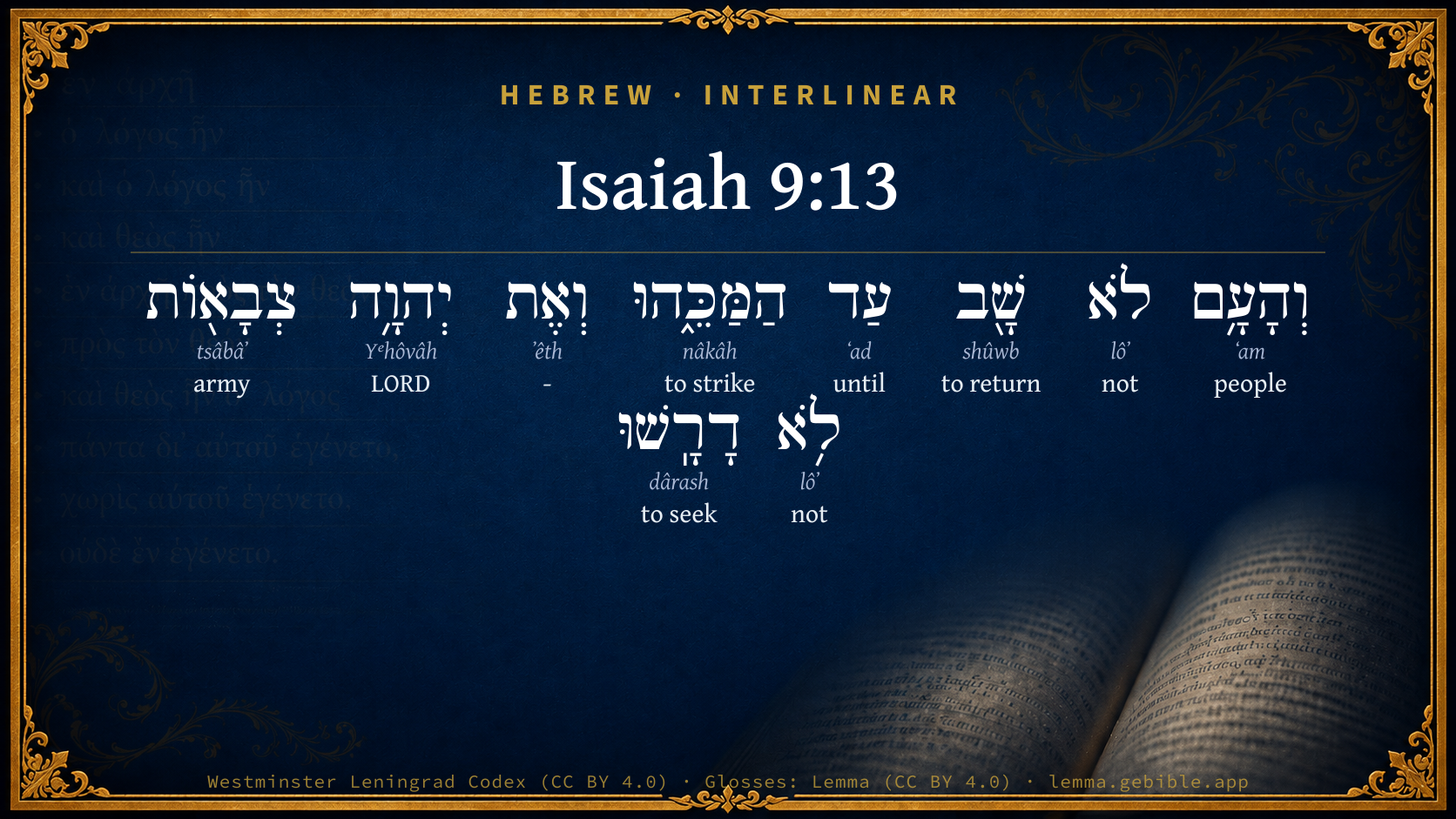
Hebrew (Westminster Leningrad Codex) Isaiah 9:13 appears in the Hebrew Old Testament. The text above is from the Westminster Leningrad Codex. Each word links to its Strong’s number, a concise gloss, and parsing drawn from the Open Scriptures Hebrew Bible morphology. Click any word for its full Brown-Driver-Briggs (BDB) entry.
Download image
Cite this verse

Isaiah 9:13 (World English Bible). Public Domain. Lemma interlinear Bible study tool, https://lemma.gebible.app/v/isaiah/9/13.

Show BibTeX & RIS
BibTeX
RIS
English Translation
Yet the people have not turned to him who struck them, neither have they sought Yahweh of Hosts.
World English Bible · Public Domain
Download a study sheet

One document with this verse’s original text, its word-by-word gloss line, the meaning frame, cross-references with their text, attributed commentary, and full source and license credits — printable, and it pastes into notes with its structure intact.

This verse Autodidact and up

Study sheet (.html) Plain text (.txt)

A passage Seminary Student

Up to 50 verses in one chapter. A passage sheet keeps up to 6 commentary sources and 12 cross-references per verse, in the order this page ranks them, and says so on the sheet whenever that leaves anything out. Ask for a single verse and you get the Autodidact verse sheet above.

Everything on this page stays free to read, with no account — the sheet is a download of what is already on screen, not access to it.

Want to remove ads? Support Godless Engineer
Compare translations 3

The same verse in 3 English versions, stacked beneath the original-language interlinear above. Click any original word for its lexicon entry.

Each is an independent rendering of the whole verse — the interlinear is not word-aligned to these translations.

Highlighted words mark where these versions differ — a whole-verse word diff, not a word-by-word alignment.

  • World English Bible Public Domain
    Yet the people have not turned to him who struck them, neither have they sought Yahweh of Hosts.
  • King James Version Public Domain
    For the people turneth not unto him that smiteth them, neither do they seek the LORD of hosts.
  • unfoldingWord Literal Text CC BY-SA 4.0
    And the people has not returned to the one striking it, and they have not sought Yahweh of Armies.

unfoldingWord Literal Text — © unfoldingWord, licensed CC BY-SA 4.0. Word-aligned USFM3 via Door43 (git.door43.org/unfoldingWord/en_ult).

Versions to compare (up to 4)

3 of 4 selected

Show all 18 translations

Every available English version of this verse, each an independent rendering of the whole verse.

  • World English Bible Public Domain
    Yet the people have not turned to him who struck them, neither have they sought Yahweh of Hosts.
  • Berean Standard Bible Public Domain
    But the people did not return to Him who struck them; they did not seek the LORD of Hosts.
  • Majority Standard Bible Public Domain
    But the people did not return to Him who struck them; they did not seek the LORD of Hosts.
  • King James Version Public Domain
    For the people turneth not unto him that smiteth them, neither do they seek the LORD of hosts.
  • American Standard Version (1901) Public Domain
    Yet the people have not turned unto him that smote them, neither have they sought Jehovah of hosts.
  • Revised Version (1885) Public Domain
    Yet the people hath not turned unto him that smote them, neither have they sought the LORD of hosts.
  • Geneva Bible (1599) Public Domain
    For the people turneth not vnto him that smiteth them, neither doe they seeke the Lord of hostes.
  • Douay-Rheims (1899) Public Domain
    And the people are not returned to him who hath struck them, and have not sought after the Lord of hosts.
  • Young's Literal Translation Public Domain
    And the people hath not turned back unto Him who is smiting it, And Jehovah of Hosts they have not sought.
  • Literal Standard Version CC BY-SA 4.0
    And the people has not turned back to Him who is striking it, || And they have not sought YHWH of Hosts.
  • Unlocked Literal Bible CC BY-SA 4.0
    Yet the people will not turn to him who struck them, nor will they seek Yahweh of hosts.
  • unfoldingWord Literal Text CC BY-SA 4.0
    And the people has not returned to the one striking it, and they have not sought Yahweh of Armies.
  • Darby Bible Public Domain
    But the people turneth not unto him that smiteth them, and they do not seek Jehovah of hosts.
  • World Messianic Bible Public Domain
    Yet the people have not turned to him who struck them, neither have they sought the LORD of Hosts.
  • Webster's Bible Public Domain
    For the people turn not to him that smiteth them, neither do they seek the LORD of hosts.
  • Free Bible Version CC BY-SA 4.0
    But the people didn't return to the one who punished them; they didn't come to worship the Lord Almighty.
  • Bible in Basic English Public Domain
    But the heart of the people was not turned to him who sent punishment on them, and they made no prayer to the Lord of armies.
  • JPS Tanakh (1917) Public Domain
    (9-12) Yet the people turneth not unto Him that smiteth them, neither do they seek the LORD of hosts.

Literal Standard Version (2020), Covenant Press — licensed CC BY-SA 4.0. Text via the HelloAO Bible API (eBible.org). Unlocked Literal Bible (unfoldingWord) — licensed CC BY-SA 4.0. Text via the HelloAO Bible API (eBible.org). unfoldingWord Literal Text — © unfoldingWord, licensed CC BY-SA 4.0. Word-aligned USFM3 via Door43 (git.door43.org/unfoldingWord/en_ult). Free Bible Version, Dr. Jonathan Gallagher — licensed CC BY-SA 4.0. Text via the HelloAO Bible API (eBible.org).

Word by word

More ways to search: Search by grammar → Find every occurrence → Compare this word →

Practice this passage: Drill this verse → Learn its vocabulary →

דָרָֽשׁוּ
dârash
H1875
“to seek”
Verb, Qal, Perfect, 3rd Person, Common, Plural
Part of Speech
Verb
Stem
Qal
Form
Perfect
Person
3rd Person
Gender
Common
Number
Plural
Full BDB Definition

Origin: a primitive root

TWOT: 455

to resort to, seek, seek with care, enquire, require - (Qal) - to resort to, frequent (a place), (tread a place) - to consult, enquire of, seek - of God - of heathen gods, necromancers - to seek deity in prayer and worship - God - heathen deities - to seek (with a demand), demand, require - to investigate, enquire - to ask for, require, demand - to practice, study, follow, seek with application - to seek with care, care for - (Niphal) - to allow oneself to be enquired of, consulted (only of God) - to be sought, be sought out - to be required (of blood)
  1. וְהָעָ֥ם ʻam H5971 “and · the · people” Conjunction + Particle, Definite Article + Noun, Common, Masculine, Singular, Absolute
  2. לֹא lôʼ H3808 “not” Particle, Negative
  3. שָׁ֖ב shûwb H7725 “to return” Verb, Qal, Perfect, 3rd Person, Masculine, Singular
  4. עַד ʻad H5704 “until” Preposition
  5. הַמַּכֵּ֑הוּ nâkâh H5221 “the · striking · him” Particle, Definite Article + Verb, Hiphil, Participle Active, Masculine, Singular, Construct + Suffix, Personal, 3rd Person, Masculine, Singular
  6. וְאֶת ʼêth H853 “and · -” Conjunction + Particle, Direct Object
  7. יְהוָ֥ה Yᵉhôvâh H3068 “LORD” Noun, Proper
  8. צְבָא֖וֹת tsâbâʼ H6635 “armies” Noun, Common, Both, Plural, Absolute
  9. לֹ֥א lôʼ H3808 “not” Particle, Negative

About this verse

These counts appear in no published source. They are computed here, from the morphology-tagged text and Lemma’s own curated glosses. What Lemma adds →

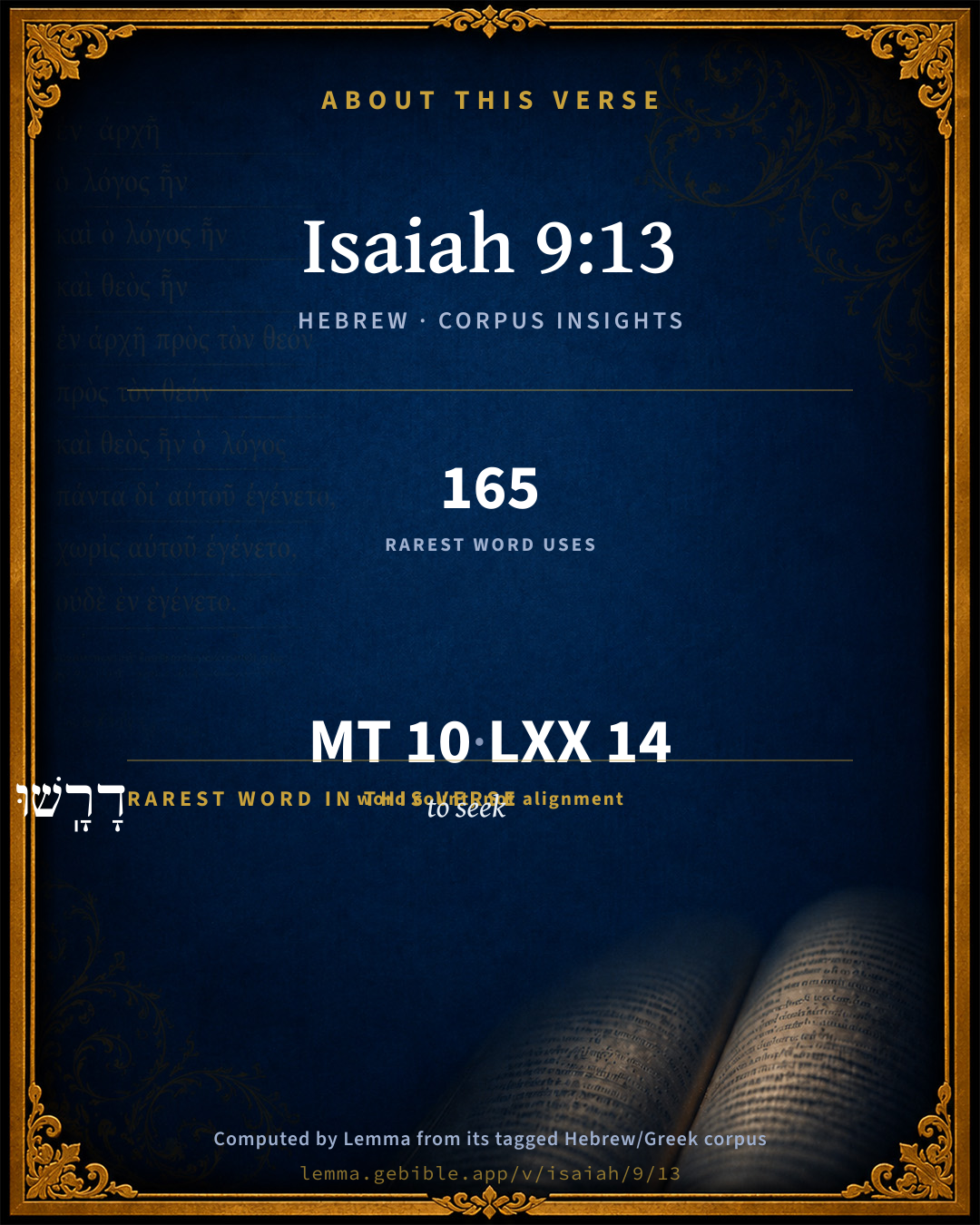
10
words
9
distinct lemmas
Prophets
section

Grammatical profile

  • 3 verbs
  • 3 nouns
  • 1 preposition
  • 3 particles

Verb forms

  • שָׁ֖ב Qal · Perfect
  • הַמַּכֵּ֑הוּ Hiphil · Participle Active
  • דָרָֽשׁוּ Qal · Perfect

Repetition

A word recurs within this verse — often emphatic in Hebrew:

Hebrew & Septuagint length

In English translation the verse runs 18 words from the Hebrew and 15 from the Septuagint (LXX English) — closely comparable.

A rough comparison of the two English renderings, which tokenize alike — not a word-level alignment.

Word counts can differ between the Hebrew and the Greek without any difference in meaning — e.g. the Hebrew direct-object marker אֵת has no separate Greek word, and Greek often adds the article ὁ.

In the original languages it is 10 Hebrew tokens and 14 Greek tokens — but the two are counted differently (Hebrew bundles its prefixes and suffixes into one token; the Greek is in lemma form), so that isn’t a like-for-like length.

Cross-references

16

Topical passages linked to Isaiah 9:13 in the Treasury of Scripture Knowledge — connected by theme and wording, ordered by reader-vote popularity; previews shown in the World English Bible.

  • Hosea 7:10 The pride of Israel testifies to his face; Yet they haven't returned to Yahweh their God, Nor sought him, for all this.
  • Isaiah 31:1 Woe to those who go down to Egypt for help, and rely on horses, and trust in chariots because they are many, and in horsemen because they are very strong, but they don't look to the Holy One of Israel, neither seek Yahweh!
  • Jeremiah 5:3 O Yahweh, don't your eyes look on truth? you have stricken them, but they were not grieved; you have consumed them, but they have refused to receive correction: they have made their faces harder than a rock; they have refused to return.
  • Isaiah 1:5 Why should you be beaten more, That you revolt more and more? The whole head is sick, And the whole heart faint.
  • Deuteronomy 4:29 But from there you shall seek Yahweh your God, and you shall find him, when you search after him with all your heart and with all your soul.
  • 2 Chronicles 28:22 In the time of his distress did he trespass yet more against Yahweh, this same king Ahaz.
  • Job 36:13 "But those who are godless in heart lay up anger. They don't cry for help when he binds them.
  • Isaiah 26:11 Yahweh, your hand is lifted up, yet they don't see: but they shall see [your] zeal for the people, and be disappointed; yes, fire shall devour your adversaries.
  • Isaiah 57:17 For the iniquity of his covetousness was I angry, and struck him; I hid [my face] and was angry; and he went on backsliding in the way of his heart.
  • Jeremiah 29:11 For I know the thoughts that I think toward you, says Yahweh, thoughts of peace, and not of evil, to give you hope in your latter end.
  • Jeremiah 31:18–20 I have surely heard Ephraim bemoaning himself [thus], You have chastised me, and I was chastised, as a calf unaccustomed [to the yoke]: turn you me, and I shall be turned; for you are Yahweh my God.
  • Jeremiah 50:4–5 In those days, and in that time, says Yahweh, the children of Israel shall come, they and the children of Judah together; they shall go on their way weeping, and shall seek Yahweh their God.
  • Ezekiel 24:13 In your filthiness is lewdness: because I have cleansed you and you weren't cleansed, you shall not be cleansed from your filthiness any more, until I have caused my wrath toward you to rest.
  • Hosea 3:4–5 For the children of Israel shall abide many days without king, and without prince, and without sacrifice, and without sacred stone, and without ephod or idols.
  • Hosea 5:15 I will go and return to my place, until they acknowledge their offense, And seek my face. In their affliction they will seek me earnestly."
  • Hosea 7:16 They return, but not to the Most High. They are like a faulty bow. Their princes will fall by the sword for the rage of their tongue. This will be their derision in the land of Egypt.

Cross-references courtesy of OpenBible.info (CC BY 4.0).

Hebrew and Greek witnesses Masoretic Hebrew ↔ Greek Septuagint

The same verse in the two great witnesses to the Old Testament, shown verse-for-verse.

These are two independent witnesses, not word-aligned to each other, and the Septuagint is shown in lemma (dictionary) form.

Hebrew Isaiah 9:13 Masoretic · Westminster Leningrad Codex

וְהָעָ֥ם לֹא שָׁ֖ב עַד הַמַּכֵּ֑הוּ וְאֶת יְהוָ֥ה צְבָא֖וֹת לֹ֥א דָרָֽשׁוּ

Yet the people have not turned to him who struck them, neither have they sought Yahweh of Hosts.

World English Bible · Public Domain

Greek LXX Isaiah 9:13 Septuagint · lemma form

καί ἀποαἱρέω κύριος ἀπό ἰσραήλ κεφαλή καί οὐρά μέγας καί μικρός ἐν εἷς ἡμέρα

But the people turned not until they were struck, and they sought not the Lord.

LXX2012 (modern English Septuagint) · Public Domain

On this verse, John Gill's Exposition discusses the Septuagint’s reading. Read the note in Commentary ↓

Hebrew: Westminster Leningrad Codex (CC BY 4.0). Greek: Septuagint (public domain); English from LXX2012 (modern English Septuagint) (Public Domain). How the Septuagint differs from the Hebrew →

Targum (Aramaic paraphrase)

1

The Targum is the ancient Jewish Aramaic paraphrase of the Hebrew Scriptures — an interpretive translation, not the Hebrew text itself. Onkelos (literal) and Pseudo-Jonathan (expansive) render the Torah, and Jonathan the Prophets. Coverage is partial: where no permissively-licensed English translation exists for a verse, only the Aramaic is shown. This is verse-level text, not a word-by-word alignment to the Hebrew.

  1. Targum Jonathan Prophets (Joshua–Malachi)
    וְשֵׁיצֵי יְיָ מִיִשְׂרָאֵל רֵישׁ וְהֶגְמוֹן שִׁלְטוֹן וְאִטְרוֹן יוֹמָא חָד:

    And the Lord will destroy, from Israel the prince, the captain, the ruler, and the governor, in one day.

    Targum Jonathan — Aramaic: “Mikraot Gedolot” (public domain). English: “Sefaria Community Translation” (CC0 1.0 (public-domain dedication)); “London "Chaldee Paraphrase," 1871” (public domain). Text via Sefaria.

Commentary

Notes on Isaiah 9:13 from classic Christian and Jewish commentators (each source and its license shown beneath its notes). The classic Christian expositions comment on the surrounding passage and are grouped to its opening verse, so a note may address several verses; the Jewish commentaries on the Tanakh (Rashi and others) are per-verse, so they appear only where the commentator wrote on this verse.

Lemma curates 59 commentaries, every one of them public domain or Creative Commons licensed, each selected and text-cleaned for this edition rather than reprinted as found. About our sources →

Trapp's Complete Commentary

John Trapp

Isa 9:13 For the people turneth not unto him that smiteth them, neither do they seek the LORD of hosts.

Ver. 13. For the people turneth not unto him that smiteth them.] This were the only way to escape God, viz., to run in to him. There is no standing before a lion, no bearing up sail in a storm, no stouting it out with God Almighty. {Amo 4:6-11} {See Trapp on "Amo 4:6"} {See Trapp on "Amo 4:7"} {See Trapp on "Amo 4:8"} {See Trapp on "Amo 4:9"} {See Trapp on "Amo 4:10"} {See Trapp on "Amo 4:11"}

John Trapp, A Commentary or Exposition upon All the Books of the Old and New Testament (1647–1656) — public domain. Text from a community e-Sword module.

The Biblical Illustrator

Joseph S. Exell

Isa_9:13

For the people turneth not unto Him that smiteth them

Gods rod should be kissed

The people turneth not unto Him that smiteth them.

That is one element of the cause of this judgment. They do not kiss the rod: they see it to be a rod only; they do not understand that judgment is the severe aspect of mercy, and that without mercy there could be no real judgment. There might be condemnation, destruction, annihilation, but judgment is a combined or compound term, involving in all its rich music every possible utterance of law and grace and song and hope. When a man kisses the hand that wields the rod, the rod blossoms, and Gods judgment becomes Gods grace. (J. Parker, D. D.)

Turning to God

Sin is described in. Scripture as departing from God. Repentance, therefore, is returning to Him. To seek God, in the idiom of Scripture, is to pray to Him (Isa_55:6), to consult Him (Isa_8:19), to resort to Him for help (Isa_31:1), to hold communion with Amo_5:4-5). Hence it is sometimes descriptive of a godly life in general (Psa_14:2). So here it includes repentance, conversion, and new obedience. (J. A. Alexander.)

Gods purpose in affliction should be considered

A very holy man, who was working on behalf of the sufferers in the recent plague at Bombay, wrote home to ask certain of his friends not to pray that God would remove the plague, but to pray that whatever was His purpose and intention in sending it might be done. It was a true and lofty view. (C. H.Sharpe.)

Chastisement should bring the soul to God

A Christian friend visiting a good man under great distress and afflicting dispensations, which he bore with such patient and composed resignation as to make his friend wonder and admire it, inquired how he was enabled so to comfort himself? The good man said, The distress I am under is indeed severe; but I find it lightens the stroke very much to creep near to Him who handles the rod! (J. Whitecross.)

The Biblical Illustrator, edited by Joseph S. Exell (c. 1880s–1900s) — public domain. Text from a community e-Sword module.

Joseph Benson's Commentary

Isa 9:13-15. For the people turneth not, &c. — We have here the second crime of this refractory people, who, impenitent and stupid, regarded not the chastisement of the Lord, nor turned to him at his reproof. Therefore a total subversion of their state and polity is denounced as the severest punishment upon them. The Lord will cut off, &c., head and tail — High and low, honourable and contemptible, as the next verse explains it; branch and rush — The goodly branches of tall trees, the mighty and noble; and the bulrush, the weakest and meanest persons. In one day — All together, one as well as another, without any distinction. The ancient, &c., he is the head — That is, is signified by the word head, in the former verse; and the prophet that teacheth lies, &c. — Whose destruction he mentions, not as if it were a punishment to them to be deprived of such persons, but partly to show the extent of the calamity, that it should reach to all sorts of persons; and partly to beat down their vain presumptions of peace and prosperity, by showing that those false prophets, which had fed their vain hopes, should perish, and their false prophecies with them. He is the tail — The basest part of the whole people.

Joseph Benson's Commentary on the Old and New Testaments (1811–1818) — public domain. Text from a community e-Sword module.

The Preacher's Complete Homiletical Commentary

Joseph S. Exell (gen. ed.)

UNSANCTIFIED SUFFERING

Isa_8:21, and Isa_9:13. And they shall pass through it, &c.

I. Sin leads to suffering.

1. This is true of individuals (H. E. I. 4603–4612). But because there is another life and a future retribution, the full results of sin are frequently not seen in this life. Nay, the sinner often appears prosperous even to the end (Psa_73:3-5).

2. But in the case of nations, which as such have no immortality, it is otherwise (P. D. 2544); it is more prompt; it is often exceedingly terrible. This fact should make those who have any love for their children hostile to any national policy that is unrighteous, however politically “expedient” it may seem.

II. There is in suffering no sanctifying power. God may use it as a means of arresting the careless, or of making good men better, but there is in it no certain reformative energy. On the contrary, it may harden men in iniquity [887]

[887] See outline: MORAL OBDURACY, p. 16.

III. Suffering does nothing in itself to abate God’s anger against sinners. We, when we are wronged, often yield to a passion of vindictiveness, which is sated when we have succeeded in inflicting a certain amount of pain on the wrong-doer. But God’s anger is not vindictive, but righteous (H. E. I. 2288–2294); hence its terribleness. As it does not thirst for suffering, it is not satisfied by suffering. As long as the sinner holds to his sin, God’s anger will burn against him, irrespective altogether of the suffering he may have endured. Nothing will turn away that anger but a genuine repentance (Isa_9:13).

1. In the hour of temptation, let us think of sin not as it then presents itself to us, but as it will certainly appear to us when its results are manifested (H. E. I. 4673–4676).

2. When suffering has come upon us, let us regard it as God’s summons to repentance (H. E. I. 56–59); and let us obey it with thankfulness that God is willing to deal with us in the way of mercy.

THE REMEDY OF THE WORLD’S MISERY

(Missionary Sermon.)

Isa_9:2-7. The people that walked in darkness, &c.

The prophecies contained in this text are of a mixed kind; they are partly fulfilled and partly unfulfilled. We have the authority of the Evangelists to apply the passage to Gospel times, and to prevent it from being restricted to the Jews (Mat_4:14-16; Luk_1:79; Luk_2:32). Let us consider—

I. The view taken by the Prophet of the moral state of the world previous to the glorious change which makes the subject of his prophecy.

1. The people are represented as walking in darkness. Darkness is an emblem of ignorance and error; and an emblem the most striking [890]

2. But darkness alone appears to the mind of the Prophet only a faint emblem of the state of the heathen: he adds, therefore, “the shadow of death.” In Scripture this expression is used for the darkness of that subterranean mansion into which the Jews supposed the souls of men went after death. Figuratively, the expression is used for great distress; a state of danger and terror. It is an amplification, therefore, of the Prophet’s thought. The predominant idea is that of a sense of insecurity, accompanied by fear. Darkness increases danger and fear at the same time. Such is the state of the heathen. The religion of the heathen has ever been gloomy and horrible.

3. The Prophet adds another note of the state of the heathen: Thou hast multiplied the nation, and not increased the joy [893] He beholdeth them increasing in number only to multiply their misery [896] Universal experience proves that misery is multiplied when God and truth are unknown. In this case there is no redeeming principle; the remedy is lost; despair completes the wretchedness of the people, and were it not for the prospects opened by the Gospel, that despair would be final and absolute. Here, however, the text breaks upon us with a glorious and cheering view. The Prophet beholds a light rising in obscurity; a great light dispels the heavy gloom; comfort, joy, and salvation dawn upon the earth (Isa_8:2).

[890] As the pall of darkness is drawn over the world, the fair face of nature fades from the sight; every object becomes indistinct, or is wholly obscured, and all that can cheer the sight or direct the steps of man vanishes. So the gradual accumulation of religious errors, thickening with every age, banished the knowledge of God and His truth from the understandings of men, till all that was sublime in speculation, cheering to the heart, supporting to the hopes, or directive to the actions of men, passed away from the soul, and left the intellectual world like that of nature when deprived of light. The heaven of the soul was hung with blackness, and “their foolish heart was darkened.”—Watson.

[893] Alexander and several other modern scholars read: “Thou hast enlarged the nation, Thou hast increased its joy,” understanding the Prophet to mean that the true Israel had been increased by the calling of the Gentiles, and that this increase had been a cause of great gladness.

[896] If the Prophet speaks of the Jewish people, he declares a fact remarkably striking. One of the blessings promised to their founder, Abraham, was, that his seed should be multiplied as the stars of heaven and the sands of the sea-shore. But that which was designed as a blessing, and is described as such in the promise, was made a curse by the wickedness of the Jews. For what end, in the former periods of their history, did they multiply, but to furnish food for captives, slaughter, and oppression? In later times, they have multiplied, and spread themselves over the world; but their joy has not been increased. Degraded in character, and despised by the nations where they sojourn, without a country, a temple, or a sacrifice, they bear, like Cain, the marks of God’s curse, are vagabonds in the earth, preserved to warn us of the just severity of God.

There is nothing, however, in the connection to induce us to suppose that the Prophet particularly contemplated the Jewish nation. The same thing must be affirmed of every nation that abandons itself to wickedness. When nations are multiplied, their political strength is increased; and happiness would be multiplied too, were it not for sin. But in wicked nations the “joy is not increased.” This negative expression signifies the misery is increased. God has not added His blessing; and there is no joy.—Watson.

II. On this blessed visitation we would now fix your attention.

1. As darkness is an emblem of the religious sorrow which had overcast the world, so light is an emblem of the truth of the Gospel. The Gospel is “light.”

(1.) This marks its origin from heaven.

(2.) This notes its truth. It is fitting that what is truth, without mixture of error, should be compared to what is the most simple substance in nature.

(3.) It is called “light” because of its penetrating and subtle nature.

(4.) Because of the discoveries which it makes.

(5.) Because it is life and health to the world.

2. As in the vision light succeeds to darkness, so also joy succeeds to fear and misery (Isa_8:3). The joy here described is no common feeling; it is the joy of harvest, the joy of victory. The effect of the diffusion of the Gospel in producing joy is a constant theme of prophecy (chap. Isa_24:16; Psa_98:8; Luk_2:10). True joy, as yet, there is none upon a large scale; of sorrow and sighing the world has ever been full; and as long as it remains in this state, even sighs might fail rather than cause to sigh. Even that which is called joy is mockery and unreal, an effort to divert a pained and wounded mind; it gleams like a transient light, only to make men more sensible of the darkness. As long as the world is wicked it must be miserable. All attempts to increase happiness, except by diminishing wickedness and strengthening the moral principle, are vain. The Gospel is the grand cure of human woe. When it has spread to the extent seen by the Prophet, a sorrowing world shall dry up its tears, and complaint give place to praise (Isa_45:8; Isa_32:17). They shall joy as in victory, for the rod of the grand oppressor shall be broken; Satan shall fall, his reign be terminated; and one universal, transporting “Hallelujah” ascend from every land, to the honour of Him by whom the victory is achieved.

III. So vast a change must be produced by causes proportionably powerful; and to the means by which this astonishing revolution is effected, the Prophet next directs our attention (Isa_8:4-5). These words speak of resistance and a struggle. He that expects the conversion of the world without the most zealous application and perseverance among God’s agents, and opposition from His enemies, has not counted the cost. In the conduct of this battle two things distinguish it from every other contest: The absolute weakness and insufficiency of the assailants [899] and their miraculous success. A remembrance of these things encourages us in our missionary operations. If our plans had been applauded by the wisdom of this world, there would have been too much of man in them, and we might have doubted the result (Jdg_7:2). The victory shall be eminently of God. For the battle shall be, not “with confused noise, and garments rolled in blood, but with burning and fuel of fire.” The demonstration of the Spirit, the power of God, is here compared to fire. The Spirit, in His saving operations, is always in Scripture compared to the most powerful principles in nature—to the rain and dew, to wind, to thunder, to fire. All these images denote His efficiency and the suddenness of the success; and the extent of the benefit shall proclaim the victory to be the Lord’s. We have seen the effect of this vital influence at home; and we may, in some degree, conjecture what will be done abroad. Yet perhaps something very remarkable may take place, as is intimated in the text; some peculiar exertion of the Divine power upon the mind of the world.

[899] The weakness and insignificance of the instruments used in breaking the rod and yoke of the oppressor is sufficiently marked by the allusion to the destruction of the host of Midian by Gideon and his three hundred men. The family of Gideon was poor in Manasseh, and he was the least of his father’s house; the number of men assigned him was contemptible; their weapons were no better than an earthen pitcher, a torch, and a trumpet; the men who dreamed of Gideon dreamed of him under the image of a barley-cake. All this meanness was adopted that the deliverance of Israel might appear to be the work of God; and this is the manner in which He has ever wrought in the revival and spread of godliness in the world. Who were the instruments of spreading true religion in the Apostolic age, we know; they were the despised fishermen of Galilee. Feeble and unpromising instruments have also been employed in subsequent revivals; and from the conformity of the present missionary system of this model we augur well of future success.—Watson.

IV. But it may be said, “Is not all this a splendid vision? You speak of weak instruments effecting a miraculous success; of the display and operation of a supernatural power touching the hearts of men and changing the moral state of the world, but what is the ground of this expectation? This natural and very proper question our text answers (Isa_8:6-7). In these verses we have the grounds of that expectation of success which we form as to missionary efforts. The plan of Christianising the world is not ours; it was laid in the mind of God before the world was. The principal arrangements of the scheme are not left to us, but are already fixed by the infinite wisdom of God. The part we fill is very subordinate; and we expect success, not for the wisdom or the fitness of the means themselves, but because they are connected with mightier motives, whose success is rapid, and whose direction is divine; because God has formed a scheme of universal redemption, to be gradually but fully developed; because He has given gifts to the world, the value of which is in every age to be more fully demonstrated; and because He has established offices in the person of Christ, which He is qualified to fill to the full height of the Divine idea (text).

Our text has set before us the moral misery of the human race; the purpose of God to remove it by the diffusion of His truth and grace; the means chosen for this purpose; and the ground of that certain success which must attend the application of the prescribed means under the Divine blessing. It now only remains for me to invite you to such a co-operation in this great work as your own ability and the importance of the enterprise demand.—Richard Watson, “Works,” vol. iv. pp. 206–224.

The Preacher's Complete Homiletical Commentary (gen. ed. Joseph S. Exell; Funk & Wagnalls, c. 1892) — public domain (pre-1929). A full-Bible homiletical/sermon-outline anthology covering 65 of 66 books (2 John is absent from the source module). Text from a community e-Sword module.

Lange's Commentary on the Holy Scriptures

2. THE DECEIVERS THE BANE OF THE DECEIVED

Isa_9:13-17 (Isa_9:12-16)

13 (12) FOR the people turneth not unto him that smiteth them,

Neither do they seek the LORD of hosts.

14 (13) Therefore the LORD will cut off from Israel head and tail,

Branch and rush, in one day.

15 (14) The ancient and honourable, he is the head;

And the prophet that teacheth lies, he is the tail.

16 (15) For the leaders of this people cause them to err:

And they that are led of them are 3destroyed.

17 (16) Therefore the LORD shall have no joy in their young men,

Neither shall have mercy on their fatherless and widows:

For every one is an hypocrite and an evil-doer,

And every mouth speaketh folly.

For all this his anger is not turned away,

But his hand is stretched out still.

TEXTUAL AND GRAMMATICAL

On Isa_9:12. By וְ before העם the thought of this verse is paratactically co-ordinated with the foregoing, where as it ought properly to be subordinated in the form of assigning a reason. For had the people been converted by the chastisement, then had the wrath of Jehovah been turned away. We have here therefore one of those frequent instances where the וְ demands definition, which however the reader must supply.—לֹא־שָׁב sounds like an echo of the same words in the foregoing verse.—עַר, especially after שׁוּב, not seldom stands for אֵל: Deu_4:30; Deu_30:2; Joe_2:12; Amo_4:6-11; Isa_19:22, etc. It appears that all these prophetic passages just cited rest on the original passage in Deuteronomy also cited. The expression דָּרָשׁוּ recalls Deu_4:29.—The article before מַכֵּחוּ is against the rule. The exception is to be explained by the pronominal force of the article according to which it refers back to Isa_9:11 b.—ויכרת and ויהיו, Isa_9:15, must be taken as pract. propheticum. with which accord the fut. imperf. ישׂמח and ירחם Isa_9:16.

On Isa_9:13. כִּכָּה found only here, Isa_19:15 and Job_15:32.——אנמווfound again only Isa_19:15. Isa_58:5, what grows in אֲנַם “the swamp.”—נשׂוא פנים comp. on Isa_3:3.—מוֹרֶה in Isaiah again only Isa_30:20.

On Isa_9:15. מאשׁרי comp. on Isa_3:12. Notice the paronomasia of the last two words.

On Isa_9:16. חָנֵף properly, “unclean, spotted,” pollutus, immundus: Isa_10:6; Isa_24:5; Isa_33:14.—מֵרָע pausal form of מֵרֵעַ, unless it is = ἐκ τοῦ πονηροῦ as KNOBEL translates.

EXEGETICAL AND CRITICAL

For the people——he is the tail.

Isa_9:12 (13)–14 (15). The four expressions, head and tail, palm-branch and rush, are to be found in the same order Isa_19:15. Many expositors (since KOPPE’SAnmm. zum Lowthschen Iesaias, 1799, sqq. the most of them) have misunderstood the figures. They have taken head and tail, as well as palm-branch and rush, as a figurative expression for “honorable and insignificant,” and, because Isa_9:14 does not suit this construction, they have declared it to be not genuine. But just that Isa_9:14 ought to have convinced the expositors that head and tail did not mean superior and inferior, but two sorts of leaders, the genuine and the bad, i.e. those who as the elders and as men of high standing had a natural right to be leaders, and those that by lying prophecies presumed to leadership. KNOBEL says: “making the tail to mean a prophet that teaches lies is false, because the false prophets, too, were leaders of the people, and therefore belonged to the head.” But that is what the prophet means. Only the irony has not been understood, with which Isaiah declares the false prophets to be such as have their place where the tail is. Thus he mocks them. He intimates thereby that the lying prophets are only seeming heads, but in fact representatives of the region of the tail, and that if men take them for heads and follow in the direction of their would be heads, then Israel will go directly backward instead of forward. Such is essentially the exposition of DRECHSLER and UMBREIT. [“The false Prophets are called the tail, because they were morally the basest of the people, and because they were the servile adherents and supporters of wicked rulers. With respect both to the head which they followed and the body of which they were the vilest part, they might justly be called the tail. The Prophet does not make a like explanation of the palm-leaf and the rush, because they are not equally suited to express his contempt for the false Prophets.”—J. A. ALEXANDER]. The palm-branch growing high up on the trunk, so named because of its resemblance to a hand (כַּף, Latin palma) means of course the elevated ones, the rush the lowly. Thus three of the figures represent the leaders, and only one, those that are led, the humble ones. “One day” (comp. Isa_10:17; Isa_47:9) expresses that the destruction comes with such might as to take off its victim with one blow.

2. For the leaders——destroyed.

Isa_9:16 (15). As Isaiah intimates here the final destiny of leaders and led, the verse corresponds to “will cut off,” Isa_9:14 (13) being, as it were, the specification of the notion. The leaders are misleaders of the people, and are themselves given over to error and its peril; but those led astray are swallowed up (Isa_3:12), a figure that recalls the position of the rush in the water. For, if it is long submerged, it perishes.

3. Therefore——stretched out still.

Isa_9:17 (16). It might be objected to the Prophet that among the led were many that were irresponsible; thus without their fault they were led astray. Does the Lord make no exception in their favor? The Prophet denies this, saying that inasmuch as all those led astray are swallowed up, it is to be understood that none are spared, not even the young men, children and widows. But are not the children required to follow their elders? Are they not innocent then if led into error’s ways by them? Ought they not, spite of this, to remain the ornament, the bloom of the nation, and consequently the delight of the Lord? But it shall not be thus. The wish expressed Psa_144:12 shall not be fulfilled. If the Lord, therefore, takes no more pleasure in the young, He leaves them indifferently to their fate. What it is may be imagined. Widows and orphans, without the guidance of husband and father seem, too, to be innocent and thus deserving of compassion. But no. They are all contaminated and thoroughly penetrated with evil. They are corrupt, atrociously bad, and what they say is insane wickedness. Therefore there can be no sparing. In fact the last degree of their judgment is far from being attained.

DOCTRINAL AND ETHICAL

1. On Isa_7:1. “Hierosolyma oppugnatur, etc. Jerusalem is assaulted but not conquered. The church is pressed but not oppressed.”—Foerster.

2. On Isa_7:2. “Quando ecclesia, etc. When the Church is assaulted and Christ crucified over again in His elect, Rezin and Pekah, Herod and Pilate are wont to form alliance and enter into friendly relations. There are, so to speak, the foxes of Samson, joined indeed by the tails, but their heads are disconnected.”—Foerster.—“He that believes flees not (Isa_28:16). ‘The righteous is bold as a lion’ (Pro_28:1). Hypocrites and those that trust in works (work-saints) have neither reason nor faith. Therefore they cannot by any means quiet their heart. In prosperity they are, indeed, overweening, but in adversity they fall away (Jer_17:9).” Cramer.

3. On Isa_7:9. (“If ye will not believe, surely ye shall not be established.”) “Insignis sententia, etc. A striking sentiment that may be adapted generally to all temptation, because all earnest endeavor after anything, as you know, beguiles us in temptation. But only faith in the word of promise makes us abide and makes sure whatever we would execute. He warns Ahaz, therefore, as if he said: I now promise you by the word, it shall be that those two kings shall not hurt you. Believe this word! For if you do not, whatever you afterwards devise will deceive you: because all confidence is vain which is not supported by the word of God.”—Luther.

4. On Isa_7:10-12. “Wicked Ahaz pretends to great sanctity in abstaining from asking a sign through fear of God. Thus hypocrites are most conscientious where there is no need for it: on the other hand, when they ought to be humble, they are the most insolent. But where God commands to be bold, one must be bold. For to be obedient to the word is not tempting God. That is rather tempting God when one proposes something without having the word for it. It is, indeed, the greatest virtue to rest only in the word, and desire nothing more. But where God would add something more than the word, then it must not be thought a virtue to reject it as superfluous. We must therefore exercise such a faith in the word of God that we will not despise the helps that are given in addition to it as aids to faith. For example the Lord offers us in the gospel all that is necessary to salvation. Why then Baptism and the Lord’s Supper? Are they to be treated as superfluous? By no means. For if one believes the word he will at the same time exhibit an entire obedience toward God. We ought therefore to learn to join the sign with the word, for no man has the power to sever the two.

But do you ask: is it permitted to ask God for a sign? We have an example of this in Gideon. Answer: Although Gideon was not told of God to ask a sign, yet he did it by the impulse of the Holy Spirit, and not according to his own fancy. We must not therefore abuse his example, and must be content with the sign that is offered by the Lord. But there are extraordinary signs or miracles, like that of the text, and ordinary ones like Baptism and the Lord’s Supper. Yet both have the same object and use. For as Gideon was strengthened by that miraculous event, so, too, are we strengthened by Baptism and the Lord’s Supper, although no miracle appears before our eyes.” Heim and Hoffmann after Luther. Eliezer, the servant of Abraham, also asked the Lord to show him the right wife for Isaac by means of a sign of His own choosing, (Gen_24:14).

It ought to be said that this asking a sign (opening the Bible at a venture, or any other book) does not suit Christian perfection (Heb_6:1). A Christian ought to be inwardly sensible of the divine will. He ought to content himself with the guarantees that God Himself offers. Only one must have open eyes and ears for them. This thing of demanding a sign, if it is not directly an effect of superstition (Mat_12:39; Mat_16:4; 1Co_1:22), is certainly childish, and, because it easily leads to superstitious abuses, it is dangerous.

5. On Isa_7:13. “Non caret, etc. That the Prophet calls God his God is not without a peculiar emphasis. In Zec_2:12 it is said, that whoever touches the servants of God touches the pupil of God’s eye. Whoever opposes teacher and preacher will have to deal with God in heaven or with the Lord who has put them into office.”—Foerster.

6. On Isa_7:14. “The name Immanuel is one of the most beautiful and richest in contents of all the Holy Scripture. ‘God with us’ comprises God’s entire plan of salvation with sinful humanity. In a narrower sense it means ‘God-man’ (Mat_1:23), and points to the personal union of divinity and humanity, in the double nature of the Son of God become man. Jesus Christ was a God-with-us, however, in this, that for about 33 years He dwelt among us sinners (Joh_1:11; Joh_1:14). In a deeper and wider sense still He was such by the Immanuel’s work of the atonement (2Co_5:19; 1Ti_2:3). He will also be such to every one that believes on Him by the work of regeneration and sanctification and the daily renewal of His holy and divine communion of the Spirit (Joh_17:23; Joh_17:26; Joh_14:19-21; Joh_14:23). He is such now by His high-priestly and royal administration and government for His whole Church (Mat_28:20; Heb_7:25). He will be snch in the present time of the Church in a still more glorious fashion (Joh_10:16). The entire and complete meaning of the name Immanuel, however, will only come to light in the new earth, and in the heavenly Jerusalem (Rev_21:3; Rev_21:23; Rev_22:5).”—Wilh. Fried. Roos.

Isa_8:7. On Isa_8:5 sqq. “Like boastful swimmers despise small and quiet waters, and on the other hand, for the better display of their skill, boast of the great sea and master it, but often are lost in it,—thus, too, did the hypocrites that despised the small kingdom of Judah, and bragged much and great things of the power and splendor of the kingdom of Israel and of the Syrians; such hypocrites are still to be found now-a-days—such that bear in their eye the admiranda Romae, the splendor, riches, power, ceremonies and pomp of the Romish church, and thereupon ‘set their bushel by the bigger-heap.’ It is but the devil’s temptation over again: ‘I will give all this to thee.’ ”—Cramer.—“Fons Siloa,” etc. “The fountain of Siloam, near the temple, daily reminded the Jews that Christ was coming.”—Calvin on Joh_9:7.

8. On Isa_8:10. “When the great Superlatives sit in their council chambers and have determined everything, how it ought to be, and especially how they will extinguish the gospel, then God sends the angel Gabriel to them, who must look through the window and say: nothing will come of it.”—Luther.—“Christ, who is our Immanuel, is with us by His becoming man, for us by His office of Mediator, in us by the work of His sanctification, by us by His personal, gracious presence.”—Cramer.

9. On Isa_8:14-15. Christ alone is set by God to be a stone by which we are raised up. That He is, however, an occasion of offence to many is because of their purpose, petulance and contempt (1Pe_2:8). Therefore we ought to fear lest we take offence at Him. For whoever falls on this stone will shatter to pieces (Mat_21:44).” Cramer.

10. On Isa_8:16 sqq. He warns His disciples against heathenish superstition, and exhorts them to show respect themselves always to law and testimony. “They must not think that God must answer them by visions and signs, therefore He refers them to the written word, that they may not become altogether too spiritual, like those now-a-days who cry: spirit! spirit! … Christ says, Luke 16 : They have Moses and the prophets, and again Joh_5:39 : Search the Scriptures. So Paul says, 2Ti_3:16 : The Scripture is profitable for doctrine. So says Peter, 2Pe_1:9 : We have a sure word of prophecy. It is the word that changes hearts and moves them. But revelations puff people up and make them insolent.” Heim and Hoffmann after Luther.

Chap. 9–11. On Isa_9:1 sqq. (2). “Postrema pars, etc. The latter part of chap. 8 was νομικὴ καὶ ἀπειλητική (legal and threatening) so, on the other hand, the first and best part of chap. 9 is εὐαγγελικὴ καὶ παραμυθητική, (evangelical and comforting). Thus must ever law and gospel, preaching wrath and grace, words of reproof and words of comfort, a voice of alarm and a voice of peace follow one another in the church.” Foerster.

12. On Isa_9:1 (2). Both in the Old Testament and New Testament Christ is often called light. Thus Isaiah calls Him “a light to the gentiles,” Isa_42:6; Isa_49:6. The same Prophet says: “Arise, shine (make thyself light), for thy light is come,” Isa_60:1. And again Isa_9:19 : “The Lord shall be unto thee an everlasting light.” In the New Testament it is principally John that makes use of this expression: “The life was the light of men,” Joh_1:4, “and the light shined in the darkness,” Joh_9:5. John was not that light, but bore testimony to the light, Joh_9:8. “That was the true light that lighteth every man that cometh into the world,” Joh_9:9. And further: “And this is the condemnation that light is come into the world, and men loved darkness rather than light,” Joh_3:19. “I am the light of the world,” (Joh_8:12; Joh_9:5; comp. Joh_12:35).

13. On Isa_9:1 (2). The people that sit in darkness may be understood to comprise three grades. First, the inhabitants of Zebulon and Naphtali are called so (Isaiah 8:23), for the Prophet’s gaze is fixed first on that region lying in the extreme end of Palestine, which was neighbor to the heathen and mixed with them, and on this account was held in low esteem by the dwellers in Judah. The night that spreads over Israel in general is darkest there. But all Israel partakes of this night, therefore all Israel, too, may be understood, as among the people sitting in darkness. Finally, no one can deny that this night extends over the borders of Israel to the whole human race. For far as men dwell extends the night which Christ, as light of the world, came to dispel, Luk_1:76 sqq.

14. On Isa_9:5 (6). Many lay stress on the notion “child,” inasmuch as they see in that the reason for the reign of peace spoken of afterwards. It is not said a man, a king, a giant is given to us. But this is erroneous. For the child does not remain a child. He becomes a man: and the six names that are ascribed to Him and also the things predicted of His kingdom apply to Him, not as a child, but as a man. That His birth as a child is made prominent, has its reason in this, that thereby His relation to human kind should be designated as an organic one. He does not enter into humanity as a man, i.e. as one whose origin was outside of it, but He was born from it, and especially from the race of David. He is Son of man and Son of David. He is a natural offshoot, but also the crowning bloom of both. Precisely because He was to be conceived, carried and born of a human mother, and indeed of a virgin, this prophecy belongs here as the completion and definition of the two prophetic pictures Isa_7:10 sqq.; Isa_8:1 sqq.—“He came down from heaven for the sake of us men, and for our bliss (1Ti_1:15; Luk_2:7). For our advantage: for He undertook not for the seed of angels, but for the seed of Abraham (Heb_2:16). Not sold to us by God out of great love, but given (Rom_5:15; Joh_3:16). Therefore every one ought to make an application of the word ‘to us’ to himself, and to learn to say: this child was given to me, conceived for me, born to me.”—Cramer.—“Cur oportuit, etc. Why did it become the Redeemer of human kind to be not merely man nor merely God, but God and man conjoined or θεάνθρωπον? Anselm replies briefly, indeed, but pithily: Deum qui posset, hominem, qui deberet.” Foerster.

15. On Isa_9:5 (6). “You must not suppose here that He is to be named and called according to His person, as one usually calls another by his name; but these are names that one must preach, praise and celebrate on account of His act, works and office.” Luther.

16. On Isa_9:6. “Verba pauca, etc. A few words, but to be esteemed great, not for their number but for their weight.” Augustine. “Admirabilis in, etc. Wonderful in birth, counsellor in what He preaches, God in working, strong in suffering, father of the world to come in resurrection, Prince of peace in bliss perpetual.” Bernard of Clairvaux. In reference to “a child is born,” and “a son is given,” Joh. Cocceius remarks in his Heb. Lex. s. v. יֶלֶד: “respectu, etc., in respect to His human nature He is said to be born, and in respect to His divine nature and eternal generation not indeed born, but given, as, Joh_3:16, it reads God gave His only begotten Son.”

“In the application of this language all depends on the words is born to us, is given to us.” The angels are, in this matter, far from being as blessed as we are. They do not say: To us a Saviour is born this day, but; to you. As long as we do not regard Christ as ours, so long we shall have little joy in Him. But when we know Him as our wisdom, righteousness, sanctification and redemption, as a gift that our heavenly Father designed for us, we will appropriate Him to ourselves in humble faith, and take possession of all His redeeming effects that He has acquired. For giving and taking go together. The Son is given to us; we must in faith receive Him.” J. J. Rambach, Betracht. über das Ev. Esaj., Halle, 1724.

On Isa_9:6 (7). “The government is on His shoulders.” “It is further shown how Christ differs in this respect from worldly kings. They remove from themselves the burden of government and lay it on the shoulders of the privy counsellors. But He does not lay His dominion as a burden on any other; He needs no prime minister and vicegerent to help Him bear the burden of administration, but He bears all by the word of His power as He to whom all things are given of the Father. Therefore He says to the house of Jacob (Isa_46:3 sq.): Hearken unto me ye who were laid on my shoulders from your mothers’ womb. I will carry you to old age. I will do it, I will lift, and carry and deliver,—on the contrary the heathen must bear and lift up their idols, (Isa_46:1; Isa_46:7).”—Rambach. “In the first place we must keep in mind His first name: He is called Wonderful. This name affects all the following.” “All is wonderful that belongs to this king: wonderfully does He counsel and comfort; wonderfully He helps to acquire and conquer, and all this in suffering and want of strength. (Luther, Jen. germ. Tom. III. Fol. 184 b.). ” “He uses weakness as a means of subduing all things to Himself. A wretched reed, a crown of thorns and an infamous cross, are the weapons of this almighty God, by means of which He achieves such great things. In the second place, He was a hero and conqueror in that just by death, He robbed him of his might who had the power of death, i.e., the devil (Heb_2:14); in that He, like Samson, buried His enemies with Himself, yea, became poison to death itself, and a plague to hell (Hos_13:14) and more gloriously resumed His life so freely laid down, which none of the greatest heroes can emulate.”—Rambach.

17. On Isa_9:18 (19) sqq. True friendship can never exist among the wicked. For every one loves only himself. Therefore they are enemies one of another; and they are in any case friends to each other, only as long as it concerns making war on a third party.

Isaiah 10-18. On Isa_10:4. (Comp. the same expression in chap. 10). God’s quiver is well filled. If one arrow does not attain His object, He takes another, and so on, until the rights of God, and justice have conquered.

19. On Isa_10:5-7. “God works through men in a threefold way. First, we all live, move and have our being in Him, in that all activity is an outflow of His power. Then, He uses the services of the wicked so that they mutually destroy each other, or He chastises His people by their hand. Of this sort the Prophet speaks here. In the third place, by governing His people by the Spirit of sanctification: and this takes place only in the elect.”—Heim and Hoffmann.

20. On Isa_10:5 sqq. “Ad hunc, etc. Such places are to be turned to uses of comfort. Although the objects of temptation vary and enemies differ, yet the effects are the same, and the same spirit works in the pious. We are therefore to learn not to regard the power of the enemy nor our own weakness, but to look steadily and simply into the word, that will assuredly establish our minds that they despair not, but expect help of God. For God will not subdue our enemies, either spiritual or corporal, by might and power, but by weakness, as says the text: my strength is made perfect in weakness.” (2Co_12:9).—Luther.

21. On Isa_10:15. “Efficacia agendi penes Deum est, homines ministerium tantum praebent. Quare nunc sibilo suo se illos evocaturum minabatur (cap. Isa_5:26; Isa_7:18); nunc instar sagenae sibi fore ad irretiendos, nunc mallei instar ad feriendos Israelitas. Sed praecipue tum declaravit, quod non sit otiosus in illis, dum Sennacherib securim vocat, quae ad secandum manu sua et destinata fuit et impacta. Non male alicubi Augustinus ita definit, quod ipsi peccant, eorum esse; quod peccando hoc vel illud agant, ex virtute Dei esse, tenebras prout visum est dividentis (De praedest Sanctt.).”—Calvin Inst. II. 4, 4.

22. On Isa_10:20-27. “In time of need one ought to look back to the earlier great deliverances of the children of God, as to the deliverance of Israel out of Egypt, or later, from the hand of the Midianites. Israel shall again grow out of the yoke.”—Diedrich.

Isaiah 11-23. On Isa_11:4. “The staff of His mouth.” “Evidence that the kingdom of Christ will not be like an earthly kingdom, but consist in the power of the word and of the sacraments; not in leathern, golden or silver girdles, but in girdles of righteousness and faith.”—Cramer.

24. On Isa_11:10 sqq. If the Prophet honors the heathen in saying that they will come to Christ before Israel, he may be the more readily believed, when Isa_11:11 sqq., he gives the assurance that the return out of the first, the Egyptian exile, shall be succeeded by a return out of the second, the Assyrian exile, (taking this word in the wider sense of Isaiah). It is manifest that the return that took place under Zerubbabel and Ezra was only an imperfect beginning of that promised return. For according to our passage this second return can only take place after the Messiah has appeared. Farthermore, all Israelites that belong to “the remnant of Israel,” in whatever land they may dwell, shall take part in it. It will be, therefore, a universal, not a partial return. If now the Prophet paints this return too with the colors of the present (Isa_11:13 sqq.), still that is no reason for questioning the reality of the matter. Israel will certainly not disappear, but arise to view in the church of the new covenant. But if the nation is to be known among the nations as a whole, though no more as a hostile contrast, but in fraternal harmony, why then shall not the land, too, assume a like position among the lands? But the nation can neither assume its place among nations, nor the land its place among lands, if they are not both united: the people Israel in the land of their fathers.

25. On Isaiah 11 “We may here recall briefly the older, so-called spiritual interpretation. Isa_11:1-5 were understood of Christ’s prophetic office that He exercised in the days of His flesh, then of the overthrow of the Roman Empire and of Antichrist, who was taken to be the Pope. But the most thorough-going of those old expositors must acknowledge, at Isa_11:4, that the Antichrist is not yet enough overthrown, and must be yet more overthrown. If such is the state of the case, then this interpretation is certainly false, for Isa_11:4 describes not a gradual judgment, but one accomplished at once. There have been many Antichrists, and among the Popes too, but the genuine Antichrist described 2 Thessalonians 2, is yet to be expected, and also the fulfillment of Isa_11:4 of our chapter. Thereby is proved at the same time that the peaceful state of things in the brute world and the return of the Jews to their native land are still things of the future, for they must happen in that period when the Antichristian world, and its head shall be judged by Christ. But then, too, the dwelling together of tame and wild beasts is not the entrance of the heathen into the church, to which they were heretofore hostile, and the return of the Jews is not the conversion of a small part of Israel that took place at Pentecost and after. The miracles and signs too, contained in Isa_11:15-16 did not take place then. We see just here how one must do violence to the word if he will not take it as it stands. But if we take it as we have done, then the whole chapter belongs to the doctrine of hope (Hoffnungslehre) of the Scripture, and constitutes an important member of it. The Lord procures right and room for His church. He overthrows the world-kingdom, together with Antichrist. He makes of the remnant of Israel a congregation of believers filled with the Spirit, to whom He is near in an unusual way, and from it causes His knowledge to go out into all the world. He creates peace in the restless creatures, and shows us here in advance what more glorious things we may look for in the new earth. He presents to the world a church which, united in itself, unmolested by neighbors, stands under God’s mighty protection. All these facts are parts of a chain of hope that must be valuable and dear to our hearts. The light of this future illumines the obscurity of the present; the comfort of that day makes the heart fresh.” Weber, der Prophet Jesaja, 1875.

Chap. 12–26. On Isa_12:4 sq. “These will not be the works of the New Testament: sacrificing and slaying, and make pilgrimage to Jerusalem and to the Holy Sepulchre, but praising God and giving thanks, preaching and hearing, believing with the heart and confessing with the mouth. For to praise our God is good; such praise is pleasant and lovely” (Psa_147:1). Cramer.

27. On Chap. 12 “With these words conclude the prophetic discourses on Immanuel. Through what obscurity of history have we not had to go, until we came to the bright light of the kingdom of Christ! How Israel and the nations had to pass through the fire of judgment before the sun arises in Israel and the entire gentile world is illumined! It is the, same way that every Christian has to travel. In and through the fire we become blessed. Much must be burnt up in us, before we press to the full knowledge of God and of His Son, before we become entirely one with Him, entirely glad and joyful in Him. Israel was brought up and is still brought up for glory, and we too. O that our end too were such a psalm of praise as this psalm!” Weber, Der Pr. Jes. 1875.

Lange's Commentary on the Holy Scriptures (Critical, Doctrinal, and Homiletical), ed. John Peter Lange, English translation edited by Philip Schaff (1864–1880) — public domain. Text from a community e-Sword module.

Tyndale Open Study Notes

Tyndale Open Resources

9:13-17 God’s punishment was intended to bring repentance, not destruction; but Israel was apostate and refused to repent or seek the Lord.

Tyndale Open Study Notes — © Tyndale Open Resources, licensed CC BY-SA 4.0. Text via the HelloAO Bible API.

Jamieson, Fausset & Brown

Robert Jamieson, A. R. Fausset & David Brown

Second strophe.

turneth not--the design of God's chastisements; not fulfilled in their case; a new cause for punishment (Jer 2:20; Jer 5:3).

Jamieson, Fausset & Brown — Commentary Critical and Explanatory on the Whole Bible (1871) — public domain (CC PDM 1.0). Text via the HelloAO Bible API.

Ellicott's Commentary for English Readers

(13) For the people turneth not . . .—What follows was the word that was meant for all Israel. They had not “turned” to the Lord, there were no proofs of that conversion which true prophets and preachers have at all times sought after.

A Bible Commentary for English Readers, edited by Charles John Ellicott (1878–1897) — public domain. Text from a community e-Sword module.

The Cambridge Bible for Schools and Colleges

gen. ed. J. J. S. Perowne

13. For the people turneth not] But the people turned not. him that smiteth them] him that smote them. do they seek] did they seek.

13–17. Second strophe. It describes a “day” of terror (which may be either a battle or a revolution) in which the leaders of the people suddenly perished. What incident is referred to cannot be determined; royal assassinations were frequent after the death of Jeroboam II. (see 2Ki_15:10; 2Ki_15:14; 2Ki_15:25), and these would naturally be accompanied by such a massacre of the King’s supporters as is here spoken of (cf. ch. Isa_3:1-4). See also the graphic, though obscure, description of a conspiracy in Hos_7:3-7.

The Cambridge Bible for Schools and Colleges (gen. ed. J. J. S. Perowne; Cambridge University Press, 1878–1918) — public domain. Text from a community e-Sword module.

John Gill's Exposition

For the people turneth not to him that smiteth them,.... Who was the Lord of hosts, as it is explained in the next clause; it was he that had smote the people with the rod of correction and chastisement, by various afflictions and distresses which he had brought upon them; in order to bring them to a sense of their sin and duty, to reclaim and recover them from their backslidings; but they had not such an effect upon them; they returned not to him by repentance and reformation, from whom they had turned themselves by their evil ways; nor to his worship, as the Targum interprets it, to his word and ordinances; for afflictions; unless sanctified, are of no use to restore backsliders. This is to be understood of the people of Israel, the ten tribes, whom the prophet calls "the people", not my people, nor the people of the Lord, because unworthy of that character. The Septuagint render the words, "the people returned not until they were smitten", and so the Syriac version intimating, as if they did return when smitten; but the following words, and the whole context, show the contrary:

neither do they seek the Lord of hosts; by prayer and supplication, for pardoning grace and mercy through Christ the Mediator; nor in his word and ordinances, for his presence and communion with him, or instruction or doctrine from him, as the Targum; to be taught true doctrine, and their duty to God and man; this is one part of the character of an unregenerate man, Rom 3:11.

John Gill's Exposition of the Whole Bible (1746–1763) — public domain (CC PDM 1.0). Text via the HelloAO Bible API.

Albert Barnes' Notes on the Bible

For the people ... - This is a reason why his anger would not cease, and it is, at the same time, the suggestion of a new crime for which the divine judgment would rest upon them. It commences the second part of the oracle.

Turneth not - It is implied here that it was the design of the chastisement to turn them to God. In this case, as in many others, such a design had not been accomplished.

Unto him that smiteth them - To God, who had punished them.

Neither do they seek - They do not seek his protection and favor; they do not worship and honor him.

The Lord of hosts - Note, Isa 1:9.

Albert Barnes' Notes on the Bible (1834–1885) — public domain. Text from a community e-Sword/MySword module.

Matthew Poole's English Annotations

Turneth not from their wicked courses unto God by true repentance.

Neither do they seek the Lord of hosts; they do not study and endeavour to procure his favour by sincere and fervent supplication, and by removing the causes of his just displeasure.

Matthew Poole's English Annotations on the Holy Bible (1683–1685) — public domain. Text from a community e-Sword/MySword module.

Whedon's Commentary on the Bible

Daniel D. Whedon

13-15. For the people turneth not — One trial passes without result, except continued hardening; and now a new crime is suggested: the people know the object of the judgment, and they still repent not.

Unto him that smiteth them — The “unto him” means, as far as him; so as fully to recognise the Smiter, and why he smites. Deu_4:30-31.

Neither do they seek the Lord of hosts — This parallel member balances the former, as poetry; but there is broader meaning in it. Not simply should they repent thoroughly, but they should be in heart-sympathy with and dependence on him. And the extra judgment now impending for this is the cutting off from Israel the leaders to evil ways.

Head and tail — High and low.

Branch and rush — The former term denotes a palm branch; the latter a marsh production, a weak stalk of one of the grasses. The Palmyra palm had been called, twenty-five centuries previously, “The king of grasses.” Sanscrit, Trina zaja. Isa_9:15 explains these proverbial appellations. The false teacher, trimmer, and timeserver, are the meanest of bad leaders. This is always true.

Daniel D. Whedon (gen. ed.), Commentary on the Old and New Testaments (1874–1909) — public domain. Text from a community e-Sword module.

The Pulpit Commentary

The people. The people of Israel, as distinct from the people of Judah. The particular judgment announced in vers. 11, 12 is clearly to fall on them. Neither do they seek the Lord of hosts. Israel had set itself to seek after Baal from the time of Ahab. (1Ki_16:31) The reform of Jehu (2Ki_10:28) had gone but skin-deep. Baal was still "sought to," rather than Jehovah, when the final judgment came. (2Ki_17:16 Hos_2:13)

The Pulpit Commentary (1880–1919), ed. H.D.M. Spence-Jones & Joseph S. Exell — public domain. Text from a community e-Sword module.

John Wesley's Explanatory Notes

Him - To God.

John Wesley, Explanatory Notes Upon the Whole Bible (1754–1765) — public domain. Text via the GEBible commentary corpus.

Keil & Delitzsch

C. F. Keil & F. Delitzsch

Strophe 2. "But the people turneth not unto Him that smiteth it, and they seek not Jehovah of hosts. Therefore Jehovah rooteth out of Israel head and tail, palm-branch and rush, in one day. Elders and highly distinguished men, this is the head; and prophets, lying teachers, this is the tail. The leaders of this people have become leaders astray, and their followers swallowed up. Therefore the Lord will not rejoice in their young men, and will have no compassion on their orphans and widows: for all together are profligate and evil-doers, and every mouth speaketh blasphemy. With all this His anger is not turned away, and His hand is stretched out still." As the first stage of the judgments has been followed by no true conversion to Jehovah the almighty judge, there comes a second. עד שׁוּב (to turn unto) denotes a thorough conversion, not stopping half-way. "The smiter of it" (hammaccēhu), or "he who smiteth it," it Jehovah (compare, on the other hand, Isa 10:20, where Asshur is intended). The article and suffix are used together, as in Isa 24:2; Pro 16:4 (vid., Ges. 110, 2; Caspari, Arab. Gram. 472). But there was coming now a great day of punishment (in the view of the prophet, it was already past), such as Israel experienced more than once in the Assyrian oppressions, and Judah in the Chaldean, when head and tail, or, according to another proverbial expression, palm-branch and rush, would be rooted out. We might suppose that the persons referred to were the high and low; but Isa 9:15 makes a different application of the first double figure, by giving it a different turn from its popular sense (compare the Arabic er-ru 'ūs w-aledhnâb = lofty and low, in Dietrich, Abhandlung, p. 209). The opinion which has very widely prevailed since the time of Koppe, that this v. is a gloss, is no doubt a very natural one (see Hitzig, Begriff der Kritik; Ewald, Propheten, i. 57). But Isaiah's custom of supplying his own gloss is opposed to such a view; also Isaiah's composition in Isa 3:3 and Isa 30:20, and the relation in which this v. stands to Isa 9:16; and lastly, the singular character of the gloss itself, which is one of the strongest proofs that it contains the prophet's exposition of his own words. The chiefs of the nation were the head of the national body; and behind, like a wagging dog's tail, sat the false prophets with their flatteries of the people, loving, as Persius says, blando caudam jactare popello. The prophet drops the figure of Cippâh, the palm-branch which forms the crown of the palm, and which derives its name from the fact that it resembles the palm of the hand (instar palmae manus), and agmōn, the rush which grows in the marsh.

(Note: The noun agam is used in the Old Testament as well as in the Talmud to signify both a marshy place (see Baba mesi'a 36b, and more especially Aboda zara 38a, where giloi agmah signifies the laying bare of the marshy soil by the burning up of the reeds), and also the marsh grass (Sabbath 11a, "if all the agmim were kalams, i.e., writing reeds, or pens;" and Kiddsin 62b, where agam signifies a talk of marsh-grass or reed, a rush or bulrush, and is explained, with a reference to Isa 58:5, as signifying a tender, weak stalk). The noun agmon, on the other hand, signifies only the stalk of the marsh-grass, or the marsh-grass itself; and in this sense it is not found in the Talmud (see Comm on Job, at Isa 41:10-13). The verbal meaning upon which these names are founded is evident from the Arabic mâ āgim (magūm), "bad water" (see at Isa 19:10). There is no connection between this and maugil, literally a depression of the soil, in which water lodges for a long time, and which is only dried up in summer weather.)

The allusion here is to the rulers of the nation and the dregs of the people. The basest extremity were the demagogues in the shape of prophets. For it had come to this, as Isa 9:16 affirms, that those who promised to lead by a straight road led astray, and those who suffered themselves to be led by them were as good as already swallowed up by hell (cf., Isa 5:14; Isa 3:12). Therefore the Sovereign Ruler would not rejoice over the young men of this nation; that is to say, He would suffer them to be smitten by their enemies, without going with them to battle, and would refuse His customary compassion even towards widows and orphans, for they were all thoroughly corrupt on every side. The alienation, obliquity, and dishonesty of their heart, are indicated by the word Chânēph (from Chânaph, which has in itself the indifferent radical idea of inclination; so that in Arabic, Chanı̄f, as a synonym of ‛âdil,

(Note: This is the way in which it should be written in Comm on Job, at Isa 13:16; ‛adala has also the indifferent meaning of return or decision.)

has the very opposite meaning of decision in favour of what is right); the badness of their actions by מרע (in half pause for מרע

(Note: Nevertheless this reading is also met with, and according to Masora finalis, p. 52, col. 8, this is the correct reading (as in Pro 17:4, where it is doubtful whether the meaning is a friend or a malevolent person). The question is not an unimportant one, as we may see from Olshausen, 258, p. 581.)

= מרע, maleficus); the vicious infatuation of their words by nebâlâh. This they are, and this they continue; and consequently the wrathful hand of God is stretched out over them for the infliction of fresh strokes.

Keil & Delitzsch — Biblical Commentary on the Old Testament (1861–1891) — public domain (CC PDM 1.0). Text via the HelloAO Bible API. (Old Testament only.)

J. A. Alexander on Isaiah

Joseph Addison Alexander

These continued and repeated strokes are still without effect in bringing the people to repentance. “And the people has not turned to Him that smote them, and Jehovah of Hosts they have not sought.” Sin is described in Scripture as departure from God. Repentance, therefore, is returning to Him. To seek God, in the idiom of Scripture, is to pray to Him (Isa 55:6), to consult Him (Isa 8:19), to resort to Him for help (Isa 31:1), to hold communion with Him (Amo 5:4-5). Hence it is sometimes descriptive of a godly life in general. (Psa 14:2) So here it includes repentance, conversion, and new obedience. This verse does not assign the reason of the fact recorded in the one preceding, but continues the description. God went on punishing, and the people went on sinning.

Joseph Addison Alexander, The Prophecies of Isaiah (1846–1847; New York: Scribner, 1870–1878) — public domain. Text from a community e-Sword module.

unfoldingWord translationNotes

Door43 World Missions Community

Yahweh of hosts

See how you translated this in Isaiah 1:9.

head and tail

Isaiah explains this metaphor in verse 15. The "head," the part of an animal a person would want to be, is "the leader and the noble man," and the "tail," the dirty part of the animal, is "the prophet who teaches lies." (See: Metaphor)

palm branch and reed

The "palm branch" grows high on the tree and is a metaphor for people who are important and rule others. The "reed" grows in shallow water and is a metaphor for people who are poor and unimportant and are ruled by others. (See: Metaphor)

translationWords

people group

turn

Yahweh of hosts

cut off

Israel

head

palm

prophet

unfoldingWord translationNotes — © Distant Shores Media and the Door43 World Missions Community, licensed CC BY-SA 4.0. Source: git.door43.org/Door43/en_tn.

Rashi

Rabbi Shlomo Yitzchaki (Rashi)

a large arch and a small arch An expression denoting kings and sultans.

כִּפָּה, arcum voltum, arvolt in O.F. [an arch] i.e., those who hover over them like an arch.

a small arch Heb. (אַגְמוֹן). This too is a small arch, and since it is bent over like a rush, (אַגְמוֹן), Scripture calls it אַגְמוֹן. And in the Baraitha of Samuel we find that there are constellations in the heavens, appointed to [influence the world], and these are their names. Here the prophet states that all their savants who prophesy for them and gaze at the stars, the Lord will cut off from them.

Rashi on the Tanakh — English translations: “The Judaica Press complete Tanach with Rashi, translated by A. J. Rosenberg” (CC BY 4.0); “Pentateuch with Rashi's commentary by M. Rosenbaum and A.M. Silbermann, 1929-1934” (public domain); “The Metsudah Tanach series, Lakewood, N.J” (CC BY 4.0); and “The Book of Joshua, Metsudah Publications, 1997” (CC BY 4.0). Text via Sefaria.

Ibn Ezra

Rabbi Abraham ibn Ezra

The people did not return to the Lord, because there was none to show them the right way.

כפה Root. Comp. וכפתו And his root (Job 15:32).

ואגמון And rush. Comp. 58:5. It is a well-known tender plant.

Ibn Ezra on the Tanakh — English translations: “Sefaria Community Translation” (CC0 1.0 (public-domain dedication)); “Yalkut, Sifsei Chachomim Chumash, Metsudah Publications, 2009” (CC BY 4.0); and “Commentary of Ibn Ezra on Isaiah - trans. by M. Friedlander, 1873” (public domain). Text via Sefaria.

Lesson kit

Teaching starters — assembled from the data on this page, not authored interpretation. Every prompt links to the verse data it draws on. Edit before teaching.

Isaiah, in the Prophets, opens this verse with 10 words (9 distinct Hebrew lemmas). Its most distinctive word is dârash (“to seek”). A historical commentator’s framing appears above. Read the whole chapter for the surrounding context.

Discussion questions

  1. How does “to seek” (dârash) shape what this verse is saying?
  2. Hosea 7:10 shares this passage’s theme. How do the two illuminate each other?
  3. “not” occurs 2× in this one verse. What is the effect of the repetition?
  4. These translations render this verse differently; the difference is in the English rendering, not the original. What questions does that raise?
  5. The verb «שָׁ֖ב» is Qal Perfect. How does its form color the action?
  6. Reading how Trapp's Complete Commentary and The Biblical Illustrator read this verse, where do the two commentators agree and where do they part?

Things to notice

Reading settings

Reading text

Shown beneath each verse's original-language words.

Old Testament
Old Testament edition

Read the OT as the Masoretic Hebrew (MT) or the Greek Septuagint (LXX).

English shown for the Greek Septuagint (in the Hebrew ↔ Greek comparison).

Comparing translations? Open the Compare panel on any verse page to stack up to four side by side.