2 Samuel 11:3

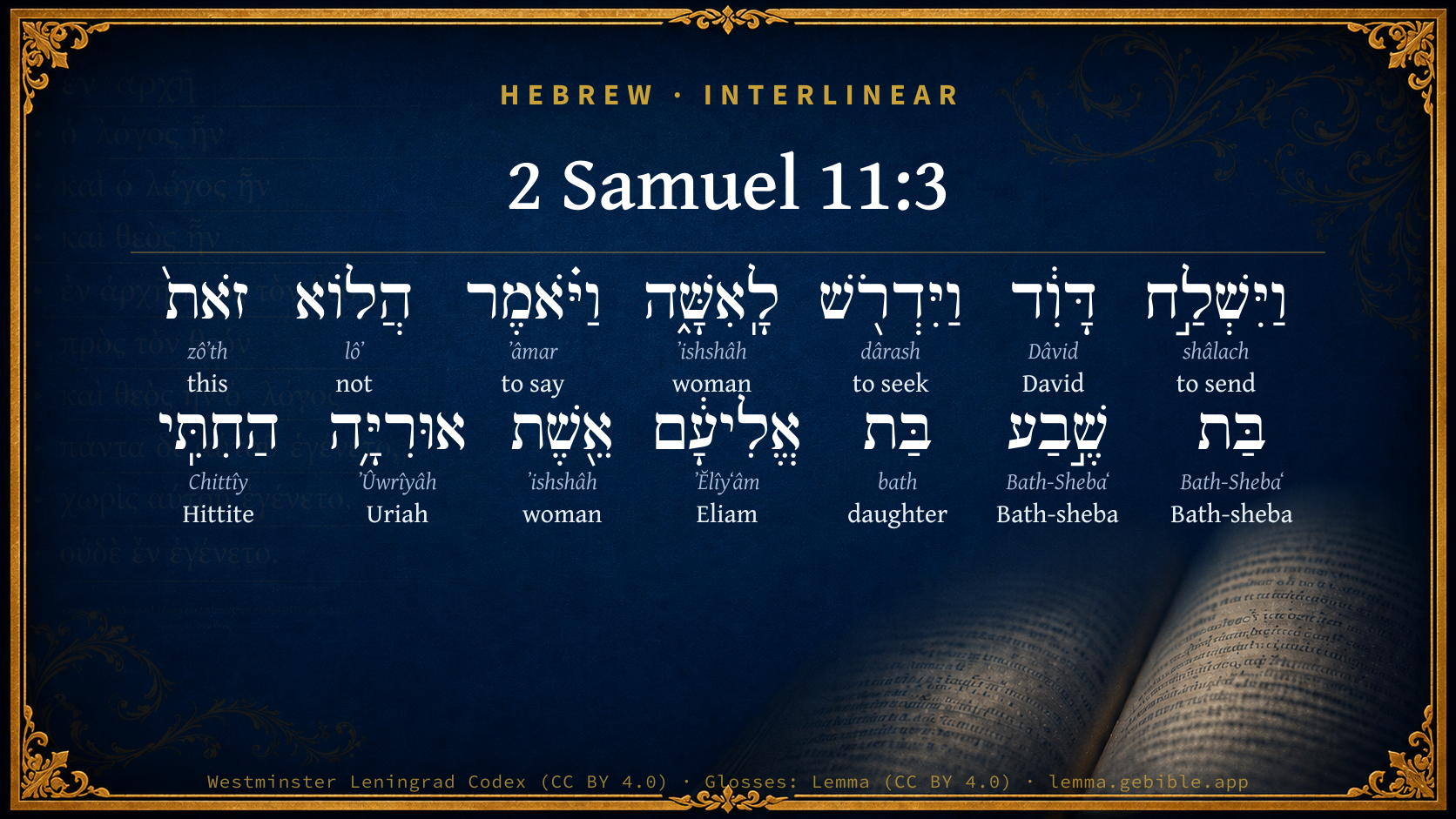
Hebrew (Westminster Leningrad Codex) 2 Samuel 11:3 appears in the Hebrew Old Testament. The text above is from the Westminster Leningrad Codex. Each word links to its Strong’s number, a concise gloss, and parsing drawn from the Open Scriptures Hebrew Bible morphology. Click any word for its full Brown-Driver-Briggs (BDB) entry.
Download image
Cite this verse

2 Samuel 11:3 (World English Bible). Public Domain. Lemma interlinear Bible study tool, https://lemma.gebible.app/v/2-samuel/11/3.

Show BibTeX & RIS
BibTeX
RIS
English Translation
David send and inquired after the woman. One said, Is not this Bathsheba, the daughter of Eliam, the wife of Uriah the Hittite?
World English Bible · Public Domain
Highlights
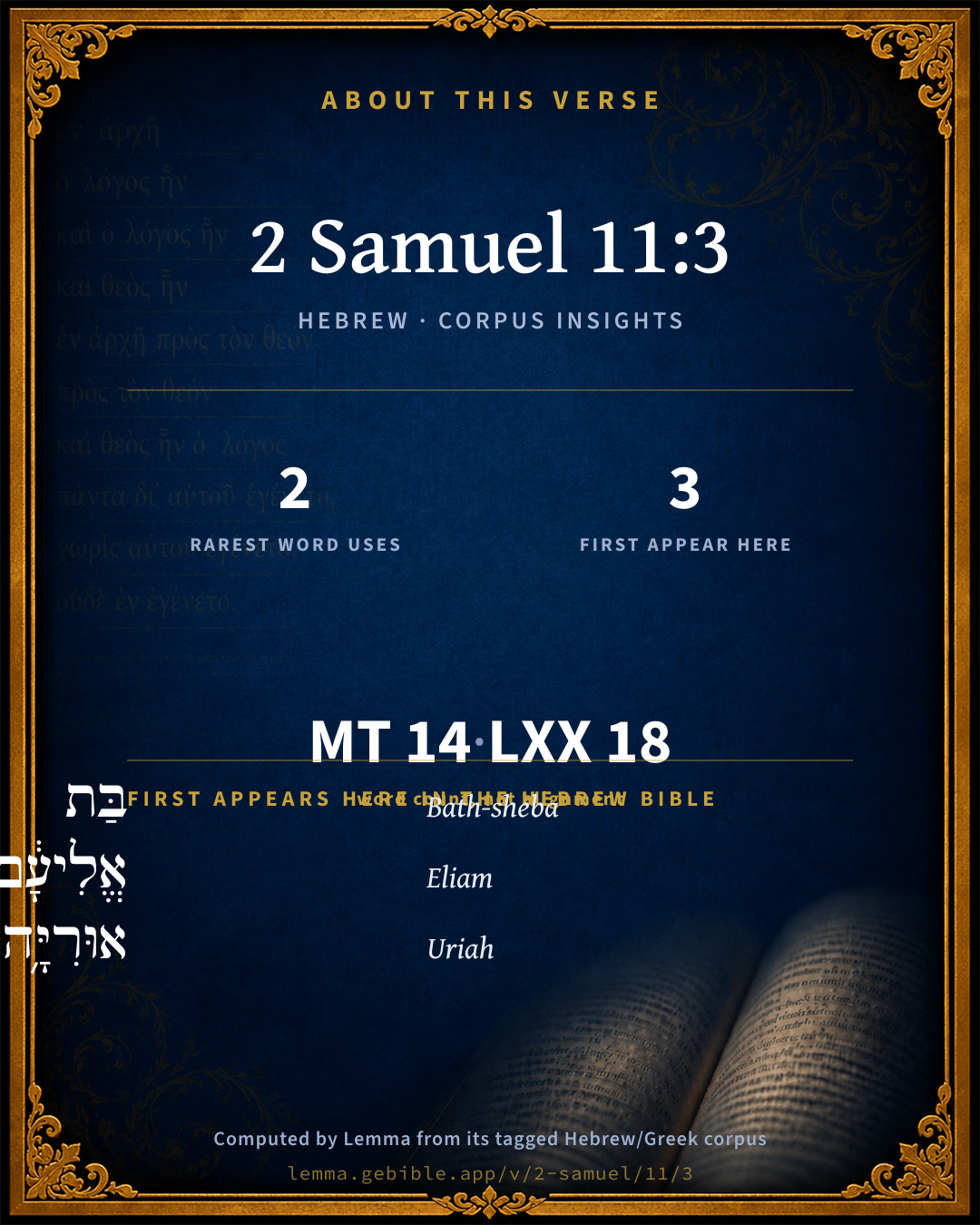
  • 3 first appearances in the Hebrew Bible
Full analysis ↓
Download a study sheet

One document with this verse’s original text, its word-by-word gloss line, the meaning frame, cross-references with their text, attributed commentary, and full source and license credits — printable, and it pastes into notes with its structure intact.

This verse Autodidact and up

Study sheet (.html) Plain text (.txt)

A passage Seminary Student

Up to 50 verses in one chapter. A passage sheet keeps up to 6 commentary sources and 12 cross-references per verse, in the order this page ranks them, and says so on the sheet whenever that leaves anything out. Ask for a single verse and you get the Autodidact verse sheet above.

Everything on this page stays free to read, with no account — the sheet is a download of what is already on screen, not access to it.

Want to remove ads? Support Godless Engineer
Compare translations 3

The same verse in 3 English versions, stacked beneath the original-language interlinear above. Click any original word for its lexicon entry.

Each is an independent rendering of the whole verse — the interlinear is not word-aligned to these translations.

Highlighted words mark where these versions differ — a whole-verse word diff, not a word-by-word alignment.

  • World English Bible Public Domain
    David send and inquired after the woman. One said, Is not this Bathsheba, the daughter of Eliam, the wife of Uriah the Hittite?
  • King James Version Public Domain
    And David sent and inquired after the woman. And one said, Is not this Bathsheba, the daughter of Eliam, the wife of Uriah the Hittite?
  • unfoldingWord Literal Text CC BY-SA 4.0
    And David sent and inquired about the woman. And one said, “Is this not Bathsheba, the daughter of Eliam, the wife of Uriah the Hittite?”

unfoldingWord Literal Text — © unfoldingWord, licensed CC BY-SA 4.0. Word-aligned USFM3 via Door43 (git.door43.org/unfoldingWord/en_ult).

Versions to compare (up to 4)

3 of 4 selected

Show all 18 translations

Every available English version of this verse, each an independent rendering of the whole verse.

  • World English Bible Public Domain
    David send and inquired after the woman. One said, Is not this Bathsheba, the daughter of Eliam, the wife of Uriah the Hittite?
  • Berean Standard Bible Public Domain
    So David sent and inquired about the woman, and he was told, “This is Bathsheba, the daughter of Eliam and the wife of Uriah the Hittite.”
  • Majority Standard Bible Public Domain
    So David sent and inquired about the woman, and he was told, “This is Bathsheba, the daughter of Eliam and the wife of Uriah the Hittite.”
  • King James Version Public Domain
    And David sent and inquired after the woman. And one said, Is not this Bathsheba, the daughter of Eliam, the wife of Uriah the Hittite?
  • American Standard Version (1901) Public Domain
    And David send and inquired after the woman. And one said, Is not this Bath-sheba, the daughter of Eliam, the wife of Uriah the Hittite?
  • Revised Version (1885) Public Domain
    And David sent and inquired after the woman. And one said, Is not this Bath-sheba, the daughter of Eliam, the wife of Uriah the Hittite?
  • Geneva Bible (1599) Public Domain
    And Dauid sent and inquired what woman it was: and one sayde, Is not this Bath-sheba the daughter of Eliam, wife to Vriah the Hittite?
  • Douay-Rheims (1899) Public Domain
    And the king sent, and inquired who the woman was. And it was told him, that she was Bethsabee the daughter of Eliam, the wife of Urias the Hethite.
  • Young's Literal Translation Public Domain
    and David sendeth and inquireth about the woman, and saith, `Is not this Bath-Sheba, daughter of Eliam, wife of Uriah the Hittite?'
  • Literal Standard Version CC BY-SA 4.0
    and David sends and inquires about the woman, and [someone] says, “Is this not Bathsheba, daughter of Eliam, wife of Uriah the Hittite?”
  • Unlocked Literal Bible CC BY-SA 4.0
    So David sent and he asked people who would know about the woman. Someone said, “Is not this Bathsheba, the daughter of Eliam, and is she not the wife of Uriah the Hittite?”
  • unfoldingWord Literal Text CC BY-SA 4.0
    And David sent and inquired about the woman. And one said, “Is this not Bathsheba, the daughter of Eliam, the wife of Uriah the Hittite?”
  • Darby Bible Public Domain
    and David sent and inquired after the woman. And one said, Is not this Bathsheba, the daughter of Eliam, the wife of Urijah the Hittite?
  • World Messianic Bible Public Domain
    David sent and inquired after the woman. One said, “Isn’t this Bathsheba, the daughter of Eliam, Uriah the Hittite’s wife?”
  • Webster's Bible Public Domain
    And David sent and inquired after the woman. And one said, Is not this Bath-sheba, the daughter of Eliam, the wife of Uriah the Hittite?
  • Free Bible Version CC BY-SA 4.0
    David sent someone to find out about the woman. He was told, “It's Bathsheba, daughter of Eliam, and wife of Uriah the Hittite.”
  • Bible in Basic English Public Domain
    And David sent to get knowledge who the woman was. And one said, Is this not Bath-sheba, the daughter of Eliam and wife of Uriah the Hittite?
  • JPS Tanakh (1917) Public Domain
    And David sent and inquired after the woman. And one said: 'Is not this Bath-sheba, the daughter of Eliam, the wife of Uriah the Hittite?'

Literal Standard Version (2020), Covenant Press — licensed CC BY-SA 4.0. Text via the HelloAO Bible API (eBible.org). Unlocked Literal Bible (unfoldingWord) — licensed CC BY-SA 4.0. Text via the HelloAO Bible API (eBible.org). unfoldingWord Literal Text — © unfoldingWord, licensed CC BY-SA 4.0. Word-aligned USFM3 via Door43 (git.door43.org/unfoldingWord/en_ult). Free Bible Version, Dr. Jonathan Gallagher — licensed CC BY-SA 4.0. Text via the HelloAO Bible API (eBible.org).

Word by word

More ways to search: Search by grammar → Find every occurrence → Compare this word →

Practice this passage: Drill this verse → Learn its vocabulary →

אֱלִיעָ֔ם
ʼĔlîyʻâm
H463
“Eliam”
Noun, Proper
Part of Speech
Noun
Type
Proper
Full BDB Definition

Origin: from H410 and H5971

TWOT: None

Eliam = "God of the people" or " God is kinsman" - Bathsheba's father - a Gilonite warrior of David
  1. וַיִּשְׁלַ֣ח shâlach H7971 “and · to send” Conjunction + Verb, Qal, Sequential Imperfect, 3rd Person, Masculine, Singular
  2. דָּוִ֔ד Dâvid H1732 “David” Noun, Proper
  3. וַיִּדְרֹ֖שׁ dârash H1875 “and · to seek” Conjunction + Verb, Qal, Sequential Imperfect, 3rd Person, Masculine, Singular
  4. לָֽאִשָּׁ֑ה ʼishshâh H802 “to/for the · woman” Preposition, Determined + Noun, Common, Feminine, Singular, Absolute
  5. וַיֹּ֗אמֶר ʼâmar H559 “and · to say” Conjunction + Verb, Qal, Sequential Imperfect, 3rd Person, Masculine, Singular
  6. הֲלוֹא lôʼ H3808 “not” Particle, Interrogative + Particle, Negative
  7. זֹאת֙ zôʼth H2063 “this” Pronoun, Demonstrative, Feminine, Singular
  8. בַּת Bath-Shebaʻ H1339 “Bath-sheba” Noun, Proper
  9. שֶׁ֣בַע Bath-Shebaʻ H1339 “Bath-sheba” Adjective, Cardinal number, Feminine, Singular, Absolute
  10. בַּת bath H1323 “daughter of” Noun, Common, Feminine, Singular, Construct
  11. אֵ֖שֶׁת ʼishshâh H802 “woman of” Noun, Common, Feminine, Singular, Construct
  12. אוּרִיָּ֥ה ʼÛwrîyâh H223 “Uriah” Noun, Proper
  13. הַחִתִּֽי Chittîy H2850 “the · Hittite” Particle, Definite Article + Noun, Gentilic, Masculine, Singular, Absolute

About this verse

These counts appear in no published source. They are computed here, from the morphology-tagged text and Lemma’s own curated glosses. What Lemma adds →

14
words
12
distinct lemmas
Historical
section

Notable vocabulary

The rarest word here is אֱלִיעָ֔ם Eliam H463 — appearing just 2 times in the whole Hebrew Bible.

First appearance in Scripture

These words make their first canonical appearance in the Hebrew Bible here:

  • בַּת Bath-sheba H1339
  • אֱלִיעָ֔ם Eliam H463
  • אוּרִיָּ֥ה Uriah H223

Shared distinctive vocabulary

אֱלִיעָ֔ם Eliam H463 occurs in 2 verses of the Hebrew Bible. Also found in:

Grammatical profile

  • 3 verbs
  • 8 nouns
  • 1 adjective
  • 1 pronoun
  • 1 particle

Verb forms

  • וַיִּשְׁלַ֣ח Qal · Sequential Imperfect
  • וַיִּדְרֹ֖שׁ Qal · Sequential Imperfect
  • וַיֹּ֗אמֶר Qal · Sequential Imperfect

Repetition

Words recur within this verse — often emphatic in Hebrew:

  • לָֽאִשָּׁ֑ה woman H802 ×2
  • בַּת Bath-sheba H1339 ×2

Hebrew & Septuagint length

In English translation the verse runs 23 words from the Hebrew and 25 from the Septuagint (LXX English) — closely comparable.

A rough comparison of the two English renderings, which tokenize alike — not a word-level alignment.

Word counts can differ between the Hebrew and the Greek without any difference in meaning — e.g. the Hebrew direct-object marker אֵת has no separate Greek word, and Greek often adds the article ὁ.

In the original languages it is 14 Hebrew tokens and 18 Greek tokens — but the two are counted differently (Hebrew bundles its prefixes and suffixes into one token; the Greek is in lemma form), so that isn’t a like-for-like length.

Cross-references

6

Topical passages linked to 2 Samuel 11:3 in the Treasury of Scripture Knowledge — connected by theme and wording, ordered by reader-vote popularity; previews shown in the World English Bible.

  • 2 Samuel 23:39 Uriah the Hittite: thirty-seven in all.
  • 1 Chronicles 3:5 and these were born to him in Jerusalem: Shimea, and Shobab, and Nathan, and Solomon, four, of Bathshua the daughter of Ammiel;
  • Jeremiah 5:8 They were as fed horses roaming at large; everyone neighed after his neighbor's wife.
  • James 1:14–15 But each one is tempted, when he is drawn away by his own lust, and enticed.
  • 1 Chronicles 11:41 Uriah the Hittite, Zabad the son of Ahlai,
  • Hosea 7:6–7 For they have made ready their heart like an oven, While they lie in wait. Their baker sleeps all the night. In the morning it burns as a flaming fire.

Cross-references courtesy of OpenBible.info (CC BY 4.0).

Hebrew and Greek witnesses Masoretic Hebrew ↔ Greek Septuagint

The same verse in the two great witnesses to the Old Testament, shown verse-for-verse.

These are two independent witnesses, not word-aligned to each other, and the Septuagint is shown in lemma (dictionary) form.

Hebrew 2 Samuel 11:3 Masoretic · Westminster Leningrad Codex

וַיִּשְׁלַ֣ח דָּוִ֔ד וַיִּדְרֹ֖שׁ לָֽאִשָּׁ֑ה וַיֹּ֗אמֶר הֲלוֹא זֹאת֙ בַּת שֶׁ֣בַע בַּת אֱלִיעָ֔ם אֵ֖שֶׁת אוּרִיָּ֥ה הַחִתִּֽי

David send and inquired after the woman. One said, Is not this Bathsheba, the daughter of Eliam, the wife of Uriah the Hittite?

World English Bible · Public Domain

Greek LXX 2 Samuel 11:3 Septuagint · lemma form

καί ἀποστέλλω δαυίδ καί ζητέω ὁ γυνή καί εἶπον οὐ οὗτος βηρσαβεε θυγάτηρ ελιαβ γυνή ουριας ὁ χετταῖος

And David sent and enquired about the woman: and one said, Is not this Bersabee the daughter of Eliab, the wife of Urias the Chettite?

LXX2012 (modern English Septuagint) · Public Domain

Hebrew: Westminster Leningrad Codex (CC BY 4.0). Greek: Septuagint (public domain); English from LXX2012 (modern English Septuagint) (Public Domain). How the Septuagint differs from the Hebrew →

Targum (Aramaic paraphrase)

1

The Targum is the ancient Jewish Aramaic paraphrase of the Hebrew Scriptures — an interpretive translation, not the Hebrew text itself. Onkelos (literal) and Pseudo-Jonathan (expansive) render the Torah, and Jonathan the Prophets. Coverage is partial: where no permissively-licensed English translation exists for a verse, only the Aramaic is shown. This is verse-level text, not a word-by-word alignment to the Hebrew.

  1. Targum Jonathan Prophets (Joshua–Malachi)
    וּשְׁלַח דָוִד וּשְׁאַל לְאִתְּתָא וַאֲמַר הֲלָא דָא בַּת שֶׁבַע בַּת אֱלִיעָם אִתַּת אוּרִיָה חִתָּאָה:

    (no public-domain English translation for this verse)

    Targum Jonathan — Aramaic: “Mikraot Gedolot” (public domain). English: “Sefaria Community Translation” (CC0 1.0 (public-domain dedication)); “London "Chaldee Paraphrase," 1871” (public domain). Text via Sefaria.

Commentary

Notes on 2 Samuel 11:3 from classic Christian and Jewish commentators (each source and its license shown beneath its notes). The classic Christian expositions comment on the surrounding passage and are grouped to its opening verse, so a note may address several verses; the Jewish commentaries on the Tanakh (Rashi and others) are per-verse, so they appear only where the commentator wrote on this verse.

Lemma curates 59 commentaries, every one of them public domain or Creative Commons licensed, each selected and text-cleaned for this edition rather than reprinted as found. About our sources →

Trapp's Complete Commentary

John Trapp

2Sa 11:3 And David sent and enquired after the woman. And [one] said, [Is] not this Bathsheba, the daughter of Eliam, the wife of Uriah the Hittite?

Ver. 3. And David sent and inquired after the woman,] viz., Who she was, and whether maid or wife. He should rather have checked himself for looking and lusting after a forbidden beauty - he should have taken an antidote of mortification, before the venom of lust had got to the vitals. But it is hard for him who hath fallen down the ladder of hell a round or two, to stop or step back, till he come to the bottom, without extraordinary help from the hand of Heaven. Can a man commit one sin more, and but one sin more? Unclean creatures went by couples into the ark: so do sins into the soul. Fornication is the devil’s nest-egg, saith one, and causeth many sins to be laid one to and upon another.

Is not this Bathsheba, the daughter of Eliam?] Or Ammiel, {1Ch 3:5} who was the son of Ahithophel, {2Sa 23:34} who might, for the dishonour done by David to his niece Bathsheba, be the readier to conspire against him, and to take part with Absalom. {a}

The wife of Uriah the Hittite?] Bathsheba therefore was an honourable lady both by parentage and marriage, for both her father and husband were of the number of David’s worthies: the greater was his sin. Uriah might be called the Hittite, as Scipio was called Africanus, for doing some notable exploit against that accursed nation, the worst of the Canaanites. {Eze 16:3}

{a} Hugo, Salianas.

John Trapp, A Commentary or Exposition upon All the Books of the Old and New Testament (1647–1656) — public domain. Text from a community e-Sword module.

Joseph Benson's Commentary

2Sa 11:3. David sent and inquired after the woman — Thus, instead of suppressing that desire which the sight of his eyes had kindled, he seeks rather to feed it; and first inquires who she was; that if she were unmarried he might make her either his wife or his concubine. And one said, Is not this Bath-sheba? — This seems to have been an answer given by some one to David’s inquiry. Uriah is called a Hittite, because he was such by nation, but a proselyte to the Jewish religion; and for his valour made one of the king’s guards among the Cherethites and the Pelethites; which was the reason, perhaps, that he had a house so near the king’s.

Joseph Benson's Commentary on the Old and New Testaments (1811–1818) — public domain. Text from a community e-Sword module.

Tyndale Open Study Notes

Tyndale Open Resources

11:3 Bathsheba means “daughter of seven” or “daughter of oath.” Her father Eliam was the son of Ahithophel (see 23:34), an adviser sought by David and then by Absalom (15:12; 16:23). Much to David’s chagrin (15:31), Ahithophel later shifted his allegiance from David to Absalom (17:1-4, 14) and advised Absalom to sleep with David’s concubines on a rooftop, in open view (16:20-22). • Uriah is a Hebrew name (meaning “Yahweh [is] my light”); either he was a foreign mercenary, a convert to Israelite religion, or an Israelite of Hittite heritage. Uriah might also have been a member of the non-Israelite aristocracy in Jerusalem that predated David’s conquest of the city. He was one of the Thirty—David’s mightiest warriors (23:39).

Tyndale Open Study Notes — © Tyndale Open Resources, licensed CC BY-SA 4.0. Text via the HelloAO Bible API.

Geneva Bible (1599)

Geneva Bible translators

Who was not an Israelite born, but converted to the true religion.

Geneva Bible (1599) marginal notes — public domain. Text via Bolls.life.

Jamieson, Fausset & Brown

Robert Jamieson, A. R. Fausset & David Brown

one said--literally, "he said to himself,"

Is not this Bath-sheba? &c.--She seems to have been a celebrated beauty, whose renown had already reached the ears of David, as happens in the East, from reports carried by the women from harem to harem.

Bath-sheba, the daughter of Eliam--or Ammiel (Ch1 3:5), one of David's worthies (Sa2 23:34), and son of Ahithophel.

Jamieson, Fausset & Brown — Commentary Critical and Explanatory on the Whole Bible (1871) — public domain (CC PDM 1.0). Text via the HelloAO Bible API.

Adam Clarke's Commentary

Verse 3. The daughter of Eliam] Called, 1Ch 3:5, Ammiel; a word of the same meaning, The people of my God, The God of my people. This name expressed the covenant - I will be your God; We will be thy people.

Adam Clarke's Commentary on the Bible (1810–1826) — public domain. Text from a community e-Sword/MySword module.

Ellicott's Commentary for English Readers

(3) Bath-sheba, the daughter of Eliam.—Her name is spelt in Chronicles Bath-shua, and her father’s name is said to be Ammiel. Ammiel and Eliam are the same name with its component parts transposed, as Scripture names are often varied: God’s people and the people of God.

Wife of Uriah the Hittite.—His name appears (2Sa_23:39) in the list of David’s thirty chief heroes, and the whole story represents him as a brave and noble-minded soldier. David had now given rein to his guilty passion so far that the knowledge of Bath-sheba’s being a married woman, and the wife of one of his chief warriors, does not check him.

A Bible Commentary for English Readers, edited by Charles John Ellicott (1878–1897) — public domain. Text from a community e-Sword module.

The Cambridge Bible for Schools and Colleges

gen. ed. J. J. S. Perowne

3. Bath-sheba, the daughter of Eliam] In 1Ch_3:5 she is called Bath-shua, the daughter of Ammiel. Eliam (= God of the people) and Ammiel (= people of God) are compounded of the same words placed in different order. If this Eliam was the same as Uriah’s brother-officer, mentioned in ch. 2Sa_23:34, Bath-sheba was the grand-daughter of David’s counsellor Ahithophel. This, it has been thought, explains Ahithophel’s adherence to Absalom (ch. 2Sa_15:12) as an act of revenge for the seduction of his grand-daughter and the murder of her husband. The theory has been well worked out with much ingenuity by Prof. Blunt (Undesigned Coincidences, p. 135 ff.), but must be regarded as very doubtful: for (1) the identity of Eliam the son of Ahithophel with Eliam the father of Bath-sheba cannot be proved; (2) even if the relationship is granted, an ambitious and unscrupulous man such as Ahithophel would be more likely to regard the elevation of his granddaughter to the position of the king’s favourite wife as an honour, than to feel aggrieved at the circumstances by which it was effected.

Uriah the Hittite] One of David’s “mighty men” (ch. 2Sa_23:39). His name (= light of Jah) indicates that although he was a Canaanite by race, he had adopted the Jewish religion. Another Hittite in David’s service was Ahimelech (1Sa_26:6). On the ancient Canaanite nation of the Hittites, see note on 1Sa_26:6.

The Cambridge Bible for Schools and Colleges (gen. ed. J. J. S. Perowne; Cambridge University Press, 1878–1918) — public domain. Text from a community e-Sword module.

John Gill's Exposition

And David sent and inquired after the woman,.... Who she was, what her name, and whether married or unmarried; if the latter, very probably his intention was to marry her, and he might, when he first made the inquiry, design to proceed no further, or to anything that was dishonourable; but it would have been better for him not to have inquired at all, and endeavoured to stifle the motions raised in him at the sight of her:

and one said, is not this Bathsheba, the daughter of Eliam; who in Ch1 3:5; is called Bathshua, and her father Ammiel, which is the same with Eliam reversed:

the wife of Uriah the Hittite? who either was of that nation originally, and became a proselyte; or had sojourned there for a while, and took the name or had it given him, for some exploit he had performed against that people, as Scipio Africanus, and others among the Romans; this was said by one that David inquired of, or heard him asking about her, and was sufficient to have stopped him from proceeding any further, when he was informed she was another man's wife: some say (h) she was the daughter of Ahithophel's son; see Sa2 23:34.

(h) Shalshalet Hakabala, fol. 8. 2.

John Gill's Exposition of the Whole Bible (1746–1763) — public domain (CC PDM 1.0). Text via the HelloAO Bible API.

Albert Barnes' Notes on the Bible

Eliam - Or Ammiel, 1Ch 3:5, the component words being placed in an inverse order. Bath-sheba was the granddaughter of Ahithophel 2Sa 23:34.

Albert Barnes' Notes on the Bible (1834–1885) — public domain. Text from a community e-Sword/MySword module.

Haydock's Catholic Bible Commentary

Eliam. By a transposition of letters, he is called Ammiel, in 1 Paralipomenon iii. 5. Both words signify "my people is God’s." This son of Achitophel (chap. xxiii. 34,) was one of David’s valiant men, as well as Urias, who is styled the Hethite, being born at Eth; (St. Jerome; Salien) or on account of his extraction, or because he or his ancestors (Haydock) had performed some great exploit against that nation; as Germanicus, Africanus, &c., received those titles among the Romans, for conquering the Germans, &c. (Calmet) --- Eth was a place near Hebron. (Adrichomius 128.) (Menochius) --- The name of Bethsabee is also different in Paralipomenon; the last b in Hebrew being changed into v. Both-shua, both-al-i-am; instead of Both-shoba, both-am-i-al. (Haydock) (Kennicott) --- The grandfather of Bethsabee is supposed to have revolted against David, to revenge the wrong done to her. (Tirinus; Cornelius a Lapide) "Let the weak tremble at the fall of the strong." (St. Augustine, in Psalm l.)

George Leo Haydock (1774–1849), Haydock's Catholic Family Bible and Commentary, 1859 edition — public domain. Excludes Psalms (Douay-Rheims chapter numbering differs from Protestant) and Deuterocanonical books (Catholic canon only).

Matthew Poole's English Annotations

Instead of suppressing that lust which the sight of his eyes had kindled, he seeks rather to feed it; and first inquires who she was; that, if she were unmarried, he might make her either his wife or his concubine.

Bath-sheba, called also Bath-shuah, 1Ch 3:5, where also Eliam is called Ammiel. The Hittite; so called, either,

1. By his original, being born either of that race, but become a zealous proselyte; or, at least. among that people. Or,

2. By his habitation among them. Or,

3. For some notable exploit of his against that people: see 1Sa 26:6, and See Poole "2Sa 8:18".

Matthew Poole's English Annotations on the Holy Bible (1683–1685) — public domain. Text from a community e-Sword/MySword module.

Whedon's Commentary on the Bible

Daniel D. Whedon

3. A woman washing herself — For the sake of healthfulness and refreshment after the heats of a summer day. But her washing in such an exposed place was imprudent and immodest, and has justly subjected her to the charge of a desire to be seen.

Daniel D. Whedon (gen. ed.), Commentary on the Old and New Testaments (1874–1909) — public domain. Text from a community e-Sword module.

The Pulpit Commentary

Bathsheba, the daughter of Eliam. In 2Sa_23:34 Eliam is said to be the son of Ahithophel, and thus Bathsheba would be his granddaughter. Mr. Blunt, in his "Undesigned Coincidences," p. 143, et seq., sees in this the explanation of the adherence to the side of Absalom of a man so high in King David"s service. It was the result of his indignation at David"s profligate treat-meat of so near a relative. In 1Ch_3:5 she is called "Bathshua, the daughter of Ammiel." The latter is a transposition of Eliam, both names being compounded of Am, people, and El, God. Uriah the Hittite. We read in 2Sa_23:39 that he was one of David"s "mighties," and it is remarkable that we should thus find high in rank in David"s army a member of that grand race who had disputed with Egypt and Assyria the empire of the East. Their head now was Toi, King of Hamath.

The Pulpit Commentary (1880–1919), ed. H.D.M. Spence-Jones & Joseph S. Exell — public domain. Text from a community e-Sword module.

John Wesley's Explanatory Notes

He inquired - Instead of suppressing that desire which the sight of his eyes had kindled, he seeks rather to feed it; and first inquires who she was; that if she were unmarried, he might make her either his wife or his concubine.

John Wesley, Explanatory Notes Upon the Whole Bible (1754–1765) — public domain. Text via the GEBible commentary corpus.

Lesson kit

Teaching starters — assembled from the data on this page, not authored interpretation. Every prompt links to the verse data it draws on. Edit before teaching.

2 Samuel, in the Historical, opens this verse with 14 words (12 distinct Hebrew lemmas). Its most distinctive word is ʼĔlîyʻâm (“Eliam”). A historical commentator’s framing appears above. Read the whole chapter for the surrounding context.

Discussion questions

  1. How does “Eliam” (ʼĔlîyʻâm) shape what this verse is saying?
  2. 3 words here appear for the first time in Scripture. What is being introduced at this debut?
  3. 2 Samuel 23:34 shares the word «Eliam» with this verse. How do the two illuminate each other?
  4. “woman” occurs 2× in this one verse. What is the effect of the repetition?
  5. These translations render this verse differently. What is at stake in choosing one wording over another?
  6. The verb «וַיִּשְׁלַ֣ח» is Qal Sequential Imperfect. How does its form color the action?
  7. Reading how Trapp's Complete Commentary and Joseph Benson's Commentary read this verse, where do the two commentators agree and where do they part?

Things to notice

Reading settings

Reading text

Shown beneath each verse's original-language words.

Old Testament
Old Testament edition

Read the OT as the Masoretic Hebrew (MT) or the Greek Septuagint (LXX).

English shown for the Greek Septuagint (in the Hebrew ↔ Greek comparison).

Comparing translations? Open the Compare panel on any verse page to stack up to four side by side.