
Psalms 109:10

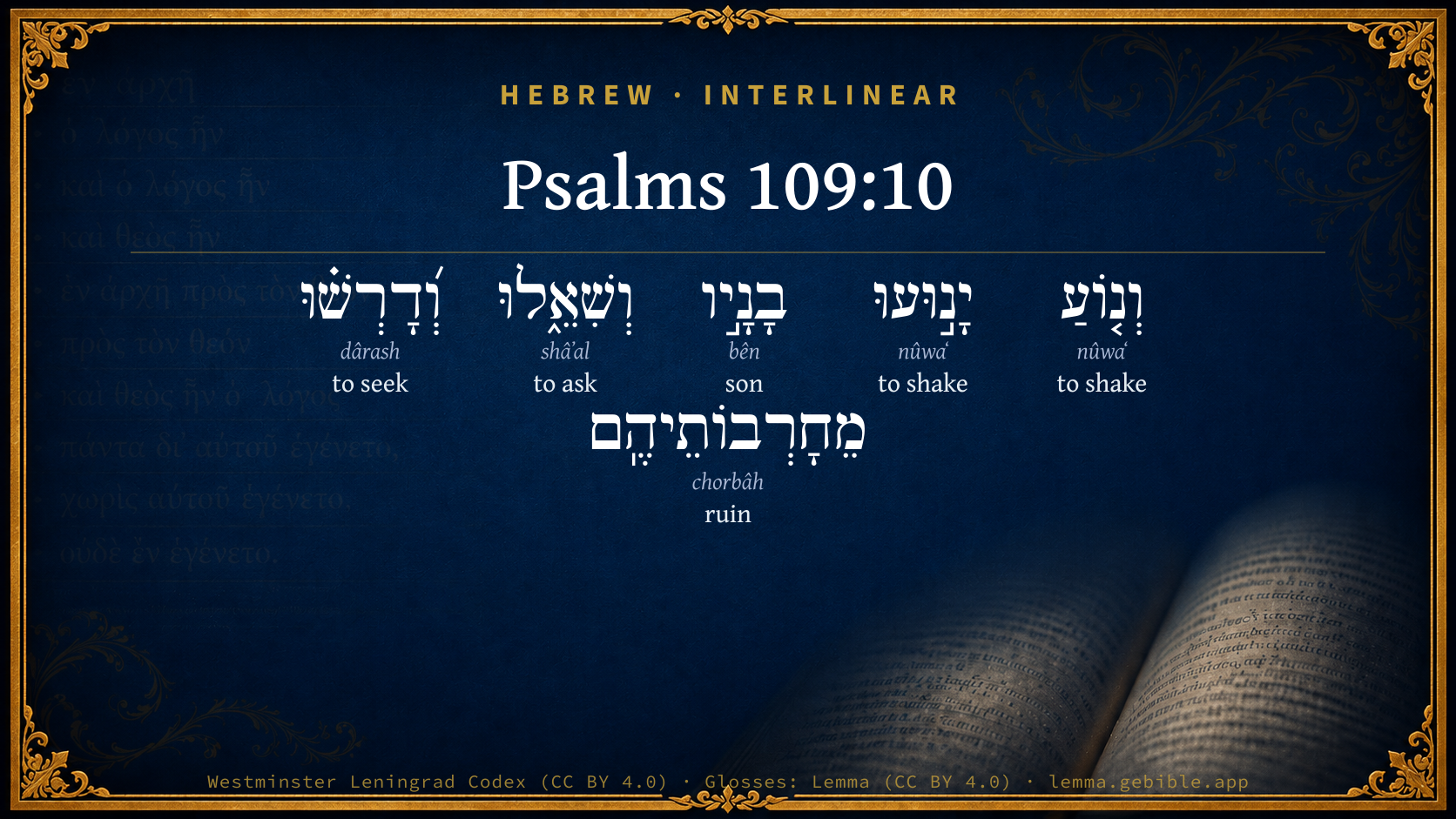
Hebrew (Westminster Leningrad Codex) Psalms 109:10 appears in the Hebrew Old Testament. The text above is from the Westminster Leningrad Codex. Each word links to its Strong’s number, a concise gloss, and parsing drawn from the Open Scriptures Hebrew Bible morphology. Click any word for its full Brown-Driver-Briggs (BDB) entry.
Download image
Cite this verse

Psalms 109:10 (World English Bible). Public Domain. Lemma interlinear Bible study tool, https://lemma.gebible.app/v/psalms/109/10.

Show BibTeX & RIS
BibTeX
RIS
English Translation
Let his children be wandering beggars. Let them be sought from their ruins.
World English Bible · Public Domain
Download a study sheet

One document with this verse’s original text, its word-by-word gloss line, the meaning frame, cross-references with their text, attributed commentary, and full source and license credits — printable, and it pastes into notes with its structure intact.

This verse Autodidact and up

Study sheet (.html) Plain text (.txt)

A passage Seminary Student

Up to 50 verses in one chapter. A passage sheet keeps up to 6 commentary sources and 12 cross-references per verse, in the order this page ranks them, and says so on the sheet whenever that leaves anything out. Ask for a single verse and you get the Autodidact verse sheet above.

Everything on this page stays free to read, with no account — the sheet is a download of what is already on screen, not access to it.

Want to remove ads? Support Godless Engineer
Compare translations 3

The same verse in 3 English versions, stacked beneath the original-language interlinear above. Click any original word for its lexicon entry.

Each is an independent rendering of the whole verse — the interlinear is not word-aligned to these translations.

Highlighted words mark where these versions differ — a whole-verse word diff, not a word-by-word alignment.

  • World English Bible Public Domain
    Let his children be wandering beggars. Let them be sought from their ruins.
  • King James Version Public Domain
    Let his children be continually vagabonds, and beg: let them seek their bread also out of their desolate places.
  • unfoldingWord Literal Text CC BY-SA 4.0
    And wandering, may his children wander and beg and seek from their desolations.

unfoldingWord Literal Text — © unfoldingWord, licensed CC BY-SA 4.0. Word-aligned USFM3 via Door43 (git.door43.org/unfoldingWord/en_ult).

Versions to compare (up to 4)

3 of 4 selected

Show all 18 translations

Every available English version of this verse, each an independent rendering of the whole verse.

  • World English Bible Public Domain
    Let his children be wandering beggars. Let them be sought from their ruins.
  • Berean Standard Bible Public Domain
    May his children wander as beggars, seeking sustenance far from their ruined homes.
  • Majority Standard Bible Public Domain
    May his children wander as beggars, seeking sustenance far from their ruined homes.
  • King James Version Public Domain
    Let his children be continually vagabonds, and beg: let them seek their bread also out of their desolate places.
  • American Standard Version (1901) Public Domain
    Let his children be vagabonds, and beg; And let them seek `their bread' out of their desolate places.
  • Revised Version (1885) Public Domain
    Let his children be vagabonds, and beg; and let them seek their bread out of their desolate places.
  • Geneva Bible (1599) Public Domain
    Let his children be vagabonds and beg and seeke bread, comming out of their places destroyed.
  • Douay-Rheims (1899) Public Domain
    Let his children be carried about vagabonds, and beg; and let them be cast out of their dwellings.
  • Young's Literal Translation Public Domain
    And wander continually do his sons, Yea, they have begged, And have sought out of their dry places.
  • Literal Standard Version CC BY-SA 4.0
    And his sons wander continually, || Indeed, they have begged, || And have sought out of their dry places.
  • Unlocked Literal Bible CC BY-SA 4.0
    May his children wander about and beg, asking for handouts as they leave their ruined home.
  • unfoldingWord Literal Text CC BY-SA 4.0
    And wandering, may his children wander and beg and seek from their desolations.
  • Darby Bible Public Domain
    Let his sons be vagabonds and beg, and let them seek [their bread] far from their desolate places;
  • World Messianic Bible Public Domain
    Let his children be wandering beggars. Let them be sought from their ruins.
  • Webster's Bible Public Domain
    Let his children be continually vagabonds, and beg: let them seek their bread also out of their desolate places.
  • Free Bible Version CC BY-SA 4.0
    May his children be homeless, wandering beggars, driven from their ruined houses.
  • Bible in Basic English Public Domain
    Let his children be wanderers, looking to others for their food; let them be sent away from the company of their friends.
  • JPS Tanakh (1917) Public Domain
    Let his children be vagabonds, and beg; and let them seek their bread out of their desolate places.

Literal Standard Version (2020), Covenant Press — licensed CC BY-SA 4.0. Text via the HelloAO Bible API (eBible.org). Unlocked Literal Bible (unfoldingWord) — licensed CC BY-SA 4.0. Text via the HelloAO Bible API (eBible.org). unfoldingWord Literal Text — © unfoldingWord, licensed CC BY-SA 4.0. Word-aligned USFM3 via Door43 (git.door43.org/unfoldingWord/en_ult). Free Bible Version, Dr. Jonathan Gallagher — licensed CC BY-SA 4.0. Text via the HelloAO Bible API (eBible.org).

Word by word

More ways to search: Search by grammar → Find every occurrence → Compare this word →

Practice this passage: Drill this verse → Learn its vocabulary →

וְנ֤וֹעַ
nûwaʻ
H5128
“and · to shake”
Conjunction + Verb, Qal, Infinitive Absolute
Part of Speech
Conjunction + Verb
Stem
Qal
Form
Infinitive Absolute
Full BDB Definition

Origin: a primitive root

TWOT: 1328

to quiver, totter, shake, reel, stagger, wander, move, sift, make move, wave, waver, tremble - (Qal) - to wave, quiver, vibrate, swing, stagger, tremble, be unstable - to totter, go tottering - vagabond (participle) - (Niphal) to be tossed about or around - (Hiphil) - to toss about - to shake, cause to totter - to shake, disturb - to cause to wander
  1. יָנ֣וּעוּ nûwaʻ H5128 “to shake” Verb, Qal, Imperfect, 3rd Person, Masculine, Plural
  2. בָנָ֣יו bên H1121 “sons · his” Noun, Common, Masculine, Plural, Construct + Suffix, Personal, 3rd Person, Masculine, Singular
  3. וְשִׁאֵ֑לוּ shâʼal H7592 “and · to ask” Conjunction + Verb, Piel, Sequential Perfect, 3rd Person, Common, Plural
  4. וְ֝דָרְשׁ֗וּ dârash H1875 “and · to seek” Conjunction + Verb, Qal, Sequential Perfect, 3rd Person, Common, Plural
  5. מֵחָרְבוֹתֵיהֶֽם chorbâh H2723 “from · ruins · their” Preposition + Noun, Common, Feminine, Plural, Construct + Suffix, Personal, 3rd Person, Masculine, Plural

About this verse

These counts appear in no published source. They are computed here, from the morphology-tagged text and Lemma’s own curated glosses. What Lemma adds →

6
words
5
distinct lemmas
Wisdom
section

Shared distinctive vocabulary

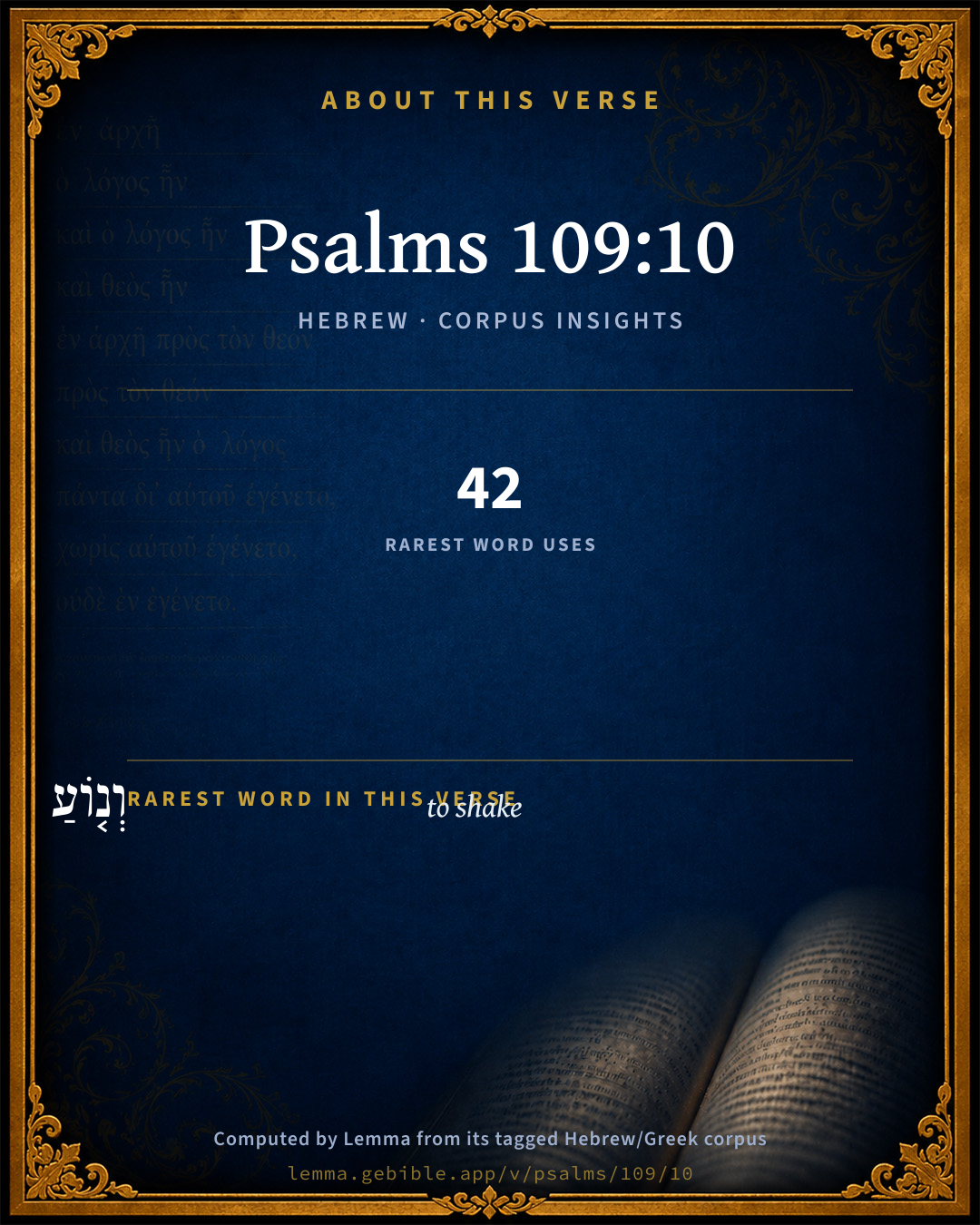
וְנ֤וֹעַ to shake H5128 occurs in 36 verses of the Hebrew Bible. Also found in:

Grammatical profile

  • 4 verbs
  • 2 nouns

Verb forms

  • וְנ֤וֹעַ Qal · Infinitive Absolute
  • יָנ֣וּעוּ Qal · Imperfect
  • וְשִׁאֵ֑לוּ Piel · Sequential Perfect
  • וְ֝דָרְשׁ֗וּ Qal · Sequential Perfect

Repetition

A word recurs within this verse — often emphatic in Hebrew:

  • וְנ֤וֹעַ to shake H5128 ×2

Hebrew & Septuagint length

In English translation the verse runs 13 words from the Hebrew and 17 from the Septuagint (LXX English) — closely comparable.

A rough comparison of the two English renderings, which tokenize alike — not a word-level alignment.

Word counts can differ between the Hebrew and the Greek without any difference in meaning — e.g. the Hebrew direct-object marker אֵת has no separate Greek word, and Greek often adds the article ὁ.

Cross-references

8

Topical passages linked to Psalms 109:10 in the Treasury of Scripture Knowledge — connected by theme and wording, ordered by reader-vote popularity; previews shown in the World English Bible.

  • Genesis 4:12–14 From now on, when you till the ground, it won't yield its strength to you. You shall be a fugitive and a wanderer in the earth."
  • Psalms 37:25 I have been young, and now am old, Yet I have not seen the righteous forsaken, Nor his children begging for bread.
  • 2 Kings 5:27 The leprosy therefore of Naaman shall cleave to you, and to your seed forever. He went out from his presence a leper [as white] as snow.
  • Psalms 59:15 They shall wander up and down for food, And wait all night if they aren't satisfied.
  • Isaiah 16:2 For it shall be that, as wandering birds, as a scattered nest, so shall the daughters of Moab be at the fords of the Arnon.
  • 2 Samuel 3:29 let it fall on the head of Joab, and on all his father's house; and let there not fail from the house of Joab one who has an issue, or who is a leper, or who leans on a staff, or who falls by the sword, or who lacks bread.
  • Job 24:8–12 They are wet with the showers of the mountains, And embrace the rock for lack of a shelter.
  • Job 30:3–9 They are gaunt from lack and famine. They gnaw the dry ground, in the gloom of waste and desolation.

Cross-references courtesy of OpenBible.info (CC BY 4.0).

Hebrew and Greek witnesses Masoretic Hebrew ↔ Greek Septuagint

The same verse in the two great witnesses to the Old Testament, shown verse-for-verse.

You’re reading Greek Psalm 108 (Hebrew Psalm 109). The Septuagint counts the superscription, so verse numbers can differ from the Hebrew — chapter-level alignment, not verse-by-verse. Numbering follows Rahlfs.

These are two independent witnesses, not word-aligned to each other, and the Septuagint is shown in lemma (dictionary) form.

Hebrew Psalms 109:10 Masoretic · Westminster Leningrad Codex

וְנ֤וֹעַ יָנ֣וּעוּ בָנָ֣יו וְשִׁאֵ֑לוּ וְ֝דָרְשׁ֗וּ מֵחָרְבוֹתֵיהֶֽם

Let his children be wandering beggars. Let them be sought from their ruins.

World English Bible · Public Domain

Greek LXX Greek Psalm 108:10 Septuagint · lemma form

σαλεύω μετα ἀναἵστημι ὁ υἱός αὐτός καί ἐπιαἰτέω ἐκβάλλω ἐκ ὁ οἰκόπεδον αὐτός

Let his children wander without a dwelling-place, and beg: let them be cast out of their habitations.

LXX2012 (modern English Septuagint) · Public Domain

On this verse, Ellicott's Commentary for English Readers discusses the Septuagint’s reading. Read the note in Commentary ↓

Hebrew: Westminster Leningrad Codex (CC BY 4.0). Greek: Septuagint (public domain); English from LXX2012 (modern English Septuagint) (Public Domain). How the Septuagint differs from the Hebrew →

Commentary

Notes on Psalms 109:10 from classic Christian and Jewish commentators (each source and its license shown beneath its notes). The classic Christian expositions comment on the surrounding passage and are grouped to its opening verse, so a note may address several verses; the Jewish commentaries on the Tanakh (Rashi and others) are per-verse, so they appear only where the commentator wrote on this verse.

Lemma curates 59 commentaries, every one of them public domain or Creative Commons licensed, each selected and text-cleaned for this edition rather than reprinted as found. About our sources →

Trapp's Complete Commentary

John Trapp

Psa 109:10 Let his children be continually vagabonds, and beg: let them seek [their bread] also out of their desolate places.

Ver. 10. Let his children be continually vagabonds] Let them wandering wander, as Gen 4:12 Cain’s curse. Let them rogue about, - et timida voce rogare cibos. This is many times a token of God’s wrath.

Out of their desolate places] Or, for that their places are desolate, and will afford them no help.

John Trapp, A Commentary or Exposition upon All the Books of the Old and New Testament (1647–1656) — public domain. Text from a community e-Sword module.

J. A. Alexander on Psalms

Joseph Addison Alexander

10. (Psa 109:10) And wander—wander—let his sons and beg, and seek (their food) from (among) their ruins. The emphatic repetition of the first verb is expressed in the English Bible, by a paraphrase, let his children be continually vagabonds. The last clause is extremely graphic, representing them as creeping forth in search of food from amidst the ruins of their habitations.

Joseph Addison Alexander, The Psalms Translated and Explained (1850) — public domain. Text from a community e-Sword module.

Adam Clarke's Commentary

Verse 10. Let his children - beg] The father having lost his office, the children must necessarily be destitute; and this is the hardest lot to which any can become subject, after having been born to the expectation of an ample fortune.

Adam Clarke's Commentary on the Bible (1810–1826) — public domain. Text from a community e-Sword/MySword module.

Ellicott's Commentary for English Readers

(10) Be continually vagabonds.—“Wander and wander about” would better reproduce the original.

Desolate places.—Rather, ruins. They are imagined creeping out of the ruins of their homes to beg. But there was a different reading, followed by the LXX. and Vulg., “let them be driven out of their homes.” This reading involves but a slight literal change. Comp.,

“Worse evil yet I pray for on my spouse;

Let him still live, through strange towns roam in want,

Exiled, suspected, cowering, with no home.”

SENECA: Med., i. 19.

A Bible Commentary for English Readers, edited by Charles John Ellicott (1878–1897) — public domain. Text from a community e-Sword module.

The Cambridge Bible for Schools and Colleges

gen. ed. J. J. S. Perowne

10. let them seek &c.] And seek (their bread) far from their ruined home. Let the wicked man’s home become a ruin, and his children have to get their living away from it. The LXX however points to the reading, and let them be driven out of their ruined home.

The Cambridge Bible for Schools and Colleges (gen. ed. J. J. S. Perowne; Cambridge University Press, 1878–1918) — public domain. Text from a community e-Sword module.

John Gill's Exposition

Let the extortioner catch all that he hath,.... Or, "lay a snare for all" (c); as the Romans did, by bringing in their army, invading the land of Judea, and besieging the city of Jerusalem; who are "the extortioner or exacter that demanded tribute of them"; which they refused to pay, and therefore they seized on all they had for it. The Syriac and Arabic versions render it, "the creditor"; who sometimes for a debt would take wife and children, and all that a man had; see Kg2 4:1. It might be literally true of Judas; who dying in debt, his wife and children, and all he had, might be laid hold on for payment.

And let the stranger spoil his labour; plunder his house of all his goods and substance he had been labouring for: which was true of the Romans, who were aliens from the commonwealth of Israel; who came into the land, and spoiled their houses, fields, and vineyards, they had been labouring in; they took away their place and nation, and all they had, Joh 11:48.

(c) "illaqueet", Pagninus, Montanus, Musculus, Piscator, Gejerus; "iretiat", Vatablus, Michaelis.

John Gill's Exposition of the Whole Bible (1746–1763) — public domain (CC PDM 1.0). Text via the HelloAO Bible API.

Albert Barnes' Notes on the Bible

Let his children be continually vagabonds, and beg - Let them continually wander about with no home - no fixed habitation. Let them be compelled to ask their daily food at the hand of charity. Here we enter on a part of the psalm which is more difficult to be reconciled with a proper feeling than the portions which have been considered. It is, indeed, a frequent consequence of crime that the children of those who are punished “are” vagabonds and beggars, but this is not a necessary consequence; and there “seems” here, therefore, to be a mixture of personal feeling, or a feeling of revenge. This runs through the remaining portion of the imprecatory part of the psalm. I confess that it is difficult to explain this without admitting that the expressions are a record only of what actually occurred in the mind of a man, truly pious, but not perfect - a man who thus, to illustrate the workings of the mind even when the general character was holy, was allowed to record his own feelings, though wrong, just as he would record the conduct of another, or his own conduct, though wrong, as a simple matter of fact - a record of what actually was felt. The “record” may be exactly correct; the sentiment recorded may have been wholly incapable of vindication. See the General Introduction, Section 6 (6).

Let them seek their bread also out of their desolate places - In places uninhabited by man; in barren regions; in deserts: let them be compelled to live on the scanty food which they may pick up there - the roots, or the wild fruits, which will simply keep them alive. See the notes at Job 30:4.

Albert Barnes' Notes on the Bible (1834–1885) — public domain. Text from a community e-Sword/MySword module.

Matthew Poole's English Annotations

Vagabonds; having no certain place of abode; which is a grievous curse in itself, Gen 4:12,14; Isa 16:2.

And beg: this increaseth their misery.

Desolate places; into which they are fled for fear and shame, as not daring to show their faces amongst men.

Matthew Poole's English Annotations on the Holy Bible (1683–1685) — public domain. Text from a community e-Sword/MySword module.

The Treasury of David

Charles H. Spurgeon

Ver. 10. Let his children be continually vagabonds, and beg. May they have neither house nor home, settlement nor substance; and while they thus wander and beg may it ever be on their memory that their father's house lies in ruins,

let them seek their bread also out of their desolate places. It has often been so: a race of tyrants has become a generation of beggars. Misused power and abused wealth have earned the family name universal detestation, and secured to the family character an entail of baseness. Justice herself would award no such doom except upon the supposition that the sin descended with the blood; but supreme providence which in the end is pure justice has written many a page of history in which the imprecation of this verse has been literally verified.

We confess that as we read some of these verses we have need of all our faith and reverence to accept them as the voice of inspiration; but the exercise is good for the soul, for it educates our sense of ignorance, and tests our teachability. Yes, Divine Spirit, we can and do believe that even these dread words from which we shrink have a meaning consistent with the attributes of the Judge of all the earth, though his name is LOVE. How this may be we shall know hereafter.

Ver. 10. Let his children be continually vagabonds. The word used in the sentence pronounced upon Cain, Ge 4:12. Compare Ps 59:11, 15. William Kay.

Ver. 10. Let them seek, etc. Horsley renders this clause, Let them be driven out from the very ruins of their dwellings, and remarks that the image is that of "vagabonds seeking a miserable shelter among the ruins of decayed or demolished buildings, and not suffered to remain even in such places undisturbed."

Ver. 10-13. Many penurious fathers are so scraping for their children, that they ravish the poor children of God; but the hand of the Lord shall be against their young lions. Na 2:13. They join house to house, and field to field, but their children shall be "vagabonds and beg", "seeking their bread out of their desolate places." How many a covetous mole is now digging a house in the earth for his posterity, and never dreams of this sequel, that God should make those children beggars, for whose sake their fathers had made so many beggars! This is a quittance which the sire will not believe, but as sure as God is just the son shall feel. Now if he had but leave to come out of hell for an hour, and see this, how should he curse his folly! Sure, if possible, it would double the pain of his infernal torture. Be moderate, then, ye that so insatiately devour, as if you had an infinite capacity: you overload your stomachs, it is fit they should be disburdened in shameful spewing. How quickly doth a worldly minded man grow a defrauder, from a defrauder to a usurer, from a usurer to an oppressor, from an oppressor to an extortioner! If his eyes do but tell his heart of a booty, his heart will charge his hand, and he must have it, Mic 2:2. They do but see it, like it, and take it. Observe their due payment. Let the extortioner catch all that he hath: they got all by extortion, they shall lose all by extortion. They spoiled their neighbours, strangers shall spoil them. How often hath the poor widow and orphan cried, wept, groaned to them for mercy, and found none! They have taught God how to deal with themselves; let there be none to extend mercy to them. They have advanced houses for a memorial, and dedicated lands to their own names, Ps 49:11; all to get them a name; and even in this they shall be crossed: In the next generation their name shall be quite put out. Thomas Adams.

Psalms 109:11*

Charles H. Spurgeon's The Treasury of David (1869–1885) — public domain. Psalms only. Text from a community e-Sword/MySword module.

Whedon's Commentary on the Bible

Daniel D. Whedon

10. Continually vagabonds—Hebrew, wandering, his sons shall wander: without a fixed habitation, homeless: the condition to which David had been already reduced by the treachery and falsehood of his enemy. The same word expresses David’s exilement (Psa_56:8) and Cain’s punishment, (Gen_4:12; Gen_4:14,) where, “for fugitive and vagabond,”

the Septuagint have στενων και τρεμων, groaning and trembling. The parallel passage is Psa_59:11; Psa_59:15, where also the same word occurs. The consequences of crime and impiety often reappear in the offspring of the wicked, according to the declarations of Exo_20:5; Exo_34:7, and of this the psalmist now forewarns them. “Every consequence of sin is a punishment, and every punishment is from the living God. And is not man permitted to desire that God should do what he really does, provided he desires it in that sense in which God does it?”—Tholuck.

Out of their desolate places— “Out of” should here read from, that is, far from. The fall of the wicked father brings ruin and desolation upon the household, and from, far from, the ruins of a home from which they are shaken out, they wander up and down, and ask and search for bread. See Psa_37:25.A description of human poverty and wretchedness which has not a parallel.

Daniel D. Whedon (gen. ed.), Commentary on the Old and New Testaments (1874–1909) — public domain. Text from a community e-Sword module.

The Pulpit Commentary

Let his children be continually vagabonds, and beg. If it be just that the sins of the fathers be visited upon the children, the psalmist may be regarded as justified in this wish. Still, it is not one that a Christian will readily echo. Let them seek their bread also out of their desolate places. Professor Cheyne corrects Wvrd into WvdGO, and translates, "Let them be driven from their desolate houses."

The Pulpit Commentary (1880–1919), ed. H.D.M. Spence-Jones & Joseph S. Exell — public domain. Text from a community e-Sword module.

John Wesley's Explanatory Notes

Desolate places - Into which they are fled for fear and shame.

John Wesley, Explanatory Notes Upon the Whole Bible (1754–1765) — public domain. Text via the GEBible commentary corpus.

Rashi

Rabbi Shlomo Yitzchaki (Rashi)

and [people] should ask and search from their ruins Everyone will ask about them, what happened to So-and-so and So-and-so, because of the rumor of ruin that emerged about them.

And “search” (וְדָרְשוּ) means from others, because it is vowelized with a short “kamatz,” and וְשִׁאֵלוּ also means from others, that others should ask about them. This can also be interpreted as וְשִׁאֵלוּ, of the intensive conjugation, meaning that they will go around by the doors [to beg for alms].

Rashi on the Tanakh — English translations: “The Judaica Press complete Tanach with Rashi, translated by A. J. Rosenberg” (CC BY 4.0); “Pentateuch with Rashi's commentary by M. Rosenbaum and A.M. Silbermann, 1929-1934” (public domain); “The Metsudah Tanach series, Lakewood, N.J” (CC BY 4.0); and “The Book of Joshua, Metsudah Publications, 1997” (CC BY 4.0). Text via Sefaria.

Lesson kit

Teaching starters — assembled from the data on this page, not authored interpretation. Every prompt links to the verse data it draws on. Edit before teaching.

Psalms, in the Wisdom, opens this verse with 6 words (5 distinct Hebrew lemmas). Its most distinctive word is nûwaʻ (“to shake”). A historical commentator’s framing appears above. Read the whole chapter for the surrounding context.

Discussion questions

  1. The word nûwaʻ carries the sense “to shake.” How does it shape the verse?
  2. How does Genesis 4:12, which shares the word «to shake», read alongside this verse?
  3. What does the repetition of “to shake” (2× in this one verse) do in this verse?
  4. The translations on this page render this verse differently — a whole-verse word diff, not a word-by-word alignment. What might account for the different wordings?
  5. «וְנ֤וֹעַ» is a Qal Infinitive Absolute verb. How does that grammatical form shape the action described?
  6. Compare how Trapp's Complete Commentary and J. A. Alexander on Psalms read this verse. Where do they agree or differ?

Things to notice

Reading settings

Reading text

Shown beneath each verse's original-language words.

Old Testament
Old Testament edition

Read the OT as the Masoretic Hebrew (MT) or the Greek Septuagint (LXX).

English shown for the Greek Septuagint (in the Hebrew ↔ Greek comparison).

Comparing translations? Open the Compare panel on any verse page to stack up to four side by side.