

Psalms 111:2

Hebrew (Westminster Leningrad Codex) Psalms 111:2 appears in the Hebrew Old Testament. The text above is from the Westminster Leningrad Codex. Each word links to its Strong’s number, a concise gloss, and parsing drawn from the Open Scriptures Hebrew Bible morphology. Click any word for its full Brown-Driver-Briggs (BDB) entry.
Download image
Cite this verse

Psalms 111:2 (World English Bible). Public Domain. Lemma interlinear Bible study tool, https://lemma.gebible.app/v/psalms/111/2.

Show BibTeX & RIS
BibTeX
RIS
English Translation
Yahweh's works are great, Pondered by all those who delight in them.
World English Bible · Public Domain
Download a study sheet

One document with this verse’s original text, its word-by-word gloss line, the meaning frame, cross-references with their text, attributed commentary, and full source and license credits — printable, and it pastes into notes with its structure intact.

This verse Autodidact and up

Study sheet (.html) Plain text (.txt)

A passage Seminary Student

Up to 50 verses in one chapter. A passage sheet keeps up to 6 commentary sources and 12 cross-references per verse, in the order this page ranks them, and says so on the sheet whenever that leaves anything out. Ask for a single verse and you get the Autodidact verse sheet above.

Everything on this page stays free to read, with no account — the sheet is a download of what is already on screen, not access to it.

Want to remove ads? Support Godless Engineer
Compare translations 3

The same verse in 3 English versions, stacked beneath the original-language interlinear above. Click any original word for its lexicon entry.

Each is an independent rendering of the whole verse — the interlinear is not word-aligned to these translations.

Highlighted words mark where these versions differ — a whole-verse word diff, not a word-by-word alignment.

  • World English Bible Public Domain
    Yahweh's works are great, Pondered by all those who delight in them.
  • King James Version Public Domain
    The works of the LORD are great, sought out of all them that have pleasure therein.
  • unfoldingWord Literal Text CC BY-SA 4.0
    The works of Yahweh great, searched by everyone desirous of them.

unfoldingWord Literal Text — © unfoldingWord, licensed CC BY-SA 4.0. Word-aligned USFM3 via Door43 (git.door43.org/unfoldingWord/en_ult).

Versions to compare (up to 4)

3 of 4 selected

Show all 18 translations

Every available English version of this verse, each an independent rendering of the whole verse.

  • World English Bible Public Domain
    Yahweh's works are great, Pondered by all those who delight in them.
  • Berean Standard Bible Public Domain
    Great are the works of the LORD; they are pondered by all who delight in them.
  • Majority Standard Bible Public Domain
    Great are the works of the LORD; they are pondered by all who delight in them.
  • King James Version Public Domain
    The works of the LORD are great, sought out of all them that have pleasure therein.
  • American Standard Version (1901) Public Domain
    The works of Jehovah are great, Sought out of all them that have pleasure therein.
  • Revised Version (1885) Public Domain
    The works of the LORD are great, sought out of all them that have pleasure therein.
  • Geneva Bible (1599) Public Domain
    The workes of the Lord are great, and ought to be sought out of al them that loue them.
  • Douay-Rheims (1899) Public Domain
    Great are the works of the Lord: sought out according to all his wills
  • Young's Literal Translation Public Domain
    Great `are' the works of Jehovah, Sought out by all desiring them.
  • Literal Standard Version CC BY-SA 4.0
    Great [are] the works of YHWH, || Sought out by all desiring them.
  • Unlocked Literal Bible CC BY-SA 4.0
    The works of Yahweh are great, eagerly awaited by all those who desire them.
  • unfoldingWord Literal Text CC BY-SA 4.0
    The works of Yahweh great, searched by everyone desirous of them.
  • Darby Bible Public Domain
    Great are the works of Jehovah; sought out of all that delight in them.
  • World Messianic Bible Public Domain
    The LORD’s works are great, pondered by all those who delight in them.
  • Webster's Bible Public Domain
    The works of the LORD are great, sought out by all them that have pleasure in them.
  • Free Bible Version CC BY-SA 4.0
    All the wonderful things the Lord has done are studied by everyone who loves them.
  • Bible in Basic English Public Domain
    The works of the Lord are great, searched out by all those who have delight in them.
  • JPS Tanakh (1917) Public Domain
    The works of the LORD are great, sought out of all them that have delight therein.

Literal Standard Version (2020), Covenant Press — licensed CC BY-SA 4.0. Text via the HelloAO Bible API (eBible.org). Unlocked Literal Bible (unfoldingWord) — licensed CC BY-SA 4.0. Text via the HelloAO Bible API (eBible.org). unfoldingWord Literal Text — © unfoldingWord, licensed CC BY-SA 4.0. Word-aligned USFM3 via Door43 (git.door43.org/unfoldingWord/en_ult). Free Bible Version, Dr. Jonathan Gallagher — licensed CC BY-SA 4.0. Text via the HelloAO Bible API (eBible.org).

Word by word

More ways to search: Search by grammar → Find every occurrence → Compare this word →

Practice this passage: Drill this verse → Learn its vocabulary →

About this verse

These counts appear in no published source. They are computed here, from the morphology-tagged text and Lemma’s own curated glosses. What Lemma adds →

6
words
6
distinct lemmas
Wisdom
section

Shared distinctive vocabulary

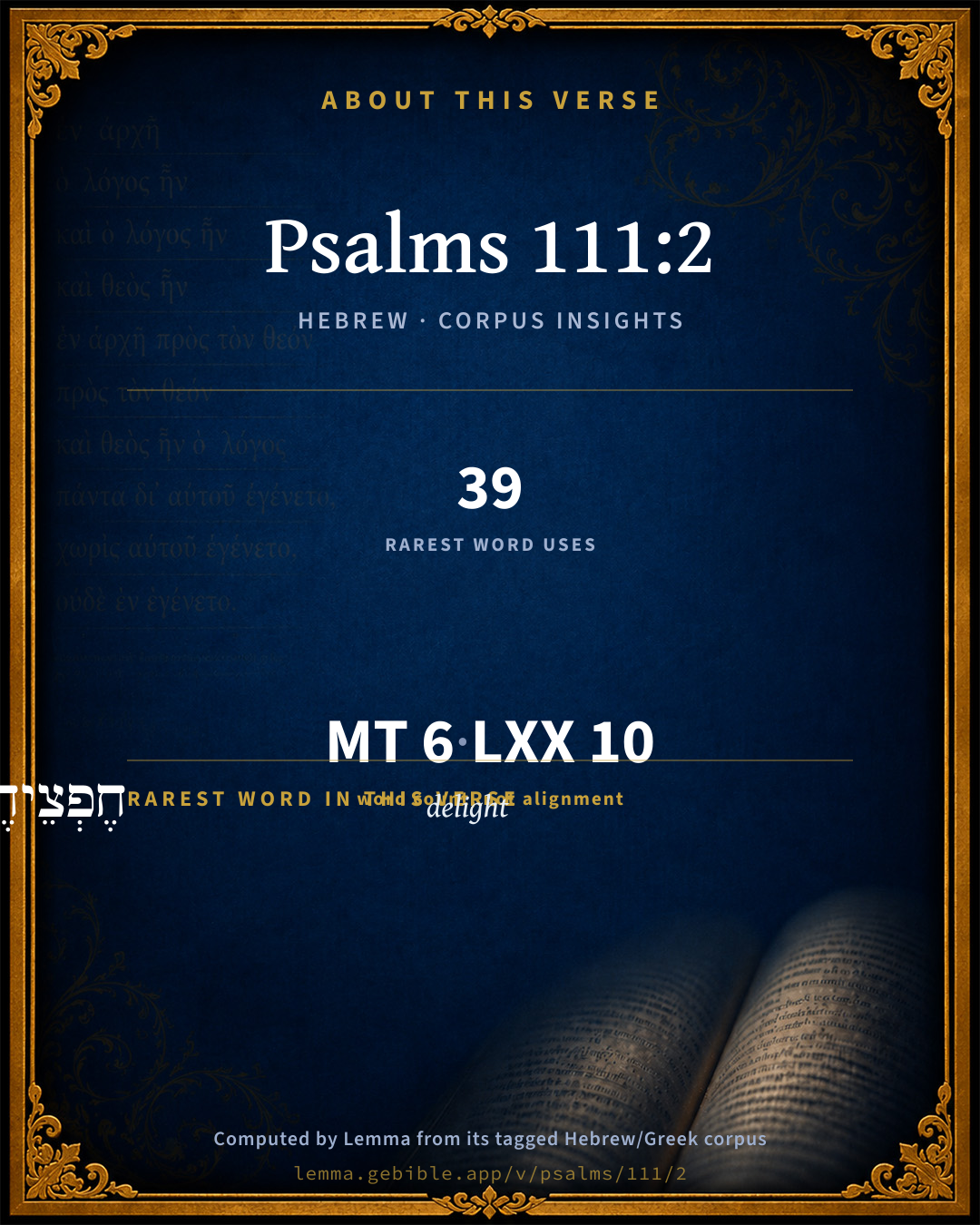
חֶפְצֵיהֶֽם delight H2656 occurs in 38 verses of the Hebrew Bible. Also found in:

Grammatical profile

  • 1 verb
  • 3 nouns
  • 2 adjectives

Verb forms

  • דְּ֝רוּשִׁ֗ים Qal · Participle Passive

Hebrew & Septuagint length

In English translation the verse runs 12 words from the Hebrew and 14 from the Septuagint (LXX English) — closely comparable.

A rough comparison of the two English renderings, which tokenize alike — not a word-level alignment.

Word counts can differ between the Hebrew and the Greek without any difference in meaning — e.g. the Hebrew direct-object marker אֵת has no separate Greek word, and Greek often adds the article ὁ.

In the original languages it is 6 Hebrew tokens and 10 Greek tokens — but the two are counted differently (Hebrew bundles its prefixes and suffixes into one token; the Greek is in lemma form), so that isn’t a like-for-like length.

Cross-references

26

Topical passages linked to Psalms 111:2 in the Treasury of Scripture Knowledge — connected by theme and wording, ordered by reader-vote popularity; previews shown in the World English Bible.

  • Psalms 104:24 Yahweh, how many are your works! In wisdom have you made them all. The earth is full of your riches.
  • Proverbs 24:14 So you shall know wisdom to be to your soul; If you have found it, then there will be a reward, Your hope will not be cut off.
  • Psalms 139:14 I will give thanks to you, For I am fearfully and wonderfully made. Your works are wonderful. My soul knows that very well.
  • Psalms 143:5 I remember the days of old. I meditate on all your doings. I contemplate the work of your hands.
  • Ephesians 1:19 and what is the exceeding greatness of his power toward us who believe, according to that working of the strength of his might
  • Jeremiah 32:17–19 Ah Lord Yahweh! behold, you have made the heavens and the earth by your great power and by your outstretched arm; there is nothing too hard for you,
  • Revelation 15:3 They sang the song of Moses, the servant of God, and the song of the Lamb, saying, "Great and marvelous are your works, Lord God, the Almighty; Righteous and true are your ways, you King of the nations.
  • Ephesians 2:7–10 that in the ages to come he might show the exceeding riches of his grace in kindness toward us in Christ Jesus;
  • Psalms 77:11–12 I will remember Yah's deeds; For I will remember your wonders of old.
  • Proverbs 17:16 Why is there money in the hand of a fool to buy wisdom, Seeing he has no understanding?
  • Ecclesiastes 3:11 He has made everything beautiful in its time. He has also set eternity in their hearts, yet so that man can't find out the work that God has done from the beginning even to the end.
  • Daniel 4:3 How great are his signs! and how mighty are his wonders! his kingdom is an everlasting kingdom, and his dominion is from generation to generation.
  • Job 5:9 Who does great things that can't be fathomed, Marvelous things without number;
  • Job 9:10 Who does great things past finding out, Yes, marvelous things without number.
  • Job 37:7 He seals up the hand of every man, That all men whom he has made may know it.
  • Proverbs 18:1–2 An unfriendly man pursues selfishness, And defies all sound judgment.
  • Romans 1:28 Even as they refused to have God in their knowledge, God gave them up to a reprobate mind, to do those things which are not fitting;
  • Romans 8:6 For the mind of the flesh is death, but the mind of the Spirit is life and peace;
  • 1 Peter 1:10–12 Concerning this salvation, the prophets sought and searched diligently, who prophesied of the grace that would come to you,
  • Job 26:12–14 He stirs up the sea with his power, And by his understanding he strikes through Rahab.
  • Job 38:1–41 Then Yahweh answered Job out of the whirlwind,
  • Job 41:1–34 "Can you draw out Leviathan with a fishhook? Or press down his tongue with a cord?
  • Psalms 92:4–5 For you, Yahweh, have made me glad through your work. I will triumph in the works of your hands.
  • Psalms 104:34 Let your meditation be sweet to him. I will rejoice in Yahweh.
  • Psalms 107:43 Whoever is wise will pay attention to these things. They will consider the loving kindnesses of Yahweh.
  • Isaiah 40:12 Who has measured the waters in the hollow of his hand, and meted out the sky with the span, and comprehended the dust of the earth in a measure, and weighed the mountains in scales, and the hills in a balance?

Cross-references courtesy of OpenBible.info (CC BY 4.0).

Hebrew and Greek witnesses Masoretic Hebrew ↔ Greek Septuagint

The same verse in the two great witnesses to the Old Testament, shown verse-for-verse.

You’re reading Greek Psalm 110 (Hebrew Psalm 111). The Septuagint counts the superscription, so verse numbers can differ from the Hebrew — chapter-level alignment, not verse-by-verse. Numbering follows Rahlfs.

These are two independent witnesses, not word-aligned to each other, and the Septuagint is shown in lemma (dictionary) form.

Hebrew Psalms 111:2 Masoretic · Westminster Leningrad Codex

גְּ֭דֹלִים מַעֲשֵׂ֣י יְהוָ֑ה דְּ֝רוּשִׁ֗ים לְכָל חֶפְצֵיהֶֽם

Yahweh's works are great, Pondered by all those who delight in them.

World English Bible · Public Domain

Greek LXX Greek Psalm 110:2 Septuagint · lemma form

μέγας ὁ ἔργον κύριος ἐκζητέω εἰς πᾶς ὁ θέλημα αὐτός

The works of the Lord are great, sought out according to all his will.

LXX2012 (modern English Septuagint) · Public Domain

On this verse, John Calvin's Commentaries discusses the Septuagint’s reading. Read the note in Commentary ↓

Hebrew: Westminster Leningrad Codex (CC BY 4.0). Greek: Septuagint (public domain); English from LXX2012 (modern English Septuagint) (Public Domain). How the Septuagint differs from the Hebrew →

Commentary

Notes on Psalms 111:2 from classic Christian and Jewish commentators (each source and its license shown beneath its notes). The classic Christian expositions comment on the surrounding passage and are grouped to its opening verse, so a note may address several verses; the Jewish commentaries on the Tanakh (Rashi and others) are per-verse, so they appear only where the commentator wrote on this verse.

Lemma curates 59 commentaries, every one of them public domain or Creative Commons licensed, each selected and text-cleaned for this edition rather than reprinted as found. About our sources →

Trapp's Complete Commentary

John Trapp

Psa 111:2 The works of the LORD [are] great, sought out of all them that have pleasure therein.

Ver. 2. The works of the Lord are great] Magnalia; no small things are done by so great a hand. Grandior solet esse Deus in parvulis quam in magnis; in formicis maior anima quam in elephantis, in nanis quam in gigantibus.

Sought out of all them] q.d. Great though they be, yet are they seriously sought into and found out by those that delight therein; and the deeper they dive into them the sweeter they find them. Basil diligently described many creatures; and so did Ambrose after him. Pliny (who was himself a very great searcher in nature’s secrets) telleth of one who spent eight and fifty years in learning the nature of the bee, Et nondum assecutus sit onmia, and yet could not attain to all. Our anatomists find still new wonders in the body of a man, &c. God hath showed singular skill in his works, that men might admire him; but woe to such as regard not his handiwork, Isa 5:12.

John Trapp, A Commentary or Exposition upon All the Books of the Old and New Testament (1647–1656) — public domain. Text from a community e-Sword module.

The Biblical Illustrator

Joseph S. Exell

Psa_111:2

The works of the Lord are great, sought out of all them that have pleasure therein.

The greatness of the works of God

Greatness, when attributed to the works of man, is a relative term, and it is only correct in one direction. Our works can only be great in comparison with the works of other men; they can have no greatness in relation to Gad, or to His operations. Our utmost skill cannot go beyond new combinations, or new discoveries of existing things; we can neither create nor preserve. Our knowledge results from creation; when correct it agrees with its works; but with God, creation results from knowledge--the prototype of it existed in the eternal mind before He began to work (Act_15:18).

I. The greatness of the works of God.

1. Their immensity. What a wonderful incomprehensible work was it to produce the matter which forms our globe! Yet our planet is but a small part of the solar system: there are spheres many times larger than our world, revolving at immense distances round the same sun. The sun itself is but one among millions of suns, which in boundless space enlighten other worlds, and are the centres of other systems. We are at once lost in the vastness of creation, in the immensity of being God has called into existence; and are oppressed with an overpowering sense of the magnitude of His works.

2. Their variety. The water affects the land, the land affects the water, an endless diversity of influences of different substances on each other are perpetually producing specific and well-ascertained results. Beings possessed of life were created from inanimate substance: by the infinite power of God the sea and land brought forth abundantly, the vegetable and animal kingdoms were called into existence by the Creators voice, and the tribes of land and ocean proclaim the magnitude of His work.

3. The preservation and government of the world. Cause and effect is not a necessary but an ordained connection; the energy that works is not that of the instrument but that of God; substances operate upon one another in a natural way, by which we mean an habitual, ordinary manner; but it is God who causes them so to operate; whatever is the instrument its efficacy is from God.

4. His moral government over voluntary and accountable beings. What a vast work must it be to educe order out of the chaotic workings of human minds; to maintain a system of operation and government over myriads of beings, who live as they list, preserving their own schemes of aggrandizement and gratification, without any reference to the will of God: and yet the mightiest of men can accomplish nothing but what God permits, and frequently they are working out, though contrary to their own intentions, the purposes of the Eternal Mind.

5. His greatest work is redemption. It unveils the whole character of God. In the natural world we behold manifestations of His power and wisdom; in His providential government we may learn something of His justice and goodness; but neither of these perfections is so gloriously exhibited as in the Gospel of His Son, where His love and mercy shine with unclouded lustre.

II. Successful inquiry is in proportion to the deep interest we take in the works of God. We must love truth, and justice, and mercy, before we can in any degree estimate the expression of Divine love and justice in saving sinners by the gift and death of the Son of God. (S. Summers.)

The worlds of God, in nature, providence, and grace

I. In nature. Every clod of earth teems with animation; every drop of water swarms with animalculae. Surely curiosity might induce us to seek out the works of God even if we had no other motive than mere inquisitiveness and curiosity. But we cannot examine these things as we ought without feelings of lively gratitude, that through the life-giving power of Jehovah everything ministers either to the necessities or to the convenience of man. But there is a still more familiar manifestation of the works of God which we should meditate upon. I wish you to turn your reflections upon yourselves. Contemplate the human body; observe the union of its several parts, and their fitness for the particular purpose for which they are designed; mark the composition and appearance of the whole; what incomparable workmanship is perceptible in the whole frame.

II. In preservation.

III. In grace. We look for new heavens and a new earth, wherein dwelleth righteousness. Since, then, all things are yours if ye are Christs, whether the world, or life, or death, or things present or things to come, let us call to mind that we have them as the subject matter of privilege; as the subject matter of improvement here, and as the subjects of praise throughout eternity. (H. F. Fell, M.A.)

The works of the Lord

1. Consider--

(1) The variety and multiplicity of the objects that constitute theearth and the creatures that dwell on it. How varied is the form of its surface! What an alternation of enormous ridges with summits of different heights, of hills and plains, of spacious, open fields, and of impassable, impenetrable forests, of continents and seas, rivers and lakes! What diversity and what riches in various kinds of precious gems, stones, ores, minerals, lie concealed in its bowels! What a world of wonders is enclosed in its fathomless abysses!

(2) Their beauty--no less great and admirable than their variety; consider the outline, the form, the hues, the infinitely blending shades of colours, the delicate texture, the artificial structure, the arrangement and composition of the several parts of every herb, every flower, every leaf, every tree, every plant, every greater and smaller, visible, and invisible, animal.

(3) The accurate and admirable connection that subsists between the several parts and creatures of the earth, causing them all to promote one grand design, the greatest possible welfare of the living.

(4) The gradual progress of all things to higher perfection. See how the plant, the tree expands, grows, flourishes, arrives at maturity, bears fruit, propagates and multiplies, from a seed so small as to be indiscernible to thy naked eye; how the crawling maggot rises into a butterfly; how every animal gradually acquires and communicates to others his agility, his powers, his habitudes; how the infant grows into the stripling, the youth into the man, and the man into the citizen of another world.

(5) The magnitude and inexhaustibility of the energies which animate and actuate all nature; those energies which operate so uniformly and silently, and yet so powerfully and irresistibly in all and through all; those energies which are in perpetual exertion through all successive evolutions, renovations, transformations of the whole innumerable host of creatures, and through all their efforts and effects, and in such various methods; those energies which, from what appears to be confusion and strife, produce the fairest harmony--from what we term death and destruction, incessant life and action.

2. Having considered these things, ascend in thought to the original, eternal energy, from whence these powers are derived--to the original, eternal fount of life, from whence these several kinds of life and efficacy flow--to the Supreme Dispenser of all that joy which fills the capacity of thy soul--to that God who predisposed, accomplished, and called them into being, who bears, upholds, connects, enlivens, and rejoices all, who through them all reveals Himself to His intelligent creature--man--speaks to him by a thousand voices, appears to him in a thousand varied forms, and in all and by all as Author, Benefactor, Father. (G. J. Zollikofer, D.D.)

The order and beauty of the visible creation

I the grandeur and simplicity of the works of God. How low and contemptible are all the proudest works of men compared to those of God! Could we suppose a person in full maturity of sense and understanding, but who had never seen the light of the sun and the face of nature, presented on a sudden with an ample prospect of the sublime canopy of heaven, the blazing sun, the illumined atmosphere, and the florid earth diversified with its various landscapes; how would the appearance astonish and transport him, stamp at once on his mind the new ideas of grandeur and beauty, and excite his veneration of the wisdom and power of God!

II. The uniformity and variety which appear in the works of creation. The heavens above, and the earth beneath, continue the same from age to age; yet afford a diversity of successive spectacles: the clouded, the clear, the parti-coloured sky; the nocturnal darkness, the meridian light. If we examine carefully the minuter productions of nature, the smallest insects, or the leaves, flowers, and fruits of plants, we find a wonderful mixture of the various and the uniform, that strikes the mind with a pleasing idea of order and beauty.

III. The perpetual circulations discernible in the world. The sun, moon, and stars perform their appointed courses with a stated unerring motion. What is it that unholds and directs them? How come they to know their seasons and courses? What enables them to travel incessantly with the same unremitting force? Why they never fall to the earth? Or wander through the pathless desert of the sky? In a word, why they never err?--These questions will necessarily turn our attention to the unerring wisdom of the Creator.

IV. The regular proportions observable in the several parts of the world, are a further evidence of creative wisdom in the structure of the whole. For as in the fabric of every plant and animal, the several parts bear a due proportion to each other and to the whole, so it is of the world in general: the parts were all formed by rule and measure, proportionate to each other and to the whole system.

V. The multiplicity of effects in nature flowing from the same cause; and the combination of a multitude of causes to the same effect. The single principle of gravitation, pervading the universe, at the same time gives solidity to the land, stability to the mountains, and fluency to the rivers; binds the ocean to its bed, and the whole earth to its orbit; maintains the due distance of the heavenly bodies; and retains everything through universal nature in its proper situation. Similar to this is the single principle of benevolence in the moral world: which in like manner is diffused through human nature, and produces, according to its different modifications, various beneficial effects: hence parental care; relative union; combination of friends; public spirit; good government of superiors; fidelity of inferiors; and it is this which retains every individual in his proper sphere, cements human society, and contributes to all virtuous actions, honourable pursuits, and innocent delights. How should it excite the inquisitive understanding, and affect the religious temper, of every considerate person, to find the whole world framed and disposed, and all the elemental parts of it contending and co-operating in a perpetual motion, to please and benefit the human race! (S. Bourn.)

On seeking out the worlds of the Lord and praising Him

The works of the Lord are great; yet, great as they are, they cannot be understood nor perceived by those who are absorbed in earthly ideas and pursuits. The works of the Lord must be sought out; that is, they must be mindfully and diligently observed, in order to their being adequately understood: nay, if we would know anything of their vastness or their excellency. We must be in the constant habit of connecting the ordinary operations and occurrences of life with a higher power, with the counsel and government of heaven; a gracious promise is given, that all things shall work together for good to them that love God; and we must be always endeavouring to trace this working, and observe the striking manner in which this effect is produced. Nor can any, but the pious and faithful servant of God, find delight in this holy and profitable exercise; and the longer he lives, the more clearly he perceives the hand of the Almighty in everything; in discomforting the evil and blessing the good: he sees and admires the wonders of grace, as well as the wonders of providence, vouchsafed to others as well as himself; to the Church in all ages. In all the good he receives or does, and all the evil he escapes or prevents, he traces the power and mercy of his God: Not unto me, O Lord, not unto me, but unto Thy name be the glory and the praise. Thus he imitates the conduct of the psalmist, recorded in the text, I will give thanks unto the Lord with my whole heart: all the power of his understanding and all the affections of his soul are employed in magnifying the majesty and loving-kindness of the Author and giver of every good gift. And the grateful Christian imitates the psalmist yet farther; he does not hide the sense of Gods goodness within his own bosom; but declares it openly as opportunity serves. (J. Slade, M. A.)

New interest in Gods works

An American poet tells us, in one of his letters, how he once met an aged French priest on the Pacific Railway. The priest told him that he was on a journey round the world, and that he had been put up to that by a dream. He dreamed that he had died, and he met the good God, who asked him how he liked the world he had come from. He was obliged to confess that he had not looked at it very much: for the whole time he was there he had been busy getting himself ready to die, and getting other people ready to die--as if getting ready to die were the chief end of man here below. When he awoke he resolved that, old as he was, if the good God would only let him stay on in this world a little while longer, he would take a good look at it before he was summoned to pass another such examination. So he had furnished himself with some little books in physical geography and the like, and was reading, and looking, and thus preparing for the other world by trying to get all the real and Divine good he could out of this earth. (John Hunter, D.D.)

The Biblical Illustrator, edited by Joseph S. Exell (c. 1880s–1900s) — public domain. Text from a community e-Sword module.

J. A. Alexander on Psalms

Joseph Addison Alexander

2. (Psa 111:2) Great are the works of Jehovah, sought (according) to all their desires. The common version of the last phrase, all them that have pleasure therein, supposes the text to be differently pointed, as in Psa 40:14; Psa 70:2. The received text can only mean to (for or according to) all their wishes. The antecedent of the pronoun (their) seems to be the upright in Psa 111:1. For a similar construction of the same pronoun, see below, on Psa 111:10. The clause, thus construed, is obscure, but may be understood to mean, that when the works of God are sought out, investigated, or explored, their greatness fully satisfies the hopes and wishes of his people. Another possible sense is, that they are sought for, i.e. the experience or knowledge of them eagerly desired, with (literally as to) all their wishes, i.e. with avidity, or, as it is expressed in the preceding verse, with all the heart.

Joseph Addison Alexander, The Psalms Translated and Explained (1850) — public domain. Text from a community e-Sword module.

Geneva Bible (1599)

Geneva Bible translators

He showeth that God’s works are a sufficient cause wherefore we should praise him, but chiefly his benefits toward his Church.

Geneva Bible (1599) marginal notes — public domain. Text via Bolls.life.

Adam Clarke's Commentary

Verse 2. The works of the Lord are great] גדלים gedolim, vast in magnitude; as רבים rabbim signifies their multitude and variety.

Sought out] Investigated, carefully examined.

Of all them that have pleasure therein.] By all that delight in them: by every genuine philosopher; every lover of nature; he who traces out the great First Cause by means of his works. And the man that does so will be astonished at the perfections of the Creator, and admire all the operations of his hands.

Adam Clarke's Commentary on the Bible (1810–1826) — public domain. Text from a community e-Sword/MySword module.

John Calvin's Commentaries

2 The works of Jehovah are great He now proceeds to inform us that there are abundant materials for praising God, supplied by his works, to which at present he makes only a general reference, and which he, subsequently, defines more explicitly in relation to the government of the Church. The magnitude of God’s works is a subject which, generally, eludes the observation of men, and, therefore, few of them are acquainted with it. This ignorance the prophet ascribes to the indifference and ingratitude of men, comparatively few of whom condescend to notice the great wisdom, goodness, justice, and power, which shine forth in these works. Expositors are divided in their sentiments about the second clause of the verse. Some translate it, sought out for all their delights; and, indeed, the Hebrew term חפף, chaphets, signifies good pleasure; but as this is too harsh an interpretation of the word, it is better to understand it as an adjective, expressing the idea of loving or desiring. As to the participle, sought out, which, according to the Hebrew verb, דרש, darash, properly denotes, to search with diligence, we yet find that the works of Jehovah are, in this place, called דרושים, derushim, that is, perceived or found out. Hence, in Isaiah 65:1, it is said, “I was found of them who sought, me not.” I must, however, not lose sight of the prophet’s design, namely, that in consequence of so few applying themselves to the study of the works of God, he teaches us that that is the reason why so many are blind amidst a flood of light; for, when he says that the excellency of the works of God is known to all who desire it, he means that none are ignorant of it, except such as are wilfully blind, or rather, malignantly and contemptuously quench the light which is offered to them. We must, however, attend to the means which we possess for arriving at the knowledge of these words because we know, that as long as the faithful are on earth, their understandings are dull and weak, so that they cannot penetrate the mysteries, or comprehend the height of the works of God. But, incomprehensible as is the immensity of the wisdom, equity, justice, power, and mercy of God, in his works, the faithful nevertheless acquire as much knowledge of these as qualifies them for manifesting the glory of God; only it becomes us to begin the study of his works with reverence, that we may take delight in them, contemptible though they be in the estimation of the reprobate, who treat them with impious scorn. The LXX. having rendered it, sought out in all his wills, Augustine has therefore taken occasion, with philosophic finesse, to ask, How can there be, or, at least, appear to be, a plurality of wills in God? And it is indeed a pleasing consideration, that though God manifest his will in his law, nevertheless there is another secret purpose by which he is guided in the wonderful management of human affairs. This doctrine, however, is, foreign to the exposition of this passage.

John Calvin's Commentaries (1540-1563) — public domain. Text from the Calvin Translation Society English edition (1840s-50s) via the Christian Classics Ethereal Library (ccel.org). Calvin's coverage is partial (roughly two-thirds of the Bible); uncommented books and verses are honest gaps, never fabricated. The 19th-century editor's footnotes and remarks are omitted so the notes are faithfully Calvin's own voice.

Ellicott's Commentary for English Readers

(2) Sought out—i.e., they are the object of meditation and enquiry. (See Note, Psa_105:4.) The psalmist was no doubt thinking of historical proofs of Jehovah’s goodness to the chosen race, but his words are capable of a wide range. The best illustration of them may be found in the writings in which Mr. Ruskin warns this generation against the danger of insensibility to natural beauty.

A Bible Commentary for English Readers, edited by Charles John Ellicott (1878–1897) — public domain. Text from a community e-Sword module.

The Cambridge Bible for Schools and Colleges

gen. ed. J. J. S. Perowne

2. The ground of praise. The doings of Jehovah of which the Psalmist is thinking are those which He has wrought for His people (Psa_111:6), but for us they will include His works in Nature (Psa_104:13; Psa_104:24; Psa_104:31) as well as in history. They are studied or to be studied (Jer. exquirenda) with loving diligence by all who delight in learning to understand His revelation of Himself (Psa_1:2; Neh_1:11). Less probable are the renderings in regard to all their desirableness (Pro_8:11); or, in regard to all their (LXX his) purposes.

The Cambridge Bible for Schools and Colleges (gen. ed. J. J. S. Perowne; Cambridge University Press, 1878–1918) — public domain. Text from a community e-Sword module.

John Gill's Exposition

The works of the Lord are great,.... His works of creation are great, being made out of nothing, are the effects of great power, and the produce of great wisdom, and which greatly display the glory of their Maker; the works of providence are great, which are daily wrought, especially such as concern the church and people of God, for whom he does great things, whereof they have reason to be glad and praise his name; the miracles of Christ he wrought here on earth were surprisingly great, some of them such as had not keen known from the creation of the world; and yet greater things were shown him, and done by him, particularly the work of redemption, a work which angels and men were unequal to, a work which none but the great God and our Saviour could effect, and is truly called the great salvation; the work of grace upon the heart is a great work, and requires the exceeding greatness of the divine power, and which is exerted in the beginning, carrying on, and finishing that work; and for all which the Lord is to be praised: and the rather since they are such as are

sought out of all them that have pleasure therein; or "sought out because of all the pleasures of them, or that are in them" (f), which comes to much the same sense: there is a pleasure in the contemplation of the works of nature and providence; to behold the power, wisdom, and goodness of God in them, and his care over all his creatures; and particularly how he makes all things to work together for the good of his people; and especially it is delightful to observe the works of grace, how the glory of all the divine perfections is displayed in them; angels themselves take pleasure in looking into them: now these are sought and found out by those who delight in them; the works of creation are to be sought and found in the book of nature, the works of providence in the book of experience, and the works of grace in the book of God; and indeed all of them are recorded there, which are searched with pleasure by those that are inquisitive after them.

(f) "ob omnes amabilitates eorum", Cocceius; "secundum omnia desideria eorum", Gejerus.

John Gill's Exposition of the Whole Bible (1746–1763) — public domain (CC PDM 1.0). Text via the HelloAO Bible API.

Albert Barnes' Notes on the Bible

The works of the Lord are great - They are great in number; great in magnitude; great in wisdom; great in goodness. This language was appropriate in the time of the psalmist, when people looked upon the heavens with the naked eye alone, and when they had very imperfect views of the real magnitude of the universe as it is now disclosed by the telescope. It is entirely appropriate now, and conveys a more solemn and sublime impression than it would in the time of the psalmist. It will still be appropriate under the larger views which may yet be obtained of the universe by more perfect instruments, by more accurate observation, and by more profound study. And it will be appropriate when people shall survey the greatness of the universe from the heights of heaven.

Sought out of all them - Studied by all such.

That have pleasure therein - More literally, “Sought to all their wishes.” Perhaps the meaning is, that they would find all their desires gratified in those works; they would find in them all that they would wish to find respecting the power, wisdom, goodness, and majesty of God. Still it implies that they have a desire thus to study his works, or that they do find a pleasure in examining the proofs of the being and attributes of God in his works. A man who loves God will have real pleasure in studying his works as well as his word; and it is as proper to find pleasure in the one as in the other - as proper to wish to find the knowledge which the one imparts as that which the other bestows. One great error among the friends of God is the neglect to study his works. In doing this, people need not neglect or undervalue the Bible and the knowledge which it gives, for such studies would be among the best means of illustrating the Bible.

Albert Barnes' Notes on the Bible (1834–1885) — public domain. Text from a community e-Sword/MySword module.

Matthew Poole's English Annotations

The works of the Lord; either,

1. The works of creation; or rather,

2. The works of his providence in the world, and especially in and for his church and people, of which he speaks in the rest of the Psalm.

Are great, for the infinite power, and wisdom, and goodness manifested in them. Sought out; highly valued and regarded, as this very word and phrase is used, Deu 11:12; Isa 62:12; or frequently called to mind, and diligently meditated upon, when others either never regarded them, or instantly forget them: or, found out, as this word is taken, Isa 65:1; the antecedent being put for the consequent, which is frequent in Scripture, as Rom 12:2, where proving or trying (for so the Greek word there signifies) is put for approving, which follows after it. And found out, i.e. truly and thoroughly understood, both as to the nature of them, and God’s counsels and ends in them; whereas the works of God are ofttimes not apprehended or minded, or are mistaken and misconstrued, by ungodly men.

Of all them that have pleasure therein; of all them who take delight in observing and considering the works of God.

Matthew Poole's English Annotations on the Holy Bible (1683–1685) — public domain. Text from a community e-Sword/MySword module.

The Treasury of David

Charles H. Spurgeon

Ver. 2. The works of the LORD are great. In design, in size, in number, in excellence, all the works of the Lord are great. Even the little things of God are great. In some point of view or other each one of the productions of his power, or the deeds of his wisdom, will appear to be great to the wise in heart.

Sought out of all them that have pleasure therein. Those who love their Maker delight in his handiwork, they perceive that there is more in them than appears upon the surface, and therefore they bend their minds to study and understand them. The devout naturalist ransacks nature, the earnest student of history pries into hidden facts and dark stories, and the man of God digs into the mines of Scripture, and hoards up each grain of its golden truth. God's works are worthy of our researches, they yield us instruction and pleasure wonderfully blended, and they grow upon, appearing to be far greater, after investigation than before. Men's works are noble from a distance; God's works are great when sought out. Delitzsch reads the passage, "Worthy of being sought after in all their purposes, "and this also is a grand truth, for the end and design which God hath in all that he makes or does is equally admirable with the work itself. The hidden wisdom of God is the most marvellous part of his works, and hence those who do not look below the surface miss the best part of what he would teach us. Because the works are great they cannot be seen all at once, but must be looked into with care, and this seeking out is of essential service to us by educating our faculties, and strengthening our spiritual eye gradually to bear the light of the divine glory. It is well for us that all things cannot be seen at a glance, for the search into their mysteries is as useful to us as the knowledge which we thereby attain. The history of the Lord's dealings with his people is especially a fit subject for the meditation of reverent minds who find therein a sweet solace, and a never failing source of delight.

Ver. 2. The works of the LORD are great. Their greatness is known from comparison with the works and powers of men, which, verily, die and perish quickly. We should, therefore, admire, fear, confide, obey. Martin Geier.

Ver. 2. The works of the LORD are great, etc. Their greatness is equally manifest when we turn from the immensity to the variety of his works...How great are the works of him who gives to every plant its leaf and flower and fruit; to every animal its faculties and functions; to every man his understanding, affections, and will. What an accumulative idea of the magnitude of his works do we gather from the innumerable multitudes and endless diversities of being called into existence by his powers. Samuel Summers, 1837.

Ver. 2. The works of the LORD are great. The workman who never makes a small article, an inferior article, but makes all his articles both great and valuable, deserves much praise; and any one that will study God's works, which we think so little of by reason of their being so constantly before us, cannot fail to behold God's infinite power and wisdom in every one of them, even though he cannot comprehend them. Robert Bellarmine.

Ver. 2. Great. The word lwdg (gadol) great, has in the Hebrew so extensive a range of meaning, that in the English there is no single substitute expressive enough to take its place. It denotes greatness and augmentation of various kinds. In this passage the works of Jehovah are described as greatly "magnified or augmented" in their influences and effects on the minds of men who behold them. The greatness ascribed to these works, is a greatness in number, in character, in dignity, in beauty, in variety, in riches. Benjamin Weiss.

Ver. 2,4. Great...sought out. Remembered. The works of Jehovah surpass the reach of human discovery, but are yet searched and explored with delight by all the members of his church; for, if they are too great to be understood, they are also too great to be forgotten. Edward Garrard Marsh.

Ver. 2. Sought out. To see God in his creatures, and to love him and converse with him, was the employment of man in his upright state. This is so far from ceasing to be our duty, that it is the work of Christ, by faith, to bring us back to it; and therefore the most holy men are the most excellent students of God's works; and none but the holy can rightly study or know them. Your studies of physics and other sciences are not worth a rush, if it be not God by them that you seek after. To see and admire, to reverence and adore, to love and delight in God appearing to us in his works, and purposely to peruse them for the knowledge of God; this is the true and only philosophy, and the contrary is mere foolery, and so called again and again by God himself. Richard Baxter, 1615-1691.

Ver. 2. It does not follow, that because the study of nature is now of itself an insufficient guide to the knowledge of the Creator and the enjoyment of eternal felicity, such studies are either to be thrown aside, or considered as of no importance in a religious point of view. To overlook the astonishing scene of the universe, or to view it with indifference, is virtually to "disregard the works of Jehovah, and to refuse to consider the operations of his hands." It is a violation of Christian duty, and implies a reflection on the character of the Deity, for any one to imagine that he has nothing to do with God considered as manifested in the immensity of his works; for his word is pointed and explicit in directing the mind to such contemplations. "Hearken unto this, stand still, and consider the wonderful works of God." "Lift up thine eye on high, and behold who hath created these orbs." "Remember that thou magnify his works which men behold." "Great and marvellous are thy works, Lord God Almighty! Thy saints shall speak of the glory of thy kingdom and talk of thy power, to make known to the sons of men the mighty operations and the glorious majesty of thy kingdom." Thomas Dick (1772) in "The Sidereal Heavens."

Ver. 2. Sought out of all them that have pleasure therein. This is a true characteristic of the upright and pious. The works of God are said to be "sought out of them, "when they regard them, call them to mind, and carefully, taking them one by one, investigate them; and at the same time explain them to others, and recount them: all which is included in the verb vrd; for that verb, properly is trivit (to rub, beat, or bray) hence by thrashing and grinding he has investigated perfectly, and has rubbed out the kernel of it for the use and profit of another: whence it is used for concionari, etc. Hermann Venema.

Ver. 2. Sought out, ...have pleasure therein. Philosophy seeks truth, Theology finds it, but Religion possesses it. Human things must be known to be loved, but divine things must be loved to be known. Blaise Pascal, 1623-1662.

Ver. 2-4. Sought out... The LORD is gracious and full of compassion. This is the grand discovery of all the searching, and therein lies the glory that is the conclusion of all. As in searching into any experiments in nature, there is an infinite pleasure that accompanies such a study to them that are addicted thereunto; so to him that hath pleasure in the works of God, and is addicted to spy out his kindness in them, there is nothing so pleasant as the discovery of new circumstances of mercy that render his work glorious and honourable. Get, therefore, skill in his dealings with thee, and study thy friend's carriage to thee. It is the end why he raised thee up, and admitted thee into friendship with him, to show his art of love and friendship to thee; to show, in a word, how well he could love thee. Thomas Goodwin.

is addicted to spy out his kindness in them, there is nothing so pleasant as the discovery of new circumstances of mercy that render his work glorious and honourable. Get, therefore, skill in his dealings with thee, and study thy friend's carriage to thee. It is the end why he raised thee up, and admitted thee into friendship with him, to show his art of love and friendship to thee; to show, in a word, how well he could love thee. Thomas Goodwin.

Ver. 2. The Christian philosopher.

1. His sphere: "The works of the Lord."

2. His work: "Sought out."

3. His qualification: "Pleasure therein."

4. His conclusion: "Praise, "as in Ps 111:1.

Ver. 2-9. The psalmist furnishes us with matter for praise from the works of God.

1. The greatness of his works and the glory of them.

2. The righteousness of them.

3. The goodness of them.

4. The power of them.

5. The conformity of them to his word of promise.

6. The perpetuity of them. Matthew Henry.

Psalms 111:3*

Charles H. Spurgeon's The Treasury of David (1869–1885) — public domain. Psalms only. Text from a community e-Sword/MySword module.

Whedon's Commentary on the Bible

Daniel D. Whedon

2. Works of the Lord—This is the theme of the psalm, and might include all God’s works in nature, providence, moral government, and redemption; but the psalm celebrates specially his moral acts in government and redemption, particularly that wonderful chain of providences by which his people had been saved and his covenant confirmed.

Sought out— Diligently studied, searched into; and which are, by implication, excellent and satisfying to the earnest inquirer who is attracted by their merit and takes delight in their teachings: but they must be studied not only for doctrine and history, but for practical living.

Daniel D. Whedon (gen. ed.), Commentary on the Old and New Testaments (1874–1909) — public domain. Text from a community e-Sword module.

The Pulpit Commentary

The works of the Lord are great. Not his material works, but the doings of his providence (see vers. 3-9). Sought out of all them that have pleasure therein. Searched into and carefully studied by all who take an interest in such things. Deru-shim, "objects of study," is etymologically connected with madrasa, a college, a "place of study and research.

Good will towards God guiding the search for God.

"Sought out of all them that have pleasure therein." "The pleasure in God"s works is in germ the best incentive to thoughtful search, and in fuller measure its sufficient reward." In regard to man"s search for God, it may be properly said that what he finds depends on what he seeks, and the spirit in which he seeks. This, indeed, is true even of scientific research. A man must know what he is looking for, or he will find nothing intelligent in the revelations of telescope or microscope. A man writes, "I have searched the heavens for God during fifty long years, and have never found him yet." He did not believe there was a God, and so he never would find him. Let a man want to find God, and his search will be fully responded to. God is revealed, God reveals himself, to moral moods, and not to mere intellectual research. Souls find God, not eyes or minds.

I GOD"S WORKS ARE BEYOND THE REACH OF WISE INTELLECTS. Men by their science can find out things, and account for the forms of things. But they cannot explain the meanings of things, or the relations of things. Nothing in the world is more uncertain and untrustworthy than wise men"s theorizings. The most humiliating book could be written on the "History of Exploded and Worn-out Theories." Illustrate by referring to "certain cruel and loathsome practices of the animal world as, for example, those of apes, dogs, frogs, the barbarity of the cat to the mouse, the thefts of the eagle from the fish-hawk, the rapture of nests by stronger birds who turn out their original tenants to die of cold and slow starvation, the enslaving of the black ants by the red, and sundry other habits which shock our sense of justice or of decency." The intellect of man, without guidance from the sense of God, has never found the meaning of such things. The key to them is hid from the wise, who in fact blind themselves by refusing to carry to the consideration of such things those truths concerning God which are "spiritually discerned." Nature in only an open secret to the God-fearing man.

II GOD"S WORKS ARE WITHIN THE REACH OF LOVING HEARTS. These only are prepared to think kind things, loving things, trustful things. When we have right apprehensions of the infinitely wise and gracious Doer, such apprehensions as enable us to set our love upon him, we simply refuse to accept explanations of nature-mysteries that are dishonorable to him. They cannot be true. We pass them by. There is something better to be "sought out." Our good will toward God will keep us from resting content with anything that is unworthy of him; and we search on, assured that mystery will yield at last to love. R.T.

The Pulpit Commentary (1880–1919), ed. H.D.M. Spence-Jones & Joseph S. Exell — public domain. Text from a community e-Sword module.

John Wesley's Explanatory Notes

Sought - Diligently meditated upon.

John Wesley, Explanatory Notes Upon the Whole Bible (1754–1765) — public domain. Text via the GEBible commentary corpus.

Lesson kit

Teaching starters — assembled from the data on this page, not authored interpretation. Every prompt links to the verse data it draws on. Edit before teaching.

Psalms, in the Wisdom, opens this verse with 6 words (6 distinct Hebrew lemmas). Its most distinctive word is chêphets (“delight”). A historical commentator’s framing appears above. Read the whole chapter for the surrounding context.

Discussion questions

  1. The word chêphets carries the sense “delight.” How does it shape the verse?
  2. How does 1 Samuel 15:22, which shares the word «delight», read alongside this verse?
  3. These translations render this verse differently; the difference is in the English rendering, not the original. What questions does that raise?
  4. «דְּ֝רוּשִׁ֗ים» is a Qal Participle Passive verb. How does that grammatical form shape the action described?
  5. Compare how Trapp's Complete Commentary and The Biblical Illustrator read this verse. Where do they agree or differ?

Things to notice

Reading settings

Reading text

Shown beneath each verse's original-language words.

Old Testament
Old Testament edition

Read the OT as the Masoretic Hebrew (MT) or the Greek Septuagint (LXX).

English shown for the Greek Septuagint (in the Hebrew ↔ Greek comparison).

Comparing translations? Open the Compare panel on any verse page to stack up to four side by side.