Zephaniah 1:6

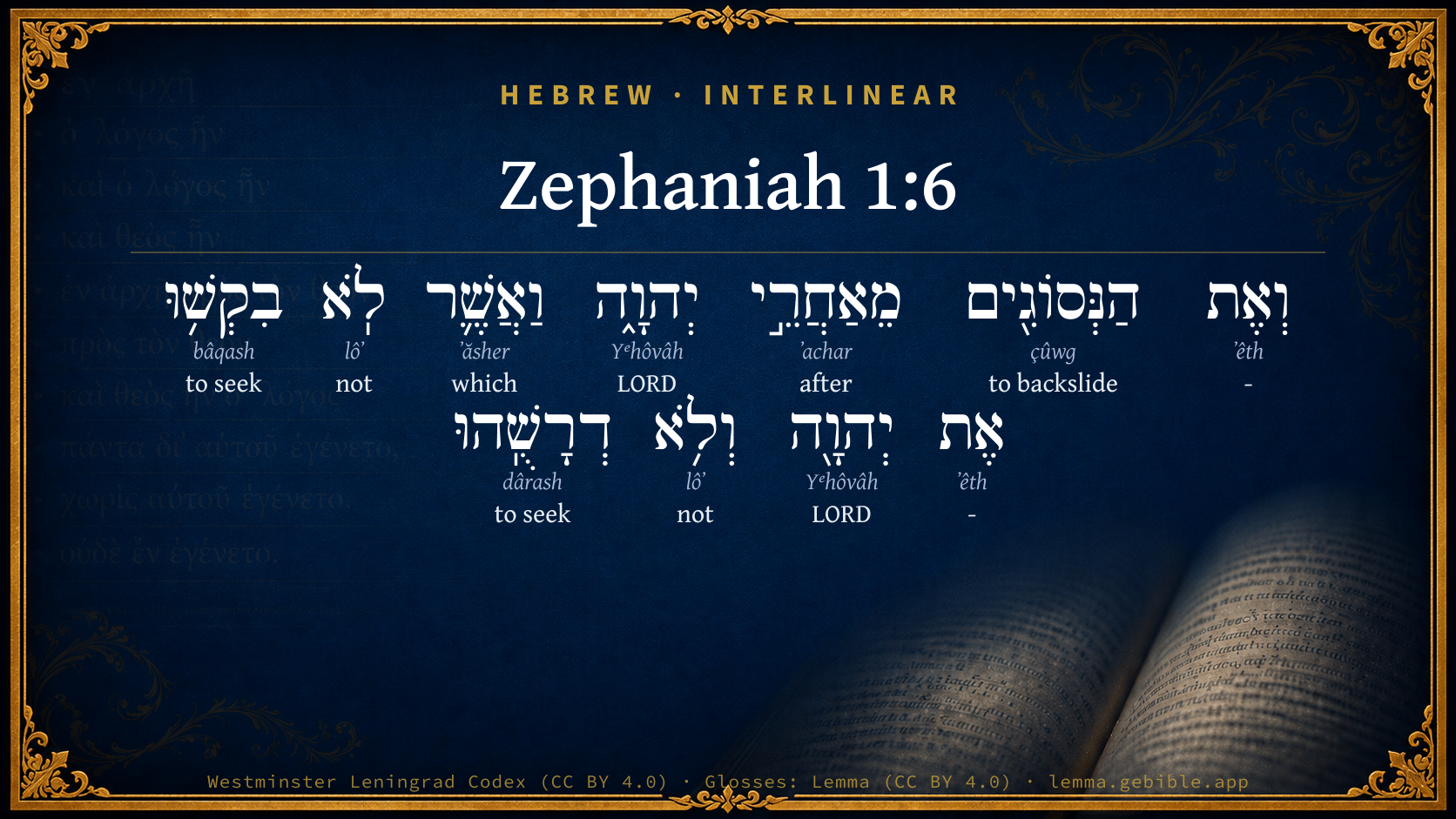
Hebrew (Westminster Leningrad Codex) Zephaniah 1:6 appears in the Hebrew Old Testament. The text above is from the Westminster Leningrad Codex. Each word links to its Strong’s number, a concise gloss, and parsing drawn from the Open Scriptures Hebrew Bible morphology. Click any word for its full Brown-Driver-Briggs (BDB) entry.
Download image
Cite this verse

Zephaniah 1:6 (World English Bible). Public Domain. Lemma interlinear Bible study tool, https://lemma.gebible.app/v/zephaniah/1/6.

Show BibTeX & RIS
BibTeX
RIS
English Translation
those who have turned back from following Yahweh, and those who haven't sought Yahweh nor inquired after him.
World English Bible · Public Domain
Download a study sheet

One document with this verse’s original text, its word-by-word gloss line, the meaning frame, cross-references with their text, attributed commentary, and full source and license credits — printable, and it pastes into notes with its structure intact.

This verse Autodidact and up

Study sheet (.html) Plain text (.txt)

A passage Seminary Student

Up to 50 verses in one chapter. A passage sheet keeps up to 6 commentary sources and 12 cross-references per verse, in the order this page ranks them, and says so on the sheet whenever that leaves anything out. Ask for a single verse and you get the Autodidact verse sheet above.

Everything on this page stays free to read, with no account — the sheet is a download of what is already on screen, not access to it.

Want to remove ads? Support Godless Engineer
Compare translations 3

The same verse in 3 English versions, stacked beneath the original-language interlinear above. Click any original word for its lexicon entry.

Each is an independent rendering of the whole verse — the interlinear is not word-aligned to these translations.

Highlighted words mark where these versions differ — a whole-verse word diff, not a word-by-word alignment.

  • World English Bible Public Domain
    those who have turned back from following Yahweh, and those who haven't sought Yahweh nor inquired after him.
  • King James Version Public Domain
    And them that are turned back from the LORD; and those that have not sought the LORD, nor enquired for him.
  • unfoldingWord Literal Text CC BY-SA 4.0
    and the ones turning back from after Yahweh, and who do not search for Yahweh and do not seek him.”

unfoldingWord Literal Text — © unfoldingWord, licensed CC BY-SA 4.0. Word-aligned USFM3 via Door43 (git.door43.org/unfoldingWord/en_ult).

Versions to compare (up to 4)

3 of 4 selected

Show all 18 translations

Every available English version of this verse, each an independent rendering of the whole verse.

  • World English Bible Public Domain
    those who have turned back from following Yahweh, and those who haven't sought Yahweh nor inquired after him.
  • Berean Standard Bible Public Domain
    and those who turn back from following the LORD, neither seeking the LORD nor inquiring of Him.”
  • Majority Standard Bible Public Domain
    and those who turn back from following the LORD, neither seeking the LORD nor inquiring of Him.”
  • King James Version Public Domain
    And them that are turned back from the LORD; and those that have not sought the LORD, nor enquired for him.
  • American Standard Version (1901) Public Domain
    and them that are turned back from following Jehovah; and those that have not sought Jehovah, nor inquired after him.
  • Revised Version (1885) Public Domain
    and them that are turned back from following the LORD; and those that have not sought the LORD, nor inquired after him.
  • Geneva Bible (1599) Public Domain
    And them that are turned backe from the Lord, and those that haue not sought the Lord, nor inquired for him.
  • Douay-Rheims (1899) Public Domain
    And them that turn away from following after the Lord, and that have not sought the Lord, nor searched after him.
  • Young's Literal Translation Public Domain
    And those removing from after Jehovah, And who have not sought Jehovah, nor besought Him.
  • Literal Standard Version CC BY-SA 4.0
    And those removing from after YHWH, || And who have not sought YHWH, nor implored Him.”
  • Unlocked Literal Bible CC BY-SA 4.0
    I will also cut off those who have turned away from following Yahweh, those who neither seek Yahweh nor ask for his guidance.”
  • unfoldingWord Literal Text CC BY-SA 4.0
    and the ones turning back from after Yahweh, and who do not search for Yahweh and do not seek him.”
  • Darby Bible Public Domain
    and them that turn back from after Jehovah, and that do not seek Jehovah, nor inquire for him.
  • World Messianic Bible Public Domain
    those who have turned back from following the LORD, and those who haven’t sought the LORD nor inquired after him.
  • Webster's Bible Public Domain
    And them that have turned back from the LORD; and those that have not sought the LORD, nor inquired for him.
  • Free Bible Version CC BY-SA 4.0
    I will destroy those who once worshiped the Lord but don't anymore. They don't seek the Lord or ask for my help.
  • Bible in Basic English Public Domain
    And those who are turned back from going after the Lord, and those who have not made prayer to the Lord or got directions from him.
  • JPS Tanakh (1917) Public Domain
    Them also that are turned back from following the LORD; and those that have not sought the LORD, nor inquired after Him.

Literal Standard Version (2020), Covenant Press — licensed CC BY-SA 4.0. Text via the HelloAO Bible API (eBible.org). Unlocked Literal Bible (unfoldingWord) — licensed CC BY-SA 4.0. Text via the HelloAO Bible API (eBible.org). unfoldingWord Literal Text — © unfoldingWord, licensed CC BY-SA 4.0. Word-aligned USFM3 via Door43 (git.door43.org/unfoldingWord/en_ult). Free Bible Version, Dr. Jonathan Gallagher — licensed CC BY-SA 4.0. Text via the HelloAO Bible API (eBible.org).

Word by word

More ways to search: Search by grammar → Find every occurrence → Compare this word →

Practice this passage: Drill this verse → Learn its vocabulary →

הַנְּסוֹגִ֖ים
çûwg
H5472
“the · backsliding”
Particle, Definite Article + Verb, Niphal, Participle Active, Masculine, Plural, Absolute
Part of Speech
Particle + Verb
Stem
Niphal
Form
Participle Active
Gender
Masculine
Number
Plural
State
Absolute
Full BDB Definition

Origin: a primitive root

TWOT: 1469

to move, go, turn back, move away, backslide - (Qal) to backslide, prove recreant to - (Niphal) - to turn oneself away, turn back - to be turned or driven back, be repulsed
  1. וְאֶת ʼêth H853 “and · -” Conjunction + Particle, Direct Object
  2. מֵאַחֲרֵ֣י ʼachar H310 “from · after” Preposition + Preposition
  3. יְהוָ֑ה Yᵉhôvâh H3068 “LORD” Noun, Proper
  4. וַאֲשֶׁ֛ר ʼăsher H834 “and · which” Conjunction + Particle, Relative
  5. לֹֽא lôʼ H3808 “not” Particle, Negative
  6. בִקְשׁ֥וּ bâqash H1245 “to seek” Verb, Piel, Perfect, 3rd Person, Common, Plural
  7. אֶת ʼêth H853 “-” Particle, Direct Object
  8. יְהוָ֖ה Yᵉhôvâh H3068 “LORD” Noun, Proper
  9. וְלֹ֥א lôʼ H3808 “and · not” Conjunction + Particle, Negative
  10. דְרָשֻֽׁהוּ dârash H1875 “to seek · him” Verb, Qal, Perfect, 3rd Person, Common, Plural + Suffix, Personal, 3rd Person, Masculine, Singular

About this verse

These counts appear in no published source. They are computed here, from the morphology-tagged text and Lemma’s own curated glosses. What Lemma adds →

11
words
8
distinct lemmas
Prophets
section

Notable vocabulary

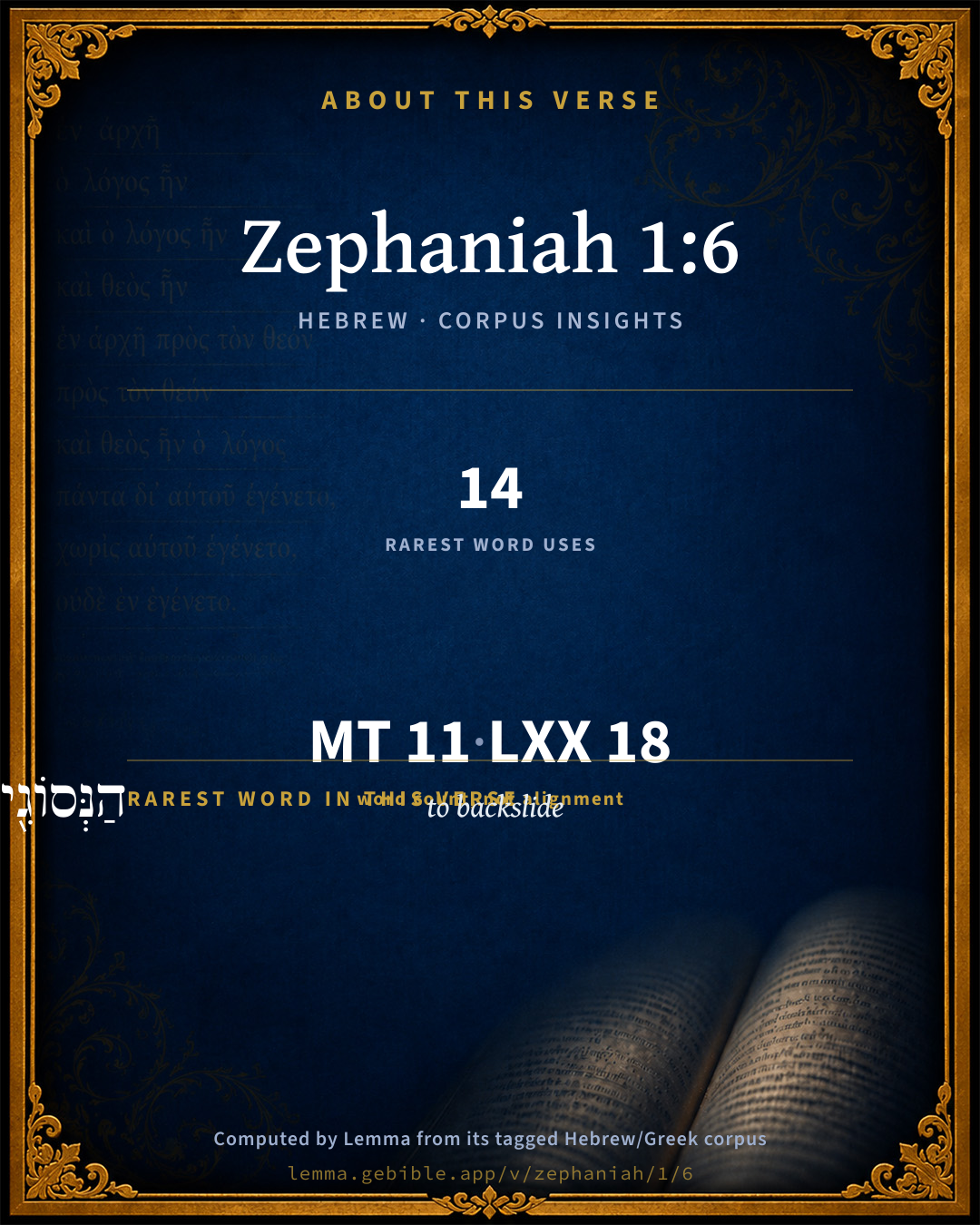
The rarest word here is הַנְּסוֹגִ֖ים to backslide H5472 — appearing just 14 times in the whole Hebrew Bible.

Shared distinctive vocabulary

הַנְּסוֹגִ֖ים to backslide H5472 occurs in 14 verses of the Hebrew Bible. Also found in:

Grammatical profile

  • 3 verbs
  • 2 nouns
  • 1 preposition
  • 5 particles

Verb forms

  • הַנְּסוֹגִ֖ים Niphal · Participle Active
  • בִקְשׁ֥וּ Piel · Perfect
  • דְרָשֻֽׁהוּ Qal · Perfect

Repetition

Words recur within this verse — often emphatic in Hebrew:

  • יְהוָ֑ה LORD H3068 ×2
  • לֹֽא not H3808 ×2

Hebrew & Septuagint length

In English translation the verse runs 18 words from the Hebrew and 23 from the Septuagint (LXX English) — closely comparable.

A rough comparison of the two English renderings, which tokenize alike — not a word-level alignment.

Word counts can differ between the Hebrew and the Greek without any difference in meaning — e.g. the Hebrew direct-object marker אֵת has no separate Greek word, and Greek often adds the article ὁ.

In the original languages it is 11 Hebrew tokens and 18 Greek tokens — but the two are counted differently (Hebrew bundles its prefixes and suffixes into one token; the Greek is in lemma form), so that isn’t a like-for-like length.

Cross-references

20

Topical passages linked to Zephaniah 1:6 in the Treasury of Scripture Knowledge — connected by theme and wording, ordered by reader-vote popularity; previews shown in the World English Bible.

  • Isaiah 1:4 Ah sinful nation, A people loaded with iniquity, A seed of evil-doers, Children who deal corruptly! They have forsaken Yahweh. They have despised the Holy One of Israel. They are estranged and backward.
  • Jeremiah 2:13 For my people have committed two evils: they have forsaken me, the spring of living waters, and hewed them out cisterns, broken cisterns, that can hold no water.
  • Jeremiah 15:6 You have rejected me, says Yahweh, you are gone backward: therefore have I stretched out my hand against you, and destroyed you; I am weary with repenting.
  • Jeremiah 2:17 Haven't you procured this to yourself, in that you have forsaken Yahweh your God, when he led you by the way?
  • Isaiah 9:13 Yet the people have not turned to him who struck them, neither have they sought Yahweh of Hosts.
  • Jeremiah 3:10 Yet for all this her treacherous sister Judah has not returned to me with her whole heart, but only in pretense, says Yahweh.
  • Ezekiel 3:20 Again, when a righteous man does turn from his righteousness, and commit iniquity, and I lay a stumbling block before him, he shall die: because you have not given him warning, he shall die in his sin, and his righteous deeds which he has done shall not be remembered; but his blood will I require at your hand.
  • Hosea 11:7 My people are determined to turn from me. Though they call to the Most High, He certainly won't exalt them.
  • Hebrews 10:38–39 But the righteous will live by faith. If he shrinks back, my soul has no pleasure in him."
  • 1 Samuel 15:11 It repents me that I have set up Saul to be king; for he is turned back from following me, and has not performed my commandments. Samuel was angry; and he cried to Yahweh all night.
  • Psalms 10:4 The wicked, in the pride of his face, Has no room in his thoughts for God.
  • Psalms 125:5 But as for those who turn aside to their crooked ways, Yahweh will lead them away with the workers of iniquity. Peace be on Israel.
  • Hosea 4:15–16 "Though you, Israel, play the prostitute, Yet don't let Judah offend; And don't come to Gilgal, Neither go up to Beth Aven, Nor swear, 'As Yahweh lives.'
  • Hebrews 2:3 how will we escape if we neglect so great a salvation-- which at the first having been spoken through the Lord, was confirmed to us by those who heard;
  • 2 Peter 2:18–22 For, uttering great swelling words of emptiness, they entice in the lusts of the flesh, by licentiousness, those who are indeed escaping from those who live in error;
  • Psalms 14:2–3 Yahweh looked down from heaven on the children of men, To see if there were any who did understand, Who did seek after God.
  • Psalms 36:3 The words of his mouth are iniquity and deceit. He has ceased to be wise and to do good.
  • Hosea 7:7 They are all hot as an oven, And devour their judges. All their kings have fallen. There is no one among them who calls to me.
  • Isaiah 43:22 Yet you have not called on me, Jacob; but you have been weary of me, Israel.
  • Romans 3:11 There is no one who understands. There is no one who seeks after God.

Cross-references courtesy of OpenBible.info (CC BY 4.0).

Hebrew and Greek witnesses Masoretic Hebrew ↔ Greek Septuagint

The same verse in the two great witnesses to the Old Testament, shown verse-for-verse.

These are two independent witnesses, not word-aligned to each other, and the Septuagint is shown in lemma (dictionary) form.

Hebrew Zephaniah 1:6 Masoretic · Westminster Leningrad Codex

וְאֶת הַנְּסוֹגִ֖ים מֵאַחֲרֵ֣י יְהוָ֑ה וַאֲשֶׁ֛ר לֹֽא בִקְשׁ֥וּ אֶת יְהוָ֖ה וְלֹ֥א דְרָשֻֽׁהוּ

those who have turned back from following Yahweh, and those who haven't sought Yahweh nor inquired after him.

World English Bible · Public Domain

Greek LXX Zephaniah 1:6 Septuagint · lemma form

καί ὁ ἐκκλίνω ἀπό ὁ κύριος καί ὁ μή ζητέω ὁ κύριος καί ὁ μή ἀντιἔχω ὁ κύριος

and them that turn aside from the Lord, and them that seek not the Lord, and them that cleave not to the Lord.

LXX2012 (modern English Septuagint) · Public Domain

Hebrew: Westminster Leningrad Codex (CC BY 4.0). Greek: Septuagint (public domain); English from LXX2012 (modern English Septuagint) (Public Domain). How the Septuagint differs from the Hebrew →

Targum (Aramaic paraphrase)

1

The Targum is the ancient Jewish Aramaic paraphrase of the Hebrew Scriptures — an interpretive translation, not the Hebrew text itself. Onkelos (literal) and Pseudo-Jonathan (expansive) render the Torah, and Jonathan the Prophets. Coverage is partial: where no permissively-licensed English translation exists for a verse, only the Aramaic is shown. This is verse-level text, not a word-by-word alignment to the Hebrew.

  1. Targum Jonathan Prophets (Joshua–Malachi)
    וְיַת דְאִסְתַּחָרוּ לַאֲחוֹרָא מִבָּתַר פּוּלְחָנָא דַייָ וּדְלָא תְבָעוּ יַת דַחַלְתָּא דַייָ וְלָא בְעוֹ מִן קֳדָמוֹהִי:

    (no public-domain English translation for this verse)

    Targum Jonathan — Aramaic: “Mikraot Gedolot” (public domain). English: “Sefaria Community Translation” (CC0 1.0 (public-domain dedication)); “London "Chaldee Paraphrase," 1871” (public domain). Text via Sefaria.

Commentary

Notes on Zephaniah 1:6 from classic Christian and Jewish commentators (each source and its license shown beneath its notes). The classic Christian expositions comment on the surrounding passage and are grouped to its opening verse, so a note may address several verses; the Jewish commentaries on the Tanakh (Rashi and others) are per-verse, so they appear only where the commentator wrote on this verse.

Lemma curates 59 commentaries, every one of them public domain or Creative Commons licensed, each selected and text-cleaned for this edition rather than reprinted as found. About our sources →

Trapp's Complete Commentary

John Trapp

Zep 1:6 And them that are turned back from the LORD; and [those] that have not sought the LORD, nor enquired for him.

Ver. 6. And them that are turned back from the Lord] Not gross idolaters, but yet treacherous backsliders, that fall off from their former forwardness, that turn from the holy commandments, 2Pe 2:21, that depart a post Dominum, from after the Lord, as the Hebrew here hath it, apostates, those worst of men, that do not only not fulfil after the Lord, as Caleb, but utterly forsake him. A heavier judgment awaiteth such. "God shall lead them forth with the workers of iniquity," Psa 125:5.

And those that have not sought the Lord, nor enquired after him] Diligently sought him, Heb 11:6, zealously inquired after him, as after a lost jewel, Jer 29:13. God will visit for unzealousness; and curse those that do his work carelessly, cursorily, in a perfunctory, formal, bedulling way.

John Trapp, A Commentary or Exposition upon All the Books of the Old and New Testament (1647–1656) — public domain. Text from a community e-Sword module.

Jamieson, Fausset & Brown

Robert Jamieson, A. R. Fausset & David Brown

This verse describes more comprehensively those guilty of defection from Jehovah in any way (Jer 2:13, Jer 2:17).

Jamieson, Fausset & Brown — Commentary Critical and Explanatory on the Whole Bible (1871) — public domain (CC PDM 1.0). Text via the HelloAO Bible API.

Adam Clarke's Commentary

Verse 6. Them that are turned back] Who have forsaken the true God, and become idolaters.

Nor inquired for him] Have not desired to know his will.

Adam Clarke's Commentary on the Bible (1810–1826) — public domain. Text from a community e-Sword/MySword module.

John Calvin's Commentaries

The Prophet seems here to include, as it were, in one bundle, the proud despisers of God, as well as those idolaters of whom he had spoken. It may yet be, that he describes the same persons in different words, and that he means that they were addicted to their own superstitions, because they were unwilling to serve God sincerely and from the heart, and even shunned everything that might lead their attention to true religion. And this view I mostly approve; for what some imagine, that their gross contempt of God is here pointed out, is not sufficiently supported. I therefore rather think that the idolaters are here reproved, that they might not suppose that they could by subterfuges wash away their guilt; for they were wont to cover themselves with the shield of ignorance, when they were overcome, and their impiety was fully proved: I did not think so; but, on the contrary, my purpose was to worship God. Since, then, the superstitious are wont to hide themselves under the covering of ignorance, the Prophet here defines the idolatry of the people, and briefly shows that it was connected with obstinacy and wickedness.

They did not seek Jehovah; but, on the contrary, they turned willfully away from him, and sought, as it were designedly, to extinguish true religion. Nor was it to be wondered at, that so grievous and severe a sentence was pronounced on them; for they had been taught by the law how God was to be served. How was it, then, that errors so gross had crept in? Doubtless, God had kindled the light of celestial truth, which clearly showed the way of true religion; but as men ever seek to perform some frivolous trifles, the Israelites and the Jews, when they felt ashamed openly and manifestly to reject the true God, labored at the same time to add many ceremonies, that their impiety might be thus concealed. This is the reason why the Prophet says that they turned back; that is, that they could not be excused on the ground of ignorance, but that they were perfidious and apostates, who had preferred their own idols to the true God; though they knew that he could not be rightly worshipped, but according to the rule prescribed in the law, they yet neglected this, and heaped together many superstitions.

And, doubtless, we shall find that the fountain of all false worship is this—that men are unwilling truly and from the heart to serve God; and, at the same time, they wish to retain some appearance of religion. For there is nothing omitted in the law that is needful for the perfect worship of God: but as God requires in the law a spiritual worship, hence it is that men seek hiding-places, and devise for themselves many ceremonies, that they may turn back from God, and yet pretend that they come to him. While they sedulously labor in their own ceremonies, it is indeed true that the worship of God and religion are continually on their lips: but, as I have said, it is all hypocrisy and deception; for they accumulate ceremonies, that there might be something intervening between God and them. It is not, therefore, without reason that the Prophet here accuses the Jews that they turned back from Jehovah, and that they sought him not. How so? For there was no need of a long, or of a difficult, or of a perplexed enquiry; for the Lord had freely offered himself to them. How, then, was it that they were blind in the midst of light, except that they knowingly and willfully followed their own inventions?

The same is the case at this day with the Papists: for though they may glamour a hundred times that they seek to worship God, it is quite evident that they willfully go astray; inasmuch as they so delight themselves with their own inventions, that they do not purely and from the heart devote and consecrate themselves to God.

We now, then, see that this verse was added, as an explanation, by the Prophet, that he might deprive the Jews of their false plea of ignorance, and show that they sinned willfully; for they would have been sufficiently taught by the law, had they not adopted their own inventions, which dazzled their eyes and all their senses. It follows—

John Calvin's Commentaries (1540-1563) — public domain. Text from the Calvin Translation Society English edition (1840s-50s) via the Christian Classics Ethereal Library (ccel.org). Calvin's coverage is partial (roughly two-thirds of the Bible); uncommented books and verses are honest gaps, never fabricated. The 19th-century editor's footnotes and remarks are omitted so the notes are faithfully Calvin's own voice.

Ellicott's Commentary for English Readers

(6) Schmieder observes that the enumeration of Zep_1:4-6 extends from gross external to refined internal apostasy. “The Lord will destroy (1) the idols of Baal; (2) their priests; (3) those who openly worship them on housetops; (4) the secret worshippers; (5) those who, without worshipping idols, have apostatised in their hearts; (6) those who are indifferent to religion.”

A Bible Commentary for English Readers, edited by Charles John Ellicott (1878–1897) — public domain. Text from a community e-Sword module.

The Cambridge Bible for Schools and Colleges

gen. ed. J. J. S. Perowne

6. In this verse also one class of persons is described in two ways: those who have turned away from Jehovah and who do not seek Him. Comp. the prophet’s exhortation ch. Zep_2:2, “seek ye the Lord, all ye meek of the earth.”

The Cambridge Bible for Schools and Colleges (gen. ed. J. J. S. Perowne; Cambridge University Press, 1878–1918) — public domain. Text from a community e-Sword module.

John Gill's Exposition

And them that are turned back from the Lord Who once were worshippers of him, but now become apostates, and had turned their backs on him and his worship. Some think this describes those who renewed their covenant with God in Josiah's time, and after that revolted from him, who must be very abominable to him; and therefore he threatens to stretch out his hand, and pour out his wrath upon them: and [those] that have not sought the Lord, nor inquired for him; profane abandoned sinners, that lived without God in the world, and as if there was no God; never concerned themselves about the worship of him, having no faith in him, love to him, or fear and reverence of him; so far were they from seeking him in the first place diligently, zealously, and with their whole heart, that they never sought him at all; nor took any pains to get any knowledge of him, or of his mind and will, and manner of worship; but were altogether careless about these things, and unconcerned for them.

John Gill's Exposition of the Whole Bible (1746–1763) — public domain (CC PDM 1.0). Text via the HelloAO Bible API.

Albert Barnes' Notes on the Bible

And them that are turned back from - (Literally, have turned themselves back from following after) the Lord From this half-service, the prophet goes on to the avowed neglect of God, by such as wholly fall away from Him, not setting His will or law before them, “but turning away from” Him. It is their misery that they were set in the right way once, but themselves “turned themselves back,” now no longer “following” God, but “their own lusts, drawn away and enticed” Jam 1:14 by them. How much more Christians, before whose eyes Christ Jesus is set forth, not as a Redeemer only but as an Example that they should “follow His steps!” 1Pe 2:21.

And those that have not sought the Lord, nor inquired for Him - This is marked to be a distinct class. “And those who.” These did not openly break with God, or turn away overtly from Him; they kept (as men think) on good terms with Him, but, like “the slothful servant,” rendered Him a listless heartless service. Both words express diligent search. God is not found then in a careless way. They who “seek” Him not “diligently” Mat 2:8, do not find Him. “Strive,” our Lord says, “to enter in at the strait gate, for many, I say unto you, shall seek to enter in, and shall not be able” Luk 13:24. She who had lost the one piece of silver, “sought” “diligently” Luk 15:8, until she had found it.

Thus, he has gone through the whole cycle. First, that most horrible and cruel worship of Baal, the idolatrous priests and those who had the name of priests only, mingled with them, yet not openly apostatizing; then the milder form of idolatry, the star-worshipers; then those who would unite the worship of God with idols, who held themselves to be worshipers of God, but whose real king was their idol; then those who openly abandoned God; and lastly those who held with Him, just to satisfy their conscience-qualms, but with no heart-service. And so, in words of Habakkuk and in reminiscence of his awful summons of the whole world before God, he sums up;

Albert Barnes' Notes on the Bible (1834–1885) — public domain. Text from a community e-Sword/MySword module.

Matthew Poole's English Annotations

Them that are turned back; apostates, who have forsaken the Lord and his worship, or that are turned atheists, or that in matter of religion have taken up not what is purest and truest, but what is nearest and most in fashion.

That have not sought the Lord; sluggishly neglected to examine pretended religions, according to the law, which they might and ought to have done, and who have embraced a fall religion instead of the true.

Nor inquired for him: though the prophets have preached against this apostacy, and called the priests and people to forsake the idols, and inquire after God, yet they would not inquire; these also are here doomed to destruction.

Matthew Poole's English Annotations on the Holy Bible (1683–1685) — public domain. Text from a community e-Sword/MySword module.

The Pulpit Commentary

Them that are turned back from the Lord. This is a third class, vie. apostates and open despisers. Those who follow him no more, renegades who have left his service. The Vulgate reproduces the original by, qui avertuntur de post tergum Domini. Those that have not sought the Lord. These are the indifferent, who do not trouble themselves about religion. The chief classes mentioned in these two verses are three, viz. the open idolaters, the syncretists who mingled the worship of Baal with that of Jehovah, and those who despised religion altogether.

The sin of apostasy.

"And them that are turned back from the Lord." Some biblical expositors regard the whole of this verse as referring to one class, even to such as are utterly indifferent and unconcerned in reference to God"s claims; whilst other commentators regard this class as referred to in the latter part of the verse, and view the expression, "And them that are turned back from the Lord" as an allusion to those who, having professed loyalty to God and his truth, had allowed themselves to be drawn away and to walk no more with him. Concerning this sin of apostasy, note

I THE CAUSES WHICH HAVE RESULTED IN MEN FALLING INTO THIS SIN.

1. Temporal success. Favourable progress in the affairs of this life has proved the ruin of many spiritually. They have set their hearts upon their treasures, and have bowed down before the golden image (Deu_32:15)

2. Temporal adversity. "The cares of life, as well as "the deceitfulness of riches," will often choke the Word. The very troubles which should unite men to God by a closer bond (for if all else fail, he abides) have been permitted to drive them away from the Source of consolation and help.

3. Mental difficulties. Forgetful that Truth is boundless and immeasurable, and that after the most earnest research there must remain profound depths yet to be explored, the inquirer has wanted to understand fully now, and, failing in this, has, through pride of intellect, brought himself into a state of mental unsettledness, so that even the plainly declared truths of revelation have lost their charm to him, and he has taken shelter in unbelief.

4. Worldliness; by which term is meant love of the untrue and unsubstantial; regard only for the outward, the transient, the unreal; the world becoming invested with ruling power over the man, instead of the man reigning over it. So Paul wrote of Demas, that he had yielded here. (2Ti_4:10)

II THE INTENSE SADNESS ASSOCIATED WITH THIS COURSE OF ACTION,

1. It involves the violation of the most solemn and sacred vows.

2. It is attended by separation from the most holy and helpful associations.

3. It hinders the progress of the cause of God.

4. It grieves and dishonours the Lord.

III THE SPIRIT WHICH SHOULD BE CHERISHED BY THE FAITHFUL IN REFERENCE TO THOSE THAT ARE TURNED BACK FROM THE LORD.

1. There must be no palliation of their sin. Zephaniah uttered burning words of condemnation with reference to these transgressors, and we shall not really help such by making light of their sin.

2. Yet we should earnestly seek their recovery. We should endeavour by kindness and gentleness to restore these erring ones. Although they may be darkly stained by sin, they are still our brethren. Whilst they have stumbled and fallen in the path, it is in very weakness that we ourselves have trodden it. The tender, loving word may perchance win them back to holiness and to God. In voyaging, some vessels are completely lost, they go down through the storm, and utterly perish; others arrive at the port, but with masts broken and sails torn through battling with wind and wave; whilst others outride every storm, and with full sail enter the destined haven. Thus was it, one has pointed out, with the three associates of St. Paul who are specially referred to in 2Ti 4; and thus is it in the spiritual life. Demas, wrecked; Mark, overpowered by adverse gales and seemingly crushed, yet rising again and reaching the harbour at length in safety; but Luke, "the beloved physician," holding peacefully and tranquilly on his course all through, and having ministered to him an abundant entrance to the heavenly kingdom (see paper by Dr. Maclaren, Good Words, 1877, p. 595). May our course be as the last named of these disciples, unmarked either by failure or even by temporary estrangement, but being steadfast and immovable! May no place be found by us amongst those "that have turned themselves back from following after the Lord"! May we, escaping the perils of the sea of life all its shoals and quicksands reach at last the haven of eternal rest and felicity!

The sin of indifference.

"And those that have not sought the Lord, nor inquired for him." Various classes of transgressors are alluded to in these verses (vers. 4-6). The corrupt priests and their followers, those dividing their allegiance between God and Baal, the backsliders in heart, are all spoken of in brief and forcible sentences. And now, in the expression before us, allusion is made to the unconcerned and indifferent, and who are described as "those that have not sought the Lord, nor inquired for him." This class is, in some respects, the most hopeless of all. An idolater is interested in worship, and may become convinced of his folly in rendering this to "the work of his own hands." The divided heart is partially directed to God, and may be won over to complete loyalty. The backslider may remember the joys he has forfeited, and, by the sacred memories of the past, which even his estrangement cannot obliterate, may be constrained to return unto the Lord. But in proportion as a man is callous and indifferent to the claims of God, he places himself outside the circle within which holy and gracious influences operate. Less fear need be cherished of the pernicious influence of the scepticism of the age than of the fatality attendant upon the spirit of indifferentism to God and his claims which so widely prevails. Observe

I THE PREVALENCE OF THIS SPIRIT MAY BE ACCOUNTED FOR.

1. The reason of it is to be found in the fact of possession. Nothing is more calculated to lead a man to be indifferent in reference to higher claims than to find property increasing in his hands. The consciousness of independence, the sense of self-sufficiency, and the feeling of comfort, all tend to lead him to think and act as though he had "need of nothing." "A certain man made a great supper, and bade many." One thus invited said, "I have bought a piece of ground, and I must needs go and see it: I pray thee have me excused". (Luk_14:16-18) See. well to it, ye who have secured the possessions of earth, that ye do not, through the influence of these material things, come short of participation in the true festal joys.

2. Another reason lies in the fact of familiarity. Is it not so that our very familiarity with anything is likely to lead us in a sense to be somewhat indifferent to it? A walk may appear long, and may be long; but take it frequently, and the distance will appear to lessen, and in time it will cease to affect you. View constantly the scenery of some charming dale, and however much of quiet enjoyment you will get out of it perpetually if you are a lover of natural beauty, yet you will not be so enthusiastic as a stranger who gazes upon it for the first time. And much of the prevailing indifference concerning God and his truth may be traced to this cause. When King Clovis heard for the first time the story of Calvary, it is said he grew excited, and cried out, "I wish I"d been there with my Franks; I"d soon have settled those Jews!" The novelty charmed the rude king; but men all around us are so familiar with the Story that they are not moved thus; and multitudes are so unconcerned respecting these great themes as that they may be described as "those who have not sought the Lord, nor inquired for him,

3. This indifference may also be traced to custom. The power of habit is very strong. Men became confirmed in their ways. (Jer_13:23)

II THEY WHO CHERISH THIS SPIRIT RUN THE RISK OF INCURRING INFINITE LOSS. Loss may be incurred unintentionally and through indifference and neglect. You neglect to insure your property, and perchance a fire breaks out and destroys it, and yon find yourself thrown back for years to come; or you neglect your health and fail to heed the first symptoms of disease, and it may end in the disease gaining too firm a hold for it ever to be eradicated; and so spiritual and eternal honour may be forfeited, not wilfully, but through indifference and unconcern.

III HENCE THE SUPREME VALUE OF THE PRESENT TIME WITH ITS OPPORTUNITIES. Our great dramatist has it"There is a tide in the affairs of men, Which, taken at the flood, leads on to fortune Omitted, all the voyage of their life Is bound in shallows and in miseries.

And it is so that there is a tide in the spiritual affairs of men. Human feelings, sentiments, desires, ebb and flow like the sea; and there are seasons in which this tide sets towards piety; and such a season, if only improved, "is the accepted time," "the day of salvation." Use it, and it shall not be said that you belong to those "that have not sought the Lord," etc. (ver. 6).

The Pulpit Commentary (1880–1919), ed. H.D.M. Spence-Jones & Joseph S. Exell — public domain. Text from a community e-Sword module.

Lesson kit

Teaching starters — assembled from the data on this page, not authored interpretation. Every prompt links to the verse data it draws on. Edit before teaching.

Zephaniah, in the Prophets, opens this verse with 11 words (8 distinct Hebrew lemmas). Its most distinctive word is çûwg (“to backslide”). A historical commentator’s framing appears above. Read the whole chapter for the surrounding context.

Discussion questions

  1. How does “to backslide” (çûwg) shape what this verse is saying?
  2. How does Psalms 35:4, which shares the word «to backslide», read alongside this verse?
  3. What does the repetition of “LORD” (2× in this one verse) do in this verse?
  4. These translations render this verse differently. What is at stake in choosing one wording over another?
  5. «הַנְּסוֹגִ֖ים» is a Niphal Participle Active verb. How does that grammatical form shape the action described?
  6. Compare how Trapp's Complete Commentary and Jamieson, Fausset & Brown read this verse. Where do they agree or differ?

Things to notice

Reading settings

Reading text

Shown beneath each verse's original-language words.

Old Testament
Old Testament edition

Read the OT as the Masoretic Hebrew (MT) or the Greek Septuagint (LXX).

English shown for the Greek Septuagint (in the Hebrew ↔ Greek comparison).

Comparing translations? Open the Compare panel on any verse page to stack up to four side by side.