
Exodus 18:15

Hebrew (Westminster Leningrad Codex) Exodus 18:15 appears in the Hebrew Old Testament. The text above is from the Westminster Leningrad Codex. Each word links to its Strong’s number, a concise gloss, and parsing drawn from the Open Scriptures Hebrew Bible morphology. Click any word for its full Brown-Driver-Briggs (BDB) entry.
Download image
Cite this verse

Exodus 18:15 (World English Bible). Public Domain. Lemma interlinear Bible study tool, https://lemma.gebible.app/v/exodus/18/15.

Show BibTeX & RIS
BibTeX
RIS
English Translation
Moses said to his father-in-law, "Because the people come to me to inquire of God.
World English Bible · Public Domain
Download a study sheet

One document with this verse’s original text, its word-by-word gloss line, the meaning frame, cross-references with their text, attributed commentary, and full source and license credits — printable, and it pastes into notes with its structure intact.

This verse Autodidact and up

Study sheet (.html) Plain text (.txt)

A passage Seminary Student

Up to 50 verses in one chapter. A passage sheet keeps up to 6 commentary sources and 12 cross-references per verse, in the order this page ranks them, and says so on the sheet whenever that leaves anything out. Ask for a single verse and you get the Autodidact verse sheet above.

Everything on this page stays free to read, with no account — the sheet is a download of what is already on screen, not access to it.

Want to remove ads? Support Godless Engineer
Compare translations 3

The same verse in 3 English versions, stacked beneath the original-language interlinear above. Click any original word for its lexicon entry.

Each is an independent rendering of the whole verse — the interlinear is not word-aligned to these translations.

Highlighted words mark where these versions differ — a whole-verse word diff, not a word-by-word alignment.

  • World English Bible Public Domain
    Moses said to his father-in-law, "Because the people come to me to inquire of God.
  • King James Version Public Domain
    And Moses said unto his father in law, Because the people come unto me to inquire of God:
  • unfoldingWord Literal Text CC BY-SA 4.0
    And Moses said to his father-in-law, “Because the people come to me to inquire of God.

unfoldingWord Literal Text — © unfoldingWord, licensed CC BY-SA 4.0. Word-aligned USFM3 via Door43 (git.door43.org/unfoldingWord/en_ult).

Versions to compare (up to 4)

3 of 4 selected

Show all 18 translations

Every available English version of this verse, each an independent rendering of the whole verse.

  • World English Bible Public Domain
    Moses said to his father-in-law, "Because the people come to me to inquire of God.
  • Berean Standard Bible Public Domain
    “Because the people come to me to inquire of God,” Moses replied.
  • Majority Standard Bible Public Domain
    “Because the people come to me to inquire of God,” Moses replied.
  • King James Version Public Domain
    And Moses said unto his father in law, Because the people come unto me to inquire of God:
  • American Standard Version (1901) Public Domain
    And Moses said unto his father-in-law, Because the people come unto me to inquire of God:
  • Revised Version (1885) Public Domain
    And Moses said unto his father in law, Because the people come unto me to inquire of God:
  • Geneva Bible (1599) Public Domain
    And Moses sayd vnto his father in law, Because the people come vnto me to seeke God.
  • Douay-Rheims (1899) Public Domain
    And Moses answered him: The people come to me to seek the judgment of God.
  • Young's Literal Translation Public Domain
    And Moses saith to his father-in-law, `Because the people come unto me to seek God;
  • Literal Standard Version CC BY-SA 4.0
    And Moses says to his father-in-law, “Because the people come to me to seek God;
  • Unlocked Literal Bible CC BY-SA 4.0
    Moses said to his father-in-law, “The people come to me to ask for God's direction.
  • unfoldingWord Literal Text CC BY-SA 4.0
    And Moses said to his father-in-law, “Because the people come to me to inquire of God.
  • Darby Bible Public Domain
    And Moses said to his father-in-law, Because the people come to me to enquire of God.
  • World Messianic Bible Public Domain
    Moses said to his father-in-law, “Because the people come to me to inquire of God.
  • Webster's Bible Public Domain
    And Moses said to his father-in-law, Because the people come to me to inquire of God:
  • Free Bible Version CC BY-SA 4.0
    “Because the people come to me to ask God for his decision,” Moses replied.
  • Bible in Basic English Public Domain
    And Moses said to his father-in-law, Because the people come to me to get directions from God:
  • JPS Tanakh (1917) Public Domain
    And Moses said unto his father-in-law: 'Because the people come unto me to inquire of God;

Literal Standard Version (2020), Covenant Press — licensed CC BY-SA 4.0. Text via the HelloAO Bible API (eBible.org). Unlocked Literal Bible (unfoldingWord) — licensed CC BY-SA 4.0. Text via the HelloAO Bible API (eBible.org). unfoldingWord Literal Text — © unfoldingWord, licensed CC BY-SA 4.0. Word-aligned USFM3 via Door43 (git.door43.org/unfoldingWord/en_ult). Free Bible Version, Dr. Jonathan Gallagher — licensed CC BY-SA 4.0. Text via the HelloAO Bible API (eBible.org).

Word by word

More ways to search: Search by grammar → Find every occurrence → Compare this word →

Practice this passage: Drill this verse → Learn its vocabulary →

לְחֹתְנ֑וֹ
châthan
H2859
“to/for · marrying · him”
Preposition + Verb, Qal, Participle Active, Masculine, Singular, Construct + Suffix, Personal, 3rd Person, Masculine, Singular
Part of Speech
Preposition + Verb
Stem
Qal
Form
Participle Active
Gender
Masculine
Number
Singular
State
Construct
Full BDB Definition

Origin: a primitive root

TWOT: 781b

to become a son-in-law, make oneself a daughter's husband - (Qal) wife's father, wife's mother, father-in-law, mother-in-law (participle) - (Hithpael) to make oneself a daughter's husband
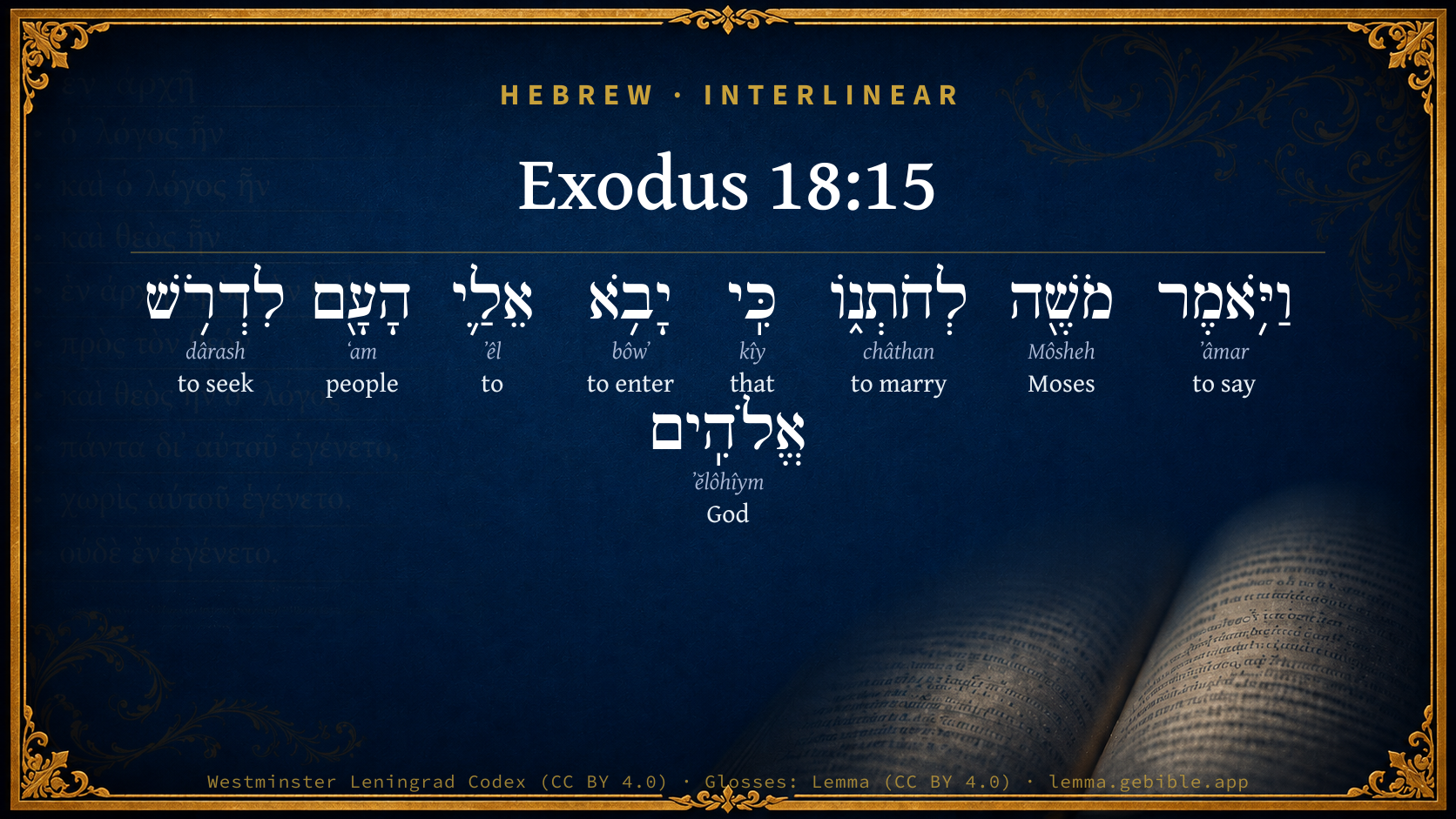
  1. וַיֹּ֥אמֶר ʼâmar H559 “and · to say” Conjunction + Verb, Qal, Sequential Imperfect, 3rd Person, Masculine, Singular
  2. מֹשֶׁ֖ה Môsheh H4872 “Moses” Noun, Proper
  3. כִּֽי kîy H3588 “that” Conjunction
  4. יָבֹ֥א bôwʼ H935 “to enter” Verb, Qal, Imperfect, 3rd Person, Masculine, Singular
  5. אֵלַ֛י ʼêl H413 “to · me” Preposition + Suffix, Personal, 1st Person, Common, Singular
  6. הָעָ֖ם ʻam H5971 “the · people” Particle, Definite Article + Noun, Common, Masculine, Singular, Absolute
  7. לִדְרֹ֥שׁ dârash H1875 “to seek” Preposition + Verb, Qal, Infinitive Construct
  8. אֱלֹהִֽים ʼĕlôhîym H430 “God(s)” Noun, Common, Masculine, Plural, Absolute

About this verse

These counts appear in no published source. They are computed here, from the morphology-tagged text and Lemma’s own curated glosses. What Lemma adds →

9
words
9
distinct lemmas
Pentateuch
section

Shared distinctive vocabulary

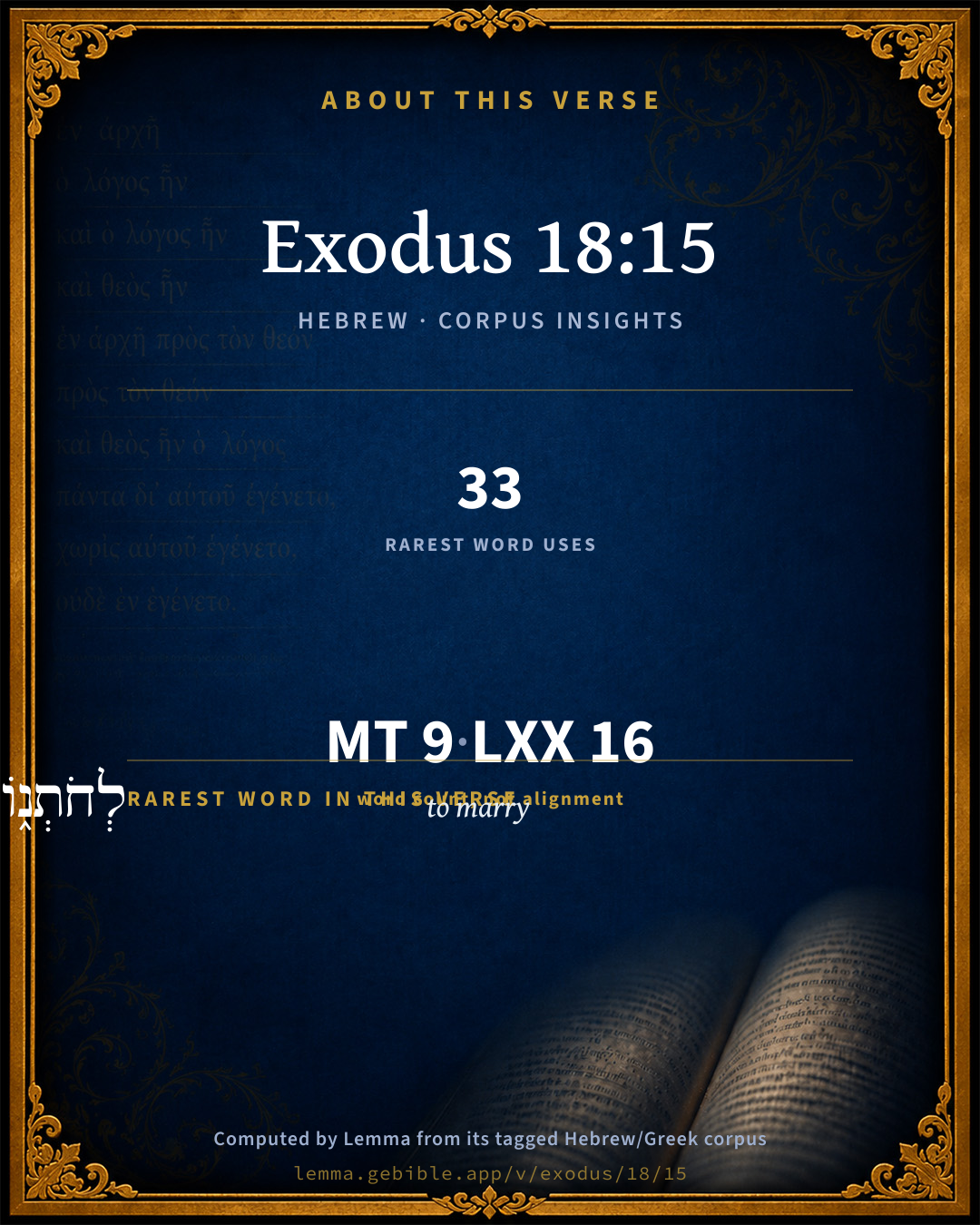
לְחֹתְנ֑וֹ to marry H2859 occurs in 32 verses of the Hebrew Bible. Also found in:

Grammatical profile

  • 4 verbs
  • 3 nouns
  • 1 preposition
  • 1 conjunction

Verb forms

  • וַיֹּ֥אמֶר Qal · Sequential Imperfect
  • לְחֹתְנ֑וֹ Qal · Participle Active
  • יָבֹ֥א Qal · Imperfect
  • לִדְרֹ֥שׁ Qal · Infinitive Construct

Hebrew & Septuagint length

In English translation the verse runs 15 words from the Hebrew and 17 from the Septuagint (LXX English) — closely comparable.

A rough comparison of the two English renderings, which tokenize alike — not a word-level alignment.

Word counts can differ between the Hebrew and the Greek without any difference in meaning — e.g. the Hebrew direct-object marker אֵת has no separate Greek word, and Greek often adds the article ὁ.

In the original languages it is 9 Hebrew tokens and 16 Greek tokens — but the two are counted differently (Hebrew bundles its prefixes and suffixes into one token; the Greek is in lemma form), so that isn’t a like-for-like length.

Cross-references

7

Topical passages linked to Exodus 18:15 in the Treasury of Scripture Knowledge — connected by theme and wording, ordered by reader-vote popularity; previews shown in the World English Bible.

  • Numbers 15:34 They put him in custody, because it had not been declared what should be done to him.
  • Numbers 27:5 Moses brought their cause before Yahweh.
  • Exodus 18:19–20 Listen now to my voice. I will give you counsel, and God be with you. You represent the people before God, and bring the causes to God.
  • Leviticus 24:12–14 They put him in custody, until the will of Yahweh should be declared to them.
  • Numbers 9:6 There were certain men, who were unclean because of the dead body of a man, so that they could not keep the Passover on that day, and they came before Moses and before Aaron on that day.
  • Numbers 9:8 Moses answered them, "Wait, that I may hear what Yahweh will command concerning you."
  • Deuteronomy 17:8–13 If there arise a matter too hard for you in judgment, between blood and blood, between plea and plea, and between stroke and stroke, being matters of controversy within your gates; then shall you arise, and go up to the place which Yahweh your God shall choose;

Cross-references courtesy of OpenBible.info (CC BY 4.0).

Hebrew and Greek witnesses Masoretic Hebrew ↔ Greek Septuagint

The same verse in the two great witnesses to the Old Testament, shown verse-for-verse.

These are two independent witnesses, not word-aligned to each other, and the Septuagint is shown in lemma (dictionary) form.

Hebrew Exodus 18:15 Masoretic · Westminster Leningrad Codex

וַיֹּ֥אמֶר מֹשֶׁ֖ה לְחֹתְנ֑וֹ כִּֽי יָבֹ֥א אֵלַ֛י הָעָ֖ם לִדְרֹ֥שׁ אֱלֹהִֽים

Moses said to his father-in-law, "Because the people come to me to inquire of God.

World English Bible · Public Domain

Greek LXX Exodus 18:15 Septuagint · lemma form

καί λέγω μωυσῆς ὁ γαμβρός ὅτι παραγίγνομαι πρός ἐγώ ὁ λαός ἐκζητέω κρίσις παρά ὁ θεός

And Moses says to his father-in-law, Because the people come to me to seek judgment from God.

LXX2012 (modern English Septuagint) · Public Domain

On this verse, The Cambridge Bible for Schools and Colleges discusses the Septuagint’s reading. Read the note in Commentary ↓

Hebrew: Westminster Leningrad Codex (CC BY 4.0). Greek: Septuagint (public domain); English from LXX2012 (modern English Septuagint) (Public Domain). How the Septuagint differs from the Hebrew →

Targum (Aramaic paraphrase)

2

The Targum is the ancient Jewish Aramaic paraphrase of the Hebrew Scriptures — an interpretive translation, not the Hebrew text itself. Onkelos (literal) and Pseudo-Jonathan (expansive) render the Torah, and Jonathan the Prophets. Coverage is partial: where no permissively-licensed English translation exists for a verse, only the Aramaic is shown. This is verse-level text, not a word-by-word alignment to the Hebrew.

  1. Targum Onkelos Torah (Genesis–Deuteronomy)
    וַאֲמַר משֶׁה לַחֲמוּהִי אֲרֵי אָתָן לְוָתִי עַמָא לְמִתְבַּע אוּלְפַן מִן קֳדָם יְיָ:

    (no public-domain English translation for this verse)

    Targum Onkelos — Aramaic: “Onkelos Genesis” (public domain); “Onkelos Exodus” (public domain); “Onkelos Leviticus” (public domain); “Onkelos Numbers” (public domain); “Onkelos Deuteronomy” (public domain). English: “Sefaria Community Translation” (CC0 1.0 (public-domain dedication)); “J.W. Etheridge. The Targums of Onkelos and Jonathan Ben Uzziel on the Pentateuch. London: Longmans, Green, 1862” (public domain). Text via Sefaria.

  2. Targum Pseudo-Jonathan Torah (Genesis–Deuteronomy)
    וַאֲמַר משֶׁה לְחָמוֹי אֲרוּם אַתְיָין לְוָותִי עַמָא לְמִתְבּוֹעַ אוּלְפַן מִן קֳדָם יְיָ

    And Mosheh said to his father-in-law, Because the people come to me to inquire for instruction from before the Lord.

    Targum Pseudo-Jonathan — Aramaic: “Targum Jonathan on Genesis” (public domain); “Targum Jonathan on Exodus” (public domain); “Targum Jonathan on Leviticus” (public domain); “Targum Jonathan on Numbers” (public domain); “Targum Jonathan on Deuteronomy” (public domain). English: “The Targum of Jonathan ben Uzziel, trans. J. W. Etheridge, London, 1862” (public domain). Text via Sefaria.

Commentary

Notes on Exodus 18:15 from classic Christian and Jewish commentators (each source and its license shown beneath its notes). The classic Christian expositions comment on the surrounding passage and are grouped to its opening verse, so a note may address several verses; the Jewish commentaries on the Tanakh (Rashi and others) are per-verse, so they appear only where the commentator wrote on this verse.

Lemma curates 59 commentaries, every one of them public domain or Creative Commons licensed, each selected and text-cleaned for this edition rather than reprinted as found. About our sources →

Trapp's Complete Commentary

John Trapp

Exo 18:15 And Moses said unto his father in law, Because the people come unto me to enquire of God:

Ver. 15. To inquire of God.] For a divine sentence is in the mouth of the Judge: therefore also the place of judicature is called the holy place. {Ecc 8:10} Let those that go to law inquire of God, and rest in his will.

John Trapp, A Commentary or Exposition upon All the Books of the Old and New Testament (1647–1656) — public domain. Text from a community e-Sword module.

Joseph Benson's Commentary

Exo 18:15. The people came to inquire of God — And happy was it for them that they had such an oracle to consult. Moses was faithful both to him that appointed him, and to them that consulted him, and made them know the statutes of God, and his laws — His business was not to make laws, but to make known God’s laws: his place was but that of a servant.

Joseph Benson's Commentary on the Old and New Testaments (1811–1818) — public domain. Text from a community e-Sword module.

Geneva Bible (1599)

Geneva Bible translators

That is, to know God’s will, and to have justice executed.

Geneva Bible (1599) marginal notes — public domain. Text via Bolls.life.

Adam Clarke's Commentary

Verse 15. The people come unto me to inquire of God] To know the mind and will of God on the subject of their inquiries. Moses was the mediator between God and the people; and as they believed that all justice and judgment must come from him, therefore they came to Moses to know what God had spoken.

Adam Clarke's Commentary on the Bible (1810–1826) — public domain. Text from a community e-Sword/MySword module.

Ellicott's Commentary for English Readers

(15, 16) Moses assigns two reasons for his conduct.

A Bible Commentary for English Readers, edited by Charles John Ellicott (1878–1897) — public domain. Text from a community e-Sword module.

The Cambridge Bible for Schools and Colleges

gen. ed. J. J. S. Perowne

15. to inquire of God] i.e. to obtain from Him a legal decision. In early times judgement was a sacred act; legal decisions were regarded as coming from God, the judge being his representative, or mouthpiece (cf. v. 16 end)1[160], accordingly ‘God’ is sometimes used, where we should say ‘judge’ (see on Exo_21:6). Perhaps in very primitive times the decision was given by the sacred lot (cf. the use of the Urim and Thummim in 1Sa_14:41 LXX. [see Kennedy’s note in the Century Bible, or DB. iv. 839b]; and the ‘breastplate of judgement,’ ch. Exo_28:15): but the same view of the nature of judgement prevailed, even after this method of obtaining it was given up, or only resorted to exceptionally. To inquire of (or seek) God (דרש) in later times, means often to seek Him generally, in prayer and worship; but it means also, particularly in the early language, to resort to Him for the sake of obtaining an oracle, either in answer to some particular question, or, as here, a legal decision (LXX, ἐκζητῆσαι κρίσιν παρὰ τοῦ θεοῦ): see Gen_25:22 the answer follows in v. 23), 1Sa_9:9, 1Ki_22:8, 2Ki_3:11; 2Ki_8:8; 2Ki_22:13; 2Ki_22:18, Jer_21:2 (so, of inquiring of the dead, or of heathen gods, 1Sa_28:7, 2Ki_1:2, Deu_18:11, Isa_8:19 al.).

[160] So in Homer, θέμιστες are spoken of as received by kings from Zeus (Il. i. 239 οἵ τε θέμιστας Πρὸς Διὸς εἰρύαται); and cf. Sir Henry Maine, Ancient Law, ch. 1.

The Cambridge Bible for Schools and Colleges (gen. ed. J. J. S. Perowne; Cambridge University Press, 1878–1918) — public domain. Text from a community e-Sword module.

John Gill's Exposition

When they have a matter, they come unto me,.... This is the other thing he did for them, as the above writer observes; which being last mentioned, he speaks of first, as follows, meaning that when there was a matter in difference between two persons or more, and they could not agree upon it among themselves, then they brought it to him to be heard and decided:

and I judge between one and another; hear what they have to say on both sides, and then judge which is in the right and which is in the wrong, and determine what is to be done, according to the laws of God or according to the rules of justice and equity:

and I do make them know the statutes of God and his laws; this relates to the first thing, their coming to him to inquire of God, what is his mind and will, or what he would have them do; and in order to this, and in answer to their request, he instructed them in the laws of God, both civil and religious: this is made use of by some, to prove that Jethro's coming to Moses was after the law was given: but this does not necessarily follow, because Moses, by a divine impulse, might be directed immediately to make known to the people what was the will and mind of God, with respect to any particular case they inquired about; and rather this seems to furnish out an argument to the contrary, since, if the laws and statutes of God had yet been given on Mount Sinai, the people could not have been ignorant of them, and so needed not such daily information and instruction from Moses.

John Gill's Exposition of the Whole Bible (1746–1763) — public domain (CC PDM 1.0). Text via the HelloAO Bible API.

Albert Barnes' Notes on the Bible

To enquire of God - The decisions of Moses were doubtless accepted by the people as oracles. The internal prompting of the Spirit was a sufficient guidance for him, and a sufficient authority for the people.

Albert Barnes' Notes on the Bible (1834–1885) — public domain. Text from a community e-Sword/MySword module.

Matthew Poole's English Annotations

i.e. Of the mind and will of God, both as to his worship and service and as to their mutual duties to one another. 1Sa 9:9.

Matthew Poole's English Annotations on the Holy Bible (1683–1685) — public domain. Text from a community e-Sword/MySword module.

Whedon's Commentary on the Bible

Daniel D. Whedon

15. The people come unto me to inquire of God — They recognised Moses as their divinely chosen lawgiver and judge, and his decision in any given case would be of the nature of a divine oracle. If we understand that this event occurred soon after the first Sinaitic legislation, it has a force not otherwise so apparent. See especially note on next verse.

Daniel D. Whedon (gen. ed.), Commentary on the Old and New Testaments (1874–1909) — public domain. Text from a community e-Sword module.

The Pulpit Commentary

And Moses said Because the people come unto me, to inquire of God. To inquire of God is certainly not a mere "juridical phrase," meaning to consult a judge (Kalisch), nor, on the other hand, is it necessarily "to consult God through an oracle." It cannot, however, mean less than to seek a decision from some one regarded as entitled to speak for God; and it is certainly assigned by Moses as the reason why he judged all the causes himself, and did not devolve the duty upon others. They could not be supposed to know the mind of God as he knew it. Jethro, however, points out, that it is one thing to lay down principles, and another to apply them. Moses might reserve the legislative function the inculcation of principles to himself, and so still, "be for the people to Godward" (ver. 19); but he might find "able men" among the congregation, quite capable of applying the principles, and delegate to them the judicial function (vers. 21, 22).

The Pulpit Commentary (1880–1919), ed. H.D.M. Spence-Jones & Joseph S. Exell — public domain. Text from a community e-Sword module.

John Wesley's Explanatory Notes

The people came to inquire of God - And happy was it for them that they had such an oracle to consult. Moses was faithful both to him that appointed him, and to them that consulted him, and made them know the statutes of God, and his laws - His business was not to make laws, but to make known God's laws: his place was but that of a servant.

John Wesley, Explanatory Notes Upon the Whole Bible (1754–1765) — public domain. Text via the GEBible commentary corpus.

unfoldingWord translationNotes

Door43 World Missions Community

translationWords

Moses

God

statute

law

unfoldingWord translationNotes — © Distant Shores Media and the Door43 World Missions Community, licensed CC BY-SA 4.0. Source: git.door43.org/Door43/en_tn.

Rashi

Rabbi Shlomo Yitzchaki (Rashi)

כי יבא — This is the same as כי בא because the people comes”, the imperfect tense expressing continuous action.

לדרש אלהים TO ENQUIRE OF GOD — Understand this as the Targum does: למתבע אלפן, to seek instruction from the mouth of the Almighty.

Rashi on the Tanakh — English translations: “The Judaica Press complete Tanach with Rashi, translated by A. J. Rosenberg” (CC BY 4.0); “Pentateuch with Rashi's commentary by M. Rosenbaum and A.M. Silbermann, 1929-1934” (public domain); “The Metsudah Tanach series, Lakewood, N.J” (CC BY 4.0); and “The Book of Joshua, Metsudah Publications, 1997” (CC BY 4.0). Text via Sefaria.

Ramban (Nachmanides)

Rabbi Moshe ben Nachman (Ramban / Nachmanides)

FOR THE PEOPLE COME UNTO ME TO INQUIRE OF G-D. Moses answered his father-in-law: “They must stand about me a great part of the day, for they come before me for many things. Because the people come unto me to inquire of G-d, that is, to pray for their sick, and to inform them of the whereabouts of what they have lost,” this being “the inquiring of G-d.”And thus the people did with the [later] prophets, just as it is said, In former times in Israel, when a man went to inquire of G-d, thus he said: Come and let us go to the seer. Similarly, Go meet the man of G-d, and inquire of the Eternal by him, saying: Shall I recover from this sickness? meaning that the prophet should pray for his recovery and that he should inform him if his prayer was accepted. This is also the meaning of the verse, and she [Rebekah] went to inquire of the Eternal, as I have explained there.“Moreover,” [Moses continued], “I adjudicate matters between them, when they have a matter, it cometh unto me, and I judge. And I also teach them Torah, and I make them know the statutes of G-d and His laws.”

Ramban (Nachmanides) on the Tanakh — English translation: “Commentary on the Torah by Ramban (Nachmanides). Translated and annotated by Charles B. Chavel. New York, Shilo Pub. House, 1971-1976” (CC BY 4.0). Text via Sefaria.

Lesson kit

Teaching starters — assembled from the data on this page, not authored interpretation. Every prompt links to the verse data it draws on. Edit before teaching.

Exodus, in the Pentateuch, opens this verse with 9 words (9 distinct Hebrew lemmas). Its most distinctive word is châthan (“to marry”). A historical commentator’s framing appears above. Read the whole chapter for the surrounding context.

Discussion questions

  1. How does “to marry” (châthan) shape what this verse is saying?
  2. How does Genesis 34:9, which shares the word «to marry», read alongside this verse?
  3. These translations render this verse differently; the difference is in the English rendering, not the original. What questions does that raise?
  4. «וַיֹּ֥אמֶר» is a Qal Sequential Imperfect verb. How does that grammatical form shape the action described?
  5. Compare how Trapp's Complete Commentary and Joseph Benson's Commentary read this verse. Where do they agree or differ?

Things to notice

Reading settings

Reading text

Shown beneath each verse's original-language words.

Old Testament
Old Testament edition

Read the OT as the Masoretic Hebrew (MT) or the Greek Septuagint (LXX).

English shown for the Greek Septuagint (in the Hebrew ↔ Greek comparison).

Comparing translations? Open the Compare panel on any verse page to stack up to four side by side.