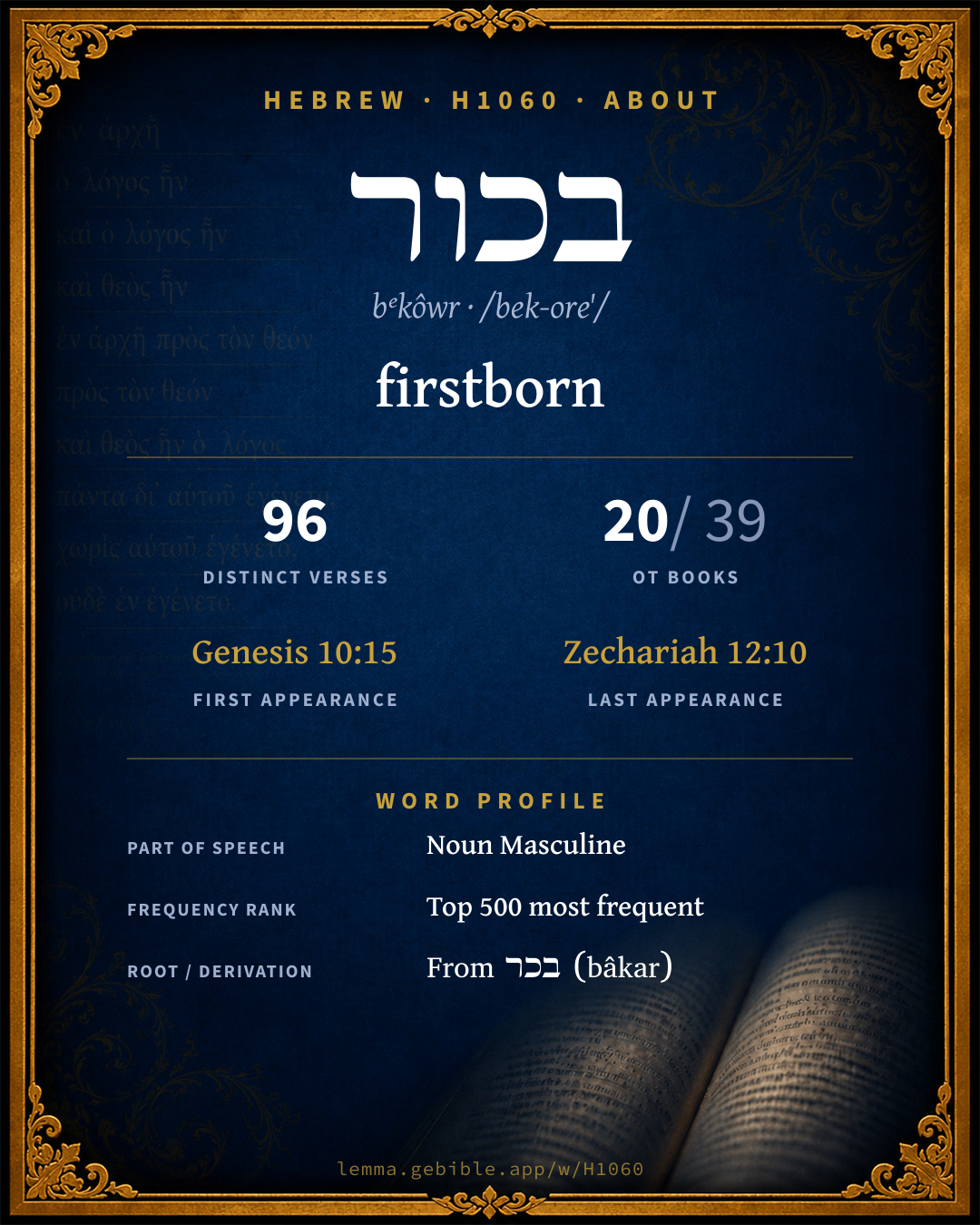
בְּכוֹר
firstborn
‘firstborn’ is one of 4 main senses fuller range ↓
Full lexicon entry — Brown-Driver-Briggs (BDB)
From Brown-Driver-Briggs (BDB)
Where this word appears
See every Construct-state word in the Hebrew Bible →
Grammar key — what these labels mean
Part of speech
- Noun
- A naming word — a person, place, thing, or idea.
Noun type
- Common
- A common noun — a general class of person, place, or thing (“king,” “city,” “water”), not a specific name.
State
- Construct
- A noun bound to a following noun in a possessive / “of” relationship (the construct chain).
- Absolute
- The independent form of a noun, not bound to a following word.
Gender
- Masculine
- Grammatically masculine.
Number
- Singular
- One.
- Plural
- More than one (in Hebrew, generally three or more).
Grammatical forms
- Noun, Common, Masculine, Singular, Construct 61 times (52%)
- Noun, Common, Masculine, Singular, Absolute 52 times (44%)
- Noun, Common, Masculine, Plural, Construct 5 times (4%)
Parsed forms decoded from the imported morphology (morphhb / Westminster Leningrad Codex — WLC text public domain, morphhb tagging CC BY 4.0), counted across 118 parsed occurrences — not distinct verses.
Every verse where H1060 appears — 96 distinct verses across 20 books. Click any verse to open its interlinear word-by-word view. Verse text shown in the World English Bible for context — . Each verse’s Hebrew form is shown with its reference; the English is not keyword-highlighted, since the data carries no word-level English alignment. Use “Compare translations” on any verse to read it across multiple English versions. This concordance covers the Hebrew Bible; Septuagint (Greek Old Testament) occurrences are not indexed here.
Genesis 15 verses
- Genesis 10:15 בְּכֹר֖/וֹ n c ms cs + sfx pers 3ms Canaan became the father of Sidon (his firstborn), Heth,
- Genesis 22:21 בְּכֹר֖/וֹ n c ms cs + sfx pers 3ms Uz his firstborn, Buz his brother, Kemuel the father of Aram,
- Genesis 25:13 בְּכֹ֤ר n c ms cs These are the names of the sons of Ishmael, by their names, according to the order of their birth: the firstborn of Ishmael, Nebaioth, then Kedar, Adbeel, Mibsam,
- Genesis 27:19 בְּכֹרֶ֔/ךָ n c ms cs + sfx pers 2ms Jacob said to his father, "I am Esau your firstborn. I have done what you asked me to do. Please arise, sit and eat of my venison, that your soul may bless me."
- Genesis 27:32 בְכֹֽרְ/ךָ֖ n c ms cs + sfx pers 2ms Isaac his father said to him, "Who are you?" He said, "I am your son, your firstborn, Esau."
- Genesis 35:23 בְּכ֥וֹר n c ms cs The sons of Leah: Reuben (Jacob's firstborn), Simeon, Levi, Judah, Issachar, and Zebulun.
- Genesis 36:15 בְּכ֣וֹר n c ms cs These are the chiefs of the sons of Esau: the sons of Eliphaz the firstborn of Esau: chief Teman, chief Omar, chief Zepho, chief Kenaz,
- Genesis 38:6 בְּכוֹר֑/וֹ n c ms cs + sfx pers 3ms Judah took a wife for Er, his firstborn, and her name was Tamar.
- Genesis 38:7 בְּכ֣וֹר n c ms cs Er, Judah's firstborn, was wicked in the sight of Yahweh. Yahweh killed him.
- Genesis 41:51 הַ/בְּכ֖וֹר ptcl def.art + n c ms Joseph called the name of the firstborn Manasseh, "For," he said, "God has made me forget all my toil, and all my father's house."
- Genesis 43:33 הַ/בְּכֹר֙ ptcl def.art + n c ms They sat before him, the firstborn according to his birthright, and the youngest according to his youth, and the men marveled one with another.
- Genesis 46:8 בְּכֹ֥ר n c ms cs These are the names of the children of Israel, who came into Egypt, Jacob and his sons: Reuben, Jacob's firstborn.
- Genesis 48:14 הַ/בְּכֽוֹר ptcl def.art + n c ms Israel stretched out his right hand, and laid it on Ephraim's head, who was the younger, and his left hand on Manasseh's head, guiding his hands knowingly, for Manasseh was the firstborn.
- Genesis 48:18 הַ/בְּכֹ֔ר ptcl def.art + n c ms Joseph said to his father, "Not so, my father; for this is the firstborn; put your right hand on his head."
- Genesis 49:3 בְּכֹ֣רִ/י n c ms cs + sfx pers 1cs "Reuben, you are my firstborn, my might, and the beginning of my strength; The pre-eminence of dignity, and the pre-eminence of power.
Exodus 11 verses
- Exodus 4:22 בְכֹרִ֖/י n c ms cs + sfx pers 1cs You shall tell Pharaoh, 'Thus says Yahweh, Israel is my son, my firstborn,
- Exodus 4:23 בְּכֹרֶֽ/ךָ n c ms cs + sfx pers 2ms and I have said to you, "Let my son go, that he may serve me;" and you have refused to let him go. Behold, I will kill your son, your firstborn.'"
- Exodus 6:14 בְּכֹ֣ר n c ms cs These are the heads of their fathers' houses. The sons of Reuben the firstborn of Israel: Hanoch, and Pallu, Hezron, and Carmi; these are the families of Reuben.
- Exodus 11:5 בְּכוֹר֮ מִ/בְּכ֤וֹר בְּכ֣וֹר בְּכ֥וֹר n c ms prep + n c ms cs n c ms cs n c ms cs and all the firstborn in the land of Egypt shall die, from the firstborn of Pharaoh who sits on his throne, even to the firstborn of the maid-servant who is behind the mill; and all the firstborn of cattle.
- Exodus 12:12 בְּכוֹר֙ n c ms For I will go through the land of Egypt in that night, and will strike all the firstborn in the land of Egypt, both man and animal. Against all the gods of Egypt I will execute judgments: I am Yahweh.
- Exodus 12:29 בְּכוֹר֮ מִ/בְּכֹ֤ר בְּכ֣וֹר בְּכ֥וֹר n c ms prep + n c ms cs n c ms cs n c ms cs It happened at midnight, that Yahweh struck all the firstborn in the land of Egypt, from the firstborn of Pharaoh who sat on his throne to the firstborn of the captive who was in the dungeon; and all the firstborn of cattle.
- Exodus 13:2 בְּכ֜וֹר n c ms "Sanctify to me all of the firstborn, whatever opens the womb among the children of Israel, both of man and of animal. It is mine."
- Exodus 13:13 בְּכ֥וֹר n c ms cs Every firstborn of a donkey you shall redeem with a lamb; and if you will not redeem it, then you shall break its neck; and you shall redeem all the firstborn of man among your sons.
- Exodus 13:15 בְּכוֹר֙ מִ/בְּכֹ֥ר בְּכ֣וֹר בְּכ֥וֹר n c ms prep + n c ms cs n c ms cs n c ms cs and it happened, when Pharaoh would hardly let us go, that Yahweh killed all the firstborn in the land of Egypt, both the firstborn of man, and the firstborn of animal. Therefore I sacrifice to Yahweh all that opens the womb, being males; but all the firstborn of my sons I redeem.'
- Exodus 22:29 בְּכ֥וֹר n c ms cs "You shall not delay to offer from your harvest and from the outflow of your presses. "You shall give the firstborn of your sons to me.
- Exodus 34:20 בְּכ֤וֹר n c ms cs The firstborn of a donkey you shall redeem with a lamb: and if you will not redeem it, then you shall break its neck. All the firstborn of your sons you shall redeem. No one shall appear before me empty.
Leviticus 1 verse
Numbers 18 verses
- Numbers 1:20 בְּכֹ֣ר n c ms cs The children of Reuben, Israel's firstborn, their generations, by their families, by their fathers' houses, according to the number of the names, one by one, every male from twenty years old and upward, all who were able to go out to war;
- Numbers 3:2 הַ/בְּכ֣וֹר ptcl def.art + n c ms These are the names of the sons of Aaron: Nadab the firstborn, and Abihu, Eleazar, and Ithamar.
- Numbers 3:12 בְּכ֛וֹר n c ms "Behold, I have taken the Levites from among the children of Israel instead of all the firstborn who open the womb among the children of Israel; and the Levites shall be mine:
- Numbers 3:13 בְּכוֹר֒ בְּכ֜וֹר בְּכוֹר֙ n c ms n c ms n c ms for all the firstborn are mine. On the day that I struck down all the firstborn in the land of Egypt I made holy to me all the firstborn in Israel, both man and animal. They shall be mine. I am Yahweh."
- Numbers 3:40 בְּכֹ֤ר n c ms Yahweh said to Moses, "Number all the firstborn males of the children of Israel from a month old and upward, and take the number of their names.
- Numbers 3:41 בְּכֹ֖ר בְּכ֔וֹר n c ms n c ms You shall take the Levites for me (I am Yahweh) instead of all the firstborn among the children of Israel; and the cattle of the Levites instead of all the firstborn among the cattle of the children of Israel."
- Numbers 3:42 בְּכֹ֖ר n c ms Moses numbered, as Yahweh commanded him, all the firstborn among the children of Israel.
- Numbers 3:43 בְּכ֨וֹר n c ms All the firstborn males according to the number of names, from a month old and upward, of those who were numbered of them, were twenty-two thousand two hundred seventy-three.
- Numbers 3:45 בְּכוֹר֙ n c ms "Take the Levites instead of all the firstborn among the children of Israel, and the cattle of the Levites instead of their cattle; and the Levites shall be mine. I am Yahweh.
- Numbers 3:46 מִ/בְּכ֖וֹר prep + n c ms cs For the redemption of the two hundred seventy-three of the firstborn of the children of Israel, who exceed the number of the Levites,
- Numbers 3:50 בְּכ֛וֹר n c ms cs from the firstborn of the children of Israel he took the money, one thousand three hundred sixty-five shekels, after the shekel of the sanctuary:
- Numbers 8:16 בְּכ֥וֹר n c ms cs For they are wholly given to me from among the children of Israel; instead of all who open the womb, even the firstborn of all the children of Israel, I have taken them to me.
- Numbers 8:17 בְּכוֹר֙ בְּכוֹר֙ n c ms n c ms For all the firstborn among the children of Israel are mine, both man and animal. On the day that I struck all the firstborn in the land of Egypt, I sanctified them for myself.
- Numbers 8:18 בְּכ֖וֹר n c ms I have taken the Levites instead of all the firstborn among the children of Israel.
- Numbers 18:15 בְּכ֣וֹר בְּכֽוֹר n c ms cs n c ms cs Everything that opens the womb, of all flesh which they offer to Yahweh, both of man and animal shall be yours: nevertheless the firstborn of man shall you surely redeem, and the firstborn of unclean animals shall you redeem.
- Numbers 18:17 בְּֽכוֹר בְכ֨וֹר בְכ֥וֹר n c ms cs n c ms cs n c ms cs But the firstborn of a cow, or the firstborn of a sheep, or the firstborn of a goat, you shall not redeem; they are holy: you shall sprinkle their blood on the altar, and shall burn their fat for an offering made by fire, for a sweet savor to Yahweh.
- Numbers 26:5 בְּכ֣וֹר n c ms cs Reuben, the firstborn of Israel; the sons of Reuben: [of] Hanoch, the family of the Hanochites; of Pallu, the family of the Palluites;
- Numbers 33:4 בְּכ֑וֹר n c ms while the Egyptians were burying all their firstborn, whom Yahweh had struck among them: on their gods also Yahweh executed judgments.
Deuteronomy 6 verses
- Deuteronomy 15:19 הַ/בְּכ֡וֹר בִּ/בְכֹ֣ר בְּכ֥וֹר ptcl def.art + n c ms prep + n c ms cs n c ms cs All the firstborn males that are born of your herd and of your flock you shall sanctify to Yahweh your God: you shall do no work with the firstborn of your herd, nor shear the firstborn of your flock.
- Deuteronomy 21:15 הַ/בְּכ֖וֹר ptcl def.art + n c ms If a man have two wives, the one beloved, and the other hated, and they have borne him children, both the beloved and the hated; and if the firstborn son be hers who was hated;
- Deuteronomy 21:16 הַ/בְּכֹֽר ptcl def.art + n c ms then it shall be, in the day that he causes his sons to inherit that which he has, that he may not make the son of the beloved the firstborn before the son of the hated, who is the firstborn:
- Deuteronomy 21:17 הַ/בְּכֹ֨ר ptcl def.art + n c ms but he shall acknowledge the firstborn, the son of the hated, by giving him a double portion of all that he has; for he is the beginning of his strength; the right of the firstborn is his.
- Deuteronomy 25:6 הַ/בְּכוֹר֙ ptcl def.art + n c ms It shall be, that the firstborn whom she bears shall succeed in the name of his brother who is dead, that his name not be blotted out of Israel.
- Deuteronomy 33:17 בְּכ֨וֹר n c ms cs The firstborn of his herd, majesty is his; His horns are the horns of the wild-ox: With them he shall push the peoples all of them, [even] the ends of the earth: They are the ten thousands of Ephraim, They are the thousands of Manasseh.
Joshua 2 verses
- Joshua 6:26 בִּ/בְכֹר֣/וֹ prep + n c ms cs + sfx pers 3ms Joshua charged them with an oath at that time, saying, Cursed be the man before Yahweh, that rises up and builds this city Jericho: with the loss of his firstborn shall he lay the foundation of it, and with the loss of his youngest son shall he set up the gates of it.
- Joshua 17:1 בְּכ֣וֹר בְּכ֨וֹר n c ms cs n c ms cs [This] was the lot for the tribe of Manasseh; for he was the firstborn of Joseph. As for Machir the firstborn of Manasseh, the father of Gilead, because he was a man of war, therefore he had Gilead and Bashan.
Judges 1 verse
1 Samuel 2 verses
- 1 Samuel 8:2 הַ/בְּכוֹר֙ ptcl def.art + n c ms Now the name of his firstborn was Joel; and the name of his second, Abijah: they were judges in Beersheba.
- 1 Samuel 17:13 הַ/בְּכ֗וֹר ptcl def.art + n c ms The three eldest sons of Jesse had gone after Saul to the battle: and the names of his three sons who went to the battle were Eliab the firstborn, and next to him Abinadab, and the third Shammah.
2 Samuel 1 verse
1 Kings 1 verse
2 Kings 1 verse
1 Chronicles 23 verses
- 1 Chronicles 1:13 בְּכֹר֖/וֹ n c ms cs + sfx pers 3ms Canaan became the father of Sidon his firstborn, and Heth,
- 1 Chronicles 1:29 בְּכ֤וֹר n c ms cs These are their generations: the firstborn of Ishmael, Nebaioth; then Kedar, and Adbeel, and Mibsam,
- 1 Chronicles 2:3 בְּכ֣וֹר n c ms cs The sons of Judah: Er, and Onan, and Shelah; which three were born to him of Shua's daughter the Canaanitess. Er, Judah's firstborn, was wicked in the sight of Yahweh; and he killed him.
- 1 Chronicles 2:13 בְּכֹר֖/וֹ n c ms cs + sfx pers 3ms and Jesse became the father of his firstborn Eliab, and Abinadab the second, and Shimea the third,
- 1 Chronicles 2:25 בְּכ֥וֹר הַ/בְּכ֣וֹר n c ms cs ptcl def.art + n c ms The sons of Jerahmeel the firstborn of Hezron were Ram the firstborn, and Bunah, and Oren, and Ozem, Ahijah.
- 1 Chronicles 2:27 בְּכ֣וֹר n c ms cs The sons of Ram the firstborn of Jerahmeel were Maaz, and Jamin, and Eker.
- 1 Chronicles 2:42 בְּכֹר֖/וֹ n c ms cs + sfx pers 3ms The sons of Caleb the brother of Jerahmeel were Mesha his firstborn, who was the father of Ziph; and the sons of Mareshah the father of Hebron.
- 1 Chronicles 2:50 בְּכ֣וֹר n c ms cs These were the sons of Caleb, the son of Hur, the firstborn of Ephrathah: Shobal the father of Kiriath Jearim,
- 1 Chronicles 3:1 הַ/בְּכ֣וֹר ptcl def.art + n c ms Now these were the sons of David, who were born to him in Hebron: the firstborn, Amnon, of Ahinoam the Jezreelitess; the second, Daniel, of Abigail the Carmelitess;
- 1 Chronicles 3:15 הַ/בְּכוֹר֙ ptcl def.art + n c ms The sons of Josiah: the firstborn Johanan, the second Jehoiakim, the third Zedekiah, the fourth Shallum.
- 1 Chronicles 4:4 בְּכ֣וֹר n c ms cs and Penuel the father of Gedor, and Ezer the father of Hushah. These are the sons of Hur, the firstborn of Ephrathah, the father of Bethlehem.
- 1 Chronicles 5:1 בְּכֽוֹר הַ/בְּכוֹר֒ n c ms cs ptcl def.art + n c ms The sons of Reuben the firstborn of Israel (for he was the firstborn; but, because he defiled his father's couch, his birthright was given to the sons of Joseph the son of Israel; and the genealogy is not to be reckoned after the birthright.
- 1 Chronicles 5:3 בְּכ֣וֹר n c ms cs the sons of Reuben the firstborn of Israel: Hanoch, and Pallu, Hezron, and Carmi.
- 1 Chronicles 6:28 הַ/בְּכֹ֥ר ptcl def.art + n c ms The sons of Samuel: the firstborn [Joel], and the second Abijah.
- 1 Chronicles 8:1 בְּכֹר֑/וֹ n c ms cs + sfx pers 3ms Benjamin became the father of Bela his firstborn, Ashbel the second, and Aharah the third,
- 1 Chronicles 8:30 הַ/בְּכ֖וֹר ptcl def.art + n c ms and his firstborn son Abdon, and Zur, and Kish, and Baal, and Nadab,
- 1 Chronicles 8:39 בְּכֹר֔/וֹ n c ms cs + sfx pers 3ms The sons of Eshek his brother: Ulam his firstborn, Jeush the second, and Eliphelet the third.
- 1 Chronicles 9:5 הַ/בְּכ֖וֹר ptcl def.art + n c ms Of the Shilonites: Asaiah the firstborn, and his sons.
- 1 Chronicles 9:31 הַ/בְּכ֖וֹר ptcl def.art + n c ms Mattithiah, one of the Levites, who was the firstborn of Shallum the Korahite, had the office of trust over the things that were baked in pans.
- 1 Chronicles 9:36 הַ/בְּכ֖וֹר ptcl def.art + n c ms and his firstborn son Abdon, and Zur, and Kish, and Baal, and Ner, and Nadab,
- 1 Chronicles 26:2 הַ/בְּכוֹר֙ ptcl def.art + n c ms Meshelemiah had sons: Zechariah the firstborn, Jediael the second, Zebadiah the third, Jathniel the fourth,
- 1 Chronicles 26:4 הַ/בְּכוֹר֙ ptcl def.art + n c ms Obed-edom had sons: Shemaiah the firstborn, Jehozabad the second, Joah the third, and Sacar the fourth, and Nethanel the fifth,
- 1 Chronicles 26:10 בְכ֔וֹר n c ms Also Hosah, of the children of Merari, had sons: Shimri the chief, (for though he was not the firstborn, yet his father made him chief),
2 Chronicles 1 verse
Nehemiah 1 verse
Job 3 verses
- Job 1:13 הַ/בְּכֽוֹר ptcl def.art + n c ms It fell on a day when his sons and his daughters were eating and drinking wine in their eldest brother's house,
- Job 1:18 הַ/בְּכֽוֹר ptcl def.art + n c ms While he was still speaking, there came also another, and said, "Your sons and your daughters were eating and drinking wine in their eldest brother's house,
- Job 18:13 בְּכ֣וֹר n c ms cs The members of his body shall be devoured, The firstborn of death shall devour his members.
Psalms 5 verses
- Psalms 78:51 בְּכ֣וֹר n c ms And struck all the firstborn in Egypt, The chief of their strength in the tents of Ham.
- Psalms 89:27 בְּכ֣וֹר n c ms I will also appoint him my firstborn, The highest of the kings of the earth.
- Psalms 105:36 בְּכ֣וֹר n c ms He struck also all the firstborn in their land, The first fruits of all their manhood.
- Psalms 135:8 בְּכוֹרֵ֣י n c mp cs Who struck the firstborn of Egypt, Both of man and animal;
- Psalms 136:10 בִּ/בְכוֹרֵי/הֶ֑ם prep + n c mp cs + sfx pers 3mp To him who struck down the Egyptian firstborn; For his loving kindness endures forever;
Isaiah 1 verse
Jeremiah 1 verse
Micah 1 verse
Zechariah 1 verse
About this entry
At a glance — auto-summarized from this page’s data, not written by a person. Every figure links to its source below. This summary describes the numbers; it doesn’t interpret them.
The Hebrew noun בכור centers on the idea of “firstborn.” Its meaning spans more than one sense — see its full sense range. Spanning 96 verses in 20 books, it ranks among the moderately common words of the Hebrew Bible. Its earliest occurrence is Genesis 10:15. Related forms include בכר, בכור and בכירה. Dig into 96-verse concordance and the renderings breakdown below.
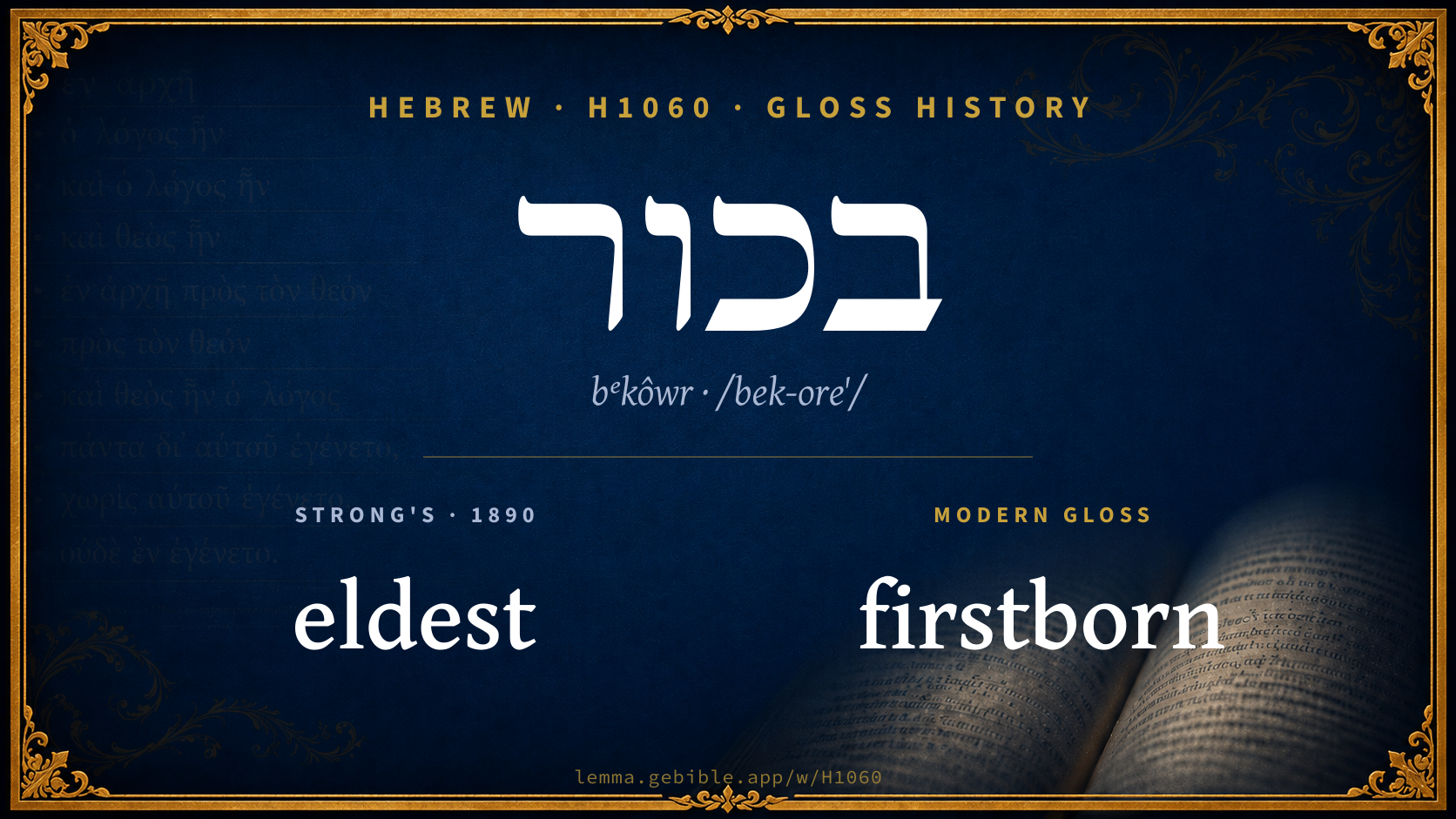
Gloss history
Strong's 1890 vs modern scholarship
About this word
Strong's H1060 catalogs a Hebrew word from the Hebrew Old Testament.
These counts are not copied from any lexicon or concordance. They are computed here, from the morphology-tagged Hebrew Old Testament. What Lemma adds →
- 96
- distinct verses
- The word appears in 96 distinct verses.
- 20 / 39
- OT books
- The word appears in 20 of 39 Old Testament books.
- #369
- by frequency
- Top 500 most frequent Hebrew words (rank 369 of 8,640 Hebrew words by occurrence).
View all 96 occurrences in the concordance →
Most concentrated in
- 1 Chronicles 23 verses 24%
- Numbers 18 verses 19%
- Genesis 15 verses 16%
By section of the Old Testament
By traditional corpus
Conventional, traditional groupings — biblical authorship is debated, so this is a traditional corpus grouping, not an authorship claim. Each share is this word’s portion of its verses in that division of the Hebrew canon. Each figure is a share of the word’s 96 distinct verses.
- Torah (Pentateuch) 51 verses · 53%
- Writings (Ketuvim) 33 verses · 34%
- Prophets (Nevi'im) 12 verses · 13%
How translations render this word
Counts come from each version’s own published word-to-Strong’s tagging or interlinear alignment — an approximate guide to how each version renders this word, not a word-level alignment the data otherwise carries. Because each total is that version’s own tagged count, the per-version totals vary from one another and need not match the appearance or distinct-verse counts above. These counts may also differ from a printed concordance because Lemma counts each distinctly tagged rendering and does not collapse phrase taggings into a single head-word total. This is a fixed set of word-tagged versions (KJV, ASV, BSB, ULT) and does not change with the reading translation you choose elsewhere. Each version’s license is shown beside its name below (and on Sources).
- King James Version: Firstborn 60×, All the firstborn 20×, Eldest 4×
- American Standard Version: First-born 56×, All the first-born 17×, 's first-born 5×
- Berean Standard Bible: Firstborn 89×, Was the firstborn 5×, Firstborn son 4×
- unfoldingWord Literal Text: Firstborn 70×, Firstborn of 36×, Was the firstborn 3×
King James Version Public Domain
Renders H1060 across 116 tagged occurrences — most commonly:
Plus 18 renderings that appear only once — usually multi-word phrases or single function words the recovered tagging swept in, not distinct renderings. Not rendered by a distinct English word in 1 further occurrence.
American Standard Version Public Domain
Renders H1060 across 116 tagged occurrences — most commonly:
Plus 20 renderings that appear only once — usually multi-word phrases or single function words the recovered tagging swept in, not distinct renderings.
Berean Standard Bible Public Domain
Renders H1060 across 117 tagged occurrences — most commonly:
Plus 8 renderings that appear only once — usually multi-word phrases or single function words the recovered tagging swept in, not distinct renderings. Not rendered by a distinct English word in 5 further occurrences.
unfoldingWord Literal Text CC BY-SA 4.0
Renders H1060 across 121 tagged occurrences — most commonly:
Plus 2 renderings that appear only once — usually multi-word phrases or single function words the recovered tagging swept in, not distinct renderings.
10 senses and sub-senses in the full BDB
What do BDB’s symbols mean?
BDB uses these scholarly abbreviations:
| Symbol | Meaning |
|---|---|
| 𝔊 | the Septuagint (the ancient Greek translation, LXX) |
| 𝔙 | the Vulgate (the Latin translation) |
| 𝔖 | the Syriac version (the Peshitta) |
| 𝔗 | the Targum (the Aramaic translation) |
| ψ | the Psalms |
| √ | root (the underlying root or stem) |
| ‖ | parallel passage (a synonymous or contrasted parallel) |
| † | the dagger: every passage where the word occurs is cited |
The 10 senses and sub-senses the full Brown-Driver-Briggs lexicon distinguishes for this word, in lexicon order (not ranked by frequency), with BDB’s own verbatim wording and sub-sense lettering. Shown in Hebrew script with BDB’s own scholarly abbreviations. The condensed entry is in the Lexicon Entry tab. See also the Forms in the corpus table below.
- 1. men and women:
- a. individuals Gn 25:13 (P) 43:33; 48:18 (E) +. e.g. Genesis 25:13
- b. coll. Nu 3:46, 50; 8:16; 18:15. e.g. Numbers 3:46
- c. pl. Ne 10:37 ψ 135:8; 136:10. e.g. Nehemiah 10:37
- d. כל בכור Ex 11:5; 12:12, 29; 13:2, 13, 15(×2); 22:28; 34:2 Nu 3:12(×3), 13, 40, 42, 43, 45; 8:17(×2), 18; 33:4 ψ 78:51; 105:36. e.g. Exodus 11:5
- 2. animals:
- a. individuals Lv 27:26; Nu 18:17; Dt 15:19(×2); 33:17. e.g. Leviticus 27:26
- b. coll. בכור בהמה Ex 11:5; 12:29; 13:15; Nu 3:41; 18:15; כל הבכור Dt 15:19. e.g. Exodus 11:5
- c. pl. בכרות Gn 4:4; Dt 12:6, 17; 14:23; Ne 10:37. e.g. Genesis 4:4
- 3. figurative, n. of relation בכור מות first-born of death Jb 18:13 (deadly disease); בְּכוֹרֵי דַלִּים first-born of the poor (the poorest) Is 14:30; Israel is the first-born of Yahweh among the nations Ex 4:22 cf. Je 31:9; and the seed of David among dynasties ψ 89:28. e.g. Job 18:13
Senses from the full Brown-Driver-Briggs lexicon (Brown, Driver, Briggs; Oxford 1906 — public domain), digitized via Sefaria, supplemented by the OpenScriptures HebrewLexicon (CC BY 4.0). Full attribution on Sources.
Word origin
n.m. first-born—Gn 35:23 + 78 times; בְּכֹר Gn 25:13 + 14 times; sf. בְּכֹרִי Gn 49:3 + 14 times; בְּכוֹרוֹ Gn 38:6 + 3 times; pl. cstr. בְּכוֹרֵי Ne 10:37 + 2 times; בְּכוֹרֵיהֶם ψ 136:10; also בְּכֹרוֹת Gn 4:4; Ne 10:37; בְּכֹרֹת Dt 12:6, 17; 14:23;—
— Brown-Driver-Briggs (Oxford 1906, public domain), digitized via Sefaria, supplemented by the OpenScriptures HebrewLexicon (CC BY 4.0). See Sources.
Derived from בכר (bâkar) (H1069) — to be firstborn.
Jastrow Dictionary
A second Hebrew/Aramaic lexicon for comparison, covering Aramaic and post-biblical (Talmudic, Targumic, Midrashic) usage that the biblical-Hebrew BDB does not. Matched by lemma rather than by Strong’s number, so a lemma may carry more than one Jastrow headword (shown separately below), and the entries cover usage well beyond the Bible.
בְּכוֹר
- first-born (opp. פשוט, a plain, unprivileged son); also of animals. B. Bath. 126ᵃ ב׳ ופשוט; a. fr.—Y. Pes. X, beg. 37ᵇ הוה ב׳ והוה אכיל was a first-born and yet did not fast (on the eve of Passover).—Yeb. 16ᵃ; Y. ib. I, 3ᵃ bot. ב׳ שטן (play on קטן) the first in obstinate dispute.—Gen. R. s. 91 (ref. to Gen. XLII, 37) הרי זה ב׳ שוטה וכ׳ is this a foolish first-born son! are thy children not my children? [ב׳ שוטה a first-born son by his mother, v. בּוּכְרָא I.]—Bekh. VIII, 1, a. fr. ב׳ לנחלה a first-born with the privileges of a double share of inheritance (Deut. XXI, 15 sq.), ב׳ לכהן one who must be redeemed from the priest (Ex. XIII, 2). Ib. IV, 4 ראה את הב׳ examined the first-born animal (and declared it defective); a. fr.—Pl. בְּכוֹרִים, בְּכוֹרוֹת. Ex. R. s. 18 בְּכוֹרֵי מצרים the first-born of Egyptian cattle; ib. מכת בכורות the plague of the first-born in Egypt; Num. R. s. 4; a. fr.—Bekh. IV, 5 he who receives payment להיות רואה ב׳ for examining first-born animals (as to bodily defects, v. supra); a. fr.—[Y. Shek. III, beg. 47ᵇ הבכו׳, read הבַּכִּירוֹת.] Ch. בּוּכְרָא. e.g. Genesis 42:37
A Dictionary of the Targumim, the Talmud Babli and Yerushalmi, and the Midrashic Literature (Marcus Jastrow; London, Luzac, 1903) — Public Domain. Digitized via Sefaria. Digitized via Sefaria. Full attribution on Sources.
Forms in the corpus
The 59 distinct written forms H1060 takes in the Hebrew Bible, most frequent first — each parse links to that state’s occurrences in the concordance. Hebrew forms include their vowel points and cantillation, so a single lemma takes many written forms.
Same root — word family
Other BDB entries built from the same root as H1060, grouped by Strong’s listed origin. These share a root / origin per the lexicon — not necessarily a shared meaning. Each links to that word’s own entry.
Derives from
Shares the same root
Derived from this word
Proper names from this root
People and places named from this root — a name, not an additional meaning of the word.
Compare all same-root words → Showing 4 of 8 — not the complete family. 2 of the same-root words are proper names (people or places). They share a root, not necessarily a meaning.
Septuagint verse parallels
This word appears in 92 verses that also exist in the Greek Old Testament (Septuagint), out of the 96 Hebrew verses it occurs in. You can read those verses in Greek by switching the Old Testament edition to the Septuagint.
Read these verses in the Septuagint
- Genesis 10:15
- Exodus 4:22
- Leviticus 27:26
- Numbers 1:20
- Deuteronomy 15:19
- Joshua 6:26
- Judges 8:20
- 1 Samuel 8:2
- 2 Samuel 3:2
- 1 Kings 16:34
- 2 Kings 3:27
- 1 Chronicles 1:13
This is a verse-level parallel only — the same verses exist in both the Hebrew and Greek Old Testaments. No word-level Hebrew↔Greek correspondence is claimed: the data carries no such alignment, so no Greek word is shown as this Hebrew word’s translation. Coverage is not total — the Septuagint omits the deuterocanon and renumbers the Psalms, so some Hebrew verses have no direct Greek parallel.