Genesis 36:15

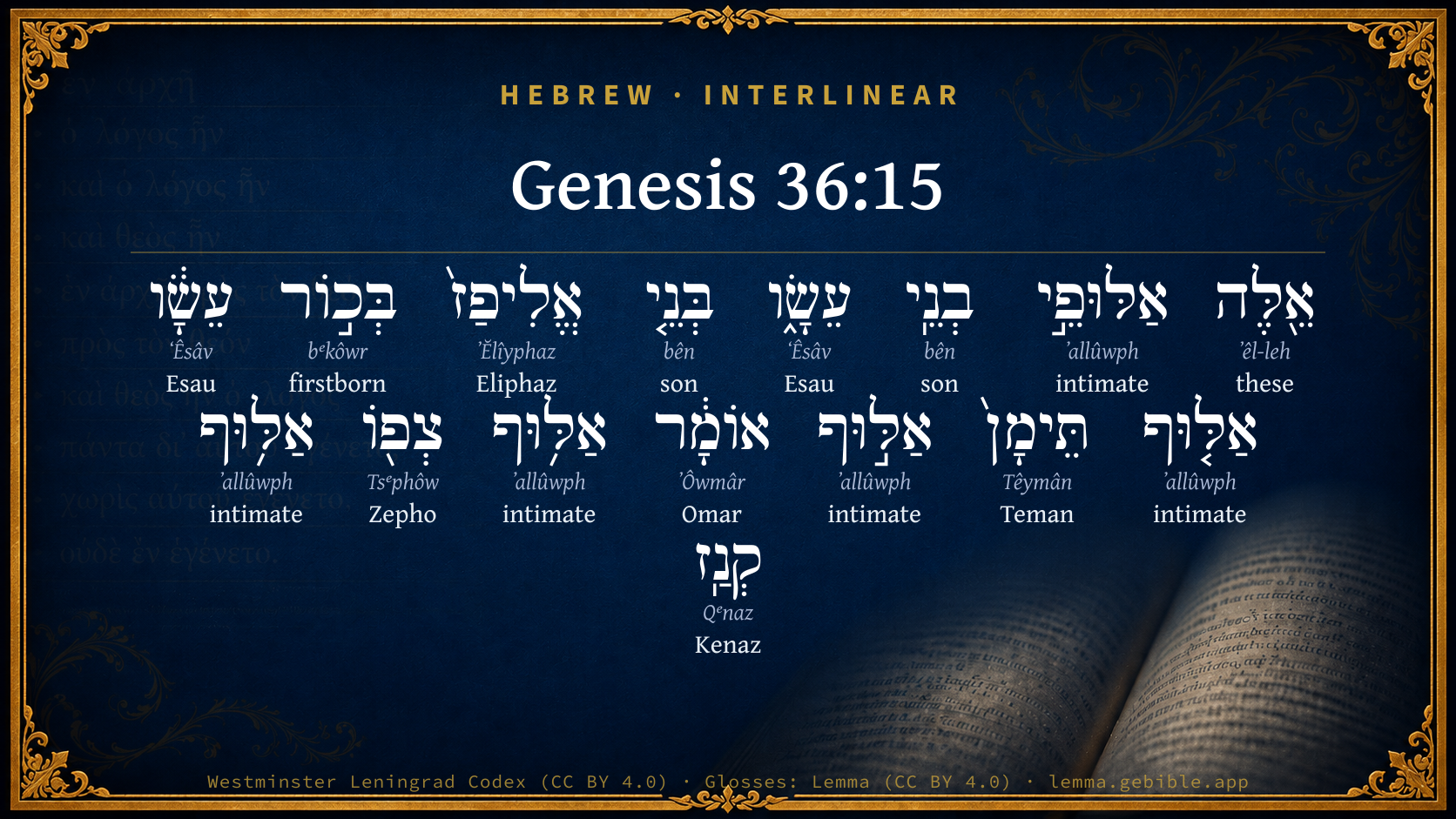
Hebrew (Westminster Leningrad Codex) Genesis 36:15 appears in the Hebrew Old Testament. The text above is from the Westminster Leningrad Codex. Each word links to its Strong’s number, a concise gloss, and parsing drawn from the Open Scriptures Hebrew Bible morphology. Click any word for its full Brown-Driver-Briggs (BDB) entry.
Download image
Cite this verse

Genesis 36:15 (World English Bible). Public Domain. Lemma interlinear Bible study tool, https://lemma.gebible.app/v/genesis/36/15.

Show BibTeX & RIS
BibTeX
RIS
English Translation
These are the chiefs of the sons of Esau: the sons of Eliphaz the firstborn of Esau: chief Teman, chief Omar, chief Zepho, chief Kenaz,
World English Bible · Public Domain
Highlights
  • 1 first appearance in the Hebrew Bible
Full analysis ↓
Download a study sheet

One document with this verse’s original text, its word-by-word gloss line, the meaning frame, cross-references with their text, attributed commentary, and full source and license credits — printable, and it pastes into notes with its structure intact.

This verse Autodidact and up

Study sheet (.html) Plain text (.txt)

A passage Seminary Student

Up to 50 verses in one chapter. A passage sheet keeps up to 6 commentary sources and 12 cross-references per verse, in the order this page ranks them, and says so on the sheet whenever that leaves anything out. Ask for a single verse and you get the Autodidact verse sheet above.

Everything on this page stays free to read, with no account — the sheet is a download of what is already on screen, not access to it.

Want to remove ads? Support Godless Engineer
Compare translations 3

The same verse in 3 English versions, stacked beneath the original-language interlinear above. Click any original word for its lexicon entry.

Each is an independent rendering of the whole verse — the interlinear is not word-aligned to these translations.

Highlighted words mark where these versions differ — a whole-verse word diff, not a word-by-word alignment.

  • World English Bible Public Domain
    These are the chiefs of the sons of Esau: the sons of Eliphaz the firstborn of Esau: chief Teman, chief Omar, chief Zepho, chief Kenaz,
  • King James Version Public Domain
    These were dukes of the sons of Esau: the sons of Eliphaz the firstborn son of Esau; duke Teman, duke Omar, duke Zepho, duke Kenaz,
  • unfoldingWord Literal Text CC BY-SA 4.0
    These the chiefs of the sons of Esau. The sons of Eliphaz, the firstborn of Esau, Chief Teman, Chief Omar, Chief Zepho, Chief Kenaz,

unfoldingWord Literal Text — © unfoldingWord, licensed CC BY-SA 4.0. Word-aligned USFM3 via Door43 (git.door43.org/unfoldingWord/en_ult).

Versions to compare (up to 4)

3 of 4 selected

Show all 18 translations

Every available English version of this verse, each an independent rendering of the whole verse.

  • World English Bible Public Domain
    These are the chiefs of the sons of Esau: the sons of Eliphaz the firstborn of Esau: chief Teman, chief Omar, chief Zepho, chief Kenaz,
  • Berean Standard Bible Public Domain
    These are the chiefs among the sons of Esau. The sons of Eliphaz the firstborn of Esau: Chiefs Teman, Omar, Zepho, Kenaz,
  • Majority Standard Bible Public Domain
    These are the chiefs among the sons of Esau. The sons of Eliphaz the firstborn of Esau: Chiefs Teman, Omar, Zepho, Kenaz,
  • King James Version Public Domain
    These were dukes of the sons of Esau: the sons of Eliphaz the firstborn son of Esau; duke Teman, duke Omar, duke Zepho, duke Kenaz,
  • American Standard Version (1901) Public Domain
    These are the chiefs of the sons of Esau: the sons of Eliphaz the first-born of Esau: chief Teman, chief Omar, chief Zepho, chief Kenaz,
  • Revised Version (1885) Public Domain
    These are the dukes of the sons of Esau: the sons of Eliphaz the firstborn of Esau; duke Teman, duke Omar, duke Zepho, duke Kenaz,
  • Geneva Bible (1599) Public Domain
    These were Dukes of the sonnes of Esau: the sonnes of Eliphaz, the first borne of Esau: Duke Teman, Duke Omar, Duke Zepho, Duke Kenaz,
  • Douay-Rheims (1899) Public Domain
    These were dukes of the sons of Esau: the sons of Eliphaz the firstborn of Esau: duke Theman, duke Omar, duke Sepho, duke Cenez,
  • Young's Literal Translation Public Domain
    These `are' chiefs of the sons of Esau: sons of Eliphaz, first-born of Esau: chief Teman, chief Omar, chief Zepho, chief Kenaz,
  • Literal Standard Version CC BY-SA 4.0
    These [are] chiefs of the sons of Esau: sons of Eliphaz, firstborn of Esau: Chief Teman, Chief Omar, Chief Zepho, Chief Kenaz,
  • Unlocked Literal Bible CC BY-SA 4.0
    These were the clans among Esau's descendants: the descendants of Eliphaz, the firstborn of Esau: Teman, Omar, Zepho, Kenaz,
  • unfoldingWord Literal Text CC BY-SA 4.0
    These the chiefs of the sons of Esau. The sons of Eliphaz, the firstborn of Esau, Chief Teman, Chief Omar, Chief Zepho, Chief Kenaz,
  • Darby Bible Public Domain
    These are the chiefs of the sons of Esau. The sons of Eliphaz, the firstborn of Esau: chief Teman, chief Omar, chief Zepho, chief Kenaz,
  • World Messianic Bible Public Domain
    These are the chiefs of the sons of Esau: the sons of Eliphaz the firstborn of Esau: chief Teman, chief Omar, chief Zepho, chief Kenaz,
  • Webster's Bible Public Domain
    These were dukes of the sons of Esau: the sons of Eliphaz the first-born son of Esau; duke Teman, duke Omar, duke Zepho, duke Kenaz,
  • Free Bible Version CC BY-SA 4.0
    These were the tribal leaders of Esau's sons. The tribal leaders of the sons of Eliphaz (Esau's firstborn) were Teman, Omar, Zepho, Kenaz,
  • Bible in Basic English Public Domain
    These were the chiefs among the sons of Esau: the sons of Eliphaz, Esau's first son: Teman, Omar, Zepho, Kenaz,
  • JPS Tanakh (1917) Public Domain
    These are the chiefs of the sons of Esau: the sons of Eliphaz the first-born of Esau: the chief of Teman, the chief of Omar, the chief of Zepho, the chief of Kenaz,

Literal Standard Version (2020), Covenant Press — licensed CC BY-SA 4.0. Text via the HelloAO Bible API (eBible.org). Unlocked Literal Bible (unfoldingWord) — licensed CC BY-SA 4.0. Text via the HelloAO Bible API (eBible.org). unfoldingWord Literal Text — © unfoldingWord, licensed CC BY-SA 4.0. Word-aligned USFM3 via Door43 (git.door43.org/unfoldingWord/en_ult). Free Bible Version, Dr. Jonathan Gallagher — licensed CC BY-SA 4.0. Text via the HelloAO Bible API (eBible.org).

Word by word

More ways to search: Search by grammar → Find every occurrence → Compare this word →

Practice this passage: Drill this verse → Learn its vocabulary →

אוֹמָ֔ר
ʼÔwmâr
H201
“Omar”
Noun, Proper
Part of Speech
Noun
Type
Proper
Full BDB Definition

Origin: from H559

TWOT: None

Omar = "speaker" or " eloquent" - grandson of Esau
  1. אֵ֖לֶּה ʼêl-leh H428 “these” Pronoun, Demonstrative, Common, Plural
  2. אַלּוּפֵ֣י ʼallûwph H441 “intimates of” Noun, Common, Masculine, Plural, Construct
  3. בְנֵֽי bên H1121 “sons of” Noun, Common, Masculine, Plural, Construct
  4. עֵשָׂ֑ו ʻÊsâv H6215 “Esau” Noun, Proper
  5. בְּנֵ֤י bên H1121 “sons of” Noun, Common, Masculine, Plural, Construct
  6. אֱלִיפַז֙ ʼĔlîyphaz H464 “Eliphaz” Noun, Proper
  7. בְּכ֣וֹר bᵉkôwr H1060 “firstborn of” Noun, Common, Masculine, Singular, Construct
  8. עֵשָׂ֔ו ʻÊsâv H6215 “Esau” Noun, Proper
  9. אַלּ֤וּף ʼallûwph H441 “intimate” Noun, Common, Masculine, Singular, Absolute
  10. תֵּימָן֙ Têymân H8487 “Teman” Noun, Proper
  11. אַלּ֣וּף ʼallûwph H441 “intimate” Noun, Common, Masculine, Singular, Absolute
  12. אַלּ֥וּף ʼallûwph H441 “intimate” Noun, Common, Masculine, Singular, Absolute
  13. צְפ֖וֹ Tsᵉphôw H6825 “Zepho” Noun, Proper
  14. אַלּ֥וּף ʼallûwph H441 “intimate” Noun, Common, Masculine, Singular, Absolute
  15. קְנַֽז Qᵉnaz H7073 “Kenaz” Noun, Proper

About this verse

These counts appear in no published source. They are computed here, from the morphology-tagged text and Lemma’s own curated glosses. What Lemma adds →

16
words
10
distinct lemmas
Pentateuch
section

Notable vocabulary

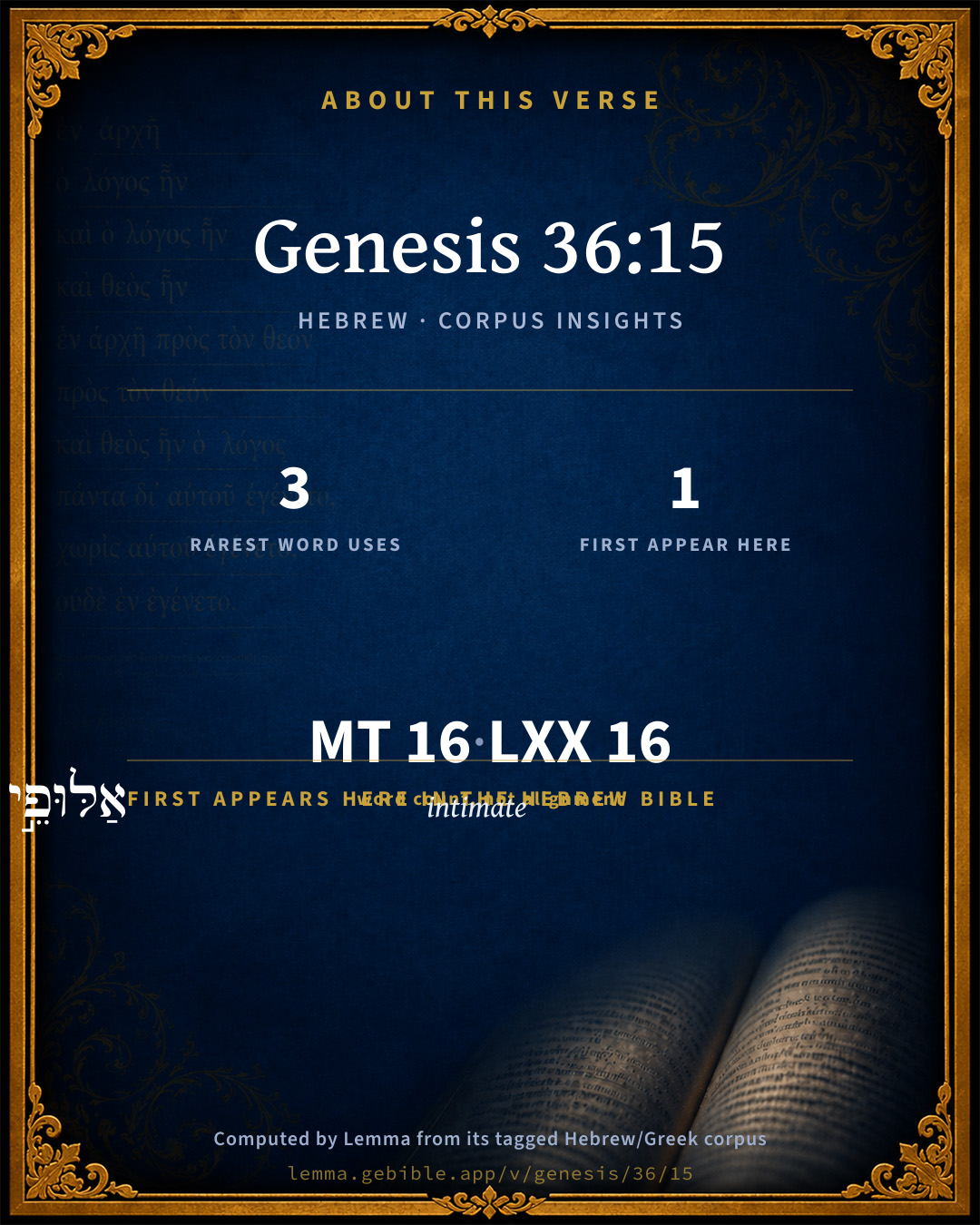
The rarest word here is אוֹמָ֔ר Omar H201 — appearing just 3 times in the whole Hebrew Bible.

First appearance in Scripture

This word makes its first canonical appearance in the Hebrew Bible here:

  • אַלּוּפֵ֣י intimate H441

Shared distinctive vocabulary

אוֹמָ֔ר Omar H201 occurs in 3 verses of the Hebrew Bible. Also found in:

Grammatical profile

  • 15 nouns
  • 1 pronoun

Repetition

Words recur within this verse — often emphatic in Hebrew:

  • אַלּוּפֵ֣י intimate H441 ×5
  • בְנֵֽי son H1121 ×2
  • עֵשָׂ֑ו Esau H6215 ×2

Hebrew & Septuagint length

In English translation the verse runs 25 words from the Hebrew and 26 from the Septuagint (LXX English) — closely comparable.

A rough comparison of the two English renderings, which tokenize alike — not a word-level alignment.

Word counts can differ between the Hebrew and the Greek without any difference in meaning — e.g. the Hebrew direct-object marker אֵת has no separate Greek word, and Greek often adds the article ὁ.

In the original languages it is 16 Hebrew tokens and 16 Greek tokens — but the two are counted differently (Hebrew bundles its prefixes and suffixes into one token; the Greek is in lemma form), so that isn’t a like-for-like length.

Cross-references

17

Topical passages linked to Genesis 36:15 in the Treasury of Scripture Knowledge — connected by theme and wording, ordered by reader-vote popularity; previews shown in the World English Bible.

  • Obadiah 1:9 Your mighty men, Teman, will be dismayed, to the end that everyone may be cut off from the mountain of Esau by slaughter.
  • Genesis 36:11–12 The sons of Eliphaz were Teman, Omar, Zepho, and Gatam, and Kenaz.
  • Job 2:11 Now when Job's three friends heard of all this evil that had come on him, they each came from his own place: Eliphaz the Temanite, Bildad the Shuhite, and Zophar the Naamathite, and they made an appointment together to come to sympathize with him and to comfort him.
  • Genesis 36:4 Adah bore to Esau Eliphaz. Basemath bore Reuel.
  • Genesis 36:18 These are the sons of Oholibamah, Esau's wife: chief Jeush, chief Jalam, chief Korah: these are the chiefs who came of Oholibamah the daughter of Anah, Esau's wife.
  • Exodus 15:15 Then the chiefs of Edom were dismayed. Trembling takes hold of the mighty men of Moab. All the inhabitants of Canaan are melted away.
  • 1 Chronicles 1:35–36 The sons of Esau: Eliphaz, Reuel, and Jeush, and Jalam, and Korah.
  • 1 Chronicles 1:45 Jobab died, and Husham of the land of the Temanites reigned in his place.
  • 1 Chronicles 1:51–54 Hadad died. The chiefs of Edom were: chief Timna, chief Aliah, chief Jetheth,
  • Job 4:1 Then Eliphaz the Temanite answered,
  • Job 21:8 Their child is established with them in their sight, Their offspring before their eyes.
  • Psalms 37:35 I have seen the wicked in great power, Spreading himself like a green tree in its native soil.
  • Jeremiah 49:7 Of Edom. Thus says Yahweh of Hosts: Is wisdom no more in Teman? is counsel perished from the prudent? is their wisdom vanished?
  • Jeremiah 49:20 Therefore hear the counsel of Yahweh, that he has taken against Edom; and his purposes, that he has purposed against the inhabitants of Teman: Surely they shall drag them away, [even] the little ones of the flock; surely he shall make their habitation desolate over them.
  • Ezekiel 25:13 therefore thus says the Lord Yahweh, I will stretch out my hand on Edom, and will cut off man and animal from it; and I will make it desolate from Teman; even to Dedan shall they fall by the sword.
  • Amos 1:12 But I will send a fire on Teman, And it will devour the palaces of Bozrah."
  • Habakkuk 3:3 God came from Teman, The Holy One from Mount Paran. Selah. His glory covered the heavens, And his praise filled the earth.

Cross-references courtesy of OpenBible.info (CC BY 4.0).

Hebrew and Greek witnesses Masoretic Hebrew ↔ Greek Septuagint

The same verse in the two great witnesses to the Old Testament, shown verse-for-verse.

These are two independent witnesses, not word-aligned to each other, and the Septuagint is shown in lemma (dictionary) form.

Hebrew Genesis 36:15 Masoretic · Westminster Leningrad Codex

אֵ֖לֶּה אַלּוּפֵ֣י בְנֵֽי עֵשָׂ֑ו בְּנֵ֤י אֱלִיפַז֙ בְּכ֣וֹר עֵשָׂ֔ו אַלּ֤וּף תֵּימָן֙ אַלּ֣וּף אוֹמָ֔ר אַלּ֥וּף צְפ֖וֹ אַלּ֥וּף קְנַֽז

These are the chiefs of the sons of Esau: the sons of Eliphaz the firstborn of Esau: chief Teman, chief Omar, chief Zepho, chief Kenaz,

World English Bible · Public Domain

Greek LXX Genesis 36:15 Septuagint · lemma form

οὗτος ἡγεμών υἱός ησαυ υἱός ελιφας πρωτότοκος ησαυ ἡγεμών θαιμαν ἡγεμών ωμαρ ἡγεμών σωφαρ ἡγεμών κενεζ

These are the chiefs of the son of Esau, even the sons of Eliphas, the firstborn of Esau; chief Thaeman, chief Omar, chief Sophar, chief Kenez,

LXX2012 (modern English Septuagint) · Public Domain

On this verse, The Cambridge Bible for Schools and Colleges discusses the Septuagint’s reading. Read the note in Commentary ↓

Hebrew: Westminster Leningrad Codex (CC BY 4.0). Greek: Septuagint (public domain); English from LXX2012 (modern English Septuagint) (Public Domain). How the Septuagint differs from the Hebrew →

Targum (Aramaic paraphrase)

2

The Targum is the ancient Jewish Aramaic paraphrase of the Hebrew Scriptures — an interpretive translation, not the Hebrew text itself. Onkelos (literal) and Pseudo-Jonathan (expansive) render the Torah, and Jonathan the Prophets. Coverage is partial: where no permissively-licensed English translation exists for a verse, only the Aramaic is shown. This is verse-level text, not a word-by-word alignment to the Hebrew.

  1. Targum Onkelos Torah (Genesis–Deuteronomy)
    אִלֵּין רַבְרְבֵי בְנֵי עֵשָׂו בְּנֵי אֱלִיפַז בּוּכְרָא דְעֵשָׂו רַבָּא תֵּימָן רַבָּא אוֹמָר רַבָּא צְפוֹ רַבָּא קְנַז

    (no public-domain English translation for this verse)

    Targum Onkelos — Aramaic: “Onkelos Genesis” (public domain); “Onkelos Exodus” (public domain); “Onkelos Leviticus” (public domain); “Onkelos Numbers” (public domain); “Onkelos Deuteronomy” (public domain). English: “Sefaria Community Translation” (CC0 1.0 (public-domain dedication)); “J.W. Etheridge. The Targums of Onkelos and Jonathan Ben Uzziel on the Pentateuch. London: Longmans, Green, 1862” (public domain). Text via Sefaria.

  2. Targum Pseudo-Jonathan Torah (Genesis–Deuteronomy)
    אִלֵין רַבְרְבֵי בְּנֵי עֵשָו בְּנֵי אֱלִיפַז בּוּכְרֵיהּ דְעֵשָו רַבָּא תֵימָן רַבָּא אוֹמָר רַבָּא צְפוֹ רַבָּא קְנַז

    These are the chieftains of the sons of Esau; the sons of Eliphaz, the first--born of Esau, Rabba Teman, Rabba Omar, Rabba Zephu, Rabba Kenaz,

    Targum Pseudo-Jonathan — Aramaic: “Targum Jonathan on Genesis” (public domain); “Targum Jonathan on Exodus” (public domain); “Targum Jonathan on Leviticus” (public domain); “Targum Jonathan on Numbers” (public domain); “Targum Jonathan on Deuteronomy” (public domain). English: “The Targum of Jonathan ben Uzziel, trans. J. W. Etheridge, London, 1862” (public domain). Text via Sefaria.

Commentary

Notes on Genesis 36:15 from classic Christian and Jewish commentators (each source and its license shown beneath its notes). The classic Christian expositions comment on the surrounding passage and are grouped to its opening verse, so a note may address several verses; the Jewish commentaries on the Tanakh (Rashi and others) are per-verse, so they appear only where the commentator wrote on this verse.

Lemma curates 59 commentaries, every one of them public domain or Creative Commons licensed, each selected and text-cleaned for this edition rather than reprinted as found. About our sources →

John Gill's Exposition

And these are the sons of Reuel.... See Gill on Gen 36:15.

.

Genesis 36:18

gen 36:18

gen 36:18

gen 36:18And these are the sons of Aholibamah Esua's wife;.... See Gill on Gen 36:15.

John Gill's Exposition of the Whole Bible (1746–1763) — public domain (CC PDM 1.0). Text via the HelloAO Bible API.

Whedon's Commentary on the Bible

Daniel D. Whedon

THE DUKES OF ESAU, Gen_36:15-19.

Here the chief tribe-fathers of the Edomites are named again, under the title of dukes, Hebrews, alluphim, (אלופים,) phylarchs, chiefs, or princes. These were all military chieftains, great patriarchal sheiks, who were celebrated by their descendants not merely as fathers but as heroes. As being merely a presentation of the same persons under a different title, they are omitted from the list in 1 Chronicles which proceeds with the sons of Seir.

Daniel D. Whedon (gen. ed.), Commentary on the Old and New Testaments (1874–1909) — public domain. Text from a community e-Sword module.

Tyndale Open Study Notes

Tyndale Open Resources

36:15-19 Thirteen of Esau’s descendants had positions as leaders of various clans. A picture begins to emerge of Esau as a grand overlord of tribes (cp. 36:40-43).

Tyndale Open Study Notes — © Tyndale Open Resources, licensed CC BY-SA 4.0. Text via the HelloAO Bible API.

Geneva Bible (1599)

Geneva Bible translators

Or, chief men.

If God’s promises be so sure towards them which are not of his household, how much more will he perform the same to us?

Geneva Bible (1599) marginal notes — public domain. Text via Bolls.life.

Jamieson, Fausset & Brown

Robert Jamieson, A. R. Fausset & David Brown

dukes--The Edomites, like the Israelites, were divided into tribes, which took their names from his sons. The head of each tribe was called by a term which in our version is rendered "duke"--not of the high rank and wealth of a British peer, but like the sheiks or emirs of the modern East, or the chieftains of highland clans. Fourteen are mentioned who flourished contemporaneously.

Jamieson, Fausset & Brown — Commentary Critical and Explanatory on the Whole Bible (1871) — public domain (CC PDM 1.0). Text via the HelloAO Bible API.

Adam Clarke's Commentary

Verse 15. Dukes of the sons of Esau] The word duke comes from the Latin dux, a captain or leader. The Hebrew אלוף alluph has the same signification; and as it is also the term for a thousand, which is a grand capital or leading number, probably the אלופי alluphey or dukes had this name from being leaders of or captains over a company of one thousand men; just as those among the Greeks called chiliarchs, which signifies the same; and as the Romans called those centurions who were captains over one hundred men, from the Latin word centum, which signifies a hundred The ducal government was that which prevailed first among the Idumeans, or descendants of Esau. Here fourteen dukes are reckoned to Esau, seven that came of his wife, Adah, four of Bashemath, and three of Aholibamah.

Adam Clarke's Commentary on the Bible (1810–1826) — public domain. Text from a community e-Sword/MySword module.

Ellicott's Commentary for English Readers

(15) Dukes.—Duke is the Latin word dux, a leader; but the Hebrew word alluph signifies a tribal prince, It is derived from eleph, a thousand, used in much the same way as the word hundred with us for a division of the country. Probably it was one large enough to have in it a thousand grown men, whereas a hundred in Saxon times was a district in which there were a hundred homesteads. For this use of it, see Mic_5:2. Each alluph, therefore, would be the prince of one of these districts, assigned to him as the possession of himself and his seed.

A Bible Commentary for English Readers, edited by Charles John Ellicott (1878–1897) — public domain. Text from a community e-Sword module.

The Cambridge Bible for Schools and Colleges

gen. ed. J. J. S. Perowne

15–19. The Tribal Chiefs of Esau

15. the dukes] Better, as marg., chiefs. The word “duke” has been introduced into the English version from the Lat. dux which translates the LXX ἡγεμών. The Heb. allûph is connected with eleph = 1000, or “a clan”; and hence is used for “the chieftain of a clan,” or “a chiliarch,” especially in Edom: cf. Exo_15:15; Zec_9:7; Zec_12:5-6.

“Duke,” in Old English, was not limited to the highest rank of nobility. It meant “leader” or “chief.” Cf. Wiclif, Matt. ii. 6, “And thou Bethleem … for of thee a duyk shall go out”; Latimer, Serm., p. 31, “Gideon a duke which God raised up.”

duke Teman] A better idea would be conveyed to English readers, if the rendering were “the chieftain of Teman, of Omar, &c.”

The Cambridge Bible for Schools and Colleges (gen. ed. J. J. S. Perowne; Cambridge University Press, 1878–1918) — public domain. Text from a community e-Sword module.

Haydock's Catholic Bible Commentary

Hebrew Aluph, prince of a tribe, or of a thousand; a Chiliarch. Zach. v. 2[Zacharias v. 2.?]. The Rabbin assert they wore not a crown, as the kings did. (Calmet) --- Both obtained their authority by election. An aristocracy prevailed under the dukes. (Menochius)

George Leo Haydock (1774–1849), Haydock's Catholic Family Bible and Commentary, 1859 edition — public domain. Excludes Psalms (Douay-Rheims chapter numbering differs from Protestant) and Deuterocanonical books (Catholic canon only).

Matthew Poole's English Annotations

1715

These were dukes, princes or heads of their several families and little principalities, according to the manner of those times, who ruled their dominions, either severally, each his own, or jointly, by common advice, or it may be under one chief prince, their superior either in title or in power. And in this division Eliphaz, as he was Esau’s first-born, so he had more than a double portion, his six sons being made dukes, as Esau’s immediate sons were. Compare 1Ch 5:1.

Matthew Poole's English Annotations on the Holy Bible (1683–1685) — public domain. Text from a community e-Sword/MySword module.

The Pulpit Commentary

Vers. 15, 16. These were dukes of the sons of Esau. The probably from pla; to be familiar, whence to join together, or associate, were Edomite and Horite phylarchs or tribe-leaders, hJgemonev, (LXX), chieftains of a thousand men (Gerlach). At a later period the term came to be applied to the Jewish chiefs or governors of the Restoration. (Zec_9:7 Zec_12:5) The sons of Eliphaz the firstborn son of Esau; duke Teman, duke Omar, duke Zepho, duke Kemaz (vide on ver. 11), duke Korah, inserted here probably by clerical error from ver. 18 (Kennicott, Tuch, Knobel, Delitzsch, Keil, Murphy, Quarry), and accordingly omitted in the Samaritan Pentateuch and Version, though still retained by Onkelos and the LXX, and on the hypothesis of its genuineness explained by some as the name of a nephew of Eliphaz (Junius); of a son by another mother (Ainsworth); of a son of Korah (ver. 18) by the widow of Timua, (1Ch_1:36) who, having died without issue, left his wife to his brother (Michaelis); of some descendant of Eliphaz by intermarriage who subsequently rose to be the head of a clan (Kalisch), duke Gatam (vide ver. 11), and duke Amalek (vide ver. 12): these are the dukes that came of Eliphaz in the land of Edom; these were the sons of Adah.

The Pulpit Commentary (1880–1919), ed. H.D.M. Spence-Jones & Joseph S. Exell — public domain. Text from a community e-Sword module.

Keil & Delitzsch

C. F. Keil & F. Delitzsch

The Tribe-Princes Who Descended from Esau. - אלּוּפים was the distinguishing title of the Edomite and Horite phylarchs; and it is only incidentally that it is applied to Jewish heads of tribes in Zac 9:7, and Zac 12:5. It is probably derived from אלף or אלפים, equivalent to משׁפּחות, families (Sa1 10:19; Mic 5:2), - the heads of the families, i.e., of the principal divisions, of the tribe. The names of these Alluphim are not names of places, but of persons-of the three sons and ten grandsons of Esau mentioned in Gen 36:9-14; though Knobel would reverse the process and interpret the whole geographically. - In Gen 36:16 Korah has probably been copied by mistake from Gen 36:18, and should therefore be erased, as it really is in the Samar. Codex.

Keil & Delitzsch — Biblical Commentary on the Old Testament (1861–1891) — public domain (CC PDM 1.0). Text via the HelloAO Bible API. (Old Testament only.)

Kretzmann's Popular Commentary

Paul E. Kretzmann

The Dukes of the House of Esau

v. 15. These were dukes of the sons of Esau: the sons of Eliphaz, the first-born son of Esau: Duke Teman, Duke Omar, Duke Zepho, Duke Kenaz,

v. 16. Duke Korah, Duke Gatam, and Duke Amalek; these are the dukes that came of Eliphaz in the land of Edom; these were the sons of Adah. Fully half the Edomite princes were thus the descendants of Adah, the Hivite, or, in a wider sense, the Hittite woman.

v. 17. And these are the sons of Reuel, Esau’s son: Duke Nahath, Duke Zerah, Duke Shammah, Duke Mizzah; these are the dukes that came of Reuel in the land of Edom; these are the sons of Bashemath, Esau’s wife, in whose descendants the strains of Ishmael and of Esau were mingled.

v. 18. And these are the sons of Aholibamah, Esau’s wife: Duke Jeush, Duke Jaalam, Duke Korah; these were the dukes that came of Aholibamah, the daughter of Anah, Esau’s wife.

v. 19. These are the sons of Esau, who is Edom, and these are their dukes. The descendants of these desert princes established themselves geographically within more or less fixed limits as bands or tribes.

Paul E. Kretzmann, Popular Commentary of the Bible (1921–1924) — public domain. Text from a community e-Sword module.

unfoldingWord translationNotes

Door43 World Missions Community

Eliphaz

This is the name of one of Esau's sons. See how you translated his name in Genesis 36:4. (See: How to Translate Names)

Teman, Omar, Zepho, Kenaz, Korah, Gatam, and Amalek

These are names of Eliphaz's sons. (See: How to Translate Names)

Adah

This is the name of one of Esau's wives. See how you translated her name in Genesis 36:2-3. (See: How to Translate Names)

translationWords

clan

Esau

descend

firstborn

Edom

unfoldingWord translationNotes — © Distant Shores Media and the Door43 World Missions Community, licensed CC BY-SA 4.0. Source: git.door43.org/Door43/en_tn.

Rashi

Rabbi Shlomo Yitzchaki (Rashi)

אלה אלופי בני עשו THESE WERE CHIEFTAINS OF THE SONS OF ESAU — Heads of families.

Rashi on the Tanakh — English translations: “The Judaica Press complete Tanach with Rashi, translated by A. J. Rosenberg” (CC BY 4.0); “Pentateuch with Rashi's commentary by M. Rosenbaum and A.M. Silbermann, 1929-1934” (public domain); “The Metsudah Tanach series, Lakewood, N.J” (CC BY 4.0); and “The Book of Joshua, Metsudah Publications, 1997” (CC BY 4.0). Text via Sefaria.

Lesson kit

Teaching starters — assembled from the data on this page, not authored interpretation. Every prompt links to the verse data it draws on. Edit before teaching.

Genesis, in the Pentateuch, opens this verse with 16 words (10 distinct Hebrew lemmas). Its most distinctive word is ʼÔwmâr (“Omar”). A historical commentator’s framing appears above. Read the whole chapter for the surrounding context.

Discussion questions

  1. The word ʼÔwmâr carries the sense “Omar.” How does it shape the verse?
  2. This is the first place “intimate” appears in Scripture (first appears here). What does its debut here establish?
  3. How does Genesis 36:11, which shares the word «Omar», read alongside this verse?
  4. What does the repetition of “intimate” (5× in this one verse) do in this verse?
  5. These translations render this verse differently. What is at stake in choosing one wording over another?
  6. Compare how John Gill's Exposition and Whedon's Commentary on the Bible read this verse. Where do they agree or differ?

Things to notice

Reading settings

Reading text

Shown beneath each verse's original-language words.

Old Testament
Old Testament edition

Read the OT as the Masoretic Hebrew (MT) or the Greek Septuagint (LXX).

English shown for the Greek Septuagint (in the Hebrew ↔ Greek comparison).

Comparing translations? Open the Compare panel on any verse page to stack up to four side by side.