
1 Kings 16:34

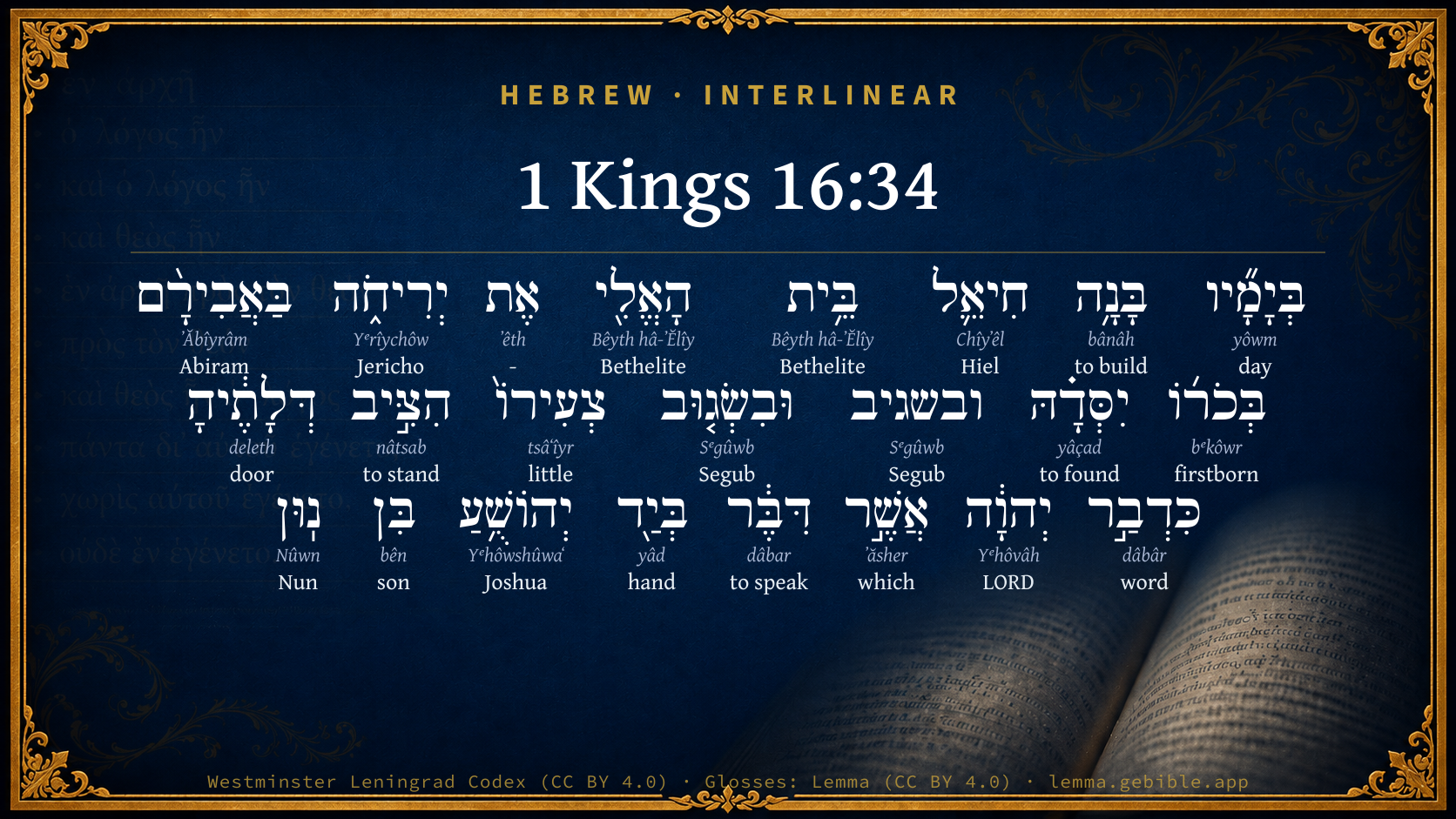
Hebrew (Westminster Leningrad Codex) 1 Kings 16:34 appears in the Hebrew Old Testament. The text above is from the Westminster Leningrad Codex. Each word links to its Strong’s number, a concise gloss, and parsing drawn from the Open Scriptures Hebrew Bible morphology. Click any word for its full Brown-Driver-Briggs (BDB) entry.
Download image
Cite this verse

1 Kings 16:34 (World English Bible). Public Domain. Lemma interlinear Bible study tool, https://lemma.gebible.app/v/1-kings/16/34.

Show BibTeX & RIS
BibTeX
RIS
English Translation
In his days did Hiel the Bethelite build Jericho: he laid the foundation of it with the loss of Abiram his firstborn, and set up the gates of it with the loss of his youngest son Segub, according to the word of Yahweh, which he spoke by Joshua the son of Nun.
World English Bible · Public Domain
Highlights
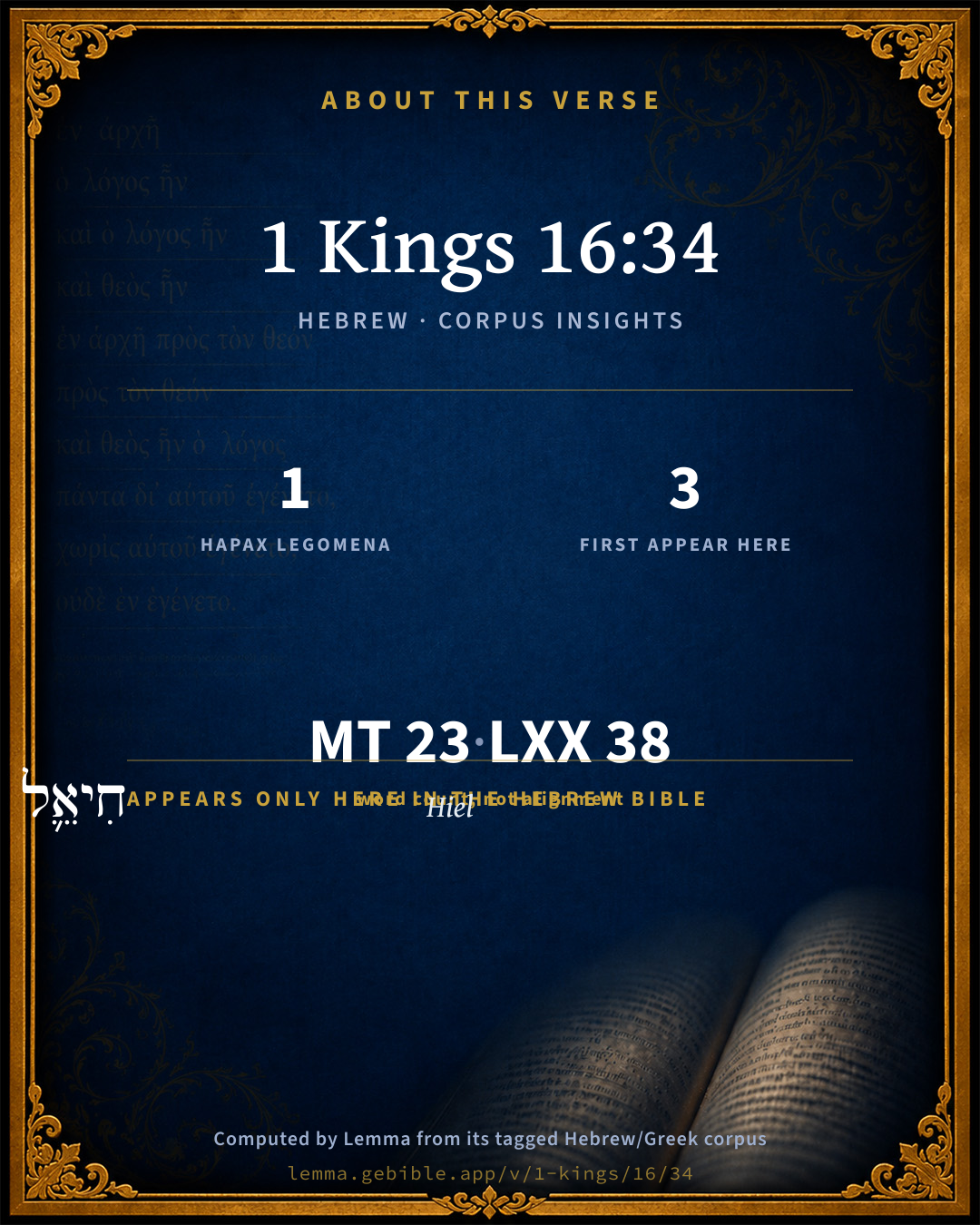
  • 1 hapax legomenon — only here in the Hebrew Bible
  • 3 first appearances in the Hebrew Bible
Full analysis ↓
Download a study sheet

One document with this verse’s original text, its word-by-word gloss line, the meaning frame, cross-references with their text, attributed commentary, and full source and license credits — printable, and it pastes into notes with its structure intact.

This verse Autodidact and up

Study sheet (.html) Plain text (.txt)

A passage Seminary Student

Up to 50 verses in one chapter. A passage sheet keeps up to 6 commentary sources and 12 cross-references per verse, in the order this page ranks them, and says so on the sheet whenever that leaves anything out. Ask for a single verse and you get the Autodidact verse sheet above.

Everything on this page stays free to read, with no account — the sheet is a download of what is already on screen, not access to it.

Want to remove ads? Support Godless Engineer
Compare translations 3

The same verse in 3 English versions, stacked beneath the original-language interlinear above. Click any original word for its lexicon entry.

Each is an independent rendering of the whole verse — the interlinear is not word-aligned to these translations.

Highlighted words mark where these versions differ — a whole-verse word diff, not a word-by-word alignment.

  • World English Bible Public Domain
    In his days did Hiel the Bethelite build Jericho: he laid the foundation of it with the loss of Abiram his firstborn, and set up the gates of it with the loss of his youngest son Segub, according to the word of Yahweh, which he spoke by Joshua the son of Nun.
  • King James Version Public Domain
    In his days did Hiel the Bethelite build Jericho: he laid the foundation thereof in Abiram his firstborn, and set up the gates thereof in his youngest son Segub, according to the word of the LORD, which he spake by Joshua the son of Nun.
  • unfoldingWord Literal Text CC BY-SA 4.0
    In his days, Hiel the Bethelite built Jericho. By Abiram, his firstborn, he founded it, and by Segub, his youngest, he set up its doors, according to the word of Yahweh that he spoke by the hand of Joshua, the son of Nun.

unfoldingWord Literal Text — © unfoldingWord, licensed CC BY-SA 4.0. Word-aligned USFM3 via Door43 (git.door43.org/unfoldingWord/en_ult).

Versions to compare (up to 4)

3 of 4 selected

Show all 18 translations

Every available English version of this verse, each an independent rendering of the whole verse.

  • World English Bible Public Domain
    In his days did Hiel the Bethelite build Jericho: he laid the foundation of it with the loss of Abiram his firstborn, and set up the gates of it with the loss of his youngest son Segub, according to the word of Yahweh, which he spoke by Joshua the son of Nun.
  • Berean Standard Bible Public Domain
    In Ahab’s days, Hiel the Bethelite rebuilt Jericho. At the cost of Abiram his firstborn he laid its foundation, and at the cost of Segub his youngest he set up its gates, according to the word that the LORD had spoken through Joshua son of Nun.
  • Majority Standard Bible Public Domain
    In Ahab’s days, Hiel the Bethelite rebuilt Jericho. At the cost of Abiram his firstborn he laid its foundation, and at the cost of Segub his youngest he set up its gates, according to the word that the LORD had spoken through Joshua son of Nun.
  • King James Version Public Domain
    In his days did Hiel the Bethelite build Jericho: he laid the foundation thereof in Abiram his firstborn, and set up the gates thereof in his youngest son Segub, according to the word of the LORD, which he spake by Joshua the son of Nun.
  • American Standard Version (1901) Public Domain
    In his days did Hiel the Beth-elite build Jericho: he laid the foundation thereof with the loss of Abiram his first-born, and set up the gates thereof with the loss of his youngest son Segub, according to the word of Jehovah, which he spake by Joshua the son of Nun.
  • Revised Version (1885) Public Domain
    In his days did Hiel the Beth-elite build Jericho: he laid the foundation thereof with the loss of Abiram his firstborn, and set up the gates thereof with the loss of his youngest son Segub; according to the word of the LORD, which he spake by the hand of Joshua the son of Nun.
  • Geneva Bible (1599) Public Domain
    In his dayes did Hiel the Bethelite buylde Iericho: he layed the foundation thereof in Abiram his eldest sonne, and set vp the gates thereof in his yongest sonne Segub, according to the worde of the Lord which he spake by Ioshua the sonne of Nun.
  • Douay-Rheims (1899) Public Domain
    In his days Hiel of Bethel built Jericho: in Abiram his firstborn he laid its foundations: and in his youngest son Segub he set up the gates thereof: according to the word of the Lord, which he spoke in the hand of Josue the son of Nun.
  • Young's Literal Translation Public Domain
    In his days hath Hiel the Beth-Elite built Jericho; in Abiram his first-born he laid its foundation, and in Segub his youngest he set up its doors, according to the word of Jehovah that He spake by the hand of Joshua son of Nun.
  • Literal Standard Version CC BY-SA 4.0
    In his days Hiel the Beth-Elite has built Jericho; he laid its foundation with Abiram his firstborn, and he set up its doors with Segub his youngest, according to the word of YHWH that He spoke by the hand of Joshua son of Nun.
  • Unlocked Literal Bible CC BY-SA 4.0
    During Ahab's rule, Hiel of Bethel rebuilt Jericho. Hiel laid the foundation of the city at the cost of the life of Abiram, his firstborn son; and Segub, his youngest son, lost his life while he was building the gates of the city, in keeping with the word of Yahweh which he spoke by Joshua son of Nun.
  • unfoldingWord Literal Text CC BY-SA 4.0
    In his days, Hiel the Bethelite built Jericho. By Abiram, his firstborn, he founded it, and by Segub, his youngest, he set up its doors, according to the word of Yahweh that he spoke by the hand of Joshua, the son of Nun.
  • Darby Bible Public Domain
    In his days Hiel the Bethelite built Jericho; he laid its foundation in Abiram his firstborn, and set up its gates in Segub his youngest, according to the word of Jehovah which he spoke through Joshua the son of Nun.
  • World Messianic Bible Public Domain
    In his days Hiel the Bethelite built Jericho. He laid its foundation with the loss of Abiram his firstborn, and set up its gates with the loss of his youngest son Segub, according to the LORD’s word, which he spoke by Joshua the son of Nun.
  • Webster's Bible Public Domain
    In his days Hiel the Beth-elite built Jericho: he laid the foundation of it in Abiram his first-born, and set up the gates of it in his youngest son Segub, according to the word of the LORD, which he spoke by Joshua the son of Nun.
  • Free Bible Version CC BY-SA 4.0
    During Ahab's reign Hiel of Bethel rebuilt Jericho. He sacrificed Abiram his firstborn son when he laid its foundation, and sacrificed Segub his youngest son when he constructed its gates. This fulfilled the message the Lord had given through Joshua, son of Nun.
  • Bible in Basic English Public Domain
    In his days Hiel made Jericho; he put its base in position at the price of Abiram, his oldest son, and he put its doors in place at the price of his youngest son Segub; even as the Lord had said by Joshua, the son of Nun.
  • JPS Tanakh (1917) Public Domain
    In his days did Hiel the Bethelite build Jericho; with Abiram his first-born he laid the foundation thereof, and with his youngest son Segub he set up the gates thereof; according to the word of the LORD, which He spoke by the hand of Joshua the son of Nun.

Literal Standard Version (2020), Covenant Press — licensed CC BY-SA 4.0. Text via the HelloAO Bible API (eBible.org). Unlocked Literal Bible (unfoldingWord) — licensed CC BY-SA 4.0. Text via the HelloAO Bible API (eBible.org). unfoldingWord Literal Text — © unfoldingWord, licensed CC BY-SA 4.0. Word-aligned USFM3 via Door43 (git.door43.org/unfoldingWord/en_ult). Free Bible Version, Dr. Jonathan Gallagher — licensed CC BY-SA 4.0. Text via the HelloAO Bible API (eBible.org).

Word by word

More ways to search: Search by grammar → Find every occurrence → Compare this word →

Practice this passage: Drill this verse → Learn its vocabulary →

חִיאֵ֛ל
Chîyʼêl
H2419
“Hiel”
Noun, Proper
Part of Speech
Noun
Type
Proper
Full BDB Definition

Origin: from H2416 and H410

TWOT: None

Hiel = "God lives" - a native of Bethel who rebuilt Jericho in the reign of Ahab and in whom was fulfilled the curse pronounced by Joshua
  1. בְּיָמָ֞יו yôwm H3117 “in/at · days · his” Preposition + Noun, Common, Masculine, Plural, Construct + Suffix, Personal, 3rd Person, Masculine, Singular
  2. בָּנָ֥ה bânâh H1129 “to build” Verb, Qal, Perfect, 3rd Person, Masculine, Singular
  3. בֵּ֥ית Bêyth hâ-ʼĔlîy H1017 “Bethelite” Noun, Gentilic, Masculine, Singular, Construct
  4. הָאֱלִ֖י Bêyth hâ-ʼĔlîy H1017 “Bethelite” Noun, Gentilic, Masculine, Singular, Absolute
  5. אֶת ʼêth H853 “-” Particle, Direct Object
  6. יְרִיחֹ֑ה Yᵉrîychôw H3405 “Jericho” Noun, Proper
  7. בַּאֲבִירָ֨ם ʼĂbîyrâm H48 “in/at · Abiram” Preposition + Noun, Proper
  8. בְּכֹר֜וֹ bᵉkôwr H1060 “firstborn · his” Noun, Common, Masculine, Singular, Construct + Suffix, Personal, 3rd Person, Masculine, Singular
  9. יִסְּדָ֗הּ yâçad H3245 “to found · her” Verb, Piel, Perfect, 3rd Person, Masculine, Singular + Suffix, Personal, 3rd Person, Feminine, Singular
  10. ובשגיב Sᵉgûwb H7687 “and · in/at · Segub” Conjunction + Preposition + Noun, Proper
  11. וּבִשְׂג֤וּב Sᵉgûwb H7687 “and · in/at · Segub” Conjunction + Preposition + Noun, Proper
  12. צְעִירוֹ֙ tsâʻîyr H6810 “little · his” Adjective, Adjective, Masculine, Singular, Construct + Suffix, Personal, 3rd Person, Masculine, Singular
  13. הִצִּ֣יב nâtsab H5324 “to stand” Verb, Hiphil, Perfect, 3rd Person, Masculine, Singular
  14. דְּלָתֶ֔יהָ deleth H1817 “doors · her” Noun, Common, Feminine, Dual, Construct + Suffix, Personal, 3rd Person, Feminine, Singular
  15. כִּדְבַ֣ר dâbâr H1697 “like/as · word of” Preposition + Noun, Common, Masculine, Singular, Construct
  16. יְהוָ֔ה Yᵉhôvâh H3068 “LORD” Noun, Proper
  17. אֲשֶׁ֣ר ʼăsher H834 “which” Particle, Relative
  18. דִּבֶּ֔ר dâbar H1696 “to speak” Verb, Piel, Perfect, 3rd Person, Masculine, Singular
  19. בְּיַ֖ד yâd H3027 “in/at · hand of” Preposition + Noun, Common, Both, Singular, Construct
  20. יְהוֹשֻׁ֥עַ Yᵉhôwshûwaʻ H3091 “Joshua” Noun, Proper
  21. בִּן bên H1121 “son of” Noun, Common, Masculine, Singular, Construct
  22. נֽוּן Nûwn H5126 “Nun” Noun, Proper

About this verse

These counts appear in no published source. They are computed here, from the morphology-tagged text and Lemma’s own curated glosses. What Lemma adds →

23
words
21
distinct lemmas
Historical
section

Notable vocabulary

1 hapax legomenon — a word that appears only here in the entire Hebrew Bible:

  • חִיאֵ֛ל Hiel H2419

First appearance in Scripture

These words make their first canonical appearance in the Hebrew Bible here:

  • חִיאֵ֛ל Hiel H2419
  • בֵּ֥ית Bethelite H1017
  • ובשגיב Segub H7687

Grammatical profile

  • 4 verbs
  • 16 nouns
  • 1 adjective
  • 2 particles

Verb forms

  • בָּנָ֥ה Qal · Perfect
  • יִסְּדָ֗הּ Piel · Perfect
  • הִצִּ֣יב Hiphil · Perfect
  • דִּבֶּ֔ר Piel · Perfect

Repetition

Words recur within this verse — often emphatic in Hebrew:

  • בֵּ֥ית Bethelite H1017 ×2
  • ובשגיב Segub H7687 ×2

Hebrew & Septuagint length

In English translation the verse runs 52 words from the Hebrew and 48 from the Septuagint (LXX English) — closely comparable.

A rough comparison of the two English renderings, which tokenize alike — not a word-level alignment.

Word counts can differ between the Hebrew and the Greek without any difference in meaning — e.g. the Hebrew direct-object marker אֵת has no separate Greek word, and Greek often adds the article ὁ.

In the original languages it is 23 Hebrew tokens and 38 Greek tokens — but the two are counted differently (Hebrew bundles its prefixes and suffixes into one token; the Greek is in lemma form), so that isn’t a like-for-like length.

Cross-references

1

Topical passages linked to 1 Kings 16:34 in the Treasury of Scripture Knowledge — connected by theme and wording, ordered by reader-vote popularity; previews shown in the World English Bible.

  • Joshua 6:26 Joshua charged them with an oath at that time, saying, Cursed be the man before Yahweh, that rises up and builds this city Jericho: with the loss of his firstborn shall he lay the foundation of it, and with the loss of his youngest son shall he set up the gates of it.

Cross-references courtesy of OpenBible.info (CC BY 4.0).

Hebrew and Greek witnesses Masoretic Hebrew ↔ Greek Septuagint

The same verse in the two great witnesses to the Old Testament, shown verse-for-verse.

These are two independent witnesses, not word-aligned to each other, and the Septuagint is shown in lemma (dictionary) form.

Hebrew 1 Kings 16:34 Masoretic · Westminster Leningrad Codex

בְּיָמָ֞יו בָּנָ֥ה חִיאֵ֛ל בֵּ֥ית הָאֱלִ֖י אֶת יְרִיחֹ֑ה בַּאֲבִירָ֨ם בְּכֹר֜וֹ יִסְּדָ֗הּ ובשגיב וּבִשְׂג֤וּב צְעִירוֹ֙ הִצִּ֣יב דְּלָתֶ֔יהָ כִּדְבַ֣ר יְהוָ֔ה אֲשֶׁ֣ר דִּבֶּ֔ר בְּיַ֖ד יְהוֹשֻׁ֥עַ בִּן נֽוּן

In his days did Hiel the Bethelite build Jericho: he laid the foundation of it with the loss of Abiram his firstborn, and set up the gates of it with the loss of his youngest son Segub, according to the word of Yahweh, which he spoke by Joshua the son of Nun.

World English Bible · Public Domain

Greek LXX 1 Kings 16:34 Septuagint · lemma form

ἐν ὁ ἡμέρα αὐτός οἰκοδομέω αχιηλ ὁ βαιθηλίτης ὁ ιεριχω ἐν ὁ αβιρων ὁ πρωτότοκος αὐτός θεμελιόω αὐτός καί ὁ σεγουβ ὁ νέος αὐτός ἐπιἵστημι θύρα αὐτός κατά ὁ ῥῆμα κύριος ὅς λαλέω ἐν χείρ ιησου υἱός ναυη

And in his days Achiel the Baethelite built Jericho: he laid the foundation of it in Abiron his firstborn, and he set up the doors of it in Segub his younger son, according to the word of the Lord which he spoke by Joshua the son of Naue.

LXX2012 (modern English Septuagint) · Public Domain

On this verse, Adam Clarke's Commentary discusses the Septuagint’s reading. Read the note in Commentary ↓

Hebrew: Westminster Leningrad Codex (CC BY 4.0). Greek: Septuagint (public domain); English from LXX2012 (modern English Septuagint) (Public Domain). How the Septuagint differs from the Hebrew →

Targum (Aramaic paraphrase)

1

The Targum is the ancient Jewish Aramaic paraphrase of the Hebrew Scriptures — an interpretive translation, not the Hebrew text itself. Onkelos (literal) and Pseudo-Jonathan (expansive) render the Torah, and Jonathan the Prophets. Coverage is partial: where no permissively-licensed English translation exists for a verse, only the Aramaic is shown. This is verse-level text, not a word-by-word alignment to the Hebrew.

  1. Targum Jonathan Prophets (Joshua–Malachi)
    בְּיוֹמוֹהִי בְּנָא חִיאֵל בֵּית מוֹמֵי יַת יְרִיחֹה קְטַל אֲבִירָם בּוּכְרֵיהּ כַּד שָׁרֵי לְשַׁכְלֵיל יָתָהּ וּשְׂגוּב זְעֵיר בְּנוֹהִי כַּד אָקֵים דְשָׁהָא כְּפִתְגָמָא דַייָ דִי מַלֵיל בִּידָא דִיהוֹשֻׁעַ בַּר נוּן:

    (no public-domain English translation for this verse)

    Targum Jonathan — Aramaic: “Mikraot Gedolot” (public domain). English: “Sefaria Community Translation” (CC0 1.0 (public-domain dedication)); “London "Chaldee Paraphrase," 1871” (public domain). Text via Sefaria.

Commentary

Notes on 1 Kings 16:34 from classic Christian and Jewish commentators (each source and its license shown beneath its notes). The classic Christian expositions comment on the surrounding passage and are grouped to its opening verse, so a note may address several verses; the Jewish commentaries on the Tanakh (Rashi and others) are per-verse, so they appear only where the commentator wrote on this verse.

Lemma curates 59 commentaries, every one of them public domain or Creative Commons licensed, each selected and text-cleaned for this edition rather than reprinted as found. About our sources →

Jamieson, Fausset & Brown

Robert Jamieson, A. R. Fausset & David Brown

JOSHUA'S CURSE FULFILLED UPON HIEL THE BUILDER OF JERICHO. (Kg1 16:34)

In his days did Hiel the Beth-elite build Jericho--(see on Jos 6:26). The curse took effect on the family of this reckless man but whether his oldest son died at the time of laying the foundation, and the youngest at the completion of the work, or whether he lost all his sons in rapid succession, till, at the end of the undertaking, he found himself childless, the poetical form of the ban does not enable us to determine. Some modern commentators think there is no reference either to the natural or violent deaths of Hiel's sons; but that he began in presence of his oldest son, but some unexpected difficulties, losses, or obstacles, delayed the completion till his old age, when the gates were set up in the presence of his youngest son. But the curse was fulfilled more than five hundred years after it was uttered; and from Jericho being inhabited after Joshua's time (Jdg 3:13; Sa2 10:5), it has been supposed that the act against which the curse was directed, was an attempt at the restoration of the walls--the very walls which had been miraculously cast down. It seems to have been within the territory of Israel; and the unresisted act of Hiel affords a painful evidence how far the people of Israel had lost all knowledge of, or respect for, the word of God.

Next: 1 Kings Chapter 17

Jamieson, Fausset & Brown — Commentary Critical and Explanatory on the Whole Bible (1871) — public domain (CC PDM 1.0). Text via the HelloAO Bible API.

Trapp's Complete Commentary

John Trapp

1Ki 16:34 In his days did Hiel the Bethelite build Jericho: he laid the foundation thereof in Abiram his firstborn, and set up the gates thereof in his youngest [son] Segub, according to the word of the LORD, which he spake by Joshua the son of Nun.

Ver. 34. In his days did Hiel the Bethelite build Jericho.] Al despite di Die, as that blasphemous Pope once said. But this bold wretch paid dearly for his presumption. See on Jos 6:26. He sought for a name, but hath left it for a curse, as Isa 65:15. He might do it also to curry favour with Ahab, as his fellow condemner of God and his prophets.

John Trapp, A Commentary or Exposition upon All the Books of the Old and New Testament (1647–1656) — public domain. Text from a community e-Sword module.

Joseph Benson's Commentary

1Ki 16:34. In his days, &c. — This is mentioned here, 1st, As an instance of the certainty of the accomplishment of the divine predictions; that here referred to being fulfilled upward of five hundred years after it was delivered: a most striking proof of the divine prescience, as well as of the authority of those sacred writings which contain so remarkable a prophecy; 2d, It is recorded as an evidence of the horrible corruption of Ahab’s times, and of the high contempt of God which then reigned; this Hiel beginning to build in defiance of the curse well known in Israel, probably jesting with it as a bug-bear, or fancying its force worn out by length of time; and going on to build in defiance of the execution of the curse in part. For though his eldest son died when he began, yet he would proceed in spite of God and his wrath revealed from heaven against his ungodliness; 3d, It was intended to be a warning to the Israelites not to think themselves innocent or safe, because the judgment threatened against them by Ahijah was not yet executed. The Bethelite — Who lived in Beth-el, the seat and sink of idolatry, wherewith he was thoroughly leavened. He laid the foundation thereof in Abiram his firstborn — Whom God took away in the beginning of his building, and others of his children successively in the progress of the work, and the youngest when he finished it. So that he found by his own sad experience the truth of God’s word, the sentence which Joshua pronounced against the builder of this city being literally and exactly executed. (See Joshua, chapter 6. 1Ki 16:26.) A remarkable instance this of the certainty of the accomplishment of God’s threatenings, and that he never forgets what he has spoken!

Joseph Benson's Commentary on the Old and New Testaments (1811–1818) — public domain. Text from a community e-Sword module.

Tyndale Open Study Notes

Tyndale Open Resources

16:34 Despite Joshua’s curse against Jericho (Josh 6:26-27), the site was occasionally and temporarily occupied prior to being rebuilt by Hiel (see Judg 3:13; 2 Sam 10:5; 1 Chr 19:5), as archaeological excavations confirm. Hiel’s efforts signify the spiritual defection of Israel. • When he laid its foundation . . . Segub: The Targum (an interpretive Aramaic translation for Jews who did not know Hebrew after the Exile) suggests that Hiel sacrificed his sons as foundation offerings according to pagan practices; others understand the deaths to be from disease or accident. The sentence might be a Hebrew merism (using boundaries to indicate everything in between), which would imply that all of Hiel’s sons died.

Tyndale Open Study Notes — © Tyndale Open Resources, licensed CC BY-SA 4.0. Text via the HelloAO Bible API.

Geneva Bible (1599)

Geneva Bible translators

Hebrew, by the hand of Joshua.

Read Josh. 6:26.

Geneva Bible (1599) marginal notes — public domain. Text via Bolls.life.

Adam Clarke's Commentary

Verse 34. Did Hiel the Beth-elite build Jericho] I wish the reader to refer to my note on Jos 6:26, for a general view of this subject. I shall add a few observations. Joshua's curse is well known: "Cursed be the man before the Lord that riseth up and buildeth this city Jericho; he shall lay the foundation thereof in his first-born; and in his youngest son shall he set up the gates of it," Jos 6:26. This is the curse, but the meaning of its terms is not very obvious. Let us see how this is to be understood from the manner in which it was accomplished.

"In his days did Hiel the Beth-elite build Jericho; he laid the foundation thereof in Abiram his first-born, and set up the gates thereof in his youngest son Segub; according to the word of the Lord, which he spake by Joshua the son of Nun." This prediction was delivered upwards of five hundred years before the event; and though it was most circumstantially fulfilled, yet we know not the precise meaning of some of the terms used in the original execration, and in this place, where its fulfillment is mentioned. There are three opinions on the words, lay the foundation in his first-born, and set up the gates in his youngest son.

1. It is thought that when he laid the foundation of the city, his eldest son, the hope of his family, died by the hand and judgment of God, and that all his children died in succession; so that when the doors were ready to be hung, his youngest and last child died, and thus, instead of securing himself a name, his whole family became extinct.

2. These expressions signify only great delay in the building; that he who should undertake it should spend nearly his whole life in it; all the time in which he was capable of procreating children; in a word, that if a man laid the foundation when his first-born came into the world, his youngest and last son should be born before the walls should be in readiness to admit the gates to be set up in them; and that the expression is of the proverbial kind, intimating greatly protracted labour, occasioned by multitudinous hinderances and delays.

3. That he who rebuilt this city should, in laying the foundation, slay or sacrifice his firstborn, in order to consecrate it, and secure the assistance of the objects of his idolatrous worship; and should slay his youngest at the completion of the work, as a gratitude-offering for the assistance received. This latter opinion seems to be countenanced by the Chaldee, which represents Hiel as slaying his first-born Abiram, and his youngest son Segub.

But who was Hiel the Beth-elite? The Chaldee calls him Hiel of Beth-mome, or the Beth-momite; the Vulgate, Hiel of Beth-el; the Septuagint, Hiel the Baithelite; the Syriac represents Ahab as the builder: "Also in his days did Ahab build Jericho, the place of execration;" the Arabic, "Also in his days did Hiel build the house of idols-to wit, Jericho." The MSS. give us no help. None of these versions, the Chaldee excepted, intimates that the children were either slain or died; which circumstance seems to strengthen the opinion, that the passage is to be understood of delays and hinderances. Add to this, Why should the innocent children of Hiel suffer for their father's presumption? And is it likely that, if Hiel lost his first-born when he laid the foundation, he would have proceeded under this evidence of the Divine displeasure, and at the risk of losing his whole family? Which of these opinions is the right one, or whether any of them be correct, is more than I can pretend to state. A curse seems to rest still upon Jericho: it is not yet blotted out of the map of Palestine, but it is reduced to a miserable village, consisting of about thirty wretched cottages, and the governor's dilapidated castle; nor is there any ruin there to indicate its former splendour.

Adam Clarke's Commentary on the Bible (1810–1826) — public domain. Text from a community e-Sword/MySword module.

Ellicott's Commentary for English Readers

(34) Did Hiel . . . build Jericho.—This marks both the growth of prosperity and power, and the neglect of the old curse of Joshua (Jos_6:26). The place had not, it would appear, been entirely deserted. (See Jdg_3:13; 2Sa_10:5.) But it was now made—what it continued to be even down to the time of Herod—an important place. Its natural advantages were great. It stood in a position well watered, and accordingly of great beauty and fruitfulness (“the city of palm trees”), and was, moreover, a city of military consequence, as commanding the pass from the valley of the Jordan to the high ground of Ai and Bethel. Having been assigned to Benjamin (Jos_18:21), it should have properly belonged to the kingdom of Judah. Its being rebuilt by a Bethelite, evidently under the patronage of Ahab, is one of the indications of a half-dependent condition of the Southern kingdom at this time.

A Bible Commentary for English Readers, edited by Charles John Ellicott (1878–1897) — public domain. Text from a community e-Sword module.

The Cambridge Bible for Schools and Colleges

gen. ed. J. J. S. Perowne

34. The rebuilding of Jericho (Not in Chronicles)

34. Hiel the Bethelite] We may perhaps trace the influence here of evil surroundings. Hiel had been living at one of the seats of Jeroboam’s calf-worship, and the neglect of one command had led to ignorance or disregard of another.

did … build Jericho] As the kings, Omri and Ahab, were great builders, so their wealthier subjects were led to imitate their grand works. For the command that Jericho should not be rebuilt, see Jos_6:26. The importance of the place lay no doubt in its neighbourhood to the passage of the Jordan, and at a time when commerce was much fostered this advantage was likely to outweigh, with such men, the prohibition which had been given so many generations before, and would be now reckoned as obsolete.

in Abiram] R.V. with the loss of Abiram. The R.V. explains the literal rendering of A.V. The preposition is used to express the cost or price of anything, and so here the penalty which Hiel paid for his transgression. The same change is also made in the second clause of the verse. The meaning is that between the beginning and the end of the undertaking all Hiel’s children were cut off.

by Joshua] The Hebrew has ‘by the hand of Joshua,’ as in so many other places where a message is in question.

The Cambridge Bible for Schools and Colleges (gen. ed. J. J. S. Perowne; Cambridge University Press, 1878–1918) — public domain. Text from a community e-Sword module.

Albert Barnes' Notes on the Bible

This seems to be adduced as a proof of the general impiety of Ahab’s time. The curse of Joshua against the man who should rebuild Jericho had hitherto been believed and respected. But now faith in the old religion had so decayed, that Joshua’s malediction had lost its power. Hiel, a Bethelite of wealth and station, undertook to restore the long-ruined fortress. But he suffered for his temerity. In exact accordance with the words of Joshua’s curse, he lost his firstborn son when he began to lay anew the foundations of the walls, and his youngest when he completed his work by setting up the gates. We need not suppose that Jericho had been absolutely uninhabited up to this time. But it was a ruined and desolate place without the necessary protection of walls, and containing probably but few houses (Jdg 3:13 note). Hiel re-established it as a city, and it soon became once more a place of some importance 2Ch 28:15.

Albert Barnes' Notes on the Bible (1834–1885) — public domain. Text from a community e-Sword/MySword module.

Haydock's Catholic Bible Commentary

Hand. Josue had committed this curse to writing. (Haydock) --- Hiel, an idolater, did not regard it, and Achab had not zeal to attempt to hinder him. But divine Providence punished his audacity. (Calmet) --- All his sons perished, while the city was rebuilding. (Worthington) --- See Josue vi. 26. (Calmet)

George Leo Haydock (1774–1849), Haydock's Catholic Family Bible and Commentary, 1859 edition — public domain. Excludes Psalms (Douay-Rheims chapter numbering differs from Protestant) and Deuterocanonical books (Catholic canon only).

Matthew Poole's English Annotations

In his days: this is here added,

1. As a character of the time, and an instance of the truth and certainty of Divine predictions and comminations, this being fulfilled eight hundred years after it was threatened; and withal, as a warning to the Israelites, not to think themselves innocent or safe, because the judgment threatened against them by Ahijah, 1Ki 14:15, was not yet executed, though they continued in that calf-worship which he condemned; but to expect the certain accomplishment of it in due time, if they persisted in their impenitency. Or,

2. As an evidence of the horrible corruption of his times, and of that high contempt of God which then reigned.

Hiel the Beth-elite; who lived in Beth-el, the seat and sink of idolatry, wherewith he was thoroughly leavened.

Built Jericho; a place seated in the tribe of Benjamin, but belonging to the kingdom of Israel; which place he seems to have chosen for his buildings; not so much for his own advantage as out of a contempt of the true God, and of his threatenings, which he designed to convince of falsehood by his own experience; and out of an ambitious desire to. advance his own reputation and interest thereby, by attempting that which he knew his king and queen too would be highly pleased with.

He laid the foundation thereof in Abiram his first-born, and set up the gates thereof in his youngest son Segub; i.e. in the beginning of his building God took away his first-born, and others successively in the progress of the work, and the youngest when he finished it. And so he found by his own sad experience the truth of God’s word, and how vain it was to contend with him.

Quest. Why did not God rather punish Hiel himself?

Answ. This was a terrible punishment, to see his children cut off by Divine vengeance before their time, one after another; and all this for his own folly and rashness. Compare Jer 52:10. And as for Hiel himself, possibly after he had been spared so long, that he might be an eyewitness of his sons untimely deaths, he also might be cut off, though it be not recorded, as not belonging to the prophecy here mentioned; or if not, his present impunity was his greatest misery; either as it continued his torment in the sad and lasting remembrance of his loss and misery; or as it was a mean to harden his heart so for greater judgments, to which he was reserved.

According to the word of the Lord, which he spake by Joshua; of which See Poole "Jos 6:26".

Matthew Poole's English Annotations on the Holy Bible (1683–1685) — public domain. Text from a community e-Sword/MySword module.

Whedon's Commentary on the Bible

Daniel D. Whedon

34. Hiel the Bethelite — A native of that city which had so long been the scene of Israelitish calf-worship, and, perhaps, a despiser of Jehovah and his laws. He was thus a fit person to undertake the daring work here mentioned.

Build Jericho — Joshua pronounced a curse upon the man who should attempt to rebuild the walls of Jericho, (Jos_6:26; where see note,) and several hundred years had passed with no one so impious as to despise that curse. The place had been inhabited, but no one had ventured to fortify it and set up the gates. It seems to have now become the possession of the northern kingdom, and Ahab’s design in having it fortified was probably to make it a frontier garrison to command the passage over the Jordan.

Laid the foundation thereof in Abiram — That is, at the cost of his life. Thus, in 1Ki_2:23, Solomon says that Adonijah had spoken a certain word בנפשׁו, in his life, that is, at the cost of his life. The manner in which the Divine judgment fell upon Hiel’s sons — whether by natural or by violent deaths — whether the firstborn died when he laid the foundation, and the youngest when he set up the gates — is nowhere stated, and so far as that is unknown so far will there be a degree of mystery hanging over this text. But the record will ever stand as a warning that no man may lightly treat Jehovah’s word and live.

Daniel D. Whedon (gen. ed.), Commentary on the Old and New Testaments (1874–1909) — public domain. Text from a community e-Sword module.

The Pulpit Commentary

In his days did Hiel the Bethelite Observe the form ylia"h; tyBe, and see note on 1Ki_2:8. It is noticeable that it was reserved for a man of Bethel to commit this act of impiety. It was to such results the worship of the calves contributed build i.e., rebuild, fortify, as in 1Ki_12:25; cf. 1Ki_9:17. It is clear from Jud_1:3:13 and 2Sa_10:5 that it had not been entirely uninhabited. But the Arab village was now converted into a town with gates and bars Jericho We learn from. Jos_18:21 that Jericho then belonged to Benjamin. It had evidently passed, however, at this date into the possession of Israel. It has been suggested that the transference took place in the reign of Baasha (Rawlinson) But it would seem that from the very first, parts of Benjamin (notably Bethel, Jos_18:13) belonged to the northern kingdom. See Ewald, "Hist. Israel," 4:2, 3. It is not quite clear whether the rebuilding of Jericho is mentioned as a proof of the daring impiety of that age and of the utter contempt with which the warnings of the law were treated, or as showing the ignorance and consequent disregard of law which prevailed. But, on the whole, it seems to be implied that Hiel knew of the threatening of Joshua, and treated it with defiance. It has been suggested that the rebuilding had really been instigated by Ahab, and for his own purposes, hoping thereby to "secure to himself the passage across the Jordan" (Keil), but the text affords but slight warrant for this conjecture: he laid the foundation thereof in Abiram his firstborn i.e. , at the cost of, in the life of, Abiram, and set up the gates thereof in his youngest son Segub, according to the word of the Lord, (Jos_6:26) which he spake by Joshua the son of Nun. The exact fulfilment of the prophecy is mentioned, as showing that even in those dark and troublous times God did not leave Himself without witness, and that law could never be violated with impunity.

The Temerity of Hiel.

In discussing this subject we have to consider

I "THE WORD OF THE LORD WHICH HE SPAKE BY JOSHUA. THE SON OF NUN." The record of this word is found in Jos_6:26. And the questions now arise

1. Why did God thus curse Jericho?

(1) That its desolate condition might be a standing testimony to His abhorrence of the wickedness of the place. So abandoned were that people to idolatry that Rahab the hostess alone was accounted worthy of being saved. And "all her kindred (hytwjp all her families the word is plural; families, viz., on her father"s and mother"s side, both were given to her. (Jos_6:23) Note: The faith of an individual is notonly a personal blessing, but also a blessing to his family, to his nation, to the world, in time, in eternity.

(2) That it might he a standing sign prophetic of judgments to come.

(a) Jericho was the first city which offered resistance to the people of God; and it was proper it should stand forth as a figure of the last city that shall offer resistance, viz., Great Babylon.

(b) As Jericho was compassed about six days before it fell, so is Great Babylon destined to last until the beginning of the seventh age of prophetic chronology.

(c) As Jericho fell at the seventh blast of the trumpet, so at the sounding of the seventh Apocalyptic thumper will Great Babylon come into remembrance before God.

(d) As Rahab, through the righteousness of faith, escaped the plagues of war and fire which destroyed the city, so are the people of God urged to come out of Babylon lest they partake her plagues also of war and fire.

2. Why did God thus curse the rebuilder of Jericho?

(1) Consider the import of the curse. His eldest son was to perish by a judgment of Heaven as soon as the work commenced; and if, notwithstanding the judgment, he persisted in the undertaking, he should see the death of his youngest son. lit is thought the intermediate members of his family would also perish as the work advanced. That the curse involved the penalty of death is evident, since the curse upon the city meant the death of its inhabitants. (see Jos_6:17) The law of God also expresses that devoted things must die. (see Lev_27:29)

(2) The curse, then, came to keep up the testimony for God against sin; also to be a public sign of the judgment upon Babylon to come. Whoever would remove such a testimony must be a man of determined wickedness, and therefore deserving execration. Let us beware how we oppose or discredit any faithful testimony for Christ.

II THE TEMERITY OF HIEL TO ENCOUNTER THIS MALEDICTION.

1. The historical fact is before us.

(1) He did build Jericho. Not only did he lay the foundation, but he also set up the gates. Resolution and persistency are fine qualities when they are concerned with truth and goodness. But it was otherwise here.

(2) He paid the penalty accordingly. When he laid the foundation his firstborn Abiram perished. This did not deter him. So when he set up the gates "his youngest son Segub" was smitten.

2. But what could have possessed him?

(1) The general answer to this question is, that the spirit of wickedness possessed him. No godly man could be so rashly defiant. Even reputable men of the world would shrink from such an audacious undertaking. The respect for sacred things manifested by such unconverted men encourages the hope that they may yet seek His grace and mercy. Hiel must have been a hardened sinner to have attempted this.

(2) A more particular answer is suggested.

(a) He was a "Bethelite." This expression may mean that he was born in Bethel, though this is not clear. It suggests rather that he was wedded to the sin of Jeroboam; for Bethel was the head-quarters of that apostasy. There Jeroboam placed one of his famous calves. There he built an altar. There also he built a temple. There his priests congregated, and there he, in person, officiated as high priest. The service of the calves would so harden the heart of Hiel as to prepare him to disregard the curse of Jehovah.

(b) Then, he lived in the days of Ahab. These were days of fearful degeneracy. For Ahab provoked the Lord by wickedness more than all that had been before him. Hiel might argue that if Ahab could thus outrage the law of the God of Israel and survive, so might his own children survive, though he should transgress the adjuration of Joshua. It is dangerous to do evil because others have done it, apparently, with impunity.

(c) The curse was denounced a long time ago. Since then five centuries and a half had passed away. Time weakens memory with men, and when man has a purpose to serve, he may argue that this also is the case with God. But He that remembers mercy forever also remembers justice and judgment. Let us not deceive ourselves. Let us pray God to bring our sins to our remembrance, that we may repent of them before Him, for with Him they are never forgotten till forgiven. J.A.M.

The Pulpit Commentary (1880–1919), ed. H.D.M. Spence-Jones & Joseph S. Exell — public domain. Text from a community e-Sword module.

John Wesley's Explanatory Notes

In his days - This is added,

1. as an instance of the certainty of divine predictions, this being fulfilled eight hundred years after it was threatened; and withal, as a warning to the Israelites, not to think themselves innocent or safe, because the judgment threatened against them by Ahijah, chap. xiv, 15, was not yet executed. Or,

2. as an evidence of the horrible corruption of his times, and of that high contempt of God which then reigned. The Bethelite - Who lived in Bethel, the seat and sink of idolatry, wherewith he was throughly leavened. He laid, &c. - That is, in the beginning of his building, God took away his first-born, and others successively in the progress of the work, and the youngest when he finished it. And so he found by his own sad experience, the truth of God's word.

John Wesley, Explanatory Notes Upon the Whole Bible (1754–1765) — public domain. Text via the GEBible commentary corpus.

Keil & Delitzsch

C. F. Keil & F. Delitzsch

In his time Hil the Bethelite (האלי בּית; compare Ges. 111. 1 with 86, 2. 5) built Jericho: "he laid the foundation of it with Abiram his first-born, and set up its gates with Segub his youngest, according to the word of Jehovah," etc. (for the explanation see the Comm. on Jos 6:26). The restoration of this city as a fortification, upon which Joshua had pronounced the curse, is mentioned as a proof how far ungodliness had progressed in Israel; whilst the fulfilment of the curse upon the builder shows how the Lord will not allow the word of His servants to be transgressed with impunity. Jericho, on the border of the tribe of Ephraim (Jos 16:7), which was allotted to the Benjaminites (Jos 18:21), had come into the possession of the kingdom of Israel on the falling away of the ten tribes from the royal house of David, and formed a border city of that kingdom, through the fortification of which Ahab hoped to secure to himself the passage across the Jordan.

Keil & Delitzsch — Biblical Commentary on the Old Testament (1861–1891) — public domain (CC PDM 1.0). Text via the HelloAO Bible API. (Old Testament only.)

unfoldingWord translationNotes

Door43 World Missions Community

at the cost of the life of Abiram, his firstborn son

The consequence of building the city is spoken of as if it were a cost that Hiel paid. AT: "and the consequence of his sin was that Abiram, his firstborn son, died" (See: Metaphor)

Segub, his youngest son, lost his life

Dying is spoken of as if he lost his life. AT: "Segub, his youngest son, died" (See: Metaphor)

while he was building the gates of the city

"while Hiel was building the gates of the city"

in keeping with the word of Yahweh

"according to the word of Yahweh"

the word of Yahweh

"the message of Yahweh" or "Yahweh's message"

which he spoke by Joshua son of Nun

Speaking "by" someone represents both telling someone to speak and the person doing it. AT: "which Yahweh caused Joshua son of Nun to speak" (See: Metonymy)

translationWords

Bethel

Jericho

found

firstborn

gate

word of God

Joshua

unfoldingWord translationNotes — © Distant Shores Media and the Door43 World Missions Community, licensed CC BY-SA 4.0. Source: git.door43.org/Door43/en_tn.

Rashi

Rabbi Shlomo Yitzchaki (Rashi)

Chieil of Beis Eil. [I.e.,] Chieil who was from Beis Eil, similar to, “Yishay of Beis Lechem [בית הלחמי],” and it does not state הבית לחמי, and similarly, “Yehoshua of Beis Shemesh [בית השמשי],” in the Book of Shmuel, and [it does] not [state] הבית שמשי, and similarly, “In Ofrah [that belonged to Yoash] of the Avi Ezri [אבי העזרי],” and it does not state האבי עזרי. Some interpret בית האלי [is from the word אלה or curse], since he accepted upon himself Yehoshua’s curses, “Cursed [before Adonoy] be the man who rises up and rebuilds, etc.” Our Rabbis stated that Chieil was of [the tribe of] Binyomin, and Yericho belonged to Yehoshofot [King of Yehudah]. Why does [Scripture] relate him to Achov [King of Yisroel], because a curse is related to a corrupt person. (Other texts: To a cursed person.)

With Avirom his first born he laid the foundation. When he laid its foundation, his firstborn son died, and he buried [him] and continued to bury all his sons until the last one died when he was installing its doors. And, these were Yehoshua’s curses, “With [the loss of] his firstborn shall he lay its foundation, and with [the loss of] his youngest child he will set up its gates.”

Rashi on the Tanakh — English translations: “The Judaica Press complete Tanach with Rashi, translated by A. J. Rosenberg” (CC BY 4.0); “Pentateuch with Rashi's commentary by M. Rosenbaum and A.M. Silbermann, 1929-1934” (public domain); “The Metsudah Tanach series, Lakewood, N.J” (CC BY 4.0); and “The Book of Joshua, Metsudah Publications, 1997” (CC BY 4.0). Text via Sefaria.

Lesson kit

Teaching starters — assembled from the data on this page, not authored interpretation. Every prompt links to the verse data it draws on. Edit before teaching.

1 Kings, in the Historical, opens this verse with 23 words (21 distinct Hebrew lemmas). Its most distinctive word is Chîyʼêl (“Hiel”). A historical commentator’s framing appears above. Read the whole chapter for the surrounding context.

Discussion questions

  1. What does “Hiel” (Chîyʼêl) contribute to the verse as a whole?
  2. 1 word here appears nowhere else in the Hebrew Bible. Why might the author reach for such rare wording?
  3. 3 words make their first appearance in Scripture here. What does this debut establish?
  4. How does Joshua 6:26, which shares this passage’s theme, read alongside this verse?
  5. What does the repetition of “Bethelite” (2× in this one verse) do in this verse?
  6. These translations render this verse differently; the difference is in the English rendering, not the original. What questions does that raise?
  7. «בָּנָ֥ה» is a Qal Perfect verb. How does that grammatical form shape the action described?
  8. Compare how Jamieson, Fausset & Brown and Trapp's Complete Commentary read this verse. Where do they agree or differ?

Things to notice

  • 1 word in this verse appears nowhere else in the Hebrew Bible.
  • 3 words make their first canonical appearance in Scripture here.
  • This verse counts 23 Hebrew ↔ 38 Greek words.
  • These translations choose different wording for 16 words in this verse.
  • “Bethelite” occurs 2× in this single verse.

Reading settings

Reading text

Shown beneath each verse's original-language words.

Old Testament
Old Testament edition

Read the OT as the Masoretic Hebrew (MT) or the Greek Septuagint (LXX).

English shown for the Greek Septuagint (in the Hebrew ↔ Greek comparison).

Comparing translations? Open the Compare panel on any verse page to stack up to four side by side.