
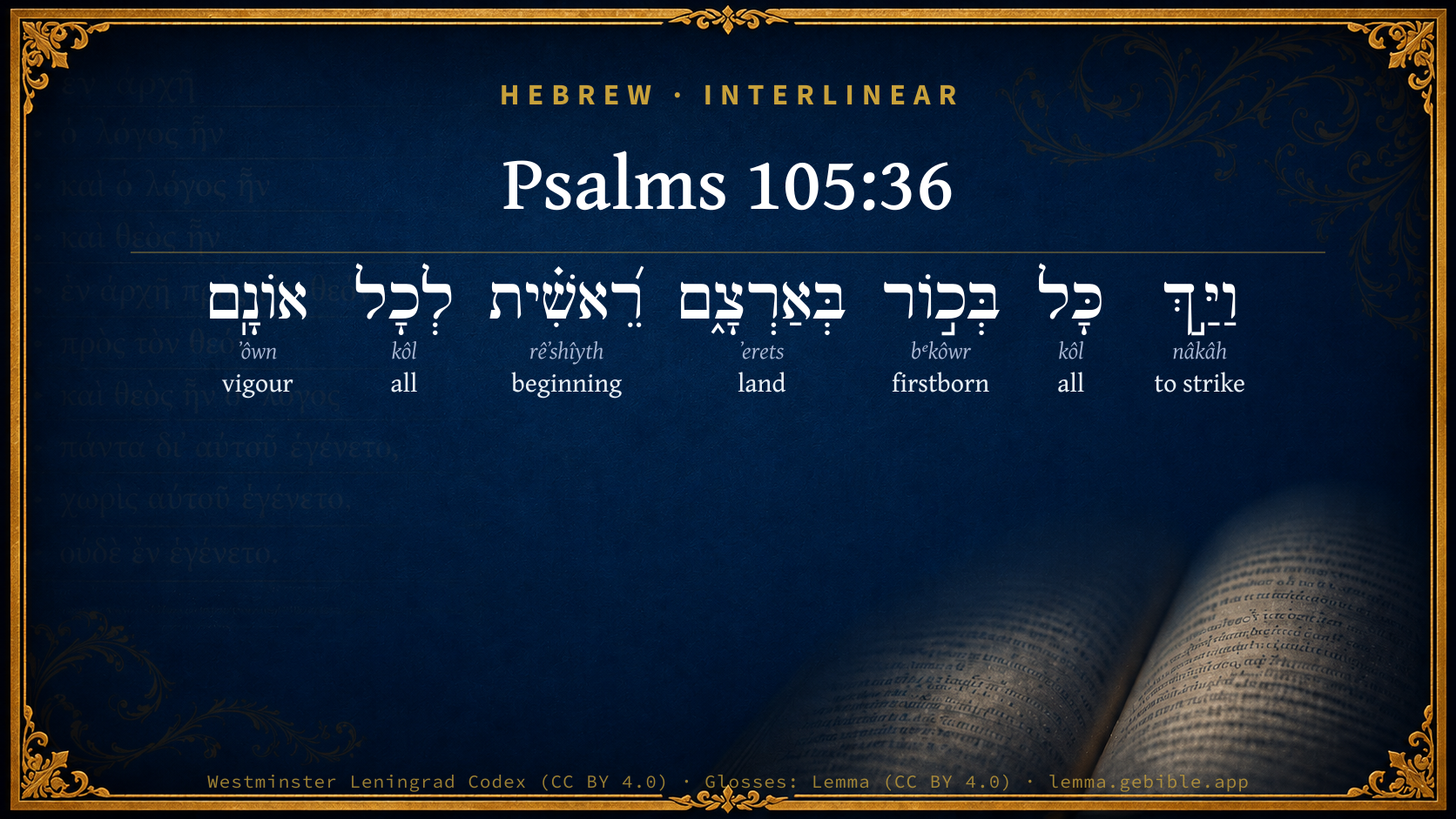
Psalms 105:36

Hebrew (Westminster Leningrad Codex) Psalms 105:36 appears in the Hebrew Old Testament. The text above is from the Westminster Leningrad Codex. Each word links to its Strong’s number, a concise gloss, and parsing drawn from the Open Scriptures Hebrew Bible morphology. Click any word for its full Brown-Driver-Briggs (BDB) entry.
Download image
Cite this verse

Psalms 105:36 (World English Bible). Public Domain. Lemma interlinear Bible study tool, https://lemma.gebible.app/v/psalms/105/36.

Show BibTeX & RIS
BibTeX
RIS
English Translation
He struck also all the firstborn in their land, The first fruits of all their manhood.
World English Bible · Public Domain
Download a study sheet

One document with this verse’s original text, its word-by-word gloss line, the meaning frame, cross-references with their text, attributed commentary, and full source and license credits — printable, and it pastes into notes with its structure intact.

This verse Autodidact and up

Study sheet (.html) Plain text (.txt)

A passage Seminary Student

Up to 50 verses in one chapter. A passage sheet keeps up to 6 commentary sources and 12 cross-references per verse, in the order this page ranks them, and says so on the sheet whenever that leaves anything out. Ask for a single verse and you get the Autodidact verse sheet above.

Everything on this page stays free to read, with no account — the sheet is a download of what is already on screen, not access to it.

Want to remove ads? Support Godless Engineer
Compare translations 3

The same verse in 3 English versions, stacked beneath the original-language interlinear above. Click any original word for its lexicon entry.

Each is an independent rendering of the whole verse — the interlinear is not word-aligned to these translations.

Highlighted words mark where these versions differ — a whole-verse word diff, not a word-by-word alignment.

  • World English Bible Public Domain
    He struck also all the firstborn in their land, The first fruits of all their manhood.
  • King James Version Public Domain
    He smote also all the firstborn in their land, the chief of all their strength.
  • unfoldingWord Literal Text CC BY-SA 4.0
    Then he struck every firstborn in their land, the first of all their strength.

unfoldingWord Literal Text — © unfoldingWord, licensed CC BY-SA 4.0. Word-aligned USFM3 via Door43 (git.door43.org/unfoldingWord/en_ult).

Versions to compare (up to 4)

3 of 4 selected

Show all 18 translations

Every available English version of this verse, each an independent rendering of the whole verse.

  • World English Bible Public Domain
    He struck also all the firstborn in their land, The first fruits of all their manhood.
  • Berean Standard Bible Public Domain
    Then He struck all the firstborn in their land, the firstfruits of all their vigor.
  • Majority Standard Bible Public Domain
    Then He struck all the firstborn in their land, the firstfruits of all their vigor.
  • King James Version Public Domain
    He smote also all the firstborn in their land, the chief of all their strength.
  • American Standard Version (1901) Public Domain
    He smote also all the first-born in their land, The chief of all their strength.
  • Revised Version (1885) Public Domain
    He smote also all the firstborn in their land, the chief of all their strength.
  • Geneva Bible (1599) Public Domain
    He smote also all the first borne in their land, euen the beginning of all their strength.
  • Douay-Rheims (1899) Public Domain
    And he slew all the firstborn in their land: the firstfruits of all their labour.
  • Young's Literal Translation Public Domain
    And He smiteth every first-born in their land, The first-fruit of all their strength,
  • Literal Standard Version CC BY-SA 4.0
    And He strikes every firstborn in their land, || The first-fruit of all their strength,
  • Unlocked Literal Bible CC BY-SA 4.0
    He killed every firstborn in their land, the firstfruits of all their strength.
  • unfoldingWord Literal Text CC BY-SA 4.0
    Then he struck every firstborn in their land, the first of all their strength.
  • Darby Bible Public Domain
    And he smote every firstborn in their land, the firstfruits of all their vigour.
  • World Messianic Bible Public Domain
    He struck also all the firstborn in their land, the first fruits of all their manhood.
  • Webster's Bible Public Domain
    He smote also all the first-born in their land, the chief of all their strength.
  • Free Bible Version CC BY-SA 4.0
    He killed all the firstborn in Egypt, the first to be produced in their vigor and strength.
  • Bible in Basic English Public Domain
    He put to death the first child of every family in the land, the first-fruits of their strength.
  • JPS Tanakh (1917) Public Domain
    He smote also all the first-born in their land, the first-fruits of all their strength.

Literal Standard Version (2020), Covenant Press — licensed CC BY-SA 4.0. Text via the HelloAO Bible API (eBible.org). Unlocked Literal Bible (unfoldingWord) — licensed CC BY-SA 4.0. Text via the HelloAO Bible API (eBible.org). unfoldingWord Literal Text — © unfoldingWord, licensed CC BY-SA 4.0. Word-aligned USFM3 via Door43 (git.door43.org/unfoldingWord/en_ult). Free Bible Version, Dr. Jonathan Gallagher — licensed CC BY-SA 4.0. Text via the HelloAO Bible API (eBible.org).

Word by word

More ways to search: Search by grammar → Find every occurrence → Compare this word →

Practice this passage: Drill this verse → Learn its vocabulary →

About this verse

These counts appear in no published source. They are computed here, from the morphology-tagged text and Lemma’s own curated glosses. What Lemma adds →

7
words
6
distinct lemmas
Wisdom
section

Notable vocabulary

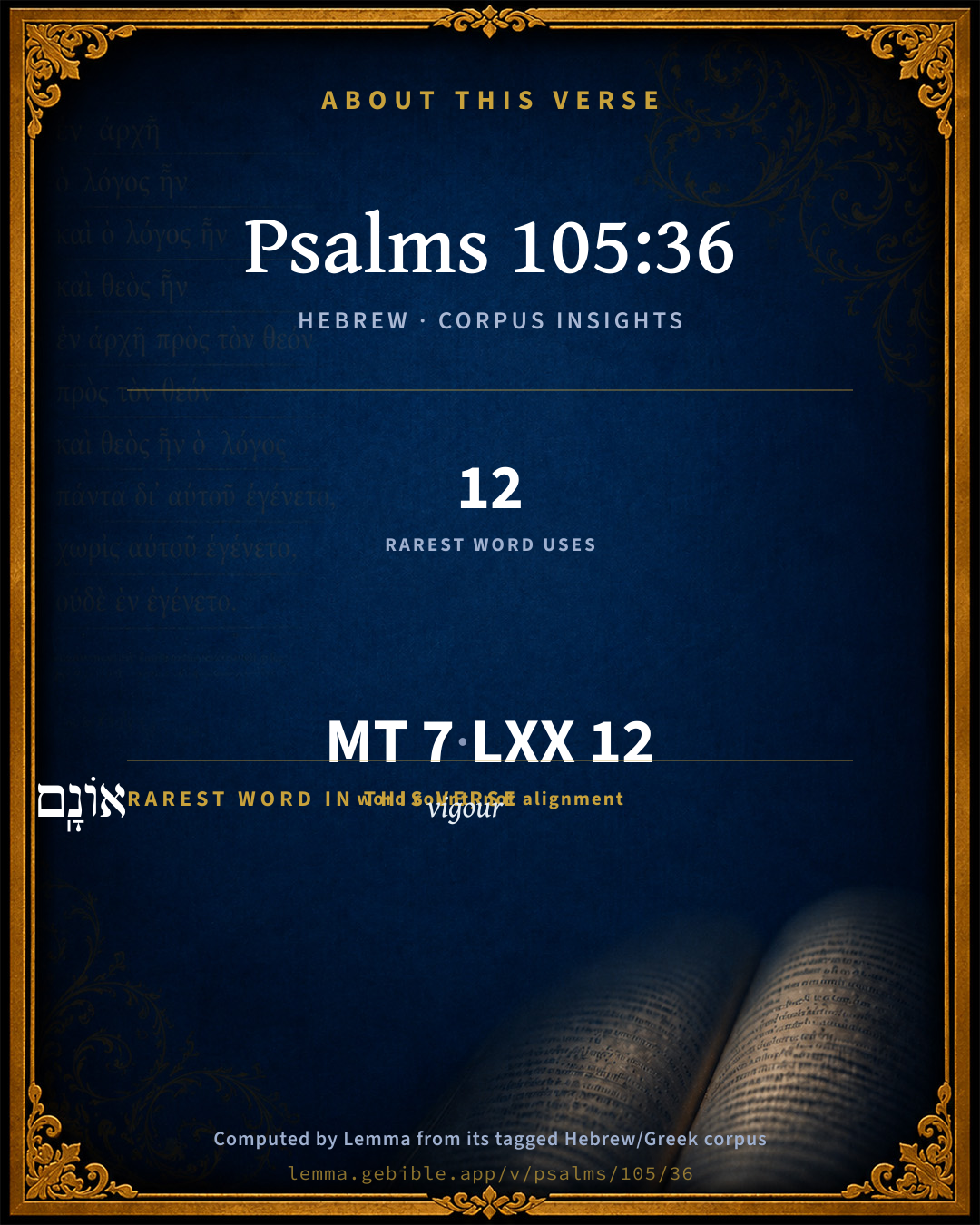
The rarest word here is אוֹנָֽם vigour H202 — appearing just 12 times in the whole Hebrew Bible.

Shared distinctive vocabulary

אוֹנָֽם vigour H202 occurs in 12 verses of the Hebrew Bible. Also found in:

Grammatical profile

  • 1 verb
  • 6 nouns

Verb forms

  • וַיַּ֣ךְ Hiphil · Sequential Imperfect

Repetition

A word recurs within this verse — often emphatic in Hebrew:

Hebrew & Septuagint length

In English translation the verse runs 16 words from the Hebrew and 15 from the Septuagint (LXX English) — closely comparable.

A rough comparison of the two English renderings, which tokenize alike — not a word-level alignment.

Word counts can differ between the Hebrew and the Greek without any difference in meaning — e.g. the Hebrew direct-object marker אֵת has no separate Greek word, and Greek often adds the article ὁ.

In the original languages it is 7 Hebrew tokens and 12 Greek tokens — but the two are counted differently (Hebrew bundles its prefixes and suffixes into one token; the Greek is in lemma form), so that isn’t a like-for-like length.

Cross-references

9

Topical passages linked to Psalms 105:36 in the Treasury of Scripture Knowledge — connected by theme and wording, ordered by reader-vote popularity; previews shown in the World English Bible.

  • Genesis 49:3 "Reuben, you are my firstborn, my might, and the beginning of my strength; The pre-eminence of dignity, and the pre-eminence of power.
  • Psalms 136:10 To him who struck down the Egyptian firstborn; For his loving kindness endures forever;
  • Hebrews 11:28 By faith, he kept the Passover, and the sprinkling of the blood, that the destroyer of the firstborn should not touch them.
  • Exodus 4:23 and I have said to you, "Let my son go, that he may serve me;" and you have refused to let him go. Behold, I will kill your son, your firstborn.'"
  • Exodus 11:4–5 Moses said, "This is what Yahweh says: 'About midnight I will go out into the midst of Egypt,
  • Exodus 12:12 For I will go through the land of Egypt in that night, and will strike all the firstborn in the land of Egypt, both man and animal. Against all the gods of Egypt I will execute judgments: I am Yahweh.
  • Exodus 12:29–30 It happened at midnight, that Yahweh struck all the firstborn in the land of Egypt, from the firstborn of Pharaoh who sat on his throne to the firstborn of the captive who was in the dungeon; and all the firstborn of cattle.
  • Psalms 78:51 And struck all the firstborn in Egypt, The chief of their strength in the tents of Ham.
  • Psalms 135:8 Who struck the firstborn of Egypt, Both of man and animal;

Cross-references courtesy of OpenBible.info (CC BY 4.0).

Hebrew and Greek witnesses Masoretic Hebrew ↔ Greek Septuagint

The same verse in the two great witnesses to the Old Testament, shown verse-for-verse.

You’re reading Greek Psalm 104 (Hebrew Psalm 105). The Septuagint counts the superscription, so verse numbers can differ from the Hebrew — chapter-level alignment, not verse-by-verse. Numbering follows Rahlfs.

These are two independent witnesses, not word-aligned to each other, and the Septuagint is shown in lemma (dictionary) form.

Hebrew Psalms 105:36 Masoretic · Westminster Leningrad Codex

וַיַּ֣ךְ כָּל בְּכ֣וֹר בְּאַרְצָ֑ם רֵ֝אשִׁ֗ית לְכָל אוֹנָֽם

He struck also all the firstborn in their land, The first fruits of all their manhood.

World English Bible · Public Domain

Greek LXX Greek Psalm 104:36 Septuagint · lemma form

καί πατάσσω πᾶς πρωτότοκος ἐν ὁ γῆ αὐτός ἀπαρχή πᾶς πόνος αὐτός

He struck also every firstborn of their land, the first fruits of all their labor.

LXX2012 (modern English Septuagint) · Public Domain

Hebrew: Westminster Leningrad Codex (CC BY 4.0). Greek: Septuagint (public domain); English from LXX2012 (modern English Septuagint) (Public Domain). How the Septuagint differs from the Hebrew →

Commentary

Notes on Psalms 105:36 from classic Christian and Jewish commentators (each source and its license shown beneath its notes). The classic Christian expositions comment on the surrounding passage and are grouped to its opening verse, so a note may address several verses; the Jewish commentaries on the Tanakh (Rashi and others) are per-verse, so they appear only where the commentator wrote on this verse.

Lemma curates 59 commentaries, every one of them public domain or Creative Commons licensed, each selected and text-cleaned for this edition rather than reprinted as found. About our sources →

Trapp's Complete Commentary

John Trapp

Psa 105:36 He smote also all the firstborn in their land, the chief of all their strength.

Ver. 36. He smote also all the firstborn] This he did last of all, the next spring after the first plague inflicted, et non nisi coactus, as that emperor once said when he subscribed a writ for execution of a certain malefactor.

The chief of all their strength] Et ubi non erat primogenitus, moritur epitropus, say the Hebrews, where was not a firstborn, there the steward died; so that there was no house in Egypt without a dead corpse, as there are few among us without many dead souls.

John Trapp, A Commentary or Exposition upon All the Books of the Old and New Testament (1647–1656) — public domain. Text from a community e-Sword module.

J. A. Alexander on Psalms

Joseph Addison Alexander

36. (Psa 105:36) And he smote all the first-born in their land, the first fruits of all their strength. For the meaning the last clause, see above, on Psa 78:51, and compare Exo 12:29-30.

Joseph Addison Alexander, The Psalms Translated and Explained (1850) — public domain. Text from a community e-Sword module.

Ellicott's Commentary for English Readers

(36) See Psa_78:51.

A Bible Commentary for English Readers, edited by Charles John Ellicott (1878–1897) — public domain. Text from a community e-Sword module.

The Cambridge Bible for Schools and Colleges

gen. ed. J. J. S. Perowne

36. The tenth and last plague, Exo_11:1 ff. As in Psa_78:51, the firstborn are described as the beginning, or firstlings of all their strength. Cp. Gen_49:3; Deu_21:17.

The Cambridge Bible for Schools and Colleges (gen. ed. J. J. S. Perowne; Cambridge University Press, 1878–1918) — public domain. Text from a community e-Sword module.

John Gill's Exposition

He brought them forth also with silver and gold,.... That is, God brought forth the Israelites out of Egypt by means of the above plagues, laden with great riches, with jewels of gold and of silver, which they borrowed of the Egyptians at the command of the Lord; and so to be justified in what they did; and besides it was but just and equitable that they should be paid for their service and hard labour in Egypt for a long course of time; and this was the method in Providence they were directed to take to do themselves justice; and hereby was accomplished an ancient prophecy concerning them, that they should come out with much substance, Gen 15:14, Besides, in the passages quoted, the words should be rendered of the Israelites that they "asked", and of the Egyptians that they "gave"; the Jews, some of them, say (c) that these were given not with the will of the Egyptians, and others say not with the will of the Israelites, but neither of them true. And so in like manner will the people of God, when rescued from the tyranny of the antichristian states, enjoy great riches and honour; see Rev 17:16.

And there was not one feeble person among their tribes; though there were six hundred thousand footmen, Num 11:21, and though they had been used to hard and rigorous service in order to weaken their strength; and though they came from among a people plagued with diseases and deaths. This confronts a lying story told by some Heathen writers (d), that the Israelites were driven out of Egypt because they had the itch, leprosy, and other diseases upon them. Aben Ezra and Kimchi interpret it, there was not a poor or necessitous man among them, for they abounded with gold and silver; compare with this the case of God's people in the latter day, Zac 12:8.

(c) T. Bab. Beracot, fol. 9. 2. (d) Justin. e Trogo, l. 36. c. 2. Tacitus, l. 5. 3. Lysimachus apud Joseph. contr. Apion. l. 1. s. 34.

John Gill's Exposition of the Whole Bible (1746–1763) — public domain (CC PDM 1.0). Text via the HelloAO Bible API.

Matthew Poole's English Annotations

To wit, their first-born, as it is in the first clause, who are so called, Gen 49:3; Psa 78:51, and the beginning of their strength, Deu 21:17.

Matthew Poole's English Annotations on the Holy Bible (1683–1685) — public domain. Text from a community e-Sword/MySword module.

The Treasury of David

Charles H. Spurgeon

Ver. 36. Are smote also all the firstborn in their land, the chief of all their strength. Now came the master blow. The Lord spoke before, but now he smites; before he only smote vines, but now he strikes men themselves. The glory of the household dies in a single night, the prime and pick of the nation are cut off, the flower of the troops, the heirs of the rich, and the hopes of the poor all die at midnight. Now the target was struck in the centre, there was no confronting this plague. Pharaoh feels it as much as the woman slave at the mill: he had smitten Israel, the Lord's firstborn, and the Lord repaid him to his face. What a cry went up throughout the land of Egypt when every house wailed its firstborn at the dead of night! O Jehovah, thou didst triumph in that hour, and with an outstretched arm didst thou deliver thy people.

Ver. 36. He smote also all the firstborn. Did you hear that cry? It is the moment of midnight, and some tragedy is enacted in that Egyptian dwelling, for such an unearthly shriek! and it is repeated and reechoed, as doors burst open and frantic women rush into the street, and, as the houses of priests and physicians are beset, they only shake their heads in speechless agony, and point to the death sealed features of their own firstborn. Lights are flashing at the palace gates, and flitting through the royal chambers; and as king's messengers hasten through the town enquiring where the two venerable Hebrew brothers dwell, the whisper flies, "The royal prince is dead!" Be off, ye sons of Jacob! speed from your house of bondage, ye oppressed and injured Israelites! And in their eagerness to "thrust forth" the terrible because Heaven protected race, they press upon them gold and jewels, and bribe them to be gone. James Hamilton.

Psalms 105:37*

Charles H. Spurgeon's The Treasury of David (1869–1885) — public domain. Psalms only. Text from a community e-Sword/MySword module.

The Pulpit Commentary

He smote also all the firstborn in their land. (see Exo_12:29) The chief of all their strength. (comp. Psa_78:51)

The Pulpit Commentary (1880–1919), ed. H.D.M. Spence-Jones & Joseph S. Exell — public domain. Text from a community e-Sword module.

Lesson kit

Teaching starters — assembled from the data on this page, not authored interpretation. Every prompt links to the verse data it draws on. Edit before teaching.

Psalms, in the Wisdom, opens this verse with 7 words (6 distinct Hebrew lemmas). Its most distinctive word is ʼôwn (“vigour”). A historical commentator’s framing appears above. Read the whole chapter for the surrounding context.

Discussion questions

  1. How does “vigour” (ʼôwn) shape what this verse is saying?
  2. How does Genesis 49:3, which shares the word «vigour», read alongside this verse?
  3. What does the repetition of “all” (2× in this one verse) do in this verse?
  4. These translations render this verse differently; the difference is in the English rendering, not the original. What questions does that raise?
  5. «וַיַּ֣ךְ» is a Hiphil Sequential Imperfect verb. How does that grammatical form shape the action described?
  6. Compare how Trapp's Complete Commentary and J. A. Alexander on Psalms read this verse. Where do they agree or differ?

Things to notice

Reading settings

Reading text

Shown beneath each verse's original-language words.

Old Testament
Old Testament edition

Read the OT as the Masoretic Hebrew (MT) or the Greek Septuagint (LXX).

English shown for the Greek Septuagint (in the Hebrew ↔ Greek comparison).

Comparing translations? Open the Compare panel on any verse page to stack up to four side by side.