
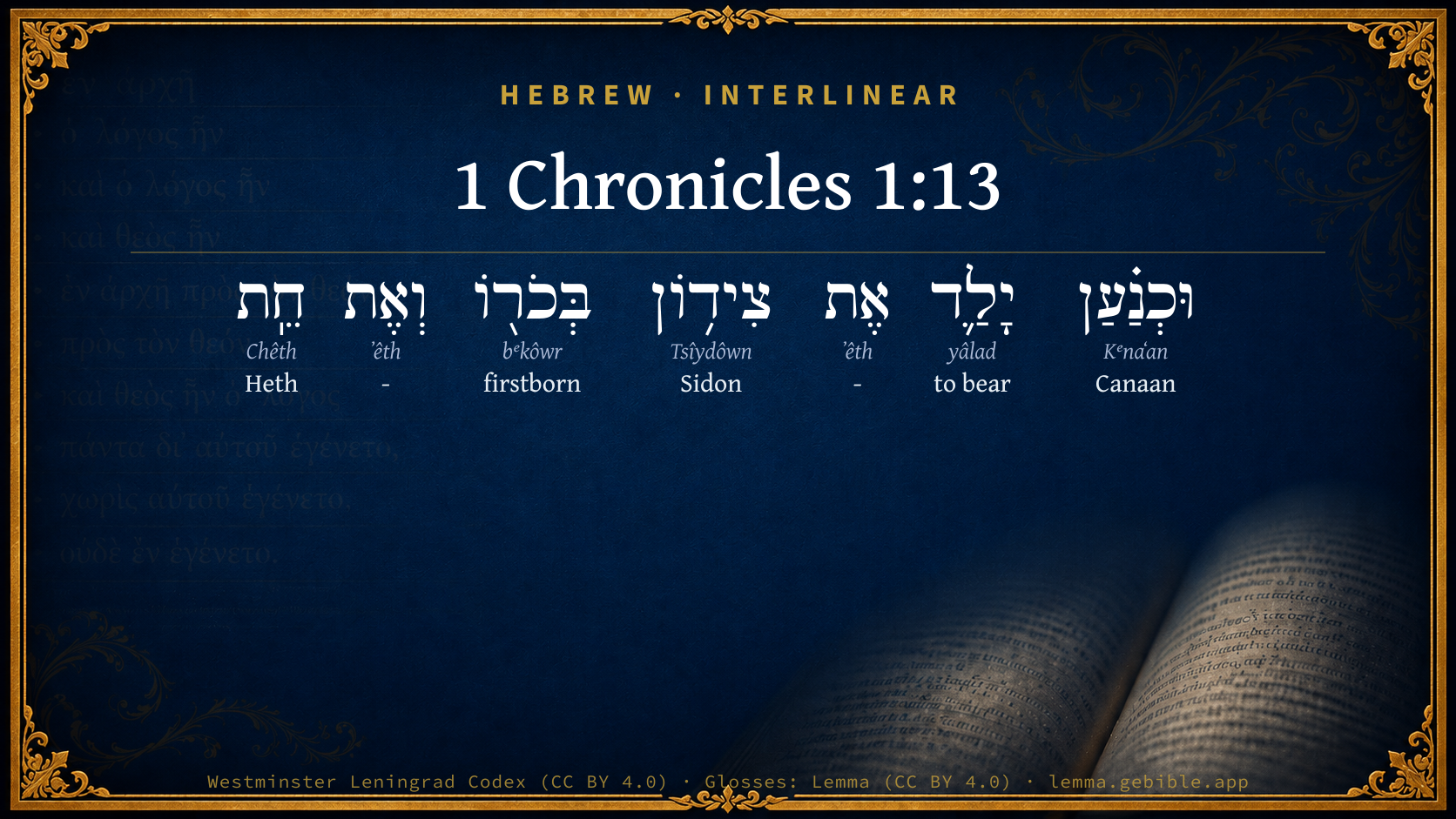
1 Chronicles 1:13

Hebrew (Westminster Leningrad Codex) 1 Chronicles 1:13 appears in the Hebrew Old Testament. The text above is from the Westminster Leningrad Codex. Each word links to its Strong’s number, a concise gloss, and parsing drawn from the Open Scriptures Hebrew Bible morphology. Click any word for its full Brown-Driver-Briggs (BDB) entry.
Download image
Cite this verse

1 Chronicles 1:13 (World English Bible). Public Domain. Lemma interlinear Bible study tool, https://lemma.gebible.app/v/1-chronicles/1/13.

Show BibTeX & RIS
BibTeX
RIS
English Translation
Canaan became the father of Sidon his firstborn, and Heth,
World English Bible · Public Domain
Download a study sheet

One document with this verse’s original text, its word-by-word gloss line, the meaning frame, cross-references with their text, attributed commentary, and full source and license credits — printable, and it pastes into notes with its structure intact.

This verse Autodidact and up

Study sheet (.html) Plain text (.txt)

A passage Seminary Student

Up to 50 verses in one chapter. A passage sheet keeps up to 6 commentary sources and 12 cross-references per verse, in the order this page ranks them, and says so on the sheet whenever that leaves anything out. Ask for a single verse and you get the Autodidact verse sheet above.

Everything on this page stays free to read, with no account — the sheet is a download of what is already on screen, not access to it.

Want to remove ads? Support Godless Engineer
Compare translations 3

The same verse in 3 English versions, stacked beneath the original-language interlinear above. Click any original word for its lexicon entry.

Each is an independent rendering of the whole verse — the interlinear is not word-aligned to these translations.

Highlighted words mark where these versions differ — a whole-verse word diff, not a word-by-word alignment.

  • World English Bible Public Domain
    Canaan became the father of Sidon his firstborn, and Heth,
  • King James Version Public Domain
    And Canaan begat Zidon his firstborn, and Heth,
  • unfoldingWord Literal Text CC BY-SA 4.0
    And Canaan fathered Sidon, his firstborn, and Heth

unfoldingWord Literal Text — © unfoldingWord, licensed CC BY-SA 4.0. Word-aligned USFM3 via Door43 (git.door43.org/unfoldingWord/en_ult).

Versions to compare (up to 4)

3 of 4 selected

Show all 18 translations

Every available English version of this verse, each an independent rendering of the whole verse.

  • World English Bible Public Domain
    Canaan became the father of Sidon his firstborn, and Heth,
  • Berean Standard Bible Public Domain
    And Canaan was the father of Sidon his firstborn, and of the Hittites,
  • Majority Standard Bible Public Domain
    And Canaan was the father of Sidon his firstborn, and of the Hittites,
  • King James Version Public Domain
    And Canaan begat Zidon his firstborn, and Heth,
  • American Standard Version (1901) Public Domain
    And Canaan begat Sidon his first-born, and Heth,
  • Revised Version (1885) Public Domain
    And Canaan begat Zidon his firstborn, and Heth;
  • Geneva Bible (1599) Public Domain
    Also Canaan begate Zidon his first borne, and Heth,
  • Douay-Rheims (1899) Public Domain
    And Chanaan beget Sidon his firstborn, and the Hethite,
  • Young's Literal Translation Public Domain
    And Canaan begat Zidon his first born, and Heth,
  • Literal Standard Version CC BY-SA 4.0
    And Canaan begot Sidon his firstborn, and Heth,
  • Unlocked Literal Bible CC BY-SA 4.0
    Canaan became the father of Sidon, his firstborn, and of the Hittites.
  • unfoldingWord Literal Text CC BY-SA 4.0
    And Canaan fathered Sidon, his firstborn, and Heth
  • Darby Bible Public Domain
    -- And Canaan begot Zidon his firstborn, and Heth,
  • World Messianic Bible Public Domain
    Canaan became the father of Sidon his firstborn, Heth,
  • Webster's Bible Public Domain
    And Canaan begat Zidon his first-born, and Heth,
  • Free Bible Version CC BY-SA 4.0
    Canaan was the father of his firstborn son, Sidon, and of the Hittites,
  • Bible in Basic English Public Domain
    And Canaan was the father of Zidon, his oldest son, and Heth,
  • JPS Tanakh (1917) Public Domain
    And Canaan begot Zidon his first-born, and Heth;

Literal Standard Version (2020), Covenant Press — licensed CC BY-SA 4.0. Text via the HelloAO Bible API (eBible.org). Unlocked Literal Bible (unfoldingWord) — licensed CC BY-SA 4.0. Text via the HelloAO Bible API (eBible.org). unfoldingWord Literal Text — © unfoldingWord, licensed CC BY-SA 4.0. Word-aligned USFM3 via Door43 (git.door43.org/unfoldingWord/en_ult). Free Bible Version, Dr. Jonathan Gallagher — licensed CC BY-SA 4.0. Text via the HelloAO Bible API (eBible.org).

Word by word

More ways to search: Search by grammar → Find every occurrence → Compare this word →

Practice this passage: Drill this verse → Learn its vocabulary →

About this verse

These counts appear in no published source. They are computed here, from the morphology-tagged text and Lemma’s own curated glosses. What Lemma adds →

7
words
6
distinct lemmas
Historical
section

Notable vocabulary

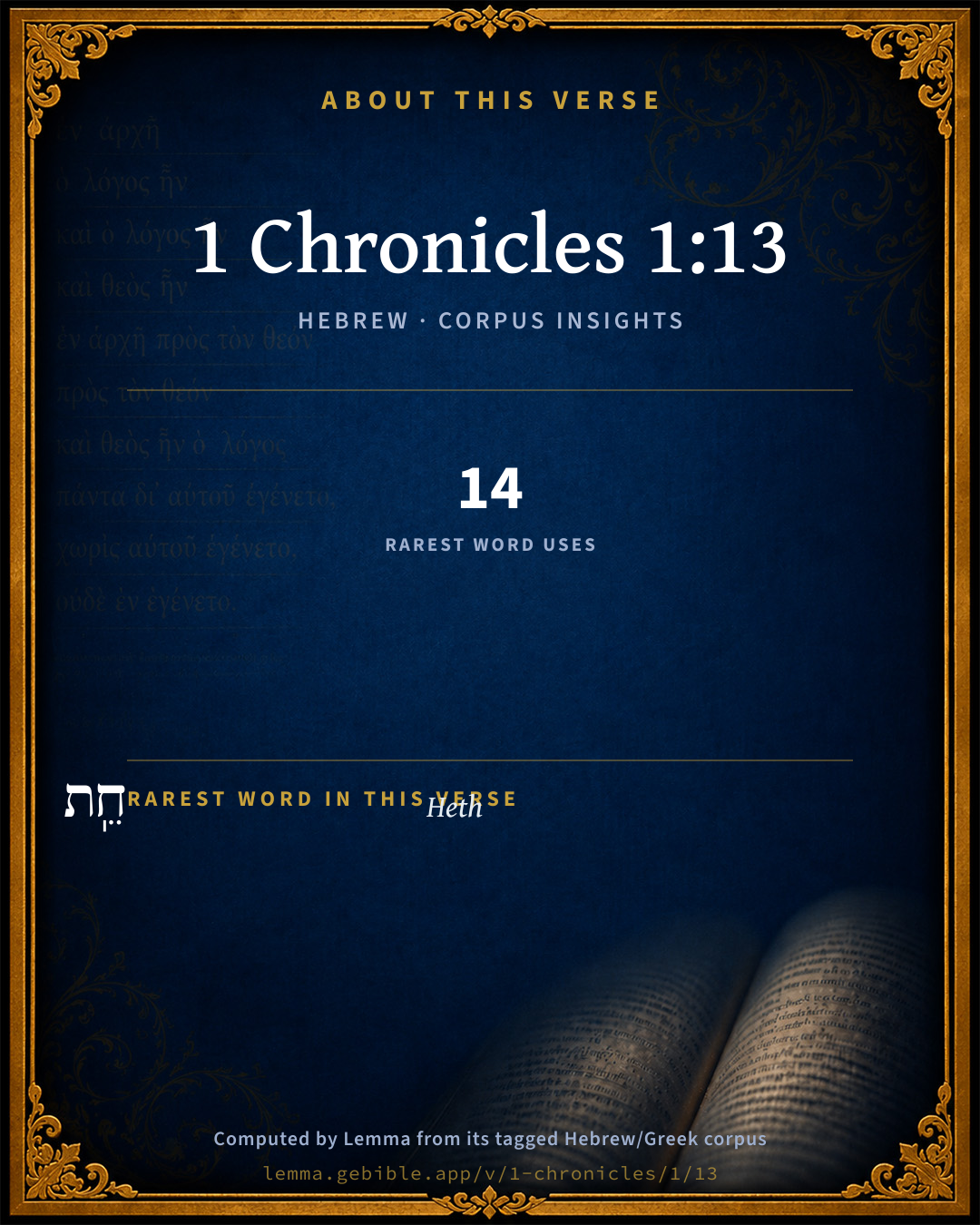
The rarest word here is חֵֽת Heth H2845 — appearing just 14 times in the whole Hebrew Bible.

Shared distinctive vocabulary

חֵֽת Heth H2845 occurs in 12 verses of the Hebrew Bible. Also found in:

Grammatical profile

  • 1 verb
  • 4 nouns
  • 2 particles

Verb forms

  • יָלַ֛ד Qal · Perfect

Cross-references

11

Topical passages linked to 1 Chronicles 1:13 in the Treasury of Scripture Knowledge — connected by theme and wording, ordered by reader-vote popularity; previews shown in the World English Bible.

  • Genesis 9:22 Ham, the father of Canaan, saw the nakedness of his father, and told his two brothers outside.
  • Genesis 9:25–26 He said, "Cursed be Canaan; A servant of servants will he be to his brothers."
  • Genesis 10:15–19 Canaan became the father of Sidon (his firstborn), Heth,
  • Genesis 23:3 Abraham rose up from before his dead, and spoke to the children of Heth, saying,
  • Genesis 23:5 The children of Heth answered Abraham, saying to him,
  • Genesis 23:20 The field, and the cave that is therein, were made sure to Abraham for a possession of a burying place by the children of Heth.
  • Genesis 27:46 Rebekah said to Isaac, "I am weary of my life because of the daughters of Heth. If Jacob takes a wife of the daughters of Heth, such as these, of the daughters of the land, what good will my life do me?"
  • Genesis 49:30–32 in the cave that is in the field of Machpelah, which is before Mamre, in the land of Canaan, which Abraham bought with the field from Ephron the Hittite as a burial place.
  • Exodus 23:28 I will send the hornet before you, which will drive out the Hivite, the Canaanite, and the Hittite, from before you.
  • Joshua 9:1 It happened, when all the kings who were beyond the Jordan, in the hill-country, and in the lowland, and on all the shore of the great sea in front of Lebanon, the Hittite, and the Amorite, the Canaanite, the Perizzite, the Hivite, and the Jebusite, heard of it;
  • 2 Samuel 11:6 David sent to Joab, [saying], Send me Uriah the Hittite. Joab sent Uriah to David.

Cross-references courtesy of OpenBible.info (CC BY 4.0).

Hebrew and Greek witnesses Masoretic Hebrew ↔ Greek Septuagint

The same verse in the two great witnesses to the Old Testament, shown verse-for-verse.

These are two independent witnesses, not word-aligned to each other, and the Septuagint is shown in lemma (dictionary) form.

Hebrew 1 Chronicles 1:13 Masoretic · Westminster Leningrad Codex

וּכְנַ֗עַן יָלַ֛ד אֶת צִיד֥וֹן בְּכֹר֖וֹ וְאֶת חֵֽת

Canaan became the father of Sidon his firstborn, and Heth,

World English Bible · Public Domain

Greek LXX 1 Chronicles 1:13 Septuagint · lemma form

εβερ φαλεκ ραγαυ

No English rendering of this Greek verse — the small residue in the structurally divergent books.

Hebrew: Westminster Leningrad Codex (CC BY 4.0). Greek: Septuagint (public domain); English from a public-domain English Septuagint. How the Septuagint differs from the Hebrew →

Commentary

Notes on 1 Chronicles 1:13 from classic Christian and Jewish commentators (each source and its license shown beneath its notes). The classic Christian expositions comment on the surrounding passage and are grouped to its opening verse, so a note may address several verses; the Jewish commentaries on the Tanakh (Rashi and others) are per-verse, so they appear only where the commentator wrote on this verse.

Lemma curates 59 commentaries, every one of them public domain or Creative Commons licensed, each selected and text-cleaned for this edition rather than reprinted as found. About our sources →

Ellicott's Commentary for English Readers

THE CITY ZIDON AND THE TEN RACES OF CANAAN (1Ch_1:13-16).

(13) Canaan begat Zidon his firstborn.—Or, in modern phrase, Zidon is the oldest city of Canaan. It is usually mentioned along with Tyre, the ruling city in later times. Sennacherib speaks of the flight of Lulî, “king of Zidon,” from Tyre. Esarhaddon mentions Baal of Tyre as a tributary. Of the eleven “sons of Canaan all but three or four have been identified in the cuneiform inscriptions of Assyria.

And Heth—that is, the Hittite race, called Heta by the Egyptians, and Hatti by the Assyrians. (See 1Ch_1:8, Note.) The Hittites were once the dominant race of Syria and Palestine. Carchemish, on the Euphrates, and Kadesh, as well as Hamath, appear to have been Hittite cities. Their kings had commercial relations with Solomon (1Ki_10:29). Inscriptions, in a kind of mixed hieroglyph, have been found at Hamath and Carchemish, but they still await decipherment.

(14) The Jebusite.—The men of Jebus, or Jerusalem (1Ch_11:4).

Amorite.—The hill-men of the trans-Jordan.

Girgashite.—Perhaps of Gergesa (Mat_8:28).

(15) Hivite.—On the slopes of Lebanon (Jos_11:3), “under Hermon,” but also in Gibeon and Shechem (Jos_9:7; Gen_34:2). Delitzsch suggests that the name is connected with Hamath (Assyrian, Hammath as Hawath).

Arkite, and the Sinite.—Tribes living to the west of northern Lebanon. A fragment of the annals of Tiglath-pileser mentions along with Simyra the towns of Arqâ and Sianu “on the sea-coast” (B C, 739). Jose-phus mentions a town Arka, which is otherwise known as the birthplace of the emperor Alexander Severus (Ruins: Tell’Araci).

(16) Arvadite.—Arvad, or Aradus, now Ruâd, an island off Phoenicia. Assurnâçirpal (B.C. 885) calls it “Arvada in the mid-sea.” Its king submitted to Sennacherib.

Zemarite.—The people of Simyra, on the coast of Phoenicia, south-east of Arvad. Simyra (Assyrian, Cimirra) was a fortified town commanding the road from the coast to the upper valley of the Orontes (Ruins: Sumra).

Hamathite.—The people of Hamath (Hamah) on the Orontes, a Hittite state which made alliance with David (circ. 1040 B.C. ).

On a review of 1Ch_1:8-16 we see that the “sons of Ham” include Ethiopia, Egypt, and the neighbouring shores of Arabia, and perhaps the founders of Babylon (1Ch_1:8-10). The tribes of Egypt and Canaan are enumerated in 1Ch_1:11-16.

A Bible Commentary for English Readers, edited by Charles John Ellicott (1878–1897) — public domain. Text from a community e-Sword module.

Tyndale Open Study Notes

Tyndale Open Resources

1:13 ancestor of the Hittites: Hebrew ancestor of Heth.

Tyndale Open Study Notes — © Tyndale Open Resources, licensed CC BY-SA 4.0. Text via the HelloAO Bible API.

Adam Clarke's Commentary

Verse 13. Canaan begat Zidon] "Canaan begat Bothniam, his first-born, who built Sidon." - T.

Adam Clarke's Commentary on the Bible (1810–1826) — public domain. Text from a community e-Sword/MySword module.

The Cambridge Bible for Schools and Colleges

gen. ed. J. J. S. Perowne

13. Canaan begat Zidon his firstborn] From the time of David downwards Tyre takes precedence of Zidon in any mention of the Phœnician cities in the O.T., but Zidon may still have been the older of the two cities, as indeed the Roman historian Justin (1Ch_18:3) asserts. So we find the Phœnicians in the earlier books of the O.T. called Zidonians, not Tyrians (e.g. Jdg_3:3; 1Ki_5:6).

Heth] i.e. the Hittites, who for centuries were the great power of Northern Syria, having their capital at Kadesh in the Orontes valley and a territory reaching from the Orontes to the Euphrates. Only an offshoot from them seems to have settled in Palestine.

The Cambridge Bible for Schools and Colleges (gen. ed. J. J. S. Perowne; Cambridge University Press, 1878–1918) — public domain. Text from a community e-Sword module.

unfoldingWord translationNotes

Door43 World Missions Community

Sidon

This is the name of a man (See: How to Translate Names)

Hittites ... Jebusites ... Amorites ... Girgashites ... Hivites ... Arkites ... Sinites ... Arvadites ... Zemarites ... Hamathites

names of people groups (See: How to Translate Names)

translationWords

Sidon

firstborn

Jebus

Amorite

Girgashites

Hivite

unfoldingWord translationNotes — © Distant Shores Media and the Door43 World Missions Community, licensed CC BY-SA 4.0. Source: git.door43.org/Door43/en_tn.

Rashi

Rabbi Shlomo Yitzchaki (Rashi)

And Canaan begot, etc. They are eleven, and with Canaan they are twelve. This is what is written: “He set up the boundaries of the peoples.” He set up the boundaries of the peoples corresponding to the tribes of Israel, for they too are twelve; corresponding to the tribes of Israel, He set up the boundaries of the peoples, on the pattern of (Gen. 21:29): “... that you set up (הִצַּבְתָּ) by themselves.”

Rashi on the Tanakh — English translations: “The Judaica Press complete Tanach with Rashi, translated by A. J. Rosenberg” (CC BY 4.0); “Pentateuch with Rashi's commentary by M. Rosenbaum and A.M. Silbermann, 1929-1934” (public domain); “The Metsudah Tanach series, Lakewood, N.J” (CC BY 4.0); and “The Book of Joshua, Metsudah Publications, 1997” (CC BY 4.0). Text via Sefaria.

Lesson kit

Teaching starters — assembled from the data on this page, not authored interpretation. Every prompt links to the verse data it draws on. Edit before teaching.

1 Chronicles, in the Historical, opens this verse with 7 words (6 distinct Hebrew lemmas). Its most distinctive word is Chêth (“Heth”). A historical commentator’s framing appears above. Read the whole chapter for the surrounding context.

Discussion questions

  1. How does “Heth” (Chêth) shape what this verse is saying?
  2. Genesis 10:15 shares the word «Heth» with this verse. How do the two illuminate each other?
  3. These translations render this verse differently; the difference is in the English rendering, not the original. What questions does that raise?
  4. The verb «יָלַ֛ד» is Qal Perfect. How does its form color the action?
  5. Reading how Ellicott's Commentary for English Readers and Tyndale Open Study Notes read this verse, where do the two commentators agree and where do they part?

Things to notice

Reading settings

Reading text

Shown beneath each verse's original-language words.

Old Testament
Old Testament edition

Read the OT as the Masoretic Hebrew (MT) or the Greek Septuagint (LXX).

English shown for the Greek Septuagint (in the Hebrew ↔ Greek comparison).

Comparing translations? Open the Compare panel on any verse page to stack up to four side by side.