
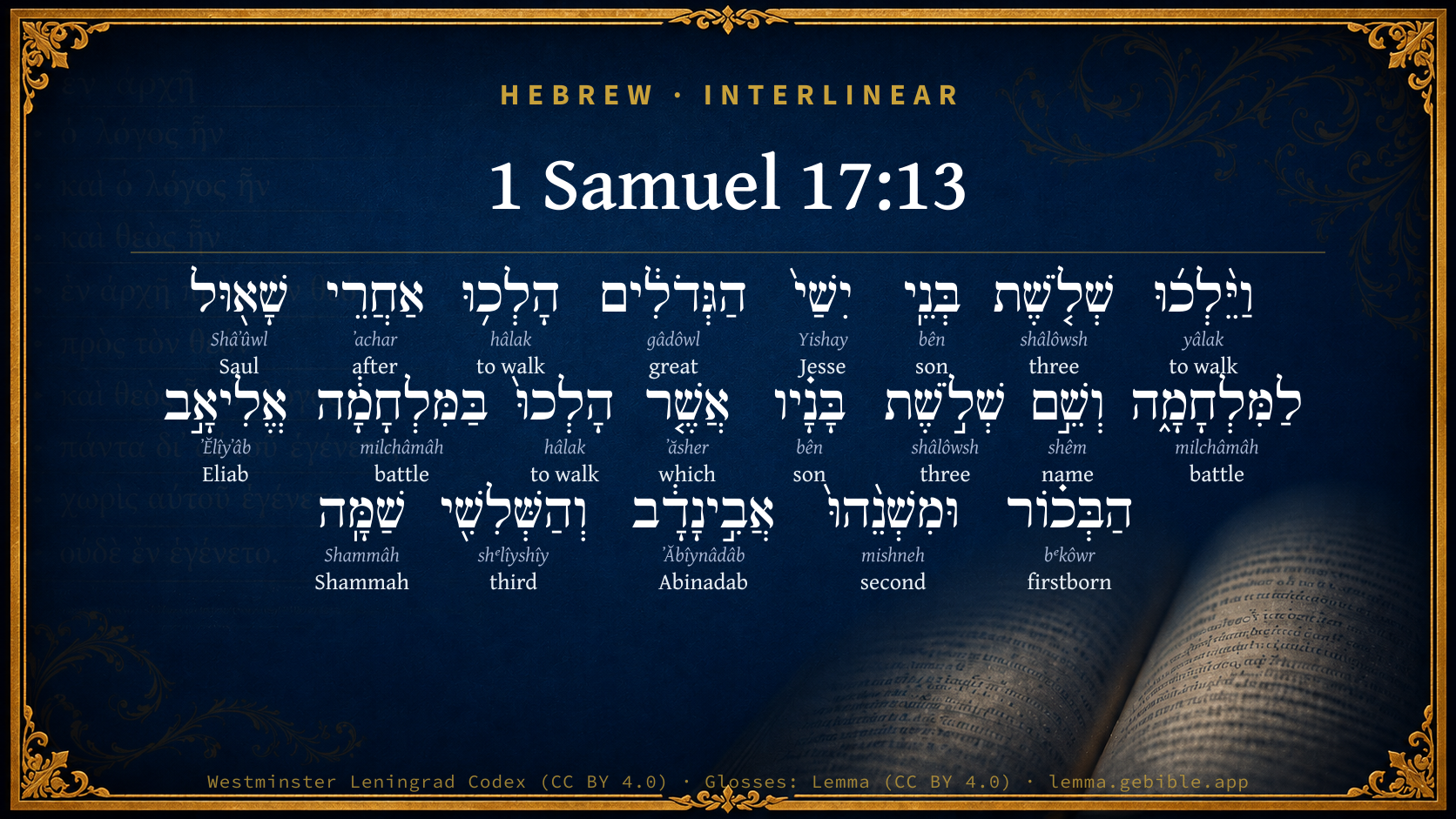
1 Samuel 17:13

Hebrew (Westminster Leningrad Codex) 1 Samuel 17:13 appears in the Hebrew Old Testament. The text above is from the Westminster Leningrad Codex. Each word links to its Strong’s number, a concise gloss, and parsing drawn from the Open Scriptures Hebrew Bible morphology. Click any word for its full Brown-Driver-Briggs (BDB) entry.
Download image
Cite this verse

1 Samuel 17:13 (World English Bible). Public Domain. Lemma interlinear Bible study tool, https://lemma.gebible.app/v/1-samuel/17/13.

Show BibTeX & RIS
BibTeX
RIS
English Translation
The three eldest sons of Jesse had gone after Saul to the battle: and the names of his three sons who went to the battle were Eliab the firstborn, and next to him Abinadab, and the third Shammah.
World English Bible · Public Domain
Download a study sheet

One document with this verse’s original text, its word-by-word gloss line, the meaning frame, cross-references with their text, attributed commentary, and full source and license credits — printable, and it pastes into notes with its structure intact.

This verse Autodidact and up

Study sheet (.html) Plain text (.txt)

A passage Seminary Student

Up to 50 verses in one chapter. A passage sheet keeps up to 6 commentary sources and 12 cross-references per verse, in the order this page ranks them, and says so on the sheet whenever that leaves anything out. Ask for a single verse and you get the Autodidact verse sheet above.

Everything on this page stays free to read, with no account — the sheet is a download of what is already on screen, not access to it.

Want to remove ads? Support Godless Engineer
Compare translations 3

The same verse in 3 English versions, stacked beneath the original-language interlinear above. Click any original word for its lexicon entry.

Each is an independent rendering of the whole verse — the interlinear is not word-aligned to these translations.

Highlighted words mark where these versions differ — a whole-verse word diff, not a word-by-word alignment.

  • World English Bible Public Domain
    The three eldest sons of Jesse had gone after Saul to the battle: and the names of his three sons who went to the battle were Eliab the firstborn, and next to him Abinadab, and the third Shammah.
  • King James Version Public Domain
    And the three eldest sons of Jesse went and followed Saul to the battle: and the names of his three sons that went to the battle were Eliab the firstborn, and next unto him Abinadab, and the third Shammah.
  • unfoldingWord Literal Text CC BY-SA 4.0
    And the oldest three of the sons of Jesse went, they went after Saul to the battle. And the names of the three of his sons who went into the battle Eliab, the firstborn, and his second, Abinadab, and the third, Shammah.

unfoldingWord Literal Text — © unfoldingWord, licensed CC BY-SA 4.0. Word-aligned USFM3 via Door43 (git.door43.org/unfoldingWord/en_ult).

Versions to compare (up to 4)

3 of 4 selected

Show all 18 translations

Every available English version of this verse, each an independent rendering of the whole verse.

  • World English Bible Public Domain
    The three eldest sons of Jesse had gone after Saul to the battle: and the names of his three sons who went to the battle were Eliab the firstborn, and next to him Abinadab, and the third Shammah.
  • Berean Standard Bible Public Domain
    The three older sons of Jesse had followed Saul into battle: The firstborn was Eliab, the second was Abinadab, and the third was Shammah.
  • Majority Standard Bible Public Domain
    The three older sons of Jesse had followed Saul into battle: The firstborn was Eliab, the second was Abinadab, and the third was Shammah.
  • King James Version Public Domain
    And the three eldest sons of Jesse went and followed Saul to the battle: and the names of his three sons that went to the battle were Eliab the firstborn, and next unto him Abinadab, and the third Shammah.
  • American Standard Version (1901) Public Domain
    And the three eldest sons of Jesse had gone after Saul to the battle: and the names of his three sons that went to the battle were Eliab the first-born, and next unto him Abinadab, and the third Shammah.
  • Revised Version (1885) Public Domain
    And the three eldest sons of Jesse had gone after Saul to the battle: and the names of his three sons that went to the battle were Eliab the firstborn, and next unto him Abinadab, and the third Shammah.
  • Geneva Bible (1599) Public Domain
    And the three eldest sonnes of Ishai went and followed Saul to the battel: and the names of his three sonnes that went to battell, were Eliab the Eldest, and the next Abinadab, and the thirde Shammah.
  • Douay-Rheims (1899) Public Domain
    And his three eldest sons followed Saul to the battle: and the names of his three sons that went to the battle, were Eliab the firstborn, and the second Abinadab, and the third Samma.
  • Young's Literal Translation Public Domain
    and the three eldest sons of Jesse go, they have gone after Saul to battle; and the name of his three sons who have gone into battle `are' Eliab the first-born, and his second Abinadab, and the third Shammah.
  • Literal Standard Version CC BY-SA 4.0
    and the three eldest sons of Jesse go, they have gone after Saul to battle; and the name of his three sons who have gone into battle [are] Eliab the firstborn, and his second Abinadab, and the third Shammah.
  • Unlocked Literal Bible CC BY-SA 4.0
    The three oldest sons of Jesse had followed Saul to the battle. The names of his three sons who went to the battle were Eliab the firstborn, second to him Abinadab, and the third Shammah.
  • unfoldingWord Literal Text CC BY-SA 4.0
    And the oldest three of the sons of Jesse went, they went after Saul to the battle. And the names of the three of his sons who went into the battle Eliab, the firstborn, and his second, Abinadab, and the third, Shammah.
  • Darby Bible Public Domain
    And the three eldest of the sons of Jesse had gone and followed Saul to the battle; and the names of his three sons that went to the battle were Eliab the firstborn, and the second to him Abinadab, and the third Shammah.
  • World Messianic Bible Public Domain
    The three oldest sons of Jesse had gone after Saul to the battle; and the names of his three sons who went to the battle were Eliab the firstborn, and next to him Abinadab, and the third Shammah.
  • Webster's Bible Public Domain
    And the three eldest sons of Jesse went and followed Saul to the battle: and the names of his three sons that went to the battle were Eliab the first-born, and next to him Abinadab, and the third Shammah.
  • Free Bible Version CC BY-SA 4.0
    Jesse's three oldest sons had joined Saul's army. These were Eliab (the firstborn), Abinadab (second), and Shammah (third).
  • Bible in Basic English Public Domain
    And the three oldest sons of Jesse had gone with Saul to the fight: the names of the three who went to the fight were Eliab, the oldest, and Abinadab the second, and Shammah the third.
  • JPS Tanakh (1917) Public Domain
    And the three eldest sons of Jesse had gone after Saul to the battle; and the names of his three sons that went to the battle were Eliab the first-born, and next unto him Abinadab, and the third Shammah.

Literal Standard Version (2020), Covenant Press — licensed CC BY-SA 4.0. Text via the HelloAO Bible API (eBible.org). Unlocked Literal Bible (unfoldingWord) — licensed CC BY-SA 4.0. Text via the HelloAO Bible API (eBible.org). unfoldingWord Literal Text — © unfoldingWord, licensed CC BY-SA 4.0. Word-aligned USFM3 via Door43 (git.door43.org/unfoldingWord/en_ult). Free Bible Version, Dr. Jonathan Gallagher — licensed CC BY-SA 4.0. Text via the HelloAO Bible API (eBible.org).

Word by word

More ways to search: Search by grammar → Find every occurrence → Compare this word →

Practice this passage: Drill this verse → Learn its vocabulary →

שַׁמָּֽה
Shammâh
H8048
“Shammah”
Noun, Proper
Part of Speech
Noun
Type
Proper
Full BDB Definition

Origin: the same as H8047

TWOT: None

Shammah = "astonishment" - son of Reuel, grandson of Esau, and a chief of Edom - the 3rd son of Jesse and a brother of David - son of Agee the Hararite and one of the 30 of David's mighty warriors - the Harodite, one of the 30 of David's mighty warriors - another Hararite, one of the 30 of David's mighty warriors
  1. וַיֵּ֨לְכ֜וּ yâlak H3212 “and · to walk” Conjunction + Verb, Qal, Sequential Imperfect, 3rd Person, Masculine, Plural
  2. שְׁלֹ֤שֶׁת shâlôwsh H7969 “three” Adjective, Cardinal number, Masculine, Singular, Construct
  3. בְּנֵֽי bên H1121 “sons of” Noun, Common, Masculine, Plural, Construct
  4. יִשַׁי֙ Yishay H3448 “Jesse” Noun, Proper
  5. הַגְּדֹלִ֔ים gâdôwl H1419 “the · great” Particle, Definite Article + Adjective, Adjective, Masculine, Plural, Absolute
  6. הָלְכ֥וּ hâlak H1980 “to walk” Verb, Qal, Perfect, 3rd Person, Common, Plural
  7. אַחֲרֵי ʼachar H310 “after” Preposition
  8. שָׁא֖וּל Shâʼûwl H7586 “Saul” Noun, Proper
  9. לַמִּלְחָמָ֑ה milchâmâh H4421 “to/for the · battle” Preposition, Determined + Noun, Common, Feminine, Singular, Absolute
  10. וְשֵׁ֣ם shêm H8034 “and · name of” Conjunction + Noun, Common, Masculine, Singular, Construct
  11. שְׁלֹ֣שֶׁת shâlôwsh H7969 “three” Adjective, Cardinal number, Masculine, Singular, Construct
  12. בָּנָ֗יו bên H1121 “sons · his” Noun, Common, Masculine, Plural, Construct + Suffix, Personal, 3rd Person, Masculine, Singular
  13. אֲשֶׁ֤ר ʼăsher H834 “which” Particle, Relative
  14. הָלְכוּ֙ hâlak H1980 “to walk” Verb, Qal, Perfect, 3rd Person, Common, Plural
  15. בַּמִּלְחָמָ֔ה milchâmâh H4421 “in/at the · battle” Preposition, Determined + Noun, Common, Feminine, Singular, Absolute
  16. אֱלִיאָ֣ב ʼĔlîyʼâb H446 “Eliab” Noun, Proper
  17. הַבְּכ֗וֹר bᵉkôwr H1060 “the · firstborn” Particle, Definite Article + Noun, Common, Masculine, Singular, Absolute
  18. וּמִשְׁנֵ֨הוּ֙ mishneh H4932 “and · second · his” Conjunction + Noun, Common, Masculine, Singular, Construct + Suffix, Personal, 3rd Person, Masculine, Singular
  19. אֲבִ֣ינָדָ֔ב ʼĂbîynâdâb H41 “Abinadab” Noun, Proper
  20. וְהַשְּׁלִשִׁ֖י shᵉlîyshîy H7992 “and · the · third” Conjunction + Particle, Definite Article + Adjective, Ordinal number, Masculine, Singular, Absolute

About this verse

These counts appear in no published source. They are computed here, from the morphology-tagged text and Lemma’s own curated glosses. What Lemma adds →

21
words
17
distinct lemmas
Historical
section

Notable vocabulary

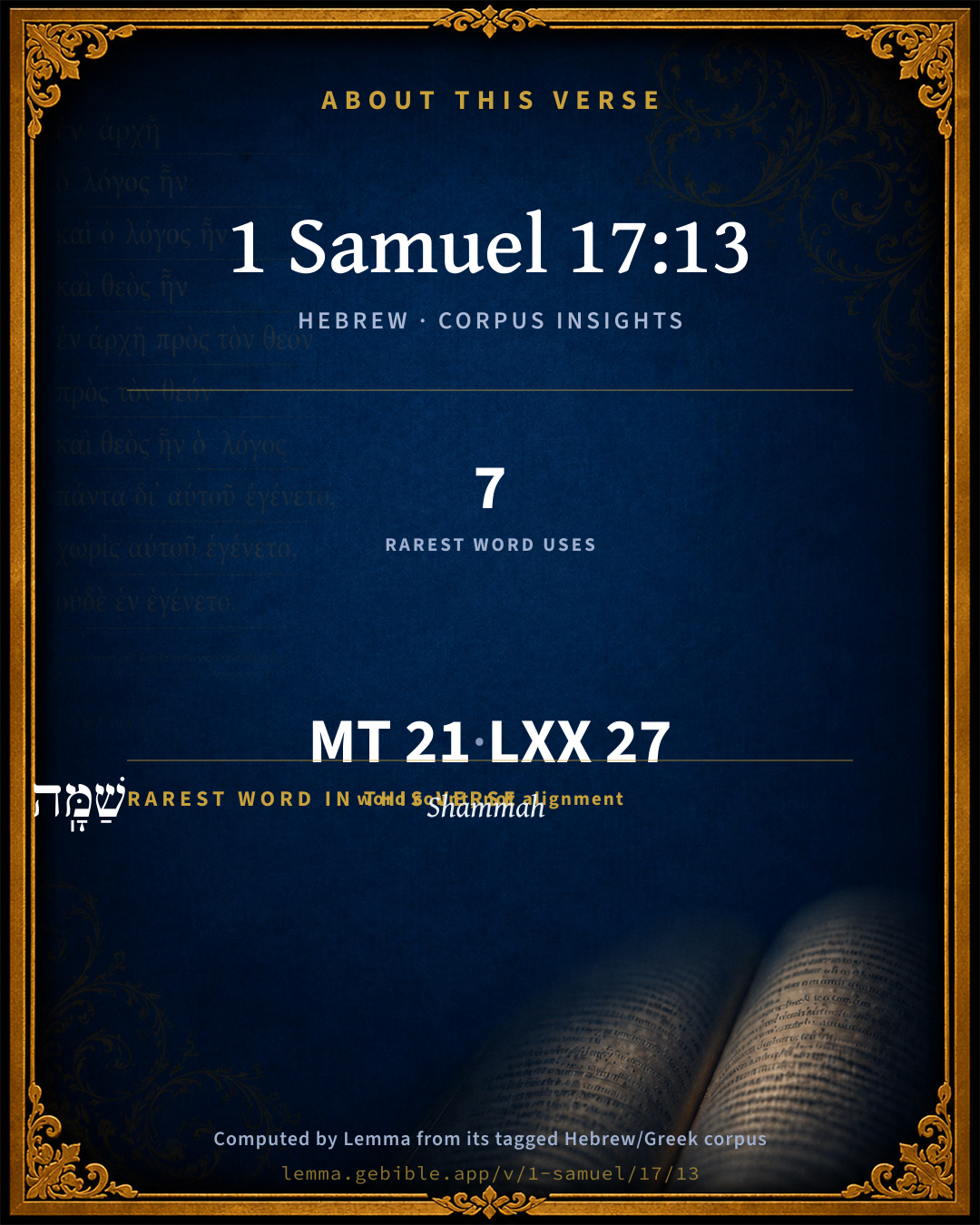
The rarest word here is שַׁמָּֽה Shammah H8048 — appearing just 7 times in the whole Hebrew Bible.

Shared distinctive vocabulary

שַׁמָּֽה Shammah H8048 occurs in 7 verses of the Hebrew Bible. Also found in:

Grammatical profile

  • 3 verbs
  • 12 nouns
  • 4 adjectives
  • 1 preposition
  • 1 particle

Verb forms

  • וַיֵּ֨לְכ֜וּ Qal · Sequential Imperfect
  • הָלְכ֥וּ Qal · Perfect
  • הָלְכוּ֙ Qal · Perfect

Repetition

Words recur within this verse — often emphatic in Hebrew:

  • שְׁלֹ֤שֶׁת three H7969 ×2
  • בְּנֵֽי son H1121 ×2
  • הָלְכ֥וּ to walk H1980 ×2
  • לַמִּלְחָמָ֑ה battle H4421 ×2

Hebrew & Septuagint length

In English translation the verse runs 38 words from the Hebrew and 38 from the Septuagint (LXX English) — the same length.

A rough comparison of the two English renderings, which tokenize alike — not a word-level alignment.

Word counts can differ between the Hebrew and the Greek without any difference in meaning — e.g. the Hebrew direct-object marker אֵת has no separate Greek word, and Greek often adds the article ὁ.

In the original languages it is 21 Hebrew tokens and 27 Greek tokens — but the two are counted differently (Hebrew bundles its prefixes and suffixes into one token; the Greek is in lemma form), so that isn’t a like-for-like length.

Cross-references

6

Topical passages linked to 1 Samuel 17:13 in the Treasury of Scripture Knowledge — connected by theme and wording, ordered by reader-vote popularity; previews shown in the World English Bible.

  • 1 Chronicles 2:13 and Jesse became the father of his firstborn Eliab, and Abinadab the second, and Shimea the third,
  • 1 Samuel 16:6–9 It happened, when they had come, that he looked at Eliab, and said, Surely Yahweh's anointed is before him.
  • 1 Samuel 17:28 Eliab his eldest brother heard when he spoke to the men; and Eliab's anger was kindled against David, and he said, Why are you come down? and with whom have you left those few sheep in the wilderness? I know your pride, and the naughtiness of your heart; for you have come down that you might see the battle.
  • 2 Samuel 13:3 But Amnon had a friend, whose name was Jonadab, the son of Shimeah, David's brother; and Jonadab was a very subtle man.
  • 2 Samuel 13:32 Jonadab, the son of Shimeah, David's brother, answered, Don't let my lord suppose that they have killed all the young men the king's sons; for Amnon only is dead; for by the appointment of Absalom this has been determined from the day that he forced his sister Tamar.
  • 2 Samuel 21:21 When he defied Israel, Jonathan the son of Shimei, David's brother, killed him.

Cross-references courtesy of OpenBible.info (CC BY 4.0).

Hebrew and Greek witnesses Masoretic Hebrew ↔ Greek Septuagint

The same verse in the two great witnesses to the Old Testament, shown verse-for-verse.

These are two independent witnesses, not word-aligned to each other, and the Septuagint is shown in lemma (dictionary) form.

Hebrew 1 Samuel 17:13 Masoretic · Westminster Leningrad Codex

וַיֵּ֨לְכ֜וּ שְׁלֹ֤שֶׁת בְּנֵֽי יִשַׁי֙ הַגְּדֹלִ֔ים הָלְכ֥וּ אַחֲרֵי שָׁא֖וּל לַמִּלְחָמָ֑ה וְשֵׁ֣ם שְׁלֹ֣שֶׁת בָּנָ֗יו אֲשֶׁ֤ר הָלְכוּ֙ בַּמִּלְחָמָ֔ה אֱלִיאָ֣ב הַבְּכ֗וֹר וּמִשְׁנֵ֨הוּ֙ אֲבִ֣ינָדָ֔ב וְהַשְּׁלִשִׁ֖י שַׁמָּֽה

The three eldest sons of Jesse had gone after Saul to the battle: and the names of his three sons who went to the battle were Eliab the firstborn, and next to him Abinadab, and the third Shammah.

World English Bible · Public Domain

Greek LXX 1 Samuel 17:13 Septuagint · lemma form

καί εἶπον σαούλ πρός δαυίδ οὐ μή δύναμαι πορεύομαι πρός ὁ ἀλλόφυλος ὁ πολεμέω μετά αὐτός ὅτι παιδάριον εἰμί σύ καί αὐτός ἀνήρ πολεμιστής ἐκ νεότης αὐτός

And the three elder sons of Jessae went and followed Saul to the war, and the names of his sons that went to the war were, Eliab his first-born, and his second Aminadab, and his third son Samma.

LXX2012 (modern English Septuagint) · Public Domain

Hebrew: Westminster Leningrad Codex (CC BY 4.0). Greek: Septuagint (public domain); English from LXX2012 (modern English Septuagint) (Public Domain). How the Septuagint differs from the Hebrew →

Targum (Aramaic paraphrase)

1

The Targum is the ancient Jewish Aramaic paraphrase of the Hebrew Scriptures — an interpretive translation, not the Hebrew text itself. Onkelos (literal) and Pseudo-Jonathan (expansive) render the Torah, and Jonathan the Prophets. Coverage is partial: where no permissively-licensed English translation exists for a verse, only the Aramaic is shown. This is verse-level text, not a word-by-word alignment to the Hebrew.

  1. Targum Jonathan Prophets (Joshua–Malachi)
    וַאֲזַלוּ תְּלָתָא בְּנֵי יִשַׁי רַבְרְבַיָא אֲזָלוּ בָּתַר שָׁאוּל לִקְרָבָא וְשׁוּם תְּלָתָא בְנוֹהִי דַאֲזָלוּ לִקְרָבָא אֱלִיאָב בּוּכְרָא וְתִנְיָנֵיהּ אֲבִינָדָב וּתְלִיתָאָה שַׁמָה:

    (no public-domain English translation for this verse)

    Targum Jonathan — Aramaic: “Mikraot Gedolot” (public domain). English: “Sefaria Community Translation” (CC0 1.0 (public-domain dedication)); “London "Chaldee Paraphrase," 1871” (public domain). Text via Sefaria.

Commentary

Notes on 1 Samuel 17:13 from classic Christian and Jewish commentators (each source and its license shown beneath its notes). The classic Christian expositions comment on the surrounding passage and are grouped to its opening verse, so a note may address several verses; the Jewish commentaries on the Tanakh (Rashi and others) are per-verse, so they appear only where the commentator wrote on this verse.

Lemma curates 59 commentaries, every one of them public domain or Creative Commons licensed, each selected and text-cleaned for this edition rather than reprinted as found. About our sources →

Trapp's Complete Commentary

John Trapp

1Sa 17:13 And the three eldest sons of Jesse went [and] followed Saul to the battle: and the names of his three sons that went to the battle [were] Eliab the firstborn, and next unto him Abinadab, and the third Shammah.

Ver. 13. And the three eldest sons of Jesse went.] These were sent by their old father, who held it

“ Dulce et decorum pro patria mori. ” - Horat.

Delightful and glorious to die for [your] country.

John Trapp, A Commentary or Exposition upon All the Books of the Old and New Testament (1647–1656) — public domain. Text from a community e-Sword module.

John Gill's Exposition

And the three eldest sons of Jesse went and followed Saul to the battle,.... Either of their own accord, or rather at their father's motion, or however with his knowledge and consent, who because he could not go himself, willed them to go; and these were forward, and some of the foremost that followed Saul to the battle, being zealous and well disposed to defend their king and country:

and the names of the three sons that went to the battle were Eliab the firstborn, and next unto him Abinadab, and the third Shammah; who are the three mentioned by name that passed before Samuel, when he came to anoint one of Jesse's sons to be king, Sa1 16:6.

John Gill's Exposition of the Whole Bible (1746–1763) — public domain (CC PDM 1.0). Text via the HelloAO Bible API.

Haydock's Catholic Bible Commentary

Battle. In these wars, all attended as much as possible, chap. xvi. 10.

George Leo Haydock (1774–1849), Haydock's Catholic Family Bible and Commentary, 1859 edition — public domain. Excludes Psalms (Douay-Rheims chapter numbering differs from Protestant) and Deuterocanonical books (Catholic canon only).

Lesson kit

Teaching starters — assembled from the data on this page, not authored interpretation. Every prompt links to the verse data it draws on. Edit before teaching.

1 Samuel, in the Historical, opens this verse with 21 words (17 distinct Hebrew lemmas). Its most distinctive word is Shammâh (“Shammah”). A historical commentator’s framing appears above. Read the whole chapter for the surrounding context.

Discussion questions

  1. How does “Shammah” (Shammâh) shape what this verse is saying?
  2. Genesis 36:13 shares the word «Shammah» with this verse. How do the two illuminate each other?
  3. “three” occurs 2× in this one verse. What is the effect of the repetition?
  4. These translations render this verse differently. What is at stake in choosing one wording over another?
  5. The verb «וַיֵּ֨לְכ֜וּ» is Qal Sequential Imperfect. How does its form color the action?
  6. Reading how Trapp's Complete Commentary and John Gill's Exposition read this verse, where do the two commentators agree and where do they part?

Things to notice

Reading settings

Reading text

Shown beneath each verse's original-language words.

Old Testament
Old Testament edition

Read the OT as the Masoretic Hebrew (MT) or the Greek Septuagint (LXX).

English shown for the Greek Septuagint (in the Hebrew ↔ Greek comparison).

Comparing translations? Open the Compare panel on any verse page to stack up to four side by side.