1 Chronicles 26:4

Hebrew (Westminster Leningrad Codex) 1 Chronicles 26:4 appears in the Hebrew Old Testament. The text above is from the Westminster Leningrad Codex. Each word links to its Strong’s number, a concise gloss, and parsing drawn from the Open Scriptures Hebrew Bible morphology. Click any word for its full Brown-Driver-Briggs (BDB) entry.
Download image
Cite this verse

1 Chronicles 26:4 (World English Bible). Public Domain. Lemma interlinear Bible study tool, https://lemma.gebible.app/v/1-chronicles/26/4.

Show BibTeX & RIS
BibTeX
RIS
English Translation
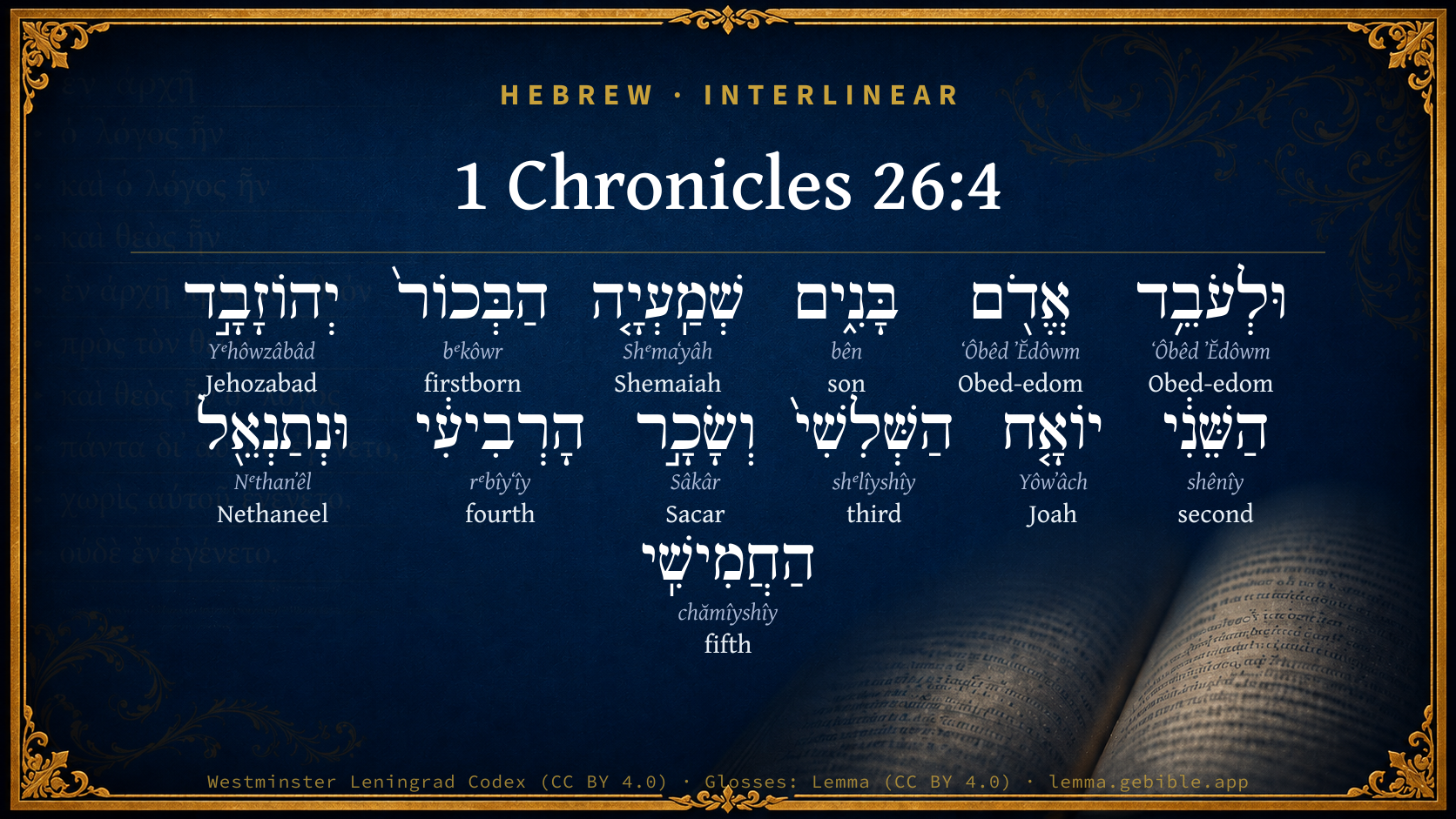
Obed-edom had sons: Shemaiah the firstborn, Jehozabad the second, Joah the third, and Sacar the fourth, and Nethanel the fifth,
World English Bible · Public Domain
Download a study sheet

One document with this verse’s original text, its word-by-word gloss line, the meaning frame, cross-references with their text, attributed commentary, and full source and license credits — printable, and it pastes into notes with its structure intact.

This verse Autodidact and up

Study sheet (.html) Plain text (.txt)

A passage Seminary Student

Up to 50 verses in one chapter. A passage sheet keeps up to 6 commentary sources and 12 cross-references per verse, in the order this page ranks them, and says so on the sheet whenever that leaves anything out. Ask for a single verse and you get the Autodidact verse sheet above.

Everything on this page stays free to read, with no account — the sheet is a download of what is already on screen, not access to it.

Want to remove ads? Support Godless Engineer
Compare translations 3

The same verse in 3 English versions, stacked beneath the original-language interlinear above. Click any original word for its lexicon entry.

Each is an independent rendering of the whole verse — the interlinear is not word-aligned to these translations.

Highlighted words mark where these versions differ — a whole-verse word diff, not a word-by-word alignment.

  • World English Bible Public Domain
    Obed-edom had sons: Shemaiah the firstborn, Jehozabad the second, Joah the third, and Sacar the fourth, and Nethanel the fifth,
  • King James Version Public Domain
    Moreover the sons of Obededom were, Shemaiah the firstborn, Jehozabad the second, Joah the third, and Sacar the fourth, and Nethaneel the fifth.
  • unfoldingWord Literal Text CC BY-SA 4.0
    And sons to Obed Edom: Shemaiah, the firstborn; Jehozabad, the second; Joah, the third; and Sakar, the fourth; and Nethanel, the fifth;

unfoldingWord Literal Text — © unfoldingWord, licensed CC BY-SA 4.0. Word-aligned USFM3 via Door43 (git.door43.org/unfoldingWord/en_ult).

Versions to compare (up to 4)

3 of 4 selected

Show all 18 translations

Every available English version of this verse, each an independent rendering of the whole verse.

  • World English Bible Public Domain
    Obed-edom had sons: Shemaiah the firstborn, Jehozabad the second, Joah the third, and Sacar the fourth, and Nethanel the fifth,
  • Berean Standard Bible Public Domain
    And Obed-edom also had sons: Shemaiah the firstborn, Jehozabad the second, Joah the third, Sachar the fourth, Nethanel the fifth,
  • Majority Standard Bible Public Domain
    And Obed-edom also had sons: Shemaiah the firstborn, Jehozabad the second, Joah the third, Sachar the fourth, Nethanel the fifth,
  • King James Version Public Domain
    Moreover the sons of Obededom were, Shemaiah the firstborn, Jehozabad the second, Joah the third, and Sacar the fourth, and Nethaneel the fifth.
  • American Standard Version (1901) Public Domain
    And Obed-edom had sons: Shemaiah the first-born, Jehozabad the second, Joah the third, and Sacar the fourth, and Nethanel the fifth,
  • Revised Version (1885) Public Domain
    And Obed-edom had sons; Shemaiah the firstborn, Jehozabad the second, Joah the third, and Sacar the fourth, and Nethanel the fifth;
  • Geneva Bible (1599) Public Domain
    And the sonnes of Obed Edom, Shemaiah the eldest, Iehozabad the second, Ioah the third, and Sacar the fourth, and Nethaneel the fift,
  • Douay-Rheims (1899) Public Domain
    And the sons of Obededom, Semeias the firstborn, Jozabad the second, Joaha the third, Sachar the fourth, Nathanael the fifth,
  • Young's Literal Translation Public Domain
    And to Obed-Edom `are' sons, Shemaiah the first-born, Jehozabad the second, Joah the third, and Sacar the fourth, and Nethaneel the fifth,
  • Literal Standard Version CC BY-SA 4.0
    And moreover, sons of Obed-Edom: Shemaiah the firstborn, Jehozabad the second, Joah the third, and Sacar the fourth, and Nethaneel the fifth,
  • Unlocked Literal Bible CC BY-SA 4.0
    Obed Edom had sons: Shemaiah the firstborn, Jehozabad the second, Joah the third, and Sakar the fourth, and Nethanel the fifth,
  • unfoldingWord Literal Text CC BY-SA 4.0
    And sons to Obed Edom: Shemaiah, the firstborn; Jehozabad, the second; Joah, the third; and Sakar, the fourth; and Nethanel, the fifth;
  • Darby Bible Public Domain
    -- And the sons of Obed-Edom: Shemaiah the firstborn, Jehozabad the second, Joah the third, and Sacar the fourth, and Nethaneel the fifth,
  • World Messianic Bible Public Domain
    Obed-Edom had sons: Shemaiah the firstborn, Jehozabad the second, Joah the third, Sacar the fourth, Nethanel the fifth,
  • Webster's Bible Public Domain
    Moreover the sons of Obed-edom were, Shemaiah the first-born, Jehozabad the second, Joah the third, and Sacar the fourth, and Nethaneel the fifth,
  • Free Bible Version CC BY-SA 4.0
    The sons of Obed-edom: Shemaiah (first), Jehozabad (second), Joah (third), Sacar (fourth), Nethanel (fifth),
  • Bible in Basic English Public Domain
    And Obed-edom had sons: Shemaiah the oldest, Jehozabad the second, Joah the third, and Sacar the fourth, and Nethanel the fifth,
  • JPS Tanakh (1917) Public Domain
    And Obed-edom had sons: Shemaiah the first-born, Jehozabad the second, Joah the third, and Sacar the fourth, and Nethanel the fifth;

Literal Standard Version (2020), Covenant Press — licensed CC BY-SA 4.0. Text via the HelloAO Bible API (eBible.org). Unlocked Literal Bible (unfoldingWord) — licensed CC BY-SA 4.0. Text via the HelloAO Bible API (eBible.org). unfoldingWord Literal Text — © unfoldingWord, licensed CC BY-SA 4.0. Word-aligned USFM3 via Door43 (git.door43.org/unfoldingWord/en_ult). Free Bible Version, Dr. Jonathan Gallagher — licensed CC BY-SA 4.0. Text via the HelloAO Bible API (eBible.org).

Word by word

More ways to search: Search by grammar → Find every occurrence → Compare this word →

Practice this passage: Drill this verse → Learn its vocabulary →

וְשָׂכָ֣ר
Sâkâr
H7940
“and · Sacar”
Conjunction + Noun, Proper
Part of Speech
Conjunction + Noun
Type
Proper
Full BDB Definition

Origin: the same as H7939

TWOT: None

Sacar = "wages" - father of Ahiam, one of David's mighty warriors - a Korahite Levite gatekeeper, the 4th son of Obed-edom in the time of David
  1. וּלְעֹבֵ֥ד ʻÔbêd ʼĔdôwm H5654 “and · to/for · Obed-edom” Conjunction + Preposition + Noun, Proper
  2. אֱדֹ֖ם ʻÔbêd ʼĔdôwm H5654 “Obed-edom” Noun, Proper
  3. בָּנִ֑ים bên H1121 “sons” Noun, Common, Masculine, Plural, Absolute
  4. שְׁמַֽעְיָ֤ה Shᵉmaʻyâh H8098 “Shemaiah” Noun, Proper
  5. הַבְּכוֹר֙ bᵉkôwr H1060 “the · firstborn” Particle, Definite Article + Noun, Common, Masculine, Singular, Absolute
  6. יְהוֹזָבָ֣ד Yᵉhôwzâbâd H3075 “Jehozabad” Noun, Proper
  7. הַשֵּׁנִ֔י shênîy H8145 “the · second” Particle, Definite Article + Adjective, Ordinal number, Masculine, Singular, Absolute
  8. יוֹאָ֤ח Yôwʼâch H3098 “Joah” Noun, Proper
  9. הַשְּׁלִשִׁי֙ shᵉlîyshîy H7992 “the · third” Particle, Definite Article + Adjective, Ordinal number, Masculine, Singular, Absolute
  10. הָרְבִיעִ֔י rᵉbîyʻîy H7243 “the · fourth” Particle, Definite Article + Adjective, Ordinal number, Masculine, Singular, Absolute
  11. וּנְתַנְאֵ֖ל Nᵉthanʼêl H5417 “and · Nethaneel” Conjunction + Noun, Proper
  12. הַחֲמִישִֽׁי chămîyshîy H2549 “the · fifth” Particle, Definite Article + Adjective, Ordinal number, Masculine, Singular, Absolute

About this verse

These counts appear in no published source. They are computed here, from the morphology-tagged text and Lemma’s own curated glosses. What Lemma adds →

13
words
12
distinct lemmas
Historical
section

Notable vocabulary

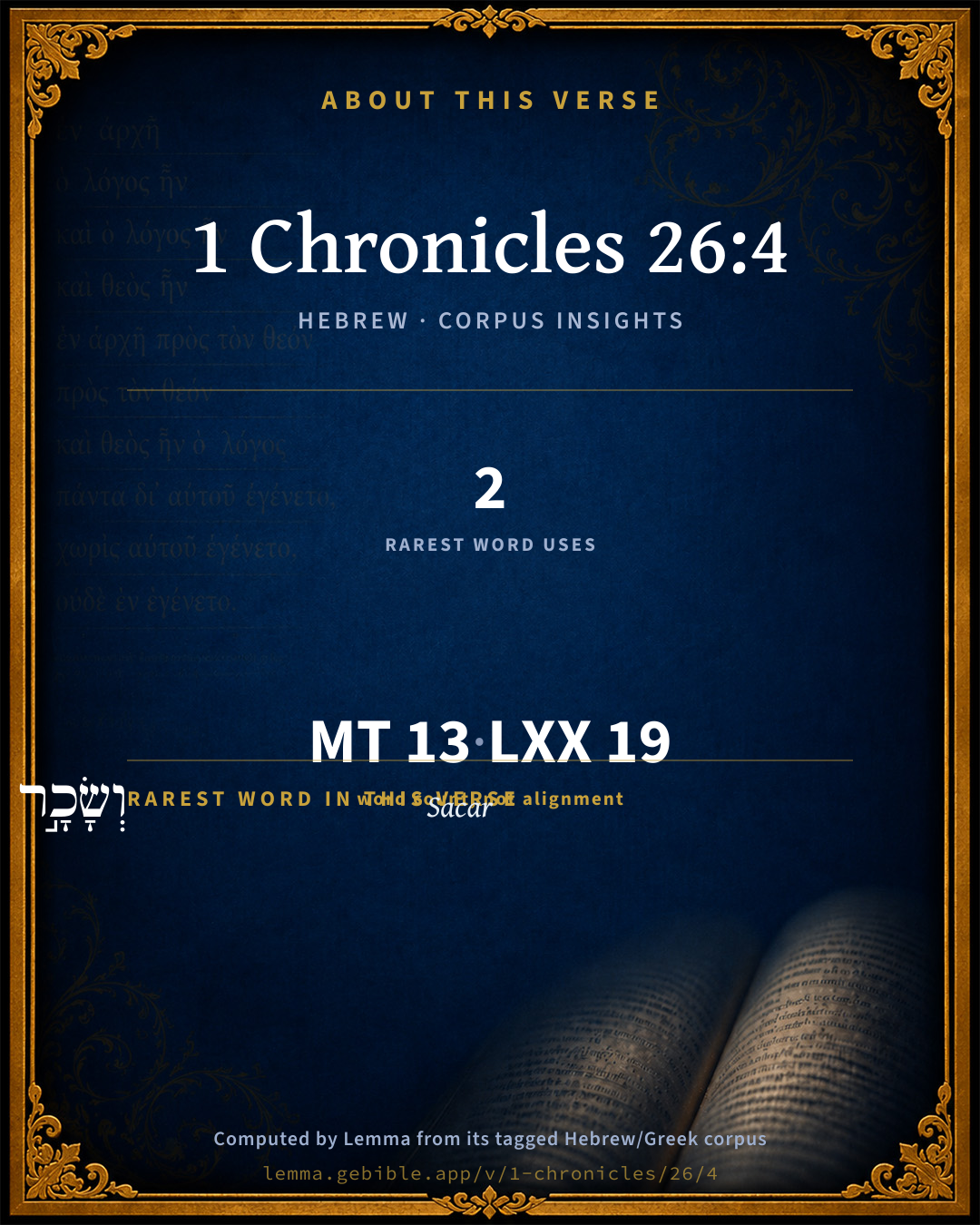
The rarest word here is וְשָׂכָ֣ר Sacar H7940 — appearing just 2 times in the whole Hebrew Bible.

Shared distinctive vocabulary

וְשָׂכָ֣ר Sacar H7940 occurs in 2 verses of the Hebrew Bible. Also found in:

Grammatical profile

  • 9 nouns
  • 4 adjectives

Repetition

A word recurs within this verse — often emphatic in Hebrew:

  • וּלְעֹבֵ֥ד Obed-edom H5654 ×2

Hebrew & Septuagint length

In English translation the verse runs 20 words from the Hebrew and 22 from the Septuagint (LXX English) — closely comparable.

A rough comparison of the two English renderings, which tokenize alike — not a word-level alignment.

Word counts can differ between the Hebrew and the Greek without any difference in meaning — e.g. the Hebrew direct-object marker אֵת has no separate Greek word, and Greek often adds the article ὁ.

In the original languages it is 13 Hebrew tokens and 19 Greek tokens — but the two are counted differently (Hebrew bundles its prefixes and suffixes into one token; the Greek is in lemma form), so that isn’t a like-for-like length.

Cross-references

5

Topical passages linked to 1 Chronicles 26:4 in the Treasury of Scripture Knowledge — connected by theme and wording, ordered by reader-vote popularity; previews shown in the World English Bible.

  • 1 Chronicles 15:18 and with them their brothers of the second degree, Zechariah, Ben, and Jaaziel, and Shemiramoth, and Jehiel, and Unni, Eliab, and Benaiah, and Maaseiah, and Mattithiah, and Eliphelehu, and Mikneiah, and Obed-edom, and Jeiel, the doorkeepers.
  • 1 Chronicles 15:24 Shebaniah, and Joshaphat, and Nethanel, and Amasai, and Zechariah, and Benaiah, and Eliezer, the priests, did blow the trumpets before the ark of God: and Obed-edom and Jehiah were doorkeepers for the ark.
  • 1 Chronicles 16:38 and Obed-edom with their brothers, sixty-eight; Obed-edom also the son of Jeduthun and Hosah to be doorkeepers;
  • 1 Chronicles 15:21 and Mattithiah, and Eliphelehu, and Mikneiah, and Obed-edom, and Jeiel, and Azaziah, with harps tuned to the eight-stringed lyre, to lead.
  • 1 Chronicles 16:5 Asaph the chief, and second to him Zechariah, Jeiel, and Shemiramoth, and Jehiel, and Mattithiah, and Eliab, and Benaiah, and Obed-edom, and Jeiel, with psalteries and with harps; and Asaph with cymbals, sounding aloud;

Cross-references courtesy of OpenBible.info (CC BY 4.0).

Hebrew and Greek witnesses Masoretic Hebrew ↔ Greek Septuagint

The same verse in the two great witnesses to the Old Testament, shown verse-for-verse.

These are two independent witnesses, not word-aligned to each other, and the Septuagint is shown in lemma (dictionary) form.

Hebrew 1 Chronicles 26:4 Masoretic · Westminster Leningrad Codex

וּלְעֹבֵ֥ד אֱדֹ֖ם בָּנִ֑ים שְׁמַֽעְיָ֤ה הַבְּכוֹר֙ יְהוֹזָבָ֣ד הַשֵּׁנִ֔י יוֹאָ֤ח הַשְּׁלִשִׁי֙ וְשָׂכָ֣ר הָרְבִיעִ֔י וּנְתַנְאֵ֖ל הַחֲמִישִֽׁי

Obed-edom had sons: Shemaiah the firstborn, Jehozabad the second, Joah the third, and Sacar the fourth, and Nethanel the fifth,

World English Bible · Public Domain

Greek LXX 1 Chronicles 26:4 Septuagint · lemma form

καί ὁ αβδεδομ υἱός σαμαιας ὁ πρωτότοκος ιωζαβαδ ὁ δεύτερος ιωαα ὁ τρίτος σωχαρ ὁ τέταρτος ναθαναηλ ὁ πέμπτος

And to Abdedom there were born sons, Samaias the firstborn, Jozabath the second, Joath the third, Sachar the fourth, Nathanael the fifth,

LXX2012 (modern English Septuagint) · Public Domain

Hebrew: Westminster Leningrad Codex (CC BY 4.0). Greek: Septuagint (public domain); English from LXX2012 (modern English Septuagint) (Public Domain). How the Septuagint differs from the Hebrew →

Commentary

Notes on 1 Chronicles 26:4 from classic Christian and Jewish commentators (each source and its license shown beneath its notes). The classic Christian expositions comment on the surrounding passage and are grouped to its opening verse, so a note may address several verses; the Jewish commentaries on the Tanakh (Rashi and others) are per-verse, so they appear only where the commentator wrote on this verse.

Lemma curates 59 commentaries, every one of them public domain or Creative Commons licensed, each selected and text-cleaned for this edition rather than reprinted as found. About our sources →

Ellicott's Commentary for English Readers

(4) Moreover the sons of Obed-edom.—And Obed-edom had sons. Obed-edom (1Ch_15:24) is called a son of Jeduthun in 1Ch_16:38. This Jeduthun was not the Merarite chief musician, but a Korhite. (Comp. 1Ch_26:1; 1Ch_26:10; 1Ch_26:19.)

A Bible Commentary for English Readers, edited by Charles John Ellicott (1878–1897) — public domain. Text from a community e-Sword module.

The Cambridge Bible for Schools and Colleges

gen. ed. J. J. S. Perowne

4. Moreover the sons of Obed-edom were] R.V. And Obed-edom had sons. For Obed-edom see 1Ch_13:13, note.

The Cambridge Bible for Schools and Colleges (gen. ed. J. J. S. Perowne; Cambridge University Press, 1878–1918) — public domain. Text from a community e-Sword module.

John Gill's Exposition

Moreover, the sons of Obededom,.... The same at whose house the ark was, before it was brought by David to Zion; his sons were porters also, as himself, Ch1 15:24, mention is made of eight sons of his, according to their birth:

Shemaiah, Jehozabad, Joah, Sacar, Nethaneel, Ammiel, Issachar, Peulthai; for God blessed him; as with wealth and riches, so with a numerous offspring, and that because of his entertainment of the ark at his house; the great increase of his family is aggravated by the Jews (q) beyond all credit, that all in his family brought eight at a birth; the Targum here makes them eighty two in all.

(q) Hieron. Trad. Heb. in 2. Reg. fol. 77. M.

John Gill's Exposition of the Whole Bible (1746–1763) — public domain (CC PDM 1.0). Text via the HelloAO Bible API.

Albert Barnes' Notes on the Bible

Obed-edom and Hosah 1Ch 26:10 had been “porters,” or door - keepers, from the time of the bringing up of the ark into Jerusalem 1Ch 15:24; 1Ch 16:38.

Albert Barnes' Notes on the Bible (1834–1885) — public domain. Text from a community e-Sword/MySword module.

The Pulpit Commentary

Vers. 4, 5. Here we have the enumeration of eight sons of Obed-edom. (1Ch_15:21, 24 16:38) That in this last reference Obed-edom seems to be called "son of Jeduthun" is owing probably to the omission of a name. For former occurrences of the sentence, God blessed him, with its present evident allusion, see 1Ch_13:14; 2Sa_6:11. To this passage, the expression of 1Ch_25:5, "to lift up the horn," is probably analogous, where see comment.

HOMILIES BY R. TUCK Vers. 4, 5.

Culture by trusts.

The reference made to Obed-edom recalls the fact that he and his family were blessed in the trust of work to do for God, the work of caring for his sacred, ark-symbol. We may dwell on God"s design in relation to the moral and spiritual characters of men by his putting them in trust, pressing them under the sense of responsibility.

I MEN PUT IN TRUST. Life is full of these trusts from its beginning to its close. The Divine idea for all men is exhibited in the two great heads of the race. The first Adam was put in Eden, and trusted to dress and keep it, and not to touch the tree of the knowledge of good and evil. The second Adam was set in our human spheres, and trusted with the great work of revealing God to men, and redeeming men from their sins. We may trace the same dealing with men at every stage of life. Man is not his own; he is under authority, trusted with his Lord"s goods, and his Lord"s commissions.

1. We deal with our children on this principle. We train character by trustsof increasing value. It is only the bad child that may not be trusted.

2. In youth-time there are foretastes of the grave life-responsibilities whichhelp to prepare us to undertake them. In youth-time we begin to feel the gravity of life, and there is a deepening thoughtfulness, the overshadowing of the seriousness of full manhood.

3. The beginning of manhood brings larger and heavier trusts andresponsibilities, which call out our best powers. These trusts concern business, the family, society, and religion.

4. And advancing life provides constant addition of trusts, until our middlemanhood sometimes seems to be overweighted, and flesh and heart almost fail. Illustrate by a few special cases: e.g.

(1) A man waking up to the consciousness of power, in knowledge, skill, influence, position, or wealth: if he be a true-hearted man to feelI can brings a solemn sense of responsibility, and a great longing to be found faithful.

(2) A girl changed into a woman by the responsibility of becoming s wife and a mother.

(3) The case of accepting a religious life. The religious man goes every day under the pressure of this trust God to glorify." And if there is any peculiar nobility and power about the life of the religious man, it comes out of his "trust," and is cultured by his "trust." Then we are no true men or women until we have found out our holy burden, and are taking it up, and bearing it cheerfully, as our Lord"s yoke laid upon us. When a man views life on earth aright, he finds it to be no play-scene, in which mere appearances meet the eye and the ear. He finds it full of awful realities and possibilities a life, not a pastime.

II MEN CURSED OR BLESSED THROUGH THEIR TRUSTS. A design of blessing is in them, and a tremendous possibility of curse. Lest they should become a curse, they are only given up to the measure of a man"s ability. If more were entrusted to us than we could undertake, our natures could only be crushed. In this view some may be thankful that they have only one talent; and some warnings come from the careers of those whom we call "men of genius." Men are blessed by their trusts when their whole natures open to accept them, as flowers, responsive to sun and shower, open to receive, and are blessed. In lifting ourselves up to meet trusts is found the repression of all evil, and the culture of all good the very blossoming of our nature. The true conception of the angel is not with folded wings, standing, but with poised, or outspread wings, ready to obey, rising to meet his trust. Men are cursed by their trusts, when they despise or neglect them; when they are unwilling to belong to another; when their natures are shut up to pleasure, not to duty; to self, not to God.

Do you say But my trusts seem such little things? So they are. So must all human trusts be. It is a little thing just to take care of God"s ark. Nevertheless they are arranged in the heavenly Father"s wisdom, and they may if we will let them culture the earth-children for their heavenly home. Let us be "faithful over the few things. R.T.

The Pulpit Commentary (1880–1919), ed. H.D.M. Spence-Jones & Joseph S. Exell — public domain. Text from a community e-Sword module.

Keil & Delitzsch

C. F. Keil & F. Delitzsch

Moreover, the sons of Obededom,.... The same at whose house the ark was, before it was brought by David to Zion; his sons were porters also, as himself, Ch1 15:24, mention is made of eight sons of his, according to their birth:

Shemaiah, Jehozabad, Joah, Sacar, Nethaneel, Ammiel, Issachar, Peulthai; for God blessed him; as with wealth and riches, so with a numerous offspring, and that because of his entertainment of the ark at his house; the great increase of his family is aggravated by the Jews (q) beyond all credit, that all in his family brought eight at a birth; the Targum here makes them eighty two in all.

(q) Hieron. Trad. Heb. in 2. Reg. fol. 77. M.

Keil & Delitzsch — Biblical Commentary on the Old Testament (1861–1891) — public domain (CC PDM 1.0). Text via the HelloAO Bible API. (Old Testament only.)

unfoldingWord translationNotes

Door43 World Missions Community

General Information:

This continues the list of gatekeepers which started in 1 Chronicles 26:1.

Obed Edom

See how you translated this man's name in 1 Chronicles 16:38. (See: How to Translate Names)

Shemaiah ... Jehozabad ... Joah ... Sakar ... Nethanel ... Ammiel ... Issachar ... Peullethai

These are the names of men. (See: How to Translate Names)

the second ... the third ... the fourth ... the eighth

This shows the order in which the sons were born. If it is more natural in your language, you may say "the next" for each son. (See: Ordinal Numbers)

who ruled over their families

"who were leaders in their father's family." This means that they were leaders among their clan.

translationWords

God

bless

rule

family

unfoldingWord translationNotes — © Distant Shores Media and the Door43 World Missions Community, licensed CC BY-SA 4.0. Source: git.door43.org/Door43/en_tn.

Lesson kit

Teaching starters — assembled from the data on this page, not authored interpretation. Every prompt links to the verse data it draws on. Edit before teaching.

1 Chronicles, in the Historical, opens this verse with 13 words (12 distinct Hebrew lemmas). Its most distinctive word is Sâkâr (“Sacar”). A historical commentator’s framing appears above. Read the whole chapter for the surrounding context.

Discussion questions

  1. The word Sâkâr carries the sense “Sacar.” How does it shape the verse?
  2. How does 1 Chronicles 11:35, which shares the word «Sacar», read alongside this verse?
  3. What does the repetition of “Obed-edom” (2× in this one verse) do in this verse?
  4. These translations render this verse differently; the difference is in the English rendering, not the original. What questions does that raise?
  5. Compare how Ellicott's Commentary for English Readers and The Cambridge Bible for Schools and Colleges read this verse. Where do they agree or differ?

Things to notice

Reading settings

Reading text

Shown beneath each verse's original-language words.

Old Testament
Old Testament edition

Read the OT as the Masoretic Hebrew (MT) or the Greek Septuagint (LXX).

English shown for the Greek Septuagint (in the Hebrew ↔ Greek comparison).

Comparing translations? Open the Compare panel on any verse page to stack up to four side by side.