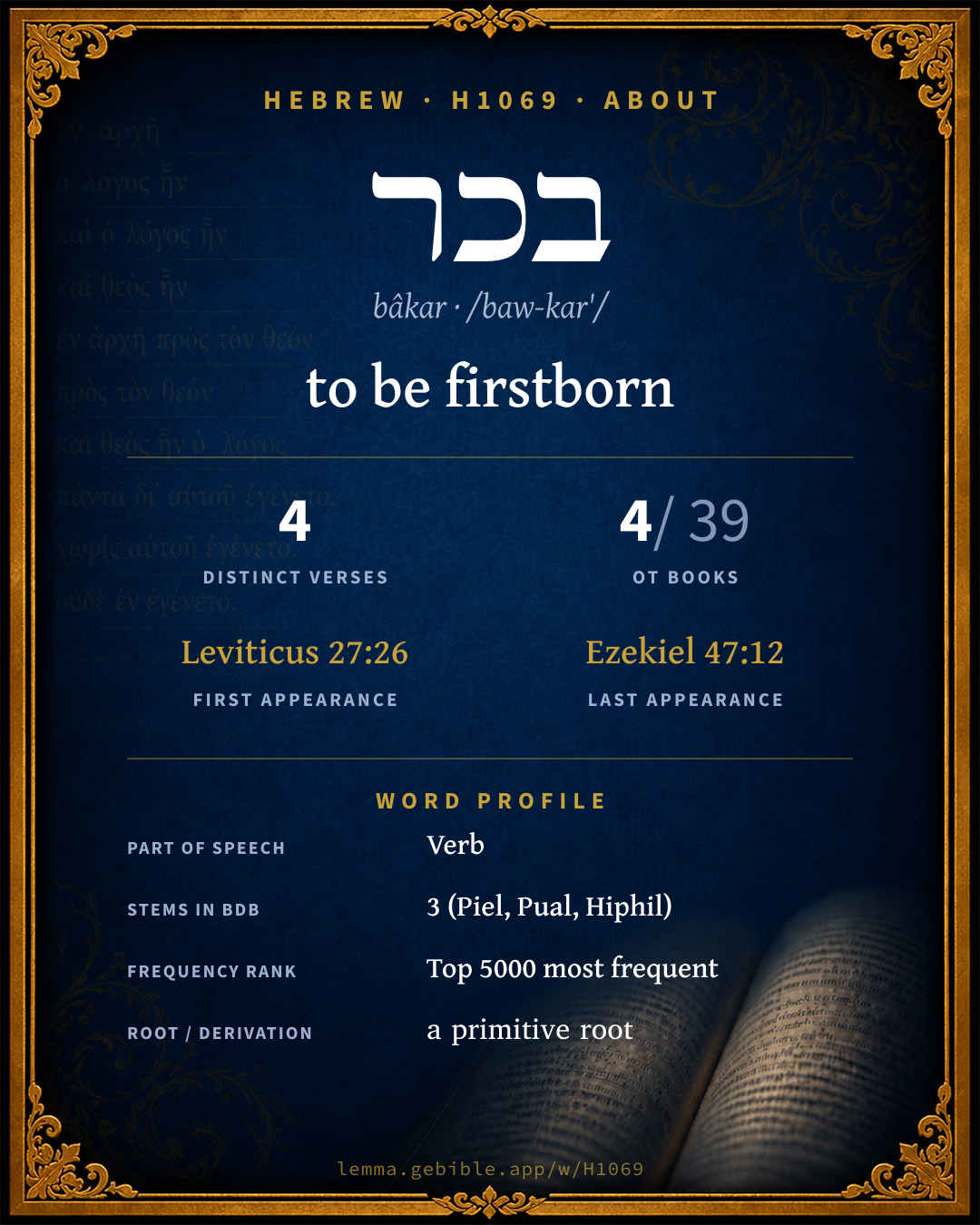
בָּכַר
to be firstborn
‘to be firstborn’ is one of 2 main senses fuller range ↓
Full lexicon entry — Brown-Driver-Briggs (BDB)
From Brown-Driver-Briggs (BDB)
Where this word appears
See every Piel verb in the Hebrew Bible →
Grammar key — what these labels mean
Part of speech
- Verb
- An action or state-of-being word.
Stem
- Hiphil
- The causative active stem (“he caused / brought about”).
- Piel
- An intensive or resultative active stem. Here: ‘bear early’
- Pual
- The passive counterpart of the Piel.
Form
- Participle Active
- A verbal adjective expressing ongoing or characteristic action (“writing / one who writes”).
- Infinitive Construct
- A bound verbal noun, frequently with prepositions (“to write / in writing”).
- Imperfect
- An incomplete, ongoing, or future action (“he will / would write”).
State
- Absolute
- The independent form of a noun, not bound to a following word.
Person
- 3rd Person
- The one spoken about (“he / she / it / they”).
Gender
- Feminine
- Grammatically feminine.
- Masculine
- Grammatically masculine.
Number
- Singular
- One.
Grammatical forms
- Verb, Hiphil, Participle Active, Feminine, Singular, Absolute 1 time (25%)
- Verb, Piel, Infinitive Construct 1 time (25%)
- Verb, Pual, Imperfect, 3rd Person, Masculine, Singular 1 time (25%)
- Verb, Piel, Imperfect, 3rd Person, Masculine, Singular 1 time (25%)
Parsed forms decoded from the imported morphology (morphhb / Westminster Leningrad Codex — WLC text public domain, morphhb tagging CC BY 4.0), counted across 4 parsed occurrences — not distinct verses.
Every verse where H1069 appears — 4 distinct verses across 4 books. Click any verse to open its interlinear word-by-word view. Verse text shown in the World English Bible for context — . Each verse’s Hebrew form is shown with its reference; the English is not keyword-highlighted, since the data carries no word-level English alignment. Use “Compare translations” on any verse to read it across multiple English versions. This concordance covers the Hebrew Bible; Septuagint (Greek Old Testament) occurrences are not indexed here.
Leviticus 1 verse
Deuteronomy 1 verse
Jeremiah 1 verse
Ezekiel 1 verse
About this entry
At a glance — auto-summarized from this page’s data, not written by a person. Every figure links to its source below. This summary describes the numbers; it doesn’t interpret them.
“to be firstborn” is the headline sense of the Hebrew verb בכר (bâkar). With only 4 verses it sits in the long tail of Hebrew Bible vocabulary. More than a quarter of its appearances fall in Leviticus. First canonically at Leviticus 27:26, it enters the text early. The verb spans 3 stems, from Piel to Pual. See the sense tree, 4-verse concordance, and the renderings breakdown below.
Gloss history
Strong's 1890 vs modern scholarship
About this word
Strong's H1069 catalogs a Hebrew word from the Hebrew Old Testament.
These counts are not copied from any lexicon or concordance. They are computed here, from the morphology-tagged Hebrew Old Testament. What Lemma adds →
- 4
- distinct verses
- The word appears in 4 distinct verses.
- 4 / 39
- OT books
- The word appears in 4 of 39 Old Testament books.
- #3,696
- by frequency
- Top 5000 most frequent Hebrew words (rank 3,696 of 8,640 Hebrew words by occurrence).
View all 4 occurrences in the concordance →
Most concentrated in
- Leviticus 1 verse 25%
- Deuteronomy 1 verse 25%
- Jeremiah 1 verse 25%
By section of the Old Testament
By traditional corpus
Conventional, traditional groupings — biblical authorship is debated, so this is a traditional corpus grouping, not an authorship claim. Each share is this word’s portion of its verses in that division of the Hebrew canon. Each figure is a share of the word’s 4 distinct verses.
- Torah (Pentateuch) 2 verses · 50%
- Prophets (Nevi'im) 2 verses · 50%
How translations render this word
Counts come from each version’s own published word-to-Strong’s tagging or interlinear alignment — an approximate guide to how each version renders this word, not a word-level alignment the data otherwise carries. Because each total is that version’s own tagged count, the per-version totals vary from one another and need not match the appearance or distinct-verse counts above. These counts may also differ from a printed concordance because Lemma counts each distinctly tagged rendering and does not collapse phrase taggings into a single head-word total. This is a fixed set of word-tagged versions (KJV, ASV, BSB, ULT) and does not change with the reading translation you choose elsewhere. Each version’s license is shown beside its name below (and on Sources).
- King James Version: Bringeth forth her first child 1×, Firstborn 1×, Firstling 1×
- American Standard Version: Bringeth forth her first child 1×, First-born 1×, Is made a firstling 1×
- Berean Standard Bible: Firstborn 1×, Like one bearing her first child 1×, They will bear fruit 1×
- unfoldingWord Literal Text: Firstborn 2×
King James Version Public Domain
Renders H1069 across 4 tagged occurrences — most commonly:
American Standard Version Public Domain
Renders H1069 across 4 tagged occurrences — most commonly:
Berean Standard Bible Public Domain
Renders H1069 across 3 tagged occurrences — most commonly:
Not rendered by a distinct English word in 1 further occurrence.
unfoldingWord Literal Text CC BY-SA 4.0
Renders H1069 across 4 tagged occurrences — most commonly:
Plus 2 renderings that appear only once — usually multi-word phrases or single function words the recovered tagging swept in, not distinct renderings.
Senses in the full BDB
Hebrew verbs can shift meaning by stem (binyan): Qal is the basic action, Niphal is often passive or reflexive, Piel often intensifies or makes it factitive, and Hiphil is typically causative. The senses below are grouped under the stem BDB assigns to each. This entry also uses Pual (the passive of Piel).
What do BDB’s symbols mean?
BDB uses these scholarly abbreviations:
| Symbol | Meaning |
|---|---|
| 𝔊 | the Septuagint (the ancient Greek translation, LXX) |
| 𝔙 | the Vulgate (the Latin translation) |
| 𝔖 | the Syriac version (the Peshitta) |
| 𝔗 | the Targum (the Aramaic translation) |
| ψ | the Psalms |
| √ | root (the underlying root or stem) |
| ‖ | parallel passage (a synonymous or contrasted parallel) |
| † | the dagger: every passage where the word occurs is cited |
The 4 senses and sub-senses the full Brown-Driver-Briggs lexicon distinguishes for this word, in lexicon order (not ranked by frequency), with BDB’s own verbatim wording and sub-sense lettering. Shown in Hebrew script with BDB’s own scholarly abbreviations. The condensed entry is in the Lexicon Entry tab. See also the Forms in the corpus table below.
Piel
- 1. bear early, new fruit
- 2. make or constitute as first-born
Pual
- . born or made a firstling.
Hiphil
- . one bearing her first child
Senses from the full Brown-Driver-Briggs lexicon (Brown, Driver, Briggs; Oxford 1906 — public domain), digitized via Sefaria, supplemented by the OpenScriptures HebrewLexicon (CC BY 4.0). Full attribution on Sources.
Word origin
Origin: a primitive root
Jastrow Dictionary
A second Hebrew/Aramaic lexicon for comparison, covering Aramaic and post-biblical (Talmudic, Targumic, Midrashic) usage that the biblical-Hebrew BDB does not. Matched by lemma rather than by Strong’s number, so a lemma may carry more than one Jastrow headword (shown separately below), and the entries cover usage well beyond the Bible.
בָּכַר
- [to break forth,] to be early. [Kal prob. not used.]
- 1. to be early, produce first fruits. Tanḥ. Vayḥi 14; Gen. R. s. 99 מְבַכֶּרֶת (פירותיה) has early crops, opp. מלקשת, מאפלת. [Ib. end מבכרין מפירותיהם read מכבדין, v. כָּבַד.]
- 2. to bear for the first time (of animals). Bekh. I, 3 sq. שלא בִיכְּרָה that never before had given birth; a. fr.
- 3. (neut. v.) to be first in ripening. Bicc. III, 1 and sees תאנה שבִּכְּרָה a fig which is first ripe, אשכול שביכר a cluster of grapes which &c. Y. Maasr. I, 49ᵃ top משיְבַכֵּר צמייא וכ׳, v. צמייא. Ib. משבִּיכֵּירוּ בנות שבע, v. בְּרַת. Ib. בִּיכֵּירוּ, משיְבַכְּרוּ (v. בָּחַל as to spelling).
- 4. (b. h.) to recognize as first-born (בכור). B. Bath. 130ᵃ sq.
- same. Bekh. III, 2 המַבְכִּירוֹת those animals which have given birth for the first time.
- tohasten. Yalk. Gen. 161 שהיא מִתְבַּכֶּרֶת בפירותיה, v. supra.
בְּכַר
- —Pa. בַּכִּר
- 1. to produce, mature. Targ. Y. Deut. XXXIII, 14 דמְבַכְּרָא וכ׳ which his land produces.
- 2. to recognize as first-born. Targ. O. Deut. XXI, 16.
- to be dedicated as the first-born. Targ. O. Lev. XXVII, 26.
כַּר
- , v. כָּרָה)
- 1. bolster, mattress. Mikv. X, 2. Kel. XXVI, 5, v. כֶּסֶת; a. fr.—Pl. כָּרִים. Kil. IX, 2; a. fr.—Meg. 12ᵃ (expl. כרפס, Esth. I, 6) כ׳ של פסים mattresses of striped goods. e.g. Esther 1:6
- 2. rounded; (cmp. כֶּבֶשׂ) fat lamb. Men. 66ᵇ, a. e., v. כַּרְמֶל.—Esth. R. to I, 14 (play on כ̇ר̇ש̇נ̇א) מי … כ̇ר̇ בן ש̇נ̇ה (not פר) who offers unto thee a lamb one year old?—Pl. as ab. Meg. 12ᵇ כ׳ בני שנה; Yalk. Esth. 1051 פרים (corr. acc.). [Y. Sabb. V, 7ᵇ bot. כ׳ יוצאין לבובין ed. Krot., read: זכרים.]—Trnsf. commander.—Pl. as ab. Koh. R. to XII, 7, a. e., v. כלירכין.—4) runner, roller.—Pl. as ab. Gen. R. s. 69 מעבירין כ׳ עליהם pass the paving rollers over them; (ib. s. 41 רדיה; Yalk. Is. 337 דדין).
כַּר ²
- , bolster. Gitt. 47ᵃ כריסי כָּרִי my fat belly is my bolster. Y. Yoma VIII, 44ᵈ top; Y. Taan. I, 64ᶜ [read:] (תותי) תחות כָּרֵיה under his bolster.—Pl. כָּרִין. Targ. Lam. II, 21.
A Dictionary of the Targumim, the Talmud Babli and Yerushalmi, and the Midrashic Literature (Marcus Jastrow; London, Luzac, 1903) — Public Domain. Digitized via Sefaria. Digitized via Sefaria. Full attribution on Sources.
Forms in the corpus
The 4 distinct written forms H1069 takes in the Hebrew Bible, most frequent first — each parse links to that stem’s occurrences in the concordance. Hebrew forms include their vowel points and cantillation, so a single lemma takes many written forms.
| Form | Parsing | Example | Uses |
|---|---|---|---|
| יְבַכֵּ֔ר | Verb, Piel, Imperfect, 3rd Person, Masculine, Singular | Ezekiel 47:12 | 1 |
| יְבֻכַּ֤ר | Verb, Pual, Imperfect, 3rd Person, Masculine, Singular | Leviticus 27:26 | 1 |
| כְּ/מַבְכִּירָ֔ה | Verb, Hiphil, Participle Active, Feminine, Singular, Absolute | Jeremiah 4:31 | 1 |
| לְ/בַכֵּר֙ | Verb, Piel, Infinitive Construct | Deuteronomy 21:16 | 1 |
Same root — word family
Other BDB entries built from the same root as H1069, grouped by Strong’s listed origin. These share a root / origin per the lexicon — not necessarily a shared meaning. Each links to that word’s own entry.
Derived from this word
- בכור bᵉkôwr H1060 firstborn
- בכור bikkûwr H1061 firstfruits
- בכירה bᵉkîyrâh H1067 firstborn daughter
- בכר beker H1070 young camel
Proper names from this root
People and places named from this root — a name, not an additional meaning of the word.
Compare all same-root words → Showing 4 of 7 — not the complete family. 2 of the same-root words are proper names (people or places). They share a root, not necessarily a meaning.
Septuagint verse parallels
This word appears in 4 verses that also exist in the Greek Old Testament (Septuagint), out of the 4 Hebrew verses it occurs in. You can read those verses in Greek by switching the Old Testament edition to the Septuagint.
Read these verses in the Septuagint
This is a verse-level parallel only — the same verses exist in both the Hebrew and Greek Old Testaments. No word-level Hebrew↔Greek correspondence is claimed: the data carries no such alignment, so no Greek word is shown as this Hebrew word’s translation. Coverage is not total — the Septuagint omits the deuterocanon and renumbers the Psalms, so some Hebrew verses have no direct Greek parallel.