1 Chronicles 2:13

Hebrew (Westminster Leningrad Codex) 1 Chronicles 2:13 appears in the Hebrew Old Testament. The text above is from the Westminster Leningrad Codex. Each word links to its Strong’s number, a concise gloss, and parsing drawn from the Open Scriptures Hebrew Bible morphology. Click any word for its full Brown-Driver-Briggs (BDB) entry.
Download image
Cite this verse

1 Chronicles 2:13 (World English Bible). Public Domain. Lemma interlinear Bible study tool, https://lemma.gebible.app/v/1-chronicles/2/13.

Show BibTeX & RIS
BibTeX
RIS
English Translation
and Jesse became the father of his firstborn Eliab, and Abinadab the second, and Shimea the third,
World English Bible · Public Domain
Download a study sheet

One document with this verse’s original text, its word-by-word gloss line, the meaning frame, cross-references with their text, attributed commentary, and full source and license credits — printable, and it pastes into notes with its structure intact.

This verse Autodidact and up

Study sheet (.html) Plain text (.txt)

A passage Seminary Student

Up to 50 verses in one chapter. A passage sheet keeps up to 6 commentary sources and 12 cross-references per verse, in the order this page ranks them, and says so on the sheet whenever that leaves anything out. Ask for a single verse and you get the Autodidact verse sheet above.

Everything on this page stays free to read, with no account — the sheet is a download of what is already on screen, not access to it.

Want to remove ads? Support Godless Engineer
Compare translations 3

The same verse in 3 English versions, stacked beneath the original-language interlinear above. Click any original word for its lexicon entry.

Each is an independent rendering of the whole verse — the interlinear is not word-aligned to these translations.

Highlighted words mark where these versions differ — a whole-verse word diff, not a word-by-word alignment.

  • World English Bible Public Domain
    and Jesse became the father of his firstborn Eliab, and Abinadab the second, and Shimea the third,
  • King James Version Public Domain
    And Jesse begat his firstborn Eliab, and Abinadab the second, and Shimma the third,
  • unfoldingWord Literal Text CC BY-SA 4.0
    And Jesse fathered his firstborn, Eliab, and Abinadab, the second, and Shimea, the third,

unfoldingWord Literal Text — © unfoldingWord, licensed CC BY-SA 4.0. Word-aligned USFM3 via Door43 (git.door43.org/unfoldingWord/en_ult).

Versions to compare (up to 4)

3 of 4 selected

Show all 18 translations

Every available English version of this verse, each an independent rendering of the whole verse.

  • World English Bible Public Domain
    and Jesse became the father of his firstborn Eliab, and Abinadab the second, and Shimea the third,
  • Berean Standard Bible Public Domain
    Jesse was the father of Eliab his firstborn; Abinadab was born second, Shimea third,
  • Majority Standard Bible Public Domain
    Jesse was the father of Eliab his firstborn; Abinadab was born second, Shimea third,
  • King James Version Public Domain
    And Jesse begat his firstborn Eliab, and Abinadab the second, and Shimma the third,
  • American Standard Version (1901) Public Domain
    and Jesse begat his first-born Eliab, and Abinadab the second, and Shimea the third,
  • Revised Version (1885) Public Domain
    and Jesse begat his firstborn Eliab, and Abinadab the second, and Shimea the third;
  • Geneva Bible (1599) Public Domain
    And Ishai begate his eldest sonne Eliab, and Abinadab the second, and Shimma the third,
  • Douay-Rheims (1899) Public Domain
    And Isai beget Eliab his firstborn, the second Abinadab, the third Simmaa,
  • Young's Literal Translation Public Domain
    and Jesse begat his first-born Eliab, and Abinadab the second, and Shimea the third,
  • Literal Standard Version CC BY-SA 4.0
    and Jesse begot his firstborn Eliab, and Abinadab the second, and Shimea the third,
  • Unlocked Literal Bible CC BY-SA 4.0
    Jesse became the father of his firstborn Eliab, Abinadab the second, Shimea the third,
  • unfoldingWord Literal Text CC BY-SA 4.0
    And Jesse fathered his firstborn, Eliab, and Abinadab, the second, and Shimea, the third,
  • Darby Bible Public Domain
    and Jesse begot his firstborn Eliab, and Abinadab the second, and Shimea the third,
  • World Messianic Bible Public Domain
    and Jesse became the father of his firstborn Eliab, Abinadab the second, Shimea the third,
  • Webster's Bible Public Domain
    And Jesse begat his first-born Eliab, and Abinadab the second, and Shimma the third,
  • Free Bible Version CC BY-SA 4.0
    Jesse was the father of his firstborn son Eliab; the second son was Abinadab, the third Shimea,
  • Bible in Basic English Public Domain
    And Jesse was the father of Eliab, his oldest son, and Abinadab, the second, and Shimea, the third,
  • JPS Tanakh (1917) Public Domain
    and Jesse begot his first-born Eliab, and Abinadab the second, and Shimea the third;

Literal Standard Version (2020), Covenant Press — licensed CC BY-SA 4.0. Text via the HelloAO Bible API (eBible.org). Unlocked Literal Bible (unfoldingWord) — licensed CC BY-SA 4.0. Text via the HelloAO Bible API (eBible.org). unfoldingWord Literal Text — © unfoldingWord, licensed CC BY-SA 4.0. Word-aligned USFM3 via Door43 (git.door43.org/unfoldingWord/en_ult). Free Bible Version, Dr. Jonathan Gallagher — licensed CC BY-SA 4.0. Text via the HelloAO Bible API (eBible.org).

Word by word

More ways to search: Search by grammar → Find every occurrence → Compare this word →

Practice this passage: Drill this verse → Learn its vocabulary →

וְשִׁמְעָ֖א
Shimʻâʼ
H8092
“and · Shimea”
Conjunction + Noun, Proper
Part of Speech
Conjunction + Noun
Type
Proper
Full BDB Definition

Origin: for H8093

TWOT: None

Shimea = "fame" - son of David by Bathsheba - brother of David, the 3rd son of Jesse - also 'Shammah', 'Shimma', and 'Shimeah' - a Gershonite Levite, father of Berachiah, and grandfather of Asaph - a Merarite Levite, son of Uzzah, and father of Haggiah
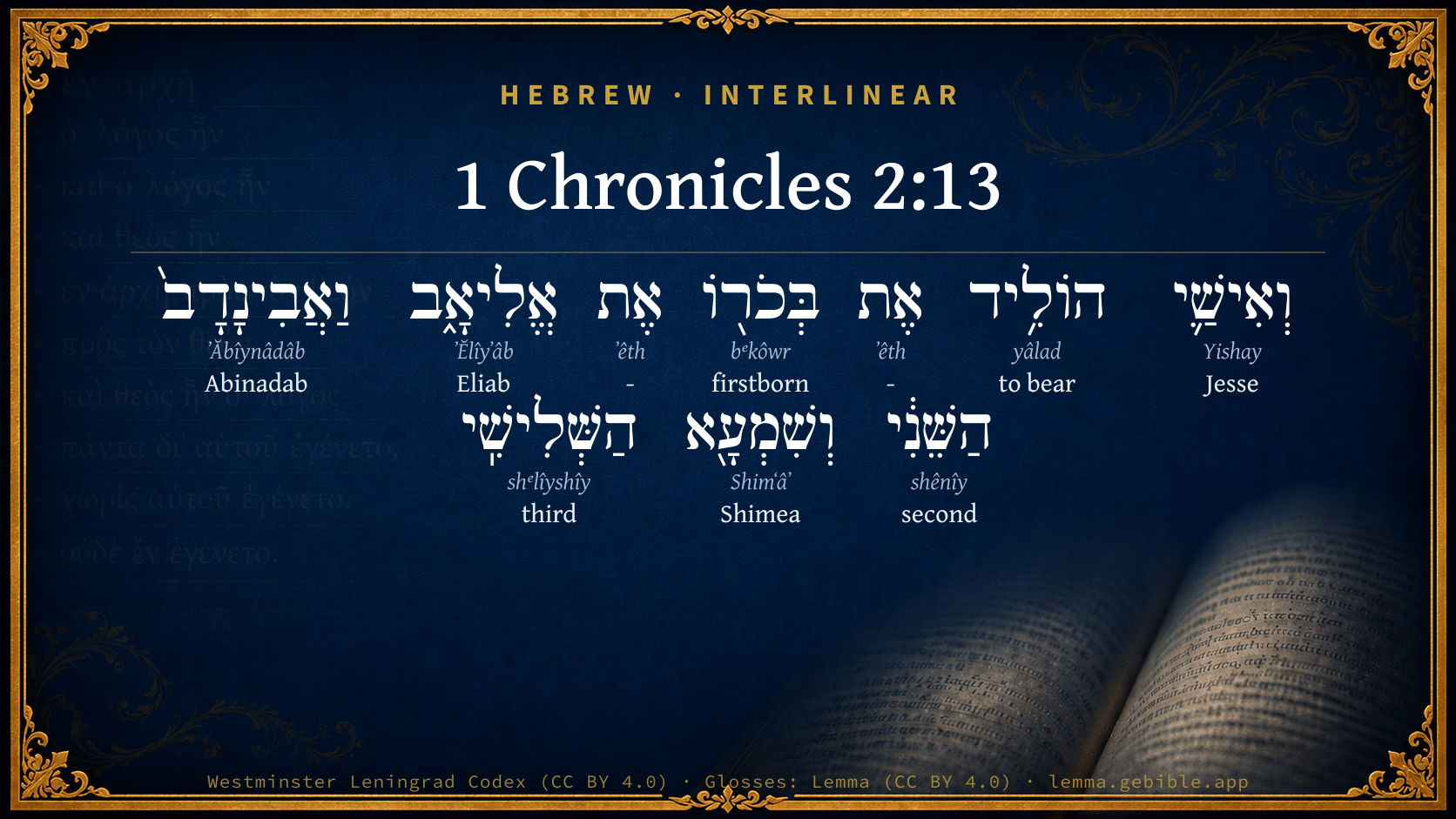
  1. וְאִישַׁ֛י Yishay H3448 “and · Jesse” Conjunction + Noun, Proper
  2. הוֹלִ֥יד yâlad H3205 “to bear” Verb, Hiphil, Perfect, 3rd Person, Masculine, Singular
  3. אֶת ʼêth H853 “-” Particle, Direct Object
  4. בְּכֹר֖וֹ bᵉkôwr H1060 “firstborn · his” Noun, Common, Masculine, Singular, Construct + Suffix, Personal, 3rd Person, Masculine, Singular
  5. אֶת ʼêth H853 “-” Particle, Direct Object
  6. אֱלִיאָ֑ב ʼĔlîyʼâb H446 “Eliab” Noun, Proper
  7. וַאֲבִינָדָב֙ ʼĂbîynâdâb H41 “and · Abinadab” Conjunction + Noun, Proper
  8. הַשֵּׁנִ֔י shênîy H8145 “the · second” Particle, Definite Article + Adjective, Ordinal number, Masculine, Singular, Absolute
  9. הַשְּׁלִישִֽׁי shᵉlîyshîy H7992 “the · third” Particle, Definite Article + Adjective, Ordinal number, Masculine, Singular, Absolute

About this verse

These counts appear in no published source. They are computed here, from the morphology-tagged text and Lemma’s own curated glosses. What Lemma adds →

10
words
9
distinct lemmas
Historical
section

Notable vocabulary

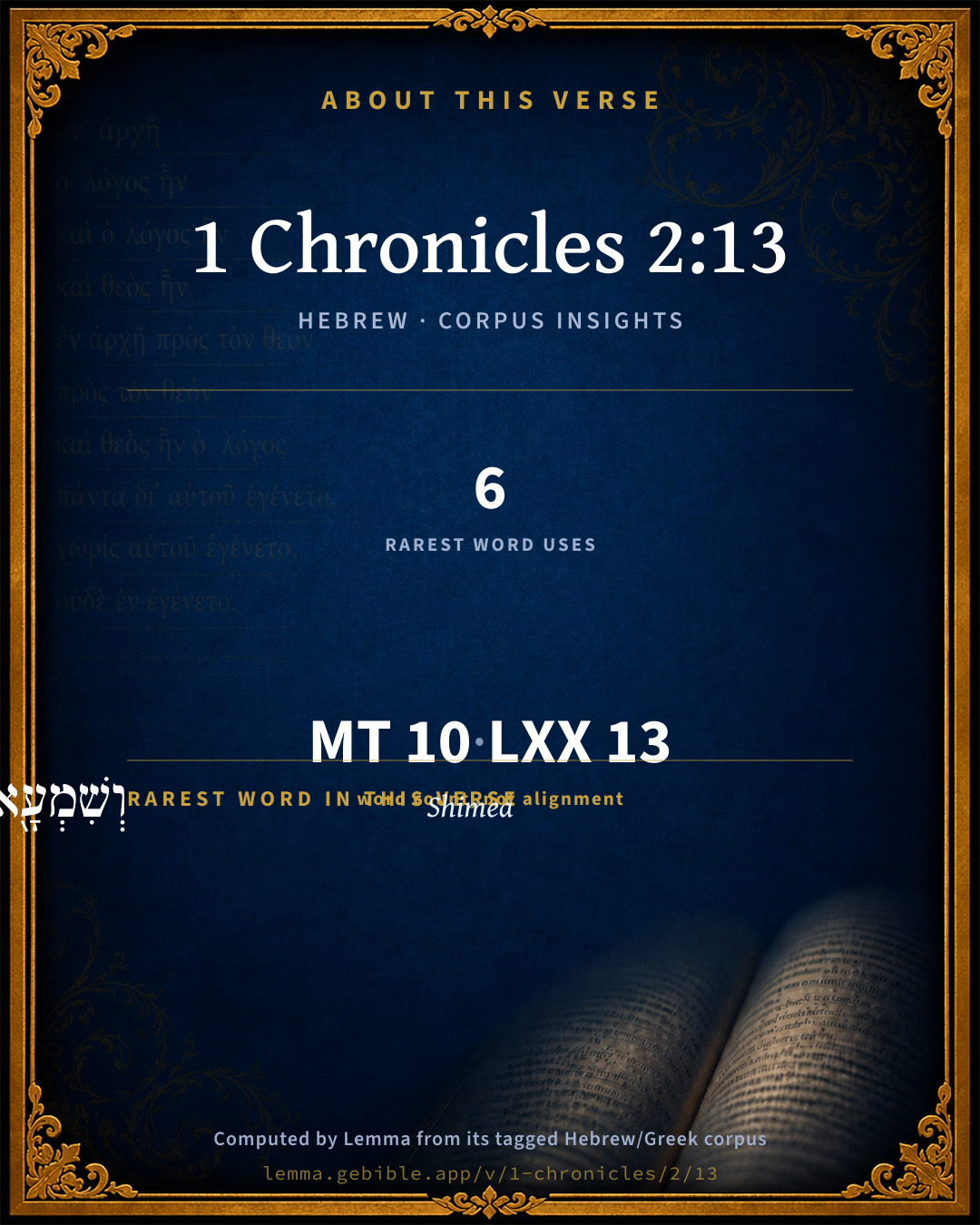
The rarest word here is וְשִׁמְעָ֖א Shimea H8092 — appearing just 6 times in the whole Hebrew Bible.

Shared distinctive vocabulary

וְשִׁמְעָ֖א Shimea H8092 occurs in 6 verses of the Hebrew Bible. Also found in:

Grammatical profile

  • 1 verb
  • 5 nouns
  • 2 adjectives
  • 2 particles

Verb forms

  • הוֹלִ֥יד Hiphil · Perfect

Hebrew & Septuagint length

In English translation the verse runs 17 words from the Hebrew and 13 from the Septuagint (LXX English) — closely comparable.

A rough comparison of the two English renderings, which tokenize alike — not a word-level alignment.

Word counts can differ between the Hebrew and the Greek without any difference in meaning — e.g. the Hebrew direct-object marker אֵת has no separate Greek word, and Greek often adds the article ὁ.

In the original languages it is 10 Hebrew tokens and 13 Greek tokens — but the two are counted differently (Hebrew bundles its prefixes and suffixes into one token; the Greek is in lemma form), so that isn’t a like-for-like length.

Cross-references

5

Topical passages linked to 1 Chronicles 2:13 in the Treasury of Scripture Knowledge — connected by theme and wording, ordered by reader-vote popularity; previews shown in the World English Bible.

  • 1 Samuel 17:13 The three eldest sons of Jesse had gone after Saul to the battle: and the names of his three sons who went to the battle were Eliab the firstborn, and next to him Abinadab, and the third Shammah.
  • 1 Samuel 16:6–13 It happened, when they had come, that he looked at Eliab, and said, Surely Yahweh's anointed is before him.
  • 1 Samuel 17:28 Eliab his eldest brother heard when he spoke to the men; and Eliab's anger was kindled against David, and he said, Why are you come down? and with whom have you left those few sheep in the wilderness? I know your pride, and the naughtiness of your heart; for you have come down that you might see the battle.
  • 1 Chronicles 20:7 When he defied Israel, Jonathan the son of Shimea David's brother killed him.
  • 1 Chronicles 27:18 of Judah, Elihu, one of the brothers of David: of Issachar, Omri the son of Michael:

Cross-references courtesy of OpenBible.info (CC BY 4.0).

Hebrew and Greek witnesses Masoretic Hebrew ↔ Greek Septuagint

The same verse in the two great witnesses to the Old Testament, shown verse-for-verse.

These are two independent witnesses, not word-aligned to each other, and the Septuagint is shown in lemma (dictionary) form.

Hebrew 1 Chronicles 2:13 Masoretic · Westminster Leningrad Codex

וְאִישַׁ֛י הוֹלִ֥יד אֶת בְּכֹר֖וֹ אֶת אֱלִיאָ֑ב וַאֲבִינָדָב֙ הַשֵּׁנִ֔י וְשִׁמְעָ֖א הַשְּׁלִישִֽׁי

and Jesse became the father of his firstborn Eliab, and Abinadab the second, and Shimea the third,

World English Bible · Public Domain

Greek LXX 1 Chronicles 2:13 Septuagint · lemma form

καί ιεσσαι γεννάω ὁ πρωτότοκος αὐτός ελιαβ αμιναδαβ ὁ δεύτερος σαμαα ὁ τρίτος

And Jessae begot his firstborn Eliab, Aminadab was the second, Samaa the third,

LXX2012 (modern English Septuagint) · Public Domain

On this verse, The Pulpit Commentary discusses the Septuagint’s reading. Read the note in Commentary ↓

Hebrew: Westminster Leningrad Codex (CC BY 4.0). Greek: Septuagint (public domain); English from LXX2012 (modern English Septuagint) (Public Domain). How the Septuagint differs from the Hebrew →

Commentary

Notes on 1 Chronicles 2:13 from classic Christian and Jewish commentators (each source and its license shown beneath its notes). The classic Christian expositions comment on the surrounding passage and are grouped to its opening verse, so a note may address several verses; the Jewish commentaries on the Tanakh (Rashi and others) are per-verse, so they appear only where the commentator wrote on this verse.

Lemma curates 59 commentaries, every one of them public domain or Creative Commons licensed, each selected and text-cleaned for this edition rather than reprinted as found. About our sources →

Joseph Benson's Commentary

1Ch 2:13-15. Eliab — Called also Elihu, 1Ch 27:18, unless that was another son of Jesse, as some think, not mentioned elsewhere; which would make the number to be eight, according to 1Sa 16:10; 1Sa 17:12. Or that Elihu, although there called the brother of David, might perhaps only be his kinsman, according to the usual language of Scripture. David the seventh — David was certainly the youngest son of Jesse, 1Sa 16:11. And if, as seems probable, one of them died soon after the time when they were said to he eight, he would of course be reckoned as the seventh.

Joseph Benson's Commentary on the Old and New Testaments (1811–1818) — public domain. Text from a community e-Sword module.

Geneva Bible (1599)

Geneva Bible translators

Or, Shammah.

Geneva Bible (1599) marginal notes — public domain. Text via Bolls.life.

The Cambridge Bible for Schools and Colleges

gen. ed. J. J. S. Perowne

13. Shimma] R.V. Shimea, as in 1Ch_20:7. His name is written “Shammah” in 1Sa_16:9. In 2Sa_21:21 “Shimei” (R.V.).

The Cambridge Bible for Schools and Colleges (gen. ed. J. J. S. Perowne; Cambridge University Press, 1878–1918) — public domain. Text from a community e-Sword module.

John Gill's Exposition

And when Azubah was dead, Caleb took unto him Ephrath,.... The Targum is, "Miriam, who was called Ephrath"; but, according to Josephus (q), it was his son Hur that was the husband of Miriam the sister of Moses:

which bare him Hur; See Gill on Exo 17:10.

(q) Antiqu. l. 3. c. 2.

John Gill's Exposition of the Whole Bible (1746–1763) — public domain (CC PDM 1.0). Text via the HelloAO Bible API.

Matthew Poole's English Annotations

Eliab, called also Elihu. 1Ch 27:18 unless that was another person, and the word brother to be taken largely for a kinsman, as is frequently used.

Matthew Poole's English Annotations on the Holy Bible (1683–1685) — public domain. Text from a community e-Sword/MySword module.

The Pulpit Commentary

Vers. 13-15 give us what we have not elsewhere, the names of the fourth, fifth, and sixth sons of Jesse, viz. Nathaneel, Raddai, (but see 1Ki_1:8) and Ozem. But, on the other hand, they make it appear that David was the seventh of seven, instead of (1Sa_14:10, 11 17:12) the eighth of eight sons. The missing son, any way, belongs to the seventh place. The Syriac and Arabic versions have taken the Elihu of 1Ch_27:18, and put him in this place. Others, following the Septuagint, suppose this Elihu, if strictly a brother of David, to be Eliab, the oldest. The explanation of the absence of the name here may be that he died early and without issue, and would accordingly be the less wanted in a genealogical register. The character of Jesse.

Biographies usually make much of the parental connections and ancestral relations of their hero. It is even discussed whether the special genius of a person is to be traced to his father or to his mother. In the earlier Scriptures the mother"s name and character are seldom given (exceptions may be found in the cases of Sarah, Rebekah, and Hannah); but in the time of the later kings the mother"s name is preserved with care. The importance of hereditary connections may concern both the intellectual forces of the mind and the moral qualities making up the character. There is the heritage of goodness as well as of greatness; and, therefore, St. Paul thanks God that Timothy stands in the third generation of marked faith and. (2Ti_1:5) Almost nothing is known of the mother of David, and the absence of information has led to strange conjecture; Dean Stanley curiously suggesting that she may have been previously a wife or concubine of one Nahash, possibly an Ammonite king, who under some circumstances not detailed became a second wife of Jesse, and by him the mother of David. All that the narrative suggests is that David was much younger than his brothers, and the child of Jesse"s old age. He is introduced to us as conversing with Samuel on the occasion of the anointing of David; (1Sa 16) as caring for the wants of his children while they were away from homo in the army of Saul; (1Sa 17) and as the object of David"s special care when the personal enmity of Saul put his relatives, as well as David himself, in peril. (1Sa_22:3, 1Sa_22:4) The incident in which the personal character of Jesse is most fully indicated is that of sending David with a present to his sons in the army; and this suggests that he was a thoughtful and affectionate father, and permits us to trace something of David"s remarkable family affection to his paternity. He may therefore serve to introduce the subject of paternal relationships and duties, and the rewards which those may find in the career and virtue of their children who have not been themselves remarkable for anything save for being good fathers. The Divine recognition of faithfulness in this precise office and relation is indicated in God"s commendation of Abraham, (Gen_18:19) "For I know him, that he will command his children and his household after him, and they shall keep the way of the Lord.

I FATHERLY LOVE FINDS FITTING EXPRESSION IN WISE RULE AND RESTRAINTS. Jesse seems to have had such authority. His sons, though of full age, promptly come and go at his bidding. He appears to have had his household fully under control, appointing each member his place and work. The well-being of families depends on the firmness of the father"s rule. The first conceptions of right, and of the duties of submission and obedience, happily come to us associated with our reverence for, and affection for, our father. And worthy fulfilment, in this respect, of the paternal duties carries to our children worthy ideas of the righteousness and love of "our Father who is in heaven.

II FATHERLY LOVE CAN MAKE HIGH SACRIFICES. Illustrated in Jesse"s sending his sons to the army in the time of national peril. How much he felt their danger is seen in his anxiety to know of their welfare while on the battle-field. Such sacrifices have often been required of parents in times of national danger, and similar sacrifices in quieter spheres, especially in devoting sons to missionary work. Show that to the true parent such sacrifices are made with mingled feelings of joy and sorrow.

III FATHERLY LOVE FINDS ITS REWARD IN THE CHILDREN"S CARE; as Jesse"s life was saved by David when Saul"s enmity put the family in peril. Loving children have no greater joy than that of caring for and tending their aged parents who have toiled and suffered so much and so long for them. See our Lord"s care of his mother from his cross. R.T.

The Pulpit Commentary (1880–1919), ed. H.D.M. Spence-Jones & Joseph S. Exell — public domain. Text from a community e-Sword module.

John Wesley's Explanatory Notes

Eliab - Called also Elihu, chap. xxvii, 18, unless that was another person, and the word brother be taken more largely for a kinsman, as it is frequently.

John Wesley, Explanatory Notes Upon the Whole Bible (1754–1765) — public domain. Text via the GEBible commentary corpus.

Keil & Delitzsch

C. F. Keil & F. Delitzsch

And when Azubah was dead, Caleb took unto him Ephrath,.... The Targum is, "Miriam, who was called Ephrath"; but, according to Josephus (q), it was his son Hur that was the husband of Miriam the sister of Moses:

which bare him Hur; See Gill on Exo 17:10.

(q) Antiqu. l. 3. c. 2.

Keil & Delitzsch — Biblical Commentary on the Old Testament (1861–1891) — public domain (CC PDM 1.0). Text via the HelloAO Bible API. (Old Testament only.)

Scofield Reference Notes

C. I. Scofield

Shimma

Or, Shammah, 1Sa 16:9.

The Scofield Reference Bible (1917 edition), notes by C. I. Scofield — public domain. Text from a community e-Sword module.

unfoldingWord translationNotes

Door43 World Missions Community

General Information:

All of the names here are names of men. (See: How to Translate Names)

the second ... the third ... the fourth ... the fifth ... the sixth ... the seventh

The word "son" is understood. Also, the numbers are in ordinal form. AT: "the second son ... the third son ... the fourth son ... the fifth son ... the sixth son ... the seventh son" (See: Ellipsis and Ordinal Numbers)

translationWords

David

unfoldingWord translationNotes — © Distant Shores Media and the Door43 World Missions Community, licensed CC BY-SA 4.0. Source: git.door43.org/Door43/en_tn.

Rashi

Rabbi Shlomo Yitzchaki (Rashi)

And Ishai begot his firstborn This is written with the plene spelling, with an “aleph,” meaning that he was a man (אִישׁ), a mighty warrior.

Rashi on the Tanakh — English translations: “The Judaica Press complete Tanach with Rashi, translated by A. J. Rosenberg” (CC BY 4.0); “Pentateuch with Rashi's commentary by M. Rosenbaum and A.M. Silbermann, 1929-1934” (public domain); “The Metsudah Tanach series, Lakewood, N.J” (CC BY 4.0); and “The Book of Joshua, Metsudah Publications, 1997” (CC BY 4.0). Text via Sefaria.

Lesson kit

Teaching starters — assembled from the data on this page, not authored interpretation. Every prompt links to the verse data it draws on. Edit before teaching.

1 Chronicles, in the Historical, opens this verse with 10 words (9 distinct Hebrew lemmas). Its most distinctive word is Shimʻâʼ (“Shimea”). A historical commentator’s framing appears above. Read the whole chapter for the surrounding context.

Discussion questions

  1. How does “Shimea” (Shimʻâʼ) shape what this verse is saying?
  2. How does 2 Samuel 21:21, which shares the word «Shimea», read alongside this verse?
  3. These translations render this verse differently; the difference is in the English rendering, not the original. What questions does that raise?
  4. «הוֹלִ֥יד» is a Hiphil Perfect verb. How does that grammatical form shape the action described?
  5. Compare how Joseph Benson's Commentary and Geneva Bible (1599) read this verse. Where do they agree or differ?

Things to notice

Reading settings

Reading text

Shown beneath each verse's original-language words.

Old Testament
Old Testament edition

Read the OT as the Masoretic Hebrew (MT) or the Greek Septuagint (LXX).

English shown for the Greek Septuagint (in the Hebrew ↔ Greek comparison).

Comparing translations? Open the Compare panel on any verse page to stack up to four side by side.