Numbers 26:5

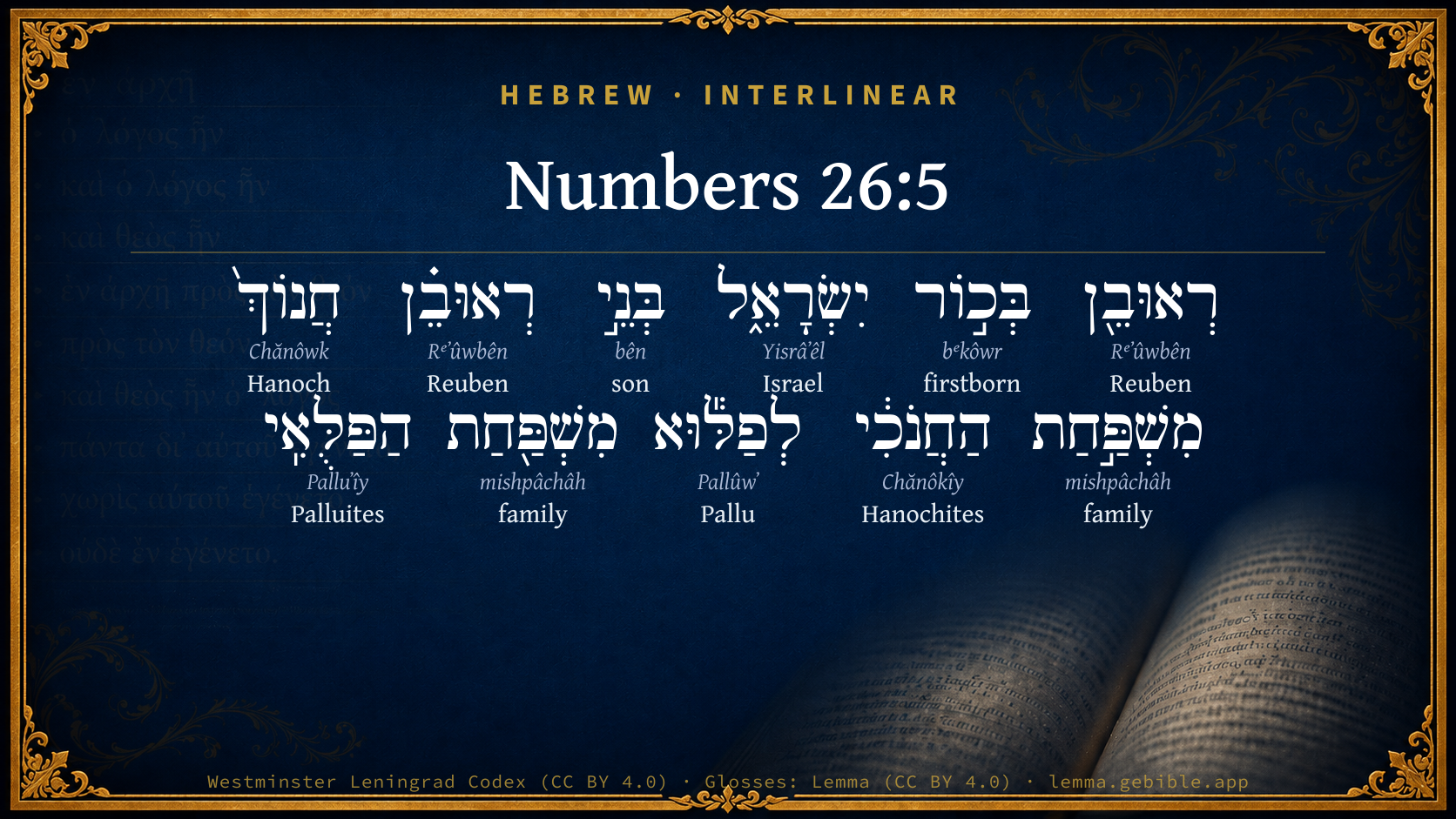
Hebrew (Westminster Leningrad Codex) Numbers 26:5 appears in the Hebrew Old Testament. The text above is from the Westminster Leningrad Codex. Each word links to its Strong’s number, a concise gloss, and parsing drawn from the Open Scriptures Hebrew Bible morphology. Click any word for its full Brown-Driver-Briggs (BDB) entry.
Download image
Cite this verse

Numbers 26:5 (World English Bible). Public Domain. Lemma interlinear Bible study tool, https://lemma.gebible.app/v/numbers/26/5.

Show BibTeX & RIS
BibTeX
RIS
English Translation
Reuben, the firstborn of Israel; the sons of Reuben: [of] Hanoch, the family of the Hanochites; of Pallu, the family of the Palluites;
World English Bible · Public Domain
Highlights
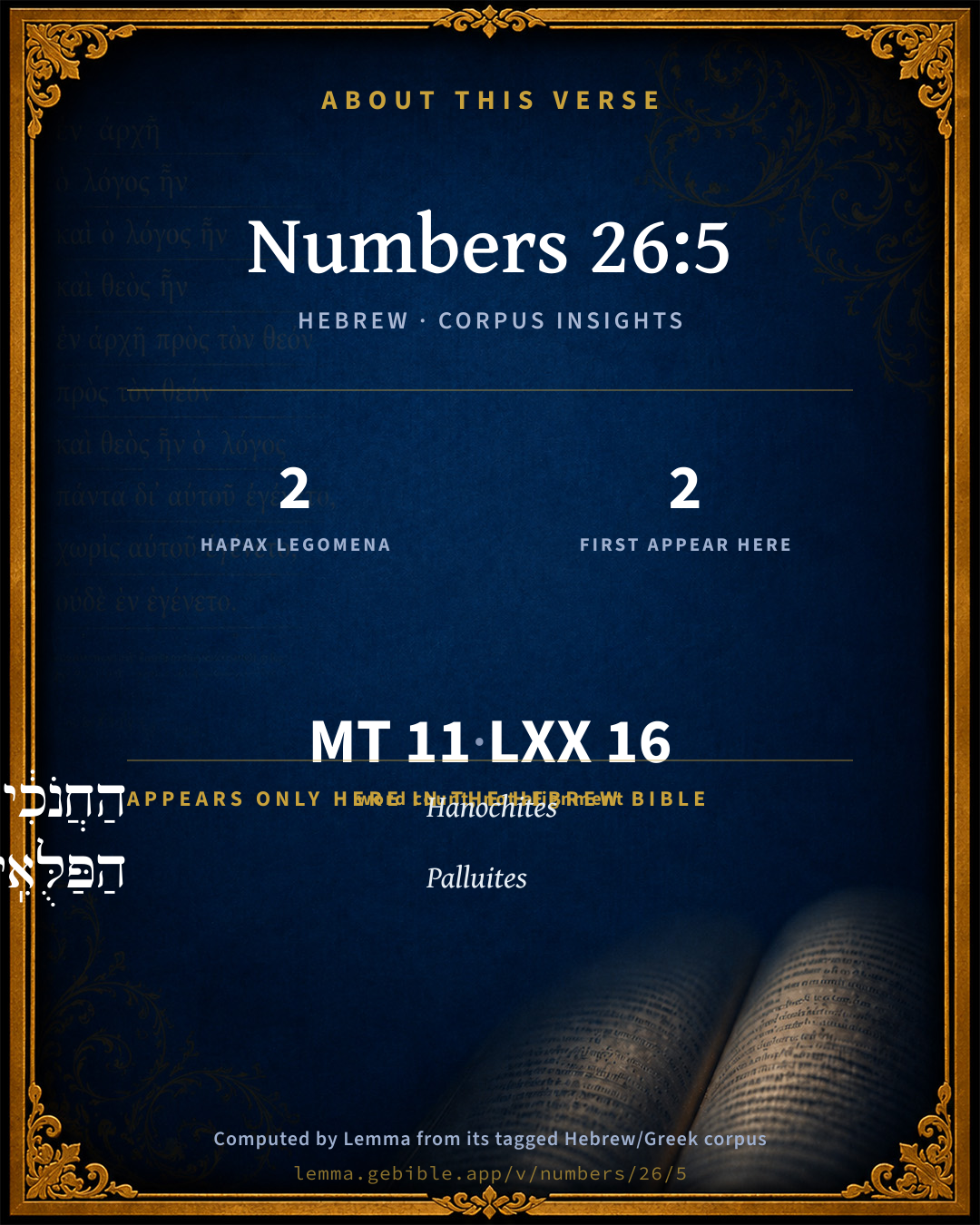
  • 2 hapax legomena — only here in the Hebrew Bible
  • 2 first appearances in the Hebrew Bible
Full analysis ↓
Download a study sheet

One document with this verse’s original text, its word-by-word gloss line, the meaning frame, cross-references with their text, attributed commentary, and full source and license credits — printable, and it pastes into notes with its structure intact.

This verse Autodidact and up

Study sheet (.html) Plain text (.txt)

A passage Seminary Student

Up to 50 verses in one chapter. A passage sheet keeps up to 6 commentary sources and 12 cross-references per verse, in the order this page ranks them, and says so on the sheet whenever that leaves anything out. Ask for a single verse and you get the Autodidact verse sheet above.

Everything on this page stays free to read, with no account — the sheet is a download of what is already on screen, not access to it.

Want to remove ads? Support Godless Engineer
Compare translations 3

The same verse in 3 English versions, stacked beneath the original-language interlinear above. Click any original word for its lexicon entry.

Each is an independent rendering of the whole verse — the interlinear is not word-aligned to these translations.

Highlighted words mark where these versions differ — a whole-verse word diff, not a word-by-word alignment.

  • World English Bible Public Domain
    Reuben, the firstborn of Israel; the sons of Reuben: [of] Hanoch, the family of the Hanochites; of Pallu, the family of the Palluites;
  • King James Version Public Domain
    Reuben, the eldest son of Israel: the children of Reuben; Hanoch, of whom cometh the family of the Hanochites: of Pallu, the family of the Palluites:
  • unfoldingWord Literal Text CC BY-SA 4.0
    Reuben was the firstborn of Israel. The sons of Reuben: Hanok, the clan of the Hanokite; of Pallu, the clan of the Palluite;

unfoldingWord Literal Text — © unfoldingWord, licensed CC BY-SA 4.0. Word-aligned USFM3 via Door43 (git.door43.org/unfoldingWord/en_ult).

Versions to compare (up to 4)

3 of 4 selected

Show all 18 translations

Every available English version of this verse, each an independent rendering of the whole verse.

  • World English Bible Public Domain
    Reuben, the firstborn of Israel; the sons of Reuben: [of] Hanoch, the family of the Hanochites; of Pallu, the family of the Palluites;
  • Berean Standard Bible Public Domain
    Reuben was the firstborn of Israel. These were the descendants of Reuben: The Hanochite clan from Hanoch, the Palluite clan from Pallu,
  • Majority Standard Bible Public Domain
    Reuben was the firstborn of Israel. These were the descendants of Reuben: The Hanochite clan from Hanoch, the Palluite clan from Pallu,
  • King James Version Public Domain
    Reuben, the eldest son of Israel: the children of Reuben; Hanoch, of whom cometh the family of the Hanochites: of Pallu, the family of the Palluites:
  • American Standard Version (1901) Public Domain
    Reuben, the first-born of Israel; the sons of Reuben: `of' Hanoch, the family of the Hanochites; of Pallu, the family of the Palluites;
  • Revised Version (1885) Public Domain
    Reuben, the firstborn of Israel: the sons of Reuben; of Hanoch, the family of the Hanochites: of Pallu, the family of the Palluites:
  • Geneva Bible (1599) Public Domain
    Reuben the first borne of Israel: the children of Reube were: Hanoch, of whom came the familie of the Hanochites, and of Pallu the familie of the Palluites:
  • Douay-Rheims (1899) Public Domain
    Ruben the firstborn of Israel. His sons were Henoch, of whom is the family of the Henochites: and Phallu, of whom is the family of the Phalluites:
  • Young's Literal Translation Public Domain
    Reuben, first-born of Israel -- sons of Reuben: `of' Hanoch `is' the family of the Hanochite; of Pallu the family of the Palluite;
  • Literal Standard Version CC BY-SA 4.0
    Reuben, firstborn of Israel—sons of Reuben: of Enoch [is] the family of the Enochite; of Pallu the family of the Palluite;
  • Unlocked Literal Bible CC BY-SA 4.0
    Reuben was the firstborn of Israel. From his son Hanok came the clan of the Hanokites. From Pallu came the clan of the Palluites.
  • unfoldingWord Literal Text CC BY-SA 4.0
    Reuben was the firstborn of Israel. The sons of Reuben: Hanok, the clan of the Hanokite; of Pallu, the clan of the Palluite;
  • Darby Bible Public Domain
    Reuben, the firstborn of Israel: the children of Reuben: [of] Enoch, the family of the Enochites; of Pallu, the family of the Palluites;
  • World Messianic Bible Public Domain
    Reuben, the firstborn of Israel; the sons of Reuben: of Hanoch, the family of the Hanochites; of Pallu, the family of the Palluites;
  • Webster's Bible Public Domain
    Reuben the eldest son of Israel: the children of Reuben; Hanoch, of whom cometh the family of the Hanochites: Of Phallu, the family of the Phalluites:
  • Free Bible Version CC BY-SA 4.0
    These were the descendants of Reuben, Israel's firstborn: Hanoch, ancestor of the Hanochite family; Pallu, ancestor of the Palluite family;
  • Bible in Basic English Public Domain
    Reuben, the first son of Israel: the sons of Reuben by their families: of Hanoch, the family of the Hanochites: of Pallu, the family of the Palluites:
  • JPS Tanakh (1917) Public Domain
    Reuben, the first-born of Israel: the sons of Reuben: of Hanoch, the family of the Hanochites; of Pallu, the family of the Palluites;

Literal Standard Version (2020), Covenant Press — licensed CC BY-SA 4.0. Text via the HelloAO Bible API (eBible.org). Unlocked Literal Bible (unfoldingWord) — licensed CC BY-SA 4.0. Text via the HelloAO Bible API (eBible.org). unfoldingWord Literal Text — © unfoldingWord, licensed CC BY-SA 4.0. Word-aligned USFM3 via Door43 (git.door43.org/unfoldingWord/en_ult). Free Bible Version, Dr. Jonathan Gallagher — licensed CC BY-SA 4.0. Text via the HelloAO Bible API (eBible.org).

Word by word

More ways to search: Search by grammar → Find every occurrence → Compare this word →

Practice this passage: Drill this verse → Learn its vocabulary →

הַחֲנֹכִ֔י
Chănôkîy
H2599
“the · Hanochites”
Particle, Definite Article + Noun, Gentilic, Masculine, Singular, Absolute
Part of Speech
Particle + Noun
Type
Gentilic
Gender
Masculine
Number
Singular
State
Absolute
Full BDB Definition

Origin: from H2585

TWOT: None

Hanochites = see Hanoch " dedicated" - descendants of Hanoch
  1. רְאוּבֵ֖ן Rᵉʼûwbên H7205 “Reuben” Noun, Proper
  2. בְּכ֣וֹר bᵉkôwr H1060 “firstborn of” Noun, Common, Masculine, Singular, Construct
  3. יִשְׂרָאֵ֑ל Yisrâʼêl H3478 “Israel” Noun, Proper
  4. בְּנֵ֣י bên H1121 “sons of” Noun, Common, Masculine, Plural, Construct
  5. רְאוּבֵ֗ן Rᵉʼûwbên H7205 “Reuben” Noun, Proper
  6. חֲנוֹךְ֙ Chănôwk H2585 “Hanoch” Noun, Proper
  7. מִשְׁפַּ֣חַת mishpâchâh H4940 “family of” Noun, Common, Feminine, Singular, Construct
  8. לְפַלּ֕וּא Pallûwʼ H6396 “to/for · Pallu” Preposition + Noun, Proper
  9. מִשְׁפַּ֖חַת mishpâchâh H4940 “family of” Noun, Common, Feminine, Singular, Construct
  10. הַפַּלֻּאִֽי Palluʼîy H6384 “the · Palluites” Particle, Definite Article + Noun, Gentilic, Masculine, Singular, Absolute

About this verse

These counts appear in no published source. They are computed here, from the morphology-tagged text and Lemma’s own curated glosses. What Lemma adds →

11
words
9
distinct lemmas
Pentateuch
section

Notable vocabulary

2 hapax legomena — words that appear only here in the entire Hebrew Bible:

  • הַחֲנֹכִ֔י Hanochites H2599
  • הַפַּלֻּאִֽי Palluites H6384

First appearance in Scripture

These words make their first canonical appearance in the Hebrew Bible here:

  • הַחֲנֹכִ֔י Hanochites H2599
  • הַפַּלֻּאִֽי Palluites H6384

Shared distinctive vocabulary

לְפַלּ֕וּא Pallu H6396 occurs in 5 verses of the Hebrew Bible. Also found in:

Grammatical profile

  • 11 nouns

Repetition

Words recur within this verse — often emphatic in Hebrew:

  • רְאוּבֵ֖ן Reuben H7205 ×2
  • מִשְׁפַּ֣חַת family H4940 ×2

Hebrew & Septuagint length

In English translation the verse runs 23 words from the Hebrew and 25 from the Septuagint (LXX English) — closely comparable.

A rough comparison of the two English renderings, which tokenize alike — not a word-level alignment.

Word counts can differ between the Hebrew and the Greek without any difference in meaning — e.g. the Hebrew direct-object marker אֵת has no separate Greek word, and Greek often adds the article ὁ.

In the original languages it is 11 Hebrew tokens and 16 Greek tokens — but the two are counted differently (Hebrew bundles its prefixes and suffixes into one token; the Greek is in lemma form), so that isn’t a like-for-like length.

Cross-references

6

Topical passages linked to Numbers 26:5 in the Treasury of Scripture Knowledge — connected by theme and wording, ordered by reader-vote popularity; previews shown in the World English Bible.

  • 1 Chronicles 5:3 the sons of Reuben the firstborn of Israel: Hanoch, and Pallu, Hezron, and Carmi.
  • Genesis 46:8–9 These are the names of the children of Israel, who came into Egypt, Jacob and his sons: Reuben, Jacob's firstborn.
  • Exodus 6:14 These are the heads of their fathers' houses. The sons of Reuben the firstborn of Israel: Hanoch, and Pallu, Hezron, and Carmi; these are the families of Reuben.
  • 1 Chronicles 5:1 The sons of Reuben the firstborn of Israel (for he was the firstborn; but, because he defiled his father's couch, his birthright was given to the sons of Joseph the son of Israel; and the genealogy is not to be reckoned after the birthright.
  • Genesis 29:32 Leah conceived, and bore a son, and she named him Reuben. For she said, "Because Yahweh has looked at my affliction. For now my husband will love me."
  • Genesis 49:2–3 Assemble yourselves, and hear, you sons of Jacob; Listen to Israel, your father.

Cross-references courtesy of OpenBible.info (CC BY 4.0).

Hebrew and Greek witnesses Masoretic Hebrew ↔ Greek Septuagint

The same verse in the two great witnesses to the Old Testament, shown verse-for-verse.

These are two independent witnesses, not word-aligned to each other, and the Septuagint is shown in lemma (dictionary) form.

Hebrew Numbers 26:5 Masoretic · Westminster Leningrad Codex

רְאוּבֵ֖ן בְּכ֣וֹר יִשְׂרָאֵ֑ל בְּנֵ֣י רְאוּבֵ֗ן חֲנוֹךְ֙ מִשְׁפַּ֣חַת הַחֲנֹכִ֔י לְפַלּ֕וּא מִשְׁפַּ֖חַת הַפַּלֻּאִֽי

Reuben, the firstborn of Israel; the sons of Reuben: [of] Hanoch, the family of the Hanochites; of Pallu, the family of the Palluites;

World English Bible · Public Domain

Greek LXX Numbers 26:5 Septuagint · lemma form

ρουβην πρωτότοκος ἰσραήλ υἱός δέ ρουβην ενωχ καί δῆμος ὁ ενωχ ὁ φαλλου δῆμος ὁ φαλλουι

Ruben was the firstborn of Israel: and the sons of Ruben, Enoch, and the family of Enoch; to Phallu belongs the family of the Phalluites.

LXX2012 (modern English Septuagint) · Public Domain

Hebrew: Westminster Leningrad Codex (CC BY 4.0). Greek: Septuagint (public domain); English from LXX2012 (modern English Septuagint) (Public Domain). How the Septuagint differs from the Hebrew →

Targum (Aramaic paraphrase)

2

The Targum is the ancient Jewish Aramaic paraphrase of the Hebrew Scriptures — an interpretive translation, not the Hebrew text itself. Onkelos (literal) and Pseudo-Jonathan (expansive) render the Torah, and Jonathan the Prophets. Coverage is partial: where no permissively-licensed English translation exists for a verse, only the Aramaic is shown. This is verse-level text, not a word-by-word alignment to the Hebrew.

  1. Targum Onkelos Torah (Genesis–Deuteronomy)
    רְאוּבֵן בּוּכְרָא דְיִשְׂרָאֵל בְּנֵי רְאוּבֵן חֲנוֹךְ זַרְעִית חֲנוֹךְ לְפַלוּא זַרְעִית פַּלוּא

    (no public-domain English translation for this verse)

    Targum Onkelos — Aramaic: “Onkelos Genesis” (public domain); “Onkelos Exodus” (public domain); “Onkelos Leviticus” (public domain); “Onkelos Numbers” (public domain); “Onkelos Deuteronomy” (public domain). English: “Sefaria Community Translation” (CC0 1.0 (public-domain dedication)); “J.W. Etheridge. The Targums of Onkelos and Jonathan Ben Uzziel on the Pentateuch. London: Longmans, Green, 1862” (public domain). Text via Sefaria.

  2. Targum Pseudo-Jonathan Torah (Genesis–Deuteronomy)
    רְאוּבֵן בּוּכְרָא דְיִשְרָאֵל בְּנוֹי דִרְאוּבֵן חֲנוֹךְ גְנִיסַת חֲנוֹךְ לְפַלוּא גְנִיסַת פַּלוּא

    Reuben, the first-born of Israel: the sons of Reuben, Hanok, the family of Hanok; of Phallu, the family of Phallu;

    Targum Pseudo-Jonathan — Aramaic: “Targum Jonathan on Genesis” (public domain); “Targum Jonathan on Exodus” (public domain); “Targum Jonathan on Leviticus” (public domain); “Targum Jonathan on Numbers” (public domain); “Targum Jonathan on Deuteronomy” (public domain). English: “The Targum of Jonathan ben Uzziel, trans. J. W. Etheridge, London, 1862” (public domain). Text via Sefaria.

Commentary

Notes on Numbers 26:5 from classic Christian and Jewish commentators (each source and its license shown beneath its notes). The classic Christian expositions comment on the surrounding passage and are grouped to its opening verse, so a note may address several verses; the Jewish commentaries on the Tanakh (Rashi and others) are per-verse, so they appear only where the commentator wrote on this verse.

Lemma curates 59 commentaries, every one of them public domain or Creative Commons licensed, each selected and text-cleaned for this edition rather than reprinted as found. About our sources →

Matthew Henry's Commentary

This is the register of the tribes as they were now enrolled, in the same order that they were numbered in ch. 1. Observe,

I. The account that is here kept of the families of each tribe, which must not be understood of such as we call families, those that live in a house together, but such as were the descendants of the several sons of the patriarchs, by whose names, in honour of them, their posterity distinguished themselves and one another. The families of the twelve tribes are thus numbered: - Of Dan but one, for Dan had but one son, and yet that tribe was the most numerous of all except Judah, Num 26:42, Num 26:43. Its beginning was small, but its latter end greatly increased. Zebulun was divided into three families, Ephraim into four, Issachar into four, Naphtali into four, and Reuben into four; Judah, Simeon, and Asher, had five families apiece, Gad and Benjamin seven apiece, and Manasseh eight. Benjamin brought ten sons into Egypt (Gen 46:21), but three of them, it seems either died childless or their families were extinct, for here we find seven only of those names preserved, and that whole tribe none of the most numerous; for Providence, in the building up of families and nations, does not tie itself to probabilities. The barren hath borne seven, and she that hath many children has waxed feeble, Sa1 2:5.

II. The numbers of each tribe. And here our best entertainment will be to compare these numbers with those when they were numbered at Mount Sinai. The sum total was nearly the same; they were now 1820 fewer than they were then; yet seven of the tribes had increased in number. Judah had increased 1900, Issachar 9900, Zebulun 3100, Manasseh 20,500, Benjamin 10,200, Dan 1700, and Asher 11,900. But the other five had decreased more than to balance that increase. Reuben had decreased 2770, Simeon 37,100, Gad 5150, Ephraim 8000, and Naphtali 8000. In this account we may observe, 1. that all the three tribes that were encamped under the standard of Judah, who was the ancestor of Christ, had increased, for his church shall be edified and multiplied. 2. That none of the tribes had increased so much as that of Manasseh, which in the former account was the smallest of all the tribes, only 32,200, while here it is one of the most considerable; and that of his brother Ephraim, which there was numerous, is here one of the least. Jacob had crossed hands upon their heads, and had preferred Ephraim before Manasseh, which perhaps the Ephraimites had prided themselves too much in, and had trampled upon their brethren the Manassites; but, when the Lord saw that Manasseh was despised, he thus multiplied him exceedingly, for it is his glory to help the weakest, and raise up those that are cast down. 3. That none of the tribes decreased so much as Simeon did; from 59,300, it such to 22,200, little more than a third part of what it was. One whole family of that tribe (namely Ohad, mentioned Exo 6:15) was extinct in the wilderness. Hence Simeon is not mentioned in Moses's blessing (Deu. 33), and the lot of that tribe in Canaan was inconsiderable, only a canton out of Judah's lot, Jos 19:9. Some conjecture that most of those 24,000 who were cut off by the plague for the iniquity of Peor were of that tribe; for Zimri, who was a ringleader in that iniquity, was a prince of that tribe, many of whom therefore were influenced by his example to follow his pernicious ways.

III. In the account of the tribe of Reuben mention is made of the rebellion of Dathan and Abiram, who were of that tribe, in confederacy with Korah a Levite, Num 26:9-11. Though the story had been largely related but a few chapters before, yet here it comes in again, as fit to be had in remembrance and thought of by posterity, whenever they looked into their pedigree and pleased themselves with the antiquity of their families and the glory of their ancestors, that they might call themselves a seed of evil doers. Two things are here said of them: - 1. That they had been famous in the congregation, Num 26:9. Probably they were remarkable for their ingenuity, activity, and fitness for business: - That Dathan and Abiram that might have been advanced in due time under God and Moses; but their ambitious spirits put them upon striving against God and Moses, and when they quarrelled with the one they quarrelled with the other. And what was the issue? 2. Those that might have been famous were made infamous: they became a sign, Num 26:10. They were made monuments of divine justice; God, in their ruin, showed himself glorious in holiness, and so they were set up for a warning to all others, in all ages, to take heed of treading in the steps of their pride and rebellion. Notice is here taken of the preservation of the children of Korah (Num 26:11); they died not, as the children of Dathan and Abiram did, doubtless because they kept themselves pure from the infection, and would not join, no, not with their own father, in rebellion. If we partake not of the sins of sinners, we shall not partake of their plagues. These sons of Korah were afterwards, in their posterity, eminently serviceable to the church, being employed by David as singers in the house of the Lord; hence many psalms are said to be for the sons of Korah: and perhaps they were made to bear his name so long after, rather than the name of any other of their ancestors, for warning to themselves, and as an instance of the power of God, which brought those choice fruits even out of that bitter root. The children of families that have been stigmatized should endeavour, by their eminent virtues, to roll away the reproach of their fathers.

Matthew Henry's Commentary on the Whole Bible (1708–1710) — public domain (CC PDM 1.0). Text via the HelloAO Bible API.

The Cambridge Bible for Schools and Colleges

gen. ed. J. J. S. Perowne

5–51. The twelve secular tribes are numbered, the sacred tribe of Levi being omitted. The names are based upon Gen_46:8-27, but with the addition of Ephraim and Manasseh, who, having been born in Egypt, could not be reckoned in Gen. among those who went down into Egypt.

The total number at the first census, thirty-eight years before (ch. 1) was 603,550; now it is 601,730. The order of the tribes is the same, except that Manasseh (Num_26:29-34) precedes Ephraim (Num_26:35-37). Reuben, Simeon, Gad, Ephraim and Naphtali have decreased in numbers, while the other seven have increased. The impossibility of the figures is shewn in note on Num_1:46.

The Cambridge Bible for Schools and Colleges (gen. ed. J. J. S. Perowne; Cambridge University Press, 1878–1918) — public domain. Text from a community e-Sword module.

John Gill's Exposition

Reuben, the eldest son of Israel,.... the number of his tribe is taken first on that account; there were four families that descended from him, the Hanochite, Palluite, Hesronite, and Carmite, and the number of men from twenty years old and upwards, fit for war, were 43,730; so that, since the last numbering, this tribe was decreased 2770; which may in part be accounted for by the families of Dathan and Abiram being cut off for their rebellion, who were this tribe, and whose affair is briefly related in the following verses, and it may be to point out this unto us.

Reuben, the eldest son of Israel,.... the number of his tribe is taken first on that account; there were four families that descended from him, the Hanochite, Palluite, Hesronite, and Carmite, and the number of men from twenty years old and upwards, fit for war, were 43,730; so that, since the last numbering, this tribe was decreased 2770; which may in part be accounted for by the families of Dathan and Abiram being cut off for their rebellion, who were this tribe, and whose affair is briefly related in the following verses, and it may be to point out this unto us.

Numbers 26:8

num 26:8

num 26:8

num 26:8And the sons of Pallu,.... Or son, the plural for the singular, Pallu having but one son, whose name was Eliab, the father of Dathan and Abiram; Num 26:9.

John Gill's Exposition of the Whole Bible (1746–1763) — public domain (CC PDM 1.0). Text via the HelloAO Bible API.

Albert Barnes' Notes on the Bible

Following The tribes are mentioned in the same order as in the earlier census Num. 1, except that Manasseh here precedes Ephraim; probably as being now the larger tribe.

The following table shows the numbers of the tribes at each census; at Sinai, and in the Plains of Moab:

At Sinai

Plains of Moab

Reuben

46,500

43,730

Simeon

9,300

22,200

Gad

45,650

40,500

Judah

74,600

76,500

Issachar

54,400

64,300

Zebulun

57,400

60,500

Ephraim

40,500

32,500

Manasseh

32,200

52,700

Benjamin

35,400

45,600

Dan

62,700

64,400

Asher

41,500

53,400

Naphtali

53,400

45,400

Totals

603, 550

601, 730

Seven of the tribes, of which three are tribes belonging to the camp of Judah, show an increase of numbers; and five, among whom are the three belonging to the camp of Reuben, show a decrease. The greatest increase of any one tribe is in Manasseh. The most remarkable decrease is in Simeon, which now shows less than half its former strength. To this tribe Zimri, the chief offender in the recent transgression, belonged Num 25:14. Probably his tribesmen generally had followed his example, and had accordingly suffered most severely in the plague. In the parting blessing of Moses, uttered at no great interval from this date, the tribe of Simeon alone is omitted.

The families of all the tribes, excluding the Levites, number 57. The ancestral heads after whom these families are named correspond nearly with the grandchildren and great-grandchildren of Jacob, enumerated in Gen 46:8 ff. Both lists consist mainly of grandchildren of Jacob, both contain also the same two grandchildren of Judah, and the same two grandchildren of Asher. The document in Genesis should be regarded as a list, not of those who went down in their own persons with Jacob into Egypt, but of those whose names were transmitted to their posterity at the date of the Exodus as the heads of Israelite houses, and wire may thus be reckoned the early ancestors of the people.

Albert Barnes' Notes on the Bible (1834–1885) — public domain. Text from a community e-Sword/MySword module.

Whedon's Commentary on the Bible

Daniel D. Whedon

5-9. Reuben, the eldest son — By Leah. Gen_29:32. The enumeration of the grandsons of Jacob in this chapter is important, since these are the basis of the tribal divisions, just as the tribes sprang from his sons. Hanoch, dedicated, is, in Hebrew, the same as Enoch, a name belonging to two other persons. There is no good reason for this twofold orthography. Nothing more is known of this Enoch. Pallu, eminent, spelled Phallu in Gen_46:9, is identified by Josephus with Peleth in Num_16:1. See note. Of Hezron and Carmi nothing is known.

The families of the Reubenites tally with Gen_46:9; Exo_6:14, and 1Ch_5:3. In Num_26:8 the word “sons” occurs where only one is mentioned, because the writer had in mind the grandsons named in Num_26:9.

Nemuel — Day of God — The record is interrupted expressly to admit a statement respecting his younger brothers,

Dathan and Abiram — See Num_16:1-33, notes.

Daniel D. Whedon (gen. ed.), Commentary on the Old and New Testaments (1874–1909) — public domain. Text from a community e-Sword module.

The Pulpit Commentary

The children of Reuben. The four names here registered as distinguishing families within the tribe of Reuben agree with the lists given in Gen_46:9 Exo_6:14 1Ch_5:3.

The Pulpit Commentary (1880–1919), ed. H.D.M. Spence-Jones & Joseph S. Exell — public domain. Text from a community e-Sword module.

unfoldingWord translationNotes

Door43 World Missions Community

General Information:

The leaders of Israel are counting the men, 20 years old and older, according to their tribes and families. (See: How to Translate Names and Numbers)

was the firstborn of Israel

Here "Israel" refers to the man also known as Jacob.

From his son

The word "his" refers to Rueben.

43,730 men

"forty-three thousand seven hundred and thirty men" (See: Numbers)

translationWords

Reuben

firstborn

Jacob

clan

descend

unfoldingWord translationNotes — © Distant Shores Media and the Door43 World Missions Community, licensed CC BY-SA 4.0. Source: git.door43.org/Door43/en_tn.

Rashi

Rabbi Shlomo Yitzchaki (Rashi)

משפחת החנכי THE FAMILY OF THE HANOCHITES — Because the heathen nations spoke slightingly of Israel, saying, “How can these trace their descent by their tribes? Do they think that the Egyptians did not overmaster their mothers? If they showed themselves master of their bodies, it is quite certain that they did so over those of their wives!”. On this account the Holy One, blessed be He, set His name upon them: the letter ה on one side of their name and the letter י on the other side (חנכיה), to intimate: I bear testimony for them that they are the sons of their reputed fathers (and not of the Egyptians) (Shir HaShirim Rabbah 4:12). This it is that is expressed by David, (Psalms 122:4) שבטי יה עדות לישראל: “that the tribes bear the name of the Lord (יה) is a testimony regarding Israel” — this Divine Name (יה) bears testimony regarding their tribes (i.e. that they rightly attach themselves to those tribes to which they claim to belong). On this account in the case of all of them it is written החנכי and הפלואי but in the case of ימנה (v. 44) it was not felt necessary to state “of the family of הימני”, because the Divine Name is already attached to it — the י at the beginning and the ה at the end (ימנה) (Yalkut Shimoni on Torah 773).

Rashi on the Tanakh — English translations: “The Judaica Press complete Tanach with Rashi, translated by A. J. Rosenberg” (CC BY 4.0); “Pentateuch with Rashi's commentary by M. Rosenbaum and A.M. Silbermann, 1929-1934” (public domain); “The Metsudah Tanach series, Lakewood, N.J” (CC BY 4.0); and “The Book of Joshua, Metsudah Publications, 1997” (CC BY 4.0). Text via Sefaria.

Ramban (Nachmanides)

Rabbi Moshe ben Nachman (Ramban / Nachmanides)

[REUBEN, THE FIRSTBORN OF ISRAEL: THE SONS OF REUBEN]: HANOCH, THE FAMILY OF THE HANOCHITES. Perhaps [the reason why the individual families of each tribe are mentioned here is that] when the Land was divided among the tribes [in equal parts] according to the opinion of our Rabbis, so that Simeon, the smallest of the tribes, took [a share] equal to that of Judah, the most populous of the tribes, it was also divided up [amongst each tribe itself] according to the number of families that went down to Egypt. Thus they made out of Reuben’s inheritance four [equal] parts [because it consisted of four main families: Hanoch, Pallu, Hezron, and Carmi], and the Hanochites received a share equal to that allotted to the Palluites, the Hezronites, and the Carmites, even though these [four families] were not all equal in the number of names … by their polls This is the reason here for counting [the people] in this manner, [namely] by counting the family according to those who went down to Egypt, and it does not mention [here] by their polls, even though it mentions the numbers [of each tribe] as a whole. And when Scripture states [here]: To the more thou shalt give the more inheritance, [and to the fewer thou shalt give the less inheritance, which seems to indicate that the Land was divided according to population, it refers to the [division amongst the] members of each [small] family, families of Reuben, despite differences in their respective populations. Likewise each of the twelve tribes, whether large in population, like Judah, or small like Simeon, received an equal share of the whole Land [that is, equal in value, although not in area] (Baba Bathra 122a). for each [of these minor families] received a share according to their numbers by their polls. It is for this reason that in the Book of Joshua [when speaking of] the division of the Land, it says according to their families, as is stated in the verse, And the lot for the tribe of the children of Judah ‘according to their families,’ and similarly in the case of all the other [tribes]. Or the meaning of [the phrase there] according to their families may be: “to ‘all’ the families of the tribe” [meaning that each minor family of each tribe was taken into account, according to the numbers of its individual members, as explained above]; or that they divided the Land according to their families, so that each family received its share in one place, so that it did not become mixed up with [that of] another family. This [latter interpretation] appears to me to be the correct one.

Ramban (Nachmanides) on the Tanakh — English translation: “Commentary on the Torah by Ramban (Nachmanides). Translated and annotated by Charles B. Chavel. New York, Shilo Pub. House, 1971-1976” (CC BY 4.0). Text via Sefaria.

Lesson kit

Teaching starters — assembled from the data on this page, not authored interpretation. Every prompt links to the verse data it draws on. Edit before teaching.

Numbers, in the Pentateuch, opens this verse with 11 words (9 distinct Hebrew lemmas). Its most distinctive word is Chănôkîy (“Hanochites”). A historical commentator’s framing appears above. Read the whole chapter for the surrounding context.

Discussion questions

  1. The word Chănôkîy carries the sense “Hanochites.” How does it shape the verse?
  2. 2 words here appear nowhere else in the Hebrew Bible. Why might the author reach for such rare wording?
  3. 2 words make their first appearance in Scripture here. What does this debut establish?
  4. How does Genesis 46:9, which shares the word «Pallu», read alongside this verse?
  5. What does the repetition of “Reuben” (2× in this one verse) do in this verse?
  6. The translations on this page render this verse differently — a whole-verse word diff, not a word-by-word alignment. What might account for the different wordings?
  7. Compare how Matthew Henry's Commentary and The Cambridge Bible for Schools and Colleges read this verse. Where do they agree or differ?

Things to notice

  • 2 words in this verse appear nowhere else in the Hebrew Bible.
  • 2 words make their first canonical appearance in Scripture here.
  • This verse counts 11 Hebrew ↔ 16 Greek words.
  • These translations choose different wording for 15 words in this verse.
  • “Reuben” occurs 2× in this single verse.

Reading settings

Reading text

Shown beneath each verse's original-language words.

Old Testament
Old Testament edition

Read the OT as the Masoretic Hebrew (MT) or the Greek Septuagint (LXX).

English shown for the Greek Septuagint (in the Hebrew ↔ Greek comparison).

Comparing translations? Open the Compare panel on any verse page to stack up to four side by side.