
Psalms 135:8

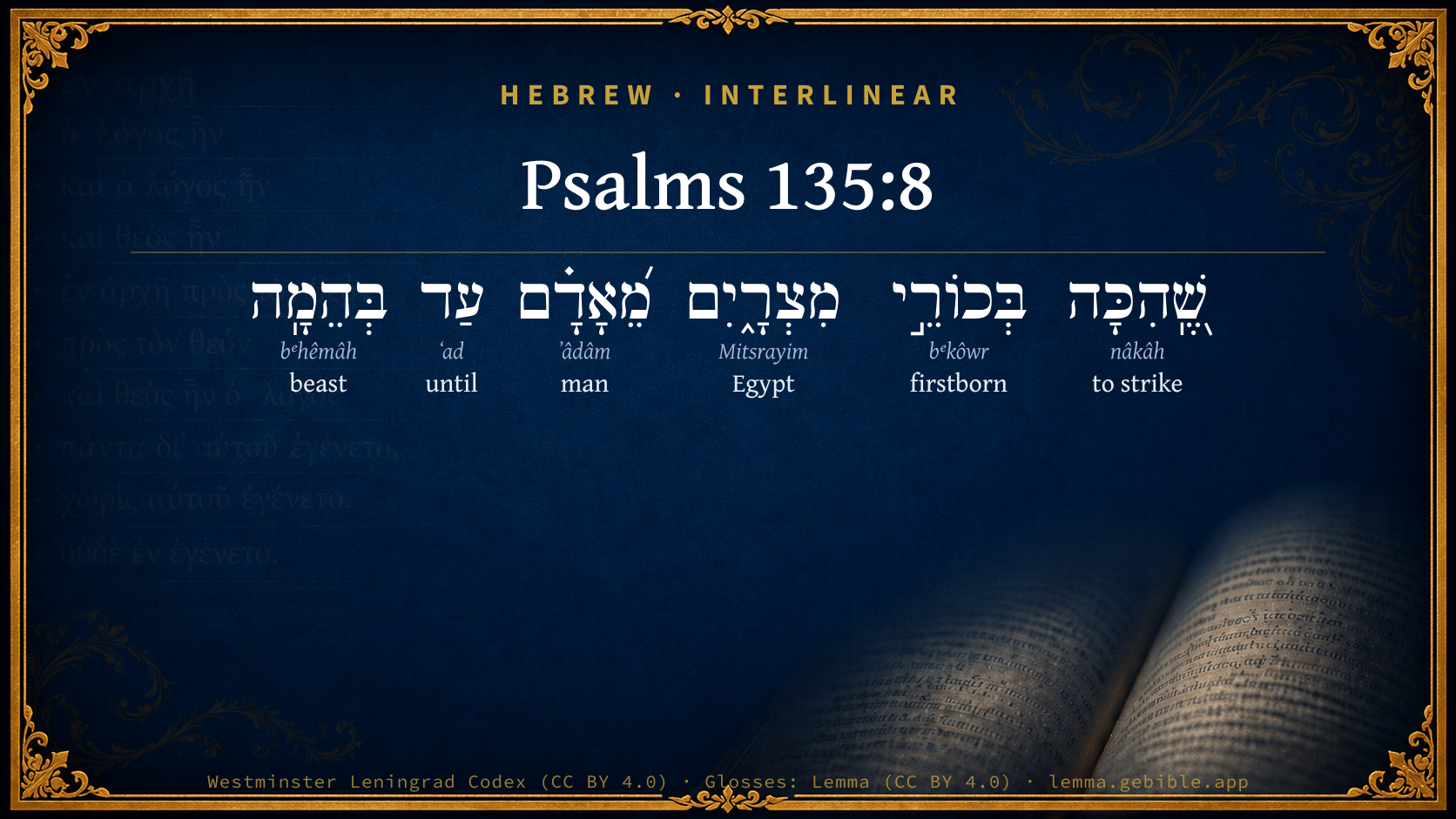
Hebrew (Westminster Leningrad Codex) Psalms 135:8 appears in the Hebrew Old Testament. The text above is from the Westminster Leningrad Codex. Each word links to its Strong’s number, a concise gloss, and parsing drawn from the Open Scriptures Hebrew Bible morphology. Click any word for its full Brown-Driver-Briggs (BDB) entry.
Download image
Cite this verse

Psalms 135:8 (World English Bible). Public Domain. Lemma interlinear Bible study tool, https://lemma.gebible.app/v/psalms/135/8.

Show BibTeX & RIS
BibTeX
RIS
English Translation
Who struck the firstborn of Egypt, Both of man and animal;
World English Bible · Public Domain
Download a study sheet

One document with this verse’s original text, its word-by-word gloss line, the meaning frame, cross-references with their text, attributed commentary, and full source and license credits — printable, and it pastes into notes with its structure intact.

This verse Autodidact and up

Study sheet (.html) Plain text (.txt)

A passage Seminary Student

Up to 50 verses in one chapter. A passage sheet keeps up to 6 commentary sources and 12 cross-references per verse, in the order this page ranks them, and says so on the sheet whenever that leaves anything out. Ask for a single verse and you get the Autodidact verse sheet above.

Everything on this page stays free to read, with no account — the sheet is a download of what is already on screen, not access to it.

Want to remove ads? Support Godless Engineer
Compare translations 3

The same verse in 3 English versions, stacked beneath the original-language interlinear above. Click any original word for its lexicon entry.

Each is an independent rendering of the whole verse — the interlinear is not word-aligned to these translations.

Highlighted words mark where these versions differ — a whole-verse word diff, not a word-by-word alignment.

  • World English Bible Public Domain
    Who struck the firstborn of Egypt, Both of man and animal;
  • King James Version Public Domain
    Who smote the firstborn of Egypt, both of man and beast.
  • unfoldingWord Literal Text CC BY-SA 4.0
    who struck the firstborn of Egypt, from man to beast.

unfoldingWord Literal Text — © unfoldingWord, licensed CC BY-SA 4.0. Word-aligned USFM3 via Door43 (git.door43.org/unfoldingWord/en_ult).

Versions to compare (up to 4)

3 of 4 selected

Show all 17 translations

Every available English version of this verse, each an independent rendering of the whole verse.

  • World English Bible Public Domain
    Who struck the firstborn of Egypt, Both of man and animal;
  • Berean Standard Bible Public Domain
    He struck down the firstborn of Egypt, of both man and beast.
  • Majority Standard Bible Public Domain
    He struck down the firstborn of Egypt, of both man and beast.
  • King James Version Public Domain
    Who smote the firstborn of Egypt, both of man and beast.
  • American Standard Version (1901) Public Domain
    Who smote the first-born of Egypt, Both of man and beast;
  • Revised Version (1885) Public Domain
    Who smote the firstborn of Egypt, both of man and beast.
  • Geneva Bible (1599) Public Domain
    He smote the first borne of Egypt both of man and beast.
  • Young's Literal Translation Public Domain
    Who smote the first-born of Egypt, From man unto beast.
  • Literal Standard Version CC BY-SA 4.0
    Who struck the firstborn of Egypt, || From man to beast.
  • Unlocked Literal Bible CC BY-SA 4.0
    He killed the firstborn of Egypt, both of man and animals.
  • unfoldingWord Literal Text CC BY-SA 4.0
    who struck the firstborn of Egypt, from man to beast.
  • Darby Bible Public Domain
    Who smote the firstborn of Egypt, both of man and beast;
  • World Messianic Bible Public Domain
    He struck the firstborn of Egypt, both of man and animal.
  • Webster's Bible Public Domain
    Who smote the first-born of Egypt, both of man and beast.
  • Free Bible Version CC BY-SA 4.0
    He struck down the firstborn of Egypt, both human and animal.
  • Bible in Basic English Public Domain
    He put to death the first-fruits of Egypt, of man and of beast.
  • JPS Tanakh (1917) Public Domain
    Who smote the first-born of Egypt, both of man and beast.

Literal Standard Version (2020), Covenant Press — licensed CC BY-SA 4.0. Text via the HelloAO Bible API (eBible.org). Unlocked Literal Bible (unfoldingWord) — licensed CC BY-SA 4.0. Text via the HelloAO Bible API (eBible.org). unfoldingWord Literal Text — © unfoldingWord, licensed CC BY-SA 4.0. Word-aligned USFM3 via Door43 (git.door43.org/unfoldingWord/en_ult). Free Bible Version, Dr. Jonathan Gallagher — licensed CC BY-SA 4.0. Text via the HelloAO Bible API (eBible.org).

Word by word

More ways to search: Search by grammar → Find every occurrence → Compare this word →

Practice this passage: Drill this verse → Learn its vocabulary →

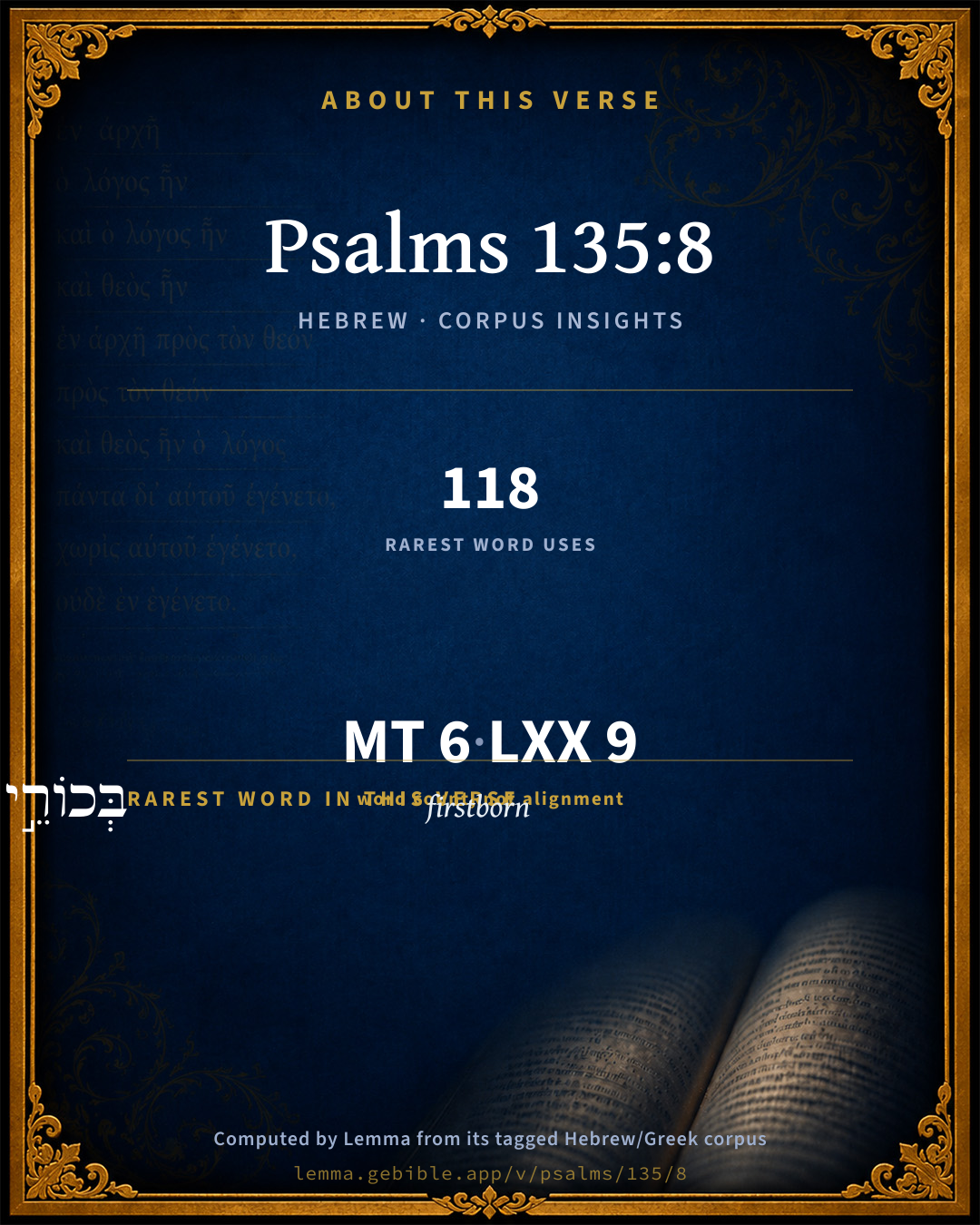
About this verse

These counts appear in no published source. They are computed here, from the morphology-tagged text and Lemma’s own curated glosses. What Lemma adds →

6
words
6
distinct lemmas
Wisdom
section

Grammatical profile

  • 1 verb
  • 4 nouns
  • 1 preposition

Verb forms

  • שֶֽׁ֭הִכָּה Hiphil · Perfect

Hebrew & Septuagint length

In English translation the verse runs 11 words from the Hebrew and 11 from the Septuagint (LXX English) — the same length.

A rough comparison of the two English renderings, which tokenize alike — not a word-level alignment.

Word counts can differ between the Hebrew and the Greek without any difference in meaning — e.g. the Hebrew direct-object marker אֵת has no separate Greek word, and Greek often adds the article ὁ.

In the original languages it is 6 Hebrew tokens and 9 Greek tokens — but the two are counted differently (Hebrew bundles its prefixes and suffixes into one token; the Greek is in lemma form), so that isn’t a like-for-like length.

Cross-references

6

Topical passages linked to Psalms 135:8 in the Treasury of Scripture Knowledge — connected by theme and wording, ordered by reader-vote popularity; previews shown in the World English Bible.

  • Psalms 78:51 And struck all the firstborn in Egypt, The chief of their strength in the tents of Ham.
  • Exodus 12:12 For I will go through the land of Egypt in that night, and will strike all the firstborn in the land of Egypt, both man and animal. Against all the gods of Egypt I will execute judgments: I am Yahweh.
  • Psalms 105:36 He struck also all the firstborn in their land, The first fruits of all their manhood.
  • Exodus 13:15 and it happened, when Pharaoh would hardly let us go, that Yahweh killed all the firstborn in the land of Egypt, both the firstborn of man, and the firstborn of animal. Therefore I sacrifice to Yahweh all that opens the womb, being males; but all the firstborn of my sons I redeem.'
  • Psalms 136:10 To him who struck down the Egyptian firstborn; For his loving kindness endures forever;
  • Exodus 12:29–30 It happened at midnight, that Yahweh struck all the firstborn in the land of Egypt, from the firstborn of Pharaoh who sat on his throne to the firstborn of the captive who was in the dungeon; and all the firstborn of cattle.

Cross-references courtesy of OpenBible.info (CC BY 4.0).

Hebrew and Greek witnesses Masoretic Hebrew ↔ Greek Septuagint

The same verse in the two great witnesses to the Old Testament, shown verse-for-verse.

You’re reading Greek Psalm 134 (Hebrew Psalm 135). The Septuagint counts the superscription, so verse numbers can differ from the Hebrew — chapter-level alignment, not verse-by-verse. Numbering follows Rahlfs.

These are two independent witnesses, not word-aligned to each other, and the Septuagint is shown in lemma (dictionary) form.

Hebrew Psalms 135:8 Masoretic · Westminster Leningrad Codex

שֶֽׁ֭הִכָּה בְּכוֹרֵ֣י מִצְרָ֑יִם מֵ֝אָדָ֗ם עַד בְּהֵמָֽה

Who struck the firstborn of Egypt, Both of man and animal;

World English Bible · Public Domain

Greek LXX Greek Psalm 134:8 Septuagint · lemma form

ὅς πατάσσω ὁ πρωτότοκος αἴγυπτος ἀπό ἄνθρωπος ἕως κτῆνος

Who struck the firstborn of Egypt, both of man and beast.

LXX2012 (modern English Septuagint) · Public Domain

Hebrew: Westminster Leningrad Codex (CC BY 4.0). Greek: Septuagint (public domain); English from LXX2012 (modern English Septuagint) (Public Domain). How the Septuagint differs from the Hebrew →

Commentary

Notes on Psalms 135:8 from classic Christian and Jewish commentators (each source and its license shown beneath its notes). The classic Christian expositions comment on the surrounding passage and are grouped to its opening verse, so a note may address several verses; the Jewish commentaries on the Tanakh (Rashi and others) are per-verse, so they appear only where the commentator wrote on this verse.

Lemma curates 59 commentaries, every one of them public domain or Creative Commons licensed, each selected and text-cleaned for this edition rather than reprinted as found. About our sources →

Trapp's Complete Commentary

John Trapp

Psa 135:8 Who smote the firstborn of Egypt, both of man and beast.

Ver. 8. Who smote the firstborn of Egypt] And thereby roused up that sturdy rebel Pharaoh, who began now to open his eyes, as they say the blind mole doth when the pangs of death are upon him; and to stretch out himself, as the crooked serpent doth when deadly wounded.

John Trapp, A Commentary or Exposition upon All the Books of the Old and New Testament (1647–1656) — public domain. Text from a community e-Sword module.

Joseph Benson's Commentary

Psa 135:8. Who smote the firstborn of Egypt — From the general works of nature he comes to God’s special works of providence toward his people. “Egypt was the theatre of the grand contest between the God of Israel and the gods of the heathen. The superiority of the former over the latter was shown in every possible way, by the miracles of Moses, which demonstrated all the powers of nature, to be under the dominion of Jehovah, and to act at his command, so that, instead of being able to protect, they were made to torment and destroy their deluded votaries.”

Joseph Benson's Commentary on the Old and New Testaments (1811–1818) — public domain. Text from a community e-Sword module.

J. A. Alexander on Psalms

Joseph Addison Alexander

8. (Psa 135:8) Who smote the first-born of Egypt, from man even to beast. From the proofs of God’s supremacy in nature, he now proceeds to those in history, and especially the history of his dealings with his people and their enemies. This is precisely the relation between Psalm 104 and Psalm 105. The first example chosen here is the last and greatest of the plagues of Egypt. From man to beast, including both; in other words, both man and beast.

Joseph Addison Alexander, The Psalms Translated and Explained (1850) — public domain. Text from a community e-Sword module.

Tyndale Open Study Notes

Tyndale Open Resources

135:8-12 The Lord was sovereign over the Exodus and the conquest of the Promised Land.

135:8-11 In the tenth and culminating plague against Egypt, God destroyed the firstborn of each family. • The miraculous signs and wonders are the ten plagues (see Exod 7–11; Deut 4:34; Neh 9:10).

Tyndale Open Study Notes — © Tyndale Open Resources, licensed CC BY-SA 4.0. Text via the HelloAO Bible API.

Adam Clarke's Commentary

Verse 8. Who smote the first-born of Egypt] See the parallel passages.

Adam Clarke's Commentary on the Bible (1810–1826) — public domain. Text from a community e-Sword/MySword module.

John Calvin's Commentaries

8. He smote the first-born of Egypt He now reverts to those more special benefits, by which God had laid his Church and chosen people under obligation to his service. As it was the Lord’s believing people only whom he addressed, the chief point singled out as the subject of praise is God’s having adopted them, small as they were in numbers, from the mass of the human family. Again, there was the fact of his having set himself in opposition, for their sakes, to great kingdoms and mighty nations. The wonderful works done by God in Egypt and in Canaan were all just so many proofs of that fatherly love which he entertained for them as his chosen people. It is not strictly according to historic order to begin with mentioning the destruction of the first-born of Egypt; but this is instanced as a memorable illustration of the great regard God had for the safety of his people, which was such that he would not spare even so mighty and wealthy a nation. The scope of the passage is to show that God, in delivering his people, had abundantly testified his power and his mercy.

John Calvin's Commentaries (1540-1563) — public domain. Text from the Calvin Translation Society English edition (1840s-50s) via the Christian Classics Ethereal Library (ccel.org). Calvin's coverage is partial (roughly two-thirds of the Bible); uncommented books and verses are honest gaps, never fabricated. The 19th-century editor's footnotes and remarks are omitted so the notes are faithfully Calvin's own voice.

Ellicott's Commentary for English Readers

(8) Egypt.—This abrupt change from the miracles of nature to the marvels of history is apparently copied from the next psalm, where see Note, Psa_135:10.

A Bible Commentary for English Readers, edited by Charles John Ellicott (1878–1897) — public domain. Text from a community e-Sword module.

The Cambridge Bible for Schools and Colleges

gen. ed. J. J. S. Perowne

8–12. Jehovah’s sovereignty exhibited in the deliverance of His people from Egypt and their establishment in the land of Canaan.

The Cambridge Bible for Schools and Colleges (gen. ed. J. J. S. Perowne; Cambridge University Press, 1878–1918) — public domain. Text from a community e-Sword module.

John Gill's Exposition

Who smote the firstborn of Egypt, both of man and beast. Which was the last of the plagues inflicted on the Egyptians; and is particularly mentioned, because, by means of it, they were made willing to let the children of Israel go out of their land: and so this includes the deliverance of the Israelites, God's firstborn, when he slew the firstborn of Egypt; and who were typical of the firstborn, whose names are written in heaven; and the deliverance of them, through the blood of the passover, was an emblem of the deliverance of those by the blood of Christ; see Exo 12:22.

.

Psalms 135:9

psa 135:9

psa 135:9

psa 135:9Who sent tokens and wonders into the midst of thee, O Egypt,.... Or, "signs and wonders". Meaning the other extraordinary plagues sent among the Egyptians, before that of slaying their firstborn; and which have some likeness to the vials of God's wrath, which will be poured out on the city called spiritually Sodom and Egypt, Rev 11:8;

upon Pharaoh, and upon all his servants: his courtiers: some of them are particularly observed to affect him and his court; as the plagues of the frogs, and slaying the firstborn: and he and his princes must be more or less affected with them all, as well as the common people; who were an emblem either of Satan and his principalities, as Jerom interprets it; or rather of antichrist and his followers; to whom the tokens of God's wrath and displeasure will be sent in a wonderful way and manner.

John Gill's Exposition of the Whole Bible (1746–1763) — public domain (CC PDM 1.0). Text via the HelloAO Bible API.

Albert Barnes' Notes on the Bible

Who smote the firstborn of Egypt - As the last and the greatest of the plagues brought upon the Egyptians; the chief and crowning judgment under which they were made willing that the children of Israel should go, and which was in fact the judgment which secured their freedom. This is selected here evidently for this reason, instead of recounting all the plagues which were brought upon the Egyptians.

Both of man and beast - Exo 11:5. Margin, as in Hebrew, From man unto beast. That is, including both; smiting both.

Albert Barnes' Notes on the Bible (1834–1885) — public domain. Text from a community e-Sword/MySword module.

Matthew Poole's English Annotations

From the general works of nature, he comes to God’s special works of providence towards his people.

Matthew Poole's English Annotations on the Holy Bible (1683–1685) — public domain. Text from a community e-Sword/MySword module.

The Treasury of David

Charles H. Spurgeon

Ver. 8. Who smote the firstborn of Egypt, both of man and beast. Herein the Lord is to be praised; for this deadly smiting was an act of justice against Egypt, and of love to Israel. But what a blow it was! All the firstborn slain in a moment! How it must have horrified the nation, and cowed the boldest enemies of Israel! Beasts because of their relationship to man as domestic animals are in many ways made to suffer with him. The firstborn of beasts must die as well as the firstborn of their owners, for the blow was meant to astound and overwhelm, and it accomplished its purpose. The firstborn of God had been sorely smitten, and they were set free by the Lord's meting out to their oppressors the like treatment.

Ver. 8. Who smote the firstborn of Egypt. The first born only were smitten; these were singled out in every family with unerring precision, the houses of the Israelites, wherever the blood of the lamb was sprinkled on the door posts, being passed over. The death of all those thousands, both of man and beast, took place at the same instant"at midnight."

Is God unrighteous, then, that taketh vengeance? No; this is an act of retribution. The Egyptians had slain the children of the Israelites, casting their infants into the river. Now the affliction is turned upon themselves; the delight of their eyes is taken from them; all their firstborn are dead, from the firstborn of Pharaoh that sat upon his throne, unto the firstborn of the captive that was in the dungeon. Thomas S. Millington, in "Signs and Wonders in the Land of Ham",

1873.

Ver. 8. And beast. The Egyptians worshipped many animals, and when the firstborn of the sacred animals died the circumstance greatly increased the impressiveness of the plague as an assault upon the gods of Egypt. C. H. S. Suggested by Otto Von Gerlach.

Ver. 8-12. Worthy is Jahve to be praised, for he is the Redeemer out of Egypt. Worthy is he to be praised, for he is the Conqueror of the Land of Promise. Franz Delitzsch.

Psalms 135:9*

Charles H. Spurgeon's The Treasury of David (1869–1885) — public domain. Psalms only. Text from a community e-Sword/MySword module.

Whedon's Commentary on the Bible

Daniel D. Whedon

8, 9. These verses present an illustration of the greatness and majesty of God (see Psa_135:5) in the redemption of his people from Egypt. See notes on Psa_78:43-53; Psa_105:26-38.

Smote the firstborn—Only the last of the ten plagues, as being the most terrible, is specified.

Both of man and beast—Hebrew, from man to beast—all grades of living creatures.

Daniel D. Whedon (gen. ed.), Commentary on the Old and New Testaments (1874–1909) — public domain. Text from a community e-Sword module.

The Pulpit Commentary

Who smote the firstborn of Egypt, both of man and beast. (comp. Exo_12:29) The most stupendous of the plagues of Egypt is given the first place in the account of God"s wonderful dealings with men, and especially with his people. It gave them the deliverance out of Egypt, which made them a people. (Exo_12:31-33)

The Pulpit Commentary (1880–1919), ed. H.D.M. Spence-Jones & Joseph S. Exell — public domain. Text from a community e-Sword module.

Keil & Delitzsch

C. F. Keil & F. Delitzsch

Worthy is He to be praised, for He is the Redeemer out of Egypt. בּתוככי as in Psa 116:19, cf. Psa 105:27.

Keil & Delitzsch — Biblical Commentary on the Old Testament (1861–1891) — public domain (CC PDM 1.0). Text via the HelloAO Bible API. (Old Testament only.)

unfoldingWord translationNotes

Door43 World Missions Community

signs and wonders

These two words mean basically the same thing and refer to the miraculous troubles that God had caused in Egypt. (See: Doublet)

into your midst, Egypt

The psalmist speaks as if the people of Egypt were listening to him. AT: "among you people of Egypt" or "among the people of Egypt" (See: Apostrophe)

against Pharaoh

"to punish Pharaoh"

translationWords

firstborn

Egypt

send

miracle

Pharaoh

servant

unfoldingWord translationNotes — © Distant Shores Media and the Door43 World Missions Community, licensed CC BY-SA 4.0. Source: git.door43.org/Door43/en_tn.

Lesson kit

Teaching starters — assembled from the data on this page, not authored interpretation. Every prompt links to the verse data it draws on. Edit before teaching.

Psalms, in the Wisdom, opens this verse with 6 words (6 distinct Hebrew lemmas). Its most distinctive word is bᵉkôwr (“firstborn”). A historical commentator’s framing appears above. Read the whole chapter for the surrounding context.

Discussion questions

  1. The word bᵉkôwr carries the sense “firstborn.” How does it shape the verse?
  2. How does Psalms 78:51, which shares this passage’s theme, read alongside this verse?
  3. These translations render this verse differently; the difference is in the English rendering, not the original. What questions does that raise?
  4. «שֶֽׁ֭הִכָּה» is a Hiphil Perfect verb. How does that grammatical form shape the action described?
  5. Compare how Trapp's Complete Commentary and Joseph Benson's Commentary read this verse. Where do they agree or differ?

Things to notice

Reading settings

Reading text

Shown beneath each verse's original-language words.

Old Testament
Old Testament edition

Read the OT as the Masoretic Hebrew (MT) or the Greek Septuagint (LXX).

English shown for the Greek Septuagint (in the Hebrew ↔ Greek comparison).

Comparing translations? Open the Compare panel on any verse page to stack up to four side by side.