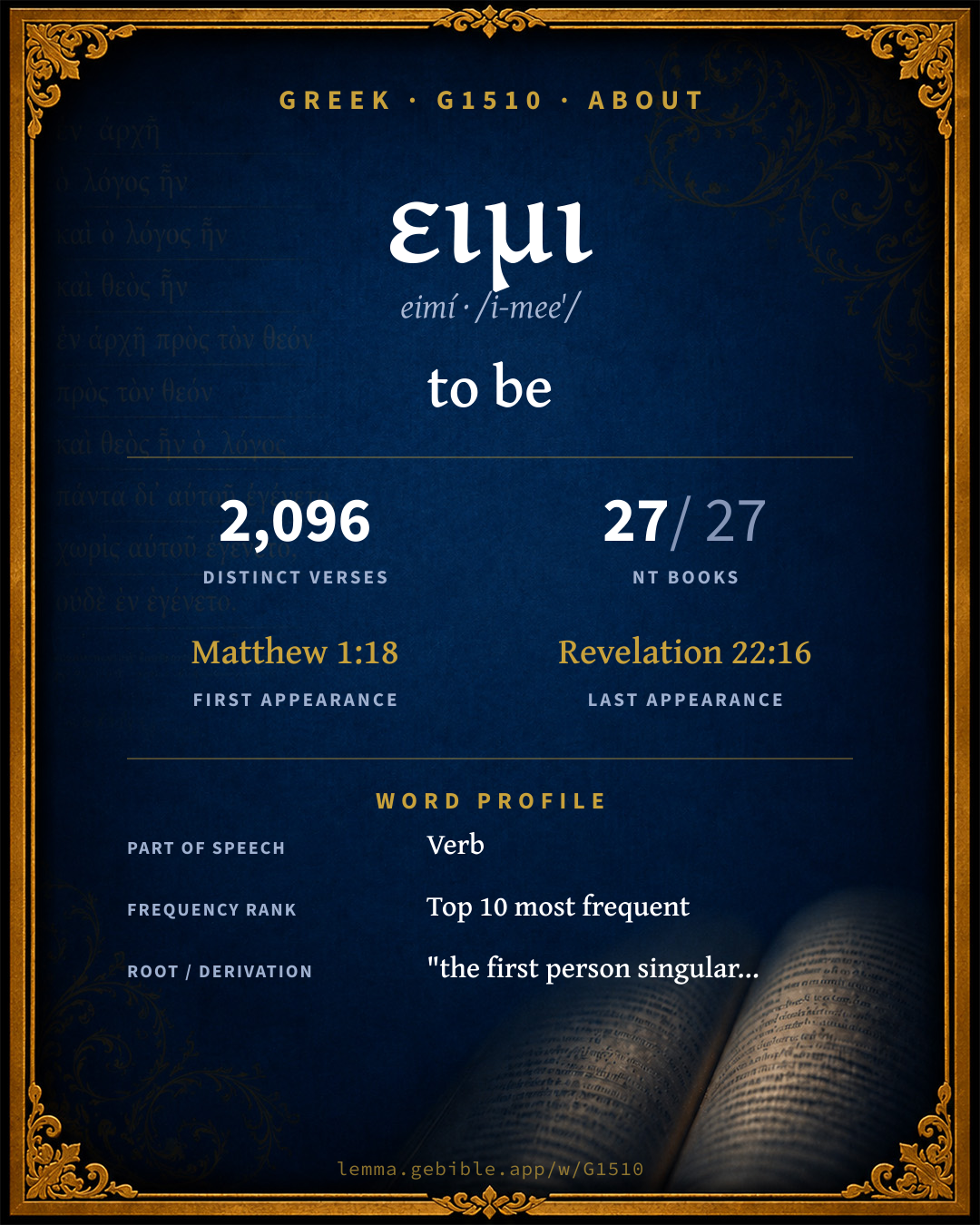
εἰμί
to be
Full lexicon entry — Thayer's Greek Lexicon
From Thayer's Greek Lexicon
Where this word appears
See every Present-tense verb in the Greek New Testament →
Grammar key — what these labels mean
Part of speech
- Verb
- An action or state-of-being word.
Tense
- Present
- Ongoing or general action in present time (imperfective aspect).
- Imperfect
- Continuous or repeated action in past time (“was writing”).
- Future
- Action expected in future time.
Voice
- Active
- The subject performs the action.
- Middle deponent
- Middle in form but active in meaning.
- Middle
- The subject acts on or for itself, or with special interest in the action.
Mood
- Indicative
- States a fact or asks a factual question (the mood of reality).
- Infinitive
- A verbal noun (“to write”), unmarked for person or number.
- Participle
- A verbal adjective (“writing,” “having written”).
- Subjunctive
- Expresses probability, purpose, or possibility (the mood of contingency).
- Imperative
- Expresses a command or request.
- Optative
- Expresses a wish or a remote possibility.
Case
- Nominative
- The case of the subject (and the predicate nominative).
- Genitive
- The case of source, possession, or “of” — answers “whose / from what.”
- Accusative
- The case of the direct object and of extent.
- Dative
- The case of the indirect object, means, or location — “to / for / with / in.”
Person
- 3rd person
- The one spoken about (“he / she / it / they”).
- 1st person
- The speaker (“I / we”).
- 2nd person
- The one addressed (“you”).
Gender
- Masculine
- Grammatically masculine.
- Feminine
- Grammatically feminine.
- Neuter
- Grammatically neuter.
Number
- Singular
- One.
- Plural
- More than one.
2 verses where G1510 appears in the Future tense in the Book of James. Filtered view — show all forms. Click any verse to open its interlinear word-by-word view. Verse text shown in the World English Bible for context — . Each verse’s Greek form is shown with its reference; the English is not keyword-highlighted, since the data carries no word-level English alignment. Use “Compare translations” on any verse to read it across multiple English versions. This concordance covers the Greek New Testament; Septuagint (Greek Old Testament) occurrences of this word are not indexed here.
James
- James 1:25 ἔσται fut mid.dep ind 3sg But he who looks into the perfect law, the law of freedom, and continues, not being a hearer who forgets but a doer of the work, this man will be blessed in what he does.
- James 5:3 ἔσται fut mid.dep ind 3sg Your gold and your silver are corroded, and their corrosion will be for a testimony against you, and will eat your flesh like fire. You have laid up your treasure in the last days.
About this entry
At a glance — auto-summarized from this page’s data, not written by a person. Every figure links to its source below. This summary describes the numbers; it doesn’t interpret them.
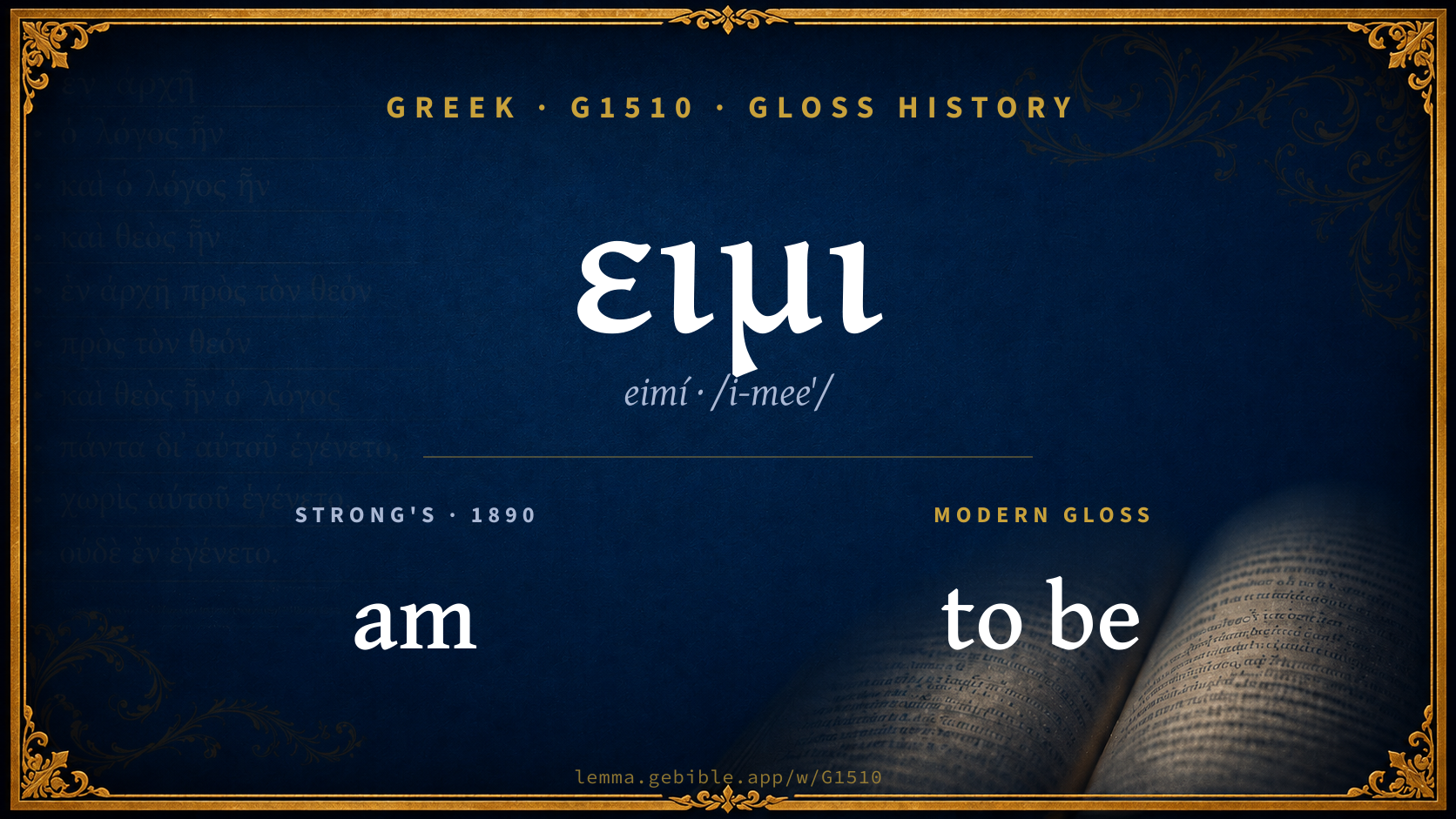
“to be” is the headline sense of the Greek verb ειμι (eimí). Translators differ — “am” in the King James Version, then “is” (Berean Standard Bible), as the renderings breakdown shows. With 2,096 verses in 27 books, it is one of the most common word in the Greek New Testament. First canonically at Matthew 1:18, it enters the text early. It clusters with ει, ειην and ειναι under a shared root. The sections below give every sense, occurrence, and version rendering.
Gloss history
Strong's 1890 vs modern scholarship
About this word
Strong's G1510 catalogs a Greek word from the Greek New Testament.
These counts are not copied from any lexicon or concordance. They are computed here, from the morphology-tagged Greek New Testament. What Lemma adds →
- 2,096
- distinct verses
- The word appears in 2,096 distinct verses.
- 27 / 27
- NT books
- The word appears in 27 of 27 New Testament books.
- #6
- by frequency
- Top 10 most frequent Greek words (rank 6 of 5,347 Greek words by occurrence).
View all 2,096 occurrences in the concordance →
By section of the New Testament
By traditional corpus
Conventional, traditional groupings — biblical authorship is debated, so this is a traditional corpus grouping, not an authorship claim. Some books belong to more than one corpus (Luke is in both the Gospels and the Lukan corpus, and so on), so these shares overlap and need not total 100%. Each figure is a share of the word’s 2,096 distinct verses.
- Gospels 1,097 verses · 52%
- Lukan (Luke–Acts) 567 verses · 27%
- Johannine 514 verses · 25%
- Pauline corpus 484 verses · 23%
- General (Catholic) Epistles 133 verses · 6%
- Revelation 81 verses · 4%
- Hebrews 48 verses · 2%
How translations render this word
Counts come from each version’s own published word-to-Strong’s tagging or interlinear alignment — an approximate guide to how each version renders this word, not a word-level alignment the data otherwise carries. Because each total is that version’s own tagged count, the per-version totals vary from one another and need not match the appearance or distinct-verse counts above. These counts may also differ from a printed concordance because Lemma counts each distinctly tagged rendering and does not collapse phrase taggings into a single head-word total. This is a fixed set of word-tagged versions (KJV, ASV, BSB, ULT) and does not change with the reading translation you choose elsewhere. Each version’s license is shown beside its name below (and on Sources).
- King James Version: Am 82×, I am 44×, Is 6×
- American Standard Version: Am 75×, I am 45×, We were 6×
- Berean Standard Bible: Is 651×, Was 240×, Are 233×
- unfoldingWord Literal Text: Is 789×, Are 272×, Was 248×
King James Version Public Domain
Renders G1510 across 140 tagged occurrences — most commonly:
Plus 3 renderings that appear only once — usually multi-word phrases or single function words the recovered tagging swept in, not distinct renderings. Not rendered by a distinct English word in 6 further occurrences.
American Standard Version Public Domain
Renders G1510 across 154 tagged occurrences — most commonly:
Plus 7 renderings that appear only once — usually multi-word phrases or single function words the recovered tagging swept in, not distinct renderings. Not rendered by a distinct English word in 1 further occurrence.
Berean Standard Bible Public Domain
Renders G1510 across 2,237 tagged occurrences — most commonly:
Plus other, less common renderings. Plus 167 renderings that appear only once — usually multi-word phrases or single function words the recovered tagging swept in, not distinct renderings. Not rendered by a distinct English word in 169 further occurrences.
unfoldingWord Literal Text CC BY-SA 4.0
Renders G1510 across 2,561 tagged occurrences — most commonly:
Plus other, less common renderings. Plus 65 renderings that appear only once — usually multi-word phrases or single function words the recovered tagging swept in, not distinct renderings.
Senses in Thayer's
The 1 sense Thayer's distinguishes for this word, in lexicon order (not ranked by frequency or importance). The full entry — with sub-senses — is in the Lexicon Entry tab.
- to be, to exist, to happen, to be present
Word origin
Origin: "the first person singular present indicative; a prolonged form of a primary and defective verb"
Forms in the corpus
The 70 distinct written forms G1510 takes in the Greek New Testament, most frequent first — each parse links to that tense’s occurrences in the concordance.
The 60 most common forms are shown; 10 rarer forms follow in the full concordance.
Same root — word family
Other Thayer's entries built from the same root as G1510, grouped by Strong’s listed origin. These share a root / origin per the lexicon — not necessarily a shared meaning. Each links to that word’s own entry.
Derived from this word
- ει eî G1488 you are
- ειην eíēn G1498 to be
- ειναι eînai G1511 to be
- εισι eisí G1526 are
- εσμεν esmén G2070 we are
- εστε esté G2075 you are
- εστι estí G2076 he is
- εστω éstō G2077 let be
- ην ēn G2258 was
- ητω ḗtō G2277 let be
- ισθι ísthi G2468 be
- ω ō G5600 to be
- ων ṓn G5607 being
Proper names from this root
People and places named from this root — a name, not an additional meaning of the word.
Compare all same-root words → Showing 4 of 15 — not the complete family. 1 of the same-root words is a proper name (a person or place). They share a root, not necessarily a meaning.
Septuagint usage
The same Greek word ειμι appears 5,347 times in the Greek Old Testament (Septuagint), across 4,423 verses in 38 books.
- 5,347
- LXX occurrences
- Tagged occurrences of this Greek word in the Septuagint.
- 4,423
- verses
- Distinct Septuagint verses containing this word.
- 38 / 39
- OT books
- The word appears in 38 of the 39 Old Testament books.
Sample Septuagint occurrences
- Genesis 1:2 εἰμί
- Exodus 1:5 εἰμί
- Leviticus 1:8 εἰμί
- Numbers 1:4 εἰμί
- Deuteronomy 1:10 εἰμί
- Joshua 1:4 εἰμί
- Judges 1:7 εἰμί
- Ruth 1:2 εἰμί
- 1 Samuel 1:1 εἰμί
- 2 Samuel 1:8 εἰμί
- 1 Kings 1:2 εἰμί
- 2 Kings 1:3 εἰμί
Septuagint occurrences (same lexeme)
Every verse where the same Strong’s number (G1510) appears in the Greek Septuagint — showing the first 50 of 4,423. Verse text shown in the World English Bible for context; the Greek form is the matched word — the English is not keyword-highlighted.
- Genesis 1:2 εἰμί Now the earth was formless and empty. Darkness was on the surface of the deep. God's Spirit was hovering over the surface of the waters.
- Genesis 1:6 εἰμί God said, "Let there be an expanse in the midst of the waters, and let it divide the waters from the waters."
- Genesis 1:7 εἰμί God made the expanse, and divided the waters which were under the expanse from the waters which were above the expanse, and it was so.
- Genesis 1:14 εἰμί God said, "Let there be lights in the expanse of sky to divide the day from the night; and let them be for signs, and for seasons, and for days and years;
- Genesis 1:15 εἰμί and let them be for lights in the expanse of sky to give light on the earth," and it was so.
- Genesis 1:29 εἰμί God said, "Behold, I have given you every herb yielding seed, which is on the surface of all the earth, and every tree, which bears fruit yielding seed. It will be your food.
- Genesis 2:5 εἰμί No plant of the field was yet in the earth, and no herb of the field had yet sprung up; for Yahweh God had not caused it to rain on the earth. There was not a man to till the ground,
- Genesis 2:11 εἰμί The name of the first is Pishon: this is the one which flows through the whole land of Havilah, where there is gold;
- Genesis 2:12 εἰμί and the gold of that land is good. There is aromatic resin and the onyx stone.
- Genesis 2:18 εἰμί Yahweh God said, "It is not good that the man should be alone; I will make him a helper suitable for him."
- Genesis 2:24 εἰμί Therefore a man will leave his father and his mother, and will join with his wife, and they will be one flesh.
- Genesis 2:25 εἰμί They were both naked, the man and his wife, and were not ashamed.
- Genesis 3:1 εἰμί Now the serpent was more subtle than any animal of the field which Yahweh God had made. He said to the woman, "Yes, has God said, 'You shall not eat of any tree of the garden?'"
- Genesis 3:3 εἰμί but of the fruit of the tree which is in the midst of the garden, God has said, 'You shall not eat of it, neither shall you touch it, lest you die.'"
- Genesis 3:5 εἰμί for God knows that in the day you eat it, your eyes will be opened, and you will be like God, knowing good and evil."
- Genesis 3:6 εἰμί When the woman saw that the tree was good for food, and that it was a delight to the eyes, and that the tree was to be desired to make one wise, she took of the fruit of it, and ate; and she gave some to her husband with her, and he ate.
- Genesis 3:7 εἰμί Both of their eyes were opened, and they knew that they were naked. They sewed fig leaves together, and made themselves aprons.
- Genesis 3:9 εἰμί Yahweh God called to the man, and said to him, "Where are you?"
- Genesis 3:10 εἰμί The man said, "I heard your voice in the garden, and I was afraid, because I was naked; and I hid myself."
- Genesis 3:11 εἰμί God said, "Who told you that you were naked? Have you eaten from the tree that I commanded you not to eat from?"
- Genesis 3:19 εἰμί By the sweat of your face will you eat bread until you return to the ground, for out of it you were taken. For you are dust, and to dust you shall return."
- Genesis 4:2 εἰμί Again she gave birth, to Cain's brother Abel. Abel was a keeper of sheep, but Cain was a tiller of the ground.
- Genesis 4:8 εἰμί Cain said to Abel, his brother, "Let's go into the field." It happened, when they were in the field, that Cain rose up against Abel, his brother, and killed him.
- Genesis 4:9 εἰμί Yahweh said to Cain, "Where is Abel, your brother?" He said, "I don't know. Am I my brother's keeper?"
- Genesis 4:12 εἰμί From now on, when you till the ground, it won't yield its strength to you. You shall be a fugitive and a wanderer in the earth."
- Genesis 4:14 εἰμί Behold, you have driven me out this day from the surface of the ground. I will be hidden from your face, and I will be a fugitive and a wanderer in the earth. It will happen that whoever finds me will kill me."
- Genesis 4:17 εἰμί Cain knew his wife. She conceived, and gave birth to Enoch. He built a city, and called the name of the city, after the name of his son, Enoch.
- Genesis 4:20 εἰμί Adah gave birth to Jabal, who was the father of those who dwell in tents and have cattle.
- Genesis 4:21 εἰμί His brother's name was Jubal, who was the father of all who handle the harp and pipe.
- Genesis 4:22 εἰμί Zillah also gave birth to Tubal Cain, the forger of every cutting instrument of brass and iron. Tubal Cain's sister was Naamah.
- Genesis 5:32 εἰμί Noah was five hundred years old, and Noah became the father of Shem, Ham, and Japheth.
- Genesis 6:2 εἰμί that God's sons saw that men's daughters were beautiful, and they took for themselves wives of all that they chose.
- Genesis 6:3 εἰμί Yahweh said, "My Spirit will not strive with man forever, because he also is flesh; yet will his days be one hundred twenty years."
- Genesis 6:4 εἰμί The Nephilim were in the earth in those days, and also after that, when God's sons came to men's daughters. They bore children to them: the same were the mighty men who were of old, men of renown.
- Genesis 6:9 εἰμί This is the history of the generations of Noah. Noah was a righteous man, blameless among the people of his time. Noah walked with God.
- Genesis 6:12 εἰμί God saw the earth, and saw that it was corrupt, for all flesh had corrupted their way on the earth.
- Genesis 6:17 εἰμί I, even, I do bring the flood of waters on this earth, to destroy all flesh having the breath of life from under the sky. Everything that is in the earth will die.
- Genesis 6:19 εἰμί Of every living thing of all flesh, you shall bring two of every sort into the ark, to keep them alive with you. They shall be male and female.
- Genesis 6:21 εἰμί Take with you of all food that is eaten, and gather it to you; and it will be for food for you, and for them."
- Genesis 7:6 εἰμί Noah was six hundred years old when the flood of waters came on the earth.
- Genesis 7:15 εἰμί They went to Noah into the ark, by pairs of all flesh with the breath of life in them.
- Genesis 7:19 εἰμί The waters prevailed exceedingly on the earth. All the high mountains that were under the whole sky were covered.
- Genesis 7:22 εἰμί All in whose nostrils was the breath of the spirit of life, of all that was on the dry land, died.
- Genesis 7:23 εἰμί Every living thing was destroyed that was on the surface of the ground, including man, cattle, creeping things, and birds of the sky. They were destroyed from the earth. Only Noah was left, and those who were with him in the ark.
- Genesis 8:1 εἰμί God remembered Noah, all the animals, and all the cattle that were with him in the ark; and God made a wind to pass over the earth. The waters subsided.
- Genesis 8:9 εἰμί but the dove found no place to rest her foot, and she returned to him into the ark; for the waters were on the surface of the whole earth. He put forth his hand, and took her, and brought her to him into the ark.
- Genesis 8:17 εἰμί Bring forth with you every living thing that is with you of all flesh, including birds, cattle, and every creeping thing that creeps on the earth; that they may breed abundantly in the earth, and be fruitful, and multiply on the earth."
- Genesis 9:2 εἰμί The fear of you and the dread of you will be on every animal of the earth, and on every bird of the sky. Everything that the ground teems with, and all the fish of the sea are delivered into your hand.
- Genesis 9:3 εἰμί Every moving thing that lives will be food for you. As the green herb, I have given everything to you.
- Genesis 9:11 εἰμί I will establish my covenant with you; neither will all flesh be cut off any more by the waters of the flood; neither will there any more be a flood to destroy the earth."
These are occurrences of the same Greek lexeme (G1510) in the Septuagint — not a translation of any one Hebrew word. The store carries no word-level Hebrew↔Greek alignment, so no Hebrew original is asserted here. Counts come from the recovered LXX Strong's tagging — high-frequency vocabulary is well covered, while rare or late forms may be untagged — so they reflect tagged occurrences and may slightly undercount.