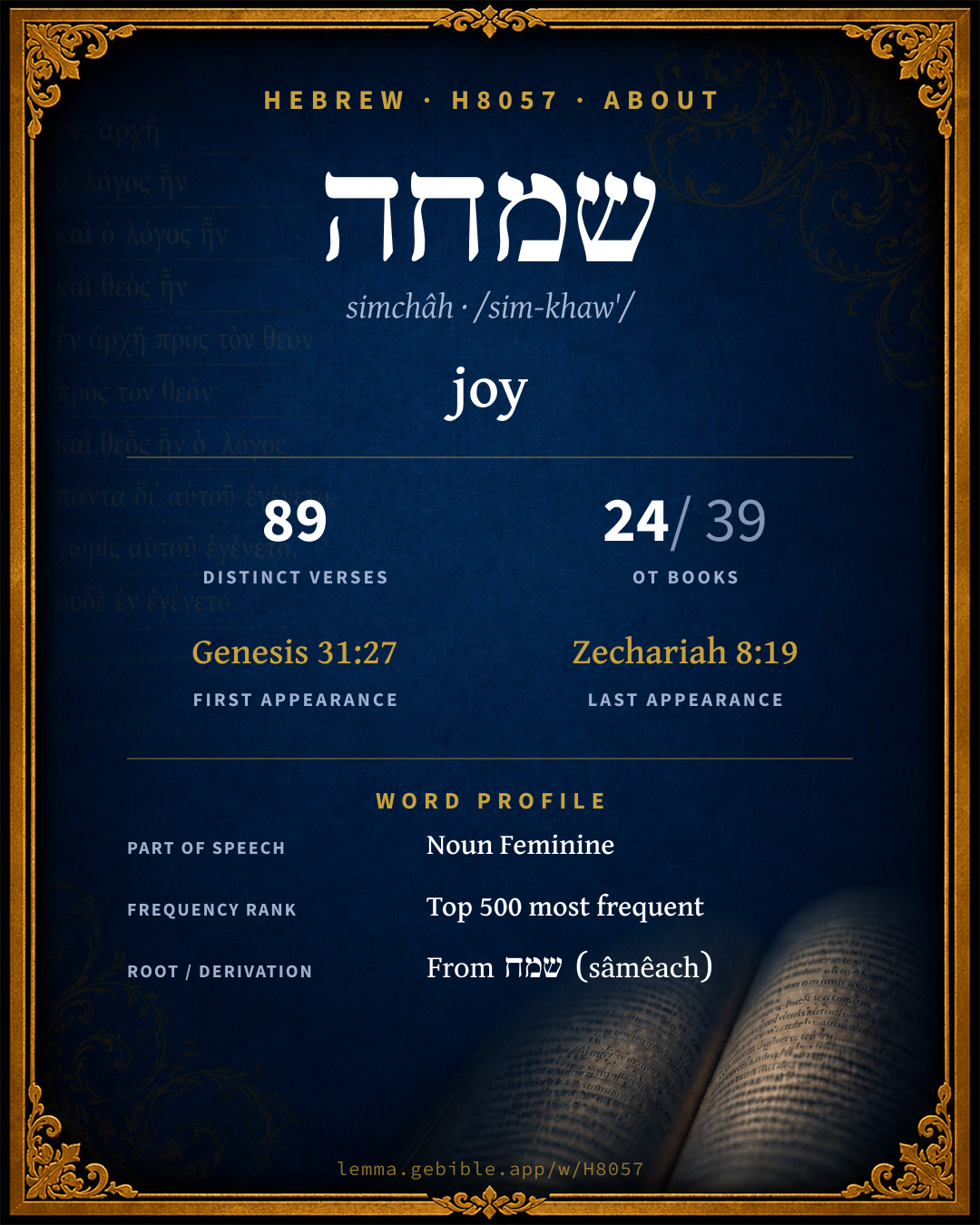
שִׂמְחָה
joy
also: mirth, gladness fuller range ↓
Full lexicon entry — Brown-Driver-Briggs (BDB)
From Brown-Driver-Briggs (BDB)
Where this word appears
See every Absolute-state word in the Hebrew Bible →
Grammar key — what these labels mean
Part of speech
- Noun
- A naming word — a person, place, thing, or idea.
Noun type
- Common
- A common noun — a general class of person, place, or thing (“king,” “city,” “water”), not a specific name.
State
- Absolute
- The independent form of a noun, not bound to a following word.
- Construct
- A noun bound to a following noun in a possessive / “of” relationship (the construct chain).
Gender
- Feminine
- Grammatically feminine.
Number
- Singular
- One.
- Plural
- More than one (in Hebrew, generally three or more).
Grammatical forms
- Noun, Common, Feminine, Singular, Absolute 73 times (78%)
- Noun, Common, Feminine, Singular, Construct 19 times (20%)
- Noun, Common, Feminine, Plural, Absolute 2 times (2%)
Parsed forms decoded from the imported morphology (morphhb / Westminster Leningrad Codex — WLC text public domain, morphhb tagging CC BY 4.0), counted across 94 parsed occurrences — not distinct verses.
Every verse where H8057 appears — 89 distinct verses across 24 books. Click any verse to open its interlinear word-by-word view. Verse text shown in the World English Bible for context — . Each verse’s Hebrew form is shown with its reference; the English is not keyword-highlighted, since the data carries no word-level English alignment. Use “Compare translations” on any verse to read it across multiple English versions. This concordance covers the Hebrew Bible; Septuagint (Greek Old Testament) occurrences are not indexed here.
Genesis 1 verse
Numbers 1 verse
Deuteronomy 1 verse
Judges 1 verse
1 Samuel 1 verse
2 Samuel 1 verse
1 Kings 1 verse
1 Chronicles 6 verses
- 1 Chronicles 12:40 שִׂמְחָ֖ה n c fs Moreover those who were near to them, [even] as far as Issachar and Zebulun and Naphtali, brought bread on donkeys, and on camels, and on mules, and on oxen, food of meal, cakes of figs, and clusters of raisins, and wine, and oil, and oxen, and sheep in abundance: for there was joy in Israel.
- 1 Chronicles 15:16 לְ/שִׂמְחָֽה prep + n c fs David spoke to the chief of the Levites to appoint their brothers the singers, with instruments of music, psalteries and harps and cymbals, sounding aloud and lifting up the voice with joy.
- 1 Chronicles 15:25 בְּ/שִׂמְחָֽה prep + n c fs So David, and the elders of Israel, and the captains over thousands, went to bring up the ark of the covenant of Yahweh out of the house of Obed-edom with joy.
- 1 Chronicles 29:9 שִׂמְחָ֥ה n c fs Then the people rejoiced, because they offered willingly, because with a perfect heart they offered willingly to Yahweh: and David the king also rejoiced with great joy.
- 1 Chronicles 29:17 בְ/שִׂמְחָ֖ה prep + n c fs I know also, my God, that you try the heart, and have pleasure in uprightness. As for me, in the uprightness of my heart I have willingly offered all these things: and now have I seen with joy your people, that are present here, offer willingly to you.
- 1 Chronicles 29:22 בְּ/שִׂמְחָ֣ה prep + n c fs and ate and drink before Yahweh on that day with great gladness. They made Solomon the son of David king the second time, and anointed him to Yahweh to be prince, and Zadok to be priest.
2 Chronicles 6 verses
- 2 Chronicles 20:27 בְּ/שִׂמְחָ֑ה prep + n c fs Then they returned, every man of Judah and Jerusalem, and Jehoshaphat in the forefront of them, to go again to Jerusalem with joy; for Yahweh had made them to rejoice over their enemies.
- 2 Chronicles 23:18 בְּ/שִׂמְחָ֣ה prep + n c fs Jehoiada appointed the officers of the house of Yahweh under the hand of the priests the Levites, whom David had distributed in the house of Yahweh, to offer the burnt offerings of Yahweh, as it is written in the law of Moses, with rejoicing and with singing, according to the order of David.
- 2 Chronicles 29:30 לְ/שִׂמְחָ֔ה prep + n c fs Moreover Hezekiah the king and the princes commanded the Levites to sing praises to Yahweh with the words of David, and of Asaph the seer. They sang praises with gladness, and they bowed their heads and worshiped.
- 2 Chronicles 30:21 בְּ/שִׂמְחָ֣ה prep + n c fs The children of Israel who were present at Jerusalem kept the feast of unleavened bread seven days with great gladness; and the Levites and the priests praised Yahweh day by day, [singing] with loud instruments to Yahweh.
- 2 Chronicles 30:23 שִׂמְחָֽה n c fs The whole assembly took counsel to keep other seven days; and they kept [other] seven days with gladness.
- 2 Chronicles 30:26 שִׂמְחָֽה n c fs So there was great joy in Jerusalem; for since the time of Solomon the son of David king of Israel there was not the like in Jerusalem.
Ezra 3 verses
- Ezra 3:12 בְ/שִׂמְחָ֖ה prep + n c fs But many of the priests and Levites and heads of fathers' [houses], the old men who had seen the first house, when the foundation of this house was laid before their eyes, wept with a loud voice; and many shouted aloud for joy:
- Ezra 3:13 הַ/שִּׂמְחָ֔ה ptcl def.art + n c fs so that the people could not discern the noise of the shout of joy from the noise of the weeping of the people; for the people shouted with a loud shout, and the noise was heard afar off.
- Ezra 6:22 בְּ/שִׂמְחָ֑ה prep + n c fs and kept the feast of unleavened bread seven days with joy: for Yahweh had made them joyful, and had turned the heart of the king of Assyria to them, to strengthen their hands in the work of the house of God, the God of Israel.
Nehemiah 5 verses
- Nehemiah 8:12 שִׂמְחָ֣ה n c fs All the people went their way to eat, and to drink, and to send portions, and to make great mirth, because they had understood the words that were declared to them.
- Nehemiah 8:17 שִׂמְחָ֖ה n c fs All the assembly of those who were come again out of the captivity made booths, and lived in the booths; for since the days of Jeshua the son of Nun to that day the children of Israel had not done so. There was very great gladness.
- Nehemiah 12:27 וְ/שִׂמְחָה֙ conj + n c fs At the dedication of the wall of Jerusalem they sought the Levites out of all their places, to bring them to Jerusalem, to keep the dedication with gladness, both with giving thanks, and with singing, with cymbals, psalteries, and with harps.
- Nehemiah 12:43 שִׂמְחָ֣ה שִׂמְחַ֥ת n c fs n c fs cs They offered great sacrifices that day, and rejoiced; for God had made them rejoice with great joy; and the women also and the children rejoiced: so that the joy of Jerusalem was heard even afar off.
- Nehemiah 12:44 שִׂמְחַ֣ת n c fs cs On that day were men appointed over the chambers for the treasures, for the heave-offerings, for the first fruits, and for the tithes, to gather into them, according to the fields of the cities, the portions appointed by the law for the priests and Levites: for Judah rejoiced for the priests and for the Levites who waited.
Esther 6 verses
- Esther 8:16 וְ/שִׂמְחָ֑ה conj + n c fs The Jews had light and gladness, and joy and honor.
- Esther 8:17 שִׂמְחָ֤ה n c fs In every province, and in every city, wherever the king's commandment and his decree came, the Jews had gladness and joy, a feast and a good day. Many from among the peoples of the land became Jews; for the fear of the Jews was fallen on them.
- Esther 9:17 וְ/שִׂמְחָֽה conj + n c fs [This was done] on the thirteenth day of the month Adar; and on the fourteenth day of the same they rested, and made it a day of feasting and gladness.
- Esther 9:18 וְ/שִׂמְחָֽה conj + n c fs But the Jews who were in Shushan assembled together on the thirteenth [day] of it, and on the fourteenth of it; and on the fifteenth [day] of the same they rested, and made it a day of feasting and gladness.
- Esther 9:19 שִׂמְחָ֥ה n c fs Therefore do the Jews of the villages, who dwell in the unwalled towns, make the fourteenth day of the month Adar [a day of] gladness and feasting, and a good day, and of sending portions one to another.
- Esther 9:22 לְ/שִׂמְחָ֔ה וְ/שִׂמְחָ֔ה prep + n c fs conj + n c fs as the days in which the Jews had rest from their enemies, and the month which was turned to them from sorrow to gladness, and from mourning into a good day; that they should make them days of feasting and gladness, and of sending portions one to another, and gifts to the needy.
Job 1 verse
Psalms 13 verses
- Psalms 4:7 שִׂמְחָ֣ה n c fs You have put gladness in my heart, More than when their grain and their new wine are increased.
- Psalms 16:11 שְׂ֭מָחוֹת n c fp You will show me the path of life. In your presence is fullness of joy. In your right hand there are pleasures forevermore.
- Psalms 21:6 בְ֝/שִׂמְחָ֗ה prep + n c fs For you make him most blessed forever. You make him glad with joy in your presence.
- Psalms 30:11 שִׂמְחָֽה n c fs You have turned my mourning into dancing for me. You have removed my sackcloth, and clothed me with gladness,
- Psalms 43:4 שִׂמְחַ֪ת n c fs cs Then I will go to the altar of God, To God, my exceeding joy. I will praise you on the harp, God, my God.
- Psalms 45:15 בִּ/שְׂמָחֹ֣ת prep + n c fp With gladness and rejoicing they shall be led. They shall enter into the king's palace.
- Psalms 51:8 וְ/שִׂמְחָ֑ה conj + n c fs Let me hear joy and gladness, That the bones which you have broken may rejoice.
- Psalms 68:3 בְ/שִׂמְחָֽה prep + n c fs But let the righteous be glad. Let them rejoice before God. Yes, let them rejoice with gladness.
- Psalms 97:11 שִׂמְחָֽה n c fs Light is sown for the righteous, And gladness for the upright in heart.
- Psalms 100:2 בְּ/שִׂמְחָ֑ה prep + n c fs Serve Yahweh with gladness. Come before his presence with singing.
- Psalms 106:5 בְּ/שִׂמְחַ֣ת prep + n c fs cs That I may see the prosperity of your chosen, That I may rejoice in the gladness of your nation, That I may glory with your inheritance.
- Psalms 137:3 שִׂמְחָ֑ה n c fs For there, those who led us captive asked us for songs. Those who tormented us demanded songs of joy: "Sing us one of the songs of Zion!"
- Psalms 137:6 שִׂמְחָתִֽ/י n c fs cs + sfx pers 1cs Let my tongue stick to the roof of my mouth if I don't remember you; If I don't prefer Jerusalem above my chief joy.
Proverbs 8 verses
- Proverbs 10:28 שִׂמְחָ֑ה n c fs The prospect of the righteous is joy, But the hope of the wicked will perish.
- Proverbs 12:20 שִׂמְחָֽה n c fs Deceit is in the heart of those who plot evil, But joy comes to the promoters of peace.
- Proverbs 14:10 וּ֝/בְ/שִׂמְחָת֗/וֹ conj + prep + n c fs cs + sfx pers 3ms The heart knows its own bitterness and joy; He will not share these with a stranger.
- Proverbs 14:13 שִׂמְחָ֣ה n c fs Even in laughter the heart may be sorrowful, And mirth may end in heaviness.
- Proverbs 15:21 שִׂמְחָ֣ה n c fs Folly is joy to one who is void of wisdom, But a man of understanding keeps his way straight.
- Proverbs 15:23 שִׂמְחָ֣ה n c fs Joy comes to a man with the reply of his mouth. How good is a word at the right time!
- Proverbs 21:15 שִׂמְחָ֣ה n c fs It is joy to the righteous to do justice; But it is a destruction to the workers of iniquity.
- Proverbs 21:17 שִׂמְחָ֑ה n c fs He who loves pleasure shall be a poor man: He who loves wine and oil shall not be rich.
Ecclesiastes 8 verses
- Ecclesiastes 2:1 בְ/שִׂמְחָ֖ה prep + n c fs I said in my heart, "Come now, I will test you with mirth: therefore enjoy pleasure;" and, behold, this also was vanity.
- Ecclesiastes 2:2 וּ/לְ/שִׂמְחָ֖ה conj + prep + n c fs I said of laughter, "It is foolishness;" and of mirth, "What does it accomplish?"
- Ecclesiastes 2:10 שִׂמְחָ֗ה n c fs Whatever my eyes desired, I didn't keep from them. I didn't withhold my heart from any joy, for my heart rejoiced because of all my labor, and this was my portion from all my labor.
- Ecclesiastes 2:26 וְ/שִׂמְחָ֑ה conj + n c fs For to the man who pleases him, God gives wisdom, knowledge, and joy; but to the sinner he gives travail, to gather and to heap up, that he may give to him who pleases God. This also is vanity and a chasing after wind.
- Ecclesiastes 5:20 בְּ/שִׂמְחַ֥ת prep + n c fs cs For he shall not often reflect on the days of his life; because God occupies him with the joy of his heart.
- Ecclesiastes 7:4 שִׂמְחָֽה n c fs The heart of the wise is in the house of mourning; but the heart of fools is in the house of mirth.
- Ecclesiastes 8:15 הַ/שִּׂמְחָ֔ה ptcl def.art + n c fs Then I commended mirth, because a man has no better thing under the sun, than to eat, and to drink, and to be joyful: for that will accompany him in his labor all the days of his life which God has given him under the sun.
- Ecclesiastes 9:7 בְּ/שִׂמְחָה֙ prep + n c fs Go your way--eat your bread with joy, and drink your wine with a merry heart; for God has already accepted your works.
Song of Solomon 1 verse
Isaiah 12 verses
- Isaiah 9:3 הַ/שִּׂמְחָ֑ה כְּ/שִׂמְחַ֣ת ptcl def.art + n c fs prep + n c fs cs You have multiplied the nation, you have increased their joy: they joy before you according to the joy in harvest, as men rejoice when they divide the spoil.
- Isaiah 16:10 שִׂמְחָ֤ה n c fs Gladness is taken away, and joy out of the fruitful field; and in the vineyards there shall be no singing, neither joyful noise: nobody shall tread out wine in the presses; I have made the [vintage] shout to cease.
- Isaiah 22:13 וְ/שִׂמְחָ֗ה conj + n c fs and behold, joy and gladness, killing oxen and killing sheep, eating flesh and drinking wine: let us eat and drink, for tomorrow we shall die.
- Isaiah 24:11 שִׂמְחָ֔ה n c fs There is a crying in the streets because of the wine; all joy is darkened, the mirth of the land is gone.
- Isaiah 29:19 שִׂמְחָ֑ה n c fs The humble also shall increase their joy in Yahweh, and the poor among men shall rejoice in the Holy One of Israel.
- Isaiah 30:29 וְ/שִׂמְחַ֣ת conj + n c fs cs You shall have a song as in the night when a holy feast is kept; and gladness of heart, as when one goes with a pipe to come to the mountain of Yahweh, to the Rock of Israel.
- Isaiah 35:10 וְ/שִׂמְחַ֥ת וְ/שִׂמְחָה֙ conj + n c fs cs conj + n c fs and the ransomed of Yahweh shall return, and come with singing to Zion; and everlasting joy shall be on their heads: they shall obtain gladness and joy, and sorrow and sighing shall flee away.
- Isaiah 51:3 וְ/שִׂמְחָה֙ conj + n c fs For Yahweh has comforted Zion; he has comforted all her waste places, and has made her wilderness like Eden, and her desert like the garden of Yahweh; joy and gladness shall be found therein, thanksgiving, and the voice of melody.
- Isaiah 51:11 וְ/שִׂמְחַ֥ת וְ/שִׂמְחָה֙ conj + n c fs cs conj + n c fs The ransomed of Yahweh shall return, and come with singing to Zion; and everlasting joy shall be on their heads: they shall obtain gladness and joy; [and] sorrow and sighing shall flee away.
- Isaiah 55:12 בְ/שִׂמְחָ֣ה prep + n c fs For you shall go out with joy, and be led forth with peace: the mountains and the hills shall break forth before you into singing; and all the trees of the fields shall clap their hands.
- Isaiah 61:7 שִׂמְחַ֥ת n c fs cs Instead of your shame [you shall have] double; and instead of dishonor they shall rejoice in their portion: therefore in their land they shall possess double; everlasting joy shall be to them.
- Isaiah 66:5 בְ/שִׂמְחַתְ/כֶ֖ם prep + n c fs cs + sfx pers 2mp Hear the word of Yahweh, you who tremble at his word: Your brothers who hate you, who cast you out for my name's sake, have said, Let Yahweh be glorified, that we may see your joy; but it is those who shall be disappointed.
Jeremiah 7 verses
- Jeremiah 7:34 שִׂמְחָ֔ה n c fs Then will I cause to cease from the cities of Judah, and from the streets of Jerusalem, the voice of mirth and the voice of gladness, the voice of the bridegroom and the voice of the bride; for the land shall become a waste.
- Jeremiah 15:16 וּ/לְ/שִׂמְחַ֣ת conj + prep + n c fs cs Your words were found, and I ate them; and your words were to me a joy and the rejoicing of my heart: for I am called by your name, Yahweh, God of hosts.
- Jeremiah 16:9 שִׂמְחָ֔ה n c fs For thus says Yahweh of Hosts, the God of Israel: Behold, I will cause to cease out of this place, before your eyes and in your days, the voice of mirth and the voice of gladness, the voice of the bridegroom and the voice of the bride.
- Jeremiah 25:10 שִׂמְחָ֔ה n c fs Moreover I will take from them the voice of mirth and the voice of gladness, the voice of the bridegroom and the voice of the bride, the sound of the millstones, and the light of the lamp.
- Jeremiah 31:7 שִׂמְחָ֔ה n c fs For thus says Yahweh, Sing with gladness for Jacob, and shout for the chief of the nations: publish you, praise you, and say, Yahweh, save your people, the remnant of Israel.
- Jeremiah 33:11 שִׂמְחָ֗ה n c fs the voice of joy and the voice of gladness, the voice of the bridegroom and the voice of the bride, the voice of those who say, Give thanks to Yahweh of Hosts, for Yahweh is good, for his loving kindness endures forever; [and of them] who bring [sacrifices of] thanksgiving into the house of Yahweh. For I will cause the captivity of the land to return as at the first, says Yahweh.
- Jeremiah 48:33 שִׂמְחָ֥ה n c fs Gladness and joy is taken away from the fruitful field and from the land of Moab; and I have caused wine to cease from the wine presses: none shall tread with shouting; the shouting shall be no shouting.
Ezekiel 2 verses
- Ezekiel 35:15 כְּ/שִׂמְחָ֨תְ/ךָ֜ prep + n c fs cs + sfx pers 2ms As you did rejoice over the inheritance of the house of Israel, because it was desolate, so will I do to you: you shall be desolate, Mount Seir, and all Edom, even all of it; and they shall know that I am Yahweh.
- Ezekiel 36:5 בְּ/שִׂמְחַ֤ת prep + n c fs cs therefore thus says the Lord Yahweh: Surely in the fire of my jealousy have I spoken against the residue of the nations, and against all Edom, that have appointed my land to themselves for a possession with the joy of all their heart, with despite of soul, to cast it out for a prey.
Joel 1 verse
Jonah 1 verse
Zephaniah 1 verse
Zechariah 1 verse
About this entry
At a glance — auto-summarized from this page’s data, not written by a person. Every figure links to its source below. This summary describes the numbers; it doesn’t interpret them.
“joy” is the headline sense of the Hebrew noun שמחה (simchâh). Beyond “joy” it also covers “mirth” and “gladness” — see its full sense range. It appears 89 verses across 24 books of the Hebrew Bible, among its moderately common vocabulary. First canonically at Genesis 31:27, it enters the text early. The sections below give every sense, occurrence, and version rendering.
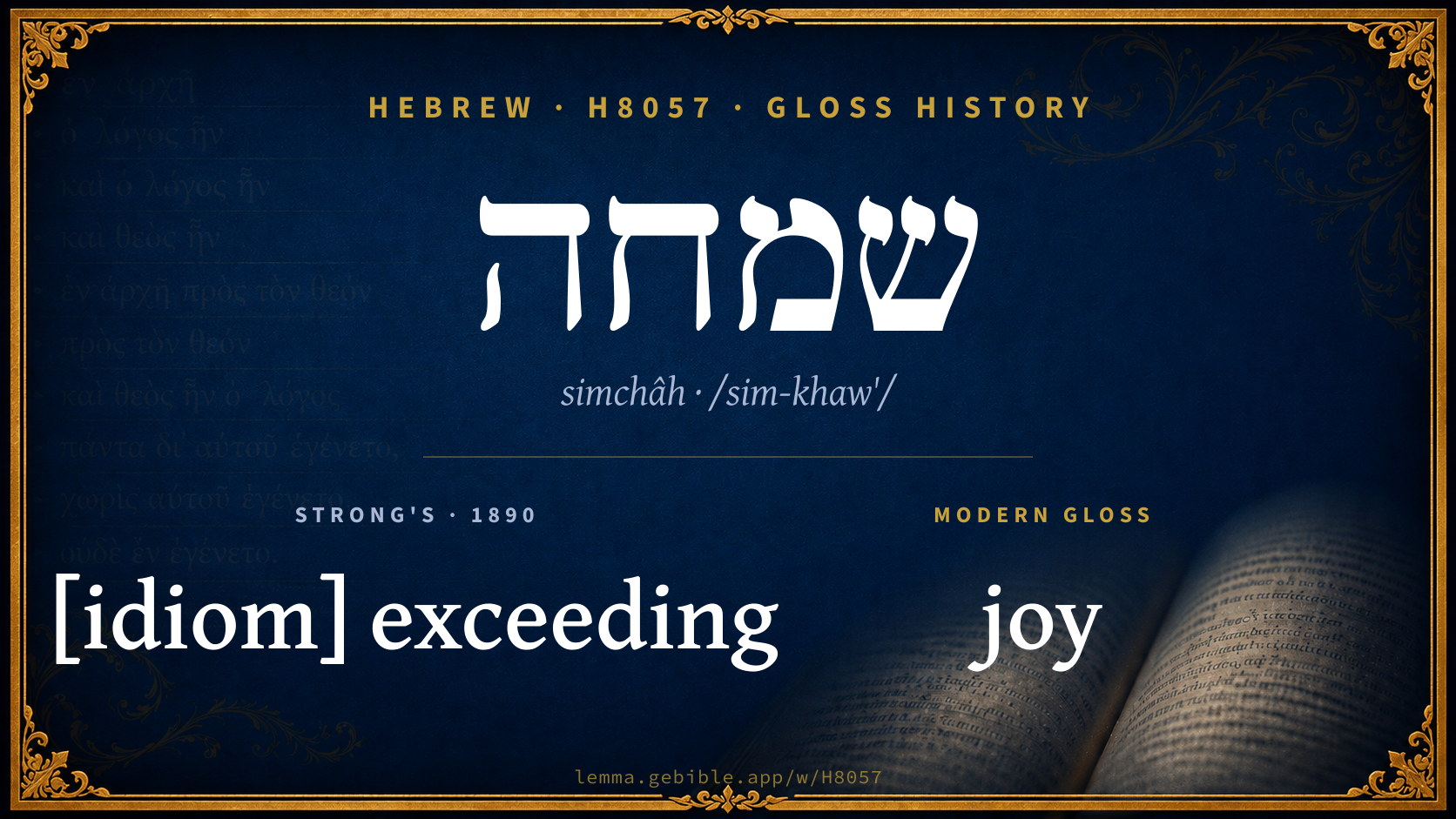
Gloss history
Strong's 1890 vs modern scholarship
About this word
Strong's H8057 catalogs a Hebrew word from the Hebrew Old Testament.
These counts are not copied from any lexicon or concordance. They are computed here, from the morphology-tagged Hebrew Old Testament. What Lemma adds →
- 89
- distinct verses
- The word appears in 89 distinct verses.
- 24 / 39
- OT books
- The word appears in 24 of 39 Old Testament books.
- #440
- by frequency
- Top 500 most frequent Hebrew words (rank 440 of 8,640 Hebrew words by occurrence).
View all 89 occurrences in the concordance →
By section of the Old Testament
By traditional corpus
Conventional, traditional groupings — biblical authorship is debated, so this is a traditional corpus grouping, not an authorship claim. Each share is this word’s portion of its verses in that division of the Hebrew canon. Each figure is a share of the word’s 89 distinct verses.
- Writings (Ketuvim) 57 verses · 64%
- Prophets (Nevi'im) 29 verses · 33%
- Torah (Pentateuch) 3 verses · 3%
How translations render this word
Counts come from each version’s own published word-to-Strong’s tagging or interlinear alignment — an approximate guide to how each version renders this word, not a word-level alignment the data otherwise carries. Because each total is that version’s own tagged count, the per-version totals vary from one another and need not match the appearance or distinct-verse counts above. These counts may also differ from a printed concordance because Lemma counts each distinctly tagged rendering and does not collapse phrase taggings into a single head-word total. This is a fixed set of word-tagged versions (KJV, ASV, BSB, ULT) and does not change with the reading translation you choose elsewhere. Each version’s license is shown beside its name below (and on Sources).
- King James Version: Joy 33×, Gladness 29×, Mirth 6×
- American Standard Version: Joy 31×, Gladness 29×, Mirth 5×
- Berean Standard Bible: Joy 42×, Gladness 14×, Rejoicing 6×
- unfoldingWord Literal Text: Joy 39×, Rejoicing 17×, Gladness 11×
King James Version Public Domain
Renders H8057 across 93 tagged occurrences — most commonly:
Plus 20 renderings that appear only once — usually multi-word phrases or single function words the recovered tagging swept in, not distinct renderings. Not rendered by a distinct English word in 1 further occurrence.
American Standard Version Public Domain
Renders H8057 across 93 tagged occurrences — most commonly:
Plus 23 renderings that appear only once — usually multi-word phrases or single function words the recovered tagging swept in, not distinct renderings.
Berean Standard Bible Public Domain
Renders H8057 across 91 tagged occurrences — most commonly:
Plus 19 renderings that appear only once — usually multi-word phrases or single function words the recovered tagging swept in, not distinct renderings. Not rendered by a distinct English word in 3 further occurrences.
unfoldingWord Literal Text CC BY-SA 4.0
Renders H8057 across 97 tagged occurrences — most commonly:
Plus 14 renderings that appear only once — usually multi-word phrases or single function words the recovered tagging swept in, not distinct renderings.
Senses in the full BDB
What do BDB’s symbols mean?
BDB uses these scholarly abbreviations:
| Symbol | Meaning |
|---|---|
| 𝔊 | the Septuagint (the ancient Greek translation, LXX) |
| 𝔙 | the Vulgate (the Latin translation) |
| 𝔖 | the Syriac version (the Peshitta) |
| 𝔗 | the Targum (the Aramaic translation) |
| ψ | the Psalms |
| √ | root (the underlying root or stem) |
| ‖ | parallel passage (a synonymous or contrasted parallel) |
| † | the dagger: every passage where the word occurs is cited |
The 4 senses and sub-senses the full Brown-Driver-Briggs lexicon distinguishes for this word, in lexicon order (not ranked by frequency), with BDB’s own verbatim wording and sub-sense lettering. Shown in Hebrew script with BDB’s own scholarly abbreviations. The condensed entry is in the Lexicon Entry tab. See also the Forms in the corpus table below.
- 1. mirth, gladness, e.g. in festivity, Gn 31:27 (E), ψ 137:3, 6, 1 K 1:40; 1 S 18:6; Is 9:2(×2); 16:10 ψ 45:16; יוֹם מִשְׁתֶּה וְשׂ׳ Est 9:17, 18, 22 cf. (יוֹם om.) v 19 (+ יוֹם טוֹב), v 22 (‖ יוֹם טוֹב), + 5 times, + קוֹל שׂ׳ Je 7:34 = 16:9 = 25:10 = 33:11; joy of heart Pr 14:10, 13; Ec 5:19; Ct 3:11, cf. (of inward joy) Jon 4:6; Pr 15:23; 21:15; = gaiety, pleasure Is 22:13; Ec 2:1, 2, 10; 8:15; 9:7, בֵּית שׂ׳ 7:4; שׂ׳ חָנֵף Jb 20:5, of foolish Pr 15:21; 21:17; malicious joy Ez 35:15 (ל rei), so שׂ׳ כָּל־לֵבָב 36:5. e.g. Genesis 31:27
- 2. 46 (especially ψψ Chr) religious: 2 S 6:12 ‖ 1 Ch 15:16, 25; Jo 1:16 +; יוֹם שׂ׳ Nu 10:10 (P); עָשָׂה שׂ׳ i.e. make a (sacred) festivity 2 Ch 30:23; Ne 8:12; 12:27; שִׂמְחַת עוֹלָם Is 35:10 = 51:11; 61:7; שׂ׳ c. עַל pers. Ne 12:44; joy of heart Is 30:29; Je 15:16; as gift of י׳ ψ 4:8; 21:7 + 7 times + (in mockery) Is 66:5. e.g. 2 Samuel 6:12
- 3. joy of י׳ Zp 3:17. e.g. Zephaniah 3:17
- 4. glad result, happy issue ψ 106:5 (‖ טוֹבָה), Pr 10:28; 12:20 (Gr. אֱמֻנָה, Toy מִשְׁפָּט; opp. מִרְמָה). e.g. Psalms 106:5
Senses from the full Brown-Driver-Briggs lexicon (Brown, Driver, Briggs; Oxford 1906 — public domain), digitized via Sefaria, supplemented by the OpenScriptures HebrewLexicon (CC BY 4.0). Full attribution on Sources.
Word origin
n.f. joy, gladness, mirth;—abs. שׂ׳ Gn 31:37 +, cstr. שִׂמְחַת Is 9:2 +; sf. שִׂמְחָתִי ψ 137:6, etc.; pl. שְׂמָחוֹת ψ 16:11, -ת֗ 45:16;—
— Brown-Driver-Briggs (Oxford 1906, public domain), digitized via Sefaria, supplemented by the OpenScriptures HebrewLexicon (CC BY 4.0). See Sources.
Derived from שמח (sâmêach) (H8056) — joyful.
Jastrow Dictionary
A second Hebrew/Aramaic lexicon for comparison, covering Aramaic and post-biblical (Talmudic, Targumic, Midrashic) usage that the biblical-Hebrew BDB does not. Matched by lemma rather than by Strong’s number, so a lemma may carry more than one Jastrow headword (shown separately below), and the entries cover usage well beyond the Bible.
שִׂמְחָה
- preced.) joy, rejoicing, festive occasion. Keth. 8ᵃ (in Chald. dict.) אפושי ש׳ בעלמא הוא it is merely an extension of the wedding joy (not a new festive occasion). Ib. מברך שהש׳ במעונו he says the benediction containing the words, ‘in whose dwelling there is joy.’ Y. B. Bath. IX, 16ᵈ bot. שִׂמְחַת זכר the joy over the birth of a male child. Gen. R. s. 70; M. Kat. 8ᵇ ש׳ בש׳, v. עָרב I; a. fr.—Esp. שמחת יום טוב, or ש׳ the rejoicing on the festival (Deut. XVI, 11; 14). R. Hash. 6ᵇ איתה בש׳ she (woman) is included in the commandment to observe the festival with joy. Ḥag. 6ᵃ חנה … מיחייבא בש׳ was not Hannah herself bound to visit the Temple in order to rejoice? Pes. 109ᵃ בזמן … אין ש׳ אלא בבשר … אין ש׳ אלא ביין as long as the Temple stood, the festive rejoicing consisted in eating meat (of the peace-offering), … but now … the festive celebration consists in partaking of wine; a. fr.—Pl. שְׂמָחוֹת. Zeb. 102ᵃ חמש ש׳ היתה וכ׳ Elisheba had five joys (distinctions) more than ordinary daughters of Israel: her brother-in-law (Moses) was king &c.; a. e.—ש׳ (מסכת) S’maḥoth, one of the small treatises of Talmud Babli, euphem. for אבל רבתי, v. אֵבֶל. e.g. Deuteronomy 16:11
A Dictionary of the Targumim, the Talmud Babli and Yerushalmi, and the Midrashic Literature (Marcus Jastrow; London, Luzac, 1903) — Public Domain. Digitized via Sefaria. Digitized via Sefaria. Full attribution on Sources.
Forms in the corpus
The 49 distinct written forms H8057 takes in the Hebrew Bible, most frequent first — each parse links to that state’s occurrences in the concordance. Hebrew forms include their vowel points and cantillation, so a single lemma takes many written forms.
Septuagint verse parallels
This word appears in 80 verses that also exist in the Greek Old Testament (Septuagint), out of the 89 Hebrew verses it occurs in. You can read those verses in Greek by switching the Old Testament edition to the Septuagint.
Read these verses in the Septuagint
- Genesis 31:27
- Numbers 10:10
- Deuteronomy 28:47
- Judges 16:23
- 1 Samuel 18:6
- 2 Samuel 6:12
- 1 Kings 1:40
- 1 Chronicles 12:40
- 2 Chronicles 20:27
- Ezra 3:12
- Esther 8:16
- Job 20:5
This is a verse-level parallel only — the same verses exist in both the Hebrew and Greek Old Testaments. No word-level Hebrew↔Greek correspondence is claimed: the data carries no such alignment, so no Greek word is shown as this Hebrew word’s translation. Coverage is not total — the Septuagint omits the deuterocanon and renumbers the Psalms, so some Hebrew verses have no direct Greek parallel.